
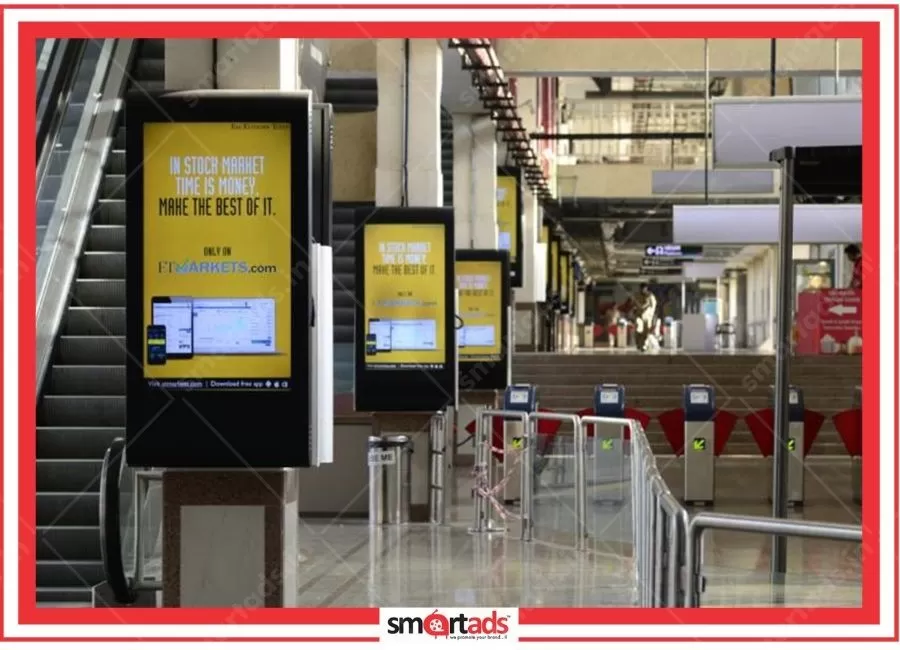
Entry Exit Panel
8 ft x 4 ft
Bright and vibrant multicolored letterin
Rate per Panel / 1 Month
Min Requirement is 3 Panel
₹48000.00
Showing 1 to 4 of 4 Results
MEDIA DETAILS
8 ft x 4 ft
Bright and vibrant multicolored letterin
Rate per Panel / 1 Month
Min Requirement is 3 Panel
₹48000.00
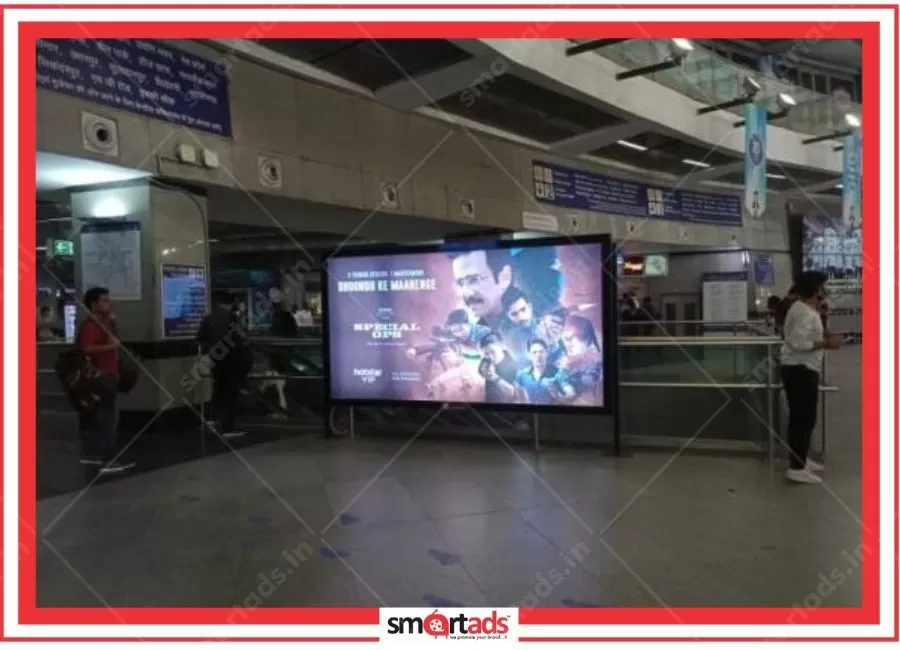
10 ft X 5 ft
A new wide wall system designed to accom
Rate per Panel / 1 Month
Min Requirement is 3 Panel
₹50000.00
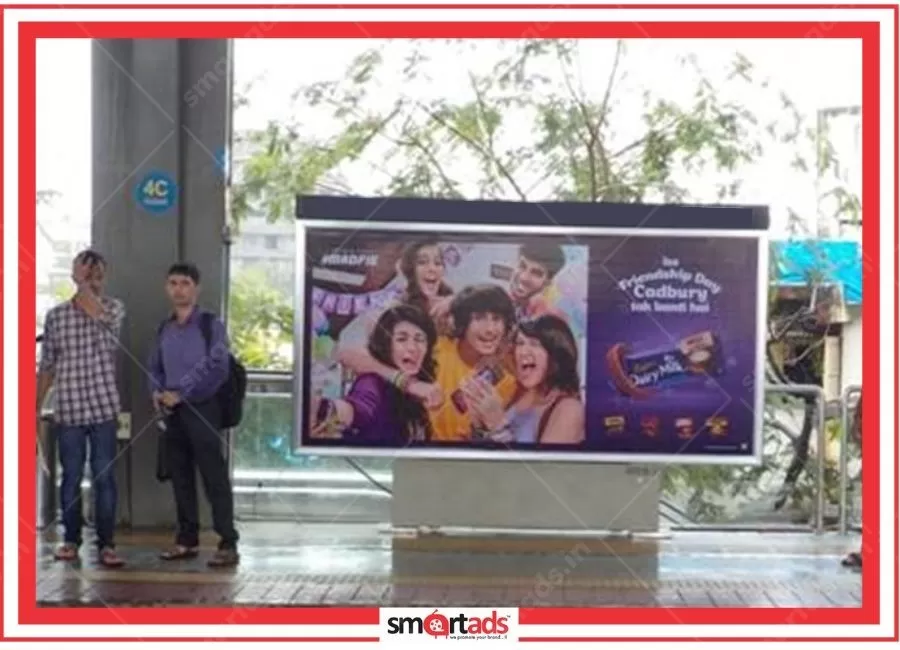
8 ft x 4 ft
A raised flooring or other horizontal su
Rate per Panel / 1 Month
Min Requirement is 3 Panel
₹35000.00
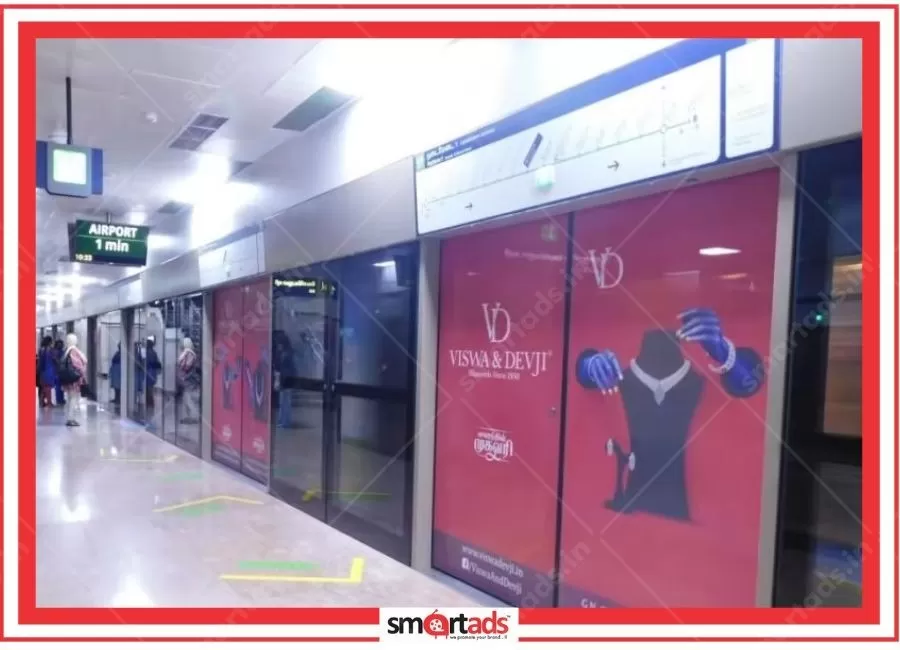
7 ft x 4 ft
Also known as platform edge doors (PEDs)
Rate per Plateform / 1 Month
Min Requirement is 1 Station
₹1200000.00
MEDIA REACH

MinimumQty :
10
EstimateReachPeople :
15 Million
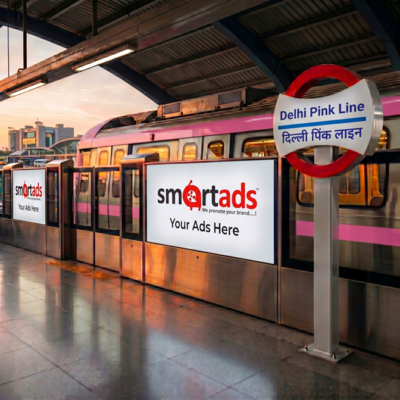
Most brand managers we speak to have already considered billboard campaigns on NH-48 or mall activations in Select Citywalk — but the Delhi Metro Pink Line keeps getting underestimated, which is frankly a mistake that costs brands real reach. Line 7 stretches 59 kilometres across 46 stations, cutting through some of Delhi NCR's most commercially active corridors; and the commuter profile it delivers — educated, employed, urban — is one that most out-of-home media formats in this city simply cannot replicate at the same cost efficiency.
There is a particular kind of attention that transit advertising captures which no other format can quite replicate — and the Delhi Pink Line demonstrates this better than most. A commuter boarding at Majlis Park in the north and travelling toward Shiv Vihar in the east spends anywhere between 40 and 90 minutes inside the metro system, which means they are exposed to brand messaging not once but repeatedly, across platform panels, concourse branding, interior train branding, and digital screens. This is not passive exposure; it is structured, unavoidable contact with a captive audience that has nowhere else to look.
What a lot of people miss is the geographic intelligence embedded in Line 7's route. The Pink Line passes through or near Netaji Subhash Place, which is one of North Delhi's most active commercial hubs; it connects to Lajpat Nagar, which draws South Delhi's shopping-oriented middle class; and it touches Rajouri Garden, which has long been a retail and entertainment anchor for West Delhi families. This is not a line that serves one demographic or one neighbourhood — it is, in effect, a cross-section of urban Delhi NCR compressed into a single transit corridor. For brands that want genuine geographic spread without running separate campaigns across multiple zones, metro station advertising on the Pink Line offers something genuinely rare.
At SmartAds, we have found that clients who initially approach us looking for hyperlocal advertising in specific Delhi NCR pockets often end up choosing Pink Line campaigns once they understand the corridor's reach. One FMCG brand we worked with — targeting young professionals in the 25-to-35 age bracket — had been running mall activations in South Delhi for two consecutive quarters with moderate results; when we shifted a portion of their BTL advertising budget to platform branding and interior train branding across eight Pink Line stations, their brand recall scores in post-campaign surveys improved by a margin that genuinely surprised their marketing head.
The variety of ad formats on Line 7 is considerably wider than most advertisers assume when they first enquire, which is why we always recommend a format-mapping exercise before any booking is confirmed. At the station level, the primary formats include backlit panels — which are the illuminated display units positioned along platform edges and concourse walls — along with pillar branding, escalator panels, and concourse branding that can be deployed across the full walking path a commuter takes from the entry gate to the platform. These static formats are the workhorses of metro station advertising, offering high dwell time exposure at relatively predictable costs.
Beyond static formats, digital screens at Pink Line stations have been expanding steadily, and DOOH inventory — meaning Digital Out-of-Home advertising slots on LED and LCD screens positioned in high-footfall concourse areas — is now available at several key stations. DOOH on the Pink Line allows for dynamic content rotation, which means a brand can run different creatives at different times of day; a coffee brand, for instance, might run a morning commute creative between 7 and 10 AM and a different evening creative between 5 and 8 PM, all within the same DOOH booking. This time-of-day targeting is something that static backlit panels simply cannot offer, and it makes DOOH a genuinely different proposition rather than just a more expensive version of the same thing.
Train-level formats are where the real scale lies, though. Interior train branding covers the panels, overhead strips, and door decals inside a rake; exterior train branding, sometimes called a train wrap or vinyl wrap, covers the exterior of the train car with full-bleed creative that is visible on platforms and at open-air sections of the route. A full train branding package — which combines interior train branding and exterior train branding across an entire rake — is the format that delivers the most dramatic brand visibility, and it is the format we most often recommend to clients launching a new product or entering the Delhi NCR market for the first time. On top of that, audio ads inside Pink Line trains — a format facilitated by platforms like PayTunes and now being integrated into DMRC's own audio system — represent a relatively new but surprisingly effective layer of commuter advertising that most brands have not yet explored.
Advertising rates on the Delhi Pink Line are not published in a single unified rate card, which causes a lot of confusion — and frankly, a lot of brands end up overpaying simply because they do not know the benchmarks. The cost structure depends on the format, the station, the duration of the campaign, and whether the booking is made directly through DMRC's authorised vendor or through a metro advertising agency that has a rate negotiation relationship with the concessionaire.
For static backlit panels at non-interchange Pink Line stations, rates work out to somewhere in the ballpark of ₹15,000 to ₹35,000 per panel per month, though high-footfall stations like Lajpat Nagar and Rajouri Garden command a premium that can push individual panel costs closer to ₹50,000 or above. Pillar branding and escalator panels tend to be priced slightly lower than backlit panels on a per-unit basis, but they are often sold in clusters rather than individually, which means the minimum spend for a pillar branding campaign across a single station can be in the range of ₹1.5 lakh to ₹3 lakh per month. Concourse branding packages — which cover multiple touchpoints within a single station's entry and exit flow — are typically priced as station-level packages rather than per-unit, and for a station like INA or Azadpur, a full concourse branding package can run anywhere between ₹4 lakh and ₹8 lakh per month depending on the specific inventory included.
Train-level advertising costs are structured differently. Interior train branding for a single rake works out to roughly ₹3 lakh to ₹6 lakh per month, while a full train branding package — covering both interior and exterior — can range from ₹8 lakh to ₹15 lakh per month per rake. A station domination package, which combines platform branding, concourse branding, escalator panels, and digital screens at a single station, is typically priced as a negotiated package; at a premium interchange station, the advertising cost for a full station domination can be in the range of ₹12 lakh to ₹25 lakh per month. These are ballpark figures, and actual advertising rates will vary based on campaign duration, creative specifications, and the negotiating position of the agency placing the booking — which is precisely why working with an experienced metro advertising agency matters more than most brands initially appreciate.
The audience profile of Pink Line daily commuters is one of the strongest arguments for metro station advertising on this corridor, and it is an argument backed by data rather than assumption. According to DMRC ridership figures and audience profiling studies referenced in the FICCI-EY Media & Entertainment Report, Delhi Metro's overall daily ridership has been recovering strongly post-pandemic and is now tracking above pre-2020 levels on several lines; Line 7 specifically, given its cross-city connectivity, draws a disproportionately high share of office-going professionals, students, and retail shoppers compared to lines that serve primarily residential or industrial zones.
The urban audience on the Pink Line skews toward the 22-to-45 age group, with a significant concentration of young professionals who use the metro as their primary daily commute mode — which makes this corridor particularly valuable for categories like financial services, ed-tech, consumer electronics, fashion, and food delivery. These are not occasional riders; they are daily commuters who travel the same route five or six days a week, which means their cumulative exposure to brand messaging over a 30-day campaign duration is substantially higher than what a single-exposure OOH format like a highway billboard can deliver. The captive audience dynamic is real: a commuter waiting on a platform for three to five minutes has nothing to do but look at the advertising around them, which creates a quality of attention that out-of-home media on open roads simply cannot manufacture.
What we tell our clients at SmartAds is that the Pink Line audience is not homogeneous — it changes character depending on which zone of the corridor you are activating in. The northern stretch around Netaji Subhash Place and Azadpur draws a more trading and wholesale commerce-oriented crowd; the central stretch through INA and Lajpat Nagar draws South Delhi's more affluent, brand-conscious consumers; and the eastern stretch toward Shiv Vihar passes through East Delhi's rapidly urbanising residential belts, which are home to a large first-generation urban professional population with strong purchase intent and growing disposable income. This zonal variation is something that smart media planning should account for, rather than treating the entire line as a single homogeneous audience.
Interchange stations are where the mathematics of metro station advertising change most dramatically, and the Pink Line has several of them — each with a distinct footfall profile that makes them attractive for different reasons. Rajouri Garden, which connects Line 7 with the Blue Line (Line 2), is consistently one of the highest-footfall interchange stations on the entire DMRC network; the volume of passengers transferring between lines here, combined with the station's proximity to one of West Delhi's most active retail and entertainment zones, creates a footfall environment that few other transit advertising locations in Delhi NCR can match.
Lajpat Nagar is the other major commercial interchange on the Pink Line, connecting with the Violet Line and serving as a gateway to one of South Delhi's most famous markets; the advertising cost premium at Lajpat Nagar is justified by the sheer volume of footfall and by the audience quality — shoppers, young professionals, and South Delhi residents who represent exactly the kind of high-purchase-intent consumer that most brand managers are trying to reach. INA, which connects with the Yellow Line, is smaller in terms of interchange volume but draws a distinctly upscale audience given its proximity to the diplomatic enclave and South Delhi's premium residential areas. Netaji Subhash Place, connecting with the Red Line, is the northern anchor of the Pink Line's commercial reach, and Azadpur, also connecting with the Yellow Line, is a critical node for North Delhi's dense residential and commercial catchment.
For brands with limited budgets who cannot afford a full-line campaign, our experience shows that concentrating spend on two or three of these interchange stations — rather than spreading thinly across the entire 46-station corridor — delivers significantly better brand recall and brand awareness outcomes. A retail client in Gurgaon that we worked with ran a concentrated station domination campaign across Rajouri Garden and Lajpat Nagar for six weeks, targeting the Pink Line's cross-city commuter flow; the campaign generated footfall to their NCR stores that was measurably higher than what their previous highway billboard campaign had produced, at a lower total advertising cost.
The DMRC approval process for advertising on the Pink Line is one of the most frequently misunderstood aspects of transit advertising in Delhi, and the confusion is understandable — because the process involves both DMRC as the regulatory authority and the exclusive concessionaire who holds the advertising rights for specific inventory on Line 7. Proactive, which holds the exclusive media rights for a significant portion of Delhi Metro advertising inventory, is the primary point of contact for most Pink Line station advertising bookings; however, certain formats and stations may fall under different concessionaires or directly under DMRC's own media management, which is why working with a metro advertising agency that understands the current tender structure is genuinely important rather than optional.
The booking process typically begins with a creative brief and format selection, after which the agency submits artwork for DMRC approval — and this is where many brands encounter delays they did not anticipate. DMRC's content guidelines are specific and non-negotiable: creatives must not contain political content, religious messaging, or anything that could be construed as controversial; they must meet technical specifications for the specific format (resolution, dimensions, material specifications for vinyl wraps, etc.); and they must be submitted with sufficient lead time before the campaign start date. The DMRC approval timeline for standard static formats is typically somewhere between 10 and 21 working days, while more complex formats like full train branding or station domination packages may require additional approvals and longer lead times — which means brands that approach us in the week before their desired launch date are almost always going to be disappointed.
At SmartAds, we manage the DMRC approval process end-to-end for our clients, which includes pre-checking creatives against DMRC's content guidelines before formal submission, coordinating with the relevant concessionaire for inventory confirmation, and managing the installation logistics once approval is granted. The government tender structure that governs DMRC advertising rights means that the process has more layers than a typical OOH booking, but it is entirely manageable with the right agency partner — and the brand safety that comes from advertising in a government-regulated environment is itself a meaningful benefit that is often overlooked in the ROI calculation.
Brand recall from metro station advertising on the Pink Line is consistently higher than what most brands achieve from comparable spends on traditional OOH advertising, and this is not a claim we make lightly — it is something we have seen validated repeatedly across campaign measurement studies. The high dwell time environment of metro stations, combined with the frequency of exposure for daily commuters, creates a brand awareness compounding effect that single-exposure formats cannot replicate; a commuter who sees a backlit panel at their home station every morning for 30 days has been exposed to that brand message somewhere between 20 and 25 times, which is a frequency that television advertising would require a much larger budget to achieve.
The ROI calculation for metro station advertising also needs to account for the quality of the audience reached, not just the volume. The GroupM TYNY Report and Dentsu e4m Report have both noted the growing premium that advertisers are placing on urban, educated, employed audiences — precisely the demographic that Pink Line daily commuters represent. When we calculate CPM (cost per thousand impressions) for Pink Line platform branding at a station like Lajpat Nagar, it works out to roughly ₹8 to ₹12, which is a number that surprises most first-time advertisers when they compare it to what they are paying for Instagram reach among a similarly defined urban audience in Delhi NCR. The purchase intent of a commuter who has been exposed to brand messaging in a high dwell time environment is also meaningfully higher than that of a social media user who scrolled past a digital ad in 1.5 seconds.
One automotive brand we worked with ran a 45-day interior train branding campaign across three Pink Line rakes, combined with platform branding at Rajouri Garden and Lajpat Nagar; their post-campaign brand recall survey showed unaided recall of 34% among Pink Line commuters in their target demographic, compared to 12% unaided recall from a concurrent digital display campaign that had a higher total spend. The ROI comparison was stark enough that they reallocated a significant portion of their next quarter's media budget toward metro station advertising on Line 7 — and that shift in budget allocation, frankly speaking, is the most honest endorsement of a media format's effectiveness that we know.
The Delhi Metro network has multiple lines, each with its own audience character and advertising cost structure, and understanding where Line 7 sits in that competitive landscape matters for media planning decisions. The Yellow Line (Line 2), which runs from Samaypur Badli to HUDA City Centre and passes through Connaught Place and AIIMS, is generally considered the premium line for advertising because of its high ridership and its passage through Delhi's most commercially dense corridors; advertising rates on the Yellow Line are correspondingly higher, often by a margin of 20 to 40 percent compared to equivalent formats on the Pink Line.
The Blue Line (Line 2/6), which connects Dwarka to Noida and Vaishali, is the longest line on the network and carries the highest total daily ridership; however, its audience is more diffuse and the line's length means that a brand cannot dominate the corridor without a very large budget. The Pink Line's advantage over both the Yellow and Blue lines is its relative cost efficiency combined with a genuinely premium audience profile — it is, in our view, the best value line on the DMRC network for brands that want urban, employed, brand-conscious consumers without paying Yellow Line premiums. Non-traditional advertising on the Pink Line also benefits from the line's relatively newer infrastructure, which means the station environments are cleaner, the digital screens are more modern, and the overall brand visibility context is more premium than on some of the older lines.
The comparison with non-metro out-of-home media is equally instructive. A large-format billboard on a prime Delhi NCR arterial road might cost ₹2 lakh to ₹5 lakh per month, but it delivers a drive-by exposure of roughly 2 to 3 seconds with no guaranteed audience profile; a backlit panel at Lajpat Nagar metro station at a similar cost delivers 3 to 5 minutes of dwell time exposure to a self-selected urban audience that is specifically the kind of consumer most brands are trying to reach. The captive audience dynamic is the fundamental difference, and it is one that we find ourselves explaining in almost every new client conversation.
Frankly speaking, the categories that perform best on the Pink Line are those whose target consumers overlap most directly with the commuter profile — and that covers a wider range of industries than most people initially assume. Financial services brands — banks, insurance companies, mutual fund platforms, and fintech apps — find the Pink Line particularly effective because their core audience of salaried urban professionals is precisely who rides this corridor every day; brand awareness campaigns for new financial products, combined with QR code activation on platform panels, have delivered measurable app download and lead generation outcomes for several clients we have worked with.
Ed-tech and higher education brands have also found strong ROI on Line 7, particularly for campaigns targeting the 18-to-28 age group that makes up a significant share of Pink Line daily commuters; one ed-tech client ran a concourse branding campaign at three stations during the April-to-June admissions season and reported a 28% increase in organic search volume for their brand name in Delhi NCR during the campaign period, which is a metric that speaks directly to brand awareness impact. Consumer electronics, fashion and apparel, food delivery platforms, and real estate developers targeting NCR buyers have all been consistent advertisers on the Pink Line, and the results across these categories reinforce a consistent pattern: metro station advertising on Line 7 works best when the creative is designed for the dwell time environment rather than adapted from a digital or print format.
Product sampling and kiosk activation at Pink Line stations represent an additional layer of BTL advertising that goes beyond pure media formats; DMRC permits brand activations at select stations under specific approval conditions, and a well-executed kiosk activation at Rajouri Garden or Lajpat Nagar can generate thousands of direct consumer interactions in a single day. AFC gate co-branding — where a brand's creative is applied to the Automatic Fare Collection gate panels — is a particularly high-frequency format because every commuter must pass through the AFC gates twice per journey; smart card branding, where a brand's creative appears on the physical smart card issued to commuters, is a longer-duration format that delivers brand visibility across the entire DMRC network wherever the card is used.
A full-funnel approach to BTL advertising on the Pink Line is something we have developed and refined over multiple campaigns, and the core principle is straightforward: different formats serve different funnel stages, and the most effective campaigns layer them intentionally rather than using a single format in isolation. At the awareness stage, exterior train branding and full train branding are the broadest reach formats — a vinyl wrap on a Pink Line rake is seen by every commuter on every platform the train passes through, which means a single rake delivers brand visibility across all 46 stations every day. This is the format that builds top-of-mind awareness fastest, and it is the format we recommend as the foundation of any significant Pink Line campaign.
At the consideration stage, platform branding and concourse branding at key interchange stations create the repeated, high dwell time exposures that move a consumer from awareness to active consideration; backlit panels and pillar branding at stations like Lajpat Nagar, Rajouri Garden, and INA keep the brand message in front of the commuter during the moments of the day when they are most mentally available — waiting for a train, walking through a concourse, riding an escalator. DOOH advertising slots at these stations add the ability to run time-sensitive or contextually relevant creatives, which is particularly valuable for promotions, seasonal campaigns, or product launches where timing matters. Audio ads inside Pink Line trains — delivered through the train's PA system or through PayTunes' in-train audio network — add a sensory layer that reinforces the visual brand messaging and contributes meaningfully to brand recall.
At the activation stage, QR code activation on platform panels, kiosk activation at high-footfall stations, and smart card branding create direct response opportunities that convert brand awareness into measurable consumer action. The campaign duration question is one we are asked constantly: our experience shows that a minimum of four weeks is required to establish meaningful brand recall among daily commuters, while six to eight weeks is the duration at which brand awareness metrics typically plateau and ROI per week of spend is maximised. Campaigns shorter than four weeks tend to underperform because the frequency of exposure — which is the mechanism through which metro station advertising builds brand recall — has not had sufficient time to accumulate to the threshold where it changes consumer behaviour.
Q: What is metro station advertising on the Delhi Pink Line?
Metro station advertising on the Delhi Pink Line refers to the placement of brand communications across the physical and digital advertising inventory available at the 46 stations of DMRC's Line 7, which runs from Majlis Park in North Delhi to Shiv Vihar in East Delhi. This includes static formats like backlit panels, pillar branding, escalator panels, and concourse branding; dynamic formats like DOOH digital screens; train-level formats including interior train branding, exterior train branding, and full train branding; and experiential formats like kiosk activation, product sampling, and AFC gate co-branding. It is classified as BTL advertising and non-traditional advertising because it operates outside the traditional broadcast media ecosystem, delivering brand messages in a transit environment to a captive audience of daily commuters.
Q: Which ad formats are available for advertising on Delhi Metro Line 7 (Pink Line)?
The full range of formats available on Line 7 includes, at the station level: backlit panels (both ambient lit and standard), pillar branding, escalator panels, concourse branding, platform branding, DOOH digital screens, AFC gate co-branding, and smart card branding. At the train level, formats include interior train branding (overhead strips, door panels, seat-back panels), exterior train branding (vinyl wrap on the exterior of individual cars), and full train branding packages that combine both. Audio ads delivered through in-train audio systems represent an emerging format on the Pink Line. Station domination packages bundle multiple station-level formats into a single booking that covers all major touchpoints within a specific station. The availability of specific formats varies by station, and a metro advertising agency with current inventory knowledge is the most reliable source for format availability at specific stations.
Q: How much does it cost to advertise at a Pink Line metro station in Delhi?
Advertising rates on the Pink Line vary significantly by format, station, and campaign duration. Static backlit panels at standard stations are in the ballpark of ₹15,000 to ₹35,000 per panel per month; at premium interchange stations like Lajpat Nagar or Rajouri Garden, individual panel costs can reach ₹50,000 or above. Pillar branding and escalator panel campaigns at a single station typically start around ₹1.5 lakh per month. Concourse branding packages at major stations range from ₹4 lakh to ₹8 lakh per month. Interior train branding for a single rake works out to roughly ₹3 lakh to ₹6 lakh per month, while full train branding (interior plus exterior) can range from ₹8 lakh to ₹15 lakh per month per rake. Station domination packages at premium interchange stations can range from ₹12 lakh to ₹25 lakh per month. These are indicative benchmarks; actual advertising cost will depend on the specific inventory, campaign duration, and the negotiating relationship of the metro advertising agency placing the booking.
Q: Who holds the exclusive advertising rights for Delhi Metro Pink Line?
Proactive holds the exclusive media rights for a significant portion of the advertising inventory on Delhi Metro Line 7, having secured this through the DMRC government tender process. This means that for most standard station and train-level formats on the Pink Line, Proactive is the primary concessionaire through whom bookings must be routed — either directly or through a metro advertising agency that has a rate agreement with them. Certain formats or specific stations may fall under different concessionaires or directly under DMRC's own media management structure, which is why the tender and rights landscape should be verified at the time of booking. Working with an experienced metro advertising agency that has current knowledge of the exclusive media rights structure is the most efficient way to navigate this.
Q: How do I get DMRC approval to advertise on the Pink Line?
The DMRC approval process for Pink Line advertising involves submitting your campaign creative, format specifications, and station/train selection to the authorised concessionaire (typically Proactive for most Line 7 inventory), who then facilitates the formal DMRC approval. Creatives must comply with DMRC's content guidelines — no political, religious, or controversial content — and must meet the technical specifications for the specific format being booked. The approval timeline for standard static formats is typically 10 to 21 working days; complex formats like full train branding or station domination packages may require additional time. Booking lead time from creative submission to campaign launch should be planned as a minimum of four weeks, and six weeks is more realistic for complex multi-format campaigns. A metro advertising agency that regularly manages DMRC approvals will have pre-established relationships with the concessionaire and familiarity with DMRC's content review process, which significantly reduces the risk of delays.
Q: What is the daily ridership and audience profile of Delhi Metro Pink Line commuters?
The Delhi Metro Pink Line carries a substantial share of DMRC's total daily ridership, which has been recovering strongly and is now tracking above pre-pandemic levels according to DMRC operational reports. The Pink Line audience skews toward the 22-to-45 age group, with a high concentration of salaried professionals, students, and retail shoppers; the line's cross-city connectivity — linking North Delhi, Central Delhi, South Delhi, and East Delhi in a single corridor — means its audience is more geographically and demographically diverse than lines that serve primarily residential or industrial zones. The urban audience on the Pink Line has above-average education levels and household incomes compared to Delhi NCR's general population, which is reflected in the higher purchase intent and brand responsiveness that advertisers consistently observe in post-campaign measurement.
Q: Can I advertise on only select Pink Line stations instead of the entire line?
Yes, station-level advertising on the Pink Line can be booked for individual stations or a selected cluster of stations rather than the entire 46-station corridor. This is, in fact, the approach we most often recommend for brands with defined geographic targeting needs or limited budgets; concentrating spend on two or three high-footfall interchange stations — Rajouri Garden, Lajpat Nagar, INA, Netaji Subhash Place, or Azadpur — typically delivers better ROI than a thin spread across the full line. Train-level formats like interior train branding and full train branding operate across the entire line by definition, since a rake travels the full corridor; but station-specific formats like platform branding, concourse branding, backlit panels, escalator panels, and DOOH slots can all be booked on a station-by-station basis.
Q: What is the difference between interior train branding and platform branding on the Pink Line?
Interior train branding refers to advertising placed inside the train cars — covering overhead panels, door decals, seat-back panels, and window strips — which is seen exclusively by passengers who are travelling inside the train. The exposure environment is highly intimate and the dwell time is the full duration of the commute, which can be 20 to 60 minutes; this makes interior train branding particularly effective for detailed brand messaging, product information, and QR code activation. Platform branding, by contrast, refers to advertising placed on the platform itself — on walls, pillars, and panel positions along the platform edge — which is seen by all commuters waiting for a train at that station, regardless of which train they board. Platform branding captures a broader audience at a specific station, while interior train branding captures a travelling audience for a longer duration; the two formats are complementary rather than substitutes, and the most effective campaigns use both.
Q: How long should a metro advertising campaign on the Pink Line run for maximum ROI?
Our experience across multiple Pink Line campaigns consistently points to a minimum of four weeks as the threshold below which brand recall accumulation is insufficient to drive meaningful brand awareness or purchase intent change. The mechanism is frequency: a daily commuter who travels five days a week will accumulate 20 to 25 exposures to a platform branding creative over a four-week period, which is the frequency level at which memory encoding and brand recall begin to show measurable effects. Six to eight weeks is the duration at which ROI per week of spend is typically maximised, because frequency continues to build while the per-week cost remains constant. Campaigns running beyond eight weeks begin to experience diminishing returns from the same creative, which is why we recommend creative rotation at the six-to-eight-week mark rather than simply extending the same execution indefinitely.
Q: Which Pink Line stations have the highest footfall for outdoor and station advertising?
The highest-footfall stations on the Pink Line are the interchange stations, where commuters transferring between lines add significantly to the base ridership. Rajouri Garden (interchange with Blue Line) and Lajpat Nagar (interchange with Violet Line) are consistently the two highest-footfall stations on the corridor and command the highest advertising rates accordingly. INA (interchange with Yellow Line), Netaji Subhash Place (interchange with Red Line), and Azadpur (interchange with Yellow Line) are the other major interchange nodes with elevated footfall. Among non-interchange stations, those adjacent to major commercial or institutional catchments — such as stations near large markets, hospitals, or educational institutions along the Pink Line route — also generate above-average footfall and are worth prioritising for hyperlocal advertising campaigns targeting specific catchment areas.
Q: Are digital screen (DOOH) advertising slots available at Pink Line metro stations?
DOOH advertising inventory is available at select Pink Line stations, primarily at the major interchange and high-footfall stations; the network of digital screens at Pink Line stations has been expanding as DMRC continues its infrastructure modernisation programme. DOOH slots on the Pink Line are typically sold in time-based packages — either full-day or daypart-specific — and allow for dynamic content rotation, which means different creatives can run at different times of day within the same booking. The minimum booking duration for DOOH slots varies by station and concessionaire, but is typically a minimum of one week. DOOH on the Pink Line is particularly valuable for time-sensitive campaigns, product launches, and promotions where the ability to update creative quickly is important; it is also the format that most naturally integrates with a broader digital advertising strategy, since the same creative assets used for digital display advertising can often be adapted for DOOH with minimal modification.
Q: What industries benefit most from advertising on the Delhi Metro Pink Line?
Financial services (banking, insurance, fintech, mutual funds), ed-tech and higher education, consumer electronics, fashion and apparel, food delivery and QSR, real estate, and healthcare are the categories that have consistently delivered strong results from Pink Line metro station advertising. The common thread is that all of these categories are targeting the urban, employed, 22-to-45 demographic that dominates the Pink Line commuter profile. Automotive brands — particularly two-wheeler and entry-level car brands targeting first-time buyers in the 25-to-35 age group — have also found the Pink Line effective, as have personal care and FMCG brands that are specifically targeting urban consumers rather than mass-market rural audiences. Categories that tend to underperform on metro station advertising are those targeting demographics that are not well-represented in the metro commuter base — agricultural products, for instance, or categories with a predominantly rural or semi-urban consumer profile.
Q: How does Pink Line metro advertising compare to billboard or mall advertising in Delhi?
The fundamental difference is the captive audience dynamic. A billboard on a Delhi NCR highway delivers roughly 2 to 3 seconds of exposure to a driver or passenger moving at speed, with no guarantee of attention and no way to target by audience profile. A mall advertising placement delivers higher dwell time than a billboard, but mall footfall is concentrated on weekends and evenings and skews toward a narrower demographic than the Pink Line's all-day, all-week commuter flow. Metro station advertising on the Pink Line delivers 3 to 5 minutes of platform dwell time plus the full commute duration for train-level formats, to a captive audience that has no competing visual environment to escape to. The CPM for Pink Line platform branding works out to roughly ₹8 to ₹12, which compares favourably to both premium billboard CPMs in Delhi NCR (typically ₹15 to ₹30) and mall advertising CPMs (which vary widely but are rarely below ₹20 for premium placements). The brand recall from metro station advertising is also measurably higher than from equivalent billboard or mall spends, based on the post-campaign measurement data we have seen across our client portfolio.
