
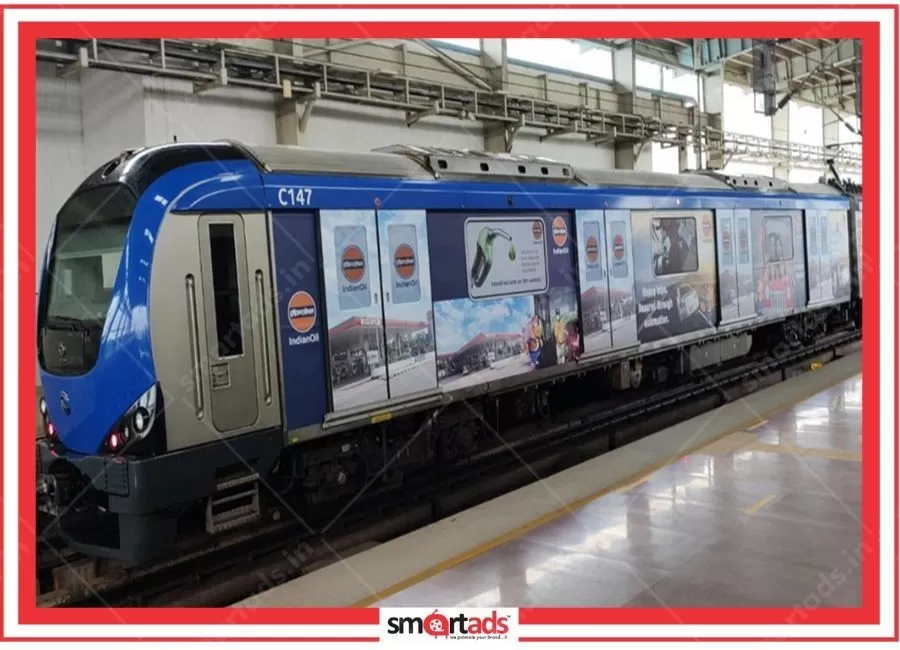
Exterior Metro Wrap
Size & Printing Cost as per actual
On the outside of metro Train, advertise
Rate per Metro Display Cost / 1 Month
6 Coaches & Route : Kashmere Gate To Raj
₹3560000.00
Showing 1 to 4 of 4 Results
MEDIA DETAILS
Size & Printing Cost as per actual
On the outside of metro Train, advertise
Rate per Metro Display Cost / 1 Month
6 Coaches & Route : Kashmere Gate To Raj
₹3560000.00
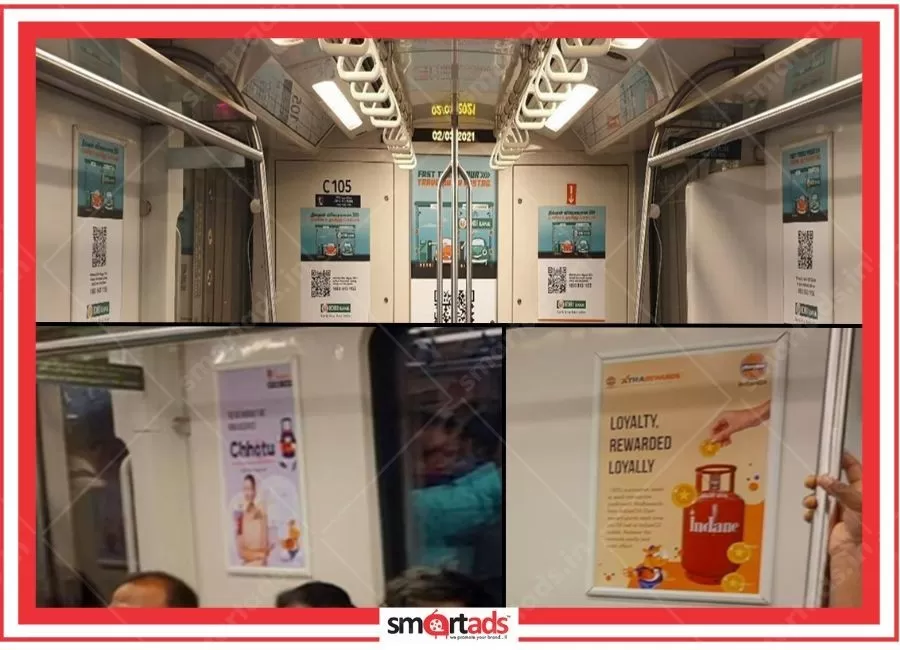
Size & Printing Cost as per actual
On the outside of metro Train, advertise
Rate per Metro Display Cost / 1 Month
6 Coach & Route : Kashmere Gate To Raja
₹822000.00

20 Sec Jingle
On the outside of metro Train, advertise
Rate per Metro Display Cost / 1 Month
Route:Kashmere Gate To Raja Nahar Singh
₹400000.00
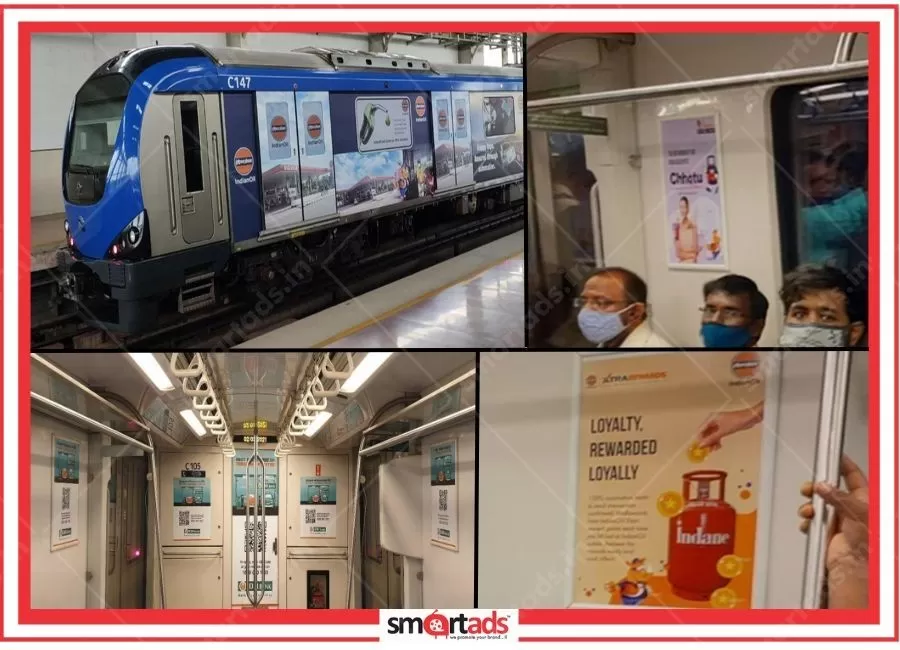
Size & Printing Cost as per actual
On the outside of metro Train, advertise
Rate per Metro Display Cost / 1 Month
Route:Kashmere Gate To Raja Nahar Singh
₹4820000.00
MEDIA REACH

MinimumQty :
1
EstimateReachPeople :
150000000
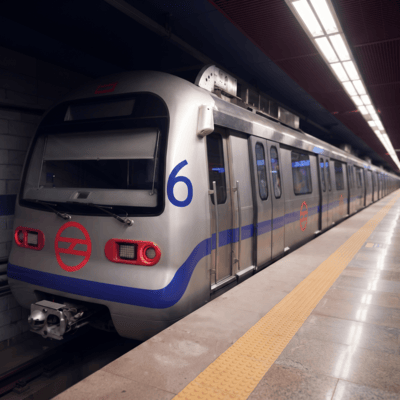
Most brands thinking about Delhi metro advertising default to station hoardings and platform panels — which is understandable, because that is where the inventory is most visible and easiest to book. What gets overlooked, consistently, is the train itself; and on the Violet Line specifically, that oversight is costing brands something genuinely valuable: 46 kilometres of moving billboard space, a cross-border audience that stretches from Kashmere Gate deep into Faridabad and Ballabhgarh, and dwell times that no static outdoor format can match.
There is a tendency to treat metro train advertising as a niche, experimental format — which, frankly speaking, it was a decade ago. That is no longer the case. Metro train advertising on the Delhi Violet Line refers to the placement of brand messaging directly on or inside the rolling stock of DMRC's Line 6, which runs the full stretch from Kashmere Gate in the north to Raja Nahar Singh station in Ballabhgarh, covering 34 stations across roughly 46 kilometres of track. The trains themselves — six-coach rakes manufactured under the Mitsubishi-ROTEM-BEML consortium — become the medium, whether through vinyl wraps on the exterior, panel branding inside each coach, or audio jingles played through the onboard public address system.
What makes this format genuinely different from other forms of outdoor advertising in Delhi is the captive audience dynamic. When a daily commuter boards a train at Badarpur and rides through to Nehru Place or Central Secretariat, they are inside that environment for anywhere between 20 and 45 minutes; there is no scrolling past, no changing the channel, no looking away from a well-placed interior panel. At SmartAds, we have found that this dwell time advantage is consistently undervalued by brand managers who are used to thinking in terms of fleeting impressions — the kind you get from a roadside hoarding at a traffic signal. Transit media, by contrast, creates repeated, sustained ad exposure across the same commute, day after day, for the full campaign duration.
The Violet Line is also one of DMRC's older operational corridors, which gives it a maturity that newer lines do not yet have — an established ridership pattern, predictable peak-hour volumes, and a commuter base that has settled into routine. The heritage segment between ITO and Kashmere Gate, which connects the Violet Line to the central heritage precinct of Delhi, adds a layer of audience diversity that brands in the cultural, educational, and government-facing sectors find particularly useful. DMRC advertising on this line is not just about mass reach; it is about reaching the right people in the right geography, repeatedly, over a sustained period.
The Violet Line's route is one of its most compelling selling points, and it is something that a lot of media planners do not fully appreciate until they map it against their target audience's geography. The line originates at Kashmere Gate — which is also an interchange with the Yellow Line and the Red Line, making it one of the busiest transfer points in the entire DMRC network — and travels south through ITO, Mandi House, Janpath, Central Secretariat, Khan Market, Jawaharlal Nehru Stadium, Jangpura, Lajpat Nagar, and Moolchand before heading further south through Kalkaji Mandir, Govind Puri, Harkesh Nagar Okhla, Jasola-Sarita Vihar, Mohan Estate, Tughlakabad, Badarpur, and then crossing the Delhi border into Faridabad and onward to Ballabhgarh and Raja Nahar Singh.
That geographic sweep — from the heritage core of Delhi to the industrial and residential corridors of Faridabad — is what makes DMRC Violet Line advertising genuinely unique among all Delhi metro lines. Most lines serve either the urban core or the suburban periphery; Line 6 does both, which means a single train branding campaign reaches audiences across dramatically different income brackets, occupational profiles, and consumption behaviours. A brand that needs to speak to South Delhi professionals at Lajpat Nagar and simultaneously reach the working-class and lower-middle-income households of Faridabad and Ballabhgarh can do so with one campaign, one creative execution, and one booking.
From a hyperlocal reach perspective, the stations that generate the highest advertiser interest — based on our booking patterns at SmartAds — are Nehru Place, Lajpat Nagar, Central Secretariat, Kalkaji Mandir, and Badarpur, each of which serves as a major commercial or transit hub. Nehru Place, in particular, is one of Delhi's most active IT and electronics markets, which draws a concentrated audience of tech-savvy, purchase-ready consumers; and Central Secretariat connects to the Yellow Line, amplifying the reach of any Violet Line train branding campaign through interchange footfall.
The format options on the Violet Line are broader than most advertisers realise, and choosing the wrong one for your objective is one of the most common mistakes we see. Interior train branding covers everything inside the coach — overhead panels above the doors, side panels along the coach walls, window decals, and floor graphics — and these formats work best when your message is detailed enough to reward the extended dwell time that interior ad exposure provides. A financial services brand, for instance, can use an interior panel to communicate a product feature, a rate, and a call to action in a way that a fleeting outdoor hoarding simply cannot support.
Exterior train branding, on the other hand, is about pure visual impact and brand visibility at scale. A full train wrap on a Violet Line six-coach rake turns the entire train into a moving billboard that is seen not just by the passengers inside but by everyone on the platform, everyone near the elevated sections of the track, and everyone in the surrounding urban environment as the train passes. The visual scale of a full train wrap is difficult to replicate with any other single format in outdoor advertising Delhi, and the cost per impression — when you factor in the number of times the same train completes its daily runs — works out to be surprisingly efficient. We have seen full train wraps generate brand recall numbers that rival prime-time television spots in the Delhi NCR market, which is a comparison that tends to get the attention of brand managers who are used to treating transit media as a secondary channel.
Coach branding — where a single coach or a set of coaches within a rake is branded rather than the full train — offers a middle ground that suits brands with moderate budgets who still want the visual impact of train branding. Panel branding within individual coaches is the most accessible entry point for smaller advertisers, and audio advertising through the onboard announcement system is an emerging format that deserves its own discussion, which we will get to shortly. The key point is that the Violet Line offers a full spectrum of non-traditional advertising options, from a single interior panel to a complete exterior wrap, which means the format can be matched to the budget rather than the other way around.
Frankly speaking, this is the question every client asks first, and it is also the question that most competitor pages dodge by saying "contact us for rates" — which tells you nothing useful when you are trying to build a media plan. We will be direct about what metro train advertising rates 2025 look like on the Violet Line, with the caveat that DMRC advertising rates are subject to tender cycles and can vary based on exclusivity, campaign duration, and the specific format being booked.
For interior train branding — specifically panel branding inside a coach — the advertising cost works out to somewhere in the ballpark of ₹80,000 to ₹1.5 lakh per coach per month, depending on the number of panels being taken and whether the booking covers peak-hour trains or the full fleet. A full coach interior branding, which covers all available panel positions within one coach, is typically priced in the range of ₹1.2 to ₹2 lakh per month per coach; and for a six-coach rake, a complete interior train branding exercise would be somewhere between ₹7 lakh and ₹12 lakh per month, which is a number that surprises most first-time advertisers when they compare it to what they are paying for equivalent reach through digital display. Exterior train branding — the partial wrap or full train wrap — carries a premium, with a full exterior wrap on a six-coach Violet Line rake typically running in the range of ₹15 lakh to ₹25 lakh per month, inclusive of production and installation; and the minimum campaign duration for a full train wrap is generally 30 days, though most brands we work with find that a 60 to 90-day campaign duration is where the brand recall metrics start to become compelling.
Metro train advertising rates 2025 for audio advertising on the Violet Line are structured differently — typically priced per spot, per day, across the full fleet, with a 15-second jingle running at roughly ₹40,000 to ₹70,000 per day for network-wide play. These are indicative figures based on our experience booking campaigns on this line; actual rates are confirmed at the time of booking and depend on DMRC's current tender structure. At SmartAds, we always tell our clients that the advertising cost conversation should begin with the objective, not the format — because a ₹5 lakh interior panel campaign that runs for 90 days on a train serving Nehru Place and Lajpat Nagar will almost always outperform a ₹20 lakh digital campaign targeting the same geography, on the metrics that actually matter for brand awareness and recall.
The audience profile of the Violet Line is one of its most underappreciated strategic assets, and it is something we spend a lot of time explaining to clients who assume that all metro lines carry broadly similar demographics. The Violet Line serves a genuinely heterogeneous audience — which is both a challenge and an opportunity, depending on how your campaign is structured. The northern segment, from Kashmere Gate through ITO, Mandi House, and Central Secretariat, carries a heavy concentration of government employees, legal professionals, media workers, and students, given the proximity of the Supreme Court, various ministry buildings, and several university campuses.
As the line moves south through Lajpat Nagar, Kalkaji, and Nehru Place, the commuter profile shifts toward working professionals in the IT, retail, and services sectors — Nehru Place being one of Delhi's most active commercial hubs, and Lajpat Nagar drawing a significant volume of retail shoppers and small business owners. The daily commuters on this stretch tend to skew toward the 25-to-45 age bracket, with household incomes in the middle to upper-middle range, which makes this segment particularly attractive for categories like FMCG, edtech, financial services, and OTT platform advertising. Our experience shows that brands in these categories consistently see stronger conversion metrics from Violet Line campaigns than from equivalent spends on outdoor advertising Delhi formats that reach a more diffuse audience.
The southern segment — from Badarpur through Faridabad and into Ballabhgarh — adds a working-class and lower-middle-income layer to the audience, which is valuable for mass-market FMCG brands, real estate advertising targeting affordable housing buyers, and categories like two-wheeler brands and consumer durables. The cross-border reach into Faridabad and Ballabhgarh is genuinely unique to the Violet Line among all DMRC corridors; no other line extends this far into Haryana, which means that a brand targeting the Delhi NCR market can reach Faridabad and Ballabhgarh audiences through the same train branding campaign without any additional spend. According to DMRC's own ridership data, the Violet Line carries upward of 3.5 to 4 lakh daily commuters, a figure that has been climbing steadily since the Ballabhgarh extension became fully operational.
Most brands get this wrong: they treat BTL advertising as a tactical, last-mile tool rather than as a brand-building medium in its own right. The Violet Line challenges that assumption at every level. The combination of captive audience conditions, extended dwell time, geographic diversity, and cross-border reach makes metro train advertising in Delhi Violet Line one of the most efficient non-traditional advertising formats available in the NCR market — and the fact that fewer brands are competing for this inventory compared to, say, Yellow Line or Blue Line formats means that the share of voice available to any single advertiser is disproportionately large.
The brand visibility dynamics on the Violet Line are also worth understanding in some detail. A full train wrap on a Violet Line rake completes somewhere between 10 and 14 return trips per day across the full 46-kilometre route; which means that a single branded train generates impressions not just among its passengers but among everyone who sees it on elevated sections, at platform level, and in the depot. When you aggregate that across a 30-day campaign duration, the total impression count for a full train wrap is in the hundreds of millions — a number that, when converted to a CPM, works out to be genuinely competitive with digital display and far ahead of most static outdoor formats on a cost-per-recall basis.
At SmartAds, we had a retail client in South Delhi — a mid-size apparel brand with outlets in Lajpat Nagar and Nehru Place — who ran a 60-day interior train branding campaign on the Violet Line targeting the Kashmere Gate to Kalkaji Mandir stretch. The campaign used overhead panel branding inside three coaches of a single rake, with creative that highlighted their festive season collection. By the end of the campaign, footfall at both outlets had increased by roughly 22 percent compared to the same period in the previous year, and the brand's own customer surveys showed that nearly 35 percent of new walk-ins mentioned having seen the metro ad. That is a return on investment figure that justified a significantly larger Violet Line advertising budget the following year — and it is the kind of outcome that static outdoor advertising Delhi rarely delivers with the same precision.
The honest answer is that they serve different purposes, and the question of which is better depends entirely on what your campaign is trying to achieve — which is something we find ourselves explaining in almost every client briefing. Interior train branding is the superior format for message depth; when a daily commuter is seated or standing inside a branded coach for 30 to 40 minutes, they have time to read, absorb, and process information in a way that no other advertising format allows. This makes interior coach branding particularly effective for categories where the purchase decision is considered — financial products, real estate advertising, edtech advertising, healthcare, and insurance — because the extended ad exposure allows for a level of creative detail that drives genuine comprehension rather than just awareness.
Exterior train branding, by contrast, is a brand awareness and brand visibility play. A full train wrap on the Violet Line is one of the most arresting visual formats in the Delhi NCR outdoor advertising ecosystem; the sheer scale of a branded six-coach rake, moving through the city at elevated height, creates an impression that is difficult to ignore and even harder to forget. We have found that full train wraps work best for categories where the primary objective is top-of-mind awareness — FMCG launches, OTT platform advertising for new content releases, telecom offers, and consumer electronics launches — because the format prioritises visual impact over message complexity. The moving billboard effect of exterior train branding also means that the campaign reaches audiences who are not even commuters on the line, which extends the effective reach well beyond the ridership numbers alone.
One approach that we recommend for brands with sufficient budget is a combination of interior and exterior formats within the same campaign — using the exterior wrap to build awareness among the broader urban audience and the interior panels to deepen engagement with the captive commuter audience. A pharmaceutical brand we worked with on the Violet Line used exactly this approach during a product launch campaign: the exterior wrap carried the product name and a single bold visual, while the interior panels explained the product's benefits in detail, with a QR code linking to a product page. The campaign ran for 45 days, and the QR code scan data alone provided a measurable, attributable signal of engagement that the brand's marketing team used to justify the spend to their management — which is the kind of ROI evidence that makes transit media increasingly attractive to data-driven marketers.
Here is where it gets interesting, and where the Violet Line has a legitimate first-mover advantage over every other DMRC corridor. The Violet Line was among the first DMRC lines to pilot audio advertising through the onboard public address system — a format where brand jingles or short audio spots are played between the automated station announcements that commuters hear throughout their journey. Metro jingle advertising is not a new concept globally, but in the Indian metro context, it is still early enough that brands adopting it now are capturing audience attention that has not yet been saturated by competitive clutter.
The mechanics of audio advertising on the Violet Line are straightforward: a 10 to 15-second audio spot — either a brand jingle or a spoken message — is inserted into the announcement sequence at defined intervals, typically after the station name announcement and before the door-closing alert. The spots are played across all coaches of the train simultaneously, which means the entire captive audience of a rake hears the message at the same moment; and because the announcement system is the primary audio channel that commuters are conditioned to pay attention to, the attention levels for metro jingle advertising are significantly higher than for ambient background audio in other environments. PayTunes and similar audio-out-of-home specialists have documented attention rates for this format that are consistently above 60 percent — a figure that most digital audio formats would struggle to match.
The advertising cost for audio advertising on the Violet Line, as mentioned earlier, runs in the ballpark of ₹40,000 to ₹70,000 per day for network-wide play; and a minimum campaign of 15 to 30 days is typically recommended to build the frequency needed for brand recall. What a lot of people miss is that audio advertising works best when it is layered with a visual format — so a brand running interior panel branding can amplify its campaign significantly by adding a jingle that reinforces the same message, creating a multi-sensory brand experience that is genuinely difficult to replicate in any other non-traditional advertising context. At SmartAds, we consider audio advertising on the Violet Line to be one of the most underutilised formats in the Delhi NCR media mix, and we expect it to become significantly more competitive — and more expensive — as more brands discover its effectiveness.
The booking process for metro train advertising in Delhi Violet Line is more structured than most advertisers expect, and understanding it upfront saves a significant amount of time and frustration. DMRC advertising inventory on the Violet Line is managed through a concessionaire system — DMRC licenses advertising rights to authorised vendors, who then sell inventory to brands and agencies. Working with an experienced violet line advertising agency that already has established relationships with the relevant concessionaires is, frankly, the most efficient path to getting a campaign live without delays.
The process, broadly, begins with a brief — defining the campaign objective, the target geography within the line, the format preference, and the campaign duration. Once the brief is clear, the advertising agency submits a booking request to the concessionaire, which triggers the creative approval process with DMRC. DMRC approval is mandatory for all train branding and audio advertising on the Violet Line; the approval process involves a review of the creative artwork against DMRC's content guidelines, which prohibit political messaging, religious content, and anything that could be construed as offensive or misleading. The DMRC approval timeline typically runs between 7 and 15 working days for straightforward campaigns; more complex executions, like full train wraps, may require additional time for structural review. Our experience shows that campaigns submitted with complete, compliant creative artwork — correct dimensions, correct file formats, and no prohibited content — clear the approval process at the faster end of that range.
After DMRC approval is received, the production and installation phase begins. For exterior train branding, the vinyl wrap is produced and installed during a scheduled maintenance window at the depot — a process that takes 24 to 48 hours per rake and requires coordination with DMRC's operations team. Interior panel branding installation is faster, typically completed within a single maintenance window. The full timeline from brief to campaign live is generally somewhere between 3 and 6 weeks for a standard campaign; which means that brands planning festive season campaigns on the Violet Line should be initiating their bookings at least 6 to 8 weeks before the desired go-live date. At SmartAds, we manage the entire process — from concessionaire liaison to DMRC approval to production oversight — so that our clients are focused on the campaign strategy rather than the logistics.
To be honest, the question of which industries benefit most from Violet Line advertising is better answered by looking at which audience segments the line serves most densely, and then working backward to the categories that those audiences are most likely to respond to. The South Delhi and Central Delhi segments of the line — from Kashmere Gate through Central Secretariat, Khan Market, and Lajpat Nagar — carry a high concentration of urban professionals, government employees, and college students, which makes these segments particularly productive for edtech advertising, financial services, OTT platform advertising, and premium FMCG brands.
Real estate advertising is one of the most consistent categories on the Violet Line, and for obvious reasons — the line's southern extension into Faridabad and Ballabhgarh passes through some of the most active affordable and mid-segment housing markets in the NCR, and the daily commuters on this stretch are precisely the audience that residential developers are trying to reach. We have seen real estate brands run 90-day interior train branding campaigns on the Faridabad segment of the line and generate qualified lead volumes that rivalled their digital campaign performance at a fraction of the cost per lead. FMCG advertising — particularly in the food, personal care, and home care categories — benefits from the mass reach and frequency that the Violet Line delivers, especially for brands that are active across both the Delhi urban market and the Faridabad-Ballabhgarh semi-urban market.
Healthcare, insurance, and banking brands have also found the Violet Line to be a productive channel, particularly for awareness campaigns ahead of product launches or regulatory deadlines. The captive audience conditions and extended dwell time make it possible to communicate relatively complex messages — which is a genuine advantage for categories where the product itself requires some explanation. One automotive brand we worked with used a 45-day interior coach branding campaign on the Violet Line to promote a new hatchback model targeting first-time car buyers; the campaign used a combination of product imagery and EMI information on interior panels, and the brand reported a measurable uplift in test drive bookings at their Faridabad and South Delhi dealerships during the campaign period — a result that reinforced our view that transit media is most powerful when the creative is tailored to the specific audience geography of the line.
This is a comparison that comes up in almost every media planning conversation we have about Delhi metro advertising, and the answer is almost never "one is better than the others" — it depends on the target audience, the budget, and the campaign objective. That said, there are meaningful differences between the lines that should inform the decision. The Yellow Line, which runs from Samaypur Badli in the north to HUDA City Centre in Gurugram, is the busiest corridor in the DMRC network by ridership; it carries the largest daily commuter volume, which makes it the highest-reach option for brands that prioritise pure numbers. The trade-off is that Yellow Line advertising inventory is the most competitive and, consequently, the most expensive — and the audience, while large, is also the most demographically diverse, which can dilute targeting precision.
The Blue Line — which runs from Dwarka in the west to Vaishali and Noida Electronic City in the east — carries a strong concentration of IT professionals, call centre employees, and corporate workers, particularly on the Noida and Vaishali extensions; which makes it the preferred choice for brands targeting the tech and corporate demographic. The Blue Line's ridership is second only to the Yellow Line, and its advertising rates reflect that. The Violet Line, by contrast, offers a more targeted audience profile — particularly on the South Delhi and Faridabad segments — at advertising rates that are, in our experience, somewhere between 20 and 35 percent lower than comparable inventory on the Yellow or Blue lines. For brands that are not trying to reach the entire Delhi NCR market but are specifically targeting the South Delhi professional, the Faridabad-Ballabhgarh consumer, or the government and legal professional audience around Central Secretariat, the Violet Line delivers superior value per rupee spent.
The cross-border reach of the Violet Line into Haryana is a differentiator that no other DMRC line offers to the same extent, and it is something that brands with a genuine NCR-wide distribution footprint should be factoring into their media mix decisions. The Violet Line is also the only DMRC corridor that connects the heritage core of Delhi — the ITO and Mandi House area — to the industrial and residential suburbs of Faridabad, which creates a unique audience journey that no other line replicates. At SmartAds, our recommendation for most brands is to use the Violet Line as a primary or co-primary channel when the target audience skews toward South Delhi, Faridabad, or the government and professional segments — and to layer it with Yellow or Blue Line activity when the objective is maximum citywide reach.
Brand recall is the primary metric for transit media, and it is also the metric that most digital-first marketers are least comfortable with — because it requires primary research rather than a dashboard. What we tell our clients is that measuring return on investment from a Violet Line campaign requires a combination of pre- and post-campaign brand tracking surveys, which can be conducted among commuters at key stations like Nehru Place, Lajpat Nagar, and Central Secretariat; and secondary metrics like footfall data, sales uplift in the relevant geographies, and — for campaigns that include a digital call to action — QR code scans, app downloads, or website traffic from the target pin codes.
The FICCI-EY Media and Entertainment Report and the GroupM TYNY Report both consistently highlight transit media as one of the fastest-growing segments of the Indian out-of-home advertising market, with brand recall rates for train branding campaigns running significantly higher than for static outdoor formats — a finding that aligns with what we observe in our own campaign post-analyses. The extended dwell time of interior train branding, in particular, produces recall rates that are, in our experience, somewhere between 40 and 60 percent higher than equivalent static panel formats, which is a meaningful difference when you are trying to justify the spend to a management team that is used to thinking in digital CPM terms.
On top of that, the frequency dynamic of transit media is worth quantifying for your ROI model. A daily commuter who takes the Violet Line five days a week is exposed to the same interior panel branding roughly 20 times over a 30-day campaign duration — which is a frequency level that most digital campaigns would require significant additional spend to replicate. When you factor in that each of those 20 exposures is occurring in a low-distraction, captive environment with extended dwell time, the effective quality of those impressions is substantially higher than a programmatic display impression that is viewable for less than a second. The honest way to present this to management is not to claim that transit media replaces digital — it does not — but to argue that it fills a specific gap in the media mix that digital cannot fill efficiently, and that the combination of the two produces brand awareness outcomes that neither achieves alone.
New advertisers are often surprised by how formal the DMRC approval process is, and that surprise frequently translates into campaign delays that could have been avoided with better planning. DMRC treats all advertising on its rolling stock as a matter of public communication — which means that the content standards are considerably stricter than what you would encounter with a private outdoor media owner. The approval process for Violet Line train branding begins with the submission of creative artwork to the authorised concessionaire, who then forwards it to DMRC's advertising department for review.
The creative guidelines that DMRC enforces for Violet Line advertising include restrictions on political content, religious imagery, and any messaging that could be interpreted as discriminatory or misleading; and the artwork must be submitted in the correct technical specifications — which vary by format, with exterior vinyl wraps requiring different file dimensions and resolution standards than interior panel artwork. DMRC also requires that the advertiser or their agency provide a declaration that the content complies with all applicable advertising standards, including the Advertising Standards Council of India (ASCI) guidelines. The DMRC approval timeline, as noted earlier, runs between 7 and 15 working days for standard campaigns; and the metro advertising tender cycle means that some inventory windows are pre-allocated, so early booking is essential for brands that have specific campaign dates in mind.
What a lot of first-time advertisers miss is that the production timeline for exterior train branding — particularly full train wraps — is separate from and additional to the DMRC approval timeline. The vinyl production for a full six-coach wrap takes approximately 5 to 7 working days after the artwork is finalised, and the installation requires a depot access window that must be coordinated with DMRC's operations schedule. Working with a violet line advertising agency that has prior experience with DMRC's processes — and established relationships with the depot operations team — compresses this timeline significantly. At SmartAds, we have managed campaigns where the full process from brief to campaign live was completed in under three weeks, which is achievable when the creative is ready and compliant from day one.
Q: What types of advertising are available on the Delhi Metro Violet Line trains?
The Violet Line offers a spectrum of advertising formats that cover both the interior and exterior of the rolling stock, as well as the audio environment inside the coaches. Interior formats include overhead panel branding above the doors, side wall panels along the coach interior, window decals, and full coach interior wraps that cover all available surface area within a single coach. Exterior formats range from partial wraps covering one or two coaches to full train wraps that brand the entire six-coach rake. Audio advertising — where brand jingles or spoken messages are played through the onboard public address system between station announcements — is an additional format that is unique to a small number of DMRC corridors, and the Violet Line is among the most established for this format. Each of these formats can be booked independently or in combination, and the right mix depends on the campaign objective, the target audience segment within the line, and the available budget.
Q: How much does metro train advertising on the Delhi Violet Line cost in 2025?
Metro train advertising rates 2025 on the Violet Line vary by format and campaign duration. Interior panel branding within a single coach runs in the range of ₹80,000 to ₹1.5 lakh per coach per month; a full interior coach branding exercise covering all panels in one coach is typically priced between ₹1.2 and ₹2 lakh per month. A full train wrap covering the exterior of all six coaches is a more significant investment, generally in the range of ₹15 to ₹25 lakh per month inclusive of production, with a minimum campaign duration of 30 days. Audio advertising is priced per spot per day, with a 15-second jingle running at roughly ₹40,000 to ₹70,000 per day for network-wide play. These are indicative figures; actual advertising cost is confirmed at the time of booking based on current DMRC tender rates and inventory availability.
Q: Which stations on the Violet Line get the highest commuter footfall?
Based on DMRC ridership data and our own campaign experience, the stations with the highest daily footfall on the Violet Line are Kashmere Gate — which is a major interchange station connecting to the Yellow and Red lines — followed by Central Secretariat, Lajpat Nagar, Nehru Place, and Kalkaji Mandir. Kashmere Gate and Central Secretariat benefit from interchange traffic, which means that a significant portion of their footfall consists of commuters transferring between lines — a highly mobile, high-frequency audience. Nehru Place draws a concentrated commercial audience of IT and electronics buyers, while Lajpat Nagar is one of Delhi's most active retail hubs. On the Faridabad extension, Badarpur and the Faridabad stations generate substantial working-class commuter volumes, particularly during morning and evening peak hours.
Q: What is the minimum budget to advertise on the Delhi Violet Line metro train?
The minimum entry point for Violet Line advertising is interior panel branding within a single coach, which can be initiated for as little as ₹80,000 to ₹1 lakh per month — making it accessible to SMEs and startups that are not in a position to commit to a full train wrap. A small business or startup can run a meaningful brand awareness campaign on the Violet Line by booking panel branding in two or three coaches of a single rake, targeting a specific segment of the route that aligns with their geographic market. Audio advertising offers another accessible entry point, particularly for brands that already have a jingle or audio asset and want to test the format before committing to a larger visual campaign. The key is to align the format and the geography to the budget — which is something an experienced violet line advertising agency can help structure efficiently.
Q: How do I book a train branding campaign on the DMRC Violet Line?
The booking process begins with defining your campaign objective, target geography, format preference, and campaign duration — after which a booking request is submitted to the authorised concessionaire for the Violet Line. The concessionaire confirms inventory availability and provides a rate card; once the booking is confirmed and the payment terms are agreed, the creative artwork is submitted for DMRC approval. DMRC approval typically takes 7 to 15 working days, after which production and installation are scheduled. The full timeline from brief to campaign live is generally 3 to 6 weeks. Working with an established advertising agency that has existing concessionaire
