
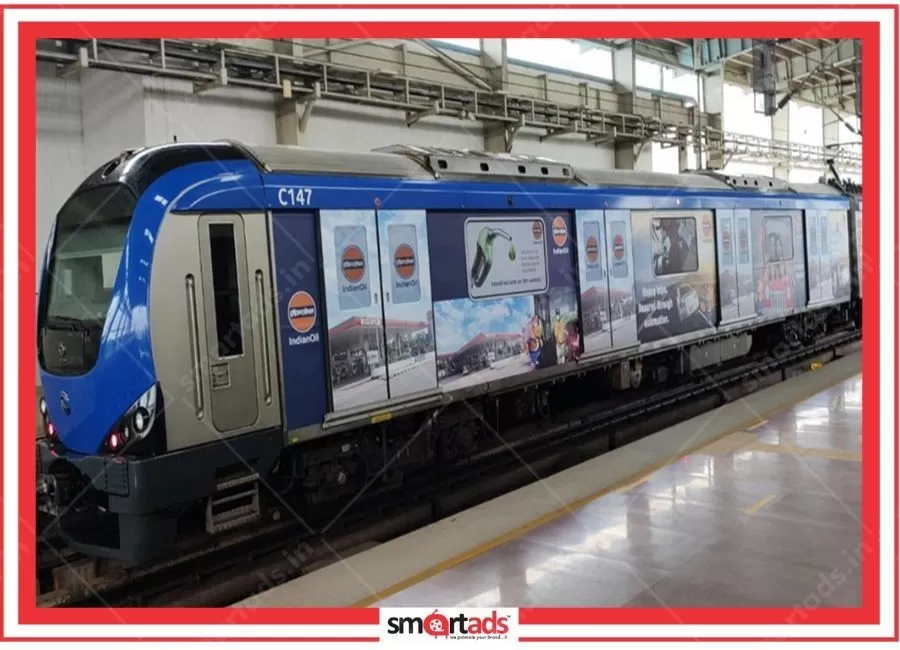
Exterior Metro Wrap
Size & Printing Cost as per actual
On the outside of metro Train, advertise
Rate per Metro Display Cost / 1 Month
Route:Nagole To Raidurg
₹860000.00
Showing 1 to 5 of 5 Results
MEDIA DETAILS
Size & Printing Cost as per actual
On the outside of metro Train, advertise
Rate per Metro Display Cost / 1 Month
Route:Nagole To Raidurg
₹860000.00
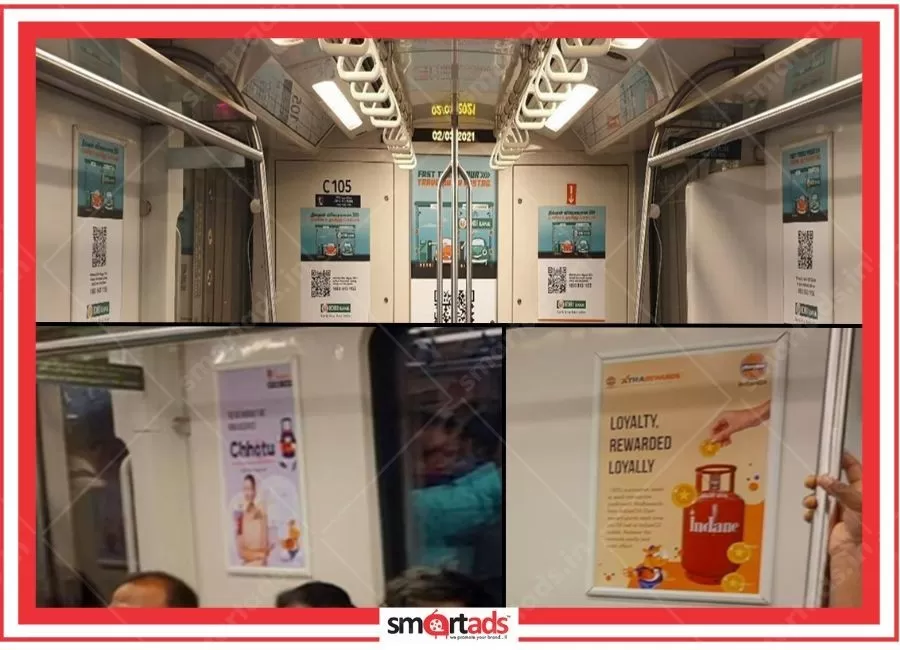
Custom
On the outside of metro Train, advertise
Rate per Metro Display Cost / 1 Month
Route:Nagole To Raidurg
₹480000.00

10 Sec Video
On the outside of metro Train, advertise
Rate per Metro Display Cost / 1 Month
Route:Nagole To Raidurg
₹135000.00
20 Sec Jingle
On the outside of metro Train, advertise
Rate per Metro Display Cost / 1 Month
Route:Nagole To Raidurg
₹400000.00

Size & Printing Cost as per actual
On the outside of metro Train, advertise
Rate per Metro Display Cost / 1 Month
Route:Nagole To Raidurg
₹1330000.00
MEDIA REACH

MinimumQty :
1
EstimateReachPeople :
150000000
The Hyderabad Metro's Blue Line carries somewhere in the ballpark of 4 to 4.5 lakh passengers every single day across its 29-station stretch from Miyapur to LB Nagar — and yet, a surprising number of brands still treat it as an afterthought in their media plans, which is a mistake we have seen cost advertisers dearly in terms of missed frequency and reach. The captive audience inside a metro coach is unlike almost any other media environment in India; commuters are trapped, alert, and often without a screen to distract them for stretches of 4 to 12 minutes between stations. What we tell our clients at SmartAds is that this is not just an out-of-home format — it is a high-frequency, high-attention environment that most media plans chronically undervalue.
There is a particular kind of advertising pressure that only a metro journey creates. When a commuter boards at Miyapur and rides all the way to Ameerpet or MGBS, they are inside a sealed, well-lit, climate-controlled environment for anywhere between 20 and 45 minutes — which means they are going to look at your creative whether they intended to or not. This is fundamentally different from a billboard on the Outer Ring Road, which competes with traffic, weather, and a driver's need to keep their eyes on the road. The Blue Line's ridership, which has grown steadily since the Hyderabad Metro Rail's full operational stabilisation, skews heavily toward working professionals, college students, and upper-middle-income households — precisely the demographic that most consumer brands, financial services companies, and educational institutions are trying to reach.
The FICCI-EY Media and Entertainment Report has consistently flagged metro rail advertising as one of the fastest-growing segments within the out-of-home category in India, and the Hyderabad Metro is no exception to this trend. What makes the Blue Line particularly interesting from a media planning standpoint is its corridor — it runs through some of Hyderabad's most commercially dense zones, passing through Ameerpet, which is arguably the city's coaching and education hub; Punjagutta, which is a retail and financial district; and HITECH City, which is the nerve centre of Hyderabad's technology and startup ecosystem. A brand that buys Blue Line inventory is essentially buying a moving billboard that passes through three or four distinct audience clusters in a single run, which is a kind of geographic efficiency that static OOH simply cannot replicate.
Our experience shows that brands in categories like BFSI, ed-tech, consumer electronics, and real estate tend to extract the highest returns from Blue Line placements, largely because their target audiences over-index on metro ridership. A financial services client we worked with — a mid-sized mutual fund house targeting salaried professionals in the 28-to-42 age bracket — ran a 45-day campaign across coach panels and station backlit panels on the Blue Line, and the brand recall scores they measured in post-campaign surveys were roughly 34% higher than what they had achieved with a comparable spend on digital display in the same period; which, frankly speaking, surprised even them.
The format landscape on the Blue Line is considerably more varied than most brands realise when they first approach us. Inside the coaches themselves, you have panel advertising across the overhead luggage racks, door panels, and the interior wall spaces — these are typically printed vinyl or backlit options, and they offer what we consider the highest dwell time of any format in the entire metro ecosystem because the passenger is physically enclosed with the creative for the duration of their journey. On top of that, train wraps — where the exterior of an entire coach or a full train set is branded — create a spectacle that generates earned media and social sharing, which amplifies the paid reach considerably.
At the station level, the inventory expands significantly. Platform screen door branding, which wraps around the glass barriers that separate the platform from the tracks, is particularly effective because it sits at eye level and is visible to every passenger waiting for a train. Concourse-level lightboxes and backlit panels, escalator panels, and entry-gate branding are all available across most of the 29 stations on the Blue Line; and the premium stations — Ameerpet, HITECH City, Miyapur, and LB Nagar — command higher rates because of their footfall volumes. Digital screens, which have been installed at several key stations, allow for dynamic content rotation and are increasingly being used by brands that want to run time-sensitive or contextual messaging.
One format that we have found consistently underused is the floor graphic inside coaches and on station concourses. The CPM on floor graphics works out to be remarkably efficient — somewhere in the ballpark of formats that cost a fraction of what brands pay for comparable attention on digital platforms — and the novelty factor means passengers genuinely stop and look, which is increasingly rare in an attention-fragmented media environment. A retail client in Hyderabad's Banjara Hills area used floor graphics across five Blue Line stations during a sale period, and footfall at their store locations near those stations increased by a number that their marketing team described as "well beyond what we expected from a single-format OOH push."
Frankly speaking, this is the question we get asked most often, and it is also the question that most vendors and media owners are least transparent about — which is something we think does the industry no favours. The cost structure on the Hyderabad Metro Blue Line is tiered by format, station category, and campaign duration, so giving a single number is genuinely misleading; but we can share the ranges our clients have worked within, which should give any media planner a reasonable starting point for budgeting.
For interior coach panel advertising, a campaign covering a reasonable number of panels across a train set for a 30-day period typically works out to somewhere between ₹2.5 lakh and ₹6 lakh depending on the number of coaches, the specific train sets booked, and whether you are running single-sided or double-sided panels. Station-level backlit panels at premium stations like HITECH City or Ameerpet are priced in the ballpark of ₹80,000 to ₹1.5 lakh per panel per month, which sounds steep until you calculate the daily footfall at those stations — which runs into tens of thousands of passengers — and work backwards to a cost-per-thousand that is genuinely competitive with mid-tier digital display. Train wraps, which are the most visually impactful format, are naturally the most expensive; a full exterior train wrap for 30 days on the Blue Line is typically negotiated in the range of ₹15 lakh to ₹25 lakh, which includes production and installation, and the earned media value from social sharing and press coverage often adds meaningful incremental reach.
What a lot of people miss is that the negotiation window matters enormously on metro advertising. Hyderabad Metro Rail Limited operates its commercial advertising through a concessionaire model, which means rates are not always fixed and there is genuine room to negotiate on multi-month bookings, multi-format packages, or campaigns that combine Blue Line inventory with the Red Line or Green Line corridors. At SmartAds, we have consistently secured 15% to 25% better effective rates for clients who commit to longer campaign durations or who are willing to bundle formats — which is something a brand going directly to the concessionaire without agency representation often does not know to ask for.
Not all 29 stations are created equal, and treating them as interchangeable is one of the most common planning errors we see. The interchange stations — Ameerpet, where the Blue Line meets the Red Line, and MGBS, which is a major transit hub — see ridership multipliers that make them disproportionately valuable; a passenger transferring between lines passes through the concourse twice, which effectively doubles the opportunity for your creative to register. HITECH City station deserves particular mention because its catchment is almost entirely composed of technology professionals, startup founders, and knowledge workers — an audience that is notoriously difficult and expensive to reach through traditional media, which makes the relatively efficient CPM at this station a genuine anomaly worth exploiting.
Miyapur, at the western terminus of the Blue Line, is interesting for a different reason: it serves as a park-and-ride hub for commuters from Bachupally, Nizampet, and the broader western suburbs, which means its audience has a slightly different profile — more family-oriented, more suburban, with higher car ownership — that suits certain categories like automobiles, home improvement, and FMCG particularly well. LB Nagar at the eastern end similarly serves as a gateway for commuters from Dilsukhnagar, Vanasthalipuram, and areas further east, which tend to skew toward value-conscious middle-income households. Understanding these micro-audience profiles is what separates a well-planned Blue Line campaign from one that simply buys inventory without strategic intent.
Our experience shows that for brands with limited budgets who cannot afford a full-corridor buy, concentrating spend on three to five stations — specifically Ameerpet, HITECH City, Punjagutta, and one terminus — delivers a reach-to-cost ratio that outperforms a thin spread across all 29 stations. We worked with an automotive brand launching a premium sedan in Hyderabad; they initially wanted to spread their budget across the entire Blue Line, but we convinced them to concentrate on HITECH City, Ameerpet, and Punjagutta, and the test drive enquiries from Hyderabad during the campaign period exceeded their national average by a margin that made the case for concentration strategy quite convincingly.
The honest answer is that it depends entirely on what you are trying to achieve — but for certain objectives, the Blue Line is simply better, and we will explain why. Traditional outdoor in Hyderabad — hoardings on the ORR, unipoles along Jubilee Hills Road, or gantries on the Rajiv Gandhi flyover — offers high-visibility reach but very low dwell time; a driver passing a hoarding at 60 kilometres per hour has perhaps two to three seconds of exposure, which is enough for brand awareness but rarely enough for message comprehension. Metro advertising, by contrast, gives you 20 to 45 minutes of proximity to the passenger, which is why it performs so much better for campaigns that need to communicate a complex message, a product feature set, or a call to action that requires some cognitive processing.
Newspaper advertising in Hyderabad — primarily through Telugu-language dailies like Eenadu and Sakshi, which have enormous circulation in the city — reaches a different audience profile and serves different objectives; it is excellent for credibility, for reaching older demographics, and for campaigns that benefit from editorial adjacency. Radio, particularly through stations like Radio Mirchi and Big FM in Hyderabad, offers reach and frequency at relatively low cost but zero visual impact. The Blue Line sits in a distinct space that none of these formats occupies: high dwell time, high visual impact, premium demographic skew, and a captive environment — which is a combination that is genuinely rare in the Indian media landscape.
What we tell clients who ask us to compare metro advertising to digital is that the comparison is somewhat false, because the two formats serve different roles in the funnel. Digital excels at targeting, retargeting, and conversion; metro advertising excels at building brand salience and mental availability among a premium urban audience. The most effective campaigns we have planned combine both — using Blue Line metro advertising to build awareness and brand stature, then using digital retargeting to convert the same audience when they are back on their phones during the commute or after they reach their destination.
Getting the creative right for metro advertising is something that a surprising number of brands underinvest in, and we have seen this backfire when an otherwise well-planned campaign underperforms because the creative was designed for a digital screen and simply did not translate to a large-format print environment. Interior coach panels on the Blue Line are typically produced in sizes that vary by coach type and panel position — the most common formats are roughly 18 inches by 24 inches for smaller panels and 24 inches by 36 inches for larger overhead panels, though these dimensions should always be confirmed with the concessionaire at the time of booking because they can vary across train sets.
The resolution requirement for backlit panels is considerably higher than for standard print, and this catches brands off guard more often than it should; artwork submitted at 72 DPI that looks fine on a monitor will look visibly soft when printed at the sizes required for station lightboxes, which are often 4 feet by 6 feet or larger. We always recommend that our clients submit artwork at a minimum of 150 DPI at actual print size, and ideally 300 DPI, which ensures that the creative holds up under the close-range scrutiny of a passenger standing directly in front of a panel. For train wraps, the production process involves large-format vinyl printing and professional installation, which typically requires a lead time of 10 to 14 days from artwork approval — so factoring this into campaign timelines is non-negotiable.
The creative strategy for metro environments should account for the fact that passengers will see the same panel multiple times across multiple journeys, which is a double-edged characteristic. On one hand, repetition builds recall; on the other, a creative that is too static or too text-heavy will start to feel wallpaper-like after the third or fourth exposure. Our recommendation — and this is something we push quite hard with clients — is to plan for creative rotation at least once during a 60-day campaign, which keeps the environment fresh and gives the brand an opportunity to progress the narrative from awareness to consideration to action across the campaign arc.
This is a question where we have a fairly strong opinion, informed by years of planning metro campaigns across Hyderabad, Mumbai, Delhi, Bengaluru, and other cities. The minimum effective duration for a metro campaign is 30 days — anything shorter than that simply does not give the frequency curve enough time to build to a level where meaningful recall is established. The average Blue Line commuter rides the metro somewhere between 18 and 22 days in a month, which means a 30-day campaign delivers roughly 18 to 22 exposures to a regular commuter; and while that sounds like a lot, research on advertising recall consistently shows that the effective frequency threshold for a new brand or campaign message is somewhere between 7 and 12 exposures, which means 30 days gets you comfortably above that threshold.
For campaigns with more ambitious objectives — brand repositioning, new product launches, or competitive conquesting — we typically recommend a 60 to 90 day run, which allows the creative rotation strategy we mentioned earlier to be executed properly and gives the brand enough time to move the audience through multiple stages of the consideration funnel. The cost efficiency of longer campaigns is also meaningful: most concessionaires offer rate structures where a 90-day booking works out to a per-day cost that is roughly 20% to 30% lower than a 30-day booking for the same inventory, which is a saving that can be reinvested into additional formats or stations.
One thing we have observed across multiple campaigns is that the first two weeks of a metro campaign tend to generate the sharpest recall gains, after which the curve flattens; this is why we often advise clients to front-load their investment in the first month with premium placements and then sustain with slightly reduced but consistent inventory in subsequent months. A consumer electronics brand we worked with used exactly this approach for a product launch on the Blue Line — heavy investment in train wraps and station domination in weeks one and two, followed by a sustained interior panel presence for the remaining six weeks — and the brand awareness metrics they tracked showed a curve that matched almost exactly what we had projected based on prior campaign data.
The perception that metro advertising is exclusively for large national brands with crore-plus budgets is one we encounter constantly, and it is largely inaccurate. The thing is, the Blue Line's format diversity means that a brand with a budget of ₹3 to ₹5 lakh can run a meaningful, well-targeted campaign — particularly if they are strategic about station selection and format choice. Interior coach panels on a single train set, combined with concourse-level branding at two or three strategically chosen stations, can be assembled into a coherent campaign at a total cost that is comparable to a modest digital display budget; and the audience quality, in terms of demographic profile and attention level, is arguably superior.
Regional brands — local real estate developers, Hyderabad-based educational institutions, healthcare chains, and retail businesses — have been among the most enthusiastic adopters of Blue Line advertising in our experience, precisely because the corridor passes through their catchment areas and delivers their target audience with a geographic precision that city-wide OOH cannot match. A coaching institute in Ameerpet, for instance, can run station-specific branding at the Ameerpet station and the adjacent stations on either side, which creates a concentrated presence in the exact geography where their prospective students are already commuting; the cost of this kind of hyper-local metro campaign is well within the budget of a mid-sized educational institution.
At SmartAds, we have helped brands with total campaign budgets as modest as ₹2.5 lakh execute Blue Line campaigns that delivered measurable results — and the key in every case was ruthless prioritisation of format and station over trying to spread the budget thin across the entire corridor. The discipline of choosing three things and doing them well, rather than doing twelve things poorly, is something we push hard in every planning conversation; and metro advertising, perhaps more than any other format, rewards that kind of focus.
This is where metro advertising has historically lagged behind digital, and it is worth being honest about that. Unlike a digital campaign where impressions, clicks, and conversions are tracked in real time, metro advertising measurement relies primarily on footfall data, brand recall surveys, and panel-level OTS (Opportunity to See) calculations — which are less precise but not without value. The Hyderabad Metro Rail Limited publishes ridership data periodically, and the concessionaires use this data to calculate OTS estimates for each station and format; these estimates, while not audited to the same standard as BARC television ratings or IRS print readership data, are generally considered reliable for planning purposes within the industry.
The more sophisticated measurement approach — and one we actively recommend to clients who want to demonstrate ROI to their management — is to combine metro advertising with a parallel digital campaign targeting the same geography and demographic, then use digital engagement metrics as a proxy for the awareness being built by the metro campaign. This is not a perfect measurement solution, but it is a practical one; and we have seen it work well in practice, particularly for brands that are running search campaigns alongside their metro activity, where the uplift in branded search volume during the campaign period provides a reasonable signal of awareness generation. On top of that, some of our clients have used mobile location data — aggregated and anonymised through third-party data providers — to track whether metro station visitors are subsequently visiting their stores or websites, which provides a more direct attribution signal.
The TAM AdEx data on out-of-home advertising, while not metro-specific, provides useful benchmarks for category-level spending and share-of-voice analysis; and the FICCI-EY report's annual tracking of the OOH segment gives a macro view of how the category is growing relative to other media, which helps brands contextualise their metro investment within the broader media landscape. What we tell clients who push back on measurement is that the absence of perfect measurement is not the same as the absence of impact — television advertising, which commands enormous budgets from Indian brands, operates on a BARC panel that covers a fraction of actual viewers, and nobody seriously questions its effectiveness on those grounds.
Q: How far in advance do I need to book Blue Line metro advertising to secure premium inventory?
The lead time question is one that catches brands off guard more often than it should. Premium inventory on the Blue Line — specifically train wraps, HITECH City station domination packages, and Ameerpet interchange branding — tends to get booked out 6 to 8 weeks in advance during high-demand periods like the festive season (September through November), the academic admission season (March through May), and around major events or elections. For standard interior coach panels and non-premium station formats, a 3 to 4 week lead time is generally sufficient; but our strong advice is to plan at least 6 weeks ahead for any campaign that has a hard launch date, because the production and installation process for metro formats — particularly backlit panels and vinyl wraps — requires time that cannot be compressed without compromising quality. Brands that come to us two weeks before their desired launch date often find themselves either settling for less desirable inventory or paying rush production premiums that erode the cost efficiency of the campaign.
Q: Is it possible to run a Blue Line campaign targeting only specific stations rather than the full corridor?
Absolutely, and in many cases it is the smarter approach. The concessionaire structure for Hyderabad Metro advertising allows for station-specific bookings, which means a brand can concentrate its investment on the 4 or 5 stations that are most relevant to its audience or geography without being required to buy the full 29-station corridor. This flexibility is particularly valuable for local and regional brands whose catchment areas are concentrated in specific parts of the city — a real estate developer with projects in the western suburbs, for instance, might focus entirely on Miyapur, Kukatpally, and KPHB Colony stations, which serve the exact geography where their prospective buyers are living and commuting. The trade-off is that a station-specific campaign sacrifices the cumulative frequency that a full-corridor buy delivers to regular commuters who travel long distances; so the right choice depends on whether the brand is optimising for geographic concentration or for frequency across the full commuter population.
Q: How does the audience profile of Blue Line commuters differ from other Hyderabad metro lines?
The Blue Line's audience profile is shaped by the specific corridor it serves, which runs through some of Hyderabad's most economically active zones. The western stretch — from Miyapur through Kukatpally, KPHB Colony, and into HITECH City — carries a very high concentration of IT professionals, software engineers, and knowledge workers, which makes it particularly valuable for categories like fintech, insurance, premium consumer goods, and professional services. The central stretch through Ameerpet and Punjagutta serves a more mixed audience of students, retail workers, and office professionals; while the eastern stretch toward LB Nagar transitions into a more middle-income, family-oriented demographic. The Red Line, by contrast, runs through areas with a higher concentration of government employees and older residential neighbourhoods, which gives it a different audience character. The Green Line, being the shortest corridor, serves a more limited geography. For brands whose target audience over-indexes on technology, education, and upper-middle-income consumption, the Blue Line is generally the most strategically valuable of the three corridors.
Q: What is the process for booking metro advertising through SmartAds, and how long does it take?
The booking process typically begins with a planning conversation where we understand the brand's objectives, target audience, budget, and campaign timeline; this usually takes one meeting or call of about an hour, after which our team prepares a media plan with recommended formats, stations, and durations along with cost estimates. Once the plan is approved, we handle the booking with the concessionaire directly, which involves a formal booking confirmation and payment schedule — typically a 50% advance at the time of booking and the balance before installation. The creative production process runs in parallel; our team can manage the production of metro-format creatives if the brand does not have an in-house design team, and we coordinate directly with the concessionaire's technical team to ensure artwork compliance. From plan approval to campaign going live, the total timeline is typically 3 to 4 weeks for standard formats and 5 to 6 weeks for train wraps or large-format station installations. Throughout the campaign, we provide photographic proof-of-installation and, where available, footfall data from the concessionaire to support reporting.
Q: Are there any restrictions on the categories of advertising permitted on the Hyderabad Metro Blue Line?
Metro rail advertising in India operates under guidelines set by the respective metro rail corporations, and Hyderabad is no exception. Categories that are typically restricted or require special approval include tobacco and alcohol advertising, which are prohibited on metro properties in line with broader public advertising regulations; political advertising, which is subject to election commission guidelines and is generally not permitted on metro infrastructure; and content that could be considered offensive, misleading, or contrary to public interest. Beyond these category restrictions, the concessionaire also has creative approval rights, which means that advertising content must be submitted for review before production — and this review process, which typically takes 3 to 5 working days, needs to be factored into the campaign timeline. Our experience is that the approval process is generally straightforward for mainstream consumer advertising categories; the only situations where we have seen delays are when creative content is ambiguous in its claims or when it touches on sensitive social or political themes.
Q: How should I integrate Blue Line metro advertising with my broader media plan for Hyderabad?
The integration question is one we find genuinely interesting because it is where media planning moves from execution to strategy. Our recommendation is to think of Blue Line metro advertising as the awareness and salience layer of the Hyderabad media plan — it builds the brand's presence in the minds of a premium urban audience over time, which then makes every other touchpoint more effective. When paired with Hyderabad-specific digital targeting — particularly on platforms where metro commuters spend time during and after their commute, such as YouTube, Instagram, and news aggregator apps — the metro campaign creates a surround-sound effect where the brand appears both in the physical environment and in the digital environment of the same audience. Radio advertising on Hyderabad stations can add a reach dimension that extends beyond the metro catchment, particularly for audiences in areas not served by the Blue Line. For brands with the budget to do all three — metro, digital, and radio — simultaneously, the synergy effects are measurable; we have seen brand recall scores in post-campaign surveys run 40% to 60% higher for integrated campaigns compared to single-format campaigns with equivalent total budgets, which is a finding that consistently reinforces our belief in the power of coordinated multi-channel planning.
The Hyderabad Metro Blue Line is, in our assessment, one of the most underpriced premium advertising environments in South India right now — and that window will not stay open indefinitely as ridership continues to grow and more brands discover what the corridor can do for them. The combination of high dwell time, premium audience demographics, geographic precision across commercially dense zones, and format variety that ranges from intimate interior coach panels to spectacle-scale train wraps makes it a format that can serve brands at almost any budget level and almost any campaign objective, which is a degree of versatility that very few media formats can genuinely claim.
What we have tried to lay out in this piece is not a sales pitch for metro advertising in the abstract, but a practical framework for how a media planner or brand manager should think about the Blue Line specifically — its audience, its formats, its pricing, its measurement, and its role in a broader Hyderabad media strategy. The brands that get the most out of this format are the ones that approach it with strategic intent rather than treating it as a line item to fill out a plan; they choose their stations deliberately, they invest in creative quality, they plan for the right duration, and they integrate metro activity with complementary digital and broadcast touchpoints.
If you are planning a campaign in Hyderabad and want to understand exactly how the Blue Line fits into your specific media mix — with real rate benchmarks, audience data, and format recommendations tailored to your category and budget — the SmartAds media planning team is available to work through the numbers with you. We operate across 500 plus Indian cities and have hands-on experience with metro advertising across multiple corridors and markets; and our approach is always to give clients the honest assessment, not the one that maximises our commission. You can reach us through SmartAds.in, where our team typically responds to planning enquiries within one business day.
