
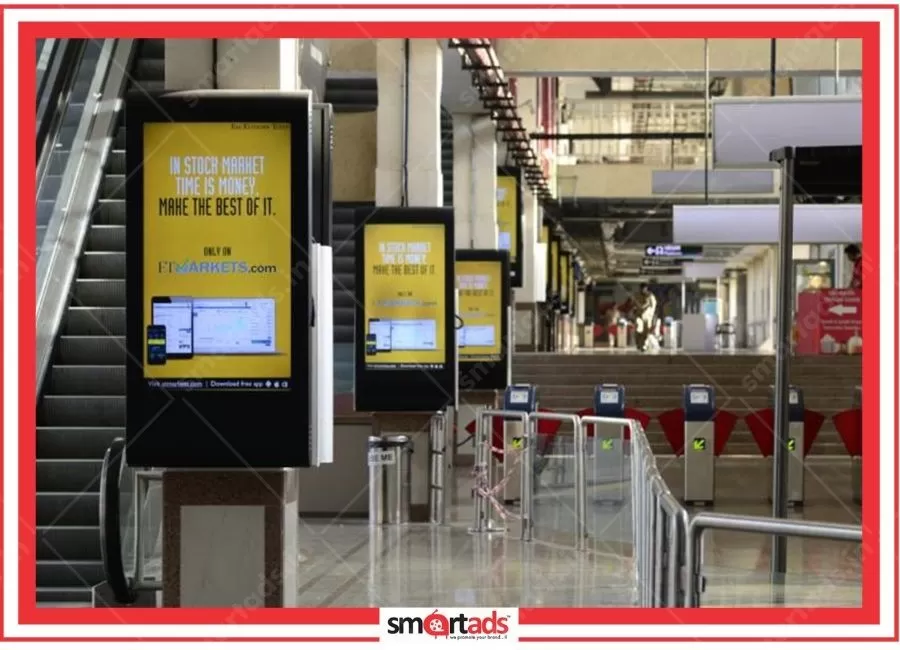
Entry Exit Panel
8 ft x 4 ft
Bright and vibrant multicolored letterin
Rate per Panel / 1 Month
Min Requirement is 3 Panel
₹48000.00
Showing 1 to 4 of 4 Results
MEDIA DETAILS
8 ft x 4 ft
Bright and vibrant multicolored letterin
Rate per Panel / 1 Month
Min Requirement is 3 Panel
₹48000.00
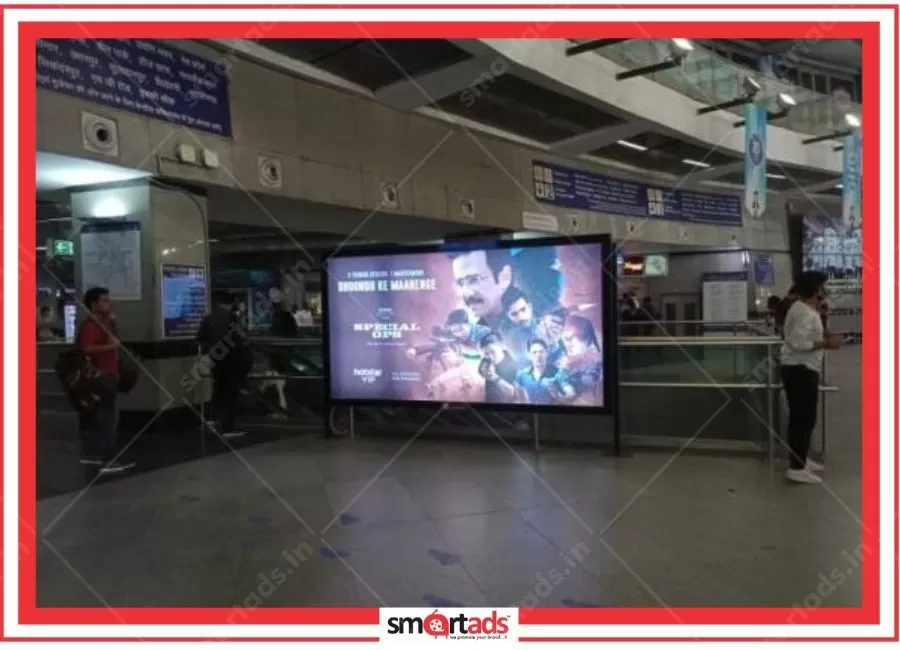
10 ft X 5 ft
A new wide wall system designed to acco
Rate per Panel / 1 Month
Min Requirement is 3 Panel
₹50000.00
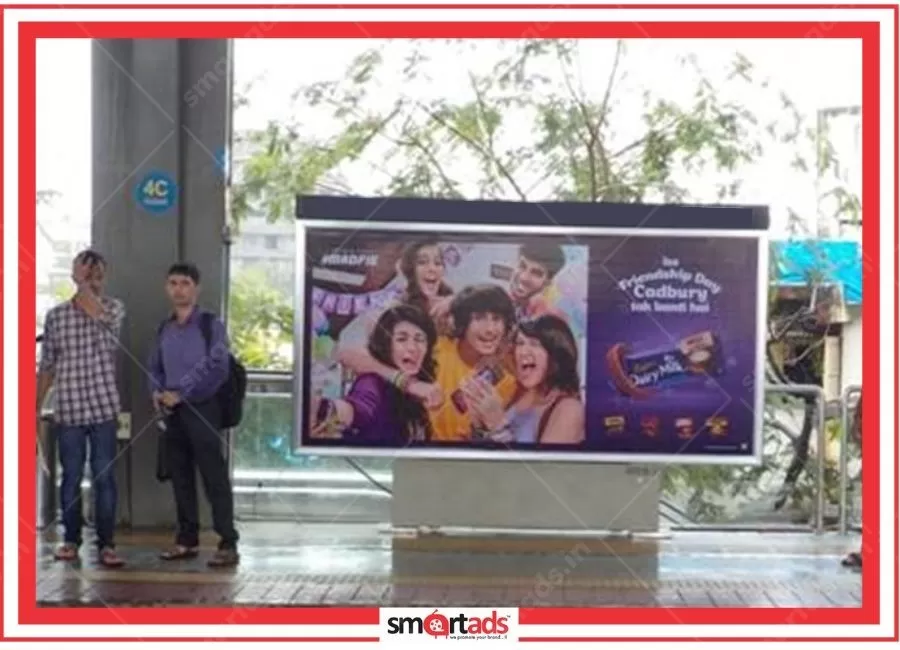
8 ft x 4 ft
A raised flooring or other horizontal su
Rate per Panel / 1 Month
Min Requirement is 3 Panel
₹35000.00
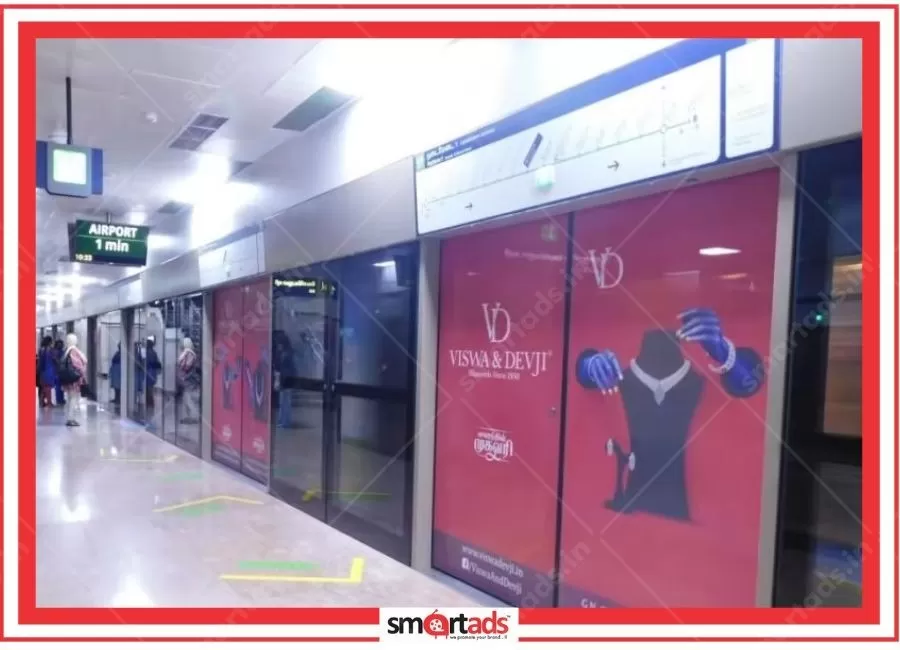
7 ft x 4 ft
Also known as platform edge doors (PEDs)
Rate per Panel / 1 Month
Min Requirement is 1 Station
₹1200000.00
MEDIA REACH

MinimumQty :
10
EstimateReachPeople :
15 Million
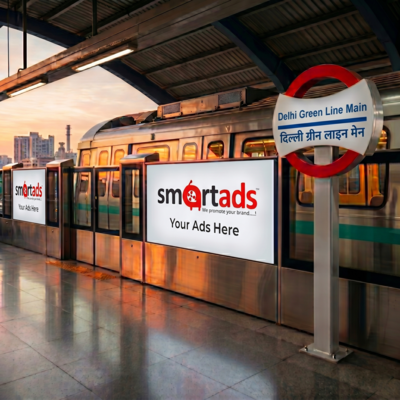
Most brands that approach us about Delhi Metro Green Line advertising are thinking about it the wrong way — they see it as a single corridor when it is, in fact, two distinct routes with very different audience profiles, footfall patterns, and advertising economics. The Green Line Main, running from Inderlok all the way to Brigadier Hoshiyar Singh in Haryana, carries a commuter mix that no other Delhi Metro line replicates: industrial workers, cross-border NCR professionals, West Delhi residents, and a growing base of urban students — all compressed into a captive, dwell-rich environment that most outdoor formats simply cannot match.
There is a particular kind of attention you get inside a metro station that no highway billboard or newspaper insert can replicate, and the Delhi Metro Green Line Main delivers that attention at scale. The line — officially DMRC Line 5 — stretches across some of Delhi's most densely populated and commercially active corridors, passing through North Delhi, North West Delhi, and crossing into Bahadurgarh, Haryana, which means the daily ridership is not merely local but genuinely cross-border in character. DMRC's own operational data has consistently shown that the Green Line carries well over three lakh passenger trips on a typical weekday, a number which climbs noticeably during examination seasons and festive months.
What makes this corridor particularly valuable for BTL advertising is the combination of dwell time and route dependency. Unlike a commuter who might glance at a billboard for three seconds while driving at 60 kmph on NH-9, a metro passenger at Nangloi metro station or Peeragarhi is standing on a platform for anywhere between four and twelve minutes, depending on headway; they are not distracted by traffic, not looking at their phone exclusively, and are genuinely exposed to the brand environment around them. We have found, across dozens of campaigns planned on this corridor, that brand recall scores from Green Line station branding consistently outperform equivalent spends on static outdoor formats in the same catchment area — sometimes by a factor of two to three times.
The elevated nature of much of the Green Line Main is also an underappreciated asset. Because large sections of the route run above ground — particularly from Punjabi Bagh West onwards toward Mundka and Bahadurgarh — the stations themselves become visible landmarks in the urban fabric, which means that even non-commuters walking or driving below develop passive familiarity with brands displayed on station exteriors. At SmartAds, we always tell our clients that this "ambient halo" effect is essentially free frequency — reach that extends beyond the ticketed passenger base and into the broader neighbourhood catchment.
The inventory at a typical Green Line metro station is considerably richer than most brand managers expect when they first sit down with us for a briefing. Platform branding — the large backlit panels lining the platform walls — is the most immediately visible format, and it commands attention precisely because passengers face the panels while waiting for trains; these are not peripheral glances but direct, sustained eye contact with the creative. Platform screen door branding, where it is available, adds another layer of visual dominance, because the PSDs are literally the last thing a commuter sees before the train doors open.
Pillar advertising is one of the most cost-efficient formats on the Green Line and, frankly, one of the most underutilised. The structural pillars in concourse areas and on platforms offer 360-degree brand wraps which are impossible to avoid — a commuter walking toward the platform passes through a corridor of brand messaging rather than past a single panel. Digital screen advertising, or DOOH metro Delhi placements, is increasingly available at higher-footfall stations like Inderlok metro station and Punjabi Bagh West, where the screens cycle through multiple advertisers but deliver the kind of motion and colour contrast that static formats cannot. We have seen DOOH placements on the Green Line generate significantly higher engagement rates for FMCG and consumer electronics brands compared to static poster advertising at the same stations.
Train interior branding and train wrap advertising represent the most immersive formats available on the DMRC Green Line. A full train wrap — where the exterior of one or more coaches is covered with brand creative — effectively turns the train into a moving billboard that travels the entire length of the Green Line Main multiple times a day, generating impressions not just from passengers inside but from commuters on platforms and bystanders at level crossings. Train interior branding, which covers overhead panels, door stickers, and grab-handle danglers inside coaches, creates a captive audience environment that is arguably unmatched by any other non-traditional advertising format in Delhi NCR. Beyond these, smart card branding and AFC gate co-branding are niche but effective formats for brands targeting the transaction moment — financial services companies, payment apps, and retail chains have used these touchpoints to very good effect.
Frankly speaking, this is the question we get most often, and it is also the question that most agency websites answer least honestly — either by refusing to publish any rates at all or by listing figures so outdated they are essentially fictional. The reality is that metro advertising rates on the Green Line Main operate across a fairly wide band depending on station tier, format type, and campaign duration, and understanding that band is essential for intelligent media planning.
For a standard backlit platform panel at a mid-tier Green Line station like Nangloi metro station or Peeragarhi, the advertising cost per month works out to somewhere in the ballpark of ₹25,000 to ₹45,000 per panel — a figure which surprises most first-time advertisers when they compare it to what they are paying for equivalent-sized hoardings on NH-9, which often run higher while delivering far less dwell time. At premium interchange stations like Inderlok metro station — which connects to the Red Line and sees significantly higher footfall — the same format can command anywhere between ₹60,000 and ₹1.2 lakh per panel per month, which reflects the audience multiplier that interchange station advertising delivers. Digital screen advertising slots at high-traffic stations are typically sold on a per-spot basis, with monthly packages for a 10-second spot cycling through a 60-second loop working out to roughly ₹40,000 to ₹80,000 depending on the station and the number of daily loops contracted.
Train wrap advertising is where the numbers get more interesting — and more justifiable when you do the per-impression math. A full exterior train wrap on a Green Line rake, which travels the entire Inderlok to Brigadier Hoshiyar Singh route multiple times daily, can be priced anywhere between ₹8 lakh and ₹15 lakh per month for a dedicated rake, which sounds significant until you calculate the daily impression count across platform audiences, street-level bystanders, and interior passengers. The CPM for train wrap advertising on the Green Line works out to roughly ₹6 to ₹10, which is a number that puts most digital advertising platforms to shame when you factor in the quality of attention being delivered. Station domination packages — where a brand takes over all available inventory at a single station — are priced on a case-by-case basis but typically start at around ₹2 to ₹4 lakh per month for a non-interchange station, and can go considerably higher at Punjabi Bagh West or Inderlok.
No competitor page we have seen actually breaks this down station by station for the Green Line Main specifically, which is a gap that costs advertisers real money when they book inventory without understanding the footfall hierarchy. The answer is not simply "whichever station is closest to a market" — it is a function of interchange connectivity, residential density in the catchment, and whether the station serves as a boarding point or a transfer point for onward journeys.
Inderlok metro station sits at the top of the footfall hierarchy on the Green Line Main, and the reason is structural: it is an interchange station connecting Line 5 with the Red Line, which means every commuter transferring between the two lines passes through Inderlok's concourse — creating a captive audience that is not just Green Line passengers but a cross-section of Delhi Metro's broader ridership. Ashok Park Main metro station, also an interchange with the Red Line, carries similar logic and is particularly strong for brands targeting North Delhi's residential and commercial catchment. Punjabi Bagh West metro station, the Pink Line interchange, is the most strategically placed station on the Green Line for brands wanting to reach the affluent West Delhi consumer — the Pink Line connection means this station sees a genuinely diverse audience mix which makes it ideal for lifestyle, retail, and financial services campaigns.
Further along the corridor, Nangloi metro station and Mundka metro station serve as the primary boarding points for the dense residential and industrial populations of West Delhi's outer belt; daily ridership at these stations is driven heavily by the working-class and lower-middle-income commuter segment, which makes them particularly effective for FMCG, telecom, and affordable housing advertisers. Mundka Industrial Area metro station is, in our experience, one of the most underutilised stations on the entire Green Line for B2B advertising — it sits adjacent to one of Delhi's largest industrial clusters, which means the audience passing through it on any given weekday includes procurement managers, logistics staff, and factory supervisors who are genuinely hard to reach through conventional media. On the Haryana side, Bahadurgarh City metro station and Brigadier Hoshiyar Singh metro station serve a cross-border commuter base that is growing year on year as Bahadurgarh develops as a satellite residential and industrial hub — brands in real estate, banking, and consumer durables have found these stations to be remarkably cost-effective relative to the audience quality they deliver.
The audience profile along the Green Line Main is one of the most genuinely heterogeneous on any Delhi Metro line, which is both its challenge and its opportunity for media planners. From Inderlok through to Punjabi Bagh West, the commuter base skews toward urban professionals, government employees, and students — a segment that is digitally active, brand-conscious, and responsive to aspirational messaging. This stretch of the corridor overlaps with some of North and North West Delhi's most established residential neighbourhoods, where household incomes and consumer spending are meaningfully above the city average.
From Punjabi Bagh West through to Mundka metro station, the audience composition shifts noticeably toward the working-class audience that forms the economic backbone of West Delhi's industrial and trading ecosystem. These are commuters who make real purchasing decisions in categories like mobile phones, two-wheelers, packaged foods, and financial products — and they are a segment that is chronically underserved by premium advertising formats which tend to concentrate in South Delhi and Central Delhi corridors. We worked with a regional FMCG brand a couple of years ago that had been concentrating its metro advertising spend entirely on the Blue Line; when we shifted a portion of that budget to Green Line station branding between Nangloi and Mundka, the brand's unaided recall in West Delhi improved by nearly 40% over a three-month campaign duration, which was a result that frankly surprised even us.
The Haryana commuters boarding at Bahadurgarh City and Brigadier Hoshiyar Singh represent a third, distinct audience layer — these are residents of Haryana's Jhajjar district who commute daily into Delhi for work, and who have historically been difficult to reach through Delhi-centric media planning. For real estate developers, educational institutions, and banks with branch presence in Bahadurgarh, advertising at these stations offers a hyperlocal precision that no other format in the area can match. The student audience is also a meaningful segment along the Green Line Main, particularly at stations near colleges and coaching institutes in the Punjabi Bagh and Peeragarhi catchments, which makes the line attractive for ed-tech brands, entrance exam coaching centres, and consumer electronics companies targeting the 18-25 demographic.
The booking process for DMRC Green Line advertising is more structured than most clients expect, and understanding it upfront saves a significant amount of time and avoids the frustration of creative rejections or delayed campaign launches. DMRC does not sell advertising inventory directly to brands; all bookings are routed through authorized advertising agencies that hold concession agreements with DMRC for specific stations or formats. This is where working with an experienced Green Line metro advertising agency becomes genuinely important rather than merely convenient.
The process begins with an inventory availability check — not all formats are available at all stations at any given time, and popular stations like Inderlok and Punjabi Bagh West can have platform panels booked months in advance, particularly around festive seasons. Once availability is confirmed, the campaign booking involves submitting a formal proposal specifying the stations, formats, campaign duration, and creative dimensions; this is followed by a rate negotiation and a purchase order, after which the DMRC approval process for creative content begins. The DMRC approval process requires that all artwork be submitted in the specified technical format — typically high-resolution print-ready files for static formats and specific video specifications for digital screen advertising — and that the creative content complies with DMRC's content guidelines, which prohibit political content, tobacco and alcohol advertising, and anything that could be deemed offensive or misleading.
At SmartAds, we manage the entire booking and DMRC approval workflow on behalf of our clients, which means the brand team only needs to supply the final creative assets; we handle the paperwork, the CISF clearances for installation access, and the vendor coordination for printing and mounting. One thing we consistently advise clients is to build at least three to four weeks of lead time into their campaign planning for the approval and installation cycle — brands that come to us two weeks before a product launch expecting metro station advertising to be live on day one are invariably disappointed, and the disappointment is entirely avoidable with better planning.
Return on investment from metro station advertising is a question that deserves a more honest answer than most agencies give, because the ROI is real but it is not always immediate or directly attributable — and pretending otherwise does clients a disservice. What metro advertising on the Green Line delivers exceptionally well is brand recall, top-of-mind awareness, and frequency of exposure among a defined geographic and demographic segment; it is not a direct-response medium in the way that performance digital advertising is, and campaigns that are planned with that understanding consistently outperform those that are not.
The brand recall data from metro advertising is, frankly, some of the strongest we have seen across any OOH format. Research consistently cited in the FICCI-EY Media & Entertainment Report and corroborated by our own post-campaign surveys shows that metro station advertising delivers unaided brand recall rates in the range of 35-55% among regular commuters on a given line — a figure which is significantly higher than the 15-25% typically reported for roadside hoardings in the same city. The captive audience dynamic is the key driver: a commuter who passes a platform panel at Peeragarhi every weekday morning for four weeks has been exposed to that brand creative somewhere between 40 and 80 times, which is a frequency level that builds genuine mental availability. We ran a campaign for an ed-tech client on the Green Line Main last year — covering Inderlok, Ashok Park Main, and Punjabi Bagh West — and the post-campaign brand tracking showed a 28% increase in unaided awareness among the 18-30 demographic in the catchment, with a 19% uplift in website traffic from North and North West Delhi during the campaign period.
The ROI calculation for metro station advertising also needs to account for the format's relative immunity to the problems that plague digital advertising — there is no ad fraud, no viewability question, no ad blocker, and no algorithm deciding whether your creative gets shown. Every impression is a genuine human impression, delivered in a physical environment where the brand message cannot be skipped or scrolled past. When we present this argument to clients who are debating whether to allocate budget to Delhi Metro Green Line advertising versus incremental digital spend, the honest answer is that the two formats are complementary rather than competitive — metro advertising builds the brand salience that makes digital retargeting more effective, and the combination consistently outperforms either channel in isolation.
Out-of-home advertising in Delhi is a genuinely competitive landscape, and the Green Line does not win every comparison — but it wins the ones that matter most for brand-building campaigns with a defined geographic focus. The most natural comparison is with roadside hoardings on NH-9, which runs parallel to much of the Green Line Main corridor; a large-format hoarding on NH-9 near Mundka or Bahadurgarh can cost somewhere between ₹1.5 lakh and ₹3 lakh per month, which sounds comparable to a station domination package on the Green Line until you account for the fact that vehicular traffic on NH-9 delivers fleeting, low-dwell impressions while the metro station delivers sustained, high-attention exposure to a captive audience.
The comparison with digital OOH advertising — programmatic screens, mall media, and transit display networks — is more nuanced. DOOH metro Delhi placements, particularly at high-footfall interchange stations, offer the targeting flexibility and creative dynamism of digital formats combined with the physical presence of OOH, which makes them a genuinely compelling hybrid; the limitation is that inventory at premium Green Line stations is limited and frequently sold out, particularly for Q3 and Q4 campaigns. Compared to cinema advertising in the same catchment, metro station advertising offers far greater frequency — a cinema ad is seen once per visit, while a metro commuter encounters platform branding twice daily, five days a week — which makes metro the stronger choice for awareness-building campaigns and cinema the stronger choice for high-impact, emotional storytelling at the point of maximum audience receptivity.
What a lot of people miss is that the Green Line's elevated structure gives it an outdoor advertising advantage that underground lines simply do not have. Station exteriors, elevated station facades, and the visual presence of the elevated guideway itself create advertising real estate that blends OOH and transit media in a way that is genuinely unique to this corridor — and which competitors running campaigns on the underground Blue Line or Yellow Line sections cannot access. For brands in categories like real estate, automotive, and consumer durables, where visual scale and neighbourhood presence matter, this is a meaningful differentiator.
The honest answer is yes — with the right format selection and a realistic expectation of what a limited budget can achieve. The perception that metro station advertising is exclusively the domain of large national brands is one we actively work to correct, because the Green Line in particular has a format and price point that works for businesses operating at almost every budget level. A single pillar wrap at a mid-tier station like Nangloi metro station, booked for a minimum campaign duration of four weeks, can be executed for a total outlay that is well within the reach of a regional retailer, a local coaching institute, or a startup with a North Delhi or North West Delhi customer base.
The key for smaller advertisers is format focus rather than geographic spread. Rather than trying to book panels at five stations with a limited budget — which results in low-frequency exposure at each location — we typically recommend concentrating the entire budget on one or two stations that are most relevant to the brand's catchment, and owning those stations as completely as the budget allows. A local real estate developer in Bahadurgarh, for instance, gets far more value from a concentrated station domination at Bahadurgarh City metro station than from a scattered presence across six stations; the frequency of exposure to the specific audience most likely to buy their product is simply much higher. One retail client in Rohini came to us with a budget of roughly ₹3 lakh for a two-month campaign; we concentrated the spend on concourse advertising and pillar advertising at Inderlok and Ashok Park Main, and the footfall to their store from the Green Line catchment increased by a measurable margin that the client attributed directly to the campaign.
To be fair, there are format minimums and booking constraints that do make some Green Line inventory inaccessible to very small budgets — train wrap advertising and full station domination packages are realistically only viable for brands with monthly media budgets of ₹5 lakh and above. But the pillar, poster, and concourse format tiers are genuinely accessible, and the minimum campaign duration requirement of typically four weeks is short enough that even a seasonal or launch-phase advertiser can run a meaningful campaign without committing to a long-term contract.
DMRC's content and technical approval process is more rigorous than most advertisers expect, and we have seen campaigns delayed by two to three weeks simply because the creative team was not briefed on the specifications upfront. The Central Industrial Security Force, which manages security across all DMRC stations including the Green Line Main, is involved in the physical installation process, which means access for installation crews needs to be coordinated and cleared in advance — a step that adds time to the campaign launch timeline and which cannot be rushed.
On the content side, DMRC's guidelines prohibit advertising for tobacco, alcohol, political parties, and content that could be construed as discriminatory or offensive to any community; these restrictions are standard and rarely cause problems for mainstream advertisers. What does cause problems more frequently is technical non-compliance — incorrect file formats, resolution below the minimum specification for large-format printing, or video files that do not meet the bitrate and aspect ratio requirements for digital screen advertising. DMRC requires that all creative content be submitted for approval before any production or printing is commissioned, which means the approval cycle needs to be factored into the campaign timeline before the brand commits to a launch date. The approval process typically takes somewhere between seven and fifteen working days for standard formats, and slightly longer for digital content or any format that involves structural installation.
The thing is, working with an authorized advertising agency that has an established relationship with DMRC's advertising concession holders significantly smooths this process. At SmartAds, we have developed a pre-submission creative review process where we check all artwork against DMRC's technical and content specifications before formal submission, which has virtually eliminated rejection-related delays for our clients. We also manage the CISF installation coordination, which is a logistical detail that seems minor until you have had a campaign delayed because the installation crew did not have the right clearance documentation.
Hyperlocal advertising is a concept that most people associate exclusively with digital platforms — geofenced mobile ads, neighbourhood-targeted social media campaigns, and the like — but the Green Line Main is, in our view, one of the most effective hyperlocal advertising vehicles available in Delhi NCR for brands with a defined geographic target. The reason is simple: metro commuters on the Green Line are, almost by definition, residents or workers in the Green Line catchment; they are not a random cross-section of Delhi's population but a geographically concentrated audience with a high degree of neighbourhood specificity.
This geographic precision has real implications for campaign planning. A brand targeting the Punjabi Bagh consumer does not need to advertise across the entire Green Line — concentrating creative at Punjabi Bagh West metro station and the adjacent stations delivers the relevant audience with far less wastage than a city-wide OOH campaign. Similarly, a Haryana-based brand targeting commuters from Bahadurgarh can achieve genuine geo-targeting by concentrating spend at Bahadurgarh City and Brigadier Hoshiyar Singh stations, reaching an audience that is both geographically defined and psychographically coherent in a way that no digital platform's location targeting can fully replicate. The combination of physical presence in the neighbourhood and repeated exposure to a consistent creative message creates a brand association with place that is particularly powerful for categories like real estate, retail, and local services.
The Green Line Phase IV extension — the approved expansion connecting Inderlok toward Indraprastha — is a forward-looking opportunity that we are already discussing with clients who have a Central Delhi or East Delhi growth agenda. Once operational, this extension will dramatically expand the Green Line's catchment and create new advertising inventory at stations that will serve some of Delhi's most commercially active corridors; brands that establish early presence on the Green Line now are positioning themselves to extend that presence into the new stations as they open, which is a media planning strategy that rewards foresight. The Haryana Orbital Rail Corridor, which is planned to connect with the Green Line at Bahadurgarh, adds another layer of future audience growth that makes the corridor's long-term advertising value genuinely compelling.
Q: What is metro station advertising on the Delhi Green Line Main?
Metro station advertising on the Delhi Green Line Main refers to paid brand placements across the physical and digital advertising inventory available at stations along DMRC Line 5 — the corridor running from Inderlok in North Delhi to Brigadier Hoshiyar Singh in Bahadurgarh, Haryana. This includes formats ranging from static platform panels and pillar wraps to digital screens, train interior branding, and full train wrap advertising; it is classified as BTL or non-traditional advertising because it operates within a controlled transit environment rather than on public roads or in mass media. The Green Line Main is distinct from the Green Line Branch, which diverges toward Kirti Nagar metro station, and the two routes serve meaningfully different audience profiles — a distinction that matters significantly for campaign planning.
Q: How much does it cost to advertise at a Delhi Metro Green Line station?
Metro advertising rates on the Green Line vary by format, station tier, and campaign duration. As a rough benchmark, a standard backlit platform panel at a mid-tier station works out to somewhere between ₹25,000 and ₹45,000 per month, while the same format at a premium interchange station like Inderlok or Punjabi Bagh West can range from ₹60,000 to ₹1.2 lakh per month. Pillar advertising is generally more affordable, while train wrap advertising — the most impactful format — is priced in the range of ₹8 lakh to ₹15 lakh per month for a dedicated rake. Digital screen advertising slots are typically sold on monthly package terms, with costs working out to roughly ₹40,000 to ₹80,000 depending on the station and loop frequency. These figures are indicative; actual rates depend on availability, campaign duration, and the specific concession holder managing the inventory.
Q: Which stations on the Green Line Main have the highest footfall for advertising?
Inderlok metro station consistently records the highest footfall on the Green Line Main by virtue of its Red Line interchange status, followed closely by Ashok Park Main (also a Red Line interchange) and Punjabi Bagh West (Pink Line interchange). Among non-interchange stations, Nangloi metro station and Mundka metro station see the highest boarding and alighting volumes, driven by the dense residential and industrial populations in their catchments. For brands targeting cross-border NCR commuters, Bahadurgarh City metro station is the most strategically significant station on the Haryana section of the line.
Q: What ad formats are available for Green Line metro station advertising?
The available formats span a wide range: platform branding (backlit panels facing the platform), pillar advertising (360-degree wraps on structural pillars in concourse and platform areas), concourse advertising (panels and posters in the ticketing and entry areas), digital screen advertising (DOOH placements at select stations), train interior branding (overhead panels, door stickers, grab-handle danglers inside coaches), train wrap advertising (exterior coach branding), smart card branding, AFC gate co-branding, and station domination packages that combine multiple formats at a single station. Audio jingle metro advertising — station announcement sponsorships — is also available at select stations, though inventory is limited and books out quickly.
Q: How do I book metro station advertising on the Delhi Green Line through a DMRC-approved agency?
Booking is done exclusively through authorized advertising agencies that hold concession agreements with DMRC — brands cannot book directly with DMRC. The process involves confirming inventory availability, submitting a campaign brief specifying stations, formats, and campaign duration, receiving a rate proposal, issuing a purchase order, and then entering the DMRC creative approval process. The entire cycle from brief to campaign live typically takes four to six weeks, which means lead time planning is essential. Working with an experienced Green Line metro advertising agency that has an established DMRC relationship significantly accelerates the process and reduces the risk of creative rejection or installation delays.
Q: What is the minimum campaign duration for Green Line metro station advertising?
The standard minimum campaign duration for most Green Line station formats is four weeks, which aligns with DMRC's booking cycle. Some premium formats — particularly train wrap advertising and station domination packages — may have minimum commitments of eight to twelve weeks, reflecting the production investment involved. Digital screen advertising can sometimes be booked for shorter durations, though the per-week rate is higher for shorter campaigns. We generally advise clients to plan for a minimum of eight weeks to allow sufficient frequency buildup for meaningful brand recall impact.
Q: Who is the target audience for brands advertising on the Delhi Metro Green Line Main?
The audience is genuinely heterogeneous across the corridor. From Inderlok to Punjabi Bagh West, the commuter base skews toward urban professionals, government employees, and students in the 22-45 age bracket. From Punjabi Bagh West to Mundka, the audience shifts toward the working-class and lower-middle-income segment employed in West Delhi's industrial and trading economy. From Mundka to Brigadier Hoshiyar Singh, the audience is predominantly Haryana commuters — residents of Bahadurgarh and surrounding areas who work in Delhi and represent a growing, aspirational consumer segment. The line as a whole delivers a daily ridership that spans income groups, age brackets, and professional categories, making it versatile for a wide range of advertising categories.
Q: How does Green Line metro advertising compare to billboard or digital OOH advertising in Delhi?
Metro station advertising on the Green Line delivers significantly higher dwell time and brand recall compared to roadside hoardings in the same corridor — a commuter on a platform is exposed to brand creative for four to twelve minutes per journey, versus three to five seconds for a hoarding at highway speed. Compared to digital OOH, metro advertising offers guaranteed physical presence without the viewability questions that affect screen-based formats. The CPM for metro advertising, when calculated against verified passenger impressions, works out to roughly ₹6 to ₹10 for train wrap formats, which is competitive with mid-tier digital display advertising and dramatically better in terms of attention quality. The trade-off is that metro advertising lacks the real-time optimisation and targeting flexibility of digital platforms, which is why we recommend using the two formats together rather than treating them as alternatives.
Q: Can small businesses or startups afford to advertise at Delhi Metro Green Line stations?
Yes, with the right format selection. Pillar advertising and concourse poster formats at mid-tier stations like Nangloi or Peeragarhi are accessible at budget levels that regional retailers, local service businesses, and early-stage startups can realistically sustain. The key is concentrating the budget at one or two stations most relevant to the brand's catchment rather than spreading it thinly across multiple locations. A focused campaign at a single station with high local relevance will almost always outperform a dispersed campaign across many stations with a limited budget.
Q: What is the DMRC approval process for placing ads at Green Line metro stations?
All creative content must be submitted to DMRC through the authorized concession holder for review before production or installation begins. The approval process checks for content compliance (no tobacco, alcohol, political, or offensive content), technical specification compliance (resolution, file format, dimensions), and structural safety compliance for any installation that involves physical mounting. Approval typically takes seven to fifteen working days for standard formats. CISF clearance for installation crew access is a separate step that must be coordinated in parallel. Building a minimum of three to four weeks of pre-campaign lead time into the planning calendar is essential to avoid delays.
Q: Is pillar advertising or platform panel advertising more effective on the Green Line?
The honest answer is that it depends on the campaign objective. Platform panels deliver higher individual impact because passengers face them directly while waiting — the exposure is frontal, sustained, and unavoidable. Pillar advertising delivers higher frequency because commuters pass through pillar corridors multiple times per journey and encounter the brand creative from multiple angles; the 360-degree wrap format means there is no "back" of the creative that commuters can miss. For awareness campaigns where a single, high-impact visual message needs to land clearly, platform panels are the stronger choice; for frequency-driven campaigns where repeated exposure to a brand name or tagline is the objective, pillar advertising often delivers better value per rupee.
Q: How does the Green Line Main differ from the Green Line Branch for advertising purposes?
The Green Line Main runs from Inderlok to Brigadier Hoshiyar Singh and serves the North West Delhi and Bahadurgarh corridor — a predominantly residential and industrial catchment with a working-class and cross-border commuter audience. The Green Line Branch diverges from Inderlok toward Kirti Nagar and serves a more mixed commercial and residential catchment in West Delhi. The two routes have meaningfully different audience profiles, footfall levels, and advertising economics; the Main line carries significantly higher daily ridership and offers more extensive advertising inventory. Most brands advertising on the "Green Line" without specifying the route are unknowingly conflating the two, which can lead to significant mismatches between campaign targeting and actual audience delivery.
Q: What ROI can brands expect from a metro station advertising campaign on the Delhi Green Line?
ROI from Green Line metro advertising is best measured in terms of brand recall uplift, top-of-mind awareness improvement, and downstream metrics like website traffic and store footfall from the catchment — not in terms of direct sales attribution, which is difficult to isolate from a brand-building format. Post-campaign research on Green Line campaigns consistently shows unaided brand recall rates of 35-55% among regular commuters, which is significantly higher than comparable OOH formats. For brands that pair metro advertising with digital retargeting in the same catchment, the combined ROI is consistently stronger than either channel in isolation, because the metro campaign builds the brand salience that makes digital ads more effective.
Q: Are there special advertising opportunities at interchange stations like Inderlok or Punjabi Bagh West?
Interchange stations offer a category of advertising opportunity that non-interchange stations simply cannot match: the audience at Inderlok metro station, for instance, includes not just Green Line commuters
