


Delhi

Mumbai

Bengluru

Ahmedabad

Jaipur

Chennai

Hydrabad

Kolkatta

Lucknow

Pune
Outdoor Metro Signage Advertising: What It Actually Costs, Where It Works, and How to Get the Most Out of It
This article draws on SmartAds' direct booking experience across metro rail networks in over a dozen Indian cities, includes real cost benchmarks that most agency pages refuse to publish, and covers the strategic decisions that separate campaigns which deliver measurable brand lift from those that simply occupy space.
Why Metro Rail Has Become One of the Most Contested OOH Environments in India
The numbers stopped surprising us after a while, but they still impress clients when we share them for the first time. The Delhi Metro alone carries somewhere in the ballpark of 60 to 65 lakh passengers on a typical weekday — a figure which, when you sit with it for a moment, represents a captive audience that most television spots can only dream of reaching with comparable attention levels. Mumbai Metro, Bangalore Namma Metro, Hyderabad Metro, and the rapidly expanding networks in Pune, Chennai, and Kochi are collectively transforming the urban commuter into one of the most valuable advertising targets in the country.
What a lot of people miss is that metro advertising is not simply another outdoor format; it operates under a fundamentally different psychology than a highway billboard or a bus shelter panel. The commuter is stationary, often without a phone signal in underground sections, and exposed to the same creative for an average dwell time of somewhere between three and eight minutes depending on the station and the platform. That kind of sustained exposure is genuinely rare in modern media, which is why brands ranging from FMCG giants to ed-tech startups to luxury automobile companies have been fighting for prime metro inventory with increasing aggression over the past three to four years.
Our experience at SmartAds shows that metro signage tends to outperform comparable OOH formats on brand recall metrics by a meaningful margin — not because the creative is necessarily better, but because the environment forces a kind of passive attention that outdoor formats placed along moving traffic simply cannot replicate. The FICCI-EY Media and Entertainment Report has consistently flagged transit OOH as one of the fastest-growing sub-segments within the broader outdoor category, and the booking patterns we see from clients across sectors confirm that assessment entirely.
What Formats Are Available Inside and Around Metro Networks?
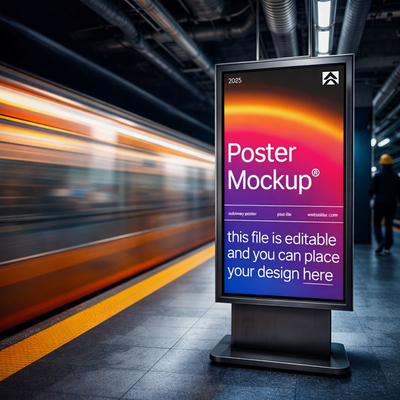
Metro signage is not a monolithic format, and this is where a lot of first-time metro advertisers get confused. The inventory available across Indian metro networks spans a surprisingly wide range — from backlit panels on station platforms and concourse walls to full train wraps, pillar branding, digital screens at entry and exit gates, ticket vending machine surrounds, and even floor graphics in high-footfall zones. Each of these formats serves a different strategic purpose, which means the format selection decision should precede the creative brief, not follow it.
Platform panels — the large backlit flex or vinyl units positioned along the waiting area — are the workhorses of metro advertising, and they are typically what clients mean when they ask about "metro signage." These panels are generally available in sizes ranging from roughly four feet by three feet at the smaller end to full-length platform domination units that can span fifteen to twenty feet; the pricing varies accordingly, and we will get into specific numbers shortly. Concourse branding, which covers the areas passengers pass through between the entry gates and the platforms, offers a different kind of exposure — shorter dwell time but higher frequency, since every passenger passes through the concourse on both the inward and outward journey.
Train wrap advertising, which involves covering the exterior of metro coaches with full-bleed vinyl graphics, is a format that tends to generate disproportionate earned media value — we have seen clients photograph and share train wraps organically on social media, which effectively extends the campaign reach beyond the metro commuter base entirely. Digital screens at station entry points and near ticketing areas represent the newest and fastest-growing segment of metro OOH inventory; these screens allow for dynamic content rotation, time-of-day targeting, and even live data integration, which makes them particularly attractive to brands in categories like finance, quick commerce, and food delivery where real-time messaging has genuine relevance.
How Much Does Outdoor Metro Signage Advertising Actually Cost?
Frankly speaking, this is the question that every client asks first, and it is also the question that most agency pages dodge by saying "contact us for a quote." We think that is unhelpful, so here is what the market actually looks like based on our current booking experience.
A single backlit platform panel at a mid-tier station in a city like Hyderabad or Kochi works out to roughly ₹15,000 to ₹25,000 per month, which is a number that surprises many clients who expect metro inventory to be dramatically more expensive than conventional OOH. At a high-footfall interchange station in Delhi Metro — think Rajiv Chowk, Kashmere Gate, or Hauz Khas — the same format can command somewhere between ₹60,000 and ₹1,20,000 per month for a single panel, depending on the exact location, panel size, and the concession operator's current demand. Mumbai Metro inventory, particularly on the Line 1 corridor and the newer Line 2 and Line 7 extensions, is priced in a similar premium range, with key stations touching ₹80,000 to ₹1,50,000 per panel per month.
Train wrap campaigns are a different investment category altogether; a full coach wrap across a set of six to eight coaches on a single trainset typically runs somewhere in the ballpark of ₹8 lakh to ₹15 lakh per month depending on the network, which sounds significant until you calculate the per-impression cost against the daily ridership numbers. The CPM on a well-placed metro platform panel in a high-ridership network works out to roughly ₹8 to ₹12, which is a figure that genuinely surprises most first-time metro advertisers when they compare it against what they are paying for Instagram reach or programmatic display. Digital screen networks within metro stations are generally sold on a per-loop or per-day basis, with a ten-second spot in a sixty-second loop at a premium station costing somewhere between ₹3,000 and ₹8,000 per day depending on the network and the number of screens included.
Which Indian Cities Offer the Best Metro Advertising ROI Right Now?
This is a question we get asked constantly, and the honest answer is that it depends on your brand's target audience more than it depends on any absolute ranking of metro networks. That said, our experience across campaigns in eight metro networks does allow us to offer some genuine market intelligence here.
Delhi Metro remains the undisputed volume leader, with a network spanning over 390 kilometres and ridership that, according to DMRC's own published data, regularly crosses 60 lakh trips on peak weekdays; the sheer scale means that a well-planned station domination campaign in Delhi can deliver reach numbers that rival mid-weight television buys in the market. The challenge with Delhi is that premium inventory — particularly at interchange stations and the Yellow Line corridor — gets booked out months in advance, especially in the October-to-March peak season, which means last-minute planning simply does not work here.
Bangalore's Namma Metro has been growing its ridership aggressively since the Purple Line extension and the Green Line expansion came online; we have seen the network's daily ridership climb from roughly 6 to 7 lakh trips a day in 2022 to figures consistently above 8 to 9 lakh trips on weekdays in more recent periods, which makes it increasingly attractive for brands targeting the city's technology and startup professional demographic. Hyderabad Metro, operated by L&T Metro Rail, offers some of the most visually impressive station environments in the country — the stations are large, well-lit, and architecturally designed in ways that make advertising creative look genuinely premium — and the CPM here is still meaningfully lower than Delhi or Mumbai, which makes it a strong value play for brands with national campaigns that need to cover Tier 1 cities efficiently.
Mumbai Metro is the market we watch most carefully right now, because the network is in the middle of a significant expansion phase; Lines 2A, 7, and the upcoming coastal road corridor are opening up entirely new commuter corridors, and early-mover inventory advantages are available for brands willing to commit to these newer lines before the ridership fully matures. One automotive brand we worked with chose to dominate three stations on a newly opened Mumbai Metro extension during its launch quarter, securing inventory at rates roughly 30 to 35 percent below what comparable established-corridor stations would have cost — and by the time ridership on that corridor had grown to its steady-state level, the brand had built significant awareness among exactly the upwardly mobile urban professional audience it was targeting.
What Is Station Domination and Is It Worth the Premium?
Station domination — the practice of booking all or nearly all of the advertising inventory at a single metro station — is one of those formats that sounds extravagant until you understand what it actually delivers. A full station domination at a premium Delhi Metro interchange station can cost somewhere between ₹8 lakh and ₹20 lakh for a four-week period, which is a number that makes some clients flinch; but when you calculate the share of voice, the creative consistency, and the brand environment control that comes with owning an entire station's visual landscape, the economics start to look quite different.
What we tell our clients at SmartAds is that station domination is not primarily a reach play — it is a brand experience play. A commuter who enters a station and finds every panel, pillar, and digital screen carrying the same brand message does not simply see an advertisement; they experience something closer to a brand environment, which creates a qualitatively different kind of impression than a single panel competing for attention alongside six other brands. We have seen this format work particularly well for product launches, brand repositioning campaigns, and premium brand entries into new markets, where the quality of the impression matters as much as the quantity.
A retail client in Pune used station domination at two high-footfall stations on the Pune Metro Purple Line during the festive season, combining the station takeover with a QR code mechanic that drove footfall to their nearby stores; the campaign generated a footfall uplift of roughly 22 percent during the campaign period compared to the equivalent weeks in the previous year, which was a figure that justified the premium spend several times over when calculated against the average transaction value of the customers who converted. The key, as we always emphasise, is that the station domination needs to be paired with a clear call to action and a measurable conversion mechanism — otherwise you are paying for brand experience without any way to demonstrate its commercial value.
How Does Metro Signage Fit Into a Broader OOH or Integrated Media Plan?
Metro signage rarely works best in isolation, and this is a point we make consistently to clients who come to us wanting to run a metro-only campaign. The format excels at delivering high-frequency, high-attention impressions to a specific urban commuter demographic; what it does not do particularly well is generate mass reach across an entire city's population, since metro ridership — even in Delhi — represents a specific slice of the urban audience rather than a cross-section of the entire market.
The most effective metro campaigns we have planned at SmartAds are those which use metro signage as the high-frequency, high-quality anchor of a broader OOH plan, supplemented by bus shelter advertising for broader residential neighbourhood coverage, digital OOH screens in commercial districts for the office-going audience, and highway billboards for the car-owning segment that the metro by definition does not reach. This kind of layered OOH approach — which the industry sometimes calls a "transit plus ambient" strategy — allows a brand to maintain consistent messaging across the urban journey while using each format's specific strengths to reach different segments of the target audience at different points in their day.
On top of that, metro signage integrates particularly well with digital media when the creative strategy is aligned from the outset. We have run campaigns where the metro panel creative was designed to be photographed and shared — featuring bold, visually striking imagery with a social media hashtag — and the earned social content generated by commuters sharing photos of the campaign extended the effective reach of the metro spend by a factor of two to three times the paid impressions. The TAM AdEx data consistently shows that OOH and digital together generate stronger brand recall than either medium alone, which aligns with what we observe in our own campaign post-analyses.
What Are the Booking Timelines and Production Requirements for Metro Advertising?
The thing is, metro advertising has some of the most specific and unforgiving production requirements of any OOH format, and brands that come to this medium from a purely digital background are often caught off guard by the lead times involved. Unlike a social media ad that can be live within hours of approval, a metro panel campaign requires material production, quality approval from the metro concessionaire, and physical installation — a process which, from final creative sign-off to live panels, typically takes somewhere between ten and twenty-one days depending on the network and the format.
Space booking lead times are a separate consideration from production; premium inventory at high-footfall stations in Delhi and Mumbai is routinely booked four to six weeks in advance during peak seasons, and for major events like the IPL period, Diwali, or budget season — when financial services brands flood metro inventory — the lead time can stretch to eight to ten weeks for the best locations. We always advise clients who have a specific campaign window in mind to begin the booking conversation at least six to eight weeks before their intended go-live date, which gives us enough time to secure the right inventory rather than settling for whatever happens to be available at short notice.
Production specifications vary by network and by format, but most metro concessionaires require backlit panels to be produced on high-quality flex or vinyl with specific brightness ratings and UV-resistant inks; digital screen content needs to meet resolution standards that are typically higher than standard digital display specifications, and some networks require content to be pre-approved for appropriateness before it can go live. At SmartAds, we manage the end-to-end production coordination for clients across all the metro networks we work with, which means we know the specific quirks of each network's approval process — including which networks have a tendency to request last-minute revisions and how much buffer time to build in as a result.
How Do You Measure the Effectiveness of Metro Signage Campaigns?
Measurement is, to be honest, the area where metro OOH has historically lagged behind digital media, and it is a genuine limitation that any honest media planner should acknowledge upfront. Unlike a digital campaign where impressions, clicks, and conversions are tracked in real time, metro signage effectiveness has traditionally been measured through footfall estimates, brand recall surveys, and proxy metrics like sales uplift or website traffic during the campaign period.
That said, the measurement landscape for metro OOH has been improving meaningfully. The Outdoor Advertising Confederation of India (OAAA India) and several metro concessionaires have been working towards standardised audience measurement frameworks; some networks now provide official daily ridership data broken down by station and time of day, which allows for more precise reach calculations than the broad estimates that used to be the only available data. Mobile location data — sourced through privacy-compliant panels of smartphone users — is increasingly being used to measure the overlap between metro station visitors and brand website visits or app downloads during campaign periods, which gives advertisers a more credible proxy for campaign-driven behaviour change.
One ed-tech brand we worked with ran a two-month metro signage campaign across four stations in Bangalore, targeting the student and young professional demographic that uses the Purple Line corridor; by tracking app download rates in the pin codes served by those stations against a control group of comparable pin codes without metro advertising, we were able to demonstrate a statistically significant uplift in app downloads that was attributable to the campaign with reasonable confidence. The uplift worked out to roughly 18 percent above the baseline download rate in the campaign stations' catchment areas, which gave the brand's marketing team a credible ROI narrative to present internally — and which led directly to a renewed and expanded metro campaign in the following quarter.
What Creative Approaches Work Best for Metro Signage?
Most brands get this wrong on their first metro campaign, and the mistake is almost always the same: they take creative that was designed for a thirty-second television spot or a full-page newspaper ad and try to adapt it to a metro panel without rethinking the fundamental communication logic. Metro signage demands a different creative philosophy — one which recognises that the viewer has three to eight seconds of active attention before their gaze moves on, even in a high-dwell-time environment.
The creative principles that consistently perform well in metro environments, based on our campaign experience, centre on visual simplicity, bold contrast, and a single clear message. A panel that tries to communicate three product benefits, a price point, a promotional mechanic, and a brand tagline is a panel that communicates nothing; the formats which generate the strongest recall scores in post-campaign research are invariably those which commit to one idea and execute it with visual confidence. This is particularly true for backlit panels, where the illumination amplifies both the best and worst qualities of the creative — a bold, well-designed image looks genuinely spectacular on a backlit metro panel, while a cluttered layout looks even more chaotic than it would in print.
For digital screens, the creative logic shifts somewhat; the ability to run multiple creatives in rotation allows for sequential storytelling across a commuter's journey, which is a technique we have used effectively for clients in categories like insurance and financial services where the message benefits from being built up across multiple exposures. A commuter who sees panel A at the entry gate, panel B on the platform, and panel C at the exit gate has effectively received a three-part narrative — which, when executed well, creates a brand experience that feels more like a conversation than an advertisement. At SmartAds, we brief creative teams specifically on the sequential logic of metro environments before any creative development begins, because the format rewards that kind of intentional planning in ways that most other OOH formats simply do not.
FAQ: Outdoor Metro Signage Advertising
Q: What is the minimum budget needed to run a meaningful metro signage campaign in India?
A meaningful metro signage campaign — one that delivers sufficient frequency and coverage to generate measurable brand awareness — can be executed in most Tier 2 metro networks for somewhere in the range of ₹3 lakh to ₹5 lakh for a four-week period, which covers a selection of four to six panels at well-chosen stations. In Delhi or Mumbai, where premium station inventory commands higher rates, a comparable campaign would typically require a budget in the ballpark of ₹8 lakh to ₹15 lakh for the same duration to achieve meaningful coverage. The important caveat is that a very small number of panels spread across a large network delivers neither reach nor frequency effectively; we always recommend concentrating a limited budget on fewer stations with higher footfall rather than spreading it thinly across many locations, because frequency is what drives brand recall in this medium.
Q: Can small and medium businesses advertise on metro networks, or is it only accessible to large brands?
Metro advertising is more accessible to smaller businesses than most people assume, particularly in the newer and smaller networks where inventory is less contested and rates are correspondingly lower. A local business in Hyderabad or Kochi can run a station-specific campaign targeting the stations closest to their physical location for budgets that are genuinely comparable to what they might spend on a local newspaper insertion or a radio spot campaign. The practical challenge for smaller businesses is navigating the booking process, which involves dealing with metro concessionaires who are accustomed to working with large agencies and may not have streamlined processes for smaller bookings; this is precisely where working with an agency like SmartAds, which has established relationships across multiple metro networks, makes the process significantly more straightforward.
Q: How far in advance should metro advertising space be booked for a festive season campaign?
For Diwali, which is the single most competitive period for metro OOH inventory across all networks, we recommend beginning the booking process no later than August — which means roughly two to three months before the campaign period. Premium locations at high-footfall stations in Delhi and Mumbai are often fully committed by September for the October-November festive window, and brands that wait until October to begin planning invariably find themselves choosing between suboptimal locations and paying significant premiums for whatever inventory remains available. For other peak periods like IPL season, the back-to-school window in June-July, and the Republic Day to Valentine's Day period in January-February, a six-week lead time is generally sufficient, though earlier is always better for securing first-choice locations.
Q: What is the difference between advertising through a metro concessionaire directly versus through a media agency?
Booking directly through a metro concessionaire — the company that holds the advertising rights for a particular network, such as Times OOH, Clear Channel, or the network's own in-house sales team — is technically possible for any advertiser, but it comes with some meaningful limitations. Concessionaires sell their own inventory exclusively, which means a direct booking gives you access to only one network's locations; an agency with relationships across multiple concessionaires can plan a campaign that spans multiple networks and multiple cities within a single booking process. Beyond the logistics, agencies with significant buying volume typically negotiate rates that are meaningfully below the rate card — our experience at SmartAds is that consolidated buying across multiple campaigns and clients allows us to secure discounts in the range of 15 to 30 percent below published rates at most networks, which is a saving that more than covers any agency fees for most campaign budgets.
Q: Are there any content restrictions or approval requirements for metro advertising?
Every metro network in India operates under content guidelines that are broadly aligned with the Advertising Standards Council of India (ASCI) code, but individual networks also have their own specific restrictions which can vary considerably. Most networks prohibit advertising for tobacco, liquor, and politically partisan content; some networks have additional restrictions on competitive advertising — for example, prohibiting advertising for private bus or taxi services on the grounds that it competes with the metro's own transport function. Political advertising is handled differently across networks, with some accepting it during election periods under specific conditions and others refusing it entirely. Beyond content, most networks require creative to be submitted for approval before production, which means finalising creative at least two to three weeks before the intended installation date; networks vary in how quickly they turn around approvals, and we have encountered situations where a creative revision requested by the network's approval team required a complete redesign, which is why building buffer time into the production schedule is non-negotiable.
Q: How does metro signage advertising compare to digital OOH screens in metro stations?
Static backlit panels and digital OOH screens within metro stations serve genuinely complementary purposes rather than competing with each other, and the choice between them should be driven by the campaign's communication objective rather than a simple cost comparison. Static panels offer the advantage of 100 percent share of voice at that location — there is no rotation, no competing creative, and no risk of your message being displaced by another brand's content; this makes them the stronger choice for campaigns where brand presence and environmental ownership are the primary objectives. Digital screens, which typically rotate between four and eight advertisers in a loop, offer lower per-advertiser costs and the flexibility to run different creative at different times of day — which is a meaningful advantage for brands with time-sensitive messages or those running promotions with specific validity windows. The CPM on digital screens tends to be somewhat lower than static panels when calculated against the full loop, but the effective share of attention is also proportionally lower; our recommendation is typically to use static panels for brand-building phases and digital screens for promotional or activation phases within the same campaign.
Closing: The Case for Making Metro Signage a Permanent Part of Your Urban Media Mix
There is a version of this conversation where metro advertising is positioned as a niche, premium-only format suitable only for large national brands with substantial OOH budgets — and that version is simply not accurate anymore. The expansion of metro networks across Indian cities, the continued growth in ridership, and the increasing sophistication of the inventory available across these networks have collectively made metro signage one of the most versatile and accessible formats in the urban OOH toolkit.
What we have found, across hundreds of campaigns planned and executed through SmartAds, is that the brands which consistently extract the most value from metro advertising are those which treat it as a strategic medium rather than a tactical add-on. They plan their metro creative specifically for the environment rather than repurposing assets from other channels; they book inventory with enough lead time to secure the locations that genuinely serve their audience rather than settling for whatever is available; and they integrate their metro spend with complementary formats and digital channels in ways that amplify the total campaign effect beyond what any single medium could achieve alone.
The Indian metro advertising market is, by most industry assessments including the FICCI-EY and Dentsu e4m reports, in a period of sustained growth that is unlikely to reverse given the infrastructure investment being made in urban transit across the country. New networks are opening, existing networks are expanding, and the commuter demographic that these networks serve — urban, educated, digitally active, and economically productive — is precisely the audience that most brand managers are trying to reach with increasing efficiency. Getting into this medium with a well-planned strategy now, while inventory in newer corridors is still competitively priced, is a decision that tends to look very smart in retrospect.
If you are considering metro signage as part of your next campaign — whether for a single city launch, a national brand-building initiative, or a festive season activation — the SmartAds media planning team works across all major metro networks in India and can provide customised rate benchmarks, audience data, and integrated media recommendations specific to your brand's objectives. Reach out to us at [SmartAds.in](https://smartads.in/services/outdoor/outdoor-metro-signage-advertising) to start the conversation; the planning process is simpler than most brands expect, and the results, when the medium is used well, tend to speak for themselves.
