
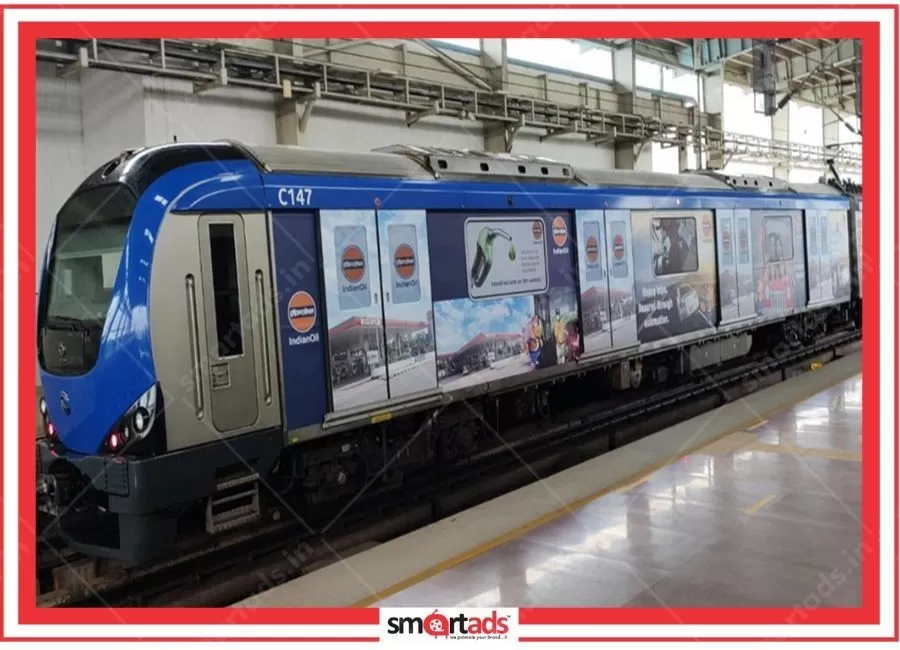
Exterior Metro Wrap
Size & Printing Cost as per actual
On the outside of metro Train, advertise
Rate per Metro Display Cost / 1 Month
Route :Dakshineshwar To Kavi Subhash
₹410000.00
Showing 1 to 3 of 3 Results
MEDIA DETAILS
Size & Printing Cost as per actual
On the outside of metro Train, advertise
Rate per Metro Display Cost / 1 Month
Route :Dakshineshwar To Kavi Subhash
₹410000.00
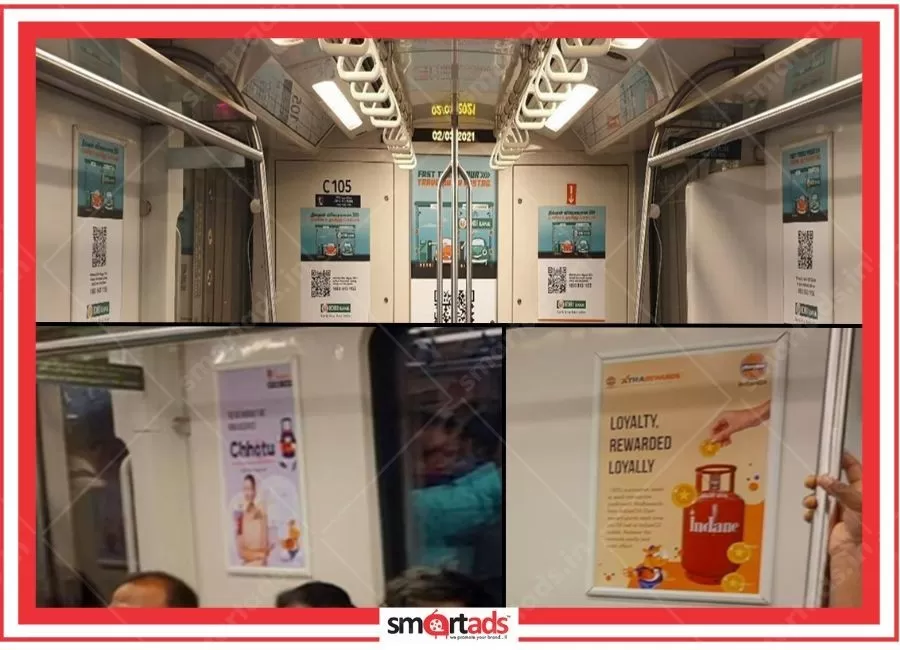
Size & Printing Cost as per actual
On the outside of metro Train, advertise
Rate per Metro Display Cost / 1 Month
Route:Dakshineshwar To Kavi Subhash
₹330000.00
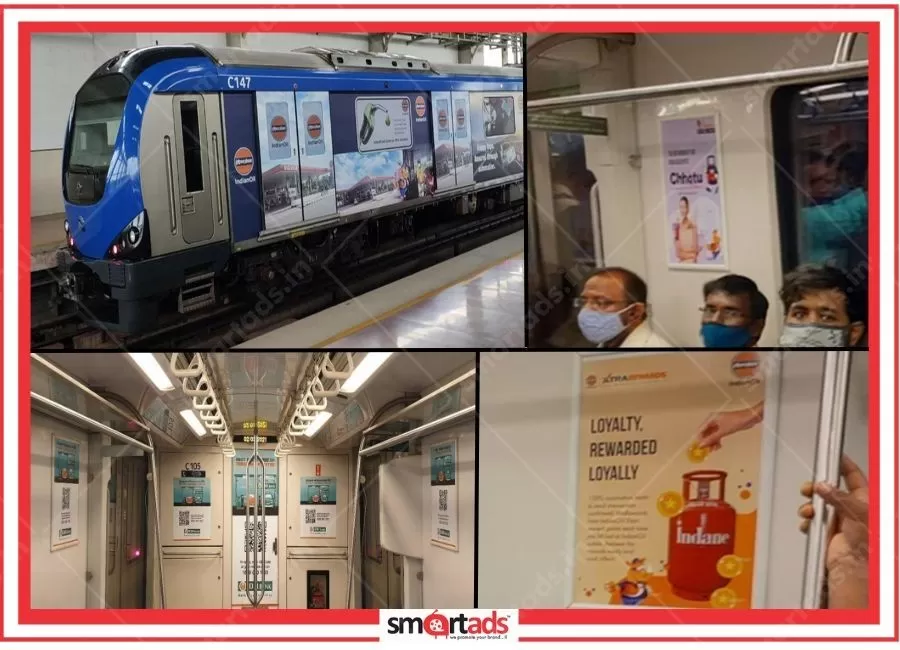
Size & Printing Cost as per actual
On the outside of metro Train, advertise
Rate per Metro Display Cost / 1 Month
Route:Dakshineshwar To Kavi Subhash
₹730000.00
MEDIA REACH

MinimumQty :
1
EstimateReachPeople :
150000000
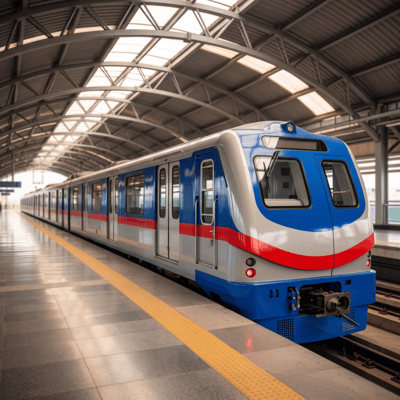
Somewhere between Dakshineswar and Kavi Subhash, roughly 600,000 to 650,000 people make a daily decision that most advertisers completely underestimate — they step into a closed, air-conditioned environment with nowhere to look except at the walls around them. The Kolkata Blue Line, which stretches across 32.13 km of the city's most commercially dense spine, delivers something that outdoor hoardings and digital feeds almost never can: a captive audience with genuine dwell time, repeated exposure across a single journey, and zero option to scroll past your message.
We have worked on metro train advertising in Kolkata across multiple campaigns over the years, and what consistently surprises brand managers is how efficiently the Blue Line converts impressions into top-of-mind recall — often at a cost-per-contact that makes their digital agency uncomfortable.
Most people, when they hear "transit media," think of bus shelters or auto-rickshaw panels — formats that get glanced at for a fraction of a second as traffic moves past. Metro train advertising on the Kolkata Blue Line is a fundamentally different proposition; it places your brand inside or on the exterior of a moving vehicle that carries the same passengers for anywhere between 8 and 45 minutes, depending on how far they travel along the North–South Metro corridor.
The Blue Line — formally designated as Line 1 of Metro Railway, Kolkata, and operating under Indian Railways — is the city's oldest and most established metro route, running from Dakshineswar in the north to Kavi Subhash (New Garia) in the south, passing through 26 operational stations that cut through the commercial, cultural, and residential heart of West Bengal's capital. This is BTL advertising in its most structured, accountable form; unlike a roadside hoarding that depends on variable traffic conditions, a metro train ad travels a fixed, predictable route and delivers repeated exposure to the same commuter population day after day.
What makes metro train advertising in Kolkata Blue Line particularly compelling from a media planning standpoint is the infrastructure itself. The Blue Line operates 8-coach trains — a configuration that gives advertisers significantly more interior surface area per train than the 6-coach formations running on newer lines. At SmartAds, we always tell our clients that the coach count is not just a logistical detail; it is a multiplier on your creative canvas, which means a full train branding campaign on the Blue Line reaches more eyeballs per train pass than most brands initially calculate.
The 32.13 km route of the Kolkata Blue Line is not a uniform corridor — it passes through distinctly different urban zones, which is something most media planners fail to account for when they treat the line as a single homogeneous audience. The northern stretch, from Dakshineswar through Noapara, Dum Dum, and Shyambazar, runs through densely populated residential neighbourhoods where the commuter profile skews toward middle-income office-goers, students, and daily wage earners who depend on the metro as their primary mode of transport. The central section — covering Esplanade, Park Street, and the surrounding commercial belt — draws a sharply different demographic: IT professionals, corporate employees, retail shoppers, and tourists who are moving through Kolkata's most economically active zone.
The southern end of the line, from Tollygunge through Kalighat down to Kavi Subhash, passes through a mix of upper-middle-class residential areas and emerging commercial zones in the Garia-Narendrapur belt, which has seen significant residential development over the past decade. This geographic diversity is actually an asset for advertisers, not a complication; a single metro train advertising in Kolkata Blue Line campaign can simultaneously reach north Kolkata's mass-market residential commuters and south Kolkata's aspirational urban consumers within the same campaign budget.
Two stations on the Blue Line carry particular strategic weight for advertisers: Esplanade, which serves as the interchange point with the Green Line (Line 2), and Noapara, which connects to the Yellow Line (Line 6). At SmartAds, our media planning team treats these interchange stations as premium inventory positions — the footfall at Esplanade, in particular, is compounded by passengers transferring between lines, which makes it one of the highest-traffic points in the entire Kolkata metro network. The 2024 aluminum third rail upgrade, which reduced train intervals to approximately 90 seconds during peak hours, has further increased the frequency of trains — and therefore the frequency of ad impressions — across the entire corridor.
The range of ad formats available for metro train advertising on the Kolkata Blue Line is broader than most brands realise when they first approach the medium, and the choice of format has a significant impact on both the campaign's cost structure and its creative effectiveness.
Interior train branding covers the advertising surfaces inside the coaches themselves — overhead panels, door panels, window decals, and the spaces above the seating rows. This is arguably the most powerful format in terms of dwell time; a passenger seated in a Blue Line coach for a 20-minute journey will have their eyes directed at interior panels repeatedly throughout the ride, which creates a frequency of exposure that no outdoor or digital format can replicate at comparable cost. Interior train branding works particularly well for campaigns that require detailed communication — financial products, healthcare services, educational institutions, or any category where the brand needs more than three seconds to make its case.
Exterior coach wrap advertising transforms the outside surface of one or more coaches into a moving billboard that travels the full 32.13 km of the Blue Line route, visible to platform audiences at all 26 stations as well as to pedestrians and motorists at the multiple at-grade crossings along the line. The exterior coach wrap is the format that generates the most spontaneous public attention; we have seen campaigns where the wrapped train became a social media talking point in its own right, with commuters photographing and sharing images of the branded coach before the campaign's digital component had even launched. The creative impact of an exterior coach wrap on the Blue Line's 8-coach trains is considerable — the sheer physical scale of a full coach surface, moving through the city at eye level, creates an impression that no static hoarding can match.
Full train branding — which involves branding all 8 coaches of a Blue Line train, both interior and exterior — is the format we recommend to clients who want the metro to function as a brand statement rather than just an ad placement. This is the format that turns the train itself into a brand vehicle; the visual consistency of a fully wrapped 8-coach train, moving through 26 stations multiple times a day, creates a brand presence that Kolkata's daily commuters find genuinely difficult to ignore. Full train branding on the Blue Line is typically booked for campaign durations of 30 days or more, which gives the creative sufficient time to build top-of-mind recall across the commuter population.
Seat-back stickers and smaller panel formats offer a more targeted, cost-efficient entry point into metro train advertising in Kolkata Blue Line, particularly for brands with tighter budgets or those testing the medium for the first time. Seat-back stickers are placed on the reverse side of passenger seats, which positions them directly in the sightline of the passenger seated behind — a placement that delivers an almost unavoidably close-range impression. These formats are particularly effective for QR-code-driven campaigns, where the proximity of the ad to the passenger makes scanning genuinely convenient.
Frankly speaking, metro advertising rates in India are one of the most opaque areas of media buying, and the Kolkata Blue Line is no exception — most vendors either refuse to publish rates or present numbers so broad as to be useless for planning purposes. Based on our active buying experience, we can share some honest benchmarks, though final metro advertising costs are always subject to negotiation, campaign duration, and the specific inventory positions selected.
For interior train branding on the Blue Line, costs typically work out to somewhere in the ballpark of ₹2 lakh to ₹5 lakh per coach per month, depending on panel count and placement quality; the overhead panels and door-adjacent positions command a premium over mid-coach placements, which is a distinction that most first-time buyers do not think to ask about. Exterior coach wrap advertising on a single coach runs roughly in the range of ₹4 lakh to ₹8 lakh per month, with the premium positions — the lead coach and the trailing coach — priced higher because they receive the most platform visibility. Full train branding, which covers all 8 coaches of a Blue Line train, is typically quoted in the range of ₹25 lakh to ₹40 lakh per month for a comprehensive interior-plus-exterior package, which sounds significant until you divide it by the daily ridership figure of 600,000 to 650,000 passengers and realise the cost-per-impression is competitive with mid-tier digital display.
The metro advertising cost structure on the Blue Line also includes production costs — vinyl printing, installation, and removal — which are typically charged separately and can add roughly 15 to 25 percent to the media cost depending on the complexity of the creative. At SmartAds, we negotiate these production costs as part of the overall package wherever possible, which has historically saved our clients between 10 and 20 percent on total campaign expenditure. One FMCG brand we worked with in 2023 was initially budgeting separately for media and production, which was inflating their effective metro advertising cost by nearly 22 percent; by consolidating the buy through a single agency relationship, we brought that number down considerably and reinvested the savings into a longer campaign duration, which improved their brand recall scores in post-campaign surveys.
The honest answer is that the Blue Line's advantage over other Kolkata metro lines comes down to three things: ridership volume, route maturity, and the specific demographic quality of its audience — and all three work together in a way that newer lines simply cannot replicate yet.
The Blue Line carries an annual ridership of approximately 18.93 crore passengers (based on 2024–2025 data), which translates to the daily ridership figure of 600,000 to 650,000 weekday commuters mentioned earlier; no other line in the Kolkata metro network comes close to this volume. The Green Line (East–West Metro), while growing rapidly, still operates at a fraction of the Blue Line's daily throughput, which means that from a pure impression-volume standpoint, the Blue Line remains the dominant metro advertising opportunity in West Bengal. The route maturity matters too — the Blue Line has been operational since 1984, which means the commuter population along the North–South corridor has deeply ingrained metro-travel habits; these are not occasional users but daily commuters whose exposure to Blue Line advertising is genuinely repeated and consistent.
The 8-coach train configuration of the Blue Line, compared to the 6-coach formations on some other lines, gives advertisers roughly 33 percent more interior surface area per train — a difference that compounds significantly when you are calculating total impressions across a campaign. On top of that, the 2024 aluminum third rail upgrade, which reduced peak-hour train intervals to approximately 90 seconds, means that more trains are moving through the system per hour, which increases the frequency with which branded trains pass through high-footfall stations like Esplanade, Park Street, and Dum Dum. We have found that clients who switch from other Kolkata metro lines to the Blue Line typically see a 20 to 30 percent improvement in aided brand recall scores in post-campaign research, though this varies by category and creative quality.
The commuter profile on the Blue Line is more economically diverse than most brands assume, and understanding that diversity is essential to making smart creative and format decisions. The core audience is urban commuters between the ages of 18 and 45, which covers a range that includes students travelling to colleges in the Park Street and Esplanade belt, IT professionals commuting to offices in the central business district, retail and service sector workers moving between residential north Kolkata and commercial south Kolkata, and a significant population of daily office-goers from middle-income households in Dum Dum, Noapara, and Tollygunge.
What a lot of people miss is that the Blue Line's audience skews meaningfully toward the economically active segment of Kolkata's population — these are not casual riders but people who have made a deliberate choice to use the metro for efficiency, which correlates strongly with higher disposable income and brand awareness. The IRS (Indian Readership Survey) data consistently shows that metro users in Indian cities over-index on categories like personal finance, consumer electronics, apparel, and food delivery — categories where brand recall and top-of-mind awareness directly influence purchase decisions. The Kolkata Blue Line audience, in our experience, is particularly receptive to financial services advertising (banks, insurance, mutual funds) and education brands, both of which benefit from the longer dwell time that interior train branding provides.
Seasonally, the Blue Line audience profile shifts in interesting ways that most advertisers overlook. During Durga Puja — when Kolkata's ridership spikes dramatically as residents travel between pandals — the metro carries a significantly higher volume of shoppers, families, and tourists, which makes the pre-Puja period (roughly August to October) one of the most valuable windows for retail and FMCG brands on the Blue Line. Similarly, the Bengali New Year (Poila Boisakh) and Eid periods see ridership increases that create premium impression opportunities for brands willing to plan their campaigns around the calendar.
Esplanade station is, without question, the single most valuable station on the Blue Line from an advertiser's perspective; it serves as the interchange point between the Blue Line and the Green Line, which means its footfall is compounded by passengers transferring between systems, making it consistently one of the busiest points in the entire Kolkata metro network. Platform pillar branding and concourse hoarding at Esplanade command a premium that is entirely justified by the volume of eyeballs passing through — we have seen brands achieve daily impression counts at Esplanade alone that rival what a mid-sized outdoor hoarding delivers over a full week.
Park Street station, which sits in the heart of Kolkata's most commercially active neighbourhood, draws a premium audience of office-goers, retail shoppers, and restaurant-goers, which makes it particularly effective for lifestyle, food and beverage, and fashion brands. Dum Dum station, at the northern end of the central section, is a major interchange point with the airport bus network and sees a significant volume of travellers, which adds a transient but economically significant audience layer to its regular commuter base. Tollygunge and Kalighat stations serve the upper-middle-class residential belt of south Kolkata and are particularly effective for real estate, automobile, and premium consumer goods advertising. Noapara station, as the interchange with the Yellow Line, is growing in strategic importance as the Yellow Line network expands, and forward-thinking brands are already treating it as a high-footfall zone worth investing in.
At SmartAds, our approach to station selection for platform-level advertising on the Blue Line is always data-driven — we cross-reference Metro Railway, Kolkata's published ridership data with our own campaign performance records to identify which stations deliver the best cost-per-impression for specific audience profiles. A consumer electronics brand we worked with in 2024 initially wanted to book platform pillar branding across all 26 stations; after analysing the footfall distribution, we recommended concentrating the budget on seven high-footfall zones, which delivered 85 percent of the total impression volume at 60 percent of the cost, and reinvested the savings into a longer campaign duration.
The booking process for metro train advertising in Kolkata Blue Line runs through Metro Railway, Kolkata, which operates under Indian Railways and has a structured approval and allocation process that is more formal than most outdoor media buying. Brands cannot book directly with the metro authority without going through an empanelled advertising agency or authorised media partner; this is a critical detail that catches many first-time advertisers off guard, particularly those accustomed to the more informal booking processes of outdoor or digital media.
The practical sequence begins with a creative brief and format selection, which determines which inventory positions are available and what the lead time requirements look like. For exterior coach wrap advertising, the lead time from booking confirmation to installation is typically somewhere between 21 and 30 days, which accounts for the creative approval process with Metro Railway, Kolkata, vinyl production, and the scheduling of installation during non-operational hours. Interior train branding has a slightly shorter lead time — roughly 15 to 21 days — because the installation process is less complex. The minimum campaign tenure for most Blue Line advertising formats is 15 days for interior formats and 30 days for exterior coach wraps and full train branding, though longer durations are strongly recommended for brand-building objectives.
Creative compliance is a non-negotiable part of the booking process; Metro Railway, Kolkata has a defined approval framework for advertising content, which we cover in detail later in this article. What we tell our clients at SmartAds is to build the approval timeline into their campaign calendar from the outset — submitting creative for approval at the last minute is the single most common reason campaigns miss their intended launch dates. Our team manages the end-to-end booking process for clients, from initial inventory assessment through creative submission, approval coordination, installation supervision, and post-campaign reporting.
Campaign duration is one of the most frequently debated questions in media planning for transit media, and our experience with metro train advertising in Kolkata Blue Line gives us a fairly clear perspective on this. A 15-day campaign is sufficient to generate awareness among the core daily commuter population — the people who travel the Blue Line every weekday will see your creative multiple times within that window; but 15 days is rarely enough to build the kind of brand recall that translates into measurable purchase behaviour.
The sweet spot, based on our campaign data and the broader body of transit media research, is somewhere between 30 and 60 days for brand-building campaigns; this duration allows for multiple exposure cycles across the commuter population, accounts for the natural variation in travel frequency (not every commuter travels every day), and gives the creative sufficient time to move from initial awareness into genuine consideration. Campaigns running for 90 days or more — which we have executed for financial services and real estate clients on the Blue Line — consistently show the strongest brand recall metrics in post-campaign surveys, with aided recall scores that are often 40 to 60 percent higher than those recorded for 30-day campaigns in the same category.
The frequency dimension of campaign planning on the Blue Line is also worth understanding in detail. A commuter who travels from Dum Dum to Park Street every weekday will encounter a branded train interior on virtually every journey, which means the effective frequency of exposure is determined by the commuter's travel pattern rather than by media buying decisions — this is a fundamental difference from outdoor or digital advertising, where frequency is a variable you control through budget allocation. The 2024 aluminum third rail upgrade, which brought peak-hour train intervals down to approximately 90 seconds, means that branded trains cycle through the system more frequently, increasing the probability that any given commuter will encounter the branded train on any given journey.
Metro Railway, Kolkata operates under Indian Railways guidelines, which means the content restrictions on Blue Line advertising are more stringent than those applied to outdoor hoardings or digital platforms. Advertising for alcohol and tobacco products is categorically prohibited, as is advertising for political parties, candidates, or ideological movements; this applies to both interior train branding and exterior coach wrap formats, without exception.
Beyond these categorical prohibitions, Metro Railway, Kolkata applies a general standard of public decency and community appropriateness to all advertising content — creative that is deemed provocative, offensive, or likely to cause public controversy will be rejected during the approval process. In practical terms, this means that campaigns for categories like lingerie, personal care products with explicit messaging, or financial products with aggressive claims require careful creative review before submission. We have seen campaigns for perfectly legitimate brands get delayed by two to three weeks simply because the creative team had not anticipated the metro authority's interpretation of "appropriate" content; at SmartAds, we conduct a pre-submission creative review for all metro campaigns to identify potential compliance issues before they become timeline problems.
The creative size specifications for Blue Line advertising are another area where precision matters enormously. Exterior coach wrap dimensions follow the specific panel geometry of the ICF BHEL and ICF MEDHA rolling stock used on the Blue Line, which means standard outdoor creative dimensions will not transfer directly without resizing and adaptation. Interior panel dimensions vary by position — overhead panels, door panels, and seat-back stickers each have specific size requirements that must be met exactly for the installation to work correctly. Providing incorrect dimensions to the print vendor is a surprisingly common and entirely avoidable error; our team provides clients with a detailed specification sheet at the outset of every campaign.
The comparison between metro train advertising in Kolkata Blue Line and conventional out-of-home advertising is one that we have this conversation with clients regularly, and the honest answer is that they are not really competing for the same function in a media plan. A roadside hoarding on the EM Bypass or a digital billboard on Park Street Connector delivers broad, high-reach exposure to a mixed audience of motorists, pedestrians, and commuters — the impression is brief, the audience is heterogeneous, and the dwell time is measured in fractions of a second. Blue Line metro advertising delivers a smaller but more concentrated and captive audience with a dwell time measured in minutes, which makes it fundamentally better suited to campaigns that require communication depth rather than pure reach.
The CPM comparison is where things get genuinely interesting for media planners. OOH advertising in Kolkata's premium zones — Park Street hoardings, EM Bypass digital screens — typically works out to a CPM in the range of ₹15 to ₹30 for verified impression counts, which sounds reasonable until you factor in the near-zero dwell time. Blue Line interior train branding, by contrast, delivers a CPM that works out to roughly ₹8 to ₹12 when calculated against the daily ridership figure — a number that surprises most first-time advertisers when they compare it to what they are paying for Instagram reach at comparable audience quality. The effective cost-per-engaged-impression on the Blue Line, which accounts for dwell time and repeated exposure, is arguably even more favourable than the raw CPM suggests.
Digital advertising offers targeting precision that metro advertising cannot match, which is a genuine advantage for performance-marketing objectives; but the combination of metro train advertising with digital remarketing integration — specifically, geofencing campaigns targeted at users whose devices are detected near Blue Line stations — creates a multi-touchpoint strategy that the FICCI-EY Media Report has consistently highlighted as one of the more effective BTL-plus-digital combinations in Indian urban markets. We have executed this integrated approach for a retail client in Kolkata, where Blue Line interior branding was combined with geofenced mobile ads served to users near Esplanade and Park Street stations; the combined campaign delivered a 34 percent higher store visit rate compared to the digital-only campaign the same client had run in the previous quarter.
The multi-line approach to Kolkata metro advertising is something we actively recommend for brands with sufficient budget and a broad geographic objective, because the different metro lines in Kolkata serve genuinely distinct catchment areas that together cover the full spectrum of the city's urban commuter population. The Blue Line covers the North–South Metro corridor from Dakshineswar to Kavi Subhash; the Green Line (East–West Metro) serves the east-west corridor from Howrah to Salt Lake Sector V, which is the primary commute route for IT professionals and corporate employees in the Salt Lake and New Town tech belt. Combining Blue Line train branding with Green Line station advertising, for instance, gives a brand simultaneous presence in both the traditional commercial heart of Kolkata and its newer corporate periphery.
The interchange stations are the strategic linchpins of a multi-line approach — Esplanade, which connects the Blue Line and the Green Line, is the point where a brand's presence on both lines creates a reinforcing effect; a commuter who sees your Blue Line interior branding on their journey to Esplanade and then encounters your Green Line platform advertising as they transfer is receiving a repeated, multi-format impression within a single commute, which is a frequency and format combination that is genuinely difficult to achieve through any other non-traditional advertising medium in Kolkata. Noapara, as the Blue-Yellow Line interchange, offers a similar compounding effect as the Yellow Line network matures.
At SmartAds, we have planned and executed multi-line metro campaigns for clients in the banking and insurance categories, where the geographic breadth of the combined network aligns well with the category's need to reach economically active urban consumers across the full Kolkata metropolitan region. The booking process for multi-line campaigns requires coordination across different inventory allocation schedules, which is one of the practical reasons why working with an experienced metro branding agency — rather than attempting to manage the buy directly — tends to produce better outcomes in terms of both cost and campaign execution quality.
Return on investment measurement for metro train advertising in Kolkata Blue Line is an area where the industry has historically been less rigorous than it should be, and we think that is partly responsible for the medium being undervalued by some brands. The most straightforward ROI framework for Blue Line campaigns involves three metrics: brand recall lift (measured through pre- and post-campaign surveys), footfall or sales lift in areas served by the Blue Line corridor, and cost-per-thousand-impressions benchmarked against alternative media in the same budget range.
On the brand recall dimension, our campaign data shows that 30-day interior train branding campaigns on the Blue Line consistently deliver aided recall scores in the range of 45 to 65 percent among regular Blue Line commuters — a figure that compares favourably with the 30 to 40 percent aided recall typically reported for outdoor hoarding campaigns of equivalent duration in the same market. The TAM AdEx data on transit media effectiveness in Indian metros supports the general finding that captive-audience formats outperform open-environment formats on recall metrics, which is consistent with what we observe in our own post-campaign research.
One automotive brand we worked with on a 45-day full train branding campaign on the Blue Line in 2023 reported a 28 percent increase in dealership enquiries from the Kolkata metropolitan region during the campaign period, compared to the same period in the previous year; while attribution in advertising is always complex, the brand's own market research identified the metro campaign as the primary driver of the awareness spike, with digital remarketing integration around Blue Line stations contributing an additional layer of measurable engagement. The campaign's total media cost worked out to a cost-per-enquiry that was roughly 40 percent lower than what the same brand had achieved through television advertising in the West Bengal market in the preceding quarter.
Q: What is metro train advertising on the Kolkata Blue Line?
Metro train advertising on the Kolkata Blue Line refers to the placement of brand communications on or inside the trains and stations of Line 1 of Metro Railway, Kolkata — the North–South Metro corridor running from Dakshineswar to Kavi Subhash across 26 stations and 32.13 km. It is a form of BTL advertising and transit media that places brands in front of a captive audience of daily commuters, office-goers, students, and urban consumers for the duration of their journey. The medium is managed through Metro Railway, Kolkata under Indian Railways, and all advertising must be booked through an authorised advertising agency or empanelled media partner.
Q: How much does it cost to advertise on the Kolkata Blue Line metro train?
Metro advertising rates on the Blue Line vary by format, duration, and specific inventory position. Interior train branding typically works out to somewhere between ₹2 lakh and ₹5 lakh per coach per month; exterior coach wrap advertising on a single coach runs roughly ₹4 lakh to ₹8 lakh per month; and full train branding covering all 8 coaches is generally quoted in the ballpark of ₹25 lakh to ₹40 lakh per month for a combined interior and exterior package. These figures exclude production costs — vinyl printing, installation, and removal — which typically add 15 to 25 percent to the total metro advertising cost. Rates are negotiable based on campaign duration, volume of inventory booked, and the time of year.
Q: What ad formats are available for Kolkata Blue Line metro train advertising?
The primary formats available for metro train advertising in Kolkata Blue Line include interior train branding (overhead panels, door panels, window decals, and mid-coach panels), exterior coach wrap branding (partial or full wrap of one or more coach exteriors), full train branding (interior plus exterior across all 8 coaches), and seat-back stickers or smaller panel formats for more targeted placements. Station-level formats — platform pillar branding, concourse hoardings, and digital screens — are also available at key Blue Line stations and can be combined with train-based advertising for a multi-touchpoint campaign.
Q: How many coaches does the Kolkata Blue Line train have for advertising?
The Blue Line operates 8-coach trains, which is a significant advantage over the 6-coach formations used on some other Kolkata metro lines. This 8-coach configuration gives advertisers roughly 33 percent more interior surface area per train, which translates directly into more advertising panels per train and a larger creative canvas for exterior coach wrap campaigns. The 8 coaches per train figure is particularly relevant for full train branding campaigns, where the visual consistency of a fully branded 8-coach train creates a stronger brand impression than a shorter formation.
Q: How many passengers travel on the Kolkata Metro Blue Line every day?
The Blue Line carries approximately 600,000 to 650,000 passengers on a typical weekday, based on 2024–2025 ridership data, with an annual ridership figure of approximately 18.93 crore. Ridership peaks during morning and evening commute hours, with additional spikes during major festivals — Durga Puja, Eid, and Poila Boisakh — when the daily figure can exceed these averages considerably. Weekend ridership is somewhat lower than weekday figures but remains substantial, particularly at stations near shopping and entertainment zones like Park Street and Esplanade.
Q: Which stations on the Kolkata Blue Line have the highest footfall for advertisers?
Esplanade station consistently records the highest footfall on the Blue Line, driven by its role as the interchange point with the Green Line and its location in Kolkata's central commercial district. Park Street, Dum Dum, Tollygunge, Kalighat, Noapara, and Shyambazar are among the other high-footfall stations that we recommend for platform-level advertising investments. Esplanade and Noapara carry additional strategic value as interchange stations, where commuter dwell time is extended by the transfer process, which increases exposure to station-level advertising formats.
Q: How do I book a metro train advertising campaign on the Kolkata Blue Line?
Booking a metro train advertising campaign on the Blue Line requires working through an empanelled advertising agency or authorised media partner — brands cannot book directly with Metro Railway, Kolkata without an intermediary. The process involves format selection, creative development, submission for Metro Railway approval, production, and installation. Lead times are typically 21 to 30 days for exterior coach wrap formats and 15 to 21 days for interior formats. Working with an experienced metro branding agency that has an established relationship with Metro Railway, Kolkata significantly reduces the risk of delays in the approval and installation process.
Q: What is the minimum duration for a Kolkata Blue Line metro ad campaign?
The minimum campaign tenure for interior train branding on the Blue Line is typically 15 days, while exterior coach wrap and full train branding campaigns generally have a minimum tenure of 30 days. From a brand-building effectiveness standpoint, however, we recommend a minimum of 30 days for any campaign where brand recall is the primary objective, and 60 days or more for categories where the purchase decision cycle is longer — financial services, real estate, automotive, and higher education being the most relevant examples.
Q: What content is not allowed on Kolkata metro train advertisements?
Metro Railway, Kolkata prohibits advertising for alcohol, tobacco, and political parties or candidates on all Blue Line advertising formats. Beyond these categorical prohibitions, the metro authority applies a standard of public decency that excludes content deemed provocative, offensive, or socially inappropriate. Claims-based advertising for financial products, pharmaceutical brands, and similar regulated categories must comply with the relevant regulatory guidelines (SEBI, IRDAI, FSSAI) in addition to the metro authority's content standards. All creative must be submitted for formal approval before production and installation can proceed.
Q: What are the creative size specifications for Kolkata Blue Line coach wraps?
Creative size specifications for Blue Line exterior coach wraps are determined by the specific panel geometry of the ICF BHEL and ICF MEDHA rolling stock used on the line; these dimensions do not correspond to standard outdoor creative formats and must be adapted specifically for the metro application. Interior panel dimensions vary by position — overhead panels, door panels, and seat-back stickers each have distinct size requirements. At SmartAds, we provide clients with a detailed specification sheet at the outset of every campaign to ensure that creative is produced to the correct dimensions, which eliminates the risk of installation delays caused by incorrectly sized artwork.
Q: Is metro train advertising on the Kolkata Blue Line better than digital or billboard advertising?
The honest answer is that it depends on the campaign objective. For pure reach and broad audience coverage, outdoor hoardings in high-traffic Kolkata locations deliver larger raw impression numbers; for precision targeting and performance measurement, digital advertising offers capabilities that metro advertising cannot match. Where Blue Line metro train advertising genuinely outperforms both alternatives is on dwell time, captive audience quality, and cost-per-engaged-impression — metrics that matter most for brand-building, awareness,
