
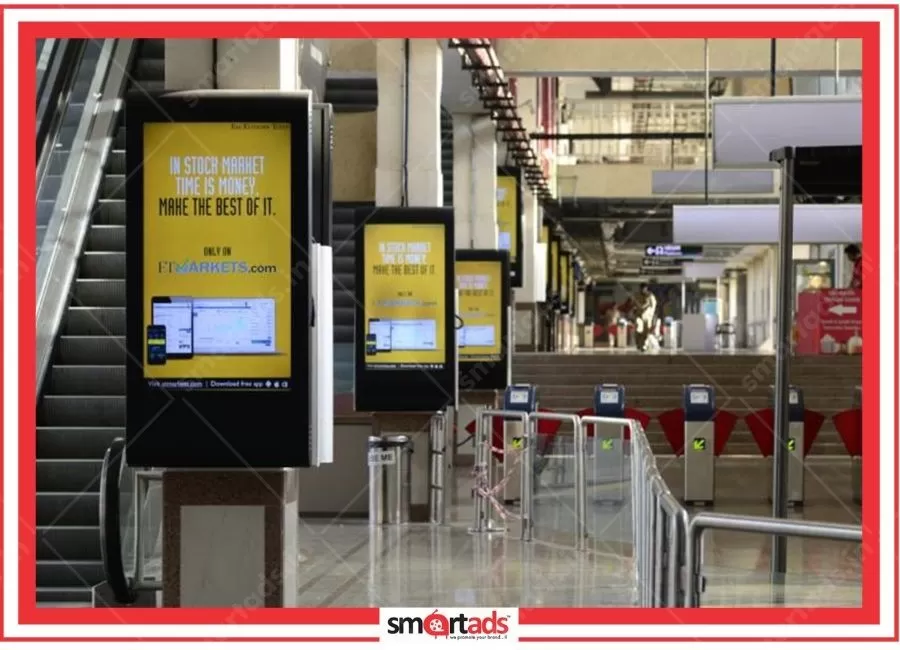
Entry Exit Panel
8 ft x 4 ft
Bright and vibrant multicolored letterin
Rate per Panel / Month
Min Requirement is 3 Panel.
₹48000.00
Showing 1 to 4 of 4 Results
MEDIA DETAILS
8 ft x 4 ft
Bright and vibrant multicolored letterin
Rate per Panel / Month
Min Requirement is 3 Panel.
₹48000.00
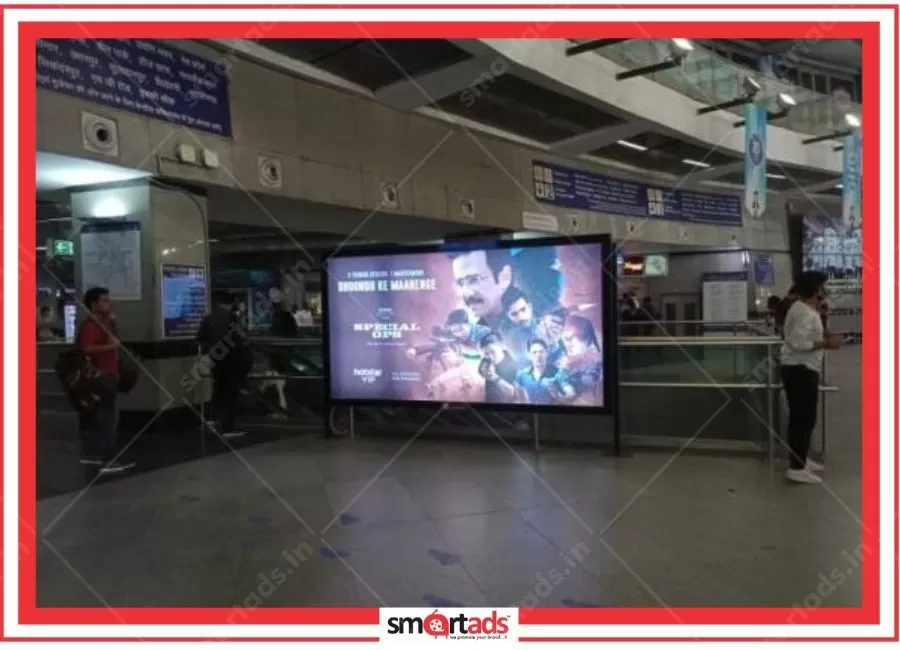
10 ft x 5 ft
A new wide wall system designed to accom
Rate per Panel / Month
Min Requirement is 3 Panel.
₹50000.00
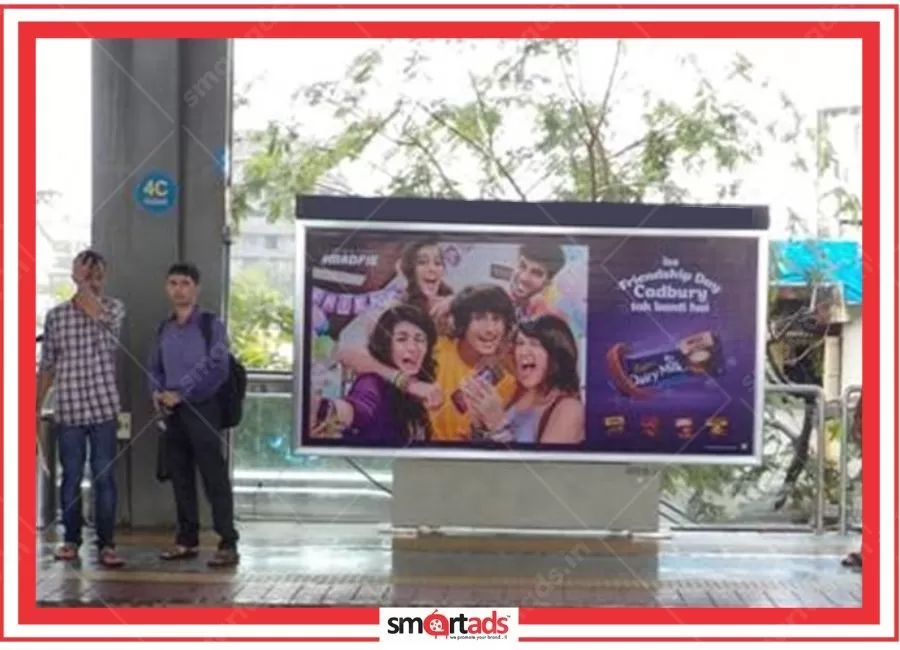
8 ft x 4 ft
A raised flooring or other horizontal su
Rate per Panel / Month
Min Requirement is 3 Panel.
₹35000.00
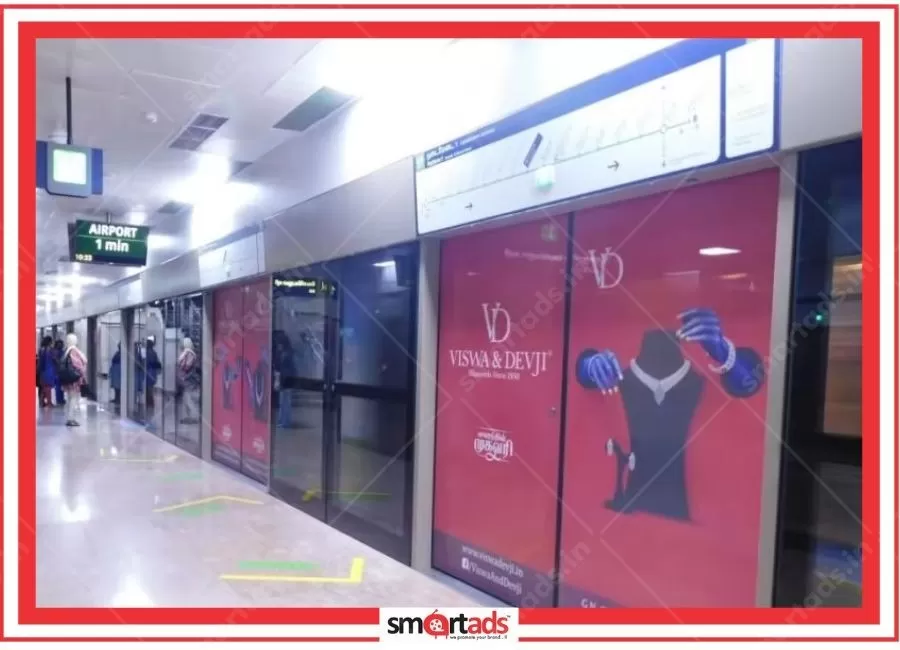
7 ft x 4 ft
Also known as platform edge doors (PEDs)
Rate per Plateform / Month
Min Requirement is 1 Stations.
₹1200000.00
MEDIA REACH

MinimumQty :
10
EstimateReachPeople :
15 Million
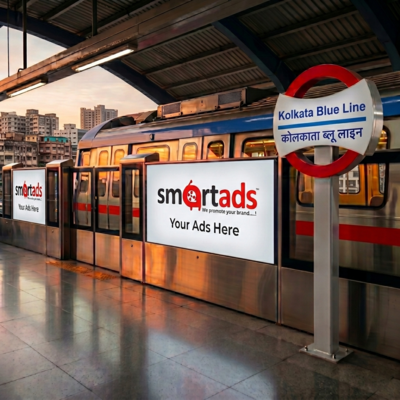
Kolkata's Blue Line carries somewhere in the ballpark of 650,000 to 700,000 commuters on a typical weekday — a number that puts it comfortably ahead of most outdoor advertising formats in the city when you measure raw captive audience exposure. What surprises most brand managers we speak to is not the scale, but the quality: these are not passive glances at a roadside hoarding while stuck in traffic; these are dwell times of four to eight minutes on a platform, followed by another eight to twelve minutes inside a coach, which means a single campaign placement can generate multiple impression touchpoints per journey. Metro station advertising in Kolkata Blue Line has quietly become one of the most underutilised and underpriced formats in the city's OOH advertising ecosystem — and the brands that have figured this out are booking slots months in advance.
The North-South Metro corridor — running from Dakshineswar to Kavi Subhash across 26 stations — is not just the oldest metro line in India outside Mumbai; it is the spine of Kolkata's urban mobility infrastructure, which means it carries a disproportionately high share of the city's economically active population. The line passes through commercial hubs like Park Street, Esplanade, and Dum Dum, through residential catchments in Tollygunge and Shyambazar, and connects the northern industrial belt to the southern IT and services corridor — which gives advertisers a rare cross-section of audience profiles within a single transit route. When we compare this to elevated highway hoardings or newspaper inserts, the Blue Line's advantage is not just reach; it is the quality of attention that comes from a captive audience with nowhere else to look.
Frankly speaking, the economics make a compelling case on their own. The CPM for platform branding on a high-footfall Blue Line station works out to roughly ₹12 to ₹18, which is a figure that consistently surprises brand managers when they realise they have been paying two to three times that for mid-roll digital video that gets skipped in the first five seconds. The FICCI-EY Media and Entertainment Report has repeatedly flagged transit media as one of the fastest-growing segments within OOH advertising in India, and the Kolkata metropolitan area's metro network — anchored by the Blue Line — is a significant part of that growth story. At SmartAds, we have found that brands which anchor their BTL advertising strategy on the Blue Line and then layer digital retargeting on top consistently see higher brand recall scores than those running standalone digital campaigns.
On top of that, the Blue Line's underground stretches — particularly the central corridor between Dum Dum and Tollygunge — create an environment where commuters are physically separated from competing media stimuli. There are no competing billboards underground, no radio signals, no ambient noise from street-level traffic; the only visual communication a commuter encounters is what has been placed on the platform, the concourse, or inside the train itself. This media isolation effect, which is something most OOH planners underestimate, is precisely why brand recall scores from metro station branding Kolkata campaigns tend to outperform equivalent spends on surface-level formats.
The range of formats available for metro advertising Kolkata campaigns is considerably wider than most advertisers assume when they first approach us. At the station level, the primary formats include concourse hoardings, backlit panels, pillar branding, AFC gate branding, ticket vending wraps, escalator wraps, staircase branding, and platform screen door graphics — each of which occupies a different position in the commuter's visual journey and therefore serves a different strategic purpose. Concourse hoardings, which are typically large-format backlit displays positioned at eye level in the entry and exit zones, are best suited for brand awareness campaigns where maximum impressions per square foot matter most; pillar branding, on the other hand, creates a surround-sound visual effect that is particularly effective for product launches and station domination campaigns.
Inside the train, the formats shift to a more intimate scale — seat-back stickers, interior branding panels above the windows, door decals, and overhead strip panels, all of which benefit from the extended dwell time that coach travel provides. A commuter travelling from Dum Dum to Tollygunge, for instance, spends somewhere between 25 and 30 minutes inside the coach, which means an interior branding placement gets repeated exposure across multiple ad positions during a single journey. For advertisers with larger budgets, a full train branding or coach exterior wrap — which covers the entire outer surface of one or more coaches with a branded vinyl — creates what is effectively a moving billboard that generates impressions at every station the train passes through, not just the ones where static placements have been booked.
The digital screen advertising and DOOH inventory on the Blue Line deserves particular mention, because it is an area where the format has evolved significantly over the past two years. Several high-footfall stations now carry LED screen advertising units in the concourse and on platforms, which allow for dynamic creative rotation, time-of-day targeting, and — in some configurations — programmatic DOOH buying. Digital screen advertising at stations like Esplanade and Park Street can be booked in time slots rather than fixed durations, which gives smaller advertisers a more flexible entry point into the network. At SmartAds, we have been advising clients to treat DOOH placements as the activation layer of a broader Blue Line advertising strategy — the static formats build frequency and brand visibility, while the LED screen advertising delivers the call-to-action message.
Not all 26 stations on the Dakshineswar to Kavi Subhash corridor are equal from an advertising standpoint, and treating them as interchangeable is one of the most common planning mistakes we see. Esplanade metro station sits at the intersection of the Blue and Green lines, which makes it the single highest-footfall interchange point on the entire Kolkata metro network; daily ridership at Esplanade on a typical weekday is estimated to be in the range of 60,000 to 80,000 unique commuters, a figure which does not include the additional footfall generated by the adjacent Maidan area, the commercial district of BBD Bagh, and the retail corridor along Chowringhee. For a brand awareness campaign targeting urban Kolkata, a station domination at Esplanade is arguably the highest-impact single-station buy available in the city's OOH advertising inventory.
Park Street metro station, which serves one of Kolkata's most commercially dense neighbourhoods, draws a distinctly upmarket commuter profile — a mix of office-goers, restaurant and retail patrons, and cultural visitors — which makes it the preferred station for premium brands in the lifestyle, banking, and FMCG categories. Dum Dum metro station, at the northern terminus of the original Blue Line stretch, functions as a major interchange with the Yellow Line and with suburban rail services, which means its commuter footfall includes a significant proportion of outstation travellers and airport-bound passengers; this cross-pollination of audience types makes Dum Dum particularly valuable for brands with a broad demographic target. Shyambazar metro station, positioned in the heart of North Kolkata's densely populated residential and commercial belt, delivers high commuter footfall from a predominantly middle-class working professional audience, which is a sweet spot for mass-market consumer brands.
Tollygunge metro station — officially renamed Mahanayak Uttam Kumar — anchors the southern end of the original Blue Line and serves as a gateway to the South Kolkata residential and entertainment district; its footfall is driven by a combination of daily office commuters, students heading to educational institutions in the area, and leisure travellers accessing the Tollygunge Club and surrounding retail. What a lot of people miss is that mid-corridor stations like Rabindra Sarani, Maidan, and Central also carry substantial commuter footfall — not because they are interchange points, but because they sit within walking distance of major employment clusters — and their advertising rates are often 20 to 30 percent lower than the premium interchange stations, which makes them excellent value buys for brands with tighter budgets.
Advertising rates on the Kolkata Blue Line vary considerably depending on the format, the station tier, the duration of the campaign, and whether the booking is made directly through Metro Railway Kolkata or through an authorised media partner. For a standard backlit panel at a mid-tier station, the monthly rate works out to somewhere between ₹25,000 and ₹45,000, which is a number that most brand managers find surprisingly accessible when they compare it to the cost of a prime-time television spot or a full-page newspaper insertion in a Kolkata-based daily. Pillar branding at a high-footfall station like Esplanade or Park Street metro station commands a premium, with monthly rates in the ballpark of ₹60,000 to ₹1,20,000 per pillar depending on size and position — but the impressions-per-rupee calculation still holds up favourably against most alternative formats.
Train wrap and coach exterior wrap campaigns are priced differently, because they are sold on a per-coach or per-train basis rather than per-location; a single coach exterior wrap on the Blue Line typically costs somewhere between ₹3 lakh and ₹6 lakh per month, while a full train branding covering all coaches of a rake can run anywhere from ₹15 lakh to ₹25 lakh per month depending on the train's route frequency and the creative complexity of the wrap. Interior branding formats — seat-back stickers, overhead panels, and door decals — are generally more affordable, with packages for a full coach interior available in the range of ₹1.5 lakh to ₹3 lakh per month. Digital screen advertising and LED screen advertising at DOOH-enabled stations are priced on a per-spot, per-day basis, with a 10-second slot on a high-footfall station screen costing roughly ₹800 to ₹1,500 per day depending on the number of daily plays booked.
Station domination packages — which bundle concourse hoardings, pillar branding, platform screen door graphics, and AFC gate branding into a single unified takeover of one station — are priced in the range of ₹8 lakh to ₹20 lakh per month for a mid-tier station, rising to ₹25 lakh to ₹40 lakh for a premium station like Esplanade. To be honest, these are the campaigns that generate the most dramatic brand visibility outcomes, because a commuter entering a fully branded station cannot avoid the messaging regardless of where they look; we have seen brand recall scores from station domination campaigns on the Blue Line reach 70 to 80 percent among regular commuters surveyed post-campaign. Festive season rates — particularly around Durga Puja advertising windows — carry a premium of roughly 20 to 40 percent over standard rates, which is why early booking is critical for brands planning festive campaign Kolkata activations.
The audience profile on the Kolkata Blue Line is one of the most strategically valuable in the city's media landscape, and it is consistently mischaracterised by planners who assume metro commuters are a homogeneous middle-class group. The reality, which our audience research across multiple campaigns has confirmed, is considerably more nuanced. The Blue Line's working professionals — who constitute the largest single segment, estimated at somewhere between 55 and 65 percent of daily ridership — are concentrated in the SEC A and SEC B income brackets, are aged between 22 and 45, and are active consumers of categories including banking and financial services, personal care, consumer electronics, quick-service restaurants, and online platforms. This is not a peripheral audience; this is the core target demographic for most national brand campaigns.
Students and youth constitute a meaningful secondary segment, particularly at stations adjacent to educational institutions — Jadavpur, Tollygunge, and the central corridor stations near Presidency University and Scottish Church College draw significant student footfall during morning and evening peak hours. What makes this segment particularly interesting for advertisers is that students and youth on the Blue Line skew heavily toward digital-native behaviour, which means metro station branding Kolkata campaigns targeting this group can be amplified effectively through digital retargeting using mobile ID data collected near station entry points. The GroupM TYNY report has consistently highlighted the growing purchasing influence of the 18-to-28 age cohort in urban India, and the Blue Line gives advertisers a physical touchpoint with this group that digital-only campaigns cannot replicate.
The Blue Line also carries a significant proportion of upper-income commuters who use the metro for speed and convenience rather than necessity — particularly on the Park Street to Esplanade stretch, where the adjacent commercial and hospitality district generates footfall from business travellers, hotel guests, and high-spending retail consumers. At SmartAds, we always tell our clients that the Blue Line's audience is not just large; it is stratified in a way that allows intelligent station selection to function as a form of hyperlocal targeting. A luxury brand can concentrate its spend at Park Street and Esplanade; a mass-market FMCG brand can dominate at Shyambazar and Dum Dum; an education brand can target Jadavpur and Tollygunge — all within the same network, using the same formats.
The booking process for metro station advertising in Kolkata Blue Line campaigns involves multiple steps and a lead time that most advertisers significantly underestimate. The formal process begins with identifying available inventory — which requires either a direct approach to the Metro Railway Kolkata advertising department or, more practically, working through an authorised media partner who maintains live inventory data across the network. Direct bookings through KMRC are possible but involve a more bureaucratic process, including formal tender submissions for larger campaigns; most brand managers and media planners find it more efficient to work through an experienced transit media partner who can navigate the approval process and provide consolidated billing.
Once inventory is confirmed, the creative approval process begins — and this is where campaigns most frequently get delayed. Metro Railway Kolkata maintains a set of content guidelines that must be adhered to before any creative is approved for installation; these guidelines prohibit political content, content that could be considered obscene or offensive, competitive comparisons that name rival brands, and certain categories of advertising including tobacco and alcohol. The creative submission must include final artwork at the specified dimensions for each format — pillar branding panels on the Blue Line are typically 1.2 metres wide by 1.8 metres tall, while concourse hoardings range from 2 metres by 1.5 metres to larger custom sizes depending on the station architecture. Backlit panels follow standard dimensions of roughly 4 feet by 3 feet in most station configurations, though premium positions may accommodate larger formats.
The lead time from booking confirmation to campaign live date is typically four to six weeks for static formats, and six to eight weeks for train wrap or coach exterior wrap campaigns — the latter requiring additional time for vinyl production, quality inspection, and installation scheduling that must be coordinated with Metro Railway Kolkata's maintenance windows. For festive season campaigns, particularly Durga Puja advertising, we strongly recommend initiating the booking process at least three to four months in advance, because premium inventory at stations like Esplanade and Park Street metro station gets absorbed very quickly. Our experience at SmartAds is that clients who come to us in August expecting to secure prime Blue Line placements for the October Puja window are almost always disappointed — the best positions are gone by July.
Campaign ROI measurement for metro advertising Kolkata campaigns has evolved considerably, and the days of simply counting estimated impressions and calling it a success are largely behind us. The primary measurement framework we use at SmartAds combines three data streams: footfall-based impression estimates derived from Metro Railway Kolkata ridership data, brand recall surveys conducted among commuters post-campaign, and digital signal attribution using mobile location data to track commuters who were exposed to Blue Line placements and subsequently interacted with the brand's digital touchpoints. This triangulated approach gives a far more defensible ROI number than impressions alone, and it is the methodology that brand managers increasingly need when justifying BTL advertising spends to their management.
The brand recall metrics from Blue Line campaigns are consistently strong — we have seen aided recall rates of 65 to 75 percent among regular Blue Line commuters for campaigns that ran for a minimum of four weeks with placements at two or more stations. One FMCG brand we worked with ran a six-week station domination campaign at Esplanade and Park Street metro station, combined with interior branding across two train rakes; the post-campaign recall survey showed that 72 percent of surveyed commuters could correctly identify the brand's campaign message, which was a significantly higher recall rate than the same brand had achieved with a comparable spend on outdoor hoardings in the same period. Repeat impressions are a key driver of this performance — a commuter who uses the Blue Line five days a week is exposed to the same platform branding placement somewhere between 20 and 40 times over a four-week campaign, which creates a depth of brand imprinting that no single-exposure format can match.
For campaigns that integrate DOOH and LED screen advertising with static formats, the measurement layer becomes richer still. Programmatic DOOH buying at Blue Line stations can now be tracked through impression verification technology, which logs the number of times a creative was served on a specific screen during the campaign period; this data, which is exportable and auditable, gives digital-native brand managers the kind of reporting they are accustomed to from performance marketing channels. The TAM AdEx data on OOH spending trends in the Kolkata metropolitan area consistently shows that transit media — particularly metro station branding Kolkata — delivers a cost-per-impression advantage over traditional outdoor formats, which is a finding that aligns with what we observe across the campaigns we plan and execute.
The question of Blue Line versus other Kolkata OOH formats is one that comes up in almost every media planning conversation we have, and the honest answer is that the comparison depends heavily on what the campaign is trying to achieve. A large-format highway hoarding on the Eastern Metropolitan Bypass or the EM Bypass flyover will generate higher gross impressions in a single day than most individual Blue Line station placements — but the quality of those impressions, measured by dwell time, audience attentiveness, and brand recall, is substantially lower. Drivers and passengers in moving vehicles have a fraction of a second to register a hoarding message; a commuter standing on a Blue Line platform for four to six minutes waiting for the next train has no choice but to engage with the environment around them.
Compared to newspaper advertising in Kolkata's major Bengali and English dailies — which remain significant media vehicles in the West Bengal market — Blue Line advertising offers a different kind of value. A full-page colour insertion in a leading Kolkata daily costs somewhere in the range of ₹3 lakh to ₹8 lakh for a single day, which is a one-time exposure to a readership that is declining year-on-year according to IRS data; a comparable spend on Blue Line platform branding delivers daily impressions for an entire month, with the added benefit of reaching an audience that skews younger and more digitally active than the average newspaper reader. The two formats serve different strategic purposes and work best in combination, but for pure frequency and urban commuter reach, the Blue Line holds a clear structural advantage.
The comparison between the Blue Line and other Kolkata metro corridors — the Green Line (East-West Metro), the Orange Line (Airport Metro), and the emerging Purple and Yellow lines — is a more nuanced conversation. The Green Line, which runs from Howrah Maidan to Salt Lake Sector V, carries a predominantly IT and services sector audience and is an excellent choice for B2B technology brands, recruitment campaigns, and premium consumer brands targeting the Salt Lake-Rajarhat corridor; its daily ridership is currently lower than the Blue Line but growing rapidly. The Orange Line, connecting the airport to the city centre, carries a high-income, high-frequency-flyer audience which is valuable for premium brands but limited in total daily ridership volume. The Blue Line's combination of scale, central corridor coverage, and audience diversity makes it the default first choice for most brand awareness campaigns targeting the Kolkata metropolitan area broadly.
The most common mistake we see in Blue Line metro advertising campaigns is treating the format like a scaled-up digital banner — designing creative that is text-heavy, information-dense, and optimised for close-up reading rather than for the rapid-impression environment of a metro platform. Platform branding and concourse hoardings are consumed at a distance and in motion; the creative needs to communicate a single, clear message in under three seconds, which means headline copy should be no more than five to seven words, the brand logo must be large and immediately legible, and the visual hierarchy must be ruthlessly simplified. We have seen campaigns where the brand's creative team submitted beautiful, detailed artwork that looked stunning in a PDF presentation and was completely illegible when installed on a pillar at Shyambazar metro station.
Station selection strategy matters enormously, and the temptation to spread a budget across too many stations should be resisted. A concentrated presence at two or three high-footfall stations — Esplanade, Park Street, and Dum Dum, for instance — will generate stronger brand recall and a more memorable campaign impression than the same budget spread thinly across ten stations. The principle of frequency over reach applies particularly strongly in transit media, where the captive audience is defined by habitual travel patterns; a commuter who passes through Park Street metro station every working day for four weeks will see the same placement 20-plus times, which creates a depth of brand imprinting that a broad but shallow distribution cannot achieve. One retail client in South Kolkata that we worked with initially wanted to book placements at 12 stations with a modest budget; we persuaded them to concentrate at four stations instead, and their post-campaign brand awareness scores were 40 percent higher than a comparable campaign they had run the previous year with the spread approach.
For brands planning multi-platform metro campaigns that integrate static formats with digital and on-ground activation, the Blue Line's geography offers a natural campaign architecture. The station domination at Esplanade — which sits at the Blue-Green interchange — can be paired with digital screen advertising on the Green Line's Salt Lake stations to create a corridor effect that follows the commuter's journey from home to office; this kind of multi-platform metro campaign, which links physical placements to digital touchpoints along a known travel route, is something we have found particularly effective for banking, insurance, and app-based service brands that need both mass awareness and performance-driven conversion. Adding a programmatic DOOH layer at the DOOH-enabled Blue Line stations, and then retargeting those same commuters on mobile through location-based audience segments, creates a closed-loop campaign that can be measured end-to-end.
This is a question we get asked more often than any other, and the answer is more encouraging than most small business owners expect. The perception that metro station advertising in Kolkata Blue Line is exclusively the domain of large national brands is largely a holdover from the early years of the network, when minimum campaign commitments were high and the booking process was opaque. The reality today is that the format has become considerably more accessible — particularly with the availability of shared panel positions, shorter minimum campaign durations, and the entry of digital screen advertising formats that can be booked in day-parts rather than full-month blocks.
A startup or small business with a monthly OOH budget of ₹50,000 to ₹1 lakh can run a meaningful Blue Line campaign by concentrating on a single station, booking a backlit panel or pillar branding position at a mid-tier station, and running for a minimum of four weeks — which is the typical minimum duration for static formats on the Blue Line. The brand visibility generated by even a single well-placed, well-designed backlit panel at a station like Tollygunge or Dum Dum, where daily commuter footfall runs into tens of thousands, is substantially higher than what the same budget would deliver in print or radio in the same market. We have worked with a Kolkata-based edtech startup that ran its first-ever out-of-home advertising campaign on the Blue Line with a budget of ₹75,000 per month, targeting two stations near educational institution clusters; the campaign generated enough brand recognition in its target catchment to produce a measurable uplift in organic search traffic and app downloads over the campaign period.
To be fair, there are format categories on the Blue Line that remain out of reach for very small budgets — a full train branding or station domination campaign requires a commitment that most startups cannot sustain. But the modular nature of the format inventory means that small businesses can enter the network at a scale that makes financial sense, build audience familiarity over time, and scale up as their brand grows. At SmartAds, we have structured entry-level Blue Line packages specifically for this segment of the market, combining a single-station static placement with a digital screen advertising slot to create a campaign that punches above its weight in terms of brand visibility and recall.
Q: What is metro station advertising on the Kolkata Blue Line?
Metro station advertising on the Kolkata Blue Line refers to the placement of brand communications across the physical and digital surfaces of the 26 stations that make up Line 1 — the North-South Metro corridor running from Dakshineswar to Kavi Subhash — as well as on the trains that operate on this corridor. The formats encompass everything from large-format concourse hoardings and backlit panels at station entry and exit points, to pillar branding, AFC gate branding, escalator wraps, staircase branding, and platform screen door graphics within the station environment, to seat-back stickers, interior branding panels, and coach exterior wraps on the trains themselves. This category of non-traditional advertising sits within the broader BTL advertising and transit media ecosystem, and it is managed through a combination of Metro Railway Kolkata's official advertising programme and authorised media partners who hold concession agreements for specific inventory categories.
Q: How much does advertising at a Kolkata Blue Line metro station cost per month?
The monthly cost of Blue Line metro station advertising depends on the format chosen and the tier of the station. A standard backlit panel at a mid-tier station runs somewhere between ₹25,000 and ₹45,000 per month; pillar branding at a premium station like Esplanade or Park Street metro station is in the range of ₹60,000 to ₹1,20,000 per pillar per month. Interior branding packages for a full coach are typically in the ₹1.5 lakh to ₹3 lakh per month range, while a coach exterior wrap costs somewhere between ₹3 lakh and ₹6 lakh per month. Station domination packages — which combine multiple format types into a full-station takeover — range from ₹8 lakh to ₹40 lakh per month depending on the station and the scope of the buy. Digital screen advertising at DOOH-enabled stations is available on a per-spot basis, with individual 10-second slots costing roughly ₹800 to ₹1,500 per day. Festive season campaigns around Durga Puja carry a premium of 20 to 40 percent over these base rates.
Q: Which Blue Line metro stations get the highest daily footfall?
Esplanade metro station is the single highest-footfall station on the Blue Line, driven by its position as the interchange between the Blue and Green lines and its proximity to the Maidan commercial and cultural district; daily ridership at Esplanade is estimated in the 60,000 to 80,000 range. Park Street metro station is the second most commercially valuable station, drawing a premium urban audience from the surrounding hospitality, retail, and office district. Dum Dum metro station is a major interchange with suburban rail and the Yellow Line, which generates high aggregate footfall from a diverse audience mix. Shyambazar metro station serves a dense North Kolkata residential and commercial catchment and delivers consistent high-volume commuter footfall from a predominantly middle-class working professional demographic. Tollygunge metro station anchors the southern end of the original Blue Line and draws a mix of office commuters, students, and leisure travellers.
Q: What ad formats are available for metro station advertising on the Kolkata Blue Line?
The full inventory of formats on the Blue Line includes concourse hoardings, backlit panels, pillar branding, AFC gate branding, ticket vending wraps, escalator wraps, staircase branding, platform screen door graphics, digital screen advertising and LED screen advertising at DOOH-enabled stations, seat-back stickers, interior branding panels, door decals, overhead strip panels inside coaches, coach exterior wraps, and full train branding packages that cover all coaches of a rake. Each format serves a different function in the commuter's visual journey — concourse and platform formats build awareness at the point of entry; interior branding formats leverage extended dwell time inside the coach; train wraps generate impressions across the entire network as the train moves between stations.
Q: How do I book an advertising campaign on the Kolkata Blue Line?
Booking begins with confirming available inventory, either directly through Metro Railway Kolkata's advertising department or through an authorised media partner. The process involves format selection, station selection, creative submission for approval against KMRC's content guidelines, production of materials to specified dimensions, and installation scheduling coordinated with the metro's maintenance windows. Working through an experienced transit media partner significantly reduces the administrative burden and shortens the time from brief to live campaign. The total lead time from booking confirmation to campaign launch is typically four to six weeks for static formats and six to eight weeks for train wrap campaigns.
Q: What is the minimum duration for metro advertising on the Kolkata Blue Line?
The standard minimum campaign duration for static formats — backlit panels, pillar branding, concourse hoardings — on the Blue Line is typically four weeks, which aligns with a calendar month booking cycle. Train wrap and coach exterior wrap campaigns generally carry a minimum duration of four to eight weeks given the production investment involved. Digital screen advertising at DOOH-enabled stations can be booked for shorter periods, sometimes as brief as one week, depending on the availability of inventory at the specific station and screen. For festive season campaigns around Durga Puja, minimum duration requirements may be extended by station operators to ensure consistent brand presence through the full festival window.
Q: Who are the typical audiences reached by advertising on the Blue Line?
The Blue Line's daily ridership is dominated by working professionals in the SEC A and SEC B income brackets, aged 22 to 45, who use the metro as their primary mode of commuting between residential areas in North and South Kolkata and employment hubs in the central and southern corridors. Students and youth constitute a significant secondary segment, particularly at stations near educational institutions. The Blue Line also carries a meaningful proportion of upper-income commuters at central corridor stations, and a mixed-income, high-volume audience at interchange stations like Dum Dum and Esplanade. The audience is broadly urban, digitally active, and concentrated in the economically productive age cohorts that most national brand campaigns are designed to reach.
Q: Is metro station advertising on the Blue Line better than hoarding advertising in Kolkata?
The two formats are not directly comparable because they serve different functions in a media plan, but for campaigns where audience attentiveness and brand recall are the primary metrics, Blue Line metro advertising consistently outperforms surface-level hoardings. The captive audience environment of an underground metro station, combined with dwell times of four to eight minutes on the platform and up to 30 minutes inside the coach, generates a depth of brand exposure that a roadside hoarding — consumed in a fraction of a second by a commuter in a moving vehicle — cannot match. The CPM comparison also tends to favour metro advertising when quality-adjusted impressions are used as the denominator rather than gross traffic counts.
Q: Can startups and small businesses afford Blue Line metro station advertising?
Yes — and more comfortably than most assume. A single backlit panel at a mid-tier Blue Line station can be secured for ₹25,000 to ₹45,000 per month, which is within the reach of many small businesses and startups with serious brand-building ambitions. The key is concentrating the budget at one or two strategically chosen stations rather than spreading it thinly, and pairing the physical placement with a digital screen advertising slot or a mobile retargeting campaign to amplify the reach. Entry-level packages that combine a static format with a DOOH component are available through media partners and represent a cost-effective way for smaller brands to establish a presence on the network.
Q: What content restrictions apply to advertising on Kolkata Metro Blue Line stations?
Metro Railway Kolkata's content guidelines prohibit political advertising, content that could be deemed obscene or morally offensive, tobacco and alcohol advertising, competitive brand comparisons that name rival products, and content that could be interpreted as misleading or contrary to public interest. All creative materials must be submitted for formal approval before production and installation; this approval process typically takes five to ten working days, which must be factored into the campaign lead time. Creative dimensions must conform to the specifications for each format category, and any deviation from approved artwork after installation approval has been granted requires a fresh approval cycle.
Q: How is ROI tracked for a Blue Line metro advertising campaign?
ROI tracking for Blue Line campaigns combines footfall-based impression estimates from Metro Railway Kolkata ridership data, post-campaign brand recall surveys among regular commuters, and digital attribution through mobile location data that identifies commuters exposed to metro placements and tracks their subsequent online behaviour. For campaigns that include DOOH and LED screen advertising, impression verification technology provides auditable play-count data. Brands that integrate their Blue Line campaigns with digital retargeting can track the full journey from physical ad exposure to online conversion, which provides the most complete picture of campaign ROI.
Q: What is the difference between platform branding and train wrap advertising on the Blue Line?
Platform branding refers to all advertising formats installed on the fixed surfaces of the station — pillars, concourse walls, backlit panels, AFC gates, escalators, and platform screen doors — which are seen by commuters during their time in the station. Train wrap advertising, by contrast, is applied to the exterior or interior surfaces of the train coaches themselves, which means the advertising moves with the train and
