
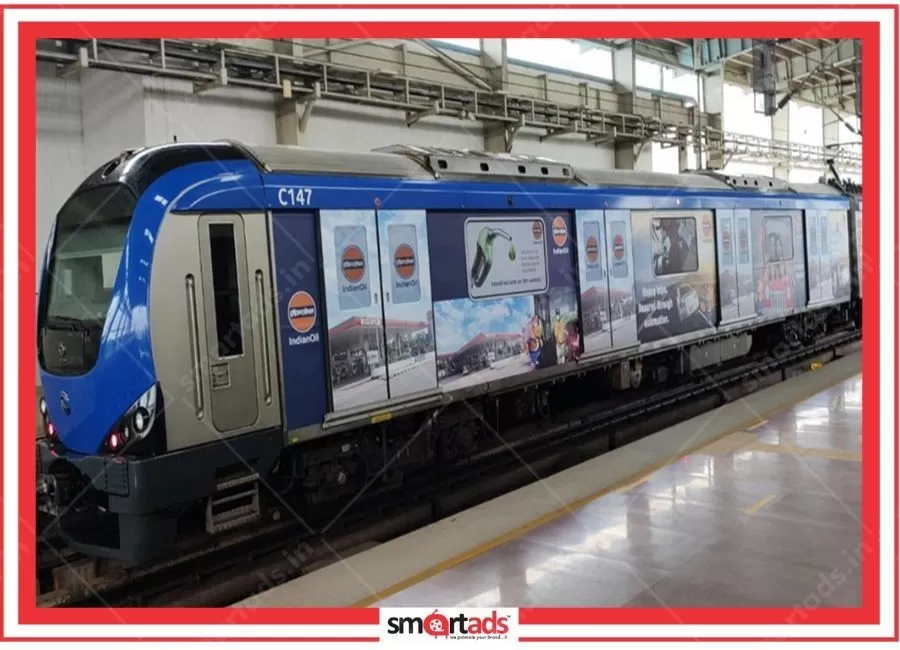
Exterior Metro Wrap
Size & Printing Cost as per actual
On the outside of metro Train, advertise
Rate per Metro Display Cost / 1 Month
Route:Vaishali To Dwarka Sector 21
₹4820000.00
Showing 1 to 4 of 4 Results
MEDIA DETAILS
Size & Printing Cost as per actual
On the outside of metro Train, advertise
Rate per Metro Display Cost / 1 Month
Route:Vaishali To Dwarka Sector 21
₹4820000.00
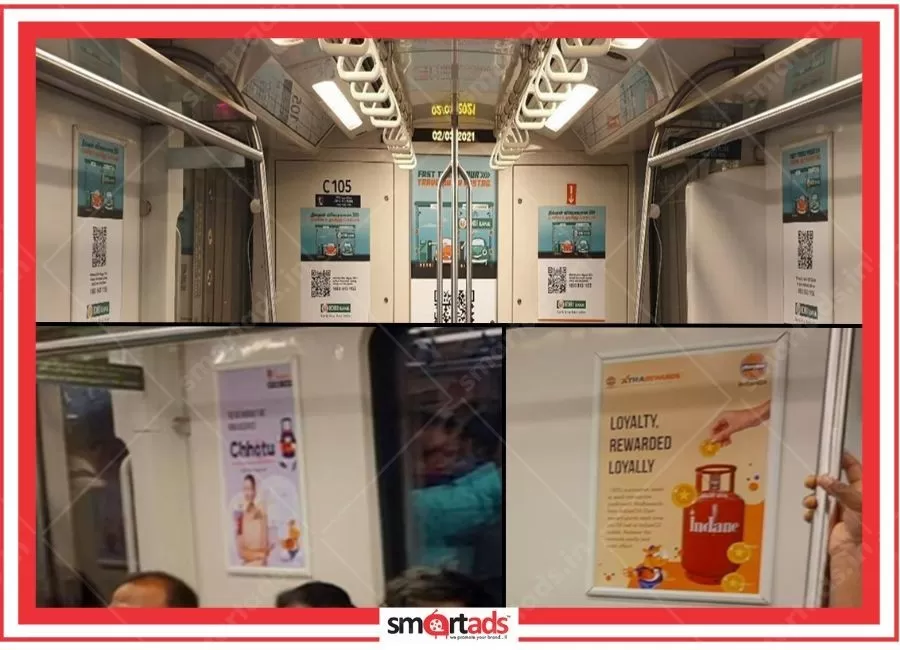
Size & Printing Cost as per actual
On the outside of metro Train, advertise
Rate per Metro Display Cost / 1 Month
Route:Vaishali To Dwarka Sector 21
₹816500.00
20 Sec Jingle
On the outside of metro Train, advertise
Rate per Metro Display Cost / Rate Per M
Route:Vaishali To Dwarka Sector 21
₹400000.00
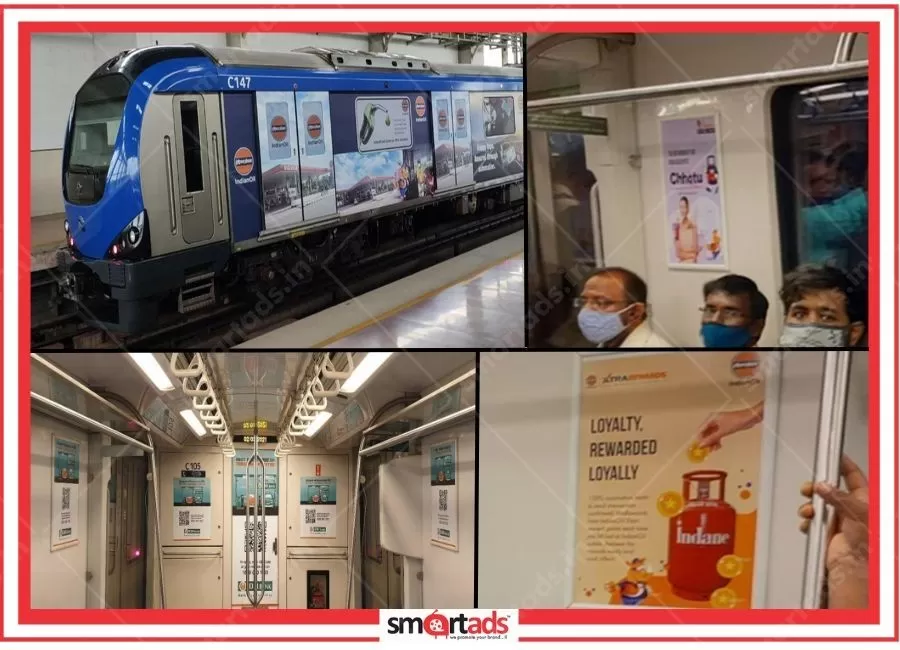
Size & Printing Cost as per actual
On the outside of metro Train, advertise
Rate per Metro Display Cost / 1 Month
Route:Vaishali To Dwarka Sector 21
₹4820000.00
MEDIA REACH

MinimumQty :
1
EstimateReachPeople :
150000000
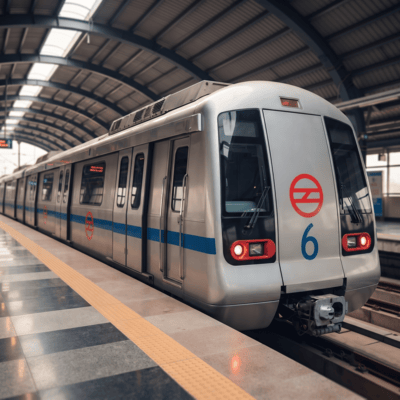
The Blue Line branch of the Delhi Metro carries somewhere in the neighbourhood of 8 to 10 lakh commuters every single day across its corridor, which makes it one of the most densely trafficked transit routes in the entire country — and yet, a surprising number of brand managers we speak to have never seriously priced it out as a standalone media buy. That is a gap worth closing, because the captive audience quality on this corridor is genuinely unlike what you find on most other out-of-home formats.
The Blue Line, officially known as Line 3 and its branch extensions, stretches from Dwarka Sector 21 through the heart of Delhi and connects to Noida and Vaishali on the eastern end; the branch lines specifically serve corridors that pass through some of the city's most commercially active and residentially dense zones. What a lot of people miss is that the "branch" designation does not mean secondary importance — it means a concentrated, slightly more homogeneous ridership profile, which is actually a gift for advertisers targeting specific demographic segments.
Our experience at SmartAds shows that the Blue Line branch corridor draws a disproportionately high share of working professionals, students travelling to educational institutions in the Noida stretch, and middle-to-upper-middle-income households from West Delhi's residential clusters. This is not anecdotal — DMRC's own ridership studies, cross-referenced with IRS data on commuter demographics, consistently point to a literacy rate and household income profile on this corridor that outperforms the Delhi NCR average. For a brand selling financial products, consumer durables, or educational services, that kind of audience pre-qualification is worth a great deal.
Frankly speaking, the thing that surprises most clients when we walk them through the Blue Line branch opportunity is the dwell time. A commuter travelling from Dwarka Sector 10 to Rajiv Chowk — which is one of the most common journey segments on this corridor — spends somewhere between 20 and 28 minutes inside the metro system, which includes platform time, in-train travel, and interchange moments. That is not a fleeting glance at a highway billboard; that is sustained, repeated exposure across multiple touchpoints within a single journey.
Metro train advertising is not a single format — it is a family of formats, each with its own pricing logic, production requirement, and audience engagement pattern. On the Blue Line branch, the primary inventory categories include train wrap advertising (full or partial exterior), in-train panel advertising (which covers door panels, overhead panels, and grab handle danglers), station branding packages at key stations along the corridor, and platform screen door branding at select high-footfall stations.
Train wraps are the format that generates the most conversation, and for good reason; a fully wrapped Blue Line branch train moving through elevated sections of the corridor — particularly the stretches near Janakpuri, Uttam Nagar, and the Noida extension — is visible to street-level audiences as well as commuters, which effectively doubles the media value of the buy. We have found that train wraps on this corridor generate estimated daily impressions in the ballpark of 3 to 5 lakh when you combine platform-level visibility, street-level exposure on elevated sections, and in-train dwell. The CPM works out to roughly ₹6 to ₹9, which is a number that genuinely surprises most first-time metro advertisers when they compare it to what they are currently paying for programmatic display or even mid-tier outdoor.
In-train panel formats — the overhead cards, door panels, and danglers — are priced more modestly and are often the smarter entry point for brands testing the medium for the first time. These panels are viewed at close range by seated and standing commuters, which means the creative can carry more copy than a typical outdoor format; we have seen pharma brands, fintech apps, and FMCG companies use this format to run genuinely informative creative that would be wasted on a 10-second highway glance. Station branding at high-interchange stations like Rajiv Chowk, which connects the Blue Line to the Yellow Line, is a separate conversation entirely — that station alone handles passenger volumes that rival some of India's busiest railway stations.
Rate transparency is something the metro advertising industry has historically been poor at, which is why so many brands approach this medium with vague budget assumptions and end up either over-spending or under-investing. To give a realistic picture: a single in-train panel placement across a Blue Line branch train set, for a campaign period of roughly 30 days, typically falls somewhere between ₹40,000 and ₹80,000 per train depending on the panel location and format type. A full train wrap — which involves vinyl application across the entire exterior of a train rake — is a significantly larger commitment, often in the ballpark of ₹8 lakh to ₹15 lakh per rake per month, with production costs for the vinyl itself adding another ₹2 to ₹4 lakh on top of the media fee.
Station branding packages are structured differently; they are usually sold as station-level packages that bundle multiple touchpoints — concourse panels, pillar wraps, floor graphics, and entry gate branding — into a single rate, which makes comparison with individual format rates a bit tricky. A mid-tier station on the Blue Line branch corridor, meaning one that is not a major interchange but still carries respectable daily footfall, typically packages at somewhere between ₹3 lakh and ₹6 lakh per month. Rajiv Chowk and other high-footfall interchange stations command a premium that can be two to three times those figures, which is justified when you look at the sheer volume of unique daily contacts.
At SmartAds, we always tell our clients that the rate card is only the starting point of the conversation — the real negotiation happens around campaign duration, multi-format bundling, and the timing of the booking relative to DMRC's inventory calendar. Brands that commit to three-month campaigns rather than single-month bursts typically see rate efficiencies in the range of 15 to 25 percent, and brands that bundle in-train formats with station branding at two or three key stations often unlock package rates that are not publicly listed anywhere. This is where working with an agency that has an established relationship with the concessionaire matters enormously.
The Blue Line branch is not a one-size-fits-all medium, and we are honest with clients about that. The corridor's ridership skews toward certain categories in ways that make some brand-audience matches almost obvious, while others require more creative thinking. Education brands — particularly coaching institutes, online learning platforms, and professional certification programmes — consistently perform well here, because the student commuter segment on the Noida branch is large and highly receptive to aspirational messaging during a commute that already puts them in a goal-oriented mindset.
Financial services brands have also found the Blue Line branch to be a productive corridor; the working professional demographic that dominates peak-hour ridership is exactly the segment that credit card companies, mutual fund platforms, and insurance brands want to reach, and the in-train dwell time gives enough contact duration for a financial message to actually register. One fintech client we worked with — a digital payments platform expanding its merchant acquisition push in West Delhi — ran a six-week in-train panel campaign on the Blue Line branch and reported a measurable uptick in merchant sign-ups from pin codes along the corridor, which they attributed partly to the metro campaign and partly to a coordinated hyperlocal digital push we ran simultaneously.
Consumer durables, retail chains, and real estate developers targeting the West Delhi and Noida residential markets are also natural fits; the corridor literally runs through the catchment areas these brands care about, which means there is geographic precision layered on top of the demographic quality. What we have seen backfire, frankly, is when luxury brands with very narrow audience definitions try to use metro advertising as a mass-reach vehicle without thinking through the creative and the format mix — the medium works best when the message is calibrated to the commuter's context, not just their demographic profile.
This is a question we get asked in almost every media planning conversation, and the honest answer is that metro advertising and traditional outdoor serve different strategic purposes rather than being direct substitutes. A large-format billboard on NH-48 or the Ring Road will generate raw impression numbers that are hard to match on a per-unit basis; the CPM on a high-traffic Delhi highway billboard can be as low as ₹2 to ₹4, which looks attractive on a spreadsheet. But the quality of that impression — a driver doing 60 kilometres per hour with a 3-second viewing window — is fundamentally different from a commuter standing in a metro car for 25 minutes.
The GroupM TYNY Report and Dentsu e4m data both point to transit media's growing share of the OOH pie in Indian metro cities, which reflects exactly this shift in how sophisticated media planners are thinking about impression quality versus impression volume. Radio advertising on Delhi stations offers another point of comparison; a 30-second spot on a top-rated Delhi FM station might reach a similar commuter demographic, but it is a single-sense, non-visual medium that disappears the moment the spot ends, whereas a metro panel stays in a commuter's visual field for the duration of their journey. We have found that the most effective campaigns we have planned use metro advertising as the sustained-awareness anchor and layer radio or digital on top for frequency and recall reinforcement.
Cinema advertising in Delhi multiplexes is perhaps the closest cousin to metro advertising in terms of captive audience quality — both formats deliver audiences who are physically present and not multitasking — but cinema reaches a very different occasion mindset and a much smaller daily volume. The Blue Line branch's daily ridership is not a number that cinema can match on a consistent basis; a single metro train set on this corridor will deliver more daily contacts in a week than a mid-sized multiplex delivers in a month.
One of the practical realities of metro advertising in Delhi that catches brands off guard is the lead time involved; unlike digital media where a campaign can theoretically go live in 48 hours, metro advertising requires production, approval, and installation timelines that need to be factored into campaign planning from the very beginning. For in-train panel formats, a realistic minimum lead time from confirmed booking to campaign live is somewhere between three and four weeks, which accounts for creative approval by DMRC's concessionaire, printing, and installation scheduling.
Train wrap campaigns require considerably more lead time — typically six to eight weeks from booking confirmation — because the vinyl production process is complex, the installation requires a train to be taken out of service during non-operational hours, and the concessionaire's installation schedule is managed across multiple advertisers simultaneously. We have had situations where clients came to us wanting a train wrap campaign to coincide with a product launch and had not accounted for this timeline, which required us to negotiate priority installation slots — something that is possible but comes at a premium and is not always available during peak inventory periods like Diwali or the January-March quarter.
The booking process itself typically runs through DMRC's authorised concessionaires, and at SmartAds we manage this end-to-end for our clients — from rate negotiation and creative submission to installation supervision and campaign monitoring. What a lot of independent advertisers discover when they try to book directly is that the concessionaire's published rate card is rarely the actual transaction rate; the real rates are negotiated based on campaign duration, format mix, and the volume of inventory being booked, which is where having an experienced media buying partner genuinely changes the economics.
DMRC and its concessionaires maintain a fairly detailed set of content guidelines, which are worth understanding before you invest in creative production. Political advertising is not permitted on DMRC infrastructure, which is a hard rule with no exceptions; similarly, advertising for tobacco, alcohol, and certain categories of financial products requires additional clearances or is restricted outright. Religious content and anything that could be construed as communally sensitive is also prohibited, which is enforced more strictly than you might expect.
Beyond the categorical restrictions, there are technical specifications that creative teams need to follow precisely — panel dimensions, bleed requirements, resolution standards for large-format prints, and colour profile specifications for vinyl wraps. We have seen campaigns delayed by two to three weeks because a brand's creative agency submitted artwork in the wrong colour profile or at insufficient resolution for large-format printing, which then required a complete re-submission and approval cycle. At SmartAds, we provide our clients with the exact technical specifications at the brief stage so that creative production and media booking can happen in parallel rather than sequentially.
The approval process itself typically takes somewhere between five and ten working days for standard formats, though train wrap approvals can take longer because they involve a more detailed review of the visual design. Brands in categories like financial services, healthcare, and real estate may be asked to provide supporting documentation — SEBI registration numbers, regulatory approvals, RERA certificates — as part of the creative clearance process, which is another reason why starting the booking process early is not optional but essential.
Measurement is the area where transit advertising has historically lagged behind digital, and we think it is important to be honest about that rather than overselling the medium's measurability. The primary metrics available for metro campaigns are ridership-based reach estimates — which DMRC publishes and which are audited against ticketing data — and impression estimates derived from those ridership figures combined with format-specific visibility factors. These are not the real-time, click-level metrics that digital campaigns provide, but they are not meaningless either; they are the same kind of audience-based measurement that television and print have used for decades.
BARC's viewership measurement methodology and TAM AdEx's tracking of traditional media are useful reference points for understanding how the industry thinks about non-digital media measurement; transit advertising uses similar principles, anchored in audited footfall data rather than panel meters. What we recommend to our clients is building a measurement framework before the campaign launches that identifies the specific business metrics they expect the campaign to influence — whether that is brand search volume, store walk-ins in the corridor's catchment area, app downloads from relevant pin codes, or direct sales from the target geography — and then tracking those metrics against a pre-campaign baseline.
One automotive brand we worked with ran a Blue Line branch campaign promoting a new compact SUV and used a combination of dealership walk-in tracking from West Delhi and Noida showrooms, branded search volume monitoring through Google Trends, and a post-campaign brand recall survey across commuters in the corridor's catchment to build a multi-dimensional effectiveness picture. The results were not a single clean ROI number — transit campaigns rarely produce those — but the combination of a 34 percent increase in dealership walk-ins from the target geography during the campaign period and a measurable lift in unaided brand recall among commuters gave the brand's marketing team enough evidence to double down on the medium in the following quarter.
The metro advertising landscape in Delhi is not static, and some of the format innovations that have emerged over the past two to three years are genuinely worth paying attention to. Digital screen networks inside metro stations — which are distinct from the static panel inventory — are expanding across the Delhi Metro network, and the Blue Line corridor has seen meaningful investment in this infrastructure. These screens allow for daypart-based content scheduling, which means a brand can run different creative executions during morning peak, afternoon off-peak, and evening peak hours without any additional production cost beyond the initial creative assets.
QR code integration on in-train panels has also matured considerably; two years ago, QR code response rates on transit panels were negligible because commuters were not in the habit of scanning codes in that context, but we are now seeing scan rates that make the format genuinely useful as a direct response mechanism, particularly for brands targeting younger commuters on the Noida branch. A retail client in Pune — who we subsequently helped replicate the approach in Delhi — ran a QR-integrated in-train campaign that drove a measurable volume of app downloads from commuters scanning during their journey, which created a direct attribution link between the metro exposure and a digital conversion event.
Augmented reality activations at select metro stations, platform domination packages that turn an entire station into a branded environment, and integration with DMRC's own digital touchpoints are all formats that are being explored and in some cases already executed on the Blue Line corridor. The FICCI-EY Media & Entertainment Report has consistently highlighted transit media as one of the fastest-growing OOH sub-categories in India, which reflects both the expansion of metro networks and the increasing sophistication of the formats available within those networks. To be fair, not every brand needs to be at the frontier of format innovation — a well-executed static train wrap or a thoughtfully placed in-train panel campaign still delivers strong results — but brands that are willing to experiment with newer formats often find that the novelty itself generates earned media and social attention that amplifies the paid media investment.
Q: What is the minimum budget required to run a meaningful metro advertising campaign on the Blue Line branch?
The honest answer is that "meaningful" depends on what the campaign is trying to achieve, but as a practical benchmark, we would say that a budget of somewhere between ₹3 lakh and ₹5 lakh for a 30-day campaign gives a brand enough to run a coherent in-train panel presence across a reasonable number of train sets on the corridor, which is enough to generate statistically significant reach among the daily ridership. Below that level, the campaign tends to be too sparse to build the frequency needed for recall. A brand that wants to include station branding at even one or two stations along the corridor should be thinking in terms of ₹8 lakh to ₹12 lakh as a more realistic floor for a properly integrated campaign; and a train wrap, which is the format that generates the most impact, requires a budget commitment that typically starts at ₹10 lakh to ₹15 lakh inclusive of production.
Q: Can small and medium businesses advertise on the Delhi Metro Blue Line branch, or is it only for large brands?
Metro advertising is genuinely accessible to SMEs, and we have planned campaigns for businesses with marketing budgets that would surprise people who assume this medium is reserved for national brands. The in-train panel formats — particularly overhead cards and door panels — are priced at levels that a regional retailer, a local educational institution, or a neighbourhood real estate developer can realistically afford. What SMEs often find is that the geographic concentration of the Blue Line branch's ridership actually makes it a more efficient buy for them than a city-wide OOH campaign, because the corridor's catchment area often aligns closely with the geographic markets these businesses actually serve. The key is working with a media partner who can help structure the buy to match the available budget rather than trying to scale down a large-brand campaign template.
Q: How far in advance should a brand book metro advertising inventory on this corridor?
For standard in-train panel formats, booking three to four weeks in advance is the minimum we would recommend, and six weeks is more comfortable. For train wraps, eight weeks is the practical minimum, and during high-demand periods — which include the October-November festive season, the January-March quarter when many brands are spending their year-end budgets, and periods around major elections — even that lead time can be insufficient because inventory is committed well in advance. Station branding packages at premium stations like Rajiv Chowk are sometimes booked months in advance by brands that have made metro advertising a consistent part of their media mix. Our advice is always to start the conversation earlier than feels necessary, because the cost of missing a campaign window is almost always higher than the cost of booking slightly ahead of schedule.
Q: Is metro advertising on the Blue Line branch effective for digital-first brands that primarily sell online?
This is a question we find genuinely interesting, because the instinct among digital-first brands is often to stay within digital channels where attribution is clean and measurable. But the reality is that brand awareness built in physical environments — and metro advertising is about as physical and present as media gets — translates into measurable lifts in branded search volume, direct traffic, and app download rates from the geographic areas covered by the campaign. We have seen this pattern repeatedly with fintech, edtech, and e-commerce brands that have run Blue Line branch campaigns; the digital metrics in the corridor's catchment area move during and after the campaign in ways that are difficult to attribute to any other cause. The medium works particularly well for digital brands that are trying to build trust and legitimacy beyond their existing user base, because the physical presence of a metro campaign signals a kind of commitment that digital advertising alone cannot convey.
Q: What creative approach works best for in-train metro advertising on this corridor?
The creative principles that work in metro advertising are somewhat different from what works in outdoor or digital, and this is an area where we see brands make avoidable mistakes. Because the audience has time — real, sustained time — to read and process the creative, the temptation is to pack in information, which usually backfires because the visual environment inside a metro car is already busy. The creative executions that consistently perform best are ones that lead with a single, clear, visually dominant idea and use the available copy space to reinforce rather than explain that idea. High contrast, legible typography, and a clear call to action that makes sense in a commuter context — whether that is a QR code, a simple URL, or a phone number — are the elements that drive response. We also find that creative which acknowledges the commuter's context — their journey, their destination, their daily routine — tends to generate stronger recall than generic brand advertising that could have appeared anywhere.
Q: How does SmartAds handle the end-to-end process for a metro advertising campaign?
At SmartAds, the process begins with a detailed brief conversation where we understand the brand's campaign objectives, target audience profile, geographic priorities, and budget parameters; from there, we develop a format recommendation and a station/train selection rationale that we walk through with the client before any booking is confirmed. We handle all concessionaire negotiations, creative submission and approval management, production coordination, and installation supervision — which means the client's team does not need to manage multiple vendor relationships or navigate DMRC's approval processes independently. Post-campaign, we provide a detailed delivery report that includes verified impression data, photographic documentation of installed creative, and, where the client has set up the appropriate measurement infrastructure, a summary of the business metrics tracked during the campaign period. Our goal is to make the process feel as straightforward as a digital campaign booking, even though the operational complexity behind the scenes is considerably greater.
The Blue Line branch is not the right medium for every brand or every campaign objective, and we would rather say that plainly than oversell the format. But for brands targeting Delhi NCR's working professional and student segments, for advertisers who need sustained contact time rather than fleeting impressions, and for campaigns that benefit from geographic precision within a specific urban corridor — this medium consistently delivers in ways that are hard to replicate through any other single format.
What we have found, across dozens of metro campaigns planned and executed on this corridor, is that the brands which get the most out of the medium are the ones that treat it as a strategic commitment rather than a tactical experiment; they book with adequate lead time, invest in creative that respects the medium's unique characteristics, and build measurement frameworks that capture the medium's real contribution to their business outcomes rather than trying to apply digital attribution logic to a fundamentally different kind of media exposure.
The corridor's ridership will only grow as Delhi's metro network continues its expansion and as commuter behaviour in NCR continues to shift toward public transit — a trend that the FICCI-EY Media Report and DMRC's own ridership projections both support. Brands that establish a consistent presence on this corridor now are building familiarity with an audience that will only become more valuable over time.
If you are evaluating metro advertising on the Delhi Blue Line branch as part of your next campaign plan, the SmartAds media planning team would be glad to work through the specifics with you — format recommendations, rate benchmarks, creative guidance, and a measurement framework that makes sense for your objectives. You can reach us at [SmartAds.in](https://smartads.in) to start that conversation.