
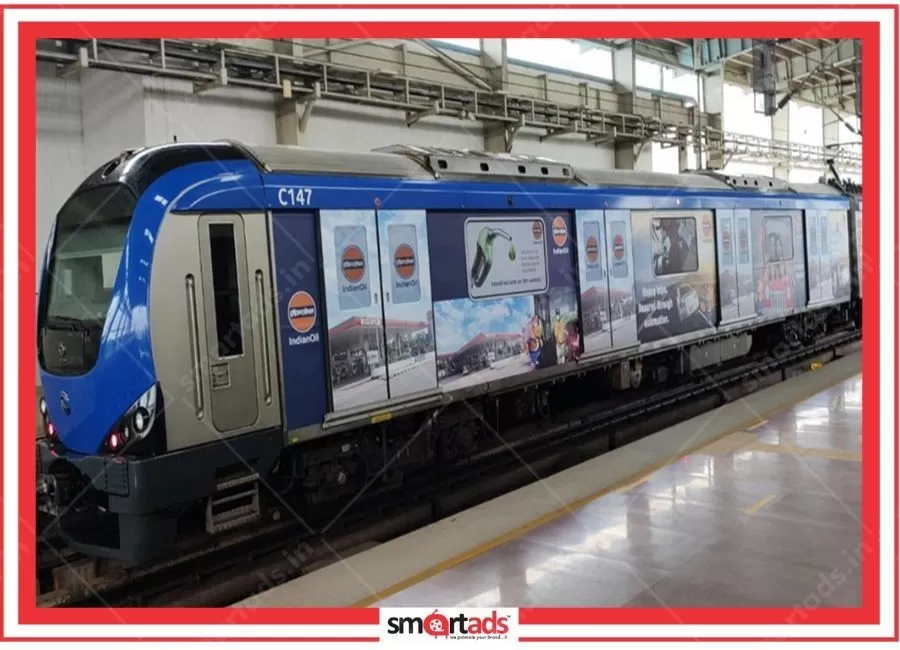
Exterior Metro Wrap
Size & Printing Cost as per actual
On the outside of metro Train, advertise
Rate per Metro Display Cost / 1 Month
6 Coach & Route : Samaypur Badli to Mill
₹3560000.00
Showing 1 to 5 of 5 Results
MEDIA DETAILS
Size & Printing Cost as per actual
On the outside of metro Train, advertise
Rate per Metro Display Cost / 1 Month
6 Coach & Route : Samaypur Badli to Mill
₹3560000.00
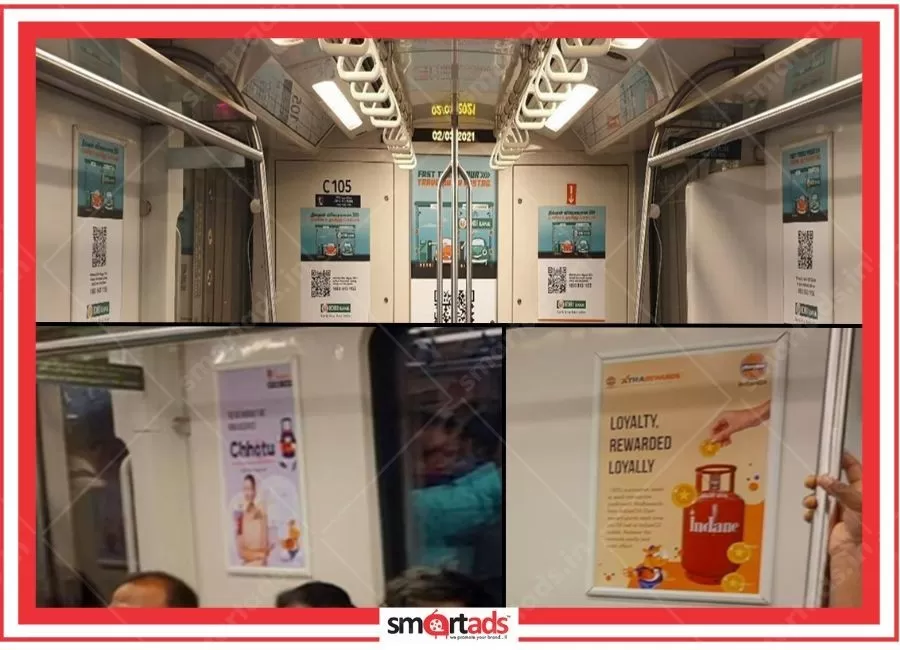
Size & Printing Cost as per actual
On the outside of metro Train, advertise
Rate per Metro Display Cost / 1 Month
8 Coach & Route : Samaypur Badli to Mill
₹1108000.00
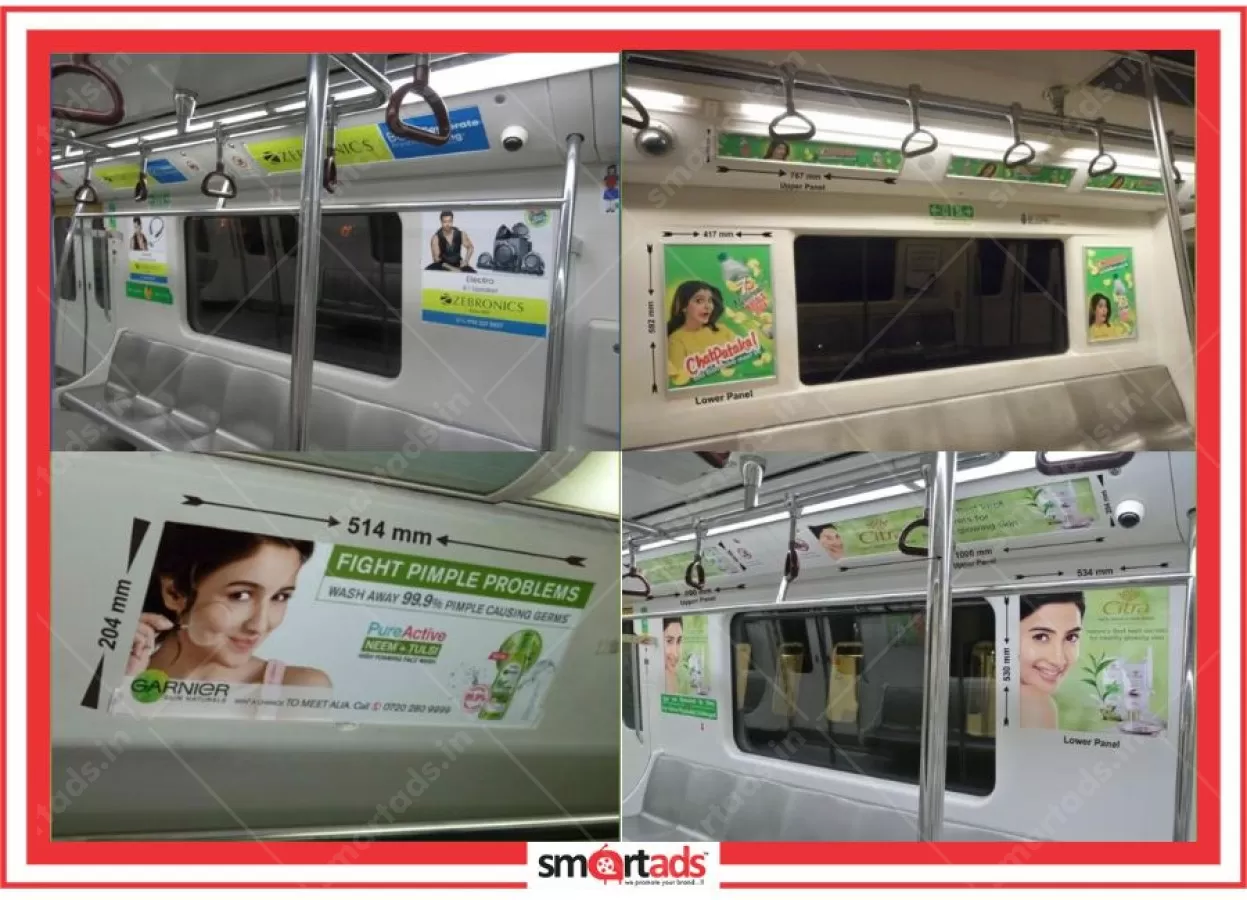
Size & Printing Cost as per actual
On the outside of metro Train, advertise
Rate per Metro Display / Month
8 Coach & Route : Samaypur Badli to Mil
₹830000.00
20 Sec Jingle
On the outside of metro Train, advertise
Rate per Metro Display Cost / Rate Per M
Route:Samaypur Badli To Huda City Centre
₹400000.00

Size & Printing Cost as per actual
On the outside of metro Train, advertise
Rate per Metro Display Cost / 1 Month
Route:Samaypur Badli To Huda City Centre
₹4150000.00
MEDIA REACH

MinimumQty :
1
EstimateReachPeople :
150000000
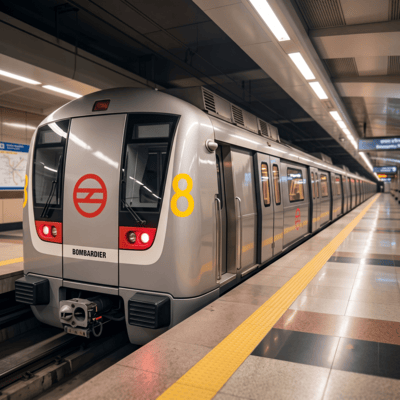
Most brand managers we speak to think of metro advertising as station hoardings — the backlit panels near the turnstiles, the pillar wraps near the escalators. What they consistently underestimate is the train itself; a moving, enclosed, high-dwell-time environment that carries somewhere in the ballpark of 1.4 million commuters every single day on the Yellow Line alone, which makes it one of the most concentrated captive audiences available in the entire Delhi NCR media landscape.
The Delhi Metro Yellow Line — officially Line 2, running 49 kilometres from Samaypur Badli in the north all the way down to Millennium City Centre Gurugram in the south — is not just a transit corridor; it is arguably the single most strategically positioned advertising artery in the National Capital Region, threading through North Delhi's dense residential zones, the commercial heart of Connaught Place, the institutional belt around AIIMS and Central Secretariat, and finally into the corporate towers of Gurgaon, which means a single campaign on this line touches audiences that most media planners would otherwise need three separate buys to reach.
There is a distinction that gets blurred surprisingly often, even among experienced media buyers, and it is worth being direct about it: advertising on the Delhi Metro Yellow Line train is fundamentally different from advertising at Yellow Line stations. Station advertising — platform screen door panels, concourse hoardings, elevator wraps — is sold under a separate inventory category by DMRC and its concessionaire partners; train advertising, by contrast, refers specifically to branded creatives placed on or inside the rolling stock itself, which travels the full 49-kilometre stretch of Line 2 across all 37 stations continuously throughout operating hours.
Metro train advertising in Delhi Yellow Line takes several forms, which we will cover in detail shortly, but the core principle is this: your brand travels with the audience rather than waiting for the audience to come to it. A full train wrap on the Yellow Line, for instance, turns the entire exterior of an 8-coach rake into a moving billboard that is visible at every platform, every level crossing, every above-ground stretch between Samaypur Badli and Gurgaon — and because the Yellow Line has significant above-ground sections particularly in the northern and southern stretches, exterior visibility is genuinely substantial, not just a theoretical benefit. Interior branding, on the other hand, captures the commuter during the journey itself, which is where dwell time becomes the decisive advantage: the average Yellow Line commute runs somewhere between 35 and 55 minutes end-to-end, which is a duration that most digital advertising formats can only dream of.
At SmartAds, we always tell our clients that metro train advertising occupies a unique middle ground in the media mix — it has the mass reach of OOH advertising, the captive audience quality of cinema, and the brand recall intensity of a well-placed television spot, all delivered through a single format that is, frankly speaking, still underpriced relative to its actual audience delivery when you run the numbers properly.
The Yellow Line's geographic sweep is what makes it genuinely special as an advertising medium. Starting at Samaypur Badli in the northwest — a dense, middle-income residential neighbourhood — the line moves south through Jahangirpuri, Adarsh Nagar, and Azadpur before entering the commercial belt around Kashmere Gate, which is also an interchange with the Red Line and Violet Line, meaning footfall here is compounded by passengers transferring from two other major corridors. From there, the line passes through Chandni Chowk, one of Delhi's oldest and highest-footfall commercial zones, before reaching New Delhi station, which connects to the Airport Express Line and handles some of the highest interchange volumes on the entire DMRC network.
South of New Delhi, the line runs through Rajiv Chowk — the Yellow Line's most critical station, which serves as the interchange with the Blue Line and is consistently among the top two or three busiest metro stations in India by daily footfall — and then continues through Central Secretariat, Udyog Bhawan, and Lok Kalyan Marg before reaching the institutional and residential belt around AIIMS metro station and Hauz Khas. The Hauz Khas station, which connects to the Magenta Line, is particularly interesting for brands targeting urban youth and students, given its proximity to Jawaharlal Nehru University, the IIT Delhi campus, and the Select Citywalk retail cluster. Further south, the line enters Gurgaon territory at Sikandarpur — which connects to the Gurugram Rapid Metro — and terminates at Millennium City Centre Gurugram, formerly known as HUDA City Centre, which is surrounded by some of the highest-density corporate campuses in the NCR.
What this routing means for a media planner is that a single Line 2 metro advertising campaign reaches genuinely diverse audience segments within one buy — the working-class commuter from Jahangirpuri, the government employee from Central Secretariat, the tech professional from Cyber City Gurgaon, and the student from South Delhi's university belt are all on the same train. We have found, across dozens of campaigns planned on this corridor, that very few other single-format media buys in Delhi NCR can claim that kind of audience diversity without significant budget fragmentation.
The full train wrap is the format that generates the most immediate brand impact, and it is also the one that most brands initially assume is out of their budget before they actually see the numbers. A full train wrap on the Delhi Metro Yellow Line involves vinyl branding applied to the complete exterior surface of an 8-coach rake — the sides, the front, and in some configurations the roof panels visible from elevated platforms — which transforms the entire train into a moving billboard that circulates across all 37 stations of Line 2 throughout the operating day. The visual impact at platforms is considerable; when a fully wrapped Yellow Line train pulls in, it commands attention in a way that a static hoarding simply cannot replicate, because the motion itself draws the eye before the audience has consciously decided to look.
IndiaMART was among the first brands to execute a full train wrap on the Yellow Line, and the campaign generated significant organic attention — photographs of the wrapped train circulated on social media without any paid amplification, which is a secondary reach benefit that most brands do not factor into their ROI calculations when they are evaluating train wrap advertising. Full train branding on this line is typically booked for a minimum of one month, though DMRC's standard contract terms for this format generally run to three months, which gives the campaign enough time to build the frequency needed for meaningful brand recall among regular commuters. The cost for a full train wrap on the Yellow Line works out to somewhere in the ballpark of ₹15 to ₹25 lakh per month depending on the rake assigned, the duration contracted, and the production specifications involved — numbers that, frankly, look very different when you divide them by the daily impressions delivered.
Interior train branding is where the real value lies for brands that want sustained engagement rather than just visual impact. Inside a Yellow Line coach, the available inventory includes wall panel branding along the sides of the coach above the windows, which are the large format panels that a seated or standing commuter faces directly for the duration of their journey; grab handle branding, which places brand messaging on the overhead handles that standing commuters hold, creating an unavoidable eye-level touchpoint; and seat branding metro formats, which apply vinyl creatives to the seat backs or headrests. Digital screens metro installations are also available in select newer rakes on the Yellow Line, which allow for dynamic content rotation and are particularly effective for brands running time-sensitive messaging or promotional offers.
The dwell time advantage of interior panel ads is something we emphasise consistently when advising clients on format selection. A commuter travelling from Samaypur Badli to Rajiv Chowk spends roughly 35 minutes inside the coach; one travelling end-to-end from Samaypur Badli to Millennium City Centre Gurugram spends close to an hour. During that time, they are in an enclosed environment with limited competing stimuli — no scrolling past your ad, no changing the channel, no walking past quickly — which produces brand recall rates that transit advertising research has consistently shown to be significantly higher than comparable OOH formats. Interior train branding on the Yellow Line can be booked at the individual coach level, which makes it accessible for brands with more modest budgets who want to test the format before committing to a full rake.
Exterior train branding — the application of vinyl graphics to the outside of the coaches — functions as a moving billboard in the truest sense, and the Yellow Line's route geometry makes this particularly effective. Between Samaypur Badli and Vishwavidyalaya, the line runs at grade or elevated, which means the exterior-branded train is visible not just to platform audiences but to pedestrians, motorists, and residents along the corridor. Similarly, the elevated sections through Gurgaon — from Sikandarpur southward — pass through some of the most commercially dense real estate in the NCR, where the branded train is visible from office towers, retail complexes, and arterial roads simultaneously. The exterior branding format is what generates the social media spillover effect we mentioned earlier; a well-designed exterior wrap on a Yellow Line train is photographed and shared by commuters regularly, which extends the campaign's effective reach beyond the platform audience alone.
This is an emerging format that most agency pages have not caught up with yet, and it represents a genuinely interesting opportunity for brands willing to move early. DMRC has been developing its in-train audio advertising inventory — essentially, branded audio spots or jingles that play through the coach's PA system during the journey, either as standalone metro jingles advertising or integrated with the station announcement sequence. Audio advertising DMRC formats on the Yellow Line work particularly well for brands whose identity is strongly tied to a sonic element — financial services brands, FMCG brands with established jingle recall, and app-based services where a spoken call-to-action is natural and effective.
The captive audience dimension of audio advertising on the Yellow Line is, if anything, even more pronounced than for visual formats, because passengers cannot look away from a sound the way they can avoid looking at a panel. We have seen this format generate strong unaided recall in post-campaign surveys, particularly among commuters who travel the same stretch daily and are exposed to the audio spot repeatedly across a campaign duration. The rates for audio advertising on DMRC Yellow Line are still being formalised as the format matures, but early indications suggest they are positioned attractively relative to the audience delivery, which makes this a format worth discussing with your media planning partner before it gets repriced upward as demand grows.
Frankly speaking, the absence of clear rate information on most agency websites is one of the most frustrating things about researching metro train advertising in Delhi Yellow Line — so let us be direct about the numbers as they stand in 2025, with the caveat that DMRC advertising rates are subject to periodic revision and production costs vary by vendor and creative complexity.
A full train wrap on the Yellow Line — covering all exterior surfaces of an 8-coach rake — is typically priced in the range of ₹18 to ₹25 lakh per month for the media space itself, with production costs (vinyl printing, application, and removal) adding somewhere between ₹8 and ₹15 lakh depending on the surface area covered and the quality of vinyl specified. Interior train branding at the full-rake level — covering all coach panels across all 8 coaches — works out to roughly ₹10 to ₹18 lakh per month, which is a number that surprises most clients when they compare it to what they are paying for a single premium outdoor hoarding in Connaught Place that reaches a fraction of the audience. Single-coach interior branding, which is the entry-level format for brands testing the medium, is available at somewhere in the ballpark of ₹1.5 to ₹3 lakh per coach per month, making it genuinely accessible for mid-sized brands and even well-funded SMEs who want a presence on the Yellow Line without committing to a full-rake buy.
The minimum campaign duration across most Yellow Line train advertising formats is three months, which is a DMRC contract requirement that catches some first-time advertisers off guard when they come expecting to run a one-month burst. This three-month minimum is actually a strategic advantage in disguise — research on transit advertising consistently shows that frequency of exposure is the primary driver of brand recall in commuter media, and a three-month campaign on the Yellow Line means that a regular commuter on the Jahangirpuri-to-Rajiv Chowk stretch will see your brand potentially 60 to 80 times during the campaign window, which is a frequency level that builds genuine brand awareness rather than just momentary recognition. Production timelines add another two to three weeks to the lead time, which means brands should ideally be briefing their agency four to six weeks before their intended campaign start date — and for festive season campaigns, we would recommend extending that lead time to eight weeks to account for the surge in bookings that typically happens between August and October.
At SmartAds, we have found that the most cost-efficient entry point for brands new to metro train advertising in Delhi Yellow Line is a single-coach interior branding package run across two or three coaches on the same rake, which gives the brand a presence across the train without the full-rake commitment, and allows for creative testing across different panel formats before scaling up.
The Yellow Line carries a daily ridership that is, in our experience, the most commercially attractive of any single metro line in Delhi — and that is not a casual observation. The line's north-to-south routing means it aggregates commuter audiences from some of the most economically diverse and commercially active zones in the NCR. The northern sections — Samaypur Badli, Jahangirpuri, Adarsh Nagar — draw primarily from middle-income residential catchments, which are heavily populated by working professionals in the ₹25,000 to ₹60,000 monthly income bracket, a demographic that is actively aspirational, brand-aware, and responsive to advertising for financial products, consumer electronics, FMCG brands, and e-commerce advertising platforms.
As the line moves south through the commercial core — Chandni Chowk, New Delhi, Rajiv Chowk — the audience composition shifts to include a significant proportion of government employees, traders, and tourists, which broadens the brand relevance for categories like banking, insurance, and retail. South of Rajiv Chowk, through the AIIMS metro station and Hauz Khas belt, the commuter profile skews younger — students commuters from Delhi University's south campus, JNU, and IIT Delhi make up a meaningful share of ridership in this stretch, which makes it particularly relevant for fintech advertising, ed-tech brands, and consumer app launches targeting urban youth. And then in the Gurgaon section — Sikandarpur through Millennium City Centre Gurugram — the audience is predominantly corporate: senior working professionals, expats, and decision-makers in the ₹1 lakh-plus monthly income bracket who are the primary target for premium consumer brands, B2B services, and luxury categories.
The aggregate daily footfall of roughly 1.4 million commuters on the Yellow Line, which is a figure derived from DMRC's own ridership data and cross-referenced against independent transit research, means that a full-rake campaign on this line delivers impressions at a CPM that works out to somewhere between ₹6 and ₹10 for exterior formats — a number that surprises most first-time advertisers when they compare it to what they are paying for programmatic digital display, which typically runs at ₹15 to ₹40 CPM in Delhi NCR with significantly lower dwell time and brand recall.
The honest answer is that the Yellow Line's advantage comes from its interchange geometry as much as its raw ridership numbers. Rajiv Chowk, which sits near the midpoint of the line, is the interchange with the Blue Line — the other major east-west artery of the DMRC network — and on a busy weekday, the combined footfall at Rajiv Chowk can exceed 500,000 passengers. A Yellow Line train that pulls into Rajiv Chowk is seen by Blue Line commuters waiting on the opposite platform, which means the exterior branding on a Yellow Line train generates impressions even among passengers who are not travelling on the Yellow Line itself. Kashmere Gate similarly amplifies reach by connecting to the Red Line and Violet Line, and New Delhi station's Airport Express connection means that international travellers and high-income domestic flyers are also part of the Yellow Line's audience footprint.
On top of that, the Yellow Line's above-ground sections — which are more extensive than those on the Blue Line's central Delhi stretch — give exterior train branding genuine roadside visibility, particularly in North Delhi between Samaypur Badli and Vishwavidyalaya, and in Gurgaon south of Sikandarpur. A brand running exterior train branding on the Yellow Line is, in effect, running a moving OOH campaign that is simultaneously visible to metro commuters, pedestrians, and motorists along the corridor — three distinct audience segments captured by a single format buy. This multi-surface reach is something that static transit advertising, however well-placed, simply cannot replicate.
We worked with a fintech client in 2023 who had previously been running a mix of digital and outdoor in Delhi NCR and was struggling to build brand awareness in the 25-to-40 working professional segment. We recommended a three-month interior train branding campaign on the Yellow Line covering four coaches per rake, combined with grab handle branding on the same coaches. Post-campaign brand recall surveys showed unaided recall among Yellow Line regular commuters at roughly 34%, which was nearly double the recall rate the same brand had achieved with a comparable spend on digital display in the same period — a result that, to be honest, even we found encouraging enough to reference in subsequent client conversations.
Rajiv Chowk is the obvious answer, and it is the right one — but the full picture is more nuanced than just pointing at the busiest interchange. Rajiv Chowk's value for train advertising specifically comes from platform dwell time: because it is an interchange station, passengers often wait longer on the platform for their connecting train, which means a Yellow Line train sitting at Rajiv Chowk is observed for longer than at a through-station. Chandni Chowk is similarly high-value, particularly for brands targeting retail consumers and the trading community, given the density of commercial activity in the surrounding area and the high proportion of first-time metro users who tend to be more attentive to in-station and on-train advertising.
AIIMS metro station deserves specific mention because it is consistently underestimated as a brand impact location. The catchment around AIIMS includes not just the hospital complex — which draws patients, families, and medical professionals from across India — but also the South Delhi residential belt, the Safdarjung Hospital corridor, and the Green Park-Hauz Khas commercial zone. For healthcare brands, pharmaceutical companies, insurance providers, and health-tech platforms, AIIMS metro station and the Yellow Line coaches that serve it represent a uniquely relevant audience concentration. Hauz Khas, similarly, is a station where the audience profile is strongly skewed toward urban youth and the creative-professional demographic, which makes it particularly relevant for lifestyle brands, fashion labels, and app-based consumer services.
At SmartAds, our experience shows that for brands with a specific geographic or demographic objective, the station-level audience data we compile for Yellow Line campaigns often reveals that the highest-impact stations for their particular category are not always the highest-footfall stations — a premium automotive brand, for instance, may find that Sikandarpur and Millennium City Centre Gurugram deliver better-qualified audience impressions than Rajiv Chowk, even though the raw footfall numbers at Rajiv Chowk are higher.
This is the question we get asked most often by clients who are new to metro train advertising in Delhi Yellow Line, and the honest answer is that it depends almost entirely on the campaign objective rather than the budget. Full train branding — the exterior wrap — is a brand awareness and visibility format; it generates high-impact impressions at every station the train visits, it creates social media spillover, and it signals brand scale in a way that few other formats can match. Interior train branding, by contrast, is a brand engagement format; it captures the commuter when they are stationary, attentive, and receptive, which produces higher dwell time per impression and, consequently, stronger brand recall and message retention.
The thing is, these two objectives are not mutually exclusive, and the most effective Yellow Line advertising campaigns we have executed have combined both formats — exterior branding for the awareness and reach dimension, interior panel ads and grab handle branding for the engagement and recall dimension. A retail client in Noida that we worked with in late 2022 ran exactly this combination on the Yellow Line for a three-month festive season campaign: the exterior wrap drove footfall to their stores from commuters who saw the train at stations, while the interior branding carried the specific promotional offer details that motivated the conversion. The campaign delivered a measurable 22% uplift in store visits from the Yellow Line catchment during the campaign period, which was tracked through a combination of store-level footfall counters and a campaign-specific discount code that appeared only in the interior branding creative.
To be fair, there are scenarios where one format clearly outperforms the other. For a brand launch or a rebranding exercise where the primary goal is maximum visibility in the shortest time, the full train wrap is the right choice — nothing else in the transit advertising inventory delivers the same visual scale. For a brand that already has strong awareness and is focused on driving a specific behaviour — downloading an app, visiting a website, redeeming an offer — interior train branding with a clear call-to-action is more efficient, because the commuter has time to process the message and act on it.
The Blue Line is longer and carries higher aggregate ridership than the Yellow Line, which makes it tempting to assume it is automatically the better advertising choice — but that conclusion misses some important nuances. The Blue Line's ridership is more heavily concentrated in the east Delhi and Noida sections, which skews the audience toward specific geographic catchments that may or may not align with a brand's distribution footprint or target consumer profile. The Yellow Line, by contrast, runs through a more commercially diverse corridor that includes both high-income Gurgaon and the dense middle-income residential zones of North Delhi, which gives it a broader audience profile in a single buy.
The Pink Line — Line 7, running from Majlis Park to Shiv Vihar — is a newer addition to the DMRC network and carries significantly lower daily ridership than either the Yellow Line or the Blue Line, which makes it a more targeted rather than mass-reach option. For brands specifically targeting the East Delhi and North-East Delhi residential market, the Pink Line has merit; for brands seeking maximum Delhi NCR reach from a single line buy, the Yellow Line remains our first recommendation, and that is a position we have held consistently across client briefs for several years now.
The interchange advantage of the Yellow Line is also worth restating in this comparative context: the Yellow Line's connections at Rajiv Chowk (Blue Line), Kashmere Gate (Red and Violet Lines), New Delhi (Airport Express), and Hauz Khas (Magenta Line) mean that a Yellow Line train is seen by passengers from virtually every other line in the DMRC network at some point during its operating day — a network exposure multiplier that the Pink Line and several other lines simply cannot match.
The booking process for metro train advertising in Delhi Yellow Line involves more steps than most clients expect, and understanding the sequence upfront saves significant time and prevents the last-minute scrambles that we have seen derail more than a few campaign launches. The first step is confirming inventory availability — DMRC's advertising rights on the Yellow Line are managed through authorised concessionaires, and specific rakes and formats may already be booked for a given period, particularly during the festive season window from September through November, which is when demand for Yellow Line advertising inventory peaks sharply.
Once availability is confirmed, the brand submits a booking request through the authorised agency, accompanied by the campaign brief, proposed creative concepts, and the intended campaign duration. DMRC's approval process then involves a content review — the corporation has specific guidelines around what can and cannot be advertised on its network, with restrictions on certain product categories (tobacco, alcohol, and politically contentious content are categorically excluded), and creative guidelines around minimum font sizes, colour contrast requirements for safety-critical signage areas, and the specific dimensions and bleed specifications for each format. For a full train wrap on the Yellow Line, the artwork specifications are particularly detailed, because the vinyl application must account for door openings, window frames, ventilation panels, and the specific body contours of the Mitsubishi-ROTEM and Bombardier MOVIA rolling stock that operates on this line — which is why working with an agency that has prior experience with Yellow Line train wrap production is genuinely important, not just a sales pitch.
After DMRC content approval — which typically takes between five and ten working days — the production phase begins, which involves printing the vinyl creatives, scheduling the application work (which is done during non-operating hours, typically between 11 PM and 4 AM), and conducting a quality inspection before the branded rake is cleared for service. The entire process from booking confirmation to campaign go-live typically takes four to six weeks, which is the lead time we consistently recommend to clients as a minimum — and which we extend to eight weeks for complex full train wrap campaigns or for campaigns targeting the October-November festive window.
Return on investment measurement for metro train advertising in Delhi Yellow Line is an area where the industry has matured considerably over the past few years, even if it has not yet reached the attribution precision of digital channels — and frankly, expecting digital-level attribution from a physical transit medium is the wrong benchmark to apply. The more useful framework, which we use with our clients at SmartAds, is to measure brand recall uplift, audience reach efficiency, and downstream behavioural indicators rather than looking for a direct click-to-conversion path.
Brand recall measurement is typically done through pre- and post-campaign surveys among Yellow Line regular commuters, which can be commissioned through independent research firms and structured to measure both aided and unaided recall for the advertised brand. The dwell time advantage of interior train branding on the Yellow Line — which, as noted, runs to 35-55 minutes for end-to-end commuters — consistently produces unaided recall rates in the 25-40% range in post-campaign research, which compares very favourably to the 8-15% unaided recall typically reported for roadside OOH formats in comparable research. Reach efficiency, measured as cost-per-thousand impressions, works out to somewhere between ₹6 and ₹12 for Yellow Line train advertising depending on the format, which is competitive with mid-tier television advertising and significantly more efficient than premium outdoor in the same geography.
Downstream behavioural measurement — tracking website traffic spikes, app download surges, or store visit uplifts during and after the campaign period — is the most direct ROI signal available for most categories, and it is something that can be structured into the campaign design from the outset. One automotive brand we worked with ran a three-month exterior train branding campaign on the Yellow Line and tracked dealership enquiry volumes from the Delhi NCR region during the same period; enquiries from the Yellow Line catchment — specifically the Gurgaon and South Delhi zones — showed a 28% increase during the campaign months compared to the equivalent period in the prior year, which was a result that the brand's marketing team used to justify a repeat booking the following year.
The Yellow Line's audience diversity means that a wider range of categories can find a relevant audience on this line than on almost any other single format in Delhi NCR — but some industries consistently outperform others, and it is worth being specific about why. E-commerce advertising and consumer app brands have been among the heaviest users of Yellow Line advertising in recent years, which makes sense given that the commuter audience is smartphone-native, digitally active, and accustomed to making purchase decisions on mobile during their commute. FMCG brands — particularly in the personal care, packaged food, and household products categories — find the Yellow Line's mass reach and demographic breadth well-suited to their broad-audience objectives, and the brand awareness impact of a full train wrap for an FMCG launch is difficult to replicate at comparable cost through any other single-format buy.
Fintech advertising has grown significantly on the Yellow Line over the past three years, driven by the strong working professional and urban youth audience concentration on the line; brands in the mutual fund, insurance, digital payments, and personal finance categories have found that the captive audience environment of interior train branding produces strong message retention for the kind of considered-purchase messaging that financial products require. Real estate brands targeting the Gurgaon and South Delhi residential markets have also been consistent Yellow Line advertisers, using exterior train branding to build project awareness among the commuter audience that is, by definition, already thinking about the geography the line serves. Educational institutions — particularly those targeting students commuters in the AIIMS-to-Hauz Khas belt — have found the Yellow Line to be an efficient channel for admissions-season campaigns, with the interior panel ads format allowing for detailed course and eligibility information that a roadside hoarding could not carry.
Q: What is metro train advertising on the Delhi Yellow Line?
Metro train advertising on the Delhi Yellow Line refers to brand creatives placed on or inside the rolling stock of DMRC's Line 2 — the 49-kilometre corridor running from Samaypur Badli to Millennium City Centre Gurugram across 37 stations. It is distinct from station advertising and includes formats such as full exterior train wraps, interior coach panel branding, grab handle branding, seat branding, and in-train audio advertising. The medium is classified as transit advertising within the broader BTL and OOH advertising categories, and it is managed through DMRC's authorised advertising concessionaires.
Q: How much does it cost to advertise on the Delhi Metro Yellow Line train in 2025?
As of 2025, a full train wrap on the Yellow Line is priced in the range of ₹18 to ₹25 lakh per month for media space, with production costs adding ₹8 to ₹15 lakh. Full-rake interior branding across all 8 coaches runs roughly ₹10 to ₹18 lakh per month, while single-coach interior branding is available at approximately ₹1.5 to ₹3 lakh per coach per month. These are indicative ranges; actual rates depend on the specific format, rake assignment, campaign duration, and the production specifications involved. The minimum campaign duration is typically three months under DMRC contract terms.
Q: What ad formats are available on Yellow Line (Line 2) metro trains?
The available formats on Yellow Line trains include full exterior train wraps (covering the entire outside surface of the rake), exterior partial wraps, interior wall panel branding above the windows, grab handle branding on overhead handles, seat branding on seat backs, digital screen advertising on rakes equipped with in-coach screens, and in-train audio advertising through the PA system. Each format has different minimum booking requirements, creative specifications, and pricing structures, which is why working with an experienced metro advertising agency Delhi is important for navigating the options efficiently.
Q: How many coaches does the Yellow Line metro train have for branding?
The Yellow Line operates with 8-coach rakes, which means a full-rake interior branding campaign covers 8 coaches. Each coach has multiple panel positions — typically four to six large wall panels per side, plus overhead grab handle positions and seat back positions — giving the format significant creative real estate within each coach. Brands can book individual coaches for interior branding, or the full rake for maximum coverage.
Q: How many daily commuters travel on the Delhi Metro Yellow Line?
The Yellow Line carries approximately 1.4 million daily commuters, making it one of the highest-ridership lines in the DMRC network. This figure is derived from DMRC's published ridership data and represents the daily audience pool for any train advertising campaign running on Line 2. The actual impressions delivered by a specific format will depend on the number of rakes branded and the frequency with which those rakes circulate across the line during operating hours.
Q: What is the minimum campaign duration for Yellow Line metro train advertising?
The standard minimum campaign duration for train advertising on the Yellow Line is three months, which is a DMRC contract requirement for most train branding formats. This minimum is actually strategically beneficial, because transit advertising research consistently shows that frequency of exposure — which accumulates over a three-month window among regular commuters — is the primary driver of brand recall in this medium. Some formats, particularly single-coach interior branding, may have more flexible minimum terms; this is worth confirming with your agency at the briefing stage.
Q: Can I book just one coach for interior branding on the Yellow Line?
Yes, single-coach interior branding is available on the Yellow Line and represents the most accessible entry point for brands testing the metro train advertising format. A single coach gives the brand presence on one of the 8 coaches in a rake, which means roughly one-eighth of the passengers boarding that rake will be exposed to the interior branding during their journey. For brands with limited budgets or those running a pilot campaign before scaling up, booking two or three coaches on the same rake is a common approach that increases audience coverage without requiring a full-rake commitment.
Q: Which stations on the Yellow Line get the most footfall for brand visibility?
Rajiv Chowk consistently records the highest footfall on the Yellow Line and is among the top two or three busiest stations in the entire DMRC network; it is also the Blue Line interchange, which means Yellow Line trains are seen by Blue Line
