
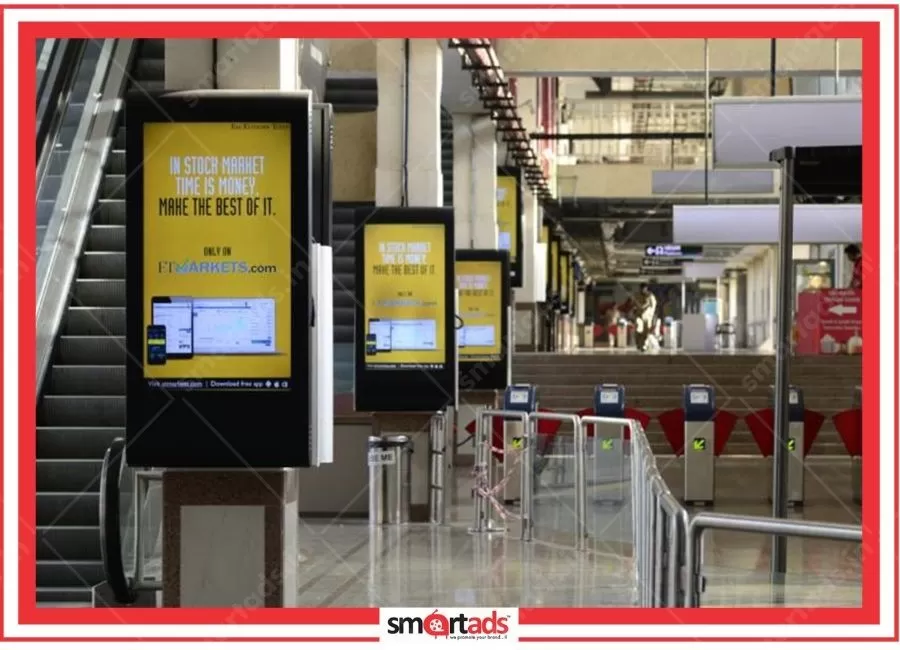
Entry Exit Panel
8 ft x 4 ft
Bright and vibrant multicolored letterin
Rate per Panel / 1 Month
Min Requirement is 3 Panel
₹48000.00
Showing 1 to 4 of 4 Results
MEDIA DETAILS
8 ft x 4 ft
Bright and vibrant multicolored letterin
Rate per Panel / 1 Month
Min Requirement is 3 Panel
₹48000.00
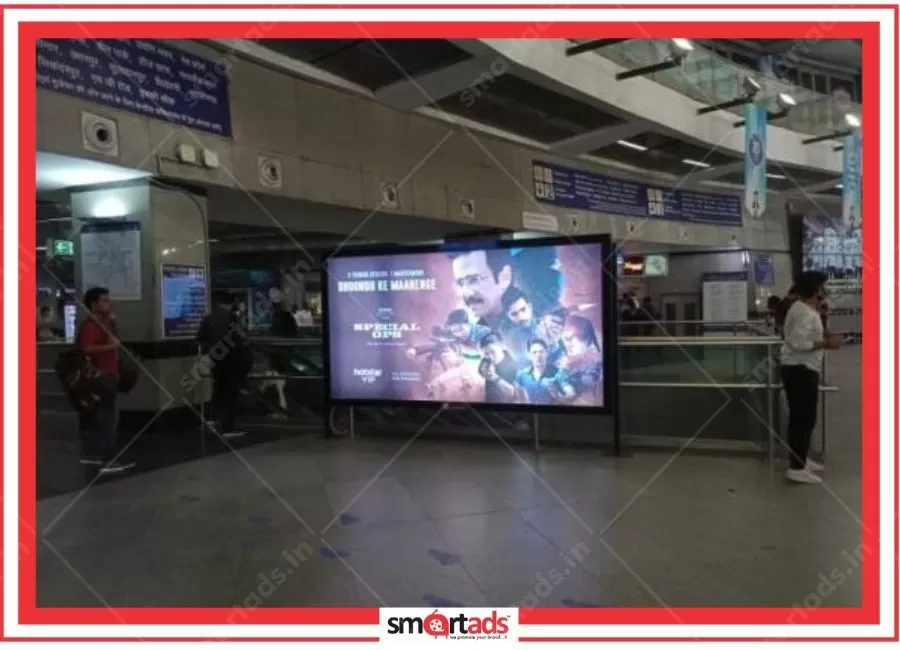
10 ft X 5 ft
A new wide wall system designed to accom
Rate per Panel / 1 Month
Min Requirement is 3 Panel
₹50000.00
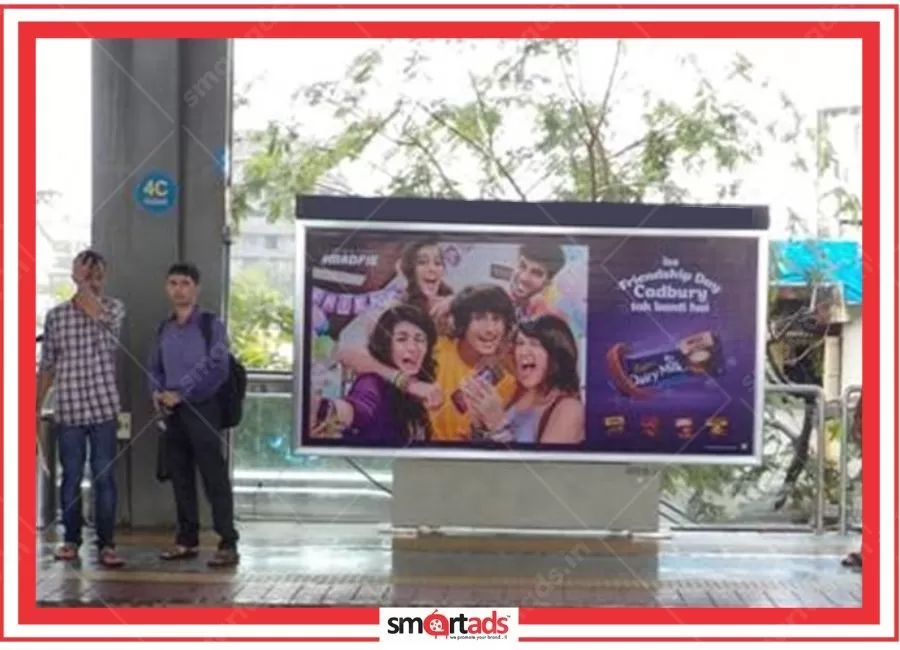
8 ft x 4 ft
A raised flooring or other horizontal su
Rate per Panel / 1 Month
Min Requirement is 3 Panel
₹35000.00
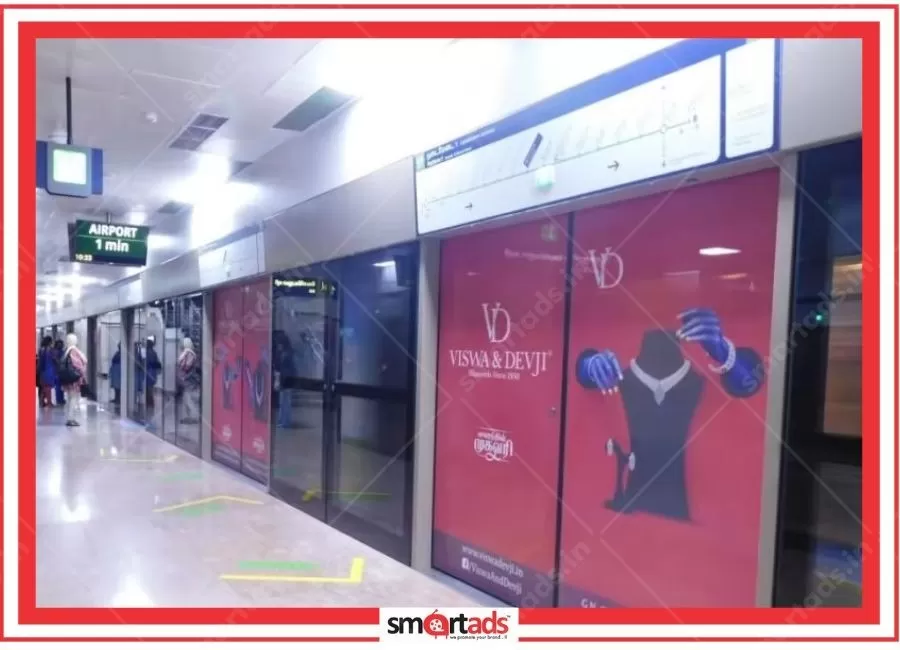
7 ft x 4 ft
Also known as platform edge doors (PEDs)
Rate per Plateform / 1 Month
Min Requirement is 1 Station
₹1200000.00
MEDIA REACH

MinimumQty :
10
EstimateReachPeople :
15 Million
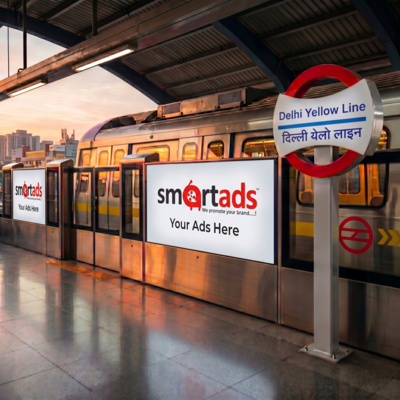
The Yellow Line carries somewhere in the ballpark of 8 to 10 lakh passengers every single day — and unlike a highway billboard that a driver glances at for three seconds, a metro commuter spends an average of 28 to 45 minutes inside the system, which means your brand gets sustained, repeated exposure in a way that most outdoor formats simply cannot match. What surprises most brand managers we work with is that metro station advertising in Delhi Yellow Line still tends to be significantly underpriced relative to the quality of audience it delivers, particularly when you compare the cost per impression to what premium digital placements are charging for the same urban professional demographic.
There is a reason experienced media planners tend to recommend DMRC Yellow Line advertising before they recommend almost anything else in Delhi NCR — and it is not just about footfall numbers. The Yellow Line, officially Line 2, runs from Samaypur Badli in North Delhi all the way down to Millennium City Centre Gurugram (formerly HUDA City Centre), cutting through the spine of the city and passing through some of the most commercially significant neighbourhoods in the entire country. Rajiv Chowk, which sits at the intersection of the Yellow and Blue Lines and functions as the busiest interchange station in the DMRC network, alone sees footfall figures that rival mid-sized airport terminals on a weekday.
What makes this corridor genuinely special from an advertising standpoint is the demographic consistency across the full stretch. The commuter profile shifts slightly as you move from Kashmere Gate metro station in the north through Central Secretariat and AIIMS metro station in the middle belt and then down into Hauz Khas metro advertising territory and eventually into the Gurugram corporate belt — but the through-line is urban, educated, economically active adults, which is precisely the audience that most mid-to-premium brands are trying to reach. We have found, across hundreds of campaigns planned through SmartAds, that the Yellow Line delivers a higher concentration of SEC A and SEC B audiences than almost any comparable out-of-home advertising Delhi format.
The captive audience advertising dynamic is what really sets metro advertising apart from traditional OOH. A commuter waiting on a platform has nowhere else to look; they are not driving, not scrolling, not multitasking in the way they might be at home. Brand recall metro advertising studies — including data referenced in the FICCI-EY Media & Entertainment Report — consistently show that transit environments produce recall rates that are substantially higher than static roadside formats, which is something we always bring up when clients are comparing metro station advertising in Delhi Yellow Line against conventional hoardings in the same geography.
The inventory of advertising formats available within the DMRC Yellow Line system is considerably broader than most advertisers realise when they first approach us, and the range has expanded meaningfully over the last three to four years as DMRC has modernised its concourse areas and introduced digital infrastructure at several key stations. At the most fundamental level, you have backlit panel advertising — the illuminated static displays positioned across platforms, concourses, entry-exit passages, and ticketing halls — which remain the backbone of most yellow line station branding campaigns because of their reliability, visual impact, and relatively accessible entry cost.
Beyond static backlit panels, the format menu includes digital OOH metro screens at select high-footfall stations, which allow for dynamic content rotation and time-of-day targeting; pillar branding metro formats that wrap the structural columns of station concourses in branded vinyl; staircase branding metro station executions that turn the high-traffic vertical transitions between levels into extended brand canvases; and platform screen door branding, which places your creative directly in the sightline of every passenger waiting for a train. Entry gate advertising metro formats — wrapping the fare gate barriers and the immediate entry zone — are particularly effective for brands that want to create a strong first impression at the point where commuters mentally transition from street to station.
For brands with larger budgets and a desire for complete environment ownership, there is full train branding on the Yellow Line, which involves wrapping the exterior of an entire train rake in branded graphics; interior train branding, which covers ceiling panels, overhead grab bars, door panels, and seat-back areas inside the coaches; and in-train audio advertising on the Delhi Metro Yellow Line, which plays brand messages through the PA system at station stops. On top of that, DMRC station naming rights advertising represents the most premium and long-term format available, where a brand co-names a station — a format that has been executed on the Yellow Line and is something we will address in detail later in this piece.
Frankly speaking, yellow line advertising rates are one of the most searched-for pieces of information in the metro advertising space, and also one of the most poorly documented — most vendor pages either refuse to publish rates or give figures so broad they are useless for planning purposes. We will try to be genuinely useful here, based on what we see in the market regularly, with the caveat that DMRC advertising inventory is managed through authorised concessionaires and rates do shift based on station tier, format, and campaign duration.
For a standard backlit panel at a mid-tier Yellow Line metro station, the metro advertising cost per month works out to somewhere between ₹25,000 and ₹60,000 per panel, depending on the station's footfall classification and the panel's placement within the station — a platform-facing panel commands a premium over a concourse panel at the same station. At premium stations like Rajiv Chowk metro station advertising inventory, where demand is consistently high, a single backlit panel can be priced in the ballpark of ₹80,000 to ₹1.5 lakh per month, which is a number that surprises some clients until they see the daily footfall data for that station and realise the cost per impression is still remarkably efficient. Digital OOH metro screens at high-footfall stations are priced higher, typically starting at roughly ₹1 lakh per month for a slot in a rotation, with DOOH metro advertising at Rajiv Chowk or New Delhi metro station commanding significantly more.
Full train branding yellow line campaigns — which involve exterior train wrap yellow line and interior train branding combined — are in a different budget category entirely, generally starting somewhere north of ₹15 lakh for a four-week campaign on a single rake, with the total cost varying based on whether you are doing exterior only, interior only, or a full integrated execution. In-train audio advertising on the Yellow Line, which is a relatively newer and still somewhat underutilised format, tends to be more accessible in cost terms, with monthly rates that we have seen quoted in the range of ₹3 to ₹8 lakh depending on frequency and station-stop coverage. At SmartAds, we always tell our clients that the most important number is not the absolute rate but the cost per thousand impressions — and on the Yellow Line, that CPM frequently works out to figures that make premium digital placements look expensive by comparison.
Not all 37 stations on the Yellow Line are created equal from an advertising standpoint, and understanding which stations to prioritise is genuinely the difference between a campaign that performs and one that merely runs. Rajiv Chowk is the undisputed anchor — as the interchange between Line 2 and Line 3 (Blue Line), it sees footfall that is categorically different from any other station on the network, and advertising here carries a reach multiplier that justifies the premium. Kashmere Gate metro station, which serves as the interchange hub connecting the Yellow Line with the Red Line and the Violet Line, is similarly high-value, particularly for brands targeting North Delhi commuters and the large student and working-class population that moves through that corridor.
Moving south, New Delhi metro station and Central Secretariat are critical for brands targeting government employees, diplomats, and the professional class that works in the Lutyens' Delhi zone; AIIMS metro station is one of the most interesting stations on the entire line from a targeting perspective, given the concentration of medical professionals, patients, and the dense residential catchment of South Delhi that feeds into it. Hauz Khas metro advertising is particularly valuable for brands targeting young urban professionals and the premium residential demographic of South Delhi — we have run campaigns for an edtech brand at Hauz Khas and Malviya Nagar that delivered significantly better response rates than the same creative running at more generic stations, which reinforced our view that station selection is as important as format selection.
In the Gurugram stretch, Sikandarpur metro station and HUDA City Centre advertising (now Millennium City Centre) are the anchors for reaching the corporate belt — the daily ridership yellow line at these stations skews heavily toward IT professionals, finance sector employees, and senior management commuters, which makes them ideal for premium financial products, business software, luxury real estate, and high-end consumer goods. Qutub Minar metro station and Chattarpur serve a somewhat different demographic — more mixed, with strong representation from the residential South Delhi population — and are worth considering for FMCG brands and consumer durables that want broader household reach. The Gurugram metro advertising opportunity at the southern end of the line is, in our experience, consistently underutilised by brands that focus their entire budget on the Delhi stations without recognising that the Gurugram commuter is often the higher-income decision-maker they are actually trying to reach.
The honest answer is that the Yellow Line works for a wider range of brands than most people assume, but there are certain categories where we have seen it deliver exceptional results and others where the fit is more situational. Edtech and upskilling platforms are among the most natural advertisers on this corridor — the Yellow Line's commuter base is disproportionately young, educated, and professionally ambitious, which is exactly the profile that platforms offering professional certifications, MBA prep, and skill development are targeting. We have worked with an edtech client who ran a three-month campaign across eight Yellow Line stations and saw a measurable spike in organic branded search volume in Delhi NCR that correlated directly with the campaign period, which is about as close to attribution as you can get in OOH advertising.
Financial services — particularly retail banking, mutual fund brands, insurance, and the newer fintech players — find the Yellow Line extremely productive because the audience's economic profile aligns well with financial product uptake. Real estate developers, particularly those with projects in South Delhi, Gurugram, or along the metro corridor itself, have long recognised the value of metro station advertising in Delhi Yellow Line as a way to reach aspirational homebuyers during their daily commute; one real estate client we worked with in the NCR market ran pillar branding and backlit panels across six stations from Hauz Khas to Sikandarpur and generated qualified inquiry volumes that outperformed their digital campaigns at a fraction of the cost per lead.
FMCG brands, consumer electronics, telecom companies, and OTT streaming platforms all have strong cases for advertising on the Yellow Line, and the format choice matters enormously for each. A telecom brand benefits from the high-frequency, repeated exposure of backlit panels across multiple stations; an OTT platform launching a new show might prefer a short, high-impact burst using full train branding yellow line or digital DOOH metro advertising screens for a two-week window; an FMCG brand might find that entry gate advertising metro formats at high-footfall stations create the kind of ambient, subconscious brand exposure that drives purchase consideration over time. Targeted advertising working professionals is where the Yellow Line genuinely excels, and any brand whose core customer is an urban professional between 22 and 45 years old should have this line on their media plan.
This is a question we get asked regularly, and the answer is more nuanced than a simple ranking. The Blue Line (Line 3/4) is the other major contender for advertising budgets in Delhi Metro, and it has the advantage of connecting East Delhi, Noida, and Dwarka — giving it a broader geographic spread. However, the Yellow Line's demographic profile tends to be more concentrated in the SEC A/B bracket, particularly in its southern stretch, which gives it an edge for premium brand advertising even if the Blue Line has comparable or slightly higher total ridership on certain segments.
The Red Line (Line 1), which runs from Rithala to Shaheed Sthal (New Bus Adda), serves a predominantly working-class and lower-middle-class commuter base in North Delhi, which makes it excellent for mass-market FMCG, telecom, and value retail brands but less suited for premium financial products or luxury categories. The Violet Line and Magenta Line serve important corridors but have lower absolute ridership than the Yellow and Blue Lines, which means the reach numbers are smaller even if the audience quality at certain stations is high. Delhi Metro Line 2, in our assessment, offers the best combination of high absolute footfall, premium audience demographics, and geographic coverage of the most commercially important zones in Delhi NCR — which is why we typically recommend it as the first line to invest in for brands new to DMRC advertising.
One comparison that is genuinely useful for budget-allocation decisions is Yellow Line versus traditional outdoor hoardings in Delhi. A premium hoarding on a major South Delhi arterial road — say, the Aurobindo Marg or the Outer Ring Road — can cost anywhere from ₹3 to ₹8 lakh per month, with exposure that is limited to vehicular traffic and highly dependent on traffic patterns and sightline. The same budget deployed across multiple yellow line metro station backlit panels delivers a captive audience advertising environment with measurably higher dwell time, better brand recall metro advertising scores, and the ability to reach commuters who may not be driving at all — a growing segment of the urban professional population that has deliberately chosen metro over car. The OOH advertising Delhi metro format, in other words, is not a substitute for outdoor hoardings but a genuinely different and often superior medium for certain audience objectives.
In-train audio advertising is one of the most underappreciated formats in the DMRC advertising inventory, and frankly speaking, it is one that we have been recommending more actively to clients over the last year or two as the format has matured. The basic mechanic is straightforward — a brand's audio message, typically a 10 to 20 second jingle or announcement, is played through the PA system inside Yellow Line coaches at designated station stops, which means every passenger in the train hears it at the moment they are stationary and attentive. Metro jingle advertising has a long history in global transit systems, and the DMRC's expansion of this format to the Yellow Line has opened up a genuinely interesting new channel for brands that have strong audio identities.
What makes in-train audio advertising particularly interesting is the combination of captive audience advertising conditions and the psychological state of the commuter at that moment — they are not distracted by traffic, they are often not on their phones (or are using them with headphones, meaning ambient audio still registers), and the station announcement context gives the brand message a degree of authority and attention that a social media ad rarely achieves. We have seen this format work especially well for brands with strong sonic branding — telecom companies, financial services brands, and consumer goods companies that have invested in recognisable jingles find that metro jingle advertising reinforces their broader brand recall in a way that compounds with their other media investments.
The cost structure for in-train audio advertising on the Delhi Metro Yellow Line is, as noted earlier, more accessible than most brands expect; the format is still building its advertiser base, which means there is a window right now to secure good inventory at rates that will likely increase as demand grows. At SmartAds, we have been tracking the expansion of this format and believe it represents one of the better value opportunities in the current DMRC advertising landscape for brands that are willing to think beyond the visual formats that most competitors default to.
Full train branding on the Yellow Line — officially Delhi Metro Line 2 — involves taking an entire train rake and transforming it into a moving brand statement, which is about as close as you can get to owning a piece of the urban landscape in a major Indian city. The format typically has two components: exterior train wrap yellow line, where the outside of the coaches is covered in large-format branded graphics, and interior train branding, which covers the ceiling panels, overhead grab bars, door decals, and sometimes seat-back panels inside the coaches. IndiaMART is often cited as one of the pioneering brands that executed a full train wrap on the Delhi Metro, and the visibility that a branded train generates — both on the platform and as it moves through the elevated sections of the line — is genuinely difficult to replicate with any other format.
The campaign mechanics are worth understanding clearly. A single rake on the Yellow Line typically consists of six to eight coaches, and the exterior wrap requires high-durability vinyl that meets DMRC's technical specifications for adhesion, finish, and removability. The production costs for a full exterior train wrap yellow line are significant — in the ballpark of ₹8 to ₹12 lakh for materials and installation alone — and these are separate from the DMRC media rights fee, which brings the total campaign cost for a four-week full train branding yellow line execution into the ₹20 to ₹35 lakh range depending on the scope of the interior component. This is not a format for every budget, but for a brand launch, a major product campaign, or a high-visibility festive season push, the impact is proportionate to the investment.
What a lot of people miss is the earned media dimension of full train branding — a fully wrapped Yellow Line train gets photographed and shared on social media by commuters, which extends the campaign's reach well beyond the direct metro audience. We have seen this happen organically with clients who ran bold, visually striking exterior train wrap yellow line campaigns, where the train itself became a piece of content that circulated on Instagram and Twitter, effectively amplifying the campaign's reach at no additional cost. The key is investing in creative that is genuinely worth photographing, which is a conversation we always have with clients before they commit to this format.
Station naming rights DMRC is the most premium, long-term advertising format in the entire DMRC inventory, and it is one that is often misunderstood in terms of how it actually works. Under the DMRC co-branding model, a brand pays for the right to have its name appended to an existing station name — so a station like Hauz Khas becomes "Hauz Khas [Brand Name]" in announcements, on signage, and in official communications. This is not renaming the station; it is a co-branding arrangement, which means the original station name is retained while the brand name is added, giving the brand repeated, organic exposure every time the station is announced over the PA system, displayed on the metro map, or referenced in navigation apps.
The commercial terms for station naming rights DMRC on the Yellow Line are negotiated directly with DMRC and are typically structured as multi-year contracts, with annual fees that vary considerably based on the station's footfall and commercial significance. A mid-tier station might be available for a co-branding fee in the range of ₹50 to ₹80 lakh per year, while a high-footfall station like AIIMS or Central Secretariat would command significantly more — figures that are, to be honest, not publicly standardised and require direct negotiation. The value proposition is clear: every single announcement, every metro map reference, every navigation app direction that mentions the station carries the brand name, which means the brand is woven into the daily language of millions of commuters in a way that no other advertising format can replicate.
We have advised clients on station naming rights DMRC inquiries, and our honest assessment is that it makes most sense for brands with long-term market-building objectives in Delhi NCR — financial institutions, telecom companies, real estate developers, and large consumer brands that are committed to the market for the long term. It is not a format for short-term campaign thinking, but for the right brand with the right objectives, it is arguably the most cost-efficient premium branding investment available in the Delhi market when you calculate the per-impression cost over the full contract period.
Backlit panel advertising remains the workhorse of metro station advertising in Delhi Yellow Line, and for good reason — the format is reliable, visually impactful, available across all 37 stations, and accessible at a range of budget levels that makes it viable for brands of different sizes. The panels are illuminated from behind, which means they are equally visible in the bright fluorescent environment of a metro station concourse and in the lower-light conditions of underground platforms; the consistent visibility regardless of ambient light is something that distinguishes backlit panel advertising from standard printed formats.
The placement hierarchy within a station matters enormously for campaign effectiveness. Panels positioned at the entry-exit gates and in the ticketing hall capture commuters at the highest-attention moment of their station experience — the moment of entry, when they are transitioning from the street and their attention is freshly available. Platform-level panels, which face commuters waiting for trains, benefit from the extended dwell time of the platform wait, which is typically two to four minutes per journey leg. Concourse panels and corridor placements have lower individual attention but higher total impression counts because of the volume of traffic moving through those spaces. A well-structured backlit panel advertising campaign on the Yellow Line will typically layer placements across these different zones to create a surround-sound brand environment.
Digital OOH metro screens — DOOH metro advertising — are available at a smaller number of Yellow Line stations but offer capabilities that static panels cannot match: dynamic content rotation, time-of-day targeting (so a coffee brand can run morning-commute creatives and an evening entertainment brand can run post-work content), and the ability to update messaging without reprinting. The DOOH metro advertising inventory on the Yellow Line is concentrated at the higher-footfall stations, and demand for these slots is consistently high, which means early booking is essential. Ambient lit panel metro formats — a hybrid between traditional backlit and full digital — are also present at several stations and offer a middle ground in terms of both capability and cost.
Pillar branding metro is one of those formats that tends to get overlooked in initial media planning conversations but consistently delivers strong results when it is executed well. The structural columns that run through metro station concourses are unavoidable — commuters walk past them, stand near them, and look at them while waiting, which gives pillar branding metro executions a 360-degree visibility that flat panels simply cannot achieve. A brand that wraps four to six pillars in a concourse creates an immersive environment rather than a single advertising touchpoint, which is a meaningful difference in terms of brand recall metro advertising impact.
The creative possibilities with pillar branding are also broader than with flat panels — the cylindrical or rectangular column format allows for narrative storytelling across multiple faces, with different sides of the pillar carrying different elements of a campaign message that the commuter encounters as they move around the space. We have executed pillar branding campaigns for a financial services client at three Yellow Line stations where each pillar face carried a different product benefit, creating a sequential brand story that commuters encountered over multiple days of their regular commute; the campaign's brand association scores in a post-campaign survey were notably higher than the same client's previous backlit panel-only campaigns.
Pillar branding metro costs on the Yellow Line are generally structured per pillar per month, with rates that vary by station tier and pillar placement within the station. At a mid-tier station, a single pillar wrap might cost somewhere between ₹15,000 and ₹40,000 per month; at premium stations, the cost per pillar is higher, but the impact justification is also stronger. The minimum booking for pillar branding is typically a set of four to six pillars within a single station, which creates the environmental impact that makes the format worthwhile — a single branded pillar in a large concourse tends to get lost, while a cluster of branded pillars creates the kind of brand environment that registers.
The booking process for metro station advertising in Delhi Yellow Line runs through DMRC's authorised advertising concessionaires — DMRC does not sell advertising inventory directly to brands, which means working with an authorised yellow line advertising agency is not just convenient but structurally necessary. The current concessionaire landscape for DMRC advertising involves several authorised partners who hold rights to different station groups and format categories, and navigating this landscape efficiently requires either significant prior experience with the system or a metro advertising agency Delhi that has established relationships with the relevant concessionaires.
The practical steps, as we walk our clients through them at SmartAds, begin with a brief that defines the campaign objective, target audience, geographic focus within the line, format preference, and budget envelope. From that brief, we identify the optimal station mix and format combination, confirm inventory availability with the relevant concessionaires, and prepare a media plan with rate cards and reach projections. The DMRC approval process for advertising artwork is a step that many first-time advertisers underestimate — DMRC has specific content guidelines that prohibit certain categories of advertising (political content, content that could be deemed offensive or misleading) and requires artwork to be submitted for approval before production begins, which adds a lead time requirement that needs to be factored into campaign timelines.
On the question of lead time: for standard backlit panel advertising campaigns on the Yellow Line, a minimum of three to four weeks from brief to installation is a realistic planning assumption, accounting for artwork approval, production, and installation scheduling. For more complex executions — full train branding yellow line, pillar branding across multiple stations, or DOOH metro advertising — the lead time extends to six to eight weeks, and for station naming rights DMRC, the negotiation and contracting process can take several months. Artwork specifications for DMRC advertising are format-specific but generally require high-resolution files (typically 300 DPI or higher for print formats), specific colour profiles, and compliance with DMRC's visual identity guidelines for co-branded content.
Metro branding ROI is a conversation that comes up in almost every client meeting, and we have strong views on how to approach it honestly. The direct attribution challenge with out-of-home advertising Delhi metro formats is real — you cannot click on a backlit panel, and the path from metro exposure to purchase is rarely linear or trackable in the way that a digital campaign is. What you can measure, and what we consistently track for our clients, includes brand recall lift (through pre- and post-campaign surveys), branded search volume changes in Delhi NCR during and after the campaign period, and — for campaigns that incorporate QR code metro advertising elements — direct digital response from the metro environment.
QR code metro advertising is an increasingly common addition to Yellow Line campaigns, where a QR code embedded in the creative allows commuters to scan and engage directly with a landing page, offer, or app download. The scan rates we have seen on Yellow Line campaigns vary considerably by station and format — platform panels at high-dwell stations like Rajiv Chowk and AIIMS tend to generate meaningfully higher scan rates than concourse panels at lower-footfall stations — but even modest scan rates represent a valuable direct-response signal on top of the broader brand awareness impact. NFC-enabled panels and augmented reality activations are emerging in the DOOH metro advertising space, though these remain relatively experimental in the Indian market as of 2025.
The cost per impression metro calculation for Yellow Line advertising, when done properly, tends to be remarkably favourable. If a backlit panel at a station like Hauz Khas generates roughly 15,000 to 20,000 impressions per day — a conservative estimate based on station footfall data — a monthly cost of ₹50,000 works out to a CPM in the range of ₹80 to ₹110, which is competitive with mid-tier digital display advertising and substantially cheaper than premium digital video placements targeting the same urban professional demographic. The GroupM TYNY Report and the Dentsu e4m Report have both highlighted transit advertising India as one of the OOH segments with the strongest ROI metrics relative to investment, which aligns with what we see in campaign performance data.
The BTL advertising Delhi metro landscape has evolved considerably over the last two to three years, and several trends are worth tracking if you are planning campaigns for 2025 and 2026. The most significant structural shift is the continued expansion of DOOH metro advertising infrastructure within the DMRC network — digital screens are being added at more stations, and the capability for dynamic, time-targeted content is becoming more widely available on the Yellow Line, which changes the creative and strategic possibilities for advertisers. Below the line advertising metro formats are also becoming more experiential, with brands increasingly using station spaces for activation zones, sampling, and interactive installations that go beyond the traditional panel-and-poster model.
Seasonal campaign planning has become a more sophisticated discipline for Yellow Line advertisers, and it is an area where we see significant variation in how well brands use the medium. The festive season — October through December, covering Navratri, Dussehra, Diwali, and the run-up to Christmas and New Year — is the highest-demand period for metro advertising inventory DMRC across all lines, and Yellow Line inventory at premium stations can be booked out months in advance during this window. The IPL season (typically March through May) is another high-demand period, particularly for consumer brands and telecom companies running integrated campaigns. Back-to-school periods in June and July are strong for edtech and stationery brands; the Union Budget season in February creates a spike in financial services advertising. Brands that plan their Yellow Line campaigns around these seasonal peaks — and book inventory early — consistently outperform those that approach the medium opportunistically.
Hyperlocal metro advertising is another trend worth noting — rather than buying across the entire line, brands are increasingly using station-specific campaigns to target very specific catchment areas, which is particularly relevant for real estate developers, local retail chains, and service businesses with specific geographic footprints. Non-traditional advertising India formats like smart card advertising metro — where brand messages appear on the physical metro smart card or on the digital interface of the ticketing system — are in early stages of development but represent an interesting frontier for brands willing to experiment. At SmartAds, we are actively tracking these developments and incorporating emerging formats into our recommendations for clients who want to stay ahead of where the medium is going rather than simply following established playbook.
Q: What is the cost of advertising at Delhi Metro Yellow Line stations?
Yellow line advertising rates vary significantly based on station tier, format, and campaign duration, which makes it genuinely difficult to give a single number without knowing the specifics of what a brand is trying to achieve. As a general orientation: a standard backlit panel at a mid-tier Yellow Line metro station runs somewhere between ₹25,000 and ₹60,000 per month per panel; at premium stations like Rajiv Chowk metro station advertising inventory or AIIMS metro station, the same format can cost ₹80,000 to ₹1.5 lakh per month. Digital OOH metro screens start at roughly ₹1 lakh per month for a rotation slot at a high-footfall station. Full train branding yellow line campaigns, inclusive of exterior train wrap yellow line and interior train branding, typically range from ₹20 to ₹35 lakh for a four-week campaign. The metro advertising cost per month for in-train audio advertising on the Yellow Line is generally in the ₹3 to ₹8 lakh range. We always recommend that brands approach these figures as starting benchmarks and work with a yellow line advertising agency to get accurate, current rates based on specific inventory availability.
Q: Which Yellow Line metro stations have the highest footfall for advertising?
Rajiv Chowk is the clear leader — as the interchange between Line 2 and the Blue Line, it sees daily footfall that is categorically higher than any other station on the network, making it the most premium and most in-demand advertising location on the Yellow Line. Kashmere Gate metro station follows as a major interchange hub connecting three lines. New Delhi metro station, Central Secretariat, AIIMS metro station, Hauz Khas metro advertising territory, Sikandarpur metro station, and HUDA City Centre advertising (Millennium City Centre) are all high-footfall stations with strong advertising value. Chandni Chowk metro station is notable for its extremely high footfall driven by the commercial density of the surrounding area. The key principle is that interchange stations and stations serving major commercial, institutional, or residential hubs consistently outperform purely residential or transit-only stations for advertising impact.
Q: What advertising formats are available at Yellow Line metro stations in Delhi?
The format range is broader than most advertisers initially realise. It includes backlit panel advertising in various sizes across platforms, concourses, ticketing halls, and entry-exit passages; digital OOH metro screens at select high-footfall stations; pillar branding metro wraps on concourse columns; staircase branding metro station executions; platform screen door branding; entry gate advertising metro formats; full train branding yellow line (exterior train wrap yellow line and interior train branding); in-train audio advertising on the Delhi Metro Yellow Line (metro jingle advertising); and station naming rights DMRC co-branding arrangements. The availability of specific formats varies by station, and not all formats are available at all 37 stations on the line.
Q: How do I book metro station advertising on the Delhi Metro Yellow Line?
DMRC advertising inventory is sold through authorised concessionaires, not directly by DMRC to brands. The practical path is to work with an authorised metro advertising agency Delhi that has established relationships with the relevant concessionaires for the Yellow Line. The process involves defining your campaign brief, confirming inventory availability, submitting artwork for DMRC approval, completing production, and coordinating installation. Lead times for standard backlit panel campaigns are typically three to four weeks from brief to installation; more complex formats require six to eight weeks. Working with an experienced yellow line advertising agency significantly reduces the friction in this process and ensures compliance with DMRC's content and artwork specifications.
Q: What is the minimum campaign duration for Yellow Line metro advertising?
The minimum campaign duration for most Yellow Line metro advertising formats is one month, which is the standard billing period for backlit panel advertising and most static formats. For digital OOH metro screens, shorter durations are sometimes available depending on inventory availability and the specific concessionaire's terms. Full train branding yellow line campaigns are typically structured as four-week minimum engagements. In-train audio
