
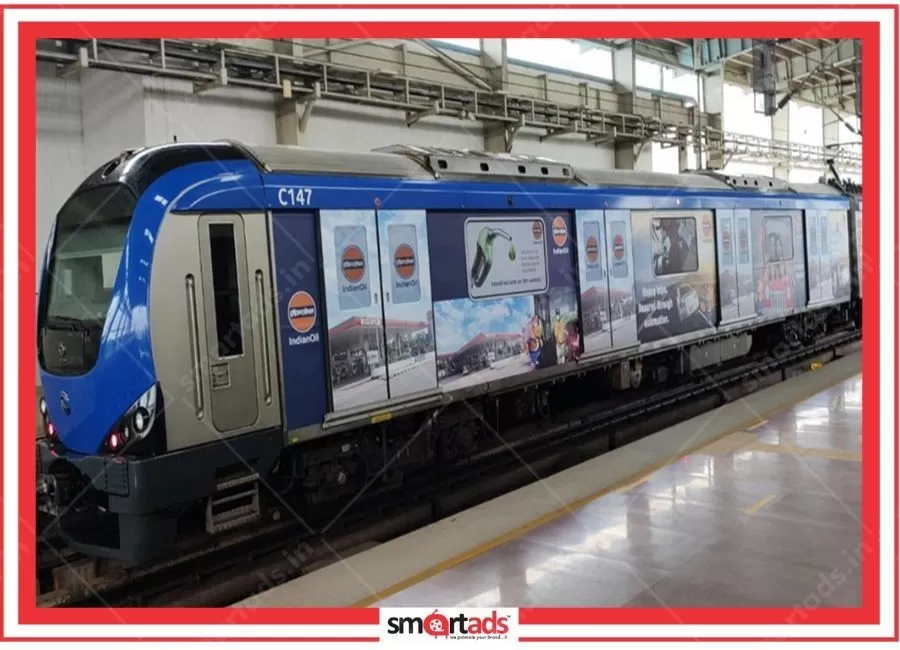
Exterior Metro Wrap
Custom
The advertisement spans the whole train,
Rate per Metro Display Cost / 1 Month
Route : Tirusulam To WIMCO Nagar
₹1000000.00
Showing 1 to 5 of 5 Results
MEDIA DETAILS
Custom
The advertisement spans the whole train,
Rate per Metro Display Cost / 1 Month
Route : Tirusulam To WIMCO Nagar
₹1000000.00
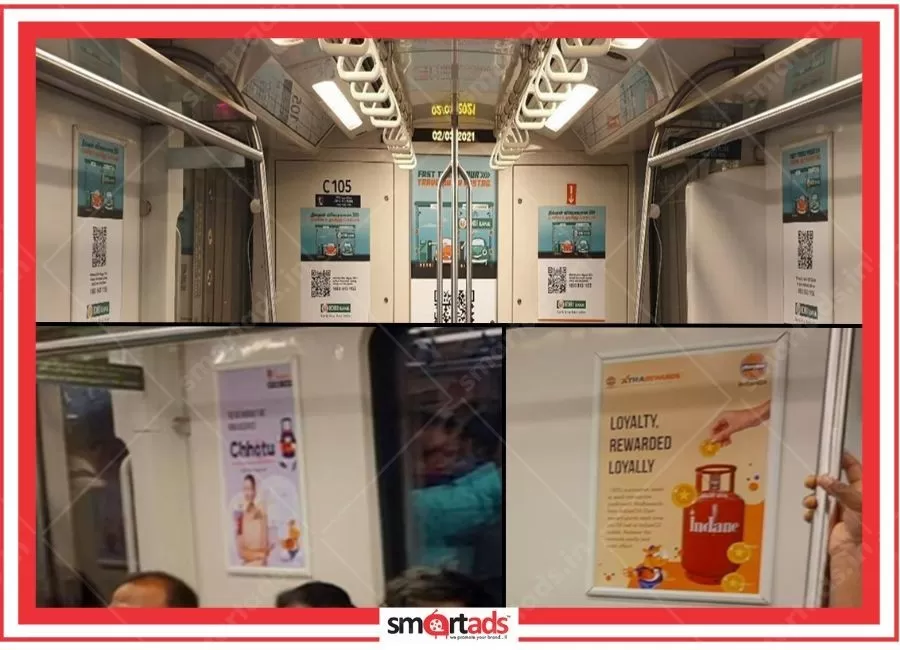
Custom
On the inside of the metro train the adv
Rate per Metro Display Cost / 1 Month
Route : Tirusulam To WIMCO Nagar
₹500000.00
20 Sec Audio
A jingle is a song or a phrase, and the
Rate per Metro Jingle Cost / 1 Month
Route :Tirusulam to WIMCO Nagar
₹400000.00

10 Sec Video
Digital screen on the metro station will
Rate per Metro Digital Display Cost / 1
Route :Tirusulam to WIMCO Nagar
₹600000.00

1 Metro Train
On the outside of the metro train the ad
Rate per Metro Display Cost / 1 Month
Route :Tirusulam to WIMCO Nagar
₹1500000.00
MEDIA REACH

MinimumQty :
1
EstimateReachPeople :
150000000
Most brand managers we speak to have already written off metro advertising as expensive, cluttered, or somehow "old school" — which is a surprising position to hold when you consider that the Delhi Metro Rail Corporation reported carrying over 60 lakh passenger trips on a single day in 2023, and a significant chunk of that captive, commuting audience passes through Gurgaon's Rapid Metro and Yellow Line extensions every morning and evening. The brands that have quietly figured this out are running some of the most cost-efficient urban reach campaigns we have seen in the NCR market, often at CPMs that would make a digital media planner do a double-take.
Gurgaon is not just another metro city; it is one of the most concentrated clusters of corporate spending power in the entire country, which makes the commuter profile here genuinely unlike anything you will find on the Blue Line or the Pink Line running through residential Delhi. The Millennium City Centre station alone sits at the confluence of DLF Cyber City, Udyog Vihar, and MG Road's retail belt — which means the person standing on that platform at 8:45 AM is, statistically speaking, far more likely to be a decision-maker, a dual-income household earner, or a high-net-worth individual than the average metro commuter elsewhere in the NCR.
What a lot of people miss is that the Rapid Metro Gurgaon corridor, which was integrated with DMRC's Yellow Line operations after Rapid Metro Rail Gurgaon Limited handed over operations, now functions as a single seamless transit spine connecting Sikanderpur to Cyber City and beyond — and this integration dramatically expanded the advertiser's ability to reach the same commuter across multiple touchpoints within a single journey. We have found, through campaign planning exercises for clients in the BFSI and consumer electronics categories, that a commuter traveling from Huda City Centre to Millennium City Centre passes through at least four distinct advertising environments: the platform screen doors, the train interior panels, the station concourse, and the entry-exit gate zones. That is a frequency opportunity that outdoor media on NH-48 simply cannot replicate at the same cost.
The GroupM TYNY Report has consistently flagged transit and out-of-home media as one of the fastest-recovering post-pandemic categories, and our own experience in the Gurgaon market bears this out — booking inquiries for metro formats here picked up sharply from 2022 onward, driven largely by fintech brands, ed-tech companies, and premium real estate advertisers who needed to speak to exactly the kind of audience that rides this corridor daily.
The format landscape here is richer than most advertisers initially expect, which is part of why a first briefing conversation at SmartAds tends to take longer than clients anticipate — there are genuinely consequential choices to make between formats, and the wrong one can dilute an otherwise strong creative. Station branding is the broadest canvas available; it typically involves wrapping an entire station's visual environment — pillars, concourse walls, fare gate surrounds, and sometimes even floor graphics — in a single brand identity, which creates an immersive experience that no single panel can achieve.
Train interior advertising is where the frequency story really comes alive. Panels inside the coaches — placed above windows, on door surrounds, or on the overhead grab-rail zones — are seen by every passenger for the entire duration of their journey, which on the Gurgaon corridor averages somewhere between eight and fourteen minutes depending on the origin-destination pair. We worked with a retail banking client in Gurgaon who ran a product launch campaign using interior coach panels across six rakes, and the brand recall scores measured in a post-campaign dipstick were notably higher than what the same client had achieved with a comparable digital video campaign running simultaneously — which, frankly speaking, surprised even us at the time.
Platform screen doors and platform back-panels are the third major format category, and they tend to be the entry point for brands with tighter budgets or shorter campaign windows; a four-week booking on platform panels at a high-footfall station like Sikanderpur or MG Road works out to a cost that is, in the ballpark of, a mid-tier digital campaign — but the audience quality differential is significant. On top of that, DMRC and its concessionaire partners have been progressively introducing digital screens at several Gurgaon stations, which opens up dynamic creative possibilities including daypart targeting, which is something we strongly recommend for brands whose messaging needs to differ between morning commuters and evening shoppers.
Frankly speaking, this is the question that dominates every first conversation, and the honest answer is that rates vary enough across formats, stations, and booking durations that a single number would be misleading — but we can give you meaningful benchmarks. A single-panel static display at a mid-tier Gurgaon metro station typically runs somewhere between ₹25,000 and ₹60,000 per month depending on the exact location and the concessionaire's current inventory position; premium stations like Huda City Centre or Sikanderpur command rates at the higher end of that range, which reflects the footfall differential.
Full station branding — which is the format that generates the most buzz and the most calls to our planning team — is a significantly larger commitment, typically falling in the ballpark of ₹8 lakh to ₹25 lakh for a four-week period, depending on the station's size, footfall classification, and the scope of formats included in the package. Train interior campaigns, where you are booking panels across multiple coaches and rakes, tend to be priced on a per-rake basis; a single rake interior package works out to roughly ₹1.5 lakh to ₹3.5 lakh per month, and most media planners recommend booking a minimum of three to four rakes to achieve meaningful frequency across the commuter base.
What we tell our clients at SmartAds is that the CPM calculation for metro advertising in Gurgaon often surprises people — when you divide the monthly cost by the verified footfall figures (which DMRC publishes and which are auditable, unlike many OOH claims), the CPM works out to roughly ₹6 to ₹14 depending on the format, which is a number that tends to make brand managers reconsider their initial assumption that metro is expensive. For comparison, a mid-funnel digital display campaign targeting a similar urban professional demographic in the NCR typically runs at CPMs of ₹18 to ₹35 on open exchanges — which puts the metro numbers in a very different light.
The thing is, metro advertising in Gurgaon is not universally effective for every category — and we would rather tell you that upfront than take a booking that underdelivers. The medium works best when the target audience has a high overlap with the commuter profile, which in Gurgaon's case skews strongly toward urban professionals aged 24 to 45, with household incomes above ₹10 lakh annually, and a demonstrated propensity for digital transactions, branded consumption, and aspirational purchases.
BFSI brands — particularly those launching credit products, investment platforms, or insurance propositions — have historically been among the most consistent performers on this medium, which makes intuitive sense when you consider that the Gurgaon metro corridor runs directly through the heart of India's largest private sector employment cluster. Ed-tech platforms targeting working professionals for upskilling, real estate developers promoting projects in the Golf Course Road or Dwarka Expressway corridors, and premium consumer durables brands have all run successful campaigns here that we have been involved in planning. One automotive brand we worked with used a combination of station branding at Cyber City station and interior coach panels to support a new sedan launch; the campaign generated a measurable spike in test drive bookings at the brand's Gurgaon dealerships over the four-week flight, which the client attributed largely to the metro presence rather than the concurrent digital activity.
Categories that tend to underperform are those with very broad, undifferentiated mass-market propositions — a commodity FMCG brand selling at ₹20 a unit, for instance, is probably better served by television or newspaper advertising where the reach-to-cost ratio works in their favour. To be fair, there are exceptions; we have seen pharma brands and OTC health products run effective awareness campaigns on metro, particularly when the creative is built around a specific life-stage or occasion that resonates with the commuter mindset.
NH-48 hoardings, MG Road unipoles, and the Cyber Hub ambient media ecosystem are the formats that most Gurgaon advertisers default to, which is understandable given that these are the most visible and familiar options — but the comparison is more nuanced than it first appears. Highway and arterial road OOH in Gurgaon reaches a very large number of vehicles, but the dwell time per exposure is measured in seconds; a driver passing a hoarding at 60 kmph on the expressway has perhaps three to five seconds of meaningful exposure, which is a fundamentally different communication context than a commuter standing on a metro platform for four to seven minutes.
The other dimension where metro holds a structural advantage is measurability; DMRC footfall data, while not perfect, is far more auditable than the traffic count estimates that underpin most outdoor media valuations in India. TAM AdEx and the Indian Readership Survey have long highlighted the difficulty of independently verifying OOH audience claims, which is a pain point that metro advertising partially addresses through the use of ticketing data and entry-exit gate counts. We have found that clients who need to justify media spends to a CFO or a global marketing head tend to find the metro's footfall documentation more defensible than the "estimated impressions" figures attached to a highway hoarding.
That said, metro and outdoor are not substitutes — they are genuinely complementary, and the campaigns we have seen perform best in Gurgaon typically combine a metro presence for depth and frequency with a strategic OOH buy for broad visual presence across the city. The budget allocation between the two depends heavily on the campaign objective; for brand launches or product introductions where awareness is the primary goal, we typically recommend a heavier outdoor weight with metro used for reinforcement, while for campaigns targeting a specific professional demographic with a considered purchase proposition, metro often earns a larger share of the OOH budget.
The booking process is more structured than most first-time metro advertisers expect, which is both a feature and a friction point. DMRC's advertising rights across most of the network — including the Gurgaon extensions — are managed through appointed concessionaires who handle inventory allocation, rate negotiation, and production coordination; going directly to DMRC as a brand without a registered agency or concessionaire relationship is technically possible but practically cumbersome.
At SmartAds, the process we follow for a typical metro campaign begins with an audience brief — understanding the target demographic, the geographic priority zones within the Gurgaon corridor, and the campaign window — before we approach the relevant concessionaire for inventory availability. Lead times matter here; premium stations and high-demand formats like full station branding are often booked four to eight weeks in advance, particularly in Q3 and Q4 when festive season demand compresses availability. We have seen clients lose their preferred station to a competitor simply because they waited two weeks too long to confirm the booking, which is a frustrating but entirely avoidable outcome.
Creative production for metro formats follows specific technical specifications — panel sizes, material requirements, and in some cases fire-retardant certification for interior coach materials — which need to be factored into the pre-campaign timeline. A campaign that is conceptually ready but materially non-compliant can face installation delays that eat into the booked flight period; this is where working with an agency that has prior metro execution experience pays dividends, because the specification knowledge is not something you want to be learning on your first campaign.
This is where the real value lies, and also where a lot of brands get it wrong by applying digital attribution frameworks to a medium that operates on different principles. Metro advertising, like most OOH, is a reach and frequency medium; its primary function is to build salience, shift brand perceptions, and create the mental availability that influences purchase decisions made days or weeks after the exposure. Expecting a direct, trackable click-to-conversion path from a metro panel is a category error — which does not mean the medium is unmeasurable, but it does mean you need to measure it differently.
The measurement approaches we recommend to our clients fall broadly into three categories. Brand lift studies — pre and post campaign dipstick surveys measuring awareness, recall, and brand attribute shifts among the target audience — are the most direct way to capture the communication effect of a metro campaign, and they are increasingly accessible even for mid-sized advertisers. Sales correlation analysis, where you track sales velocity or lead volume in the Gurgaon market during and after the campaign flight and compare it to a control period or a comparable city without the metro presence, is a cruder but often persuasive method for internal ROI justification. The third approach, which we have used with several e-commerce and fintech clients, involves tracking app download or website traffic spikes from Gurgaon as a geographic segment during the campaign period — which is an imperfect proxy but a useful directional indicator.
One BFSI client we worked with ran a six-week metro campaign across four Gurgaon stations to promote a new savings product; the post-campaign brand tracking showed a 22-percentage-point increase in unaided awareness among the target demographic in the Gurgaon market compared to a 6-point increase in a matched Delhi market where no metro activity ran — which, to be honest, was a stronger result than the client's own internal projections had anticipated, and it directly influenced the brand's media mix allocation for the following year.
The short answer — and we say this from watching this market evolve over several years — is yes, meaningfully so. DMRC has been progressively installing digital screens across its network, including at several stations along the Gurgaon corridor, which introduces capabilities that static formats simply cannot offer: daypart scheduling, creative rotation, real-time content updates, and in some configurations, audience-triggered messaging. These formats are still a smaller share of total metro inventory than static panels, but their share is growing, and the premium they command over static is narrowing as supply increases.
What makes digital metro screens particularly interesting for media planners is the daypart dimension — the ability to run a "morning commute" creative that speaks to the productivity and career mindset of the 8 AM traveler, and then switch to a lifestyle or leisure-oriented message for the 6 PM homebound crowd, is a targeting granularity that was simply not available in the metro environment two or three years ago. We have experimented with this approach for a food delivery client in the NCR, running different creative treatments across morning and evening dayparts at three Gurgaon stations; the evening daypart, unsurprisingly, generated a measurably higher order conversion rate in the Gurgaon delivery zones during the campaign period, which validated the daypart hypothesis and has since become a standard recommendation in our metro planning toolkit.
The FICCI-EY Media and Entertainment Report has noted the growing convergence between digital out-of-home and programmatic buying infrastructure in India, which suggests that metro screen inventory may eventually become accessible through automated buying platforms — a development that would significantly lower the entry barrier for smaller advertisers and change the competitive dynamics of metro inventory pricing. We are watching this space closely, and our honest view is that brands which build metro advertising capability now, before programmatic access democratizes the medium, are likely to enjoy a first-mover advantage in terms of preferred inventory access and rate relationships.
Most brands get this wrong on the first attempt, and the mistake is almost always the same: they repurpose a creative that was designed for another medium — a print ad, a digital banner, or a television frame — without adapting it to the specific visual and contextual demands of the metro environment. Metro advertising is consumed in motion, in variable lighting conditions, often by people who are simultaneously managing their phones, their bags, and their personal space; the creative needs to work in two seconds for a platform viewer and in thirty seconds for a coach interior reader, which are fundamentally different communication requirements.
The principles we have found most effective, across dozens of metro campaigns in the NCR, are simplicity of message (one idea, not three), high contrast visual design that reads clearly against the typically grey and white metro environment, and a brand presence that is large and unambiguous enough to register even in peripheral vision. Copy should be minimal — ideally under eight words for platform-facing formats — and the visual hierarchy should lead with the most emotionally engaging element rather than the logo. Interior coach panels can carry slightly more information because the dwell time is longer, but even here, the temptation to include too much text should be resisted.
One consumer electronics brand we worked with initially submitted creative that included a product feature list of seven points in 10-point type — which, on a 40×60 cm coach panel, was effectively invisible to anyone standing more than two feet away. We pushed back, the creative was simplified to a single product image with a four-word headline and the brand logo, and the post-campaign recall scores were significantly stronger than the brand had achieved with a more information-heavy execution on a previous campaign. The lesson, which we now share in every metro campaign briefing, is that restraint in metro creative is not a compromise — it is the strategy.
Q: What is the minimum budget required to run a metro advertising campaign in Gurgaon?
The honest answer is that there is no universal minimum, because the entry point depends entirely on the format and duration you choose — but as a practical benchmark, a meaningful campaign that achieves genuine reach and frequency in the Gurgaon metro corridor typically requires a budget in the range of ₹3 lakh to ₹5 lakh for a four-week flight, which would cover a combination of platform panels at two or three stations. Below that threshold, you can certainly book a single panel at a single station, which works out to somewhere between ₹25,000 and ₹60,000 per month depending on the location — but the frequency and reach generated by a single panel is unlikely to move brand metrics in any measurable way. Our recommendation to clients with tighter budgets is to concentrate spend at one or two high-footfall stations rather than spreading thinly across many, which is a principle that applies to most media planning decisions but is particularly consequential in the metro environment where station selection directly determines audience quality.
Q: How far in advance do I need to book metro advertising space in Gurgaon?
For standard platform panel formats at mid-tier stations, four to six weeks of lead time is generally sufficient outside of peak demand periods. However, for premium formats — full station branding, train wrap campaigns, or high-footfall stations like Huda City Centre and Sikanderpur — eight to twelve weeks is a more realistic planning horizon, and during the festive quarter (September through November), even that can be insufficient if you are targeting the most sought-after inventory. We have had clients approach us in October wanting a Diwali metro campaign, only to find that the stations they wanted had been committed months earlier; the frustration is understandable, but the solution is simply to build metro into the annual media plan rather than treating it as a last-minute addition. Production timelines — particularly for interior coach materials that require fire-retardant certification — add another two to three weeks to the pre-campaign preparation, which further compresses the available booking window.
Q: Can small and medium-sized businesses run metro advertising in Gurgaon, or is it only for large brands?
Metro advertising is more accessible to SMEs than the perception suggests, which is something we actively try to communicate because the assumption that metro is exclusively a large-brand medium causes smaller advertisers to miss a genuinely cost-effective reach opportunity. A local business — a coaching institute, a healthcare clinic, a premium retail store — operating in the Gurgaon market can run a meaningful metro campaign at a station or two near their catchment area for a monthly investment that is comparable to a modest digital campaign, and the audience quality in terms of local urban professionals is often superior to what a geo-targeted digital buy delivers in practice. The key for SMEs is to be very precise about station selection, choosing locations that are geographically and demographically aligned with their customer base rather than trying to cover the entire corridor, which is a strategy that requires good local market knowledge and is exactly the kind of planning guidance that SmartAds provides to clients across budget tiers.
Q: How is the audience for Gurgaon metro advertising measured and verified?
DMRC publishes ridership data through official channels, and the concessionaire partners who manage advertising inventory use these figures — supplemented by station-level entry-exit gate counts — as the basis for audience delivery claims. This is meaningfully more verifiable than the traffic count estimates used for most roadside OOH, though it is not equivalent to the impression-level tracking available in digital media. The key metric used in metro advertising is typically "footfall" or "passenger contacts," which represents the number of times a passenger passes through a station or travels in a coach during the campaign period; this is calculated by multiplying the daily ridership count by the campaign duration, which gives a gross impressions figure that can then be used to calculate CPM. We always advise clients to treat these figures as directional rather than precise, and to supplement them with brand lift measurement if the campaign budget justifies the additional research investment — which, for campaigns above ₹10 lakh, it almost always does.
Q: What is the difference between DMRC metro advertising and Rapid Metro Gurgaon advertising?
This is a question that comes up frequently, and the operational answer has evolved since Rapid Metro Rail Gurgaon Limited transferred its operations to DMRC in 2019. The Rapid Metro corridor — which covers stations from Sikanderpur through Cyber City and the Phase II extension — is now operationally integrated with DMRC's Yellow Line, which means that from a commuter's perspective, it functions as a single network; passengers transfer between the two systems without exiting the paid zone at Sikanderpur. From an advertising perspective, however, the inventory across the former Rapid Metro stations may still be managed through different concessionaire arrangements than the main DMRC network, which is why working with an agency that has established relationships across both systems is important for brands that want to advertise across the full Gurgaon corridor rather than just one segment of it. At SmartAds, we navigate these concessionaire relationships on behalf of our clients, which simplifies the booking process considerably and often results in better rate outcomes than a brand would achieve approaching each concessionaire independently.
Q: How do I choose between station branding and train interior advertising for my campaign objective?
The choice between these two formats really comes down to whether your primary objective is broad awareness or targeted frequency — and both are legitimate goals that require different media strategies. Station branding, which involves wrapping the visual environment of an entire station in your brand identity, is the format of choice when you want to create a strong, memorable impression on a large number of people passing through a specific location; it is particularly effective for brand launches, major product introductions, or campaigns where the physical association between your brand and a specific station (say, a tech company branding Cyber City station) carries strategic meaning. Train interior advertising, by contrast, is a frequency medium — the same commuter who rides the same route every day sees your panel repeatedly over the campaign period, which builds the kind of repeated exposure that is most effective for messaging that requires some cognitive engagement, such as a product feature explanation or a financial product proposition. The most effective campaigns we have planned in the Gurgaon market typically use both formats in combination, with station branding providing the initial impact and interior panels reinforcing the message through repeated exposure over the campaign flight.
Metro train advertising in Gurgaon occupies a genuinely unusual position in the Indian media landscape — it is a medium with demonstrably high audience quality, reasonable CPMs, and growing format sophistication, which is being systematically underutilized by a large proportion of the brands that would benefit most from it. The reasons for this underutilization are partly perceptual (the assumption that it is expensive or difficult to execute), partly structural (the concessionaire relationships and booking processes are less transparent than digital buying), and partly a function of how media plans are typically built — with television and digital consuming the majority of attention and budget before OOH formats are considered.
What our experience at SmartAds has consistently shown is that brands which treat metro advertising as a strategic component of their media mix — rather than a tactical add-on or a prestige play — tend to extract significantly more value from the medium. This means planning metro alongside television and digital from the outset of the campaign, building creative specifically for the metro environment rather than repurposing assets from other channels, and measuring outcomes through brand lift methodology rather than expecting direct attribution. The Gurgaon corridor, in particular, rewards this kind of strategic commitment because the audience concentration here — corporate professionals, high-income households, aspirational consumers — is genuinely difficult to reach at comparable efficiency through any other single medium.
The brands that have built a consistent metro presence in Gurgaon over the past three to four years — and we have worked with several of them across BFSI, real estate, and consumer technology categories — have developed a meaningful structural advantage in terms of brand salience among the city's professional class, which is an asset that compounds over time in ways that a single-campaign burst cannot replicate. If you are a brand manager or media planner evaluating whether metro advertising belongs in your Gurgaon media plan, the honest answer from our side of the table is that for the right category and the right audience objective, it almost certainly does.
If you would like a customized media plan for metro advertising in Gurgaon — including station recommendations, format mix, rate benchmarks, and creative specifications tailored to your campaign objectives — the SmartAds media planning team is available to work through the details with you. Reach us at [SmartAds.in](https://smartads.in) to start the conversation.
