
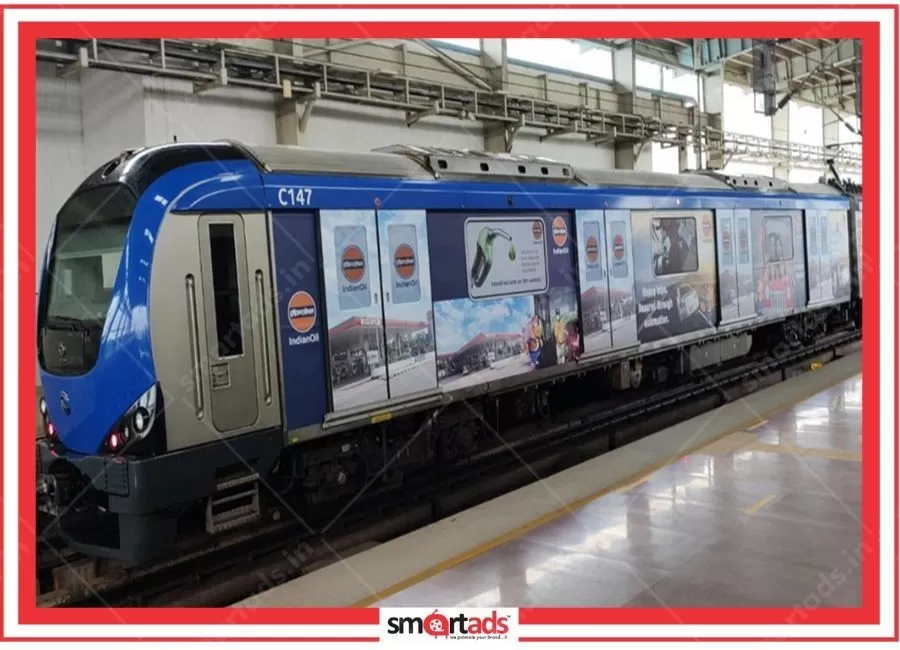
Exterior Metro Wrap
Custom
The advertisement spans the whole train,
Rate per Metro Display Cost / 1 Month
Route : Tirusulam To WIMCO Nagar
₹1000000.00
Showing 1 to 5 of 5 Results
MEDIA DETAILS
Custom
The advertisement spans the whole train,
Rate per Metro Display Cost / 1 Month
Route : Tirusulam To WIMCO Nagar
₹1000000.00
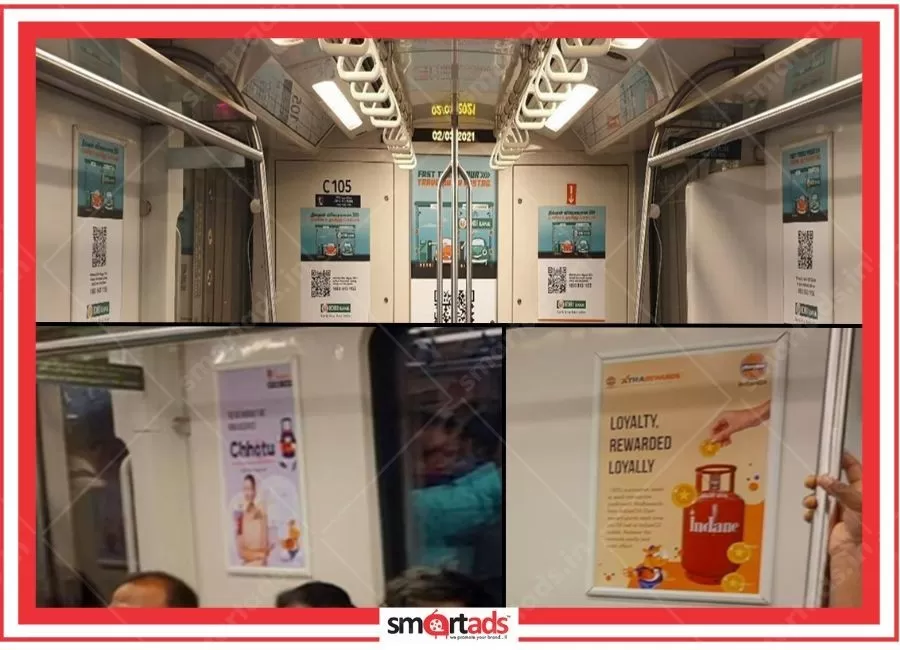
Custom
On the inside of the metro train the adv
Rate per Metro Display Cost / 1 Month
Route : Tirusulam To WIMCO Nagar
₹500000.00
20 Sec Audio
A jingle is a song or a phrase, and the
Rate per Metro Jingle Cost / 1 Month
Route :Tirusulam to WIMCO Nagar
₹400000.00

10 Sec Video
Digital screen on the metro station will
Rate per Metro Digital Display Cost / 1
Route :Tirusulam to WIMCO Nagar
₹600000.00

1 Metro Train
On the outside of the metro train the ad
Rate per Metro Display Cost / 1 Month
Route :Tirusulam to WIMCO Nagar
₹1500000.00
MEDIA REACH

MinimumQty :
1
EstimateReachPeople :
150000000

Faridabad moves roughly 1.5 lakh commuters through its Delhi Metro Violet Line stations every single day — and yet, when we look at the advertising inventory booked on this corridor, a surprisingly large portion of it sits empty or underutilised. That gap is not a sign of weak demand; it is a sign that most brands operating in Faridabad Haryana have not yet figured out how to use this channel strategically. The ones who have are quietly building some of the strongest brand recall numbers we have seen in any BTL advertising faridabad campaign.
The format question is where most first-time advertisers get confused, and frankly speaking, the confusion is understandable — DMRC advertising on the Violet Line offers a wider range of placements than most people realise when they first start exploring the channel. At the broadest level, you are looking at two distinct environments: the train itself, and the station. Both carry very different audience behaviours, dwell times, and creative requirements, which is why we always advise clients to think of them as complementary rather than interchangeable.
Inside the train, the primary formats are metro coach panel advertising — which refers to the panels placed above the seating rows and along the upper walls of each coach — and interior train branding, which can range from single panel takeovers to full coach wraps where every surface inside the compartment carries the brand's creative. Interior train branding tends to work exceptionally well for categories that benefit from extended storytelling, because the average commuter on the Delhi-Faridabad Metro corridor spends somewhere between 20 and 35 minutes inside the train, which gives a brand considerably more dwell time advertising opportunity than almost any other outdoor format in the city. On the exterior side, exterior train branding and full train wrap options allow a brand to turn the entire train into a moving billboard that travels between Kashmere Gate and Raja Nahar Singh station — a distance that covers the full economic spine of the National Capital Region.
At the station level, the formats multiply further. Entry exit gate branding, pillar advertising, station domination packages, digital screens metro placements, and even metro smart card advertising are all available across Faridabad metro stations on the Violet Line. Station domination — where a single brand takes over all available advertising surfaces at a given station — is particularly powerful at high-footfall nodes like Escorts Mujesar metro station and Bata Chowk metro station, which serve as interchange points for large industrial and commercial zones. One format that has been generating significant interest recently is the audio advertisement metro placement, which DMRC has been piloting on select coaches; this allows a brand's audio message to be played inside the train at defined intervals, creating an entirely new sensory touchpoint for daily commuters who may have learned to visually tune out static panels.
We get this question in almost every initial client conversation, and the honest answer is that metro advertising cost on the Violet Line is more accessible than most brands assume — especially when you calculate it on a cost per impression basis rather than looking at the absolute monthly figure. The CPM for interior coach panel advertising works out to roughly ₹8 to ₹12, which is a number that genuinely surprises most brand managers when they compare it against what they are currently paying for Instagram reach or programmatic display in the same city.
For a single coach panel placement across a 30-day campaign, the advertising rates faridabad market would typically see pricing in the ballpark of ₹15,000 to ₹25,000 per panel per month, depending on the specific coach position and whether the placement is on a high-frequency route train or a standard service. Full train wrap advertising — which is the most premium format and involves exterior train branding across the entire rake — is priced considerably higher, somewhere between ₹8 lakh and ₹15 lakh per month for a full wrap on a dedicated train, though the reach figures that accompany that investment are equally substantial given that a single wrapped train on the Delhi metro violet line generates millions of impressions across its daily runs. Station-level formats like pillar advertising and entry exit gate branding at individual Faridabad metro stations tend to fall in the ₹20,000 to ₹80,000 per month range per unit, which makes them genuinely viable for local businesses and MSMEs who want metro station advertising presence without committing to a full train-level budget.
What a lot of people miss is that faridabad metro advertising rates are not fixed in the way a rate card might suggest — they are negotiated through the DMRC tendering process, and an authorised metro advertising agency with established relationships in the system can often secure significantly better rates than a brand approaching the channel independently. At SmartAds, we have found that clients who come to us after trying to book directly through DMRC's official channels often end up paying more and receiving less inventory flexibility than clients who let us handle the media buying from the start. The seasonal dimension also matters here: campaign execution during peak festive periods like Diwali, or during major election cycles in Haryana, typically commands a premium of 15 to 25 percent over standard rates, which is something any serious media plan for Faridabad Haryana needs to account for.
The Delhi Metro Violet Line enters Faridabad territory after crossing Badarpur Border, and from that point southward, the advertising geography becomes genuinely interesting for any brand trying to reach the industrial hub faridabad audience with precision. The stations available for metro station advertising within Faridabad include Sarai metro station, Mewala Maharajpur, NHPC Chowk, Escorts Mujesar metro station, Bata Chowk metro station, Old Faridabad metro station, Neelam Chowk Ajronda, Badkhal Mor metro station, Sector 28 Faridabad, and the southern terminal at Raja Nahar Singh station — which serves the Ballabgarh metro catchment area and has seen a meaningful increase in footfall since the Ballabgarh extension became fully operational.
Each of these stations serves a distinct micro-catchment, which is something we factor into every media plan we build for Faridabad. Escorts Mujesar metro station, for instance, is positioned at the heart of one of India's largest industrial estates; the commuter profile here skews heavily toward factory workers, supervisors, and logistics professionals, which makes it ideal for categories like financial services, health insurance, and vocational education. Bata Chowk metro station, by contrast, draws a more mixed retail and residential audience from the surrounding commercial belt, making it better suited for consumer goods, apparel, and quick-service restaurant brands. Old Faridabad metro station sits adjacent to the older commercial core of the city, where small business owners and traders are a significant part of the daily footfall — a profile that is often underserved by conventional Delhi NCR advertising strategies.
The Ballabgarh extension — culminating at Raja Nahar Singh station — deserves special mention because it extended the Delhi metro violet line's reach into a part of Faridabad Haryana that was previously accessible only by road. This has opened up a new advertising corridor that connects Ballabgarh's growing industrial and residential zones to the broader metro network, and the advertising inventory here is still relatively uncrowded compared to stations closer to Delhi. For brands looking to establish early presence in a high-growth micro-market within the National Capital Region, this southern stretch of the Violet Line represents genuinely underpriced opportunity.
There is a structural reason why the Delhi metro violet line works so well for brand advertising in Faridabad, and it comes down to the nature of the commuter journey itself. Unlike bus advertising or auto advertising — where journeys are short, fragmented, and often shared with significant ambient noise — the metro journey between Faridabad and central Delhi is a contained, relatively quiet, and time-consistent experience; commuters board at roughly the same time every day, sit or stand in the same sections of the train, and are exposed to the same creative for the same duration across repeated trips. That repetition is the engine of brand recall, and it is something that most other BTL advertising faridabad formats simply cannot replicate at the same scale.
The transit advertising literature — and our own experience across hundreds of campaigns — consistently shows that repeated exposure to the same creative in a familiar, low-distraction environment produces brand recall rates that are meaningfully higher than equivalent spend on roadside hoardings or even mall branding. The FICCI-EY Media Report has consistently highlighted transit advertising as one of the fastest-growing segments within OOH advertising in India, and the Delhi Metro specifically accounts for a disproportionate share of that growth given the scale of its daily ridership. For a brand operating in Faridabad Haryana, the additional advantage is that the Violet Line connects the city directly to the commercial and cultural centre of Delhi, which means a single campaign on this corridor reaches both the local Faridabad audience and the broader Delhi NCR advertising market simultaneously.
At SmartAds, we always tell our clients that the Violet Line is not just a Faridabad media buy — it is a Delhi NCR media buy with a Faridabad anchor. A working professional who boards at Escorts Mujesar metro station and exits at Kashmere Gate metro is carrying your brand's message through the entire economic corridor of the National Capital Region, which is a distribution of impressions that no hyperlocal advertising strategy based purely within Faridabad city limits can match.
The audience profile of the Faridabad metro is more economically diverse and professionally varied than most brands initially assume, and getting this segmentation right is the difference between a campaign that drives real business outcomes and one that simply generates impressions. The core audience is working professionals — engineers, factory managers, IT professionals, and administrative staff — who commute daily from Faridabad Haryana into Delhi NCR for work; this segment is characterised by stable incomes, high purchase intent for financial products, consumer electronics, and lifestyle categories, and a commute pattern that makes them highly predictable targets for repeated exposure campaigns.
What competitors consistently miss in their audience analysis is the station-level segmentation that makes metro train advertising in faridabad so precise as a targeting tool. The commuter profile at NHPC Chowk skews toward government sector employees and engineers from the NHPC township, which is a very different purchase behaviour profile from the manufacturing-sector workforce that dominates the Escorts Mujesar catchment. NIT Faridabad students and faculty represent a meaningful portion of the Sector 28 Faridabad station footfall, making that node particularly valuable for edtech, banking, and FMCG brands targeting the 18-to-28 age cohort. Urban commuters in the Badkhal Mor and Neelam Chowk Ajronda zone tend to include a higher proportion of retail business owners and traders, which opens up interesting possibilities for B2B service brands and financial institutions.
The daily commuters on this corridor also include a significant Haryana Government employee population, given the proximity of several state government offices to the Faridabad metro network; this group has strong demand for real estate, insurance, and education products, and they are notoriously difficult to reach through digital channels alone because their media consumption skews heavily toward physical environments. For brands in the real estate sector — and Faridabad Haryana has seen consistent real estate activity in the Sector 16A Faridabad and Sector 28 Faridabad zones — metro train branding faridabad offers a direct line to the exact audience that is actively evaluating property purchase decisions.
Frankly speaking, this is the comparison that most media planners in Faridabad have been doing informally for years, and the results are more nuanced than the simple "metro is better" narrative that some agencies push. Outdoor advertising faridabad — specifically large-format hoardings on NH-48, the Mathura Road corridor, and key intersections in the industrial zone — offers unmatched visual scale and works exceptionally well for brand awareness among vehicular traffic; however, the audience is transient, the dwell time is measured in seconds rather than minutes, and there is no captive audience dynamic whatsoever. Metro train advertising, by contrast, delivers a captive audience that is physically enclosed with the creative for 20 to 35 minutes per journey, which produces a fundamentally different quality of exposure.
Bus shelter advertising in Faridabad offers some of the lowest cost-per-impression figures in the OOH advertising market — we have seen placements at major bus stops go for as little as ₹5,000 to ₹8,000 per month — but the creative environment is cluttered, the audience is fragmented, and brand recall studies consistently show that bus shelter ads underperform metro placements by a significant margin when campaign duration and creative consistency are held constant. Mall branding at Faridabad's major retail centres offers a high-quality audience environment and strong dwell time advertising potential, but the reach is capped by the mall's footfall, which rarely exceeds 30,000 to 40,000 visitors per day even at peak periods — a figure that a single busy metro station on the Violet Line can match or exceed on its own. Auto advertising in Faridabad is a hyperlocal advertising tool that works well for very local service businesses, but it offers almost no audience targeting, no creative consistency, and no measurable brand recall.
The honest position — and this is something we tell clients who are trying to allocate a limited BTL advertising faridabad budget across multiple formats — is that metro train advertising in faridabad and outdoor advertising faridabad are not competitors; they are complements. A hoarding on the NH-48 creates broad awareness among vehicular traffic, while metro coach panel advertising converts that awareness into recall among the same audience during their daily commute. One automotive brand we worked with in the Faridabad NCR market ran a simultaneous campaign across three Violet Line stations and two highway hoardings; the metro component alone accounted for 68 percent of the unaided brand recall in the post-campaign survey, despite representing only 45 percent of the total campaign budget — which is the kind of efficiency data that tends to change how clients think about their non-traditional advertising faridabad allocation going forward.
Return on investment from metro train advertising in faridabad is not a single number — it depends heavily on the category, the creative quality, the campaign duration, and how well the station selection maps to the brand's actual target audience. That said, the directional data we have accumulated across campaigns on the Delhi metro violet line is consistently encouraging. Brand recall studies conducted by independent research firms on Delhi Metro advertising campaigns — referenced in the TAM AdEx and GroupM TYNY reports — suggest that aided brand recall for metro advertising runs somewhere between 65 and 80 percent among regular commuters who have been exposed to a campaign for 30 days or more, which compares favourably to the 40 to 55 percent range typically observed for equivalent-spend outdoor advertising faridabad campaigns.
The return on investment calculation looks particularly strong when you factor in the cost per impression against the quality of that impression. A full train wrap on the Violet Line, priced in the ballpark of ₹10 lakh per month, generates an estimated 8 to 12 crore impressions across its daily runs — which works out to a CPM in the range of ₹8 to ₹12, a figure that is genuinely difficult to match in any other non-digital advertising format in the Delhi NCR market. Interior train branding placements, which are more accessible from a budget standpoint, deliver a smaller absolute reach but a significantly higher quality of engagement per impression because the commuter is physically enclosed with the creative and has limited alternative visual stimuli competing for their attention.
A retail client we worked with in Faridabad — a mid-sized apparel brand with stores near Old Faridabad metro station and Bata Chowk metro station — ran a 45-day interior coach panel campaign across six coaches on the Violet Line. The campaign reached an estimated 18 lakh unique commuters over the campaign period, and the client reported a 34 percent increase in walk-in traffic to their Old Faridabad store in the month following the campaign launch — a correlation that was strong enough for them to immediately book a follow-up campaign for the Diwali season. That kind of direct footfall attribution is rare in OOH advertising, and it speaks to the geographic precision that metro station advertising can deliver when the station selection is aligned with the brand's physical retail presence.
The booking process for metro train advertising in faridabad runs through DMRC's officially authorised advertising concessionaires, which means a brand cannot simply approach DMRC directly and purchase inventory the way you might buy a digital ad placement. DMRC advertising rights on the Violet Line are held by authorised concessionaires through a formal DMRC tendering process, and all bookings — whether for train panels, station formats, or full train wraps — must be routed through these authorised channels. This is where working with an authorised metro advertising agency becomes not just convenient but structurally necessary for campaign execution.
The campaign execution process, as we manage it at SmartAds, typically begins with a brief and audience alignment conversation — understanding the brand's geography, target demographic, campaign objectives, and budget envelope. From there, we map the brief against available inventory on the Violet Line, identify which Faridabad metro stations and train placements best match the audience profile, and present a media plan with reach projections, cost estimates, and creative format recommendations. Once the plan is approved, artwork is produced to DMRC's specific creative specifications — which cover material quality, size tolerances, colour reproduction standards, and content compliance requirements — and submitted for DMRC approval before installation. The typical lead time from brief to live campaign is somewhere between 15 and 25 working days, depending on the complexity of the formats selected and the speed of creative approvals.
Campaign duration is a variable that deserves careful thought. Our experience shows that campaigns running for less than 21 days rarely generate the repeated exposure necessary to drive meaningful brand recall among daily commuters; the sweet spot for most categories is somewhere between 30 and 60 days, which allows the average commuter to encounter the creative 20 to 40 times over the campaign period. For seasonal campaigns — Diwali, New Year, or the Haryana election cycle — we typically recommend booking inventory at least 6 to 8 weeks in advance, because high-demand periods on the Delhi metro violet line see inventory fill up quickly, particularly for premium formats like station domination at Escorts Mujesar metro station and full train wrap placements.
This is a question we hear constantly, and the short version of our answer is: more often than you would expect, yes. The perception that metro train advertising is exclusively a large-brand channel is a holdover from the early years of DMRC advertising, when minimum campaign sizes were genuinely prohibitive for smaller advertisers; the market has evolved considerably since then, and the range of formats available today means that a well-planned entry-level campaign on the Violet Line is accessible to businesses with monthly advertising budgets in the ₹50,000 to ₹1.5 lakh range.
A single interior coach panel placement at a mid-tier station like Sarai metro station or Mewala Maharajpur, running for 30 days, can be executed for roughly ₹15,000 to ₹20,000 — which is a figure that sits comfortably within the advertising rates faridabad range that most local MSMEs already spend on newspaper inserts or auto advertising. Combining two or three such placements across strategically selected stations creates a meaningful metro advertising faridabad footprint without requiring a budget that only large corporates can justify. For businesses in the educational, healthcare, financial services, or real estate sectors — categories where a single converted customer can generate ₹50,000 or more in lifetime value — even a modest metro station advertising presence can deliver a return on investment that is difficult to argue with.
The key for small businesses, frankly, is creative discipline. A cluttered or poorly designed panel wastes the captive audience advantage that makes metro train advertising in faridabad valuable in the first place; a clean, high-contrast creative with a single clear message and a local call-to-action — "Visit us at Old Faridabad metro station, Exit 2" — consistently outperforms elaborate multi-message designs in the metro environment. At SmartAds, we have seen this pattern repeat across dozens of MSME campaigns on the Violet Line, which is why creative consultation is something we build into every media buying engagement we take on, regardless of the client's budget size.
DMRC advertising has a specific and non-negotiable set of creative specifications that every advertiser on the Violet Line must comply with, and getting these wrong at the artwork stage is one of the most common — and most avoidable — reasons for campaign delays. The specifications vary by format: interior coach panels typically require artwork at 1800mm x 600mm or 600mm x 450mm depending on the panel position, printed on vinyl with a minimum 200-micron thickness and a matte laminate finish to reduce glare under the train's fluorescent lighting. Exterior train branding and full train wrap formats require high-resolution files at 1:10 scale with specific bleed and safe-zone margins, and the material specifications are considerably more demanding given the exposure to weather, speed, and cleaning cycles.
Content compliance is an area where we have seen campaigns get delayed — or in a few cases, rejected entirely — because the creative contained elements that DMRC's approval committee flagged as non-compliant. Political advertising is prohibited on DMRC advertising inventory, as are creatives that reference competing transit services or contain imagery that could be interpreted as safety-related messaging. Alcohol and tobacco advertising is entirely off-limits, which is consistent with DMRC's broader content policy. Beyond these prohibitions, the approval committee also reviews creatives for visual clarity and legibility standards; an ad that is too text-heavy or uses font sizes below the minimum readable threshold at viewing distance will typically be returned for revision.
For digital screens metro placements — which are available at select Faridabad metro stations and are growing in availability as DMRC expands its digital infrastructure — the specifications shift to video and motion graphics formats, typically 1920x1080 resolution at 25fps with a maximum file size of 100MB per creative unit. Audio advertisement metro placements, where available, require audio files in MP3 format at 128kbps or higher, with a maximum duration of 15 to 30 seconds per spot. At SmartAds, our creative team works directly with DMRC's technical specifications to ensure that every piece of artwork we submit clears the approval process on the first submission — which saves clients anywhere from 5 to 10 working days compared to the revision cycles that are common when brands manage the submission process independently.
Q: What is metro train advertising in Faridabad and how does it work?
Metro train advertising in faridabad refers to the placement of brand creatives across the advertising inventory managed by DMRC on the Delhi Metro Violet Line as it passes through Faridabad Haryana. It works through a concessionaire model, where DMRC licenses advertising rights to authorised agencies, which then sell inventory to brands either directly or through media buying intermediaries. Brands can place ads inside train coaches, on the exterior of trains, at metro stations, or across digital and audio formats depending on the budget and campaign objectives; the creative is installed by DMRC-approved vendors and remains live for the agreed campaign duration, after which it is removed or replaced.
Q: Which metro line covers Faridabad for advertising purposes?
Faridabad is served exclusively by the Delhi Metro Violet Line, which is officially designated as Line 6 by DMRC. The line runs from Kashmere Gate metro in the north to Raja Nahar Singh station in Ballabgarh in the south, passing through all major Faridabad metro stations including Sarai metro station, Escorts Mujesar metro station, Bata Chowk metro station, Old Faridabad metro station, Neelam Chowk Ajronda, Badkhal Mor metro station, Sector 28 Faridabad, and the Ballabgarh metro terminal. The entire Delhi-Faridabad Metro corridor is accessible for advertising purposes, and campaigns can be targeted to specific stations or formatted to run across the full length of the line.
Q: How much does metro train advertising in Faridabad cost in 2025?
Metro advertising cost on the Violet Line in 2025 ranges from roughly ₹15,000 per month for a single interior coach panel at a smaller station to upward of ₹12 to ₹15 lakh per month for a full train wrap. Station-level formats like pillar advertising and entry exit gate branding at individual Faridabad metro stations typically fall somewhere between ₹20,000 and ₹80,000 per unit per month, while station domination packages — which cover all available advertising surfaces at a single station — are priced in the ballpark of ₹2 lakh to ₹5 lakh per month depending on the station's footfall and strategic importance. These figures are indicative; actual advertising rates faridabad will vary based on negotiation, campaign duration, and seasonal demand.
Q: Which metro stations in Faridabad are available for advertising?
All stations on the Delhi metro violet line within Faridabad are available for metro station advertising, including Sarai metro station, Mewala Maharajpur, NHPC Chowk, Escorts Mujesar metro station, Bata Chowk metro station, Old Faridabad metro station, Neelam Chowk Ajronda, Badkhal Mor metro station, Sector 28 Faridabad, and Raja Nahar Singh station at the Ballabgarh metro terminal. Each station offers a different inventory mix and audience profile; high-footfall stations like Escorts Mujesar metro station and Bata Chowk metro station command premium rates and tend to book out faster during peak campaign seasons.
Q: What are the different formats of metro train advertising available in Faridabad?
The formats available span interior and exterior train placements as well as station-level inventory. Interior formats include metro coach panel advertising, interior train branding, and full coach wraps; exterior formats include exterior train branding and full train wrap advertising. At the station level, brands can access pillar advertising, entry exit gate branding, digital screens metro placements, station domination packages, and metro smart card advertising. Audio advertisement metro placements are available on select Violet Line coaches and represent an emerging format that is gaining traction among brands looking for sensory differentiation in the metro environment.
Q: How do I book a metro train advertising campaign in Faridabad?
Booking is done through an authorised metro advertising agency that holds or has access to DMRC advertising inventory on the Violet Line. The process involves briefing the agency on campaign objectives, audience, budget, and duration; receiving a media plan with format recommendations and cost estimates; approving the plan and submitting artwork for DMRC compliance review; and then proceeding to installation and campaign execution. The total lead time from brief to live campaign is typically 15 to 25 working days. Working with an experienced agency significantly simplifies the DMRC tendering process and creative approval process.
Q: Who is the target audience for metro advertising on the Faridabad Violet Line?
The target audience is primarily working professionals, urban commuters, and daily commuters travelling between Faridabad Haryana and Delhi NCR for employment, education, and commerce. The audience profile varies meaningfully by station — industrial workers and factory supervisors at Escorts Mujesar metro station, government employees and engineers at NHPC Chowk, students and young professionals near Sector 28 Faridabad, and retail traders and small business owners at Old Faridabad metro station. The overall audience skews toward the 22-to-45 age bracket with stable incomes and high purchase intent across financial services, real estate, consumer goods, and lifestyle categories.
Q: Is metro train advertising in Faridabad suitable for small businesses and MSMEs?
Yes, and more so than most small business owners realise. Entry-level placements — a single interior coach panel at a strategically selected station — can be executed for ₹15,000 to ₹20,000 per month, which is comparable to what many MSMEs already spend on newspaper advertising or local outdoor advertising faridabad. The key is selecting stations that are geographically aligned with the business's physical location or customer base, and investing in clean, high-impact creative that makes the most of the captive audience environment. For service businesses with a local catchment — healthcare clinics, coaching centres, financial advisors — metro station advertising near the closest Violet Line station can be a highly efficient customer acquisition channel.
Q: What is the ROI and brand recall rate of metro advertising in Faridabad?
Based on industry research referenced in the TAM AdEx and FICCI-EY Media Report, aided brand recall for metro advertising among regular commuters exposed to a 30-day campaign runs somewhere between 65 and 80 percent — significantly higher than the 40 to 55 percent range observed for comparable outdoor advertising faridabad spend. Return on investment varies by category; high-ticket categories like real estate and financial services tend to see the strongest ROI given the high lifetime value of a single converted customer. Our experience at SmartAds shows that campaigns running for 30 to 60 days with well-targeted station selection consistently outperform shorter campaigns on both recall and conversion metrics.
Q: How does metro train advertising in Faridabad compare to hoardings and outdoor advertising?
The fundamental difference is audience quality versus audience scale. Outdoor advertising faridabad — particularly highway hoardings — delivers very high reach among vehicular traffic but with extremely short dwell times measured in seconds. Metro train advertising delivers a smaller but captive audience that is enclosed with the creative for 20 to 35 minutes per journey, producing meaningfully higher brand recall and purchase intent lift. The two formats work best in combination: hoardings build broad awareness, while metro advertising converts that awareness into recall and action among the commuter audience. On a pure cost-per-impression basis, metro advertising is broadly comparable to premium OOH advertising in Faridabad, but the quality of each impression is substantially higher.
Q: What are the creative specifications and artwork guidelines for metro ads in Faridabad?
Interior coach panels typically require artwork at 1800mm x 600mm or 600mm x 450mm, printed on 200-micron-minimum vinyl with matte laminate. Exterior and full train wrap formats require high-resolution files at 1:10 scale with specified bleed margins and weather-resistant material. Digital screens metro placements require 1920x1080 video files at 25fps. All creatives must pass DMRC's content compliance review, which prohibits political, alcohol, tobacco, and safety-related content. Artwork should be submitted at least 10 to 15 working days before the campaign start date to allow for DMRC approval and installation scheduling.
Q: Can brands run audio advertisements on metro trains in Faridabad?
Audio advertisement metro placements are available on select Violet Line coaches as part of DMRC's in-train audio advertising pilot, which has been expanding gradually across the network. These placements allow a brand's audio message to be broadcast inside the coach at defined intervals, creating an additional sensory touchpoint for daily commuters. Audio spots are typically 15 to 30 seconds in duration and must comply with DMRC's content and decibel-level specifications. Availability on specific Faridabad metro stations and train sets should be confirmed at the time of booking, as the rollout is ongoing.
Q: How long should a metro train advertising campaign run in Faridabad for best results?
Our experience consistently points to 30 to 60 days as the optimal campaign duration for most categories. A 30-day campaign allows the average daily commuter to encounter the creative 20 to 30 times, which is the threshold at which brand recall begins to consolidate meaningfully. Campaigns shorter than 21 days rarely generate sufficient repeated exposure to drive measurable recall lift. For major brand launches or seasonal campaigns — Diwali, New Year, or back-to-school periods — 45 to 60 days is the recommended window, with creative refreshes at the 30-day mark if budget permits.
Q: What is station domination advertising and is it available at Faridabad metro stations?
Station domination refers to a campaign format where a single brand takes over all available advertising surfaces at a given metro station — including entry exit gate branding, pillar advertising, concourse panels, and any digital screens metro placements — creating an immersive brand environment for every commuter passing through. It is available at Faridabad metro stations on the Violet Line, with Escorts Mujesar metro station and Bata Chowk metro station being the most sought-after locations due to their high footfall and strategic positioning within the Faridabad industrial and commercial belt. Station domination packages are priced in the ₹2 lakh to ₹5 lakh per month range depending on the station.
Q: Which industries and brand categories benefit most from metro advertising in Faridabad?
Real estate consistently tops the list, given the active property market in Sector 16A Faridabad, Sector 28 Faridabad, and the Ballabgarh metro corridor. Financial services — banking, insurance, mutual funds, and lending — perform strongly because the commuter audience has stable incomes and high financial product demand. Education and edtech brands targeting working professionals and NIT Faridabad students find the metro environment highly productive. Consumer durables, apparel, and FMCG brands benefit from the sheer volume of daily commuters and the repeated exposure dynamic. Healthcare, particularly hospitals and diagnostic chains with facilities near Faridabad metro stations, have also seen strong results from metro train branding faridabad campaigns.
There is a version of this conversation that ends with a simple rate card and a booking form, but
