
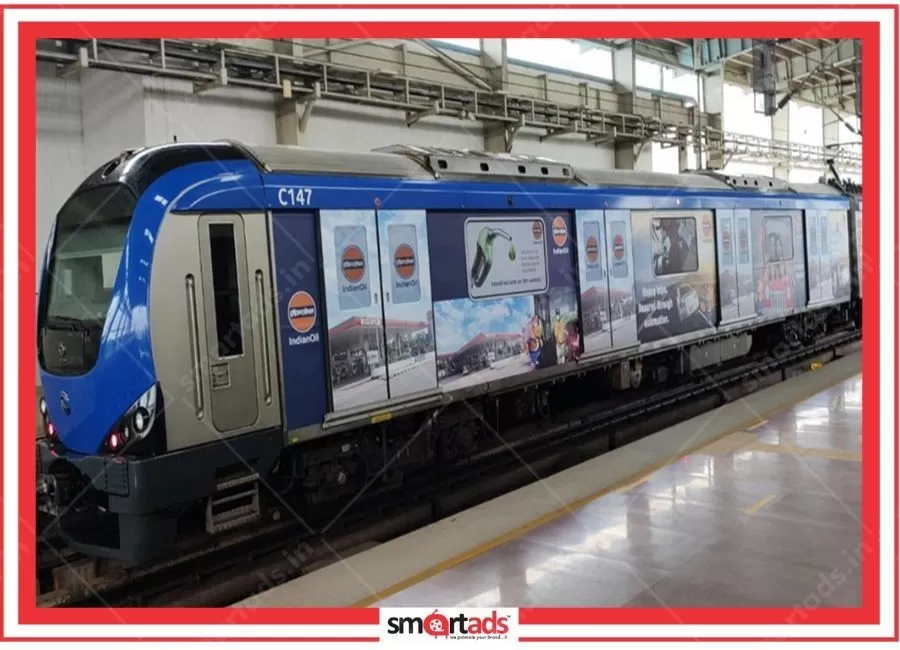
Exterior Metro Wrap
Custom
The advertisement spans the whole train,
Rate per Metro Display Cost / 1 Month
Route : Tirusulam To WIMCO Nagar
₹1000000.00
Showing 1 to 5 of 5 Results
MEDIA DETAILS
Custom
The advertisement spans the whole train,
Rate per Metro Display Cost / 1 Month
Route : Tirusulam To WIMCO Nagar
₹1000000.00
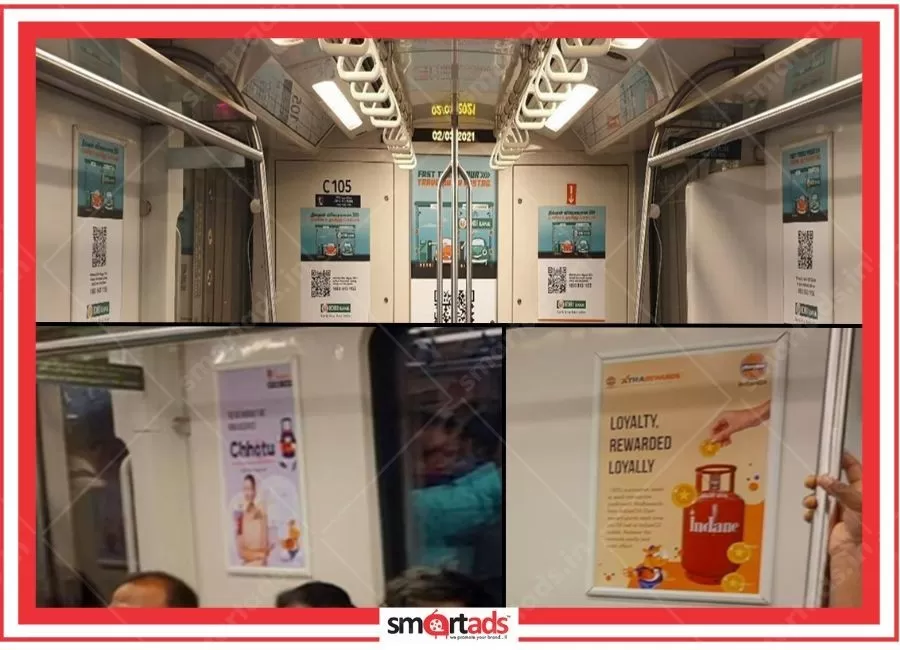
Custom
On the inside of the metro train the adv
Rate per Metro Display Cost / 1 Month
Route : Tirusulam To WIMCO Nagar
₹500000.00
20 Sec Audio
A jingle is a song or a phrase, and the
Rate per Metro Jingle Cost / 1 Month
Route :Tirusulam to WIMCO Nagar
₹400000.00

10 Sec Video
Digital screen on the metro station will
Rate per Metro Digital Display Cost / 1
Route :Tirusulam to WIMCO Nagar
₹600000.00

1 Metro Train
On the outside of the metro train the ad
Rate per Metro Display Cost / 1 Month
Route :Tirusulam to WIMCO Nagar
₹1500000.00
MEDIA REACH

MinimumQty :
1
EstimateReachPeople :
150000000
Howrah Maidan metro station sits 33 metres below street level — making it the deepest metro station in India — and that single geographical fact changes everything about how advertising works there. Commuters descend into a world where mobile signals fade, outdoor distractions vanish, and the only visual stimulus available is whatever brand has chosen to occupy that space. What we have found, after planning dozens of transit media campaigns across this corridor, is that most brands dramatically underestimate what metro train advertising in Howrah can do for recall, and dramatically overestimate how complicated it is to get started.
Most people, when they first hear about metro train advertising in Howrah, picture a small sticker on a train door and assume that is roughly the extent of it. The reality is considerably more interesting. Metro train advertising in Howrah operates across the Kolkata Metro Green Line — formally the East-West Metro corridor — which connects Howrah Maidan to Salt Lake Sector V via an underground route that passes beneath the Hooghly River, through Esplanade, and across the heart of Kolkata. Advertising on this network means your brand travels with commuters across one of the most economically active transit corridors in eastern India, which is a very different proposition from a static hoarding on a flyover.
The mechanics are straightforward, though the execution requires coordination with the Kolkata Metro Rail Corporation (KMRC), which manages the Green Line's commercial advertising rights. Brands can purchase space inside train coaches — on panels, seat-backs, overhead racks, and door vinyls — or on the exterior of coaches through full or partial train wraps; they can also book station-level inventory including platform pillars, concourse hoardings, digital screens, and entry-gate branding. What distinguishes this from most out-of-home advertising is the dwell time: a commuter travelling from Howrah Maidan to Salt Lake Sector V spends somewhere between 35 and 45 minutes in the system, which means your brand has an extended, uninterrupted window that no roadside hoarding can replicate.
At SmartAds, we always tell our clients that metro train advertising is not just a placement — it is an environment. The commuter is physically enclosed with your creative, which forces a level of engagement that most outdoor formats simply cannot manufacture. This is particularly true on the Green Line, where the Hooghly River underwater tunnel section — a 520-metre stretch beneath the river — creates a dead zone for mobile connectivity, leaving passengers with nothing to look at except the interior branding around them. We have seen brand recall scores from campaigns that specifically accounted for this tunnel dwell time come in significantly higher than equivalent spends on surface-level OOH advertising in Howrah West Bengal.
Frankly speaking, Howrah is not a market that most national brands think about with the same strategic attention they give to South Mumbai or Connaught Place — and that is precisely why it represents disproportionate value for advertisers who do their homework. Howrah Junction Railway Station is the busiest railway station in India by passenger volume, handling somewhere in the range of one million commuters daily, and the metro station at Howrah Maidan sits at the intersection of that rail traffic, the Howrah Bridge commuter footfall, and the East-West Metro corridor. The multimodal transit hub effect here is real: people are not just passing through Howrah, they are converging on it from multiple directions, which creates an audience density that is difficult to find anywhere else in West Bengal advertising.
The BTL advertising environment in Howrah benefits from something that larger metros sometimes struggle with — relative clutter-freedom. The Green Line is newer infrastructure, which means the advertising inventory has not yet been saturated the way the Blue Line (Noapara–Kavi Subhash) has been over its longer operational history. This clutter-free advertising environment is something we actively highlight to clients when we are comparing formats, because it directly affects how much cognitive bandwidth a commuter has available for your message. On a crowded surface road with forty competing hoardings, your brand is one of many; inside a metro coach on the Green Line, you may be the only brand in that visual field.
Non-traditional advertising in Howrah has grown considerably since the East-West Metro began phased operations, and the data supports this shift. The FICCI-EY Media & Entertainment Report has consistently tracked transit media as one of the fastest-growing segments within OOH advertising in India, and the Kolkata metro market specifically has seen increased interest from FMCG brands, real estate developers, and financial services companies — all of whom recognise that the daily commuter demographic on the Green Line skews toward educated, employed, urban adults with disposable income. One retail client we worked with in Howrah, a mid-size apparel chain expanding from a local to a regional footprint, saw unaided brand recall jump from 12 percent to 31 percent within a single quarter of running interior train branding on the Green Line — a result that surprised even them.
The format menu for metro train advertising in Howrah is broader than most advertisers realise, and choosing the wrong format for your objective is one of the most common mistakes we see brands make. Interior train branding covers everything from full coach wraps — where every surface inside a coach is branded with a single campaign — to more modular options like seat-back stickers, overhead panel displays, door vinyls, and window decals. Each of these formats serves a different purpose: seat-back stickers deliver close-proximity, eye-level messaging to seated passengers over an extended journey, while overhead panels work better for standing passengers in crowded peak-hour coaches.
Exterior train branding, which includes partial side panels and full train wraps, functions more like a moving billboard — the train becomes a branded vehicle that is seen by platform audiences, station bystanders, and anyone along the surface sections of the route. A full train wrap on the Green Line is among the most visually arresting formats available in transit advertising in Howrah, and we have seen it used to particularly strong effect by real estate developers launching new projects in the Howrah-Kolkata corridor, where the train's route physically passes through or near the target geography. Metro coach branding of this kind generates impressions not just from passengers inside the train but from the thousands of people on platforms who watch the train arrive and depart.
At the station level, the inventory includes platform pillar advertising, concourse hoarding placements, digital screen advertising at entry and exit points, and branded gate panels — all of which contribute to a layered brand presence that surrounds the commuter from the moment they enter the station to the moment they board the train. Howrah Maidan metro station, given its depth and its role as a terminal station, has particularly strong dwell time at the platform level, because passengers tend to wait longer at terminal stations than at through-stations; this makes platform pillar advertising here more valuable than the same format at a mid-corridor station. DOOH metro advertising is also available at select stations on the Green Line, which allows for dynamic creative that can be updated without reprinting physical materials — a format that is especially useful for time-sensitive campaigns like Durga Puja advertising or product launches with specific windows.
Metro train advertising rates in Howrah vary considerably depending on format, duration, and the specific inventory you are booking, which is why we are always cautious about giving a single number without context. That said, our experience with metro branding rates in Kolkata through 2024 and into 2025 gives us a reasonable sense of the market. Interior train branding for a single coach — covering seat-back stickers and overhead panels — works out to somewhere in the ballpark of ₹80,000 to ₹1.5 lakh per month, which is a number that surprises most clients when they compare it to what they are paying for a single mid-size hoarding in Howrah West Bengal. The per-impression cost, when you factor in the daily commuter volume and the extended dwell time, is often meaningfully lower than equivalent OOH advertising in Howrah.
Full train wrap exterior branding is naturally at the higher end of the metro advertising cost spectrum in India — campaigns of this kind typically run somewhere between ₹8 lakh and ₹20 lakh per month depending on the number of coaches, the complexity of the creative execution, and the duration of the booking. What a lot of people miss is that these rates are almost always negotiable for longer campaign durations; a brand committing to a three-month or six-month campaign duration for metro branding will almost always secure better rates than one booking month-to-month, and this is a negotiation point we actively pursue on behalf of our clients. Metro advertising cost in India at the station level — for concourse hoardings and platform pillar advertising — typically falls somewhere between ₹50,000 and ₹3 lakh per month per unit, with Howrah Maidan metro station commanding a premium over mid-corridor stations given its footfall and strategic position.
For small businesses and startups in Howrah, metro train advertising for small business is genuinely accessible at the lower end of the format range. A single seat-back sticker campaign across a partial coach can be initiated with a minimum budget in the range of ₹30,000 to ₹50,000 per month, which puts metro advertising within reach of hyperlocal advertising strategies for local brands that previously assumed this format was only for large corporates. We worked with a Howrah-based EdTech startup — a coaching institute expanding to online courses — that ran a targeted seat-back sticker campaign for two months ahead of board exam season; the metro advertising howrah cost per month for their campaign was approximately ₹45,000, and they reported a 40 percent increase in website traffic from the Howrah-Kolkata corridor during the campaign period.
The audience profile on the Kolkata Metro Green Line is one of the most compelling arguments for transit advertising in Howrah, and it is an argument that is rarely made with enough specificity. The East-West Metro corridor connects Howrah — a dense, historically industrial city with a rapidly growing services sector — to Salt Lake Sector V, which is Kolkata's primary IT and technology hub. This means the Green Line carries a daily commuter population that skews heavily toward employed professionals, IT workers, students at colleges along the corridor, and inter-state travelers passing through Howrah Junction Railway Station. Audience segmentation on this metro line is, in our assessment, more economically homogeneous than most surface transit options in West Bengal, which makes it particularly valuable for brands targeting the urban middle class.
The daily commuter volume on the Green Line has grown substantially since the full corridor opened, with ridership figures reported by KMRC showing consistent month-on-month growth through 2023 and 2024. Howrah Maidan metro station, as the western terminus, sees a concentration of boarding passengers in the morning peak and alighting passengers in the evening, which means the captive audience at this station is particularly dense during the hours when most working professionals are commuting. The Esplanade metro interchange station — where the Green Line connects with the Blue Line — adds another layer of audience value, because passengers transferring between lines spend additional time in the system, increasing their exposure to interior and station-level branding.
What makes this audience particularly attractive for brand visibility campaigns is the captive nature of the environment. Unlike a commuter in a private car who can change the radio or look away from a hoarding, a metro passenger is physically enclosed in a branded environment for the duration of their journey. TAM AdEx data on transit media has consistently shown that commuter advertising in India generates higher aided recall than most surface OOH formats, and our own campaign measurement work on the Green Line corridor supports this finding. One FMCG brand we worked with — a personal care company launching a new product line — used the Green Line specifically to reach the 22–38 age demographic in the Howrah-Kolkata market; their post-campaign brand recall survey showed that 67 percent of surveyed Green Line commuters could identify the brand without prompting, which is an unaided brand recall figure that most digital campaigns at equivalent spend struggle to match.
This is genuinely one of the most common questions we field, and the honest answer is that it depends on your objective in a way that most generic media guides do not adequately explain. Interior train branding — seat-back stickers, overhead panels, door vinyls, full coach wraps — is optimised for depth of engagement; the commuter is with your message for the entire journey, which creates multiple exposures per trip and allows for longer-copy creative that would be impossible on a roadside hoarding. Exterior train branding, by contrast, is optimised for breadth of reach; the train becomes a moving billboard that generates impressions from platform audiences, bystanders at surface-level sections, and anyone who sees the train in motion.
The practical implication of this distinction is that interior train branding tends to perform better for campaigns where the message is complex — a new product with multiple features, a service that requires explanation, or a brand building narrative that needs more than three seconds of attention. Exterior train branding, particularly a full train wrap, works best for pure awareness plays where the objective is maximum visual impact and broad reach across the transit advertising Howrah market. We have seen brands make the mistake of using exterior branding for a message that required reading time, and the creative simply did not land because no one on a platform has 15 seconds to read a paragraph on a moving train.
The cost differential is also significant and worth factoring into the decision. Interior train branding at the panel and seat-back level is considerably more affordable than a full train wrap, which means brands with tighter budgets can achieve meaningful metro coach branding presence without committing to the higher spend that exterior formats demand. To be fair, the two formats are not mutually exclusive — some of the most effective campaigns we have planned for clients on the Green Line use a combination of exterior branding for initial awareness and interior branding for message depth, which creates a layered experience where the commuter sees the brand on the platform and then finds themselves surrounded by it inside the coach. This integrated approach, while more expensive, produces metro advertising ROI figures that consistently outperform single-format campaigns in our experience.
The metro advertising booking process for the Green Line runs through KMRC's authorised media partners, which are the agencies and vendors that hold commercial rights to sell advertising inventory on the East-West Metro corridor. Direct booking through KMRC is possible in principle but rarely the most efficient route for most advertisers; working through an experienced advertising agency in Howrah that has established relationships with the authorised vendors typically results in faster turnaround, better rate negotiation, and smoother creative approval. At SmartAds, we manage the entire booking process on behalf of our clients, from initial format selection and rate negotiation through to proof of execution advertising and campaign reporting.
The process itself typically begins with a brief — your target audience, campaign objective, budget range, and preferred campaign duration — which informs the format recommendation. Once the format is agreed, a booking form is submitted to the authorised vendor along with the creative brief; creative materials then go through KMRC's content approval process, which has specific restrictions that every advertiser needs to be aware of before they commission creative work. How to advertise on Kolkata Metro Green Line without running into creative rejection issues is something we brief our clients on at the start of every campaign, because a rejected creative can delay a campaign by two to three weeks, which is a painful outcome when you have a time-sensitive launch or a Durga Puja advertising window to hit.
Creative restrictions on the Kolkata metro network — enforced by KMRC — prohibit advertising for alcohol, tobacco, and political content, and there are specific guidelines around religious imagery and content that could be considered offensive or divisive. Beyond these categorical restrictions, creative materials must meet minimum resolution and file format specifications, and any copy that makes comparative claims about competitors requires additional clearance. The campaign duration for metro branding is typically sold in monthly cycles, with a minimum booking of one month for most formats; longer campaigns — three months, six months, or annual bookings — are available and almost always come with rate advantages that make them worth considering if your brand has a sustained presence objective rather than a one-time activation.
The short version is that any brand targeting urban, employed, educated adults in the Howrah-Kolkata market will find the Green Line relevant — but some categories extract disproportionate value from this format. Real estate advertising on the metro is one of the most natural fits we have seen, because the audience profile — professionals commuting between Howrah and Salt Lake Sector V — maps almost perfectly onto the target buyer for residential projects in the Howrah West Bengal and New Town-Rajarhat corridor. One real estate developer we worked with ran a six-month metro coach branding campaign on the Green Line to promote a new residential township near Howrah; the campaign generated a measurable increase in site visits from the Howrah-Kolkata commuter belt, and the developer attributed a significant portion of their Q3 bookings to the metro campaign's sustained brand visibility.
FMCG metro advertising is another strong category on this network, particularly for personal care, food and beverage, and household products targeting the 25–45 demographic. The Green Line's audience skews toward dual-income households in urban Howrah and Kolkata, which is precisely the purchase-decision-maker segment that FMCG brands want to reach. Financial services — banking, insurance, mutual funds, and fintech — also perform well on this network, because the IT and services professional demographic that dominates the Salt Lake Sector V end of the corridor is a high-value target for these categories. Advertising for startups on the metro is increasingly common, particularly for EdTech, HealthTech, and D2C brands that are trying to build awareness among young urban professionals without the budget for television or large-format outdoor.
Education brands — coaching institutes, universities, online learning platforms — find the Green Line particularly effective because students form a meaningful portion of the daily ridership, especially at stations near college clusters. We have also seen strong performance from healthcare brands, particularly hospitals and diagnostic centres in Howrah and Kolkata that want to build trust and top-of-mind awareness among the commuter population. The thing is, transit advertising in Howrah rewards brands that think about the commuter's mental state during their journey — they are often planning their day, thinking about decisions, and in a receptive frame of mind that is quite different from the distracted, scrolling state of a social media user. This is where the real value of metro advertising lies, and it is something that most media plans do not adequately account for.
OOH advertising in Howrah covers a wide range of formats — large-format hoardings on the Howrah Bridge approach, bus shelter panels, wall murals, and unipoles along major arterials — and each has its own reach and cost profile. The comparison with metro train advertising is worth making carefully, because the two formats serve different roles in a media plan rather than being direct substitutes. A hoarding on the Howrah Bridge approach might generate somewhere between 300,000 and 500,000 impressions per day from vehicle traffic and pedestrian footfall, which sounds impressive until you consider that each impression lasts approximately two to three seconds and competes with dozens of other visual stimuli in the commuter's field of vision. Metro train advertising in Howrah, by contrast, generates fewer total impressions but holds each one for significantly longer — the high dwell time advantage is the defining characteristic of this format.
When we run CPM comparisons for clients who are deciding between out-of-home advertising formats in Howrah, the metro consistently delivers a lower effective CPM when dwell time is factored into the calculation. A hoarding CPM might look lower on paper, but if the actual message retention rate is a fraction of what interior train branding achieves, the cost-per-recalled-impression is often higher for the hoarding. This is a distinction that is well-supported by research from the Outdoor Advertising Association and by our own campaign measurement work; unaided brand recall OOH data consistently shows transit formats outperforming static outdoor on message retention, particularly for text-heavy or information-dense creative.
Compared to digital advertising — display, social, or programmatic — metro train advertising in Howrah offers something that no digital format can replicate: physical presence in a clutter-free environment with zero skip rate. A commuter cannot scroll past a seat-back sticker; they cannot install an ad blocker on a platform pillar. The CPM for digital display in India has been falling as inventory has expanded, and while the targeting precision of digital is undeniable, the attention quality is increasingly questionable. What we tell our clients is that the most effective media plans for brands operating in the Howrah West Bengal market use metro advertising and digital in combination — metro for attention and recall, digital for retargeting and conversion — rather than treating them as competing options. The GroupM TYNY Report has consistently highlighted this kind of multi-format integration as the approach that delivers the strongest overall brand metrics, and our campaign experience in this market supports that conclusion.
Howrah Maidan metro station is not just the western terminus of the East-West Metro corridor — it is a genuinely unique advertising environment, and the reasons for that uniqueness are structural rather than incidental. At 33 metres below street level, it is the deepest metro station in India, which means commuters spend a longer time on escalators and in the station environment before reaching the platform; this extended transit through the station creates additional dwell time and additional exposure to metro station branding that shallower stations simply cannot offer. The station's proximity to Howrah Junction Railway Station — which handles inter-city and inter-state rail traffic at enormous volumes — means that the audience at Howrah Maidan is not just local commuters but also travelers arriving in Kolkata from across India, which gives the station a reach that extends well beyond the immediate catchment area.
The underground environment at Howrah Maidan also eliminates the ambient distractions that reduce advertising effectiveness at surface-level locations. There is no traffic noise, no competing visual clutter from street-level signage, and — critically — no mobile connectivity in the deeper sections of the station and the tunnel approach. This creates what we would describe as a genuinely captive audience in the most literal sense: commuters waiting on the platform at Howrah Maidan have limited options for distraction, which makes them significantly more receptive to brand messaging than they would be at street level. Platform pillar advertising and concourse hoarding placements at this station command a premium over equivalent inventory at other Green Line stations, and in our experience, that premium is justified by the measurably higher engagement rates.
The Hooghly River underwater metro tunnel — the 520-metre section that connects Howrah to Mahakaran station beneath the river — is another factor that makes the Howrah end of the Green Line particularly interesting for interior train branding. During the tunnel crossing, mobile connectivity drops entirely, and passengers are enclosed in the coach for a stretch that takes approximately three to four minutes to traverse. Interior branding in coaches that are running this section has, in our observation, a higher probability of being read and retained than equivalent branding on surface sections of any metro line, precisely because there is nothing else competing for attention. We have started specifically recommending that clients with limited budgets prioritise interior train branding over exterior formats on the Green Line, because the tunnel dwell time effect is a genuine differentiator that no other transit advertising format in Howrah West Bengal can offer.
Metro train advertising in Howrah is one of the most powerful individual formats available in the BTL advertising landscape here, but it works best when it is part of a broader non-traditional advertising strategy rather than a standalone buy. Howrah is a market with multiple high-traffic touchpoints — the railway station, the bridge approach, the ferry ghats, the wholesale markets of Shibpur and Bally — and a well-designed BTL campaign can use metro branding as the anchor while layering in bus shelter advertising, auto-rickshaw branding, and retail point-of-sale activation to create a surround-sound effect that dramatically increases overall brand recall. This kind of multi-format integration is where transit media planning becomes genuinely strategic rather than just a media buy.
The seasonal dimension of West Bengal advertising is something that national brands often underestimate. Durga Puja is not just a festival — it is the single largest consumer spending event in eastern India, and the weeks leading up to it represent a period when advertising effectiveness is measurably higher because consumers are in an active purchasing mindset. A metro train advertising campaign in Howrah that runs through the Durga Puja period — typically October — benefits from elevated ridership as people travel across the city for shopping and celebrations, which means higher impressions and higher engagement than the same campaign would achieve in a quieter month. We plan Durga Puja advertising campaigns for several clients on the Green Line specifically because the combination of elevated ridership and heightened consumer receptivity creates a multiplier effect on campaign performance.
Urban brand activation in Howrah, when it is designed thoughtfully, can use the metro as both a media channel and a physical venue. Brand activations at Howrah Maidan metro station — sampling, demonstration, experiential events in the concourse — are possible with KMRC approval and can be combined with ongoing metro train branding to create a campaign that operates simultaneously at the awareness and trial stages of the purchase funnel. At SmartAds, we have planned integrated BTL campaigns for clients in Howrah West Bengal that combine metro branding, outdoor hoardings, and in-station activation into a single coordinated strategy; the results in terms of brand visibility and consumer engagement have consistently outperformed what any single format would have achieved independently. For brands that are serious about building a presence in this market, this kind of integrated approach is not a luxury — it is the most efficient use of the available budget.
Q: What is metro train advertising in Howrah and how does it work?
Metro train advertising in Howrah refers to the placement of brand communications across the physical surfaces of trains and stations on the Kolkata Metro Green Line, which connects Howrah Maidan to Salt Lake Sector V via the East-West Metro corridor. The format works by purchasing advertising inventory from KMRC's authorised media partners — either inside train coaches (seat-back stickers, overhead panels, door vinyls, full coach wraps) or on the exterior of trains (partial or full train wraps) or at stations (platform pillars, concourse hoardings, digital screens). The brand's creative is installed by the vendor, and the campaign runs for the agreed duration while commuters travelling the route are exposed to the messaging. What distinguishes this from most other advertising formats is the combination of high dwell time — commuters spend 35 to 45 minutes in the system on a full corridor journey — and the captive audience environment, particularly in the underground sections where mobile connectivity is absent.
Q: How much does metro train advertising in Howrah cost per month?
Metro train advertising rates in Howrah vary by format, but to give a practical sense of the range: interior panel and seat-back sticker campaigns for a partial coach start somewhere around ₹30,000 to ₹50,000 per month, which makes it accessible for smaller brands; full coach interior wraps are typically in the ₹80,000 to ₹1.5 lakh per month range; and full exterior train wraps — the most premium format — can run from ₹8 lakh to ₹20 lakh per month depending on the number of coaches and campaign complexity. Station-level formats like platform pillar advertising and concourse hoardings are priced per unit and typically fall between ₹50,000 and ₹3 lakh per month, with Howrah Maidan metro station commanding higher rates than mid-corridor stations. Longer campaign durations almost always attract rate discounts, and working through an experienced advertising agency in Howrah that has vendor relationships can yield additional negotiation advantages.
Q: What advertising formats are available on the Howrah metro Green Line?
The format inventory on the Green Line covers both train-level and station-level options. At the train level, interior train branding includes seat-back stickers, overhead panel displays, door vinyls, window decals, and full coach interior wraps; exterior train branding includes partial side panel vinyls and full train wraps that cover the entire exterior surface of one or more coaches. At the station level, available formats include platform pillar advertising, concourse hoardings, entry and exit gate branding, digital screen advertising (DOOH), and — at select stations — floor graphics and elevator branding. Howrah Maidan metro station, as a terminal station with high dwell time, has a particularly rich inventory of station-level formats, and the combination of train and station branding creates a layered campaign presence that significantly amplifies overall impact.
Q: Which metro line covers Howrah for advertising purposes?
Howrah is served by the Green Line — formally the East-West Metro corridor — which is managed by the Kolkata Metro Rail Corporation (KMRC). This line runs from Howrah Maidan in the west to Salt Lake Sector V in the east, passing through stations including Howrah Maidan, Howrah (under the river), Mahakaran, Esplanade (interchange with the Blue Line), Sealdah (interchange with the Eastern Railway zone), and continuing through to the Sector V terminus. The Esplanade metro interchange station is a particularly important node because it connects the Green Line with the Blue Line (Noapara–Kavi Subhash), which means advertising on the Green Line has indirect reach into the Blue Line audience through the interchange. The Green Line is the only metro line that currently serves Howrah directly, though future network extensions may change this.
Q: What is the minimum budget to start a metro train advertising campaign in Howrah?
The minimum budget for metro train advertising in Howrah is lower than most brands assume. At the entry level, a seat-back sticker campaign across a partial coach can be initiated with a budget of approximately ₹30,000 to ₹50,000 per month, which puts metro advertising within reach for local businesses, startups, and SMBs that have previously considered it out of their range. This minimum spend covers creative installation, the media placement, and basic campaign monitoring; it does not include creative production costs, which are separate and depend on the complexity of the design. For brands that want station-level presence without a full interior branding campaign, single-unit platform pillar advertising at a non-premium station can also be accessed at the lower end of the rate range. Metro train advertising for small business in Howrah is genuinely viable at these entry-level spends, particularly for hyperlocal advertising objectives where the goal is building awareness within the specific commuter corridor rather than city-wide reach.
Q: How many daily commuters does the Howrah metro station attract?
Precise daily ridership figures for individual stations on the Green Line are published periodically by KMRC, and the overall Green Line ridership has grown consistently since the full corridor opened. Howrah Maidan metro station, as the western terminus, sees concentrated passenger volumes during morning and evening peak hours — the station functions as a major boarding point for westbound commuters in the morning and a major alighting point in the evening, which means the audience density at the station is particularly high during these windows. The broader context is that Howrah Junction Railway Station — adjacent to the metro station — handles approximately one million passengers daily across its rail services, and a meaningful portion of these travelers use the metro connection, which contributes to the station's overall footfall. For campaign planning purposes, we recommend treating Howrah Maidan as a premium footfall location and pricing it accordingly in the media plan.
Q: What is the difference between interior and exterior metro train branding in Howrah?
Interior train branding places your creative inside the coach — on seat-backs, overhead panels, doors, and windows — where it is seen exclusively by passengers travelling in that coach, for the full duration of their journey. This format is optimised for depth of engagement, message retention, and campaigns where the creative requires more than a few seconds of attention. Exterior train branding places your creative on the outside surface of the coach — as a partial panel or a full train wrap — where it is seen by platform audiences, bystanders, and anyone who observes the train in motion. This format is optimised for broad awareness and visual impact. The two formats are not interchangeable: interior branding is better for complex messages and high recall objectives, while exterior branding is better for pure awareness and brand visibility at scale. The most effective campaigns on the Green Line typically use both in combination, with exterior branding driving initial awareness and interior branding delivering the message depth that converts awareness into recall.
Q: Which industries or brands benefit most from advertising on Howrah metro trains?
Real estate, FMCG, financial services, education, and healthcare are the categories that consistently extract the strongest returns from metro train advertising in Howrah, based on our campaign experience. Real estate advertising benefits from the audience's profile — employed professionals commuting between Howrah and Salt Lake Sector V are precisely the demographic that residential developers want to reach. FMCG metro advertising works well because the daily commuter frequency means high repeat exposure, which is critical for category-level awareness campaigns. Financial services brands — banks, insurance companies, mutual fund houses, fintech startups — find the Green Line's IT-professional-heavy audience particularly valuable. Education brands, both offline coaching institutes and online learning platforms, benefit from the student ridership on the corridor. Healthcare brands — hospitals, diagnostic chains, pharmacy networks — use the metro to build trust and top-of-mind awareness among the urban adult demographic. Advertising for startups on the metro is also increasingly common, particularly for D2C brands and app-based services targeting young urban professionals.
Q: How do I book metro train advertising space in Howrah?
Booking metro train advertising in Howrah involves working through KMRC's authorised media partners, which are the vendors and agencies that hold the commercial rights to sell inventory on the Green Line. The process begins with identifying your format, duration, and budget; an authorised agency then submits a booking request to the vendor, who confirms availability and provides a rate card. Creative materials are submitted for KMRC content approval — this step typically takes one to two weeks and must be completed before installation can begin. Once approved, the creative is installed by the vendor's team, and a proof of execution advertising report is provided to confirm that the campaign is live. Working with an advertising agency in Howrah that has established vendor relationships — as SmartAds does across the 500+ cities where we operate
