
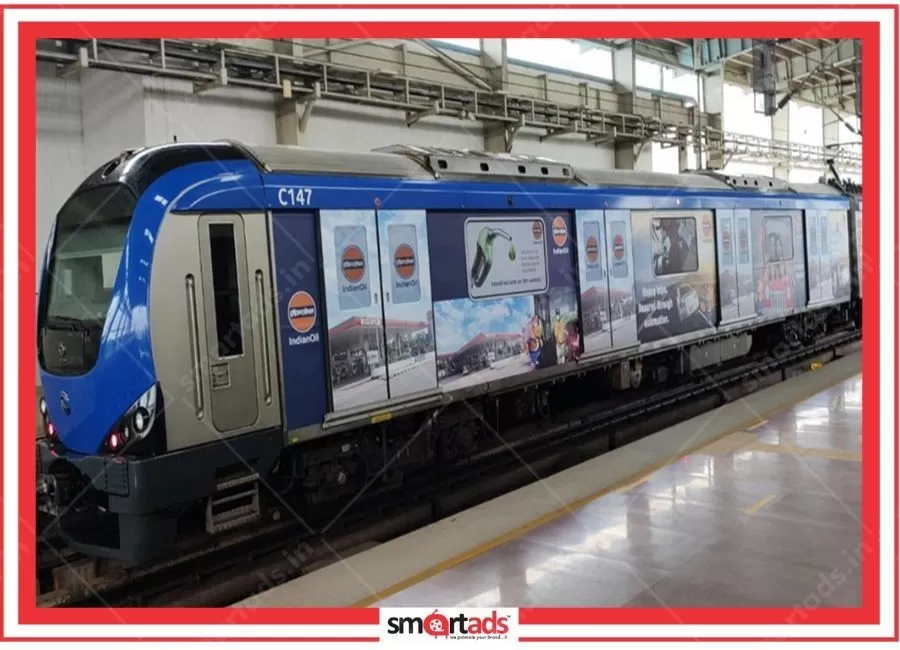
Exterior Metro Wrap
Custom
The advertisement spans the whole train,
Rate per Metro Display Cost / 1 Month
Route : Tirusulam To WIMCO Nagar
₹1000000.00
Showing 1 to 5 of 5 Results
MEDIA DETAILS
Custom
The advertisement spans the whole train,
Rate per Metro Display Cost / 1 Month
Route : Tirusulam To WIMCO Nagar
₹1000000.00
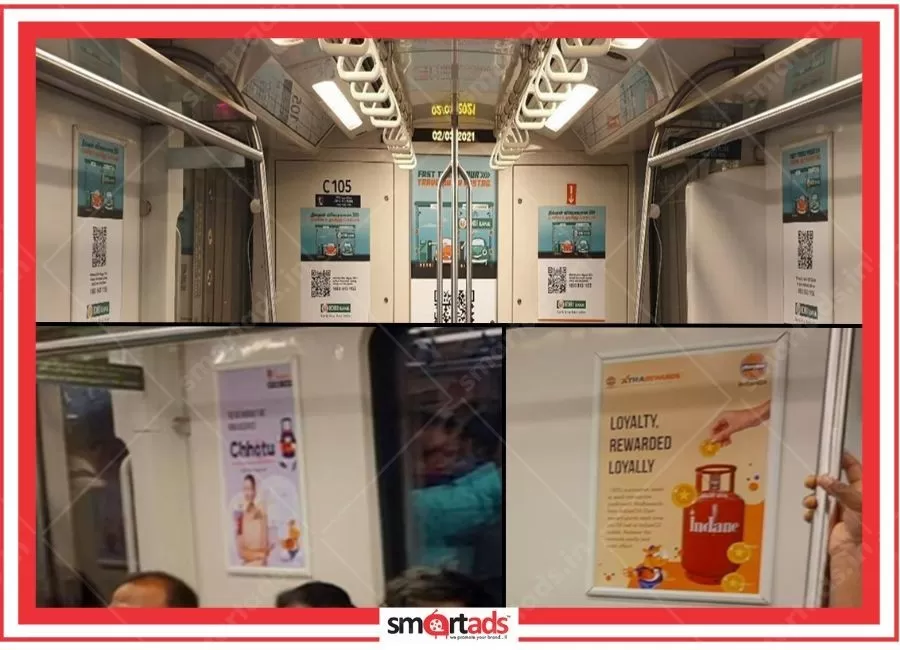
Custom
On the inside of the metro train the adv
Rate per Metro Display Cost / 1 Month
Route : Tirusulam To WIMCO Nagar
₹500000.00
20 Sec Audio
A jingle is a song or a phrase, and the
Rate per Metro Jingle Cost / 1 Month
Route :Tirusulam to WIMCO Nagar
₹400000.00

10 Sec Video
Digital screen on the metro station will
Rate per Metro Digital Display Cost / 1
Route :Tirusulam to WIMCO Nagar
₹600000.00

1 Metro Train
On the outside of the metro train the ad
Rate per Metro Display Cost / 1 Month
Route :Tirusulam to WIMCO Nagar
₹1500000.00
MEDIA REACH

MinimumQty :
1
EstimateReachPeople :
150000000
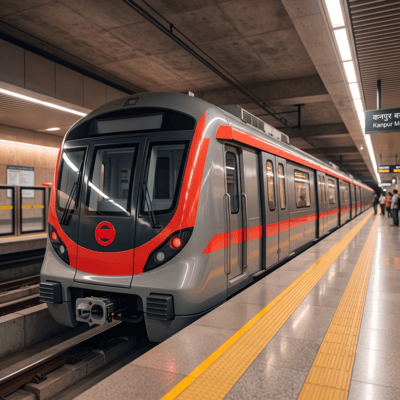
Kanpur's metro system is quietly becoming one of the most underutilised advertising assets in Uttar Pradesh — and the brands that figure this out early are going to enjoy a significant first-mover advantage. The Orange Line already carries tens of thousands of daily commuters through some of the city's most commercially active corridors, which means the captive audience available to advertisers is both sizeable and, frankly, far more receptive than most media planners assume. What surprises many of our clients is that metro train advertising in Kanpur often delivers stronger brand recall per rupee than traditional hoardings, simply because the exposure happens in an environment where people have nowhere else to look.
Most people think of out-of-home advertising as something static — a hoarding on a flyover, a wall painting at a busy junction. Metro train advertising works on an entirely different principle; it brings the advertisement to the audience rather than waiting for the audience to pass by. On the Kanpur Metro's Orange Line (officially Corridor-1), which runs under the operational oversight of the Uttar Pradesh Metro Rail Corporation (UPMRC), advertising space exists across multiple touchpoints — the exterior of the train itself, the interior panels, station concourses, platform edges, entry-exit gate areas, and increasingly, digital OOH screens installed at key stations.
The mechanics of how a campaign is executed are worth understanding before a brand commits budget. An advertiser — working either directly with UPMRC's concessionaire or through a registered advertising agency in Kanpur — selects the format, duration, and station or train-level placement. The creative materials, which must comply with UPMRC's technical and content guidelines, are then produced using fire-retardant materials compliance standards mandated for all transit environments; this is a non-negotiable requirement that catches first-time advertisers off guard if they come unprepared. Once materials pass inspection, they are applied by certified installation vendors, and the campaign runs for the agreed duration — typically a minimum of one month, though we have seen shorter activations approved for special events.
At SmartAds, we always tell our clients that the real power of metro advertising in Kanpur lies in the concept of dwell time. A commuter waiting on a platform at Kanpur Central metro station or riding between Rawatpur and IIT Kanpur metro station is not scrolling past your ad in 1.5 seconds the way they might on social media; they are sitting or standing in close proximity to your brand message for anywhere between four and twenty-two minutes per journey, which creates the kind of repeated exposure that builds genuine brand awareness over a campaign duration of even four to six weeks.
The format menu on Kanpur Metro is broader than most advertisers realise, and choosing the wrong one for your objective is probably the most common planning mistake we encounter. The most visually dominant option is the full train wrap — a vinyl wrap ads execution that covers the entire exterior of one or more coaches, effectively turning the rolling stock into a moving billboard that travels the full length of Corridor-1 multiple times each day. A full train wrap on the Kanpur Metro generates brand impressions at every station, every level crossing, and every stretch of elevated track, which makes it the format of choice for product launches or campaigns where sheer visual impact is the primary goal.
Interior panel ads are, in our experience, the more strategically nuanced option; they sit directly in the sightline of seated and standing passengers, which means the brand message is absorbed during those long dwell time windows we mentioned. Interior formats include seat-back branding panels positioned at eye level for seated commuters, hand grab advertising on the overhead straps and poles, and ceiling panel branding — a format that is underused but surprisingly effective because it captures the gaze of passengers who are avoiding eye contact with fellow travellers, which is essentially everyone. Station-level formats add another layer: platform panel advertising along the edge walls, concourse advertising in the ticketing and entry zones, metro pillar branding on the structural columns, and entry exit gate branding that catches commuters at the precise moment of arrival and departure.
The newer and arguably more exciting development is the rollout of DOOH digital screens at select Kanpur Metro stations; these digital OOH placements allow for time-of-day scheduling, which means a quick-service restaurant can push a lunch offer between 11 AM and 2 PM and switch to a dinner promotion in the evening without reprinting a single piece of creative. One FMCG client we worked with used this format combination — static interior panels for brand awareness and DOOH digital screens for promotional messaging — and found that the layered approach produced significantly stronger recall scores than either format used in isolation. The QR code integration OOH capability on these digital screens also opens the door to measurable, trackable campaigns, which is something we will come back to later in this piece.
Frankly speaking, this is the question every client asks first, and it is also the question that most agency websites and competitor pages refuse to answer — which is a disservice to anyone trying to plan a budget. We will give you real numbers here, with the caveat that rates are subject to UPMRC tender cycles and concessionaire negotiations, so treat these as indicative benchmarks rather than a live rate card.
A full train wrap on the Kanpur Metro — covering the exterior of a complete train rake — is typically priced somewhere in the ballpark of ₹8 to ₹14 lakh per month, depending on the number of coaches wrapped and the campaign duration; longer commitments of three months or more generally attract a negotiated discount in the range of 15 to 20 percent. Interior panel ads are considerably more accessible: a set of interior panels across one coach works out to roughly ₹40,000 to ₹80,000 per month, which makes this format genuinely viable for mid-sized brands and even well-funded startups. Platform panel advertising at high-footfall stations like Kanpur Central metro station or Naveen Market tends to be priced at around ₹25,000 to ₹60,000 per panel per month, with station domination packages — where a brand takes over all available inventory at a single station — running somewhere between ₹2 lakh and ₹5 lakh per month depending on the station's footfall tier.
Metro advertising rates for DOOH digital screens are typically sold on a per-spot basis, with a 10-second spot in a loop of six to eight advertisers priced at roughly ₹15,000 to ₹35,000 per screen per month; the CPM on these digital placements works out to somewhere around ₹6 to ₹10, which is a number that genuinely surprises most brand managers when they compare it to what they are paying for programmatic display or even mid-tier social media reach. Metro pillar branding and concourse advertising tend to sit in the ₹20,000 to ₹50,000 per unit per month range. For SMEs and startups exploring BTL advertising on a tighter budget, we typically recommend starting with two to four interior panel ads across a high-frequency route section, which can be executed for a total metro advertising cost of under ₹2 lakh for a month-long campaign — and that is a number that delivers meaningful brand impressions given the daily ridership volumes.
Not all stations are created equal, and the audience profile at each stop along Corridor-1 is meaningfully different — a fact that most generic metro advertising guides completely ignore. Kanpur Central metro station is the obvious anchor; it connects to one of India's busiest railway junctions and sees a mixed, high-volume footfall of travellers, shoppers, and office-goers, which makes it the right choice for mass-market consumer brands targeting broad demographics. The station domination format performs particularly well here because the sheer volume of people passing through the concourse and entry exit gate areas ensures that even a short campaign duration generates substantial brand impressions.
IIT Kanpur metro station draws a very different crowd — students, faculty, research professionals, and the ecosystem of tech and education businesses that orbit one of India's premier engineering institutions; this makes it the natural choice for brands in edtech, financial services, laptops and electronics, and professional courses. Rawatpur, which sits in a predominantly residential and office corridor, skews toward daily commuters in the 25-to-45 age bracket with stable household incomes — an audience that is particularly valuable for banking, insurance, and consumer durables advertisers. Naveen Market and Chunniganj metro stations serve Kanpur's dense commercial and retail districts, which means footfall here is heavily weighted toward active shoppers and small business owners; a retail client in Kanpur's textile trade that we worked with ran a four-week platform panel advertising campaign across these two stations and reported a measurable uptick in walk-ins that they attributed directly to the metro advertising exposure. Moti Jheel and Bada Chauraha round out the high-interest stations, both serving areas with significant civic and commercial activity.
The strategic implication here is that metro station advertising in Kanpur is not a one-size-fits-all buy; it is a hyperlocal advertising tool that, when planned correctly, allows a brand to reach a very specific audience segment at the precise point in their day when they are most receptive. At SmartAds, our media planning Kanpur team routinely maps client audience profiles against station-level commuter data before recommending a station mix — because buying the wrong stations, even at the right format, is money that simply does not work hard enough.
The assumption that metro advertising only reaches a narrow slice of urban professionals is one that the data does not support. Kanpur Metro's daily commuters span a genuinely broad socioeconomic range — from IIT students and IT professionals to government employees, retail workers, students from CSJM Kanpur University, and the city's growing base of young working adults who have shifted from two-wheelers and autos to the metro for its predictability and cost efficiency. The GroupM TYNY Report and Dentsu e4m Report have both highlighted the rapid growth of metro rail ridership in tier-2 cities as a key trend reshaping out-of-home advertising strategy in India, and Kanpur is a textbook example of this dynamic.
What makes this audience particularly valuable from an advertiser's perspective is the combination of captive audience conditions and repeated exposure patterns. A daily commuter on the Orange Line is not a one-time impression; they ride the same route five or six days a week, which means a four-week campaign delivers somewhere between 20 and 25 exposures to the same individual — a frequency level that brand awareness research consistently associates with strong recall and purchase intent lift. This is the kind of repeated exposure that is structurally impossible to replicate with a roadside hoarding, where the same person might drive past twice a day but at 40 kilometres per hour with competing visual stimuli on all sides.
Peak hour advertising windows — roughly 8 to 10 AM and 5:30 to 8 PM on weekdays — are when the trains and stations are most crowded, and these are also the moments when brand visibility is at its highest because physical proximity to ad surfaces increases. Brands in categories like personal care, food and beverage, financial services, and consumer electronics tend to perform particularly well in these windows; experiential marketing Kanpur activations timed around peak hours at high-footfall stations have produced some of the strongest engagement metrics we have seen in the BTL advertising space.
The Uttar Pradesh Metro Rail Corporation maintains strict oversight of all commercial advertising on the Kanpur Metro network, and understanding the regulatory framework before you start planning is essential — not optional. UPMRC operates a concessionaire model for non-fare revenue UPMRC generation, which means advertising rights are typically bundled and awarded to a primary concessionaire through a competitive tender process; recent tender activity, including Tender ID 2026_UPMRC_265845_1 and Tender No. KNPAR-18, gives you a sense of how formally this process is structured. Advertisers working through registered agencies like SmartAds navigate this system on behalf of their clients, which removes a significant administrative burden.
The content guidelines are firm and worth knowing upfront. UPMRC prohibits advertising for tobacco, alcohol, and politically partisan content; all creative materials must be submitted for approval before production begins, and any changes to approved artwork require a fresh approval cycle — something that can add one to two weeks to a campaign timeline if not planned for. The UPMRC approval process for physical formats requires that all materials be produced using fire-retardant materials compliance standards, which means standard vinyl or flex materials used in outdoor advertising are not automatically acceptable; the materials must carry appropriate fire-resistance certification, and installation must be carried out by vendors approved by the concessionaire.
On top of that, there are dimensional specifications for every format — panel sizes, bleed margins, resolution requirements for digital OOH content — which vary by station and by format type. We have seen this catch advertisers who come with artwork sized for standard outdoor formats and then discover that metro panel dimensions are non-standard; the rework costs time and money. Our standard advice to clients is to brief the creative team only after the format specifications have been confirmed in writing from the concessionaire, and to build at least two weeks of buffer into the pre-campaign timeline for the UPMRC approval process and material production.
This comparison comes up in almost every media planning conversation we have with clients who are weighing their out-of-home advertising options in Kanpur Nagar, and the answer is more nuanced than a simple "one is better than the other." A large-format hoarding on a busy arterial road like GT Road or Mall Road in Kanpur can deliver enormous reach — we are talking about exposure to hundreds of thousands of vehicle and pedestrian movements per day — but the quality of that exposure is fundamentally different from what metro advertising delivers. A driver passing a billboard at speed has perhaps 1.5 to 3 seconds of actual visual engagement; a metro commuter sitting in a coach for twelve minutes has the same ad in their peripheral vision for the entire journey, which is a categorically different quality of brand impression.
The cost comparison is also instructive. A premium hoarding at a high-traffic Kanpur junction is typically priced somewhere between ₹80,000 and ₹2.5 lakh per month depending on size and location — which sounds comparable to metro advertising costs until you factor in the CPM differential. When you divide the monthly cost by the number of quality impressions (not just raw exposures), metro train advertising in Kanpur consistently delivers a lower effective CPM, particularly for interior formats where dwell time is highest. Bus advertising and auto advertising in Kanpur offer lower absolute costs, but they lack the controlled, captive audience environment that makes metro advertising so efficient; a bus passenger is often distracted by traffic, noise, and the general chaos of city movement, whereas a metro commuter is in a quieter, more contained space.
The moving billboard dimension of a full train wrap is perhaps the most direct comparison to traditional OOH advertising, and here the metro format wins on both reach and novelty. A wrapped train travelling the full length of Corridor-1 multiple times daily generates brand impressions at every station stop, at every level crossing, and along every elevated section visible from the surrounding urban fabric — which means the effective reach extends well beyond the passenger base to include pedestrians, motorists, and residents in the vicinity of the elevated track. This is why we position train wrap advertising as a premium OOH buy rather than a niche BTL advertising format; it genuinely functions as both.
ROI from transit advertising is a topic where the industry has historically been vague, and we think that vagueness does a disservice to brands trying to make evidence-based budget decisions. The honest answer is that advertising ROI transit metrics vary significantly by category, creative quality, campaign duration, and how well the metro buy is integrated with other channels — but there are meaningful benchmarks we can share from our experience and from published industry data.
Brand recall from metro advertising consistently outperforms roadside OOH in research conducted across Indian metro networks; studies cited in the FICCI-EY Media Report have indicated that transit advertising environments generate recall rates in the range of 60 to 75 percent among regular commuters, compared to 30 to 45 percent for equivalent roadside formats. The mechanism is straightforward — repeated exposure in a low-distraction environment is the most reliable driver of memory encoding, and metro commuters who ride the same route daily are being exposed to the same brand message with a frequency that most digital campaigns struggle to match without significant retargeting spend. One automotive brand we worked with ran a six-week interior panel campaign across the Orange Line timed around a new model launch; their post-campaign brand awareness survey in Kanpur showed a 34-percentage-point lift among metro-using respondents compared to a 12-point lift among non-metro respondents in the same city, which gave us a reasonably clean read on the metro advertising contribution.
The integration of QR code integration OOH elements into metro campaigns has opened up a new dimension of measurability that was not available even three years ago. A retail client in Kanpur's education sector ran a campaign combining interior panel ads with QR codes linking to a course inquiry page; the QR-driven traffic during the campaign period was tracked separately from other digital sources, and the cost per qualified lead from the metro channel worked out to roughly 40 percent lower than their Google Search cost per lead during the same period — a result that genuinely changed how that client thinks about media planning Kanpur going forward. We are not suggesting metro advertising replaces digital; we are saying that when the two are planned together intelligently, the combined ROI is consistently stronger than either channel in isolation.
The booking process has a few more steps than buying a newspaper ad or a digital placement, and knowing the sequence upfront saves a significant amount of time. The first step is identifying the current concessionaire holding the advertising rights for UPMRC's Kanpur network; this changes periodically through the tender cycle, and working with an advertising agency in Kanpur that maintains active relationships with UPMRC's commercial team is the most efficient way to navigate this without spending weeks on administrative back-and-forth. SmartAds maintains these relationships across multiple UPMRC cities, which means our clients typically move from brief to booking confirmation significantly faster than brands approaching the process cold.
Once the concessionaire is identified, the process involves submitting a campaign brief that specifies format, station or train preferences, campaign duration, and target start date; the concessionaire then provides availability and a formal rate proposal. Creative artwork must be submitted for UPMRC content approval before any production begins — and this step, which many advertisers try to skip or compress, is where most delays originate. After approval, material production (using compliant fire-retardant materials) and installation are coordinated through the concessionaire's approved vendor network. The entire pre-campaign timeline from brief to installation typically runs four to six weeks for a well-prepared advertiser; rushing this timeline is possible but adds cost and risk.
For brands exploring co-branding metro kanpur opportunities — where two non-competing brands share a train wrap or station domination buy to split costs — the process requires both brands' artwork to be submitted and approved simultaneously, which adds coordination complexity but can meaningfully reduce the per-brand metro advertising cost. This is a model we have facilitated for smaller clients who want the visibility of a full train wrap without the full-format price tag, and it works well when the brand pairing is complementary rather than competing.
Kanpur Metro's Phase 1 full network — which spans 32.3 kilometres across 30 stations — is being developed in stages, and the advertising implications of that expansion are significant enough that any brand thinking about a multi-year metro advertising strategy needs to factor them in now. The currently operational section of Corridor-1 already covers a substantial portion of the city's commercial and residential spine, but as additional stations come online, the daily ridership figures will grow substantially — and with them, the reach and value of every advertising format on the network.
The European Investment Bank (EIB) has been among the financing partners for UPMRC's expansion, which signals the seriousness of the infrastructure commitment and the long-term stability of the network as an advertising platform. For brands in categories like real estate, financial services, and consumer durables — where brand building is a multi-year exercise — locking in metro advertising relationships early, before the network reaches full capacity and advertising inventory becomes more competitive, is a strategic decision that we think will look very smart in retrospect. The tier-2 city advertising opportunity in Kanpur is still in its early innings; the brands that build metro advertising into their annual media plan now are establishing a presence that will compound in value as the network grows.
What a lot of people miss is that the expansion also means new station-level inventory at locations that do not yet have advertising infrastructure — which creates opportunities for station domination buys at emerging high-footfall nodes before competitors establish a presence. Our media planning team tracks UPMRC tender releases and construction timelines precisely so we can advise clients on when to move on these early-mover opportunities; it is the kind of forward-looking media planning Kanpur that separates strategic advertising from reactive spending.
Q: What is metro train advertising and how does it work in Kanpur?
Metro train advertising in Kanpur refers to commercial brand placements across the physical and digital advertising inventory operated by UPMRC on the Orange Line (Corridor-1) network — which includes the exterior and interior surfaces of the rolling stock, station platforms, concourses, pillars, entry-exit gates, and DOOH digital screens. Advertisers work through the UPMRC-appointed concessionaire, typically via a registered advertising agency, to select formats, submit creative for approval, and coordinate installation. The fundamental mechanism is one of captive audience exposure — commuters are in close proximity to brand messaging for extended dwell time periods, which drives the brand recall and repeated exposure metrics that make transit advertising so effective relative to other OOH formats.
Q: How much does metro train advertising cost in Kanpur?
Indicative rates vary by format: a full train wrap runs somewhere between ₹8 and ₹14 lakh per month; interior panel ads per coach are in the ₹40,000 to ₹80,000 range; platform panel advertising at major stations is roughly ₹25,000 to ₹60,000 per panel per month; and DOOH digital screen spots are priced at approximately ₹15,000 to ₹35,000 per screen per month. Station domination packages at premium stations like Kanpur Central metro station can range from ₹2 to ₹5 lakh per month. These are indicative benchmarks — actual metro advertising rates are subject to UPMRC tender cycles, campaign duration, and the specific inventory selected, so a formal quote from the concessionaire or a registered agency is always necessary for budget planning.
Q: Which metro stations in Kanpur get the highest passenger footfall?
Kanpur Central metro station consistently records the highest footfall given its connection to the main railway junction. IIT Kanpur metro station, Rawatpur, Naveen Market, Chunniganj, Bada Chauraha, and Moti Jheel are all high-traffic nodes for different demographic reasons — IIT Kanpur for the student and academic community, Rawatpur for office commuters, and Naveen Market and Chunniganj for retail and commercial traffic. The right station selection depends on your target audience profile, not just raw footfall numbers.
Q: What ad formats are available on Kanpur Metro trains?
The available formats span exterior train wraps (full train wrap and partial wraps), interior panel ads (including seat-back branding, hand grab advertising, and ceiling panel branding), platform panel advertising, concourse advertising, metro pillar branding, entry exit gate branding, and DOOH digital screens at select stations. Each format has different reach, dwell time, and cost characteristics, and the most effective campaigns typically combine two or more formats.
Q: Who regulates metro advertising in Kanpur and what are the rules?
The Uttar Pradesh Metro Rail Corporation (UPMRC) is the regulatory authority. Advertising rights are awarded to concessionaires through a formal tender process, and all campaigns must comply with UPMRC's content guidelines — which prohibit tobacco, alcohol, and political advertising — as well as technical specifications for fire-retardant materials compliance, dimensional accuracy, and digital content formats. Creative approval from UPMRC is mandatory before production begins.
Q: How do I get UPMRC approval to advertise on Kanpur Metro?
The UPMRC approval process involves submitting your campaign brief and creative artwork to the concessionaire, who forwards it to UPMRC's commercial team for content and technical review. Approval typically takes five to ten working days for straightforward creatives; complex or non-standard formats may take longer. Working through an experienced advertising agency in Kanpur that has existing relationships with the concessionaire significantly streamlines this process and reduces the risk of rejection due to technical non-compliance.
Q: What is the difference between a full train wrap and interior panel advertising?
A full train wrap is an exterior vinyl wrap ads execution that covers the outside surface of one or more coaches, functioning as a moving billboard visible to people outside the train — at stations, along the elevated track, and at level crossings. Interior panel ads are placements inside the coach, visible only to passengers; they benefit from much longer dwell time and closer physical proximity to the viewer, which drives stronger brand recall. The two formats serve different objectives: train wraps maximise broad brand visibility and reach, while interior panels maximise depth of engagement with the captive audience.
Q: Is metro train advertising in Kanpur affordable for small businesses?
Yes, particularly for interior panel ads and platform panel advertising at non-premium stations. A small business can run a meaningful metro advertising campaign in Kanpur for a total metro advertising cost of under ₹2 lakh for a month, which delivers genuine brand impressions among a targeted daily commuter audience. The key for SMEs is to concentrate budget on one or two high-relevance stations rather than spreading thin across the network, and to run campaigns for a minimum of four weeks to allow repeated exposure to build brand awareness.
Q: How long should I run a metro advertising campaign in Kanpur for best results?
Our experience consistently shows that a minimum campaign duration of four weeks is necessary to generate meaningful brand recall among regular commuters; eight to twelve weeks produces significantly stronger results because the repeated exposure frequency compounds over time. For product launches or seasonal campaigns, a four-to-six week burst is appropriate; for brand-building objectives, a sustained presence of three months or longer is where the real value accumulates. The economics also improve with duration, as longer bookings typically attract concessionaire discounts.
Q: Can I target specific metro stations or routes in Kanpur for my ad campaign?
Yes — metro station advertising in Kanpur can be planned at the individual station level, which is one of its key advantages over network-wide OOH formats. You can select specific stations based on their audience profile, buy interior panel ads on trains that service particular route sections, or combine station-level and train-level placements for a layered approach. This hyperlocal advertising capability is something that roadside hoardings and mass media simply cannot replicate.
Q: What industries benefit most from advertising on Kanpur Metro trains?
Education and edtech (particularly around IIT Kanpur metro station and CSJM University catchment areas), financial services and banking, retail and e-commerce, consumer electronics, real estate, FMCG, healthcare, and automotive are the categories we see performing most consistently well. The common thread is that these categories either have a broad enough target audience to benefit from the metro's demographic mix, or they have a specific audience segment (students, professionals, shoppers) that maps cleanly onto particular stations or route sections.
Q: How does Kanpur Metro advertising compare to hoardings or billboard advertising?
Metro advertising delivers lower effective CPM, higher brand recall, and significantly longer dwell time than roadside hoardings; hoardings deliver higher raw reach and are more visible to vehicle-borne audiences. The two formats are complementary rather than competitive — a brand running a full train wrap as a moving billboard alongside a concourse advertising placement gets both the broad reach of OOH advertising and the depth of engagement that transit advertising uniquely provides. For brands with limited budgets choosing between the two, the decision should be driven by whether reach or recall is the primary campaign objective.
Q: What is the daily ridership of Kanpur Metro and how does it affect ad reach?
UPMRC's operational data indicates that Kanpur Metro's daily ridership has been growing steadily since the Orange Line's commercial launch, with figures in the range of tens of thousands of daily commuters on the currently operational section — a number that is expected to grow substantially as the Phase 1 full 30-station, 32.3 km network comes online. For advertisers, this ridership figure is the foundation of the brand impressions calculation; even at current ridership levels, a month-long interior panel campaign generates hundreds of thousands of quality impressions among a captive audience, which is a reach figure that competes seriously with mid-tier digital campaigns in the same market.
Q: Can metro train advertising in Kanpur be integrated with digital marketing campaigns?
Absolutely — and this is where we think the most interesting ROI opportunities lie. QR code integration OOH on interior panels and DOOH digital screens creates a direct bridge between the physical ad and a digital destination, allowing brands to track metro-driven traffic separately from other digital sources. Geofencing campaigns can be configured to serve mobile ads to users within the vicinity of specific metro stations, reinforcing the metro message with a digital touchpoint. Retargeting audiences who have been exposed to metro placements through mobile location data is another tactic that is gaining traction; the combination of high-frequency physical exposure and precision digital follow-up produces measurably stronger conversion rates than either channel alone.
Q: When will Kanpur Metro expand to 30 stations and how will it impact advertising opportunities?
The full Phase 1 network of 30 stations across 32.3 km is being developed in stages under UPMRC's project timeline; specific commissioning dates for individual sections are subject to construction progress and regulatory clearances. What is clear is that each new station and route section added to the network multiplies the available advertising inventory and extends the reach of every train-level format. Brands that establish metro advertising relationships now — before the full network is operational and inventory becomes more competitive — are positioning themselves advantageously for the medium-term.
The case for metro train advertising in Kanpur does not rest on novelty or trend-chasing; it rests on a straightforward media planning logic that has held true across every transit advertising market in India. You have a captive audience, a controlled environment, extended dwell time, and a daily commuter pattern that delivers repeated exposure to the same individuals over weeks and months — which is precisely the combination that drives the brand recall and awareness metrics that most advertising channels struggle to replicate at comparable cost. The tier-2 city advertising opportunity in Kanpur Nagar is real, it is growing, and it is still early enough that brands entering the metro advertising space now will benefit from lower competition for premium inventory and stronger first-mover brand associations among a commuter base that is expanding every quarter.
To be fair, metro advertising is not the right answer for every brief. A brand that needs immediate, city-wide mass reach in a single week is probably better served by a combination of newspaper advertising and digital; a brand running a purely rural distribution campaign has no business on an urban transit network. But for brands targeting Kanpur's urban middle class, its student population, its office-going professionals, and its retail-active shoppers — which describes a very large proportion of the brands we work with — metro train advertising in Kanpur deserves a serious allocation in the annual media plan, not a token test budget.
The thing is, the brands that treat metro advertising as an experimental line item rather than a strategic channel tend to under-invest in campaign duration and creative quality, which produces underwhelming results and confirms their scepticism — a self-fulfilling outcome that we have seen play out too many times. The brands that commit to a properly planned, adequately funded, multi-format metro campaign, integrated with their digital activity and timed to their business calendar, consistently come back for more because the results justify it. That is not a sales pitch; it is simply what the data from our campaigns shows.
If you are evaluating metro advertising in Kanpur for your brand — whether you are a national advertiser looking to strengthen presence in Uttar Pradesh or a local business building awareness among the city's daily commuters — the SmartAds media planning team is available to build a customised plan with format recommendations, station selection rationale, and indicative budgets tailored to your specific objectives. Visit SmartAds.in to connect with our team and start the conversation.
