
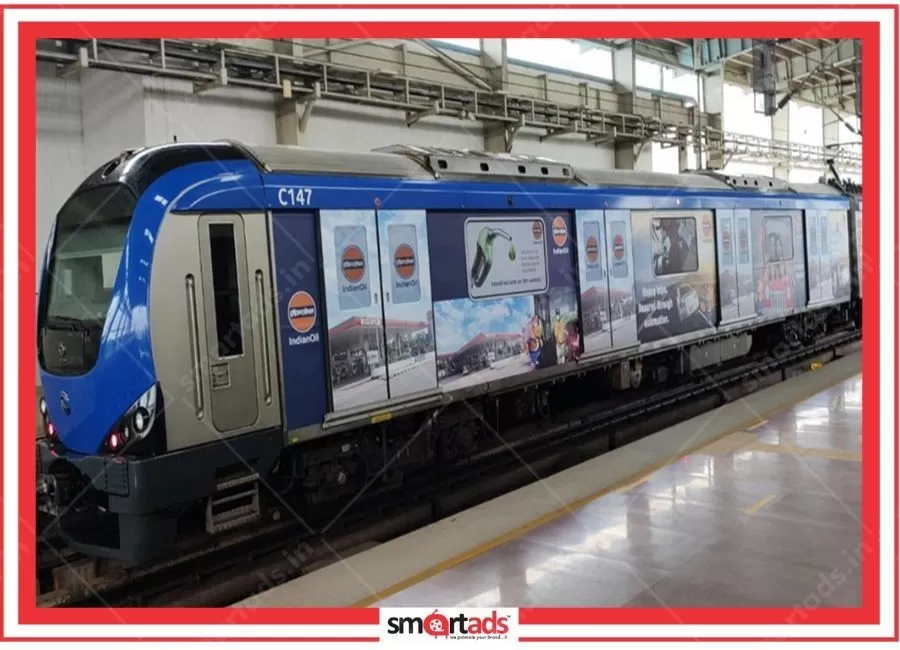
Exterior Metro Wrap
Custom
The advertisement spans the whole train,
Rate per Metro Display Cost / 1 Month
Route : Tirusulam To WIMCO Nagar
₹1000000.00
Showing 1 to 5 of 5 Results
MEDIA DETAILS
Custom
The advertisement spans the whole train,
Rate per Metro Display Cost / 1 Month
Route : Tirusulam To WIMCO Nagar
₹1000000.00
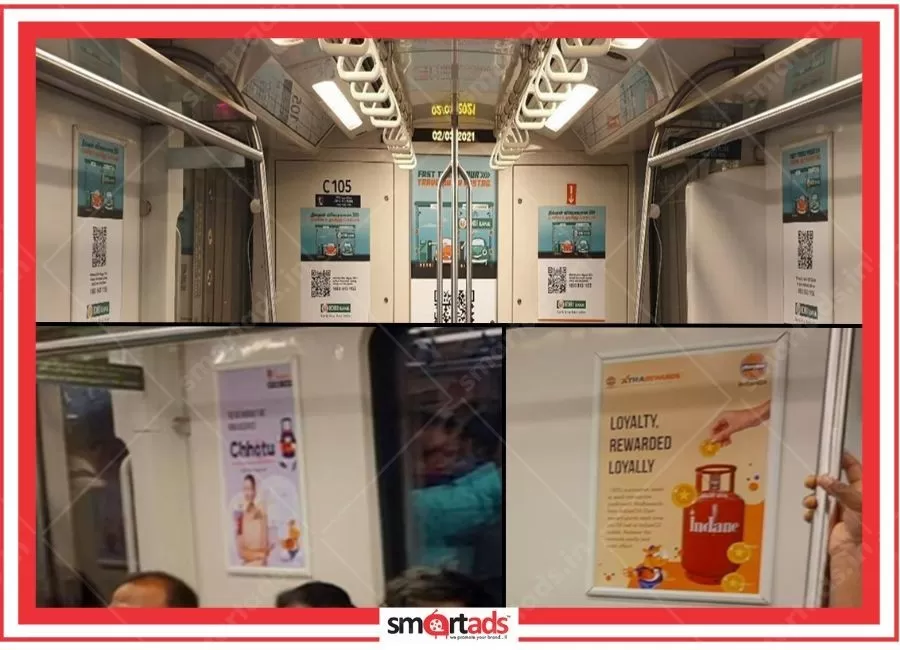
Custom
On the inside of the metro train the adv
Rate per Metro Display Cost / 1 Month
Route : Tirusulam To WIMCO Nagar
₹500000.00
20 Sec Audio
A jingle is a song or a phrase, and the
Rate per Metro Jingle Cost / 1 Month
Route :Tirusulam to WIMCO Nagar
₹400000.00

10 Sec Video
Digital screen on the metro station will
Rate per Metro Digital Display Cost / 1
Route :Tirusulam to WIMCO Nagar
₹600000.00

1 Metro Train
On the outside of the metro train the ad
Rate per Metro Display Cost / 1 Month
Route :Tirusulam to WIMCO Nagar
₹1500000.00
MEDIA REACH

MinimumQty :
1
EstimateReachPeople :
150000000
Most brands that come to us with a Noida media brief are thinking billboards, digital display, or maybe a radio burst — and almost none of them have seriously considered what is sitting right under their noses: a fleet of air-conditioned trains carrying tens of thousands of educated, employed, digitally active commuters through the heart of one of India's fastest-growing urban corridors. The Noida Metro Aqua Line, operated by the Noida Metro Rail Corporation, is not a secondary transit system; it is a precision-targeted advertising environment which happens to move your brand message through Sector 18, Sector 62, and Greater Noida six days a week, at a CPM that makes most digital planners do a double-take.
Metro train advertising in Noida refers to the placement of brand communications directly on or inside the rolling stock — the trains themselves — operated by the Noida Metro Rail Corporation on the Aqua Line corridor. Unlike station advertising, which is static and location-bound, train-based transit media travels with the commuter across every station on the route, which means a single campaign placement generates impressions at Sector 51, Sector 62, Sector 18, Noida City Centre, and all the way through to the Depot Station in Greater Noida without requiring separate bookings at each location.
The mechanics are straightforward, though the execution requires more coordination than most clients expect. NMRC licenses advertising rights on its rolling stock through authorised media partners and agencies; brands cannot simply walk in and paste a vinyl on a train. The process involves creative approvals, material specifications, installation slots coordinated around the train's maintenance schedule, and compliance with NMRC's brand safety guidelines — all of which we handle end-to-end for our clients at SmartAds. What a lot of people miss is that the advertising is not just about the physical placement; it is about the dwell time, which on an Aqua Line journey averages somewhere between 18 and 28 minutes depending on origin and destination, giving your creative far more sustained attention than a three-second scroll or a roadside billboard passed at 60 kilometres per hour.
The Aqua Line currently runs 21 stations across a 29.7-kilometre stretch, connecting Sector 51 in Noida — where it interchanges with the Delhi Metro Blue Line at Sector 52 — down through the commercial and IT spine of Noida and into Greater Noida. That interchange point is particularly valuable for advertisers, because it means the Aqua Line audience is not isolated; it includes commuters flowing in from the broader Delhi NCR network, which substantially expands the effective reach of any metro train branding campaign placed on this corridor.
The Aqua Line was inaugurated in January 2019, and it was designed from the ground up as an elevated corridor serving the Noida-Greater Noida urban spine — a stretch which happens to contain some of the most commercially significant real estate in the National Capital Region. The route passes through Sector 62, which is one of the densest IT park clusters in NCR, drawing a daily workforce of software engineers, product managers, and analysts who represent exactly the demographic that fintech, edtech, OTT platform, and premium FMCG brands are trying to reach. It also passes through Sector 18, which is arguably Noida's most active commercial and retail zone, home to DLF Mall of India and dozens of branded retail outlets.
What makes the network particularly interesting from a media planning perspective is the demographic consistency of its ridership. The Aqua Line was built to serve a planned urban environment, which means the catchment areas along the route are predominantly residential sectors with high-income housing, IT campuses, and educational institutions — not the mixed-use, highly variable catchment you find on older metro lines in more organically developed cities. NMRC's own ridership data, which has been cited in various urban transport studies, suggests daily ridership has been recovering and growing post-pandemic, with figures in the range of roughly 50,000 to 70,000 daily commuters on regular weekdays; and while that number is lower than the Delhi Metro's headline figures, the audience quality — in terms of purchasing power, digital adoption, and brand receptivity — is arguably more uniform and more valuable for certain categories.
The upcoming Phase 2 expansion, which will add approximately 17.4 kilometres and 11 new stations extending toward Greater Noida West and terminating near Knowledge Park V, is something we are already factoring into long-term campaign planning for clients. Greater Noida West has seen explosive residential development over the past five years, and when Phase 2 opens, the Aqua Line advertising inventory will cover a significantly larger and denser commuter population — which means brands that establish metro train branding on this network now will benefit from the expanded reach without having to renegotiate from scratch.
The range of formats available for metro train advertising in Noida is wider than most brands realise, and the choice of format should be driven by campaign objectives rather than budget alone — though frankly speaking, budget usually ends up driving the conversation anyway. At the broadest level, formats fall into two categories: exterior placements, which are visible to people outside the train as it moves through the city, and interior placements, which target the captive audience riding inside the coaches.
Exterior formats include full train branding — sometimes called a train wrap or metro wrap advertising — where the entire external surface of a train is covered in vinyl graphics carrying the brand's creative. This is the most impactful and most expensive format, functioning essentially as a moving billboard that travels the full 29.7-kilometre route multiple times a day. A less expensive exterior option involves partial wraps covering specific panels or sections of the train exterior, which still deliver strong brand visibility at a lower cost. Interior formats include overhead panel advertising placed in the luggage rack area above seats, seat-back panels, door-panel advertising, and, increasingly, digital screens which are being installed in newer coaches and at key points within the train environment.
On top of that, there are format combinations which work particularly well for certain campaign types. A real estate developer we worked with in the Greater Noida market ran a campaign that combined exterior train branding on two rakes with interior seat-back panels carrying QR codes — the exterior creative drove awareness among pedestrians and motorists along the elevated corridor, while the interior panels captured the commuter's attention during the journey and prompted direct digital engagement. The campaign ran for 45 days and generated what the client described as their highest-ever volume of site visit inquiries from a single OOH placement, which is a result that is difficult to replicate with static outdoor advertising noida formats alone.
Full train branding is, without question, the format that generates the most conversation in client meetings — and also the most sticker shock when the rate card comes out. A full train wrap on the Noida Aqua Line involves applying vinyl graphics across the entire exterior surface of a rake, which typically comprises three coaches, covering the sides, ends, and sometimes the roof panels visible from elevated structures. The visual impact is extraordinary; a fully branded train moving through Sector 18 or past the Sector 62 IT hub is essentially a moving billboard which cannot be skipped, blocked, or scrolled past.
The creative specifications for exterior train branding are non-trivial. The vinyl material must meet NMRC's approved specifications for adhesion, weather resistance, and removability — cheap vinyl that leaves residue or damages the train surface will get a brand blacklisted from future bookings, and we have seen this happen with clients who tried to cut corners on production. The design itself needs to account for the fact that it will be viewed at speed, from varying distances, and in varying light conditions; which means the messaging needs to be bold, simple, and legible within roughly two to three seconds of viewing time. Our creative guidance to clients is always to treat the exterior of a train the way you would treat a highway billboard — headline, visual, brand name, and one call to action, nothing more.
From a cost perspective, full train branding on the Noida Metro Aqua Line works out to somewhere in the ballpark of ₹8 lakh to ₹15 lakh per rake per month, depending on the number of rakes, the campaign duration, and the current inventory availability — though these figures shift with demand, and festive season campaigns or high-demand periods like the IPL window typically attract a premium. The cost per impression, when calculated against the daily ridership and the number of times a single rake completes the full route in a day, works out to a CPM in the range of roughly ₹8 to ₹15, which surprises most first-time advertisers when they compare it to what they are paying for Instagram reach or programmatic display.
Not every brand has the budget or the campaign need for a full train wrap, and partial exterior branding options on the Aqua Line offer a meaningful middle ground. Partial exterior train branding typically covers specific panels — the side panels between doors, the end panels, or the lower body panels — and can be executed on one, two, or all three coaches of a rake depending on the budget. The visual impact is lower than a full wrap, but the brand visibility is still substantial, particularly when the creative is designed to work within the constrained panel dimensions.
Train wrap advertising in partial formats works out to somewhere between ₹3 lakh and ₹6 lakh per rake per month for a meaningful panel coverage, which puts it within reach of mid-sized brands and regional advertisers who might not have the budget for a full wrap but still want the moving billboard effect. One edtech brand we worked with used partial exterior branding on two rakes, focusing the creative entirely on the side panels facing the station platforms — the logic being that passengers waiting on platforms would see the branded train arriving and departing, which gave the creative maximum dwell time with a stationary audience. The campaign ran for 60 days and was subsequently extended, which is usually the clearest indicator that the client was seeing results.
The thing is, exterior train branding on the Aqua Line has a geographic reach that goes beyond the commuter audience. The Aqua Line is elevated for most of its route, which means the branded train is visible from roads, residential towers, commercial buildings, and open areas along the corridor — effectively turning the train into an OOH advertising unit that reaches non-commuters as well. This dual audience — commuters inside the train environment and general public along the elevated route — is a dimension of transit advertising that is often undervalued in media planning.
Interior train branding is where the captive audience dynamic really comes into its own. Once a commuter is inside a Noida Metro coach, they are in a closed, relatively distraction-free environment for the duration of their journey — which, as noted earlier, averages somewhere between 18 and 28 minutes. The dwell time is significantly higher than any other OOH format, and the audience is stationary, which means they are far more likely to actually read and process advertising content than they would be in a moving vehicle or walking past a billboard.
Interior formats include overhead panel advertising in the luggage rack area, which is typically a backlit panel or a printed panel running the length of the coach interior; seat-back advertising, which places the brand message directly in the sightline of seated passengers; door-panel advertising on the interior surfaces of coach doors; and, increasingly, LED display advertising on digital screens which are being fitted in newer rolling stock and at coach entry points. The digital screens are particularly interesting because they allow dynamic content rotation, which means a single screen placement can carry multiple brand messages across different time slots — a format which blurs the line between traditional transit media and DOOH (Digital Out-of-Home) advertising.
At SmartAds, we have found that interior train branding delivers the highest brand recall of any format in the metro train advertising mix, precisely because of the dwell time and the captive nature of the audience. A commuter who sees your backlit panel every morning for 30 days is not just generating an impression; they are building a memory structure around your brand which influences purchase decisions in ways that a single high-reach OOH placement simply cannot replicate. Interior advertising rates on the Aqua Line work out to roughly ₹50,000 to ₹1.5 lakh per coach per month depending on the format type, the number of coaches, and the placement position within the coach — with backlit panels and digital screens commanding a premium over standard printed panels.
Frankly speaking, the absence of transparent rate information is one of the biggest frustrations for brand managers and media planners trying to evaluate metro train advertising in Noida — most vendors either refuse to publish rates or present such wide ranges as to be useless. We are going to be more direct about this, because our experience shows that informed clients make better campaign decisions and end up with better results.
For full train branding on the Aqua Line, the rate for a single rake works out to somewhere between ₹8 lakh and ₹15 lakh per month, with the variation driven by factors including the specific rake, the campaign duration, and the time of year. Partial exterior train branding, covering two to three panels per coach, typically falls in the range of ₹3 lakh to ₹6 lakh per rake per month. Interior overhead panel advertising works out to roughly ₹60,000 to ₹1.2 lakh per coach per month for backlit panel formats; seat-back advertising is somewhat lower, in the ballpark of ₹40,000 to ₹80,000 per coach per month. Digital screen advertising, where available, commands a premium and is typically priced on a per-spot, per-day basis, with monthly packages working out to somewhere between ₹1 lakh and ₹2.5 lakh per screen depending on the number of spots and the loop duration.
Campaign duration has a significant effect on the effective rate. NMRC and its authorised partners typically require a minimum campaign duration of 30 days for train-based advertising, and campaigns of 90 days or more generally attract a negotiated discount of somewhere between 10 and 20 percent on the base rate. Production costs — vinyl printing, installation, and removal — are typically charged separately and can add anywhere from ₹50,000 to ₹2 lakh to the total campaign cost depending on the format and the extent of coverage. The total investment for a meaningful metro train advertising campaign in Noida — covering exterior branding on one rake plus interior panels across two coaches — works out to roughly ₹12 lakh to ₹20 lakh per month all-inclusive, which is a number that needs to be evaluated against the reach and frequency it delivers rather than compared in isolation to cheaper but less impactful formats.
The Aqua Line commuter audience is not a general mass audience; it is a specific, definable demographic which happens to be exactly what certain categories of advertisers are looking for. The route connects IT parks, educational institutions, residential sectors, and commercial zones in a corridor which is predominantly inhabited by urban professionals between the ages of 22 and 45, with household incomes that place them firmly in the SEC A and SEC B+ categories. This is the audience that buys smartphones, invests in mutual funds, subscribes to OTT platforms, considers premium FMCG brands, and makes real estate decisions — which is why we consistently see the best ROI from metro train advertising in Noida when it is used by brands in these categories.
Real estate advertising is perhaps the most natural fit, and it is consistently the category that spends the most on Noida metro advertising. Developers launching projects in Greater Noida, Noida Extension, or along the Yamuna Expressway use the Aqua Line as a precision channel to reach exactly the kind of employed, financially capable audience that is actively considering property purchases; and the geographic relevance of the medium — advertising on a train that literally runs through the neighbourhood where the project is located — adds a contextual credibility that no other format can match. Similarly, edtech advertising on the Aqua Line reaches students and young professionals who are the core users of online learning platforms, while fintech advertising finds a highly receptive audience among the IT workforce that passes through Sector 62 daily.
FMCG brands, retail chains, healthcare providers, automobile manufacturers, and OTT platform advertisers have all run successful campaigns on the Aqua Line, and the common thread is that they are all trying to reach an urban, aspirational, digitally active audience in the NCR market. What a lot of people miss is that the Noida metro audience is not just a Noida audience — the Sector 52 interchange with the Delhi Metro Blue Line means that a significant portion of Aqua Line commuters are travelling from or to Delhi, which effectively makes metro train advertising in Noida a tool for reaching the broader NCR professional audience, not just hyperlocal Noida consumers.
The comparison between metro train advertising and traditional outdoor advertising noida formats — hoardings, unipoles, bus shelters, gantries — is one we have this conversation with clients constantly, and the honest answer is that neither is universally better; they serve different objectives and work best in combination. That said, there are specific dimensions on which metro train advertising consistently outperforms traditional OOH, and brand managers who understand these dimensions make significantly better allocation decisions.
The most important dimension is dwell time. A commuter on the Aqua Line spends 18 to 28 minutes in the train environment, which means interior train branding gets sustained, repeated exposure during a single journey — a fundamentally different kind of attention than the two to three seconds a driver gives a roadside hoarding. High-frequency exposure is built into the medium by design; a daily commuter who takes the Aqua Line five days a week will see your interior panel 20 to 22 times in a single month, which is a frequency level that drives brand recall in ways that even well-placed outdoor advertising noida cannot match. The FICCI-EY Media & Entertainment Report has consistently noted transit media as one of the highest-recall OOH sub-categories, and our own campaign monitoring data supports this finding.
To be fair, traditional OOH has advantages that metro train advertising does not — primarily the ability to reach a much broader and more geographically dispersed audience, including people who never use the metro. A well-placed unipole on the Noida Expressway or a gantry at a major intersection will generate higher raw impression numbers than a single train branding campaign. The strategic answer, which is what we recommend to most clients with meaningful budgets, is to use metro train advertising as the high-frequency, high-recall anchor of the campaign — building deep brand memory with the core target audience — while using traditional OOH for broad reach and awareness amplification. This combination consistently delivers better brand awareness and brand recall metrics than either medium used in isolation.
Booking metro train advertising in Noida is not as simple as calling a vendor and placing an order, and brands that approach it that way often end up with delayed launches, creative rejections, or suboptimal placements. The process has several distinct stages, each of which has its own timeline and requirements, and understanding the full sequence is essential for anyone managing a campaign with a fixed launch date.
The first stage is inventory assessment and booking confirmation. NMRC licenses advertising rights on the Aqua Line to authorised media partners, and availability of specific rakes, formats, and positions needs to be confirmed before any creative work begins. Inventory on premium formats — particularly full train branding — is limited by the number of rakes in service, which means popular periods like the October-November festive window or the March-April quarter can see availability constraints. We always advise clients to confirm inventory and sign the booking at least 45 to 60 days before the desired campaign launch date; for full train branding, 60 to 90 days is more realistic given the production and approval timeline.
The second stage is creative development and NMRC approval. All advertising creative for metro train advertising in Noida must be submitted to NMRC for approval before production begins; the corporation has guidelines around content, brand safety, and creative standards which must be met. This approval process typically takes somewhere between 7 and 14 working days, and revisions can add to that timeline. Production — vinyl printing for exterior formats, panel printing for interior formats — takes an additional 7 to 14 days depending on the format and the production vendor. Installation is scheduled during the train's maintenance window, typically at the depot, and requires coordination between the advertising agency, the production vendor, and NMRC's operations team. End-to-end, from booking confirmation to campaign live date, the realistic timeline is 45 to 60 days for most formats, which is why lead time planning is non-negotiable.
The comparison between advertising on the Noida Aqua Line and advertising on the Delhi Metro — specifically the Blue Line or Magenta Line, which are the most relevant for brands targeting the Noida-Delhi commuter corridor — is a question we field regularly, and the answer is more nuanced than most people expect. Delhi Metro advertising, managed through DMRC's authorised partners, offers access to a vastly larger ridership — the Delhi Metro carries upwards of 60 lakh daily commuters across its network, compared to the Aqua Line's 50,000 to 70,000 — and the advertising rates reflect that scale accordingly.
Full train branding on a Delhi Metro Blue Line rake, for instance, works out to significantly higher than the equivalent on the Aqua Line — in the ballpark of ₹25 lakh to ₹40 lakh per rake per month for premium routes — which puts it out of reach for many mid-sized brands. The Aqua Line, by contrast, offers a more targeted and more affordable entry point into transit media in the NCR market; and for brands whose primary audience is the Noida-Greater Noida urban professional, the Aqua Line actually delivers better targeting efficiency than a Delhi Metro placement, because the audience is more geographically and demographically concentrated. A fintech brand targeting IT professionals in Sector 62, for example, will get far better audience alignment from Aqua Line advertising than from a Blue Line campaign which spans from Dwarka to Noida City Centre and covers a much more heterogeneous commuter base.
The strategic recommendation we give clients who have the budget for both is to use Delhi Metro for broad NCR reach and brand awareness, and to use metro train advertising in Noida specifically for frequency and depth with the Noida-Greater Noida professional audience. The two networks complement each other well; and the Sector 52 interchange, where the Aqua Line connects to the Blue Line, is a point of overlap which means commuters on both networks can be reached through a coordinated campaign across both systems. BTL advertising that uses both networks in combination — with consistent creative across both — delivers a brand recall uplift that neither network achieves independently.
ROI measurement for metro train advertising in Noida is an area where the industry has historically been weak, and we want to be honest about that. Unlike digital advertising, where every click and conversion is tracked in real time, transit media relies on estimated reach figures, survey-based brand recall studies, and proxy metrics like website traffic uplift or sales lift during the campaign period. That said, the metrics that are available are meaningful, and they tell a consistent story.
The daily reach of a fully branded Aqua Line rake — accounting for both interior commuter exposure and exterior visibility along the elevated corridor — is estimated at somewhere between 80,000 and 1,20,000 impressions per day when you include both the captive commuter audience and the general public along the route. Over a 30-day campaign, that works out to roughly 24 lakh to 36 lakh impressions per rake, which at a total campaign cost of ₹10 lakh to ₹15 lakh gives a CPM in the range of ₹4 to ₹6 for exterior formats — a number which is genuinely competitive with most outdoor advertising noida options and significantly below the CPM for most digital display formats targeting the same demographic. Interior formats, with their higher dwell time and captive audience, deliver fewer raw impressions but significantly higher brand recall; survey-based studies cited in the FICCI-EY report and various transit media industry analyses suggest recall rates for interior transit advertising are in the range of 65 to 80 percent, compared to 20 to 35 percent for roadside OOH.
One automotive brand we worked with ran a 60-day campaign combining exterior train branding on two Aqua Line rakes with interior overhead panels across four coaches; post-campaign brand recall surveys conducted in the Noida and Greater Noida markets showed a 34-point uplift in unaided brand awareness among commuter respondents compared to a control group of non-commuters in the same geography — which is a result that the client's management used to justify a significantly larger transit media allocation in the following year's plan. The campaign monitoring process involved weekly photographic verification of creative placement, which is something we build into every campaign as standard practice.
Station branding and train advertising are often discussed as alternatives, but the most effective campaigns on the Noida Metro use them as complementary layers of a single brand presence. Station advertising — which includes platform branding, concourse media, pillar branding, escalator advertising, and digital screens at station entry and exit points — reaches commuters when they are stationary and transitioning, which is a different behavioural state than the seated, in-journey audience that interior train branding captures.
Platform branding and pillar branding at high-footfall stations like Sector 18, Sector 62, and Noida City Centre are particularly effective for brands that want to reach commuters at the moment of arrival or departure — which is often the moment when purchase decisions and information-seeking behaviour are most active. A commuter stepping off the train at Sector 18 and seeing a consistent brand message on the platform, the escalator, and the station concourse is experiencing a station domination effect which reinforces whatever they saw on the train during their journey. This layered approach — train branding for in-journey frequency, station branding for point-of-exit reinforcement — is what we recommend to clients who want to maximise brand recall within the metro environment.
The cost of station advertising on the Aqua Line varies significantly by station and by format. Concourse media at a high-footfall station like Sector 18 works out to roughly ₹1.5 lakh to ₹3 lakh per month for a standard backlit panel, while platform branding and pillar branding are somewhat lower. A combined station-plus-train campaign covering one rake and key placements at three to four stations works out to a total monthly investment in the range of ₹15 lakh to ₹25 lakh, which is a significant spend but one which delivers a brand presence within the Noida Metro environment that is genuinely difficult for competitors to ignore or replicate quickly.
Q: What is metro train advertising in Noida and how does it work?
Metro train advertising in Noida refers to brand placements on the rolling stock — the trains — operated by the Noida Metro Rail Corporation on the Aqua Line. It works by applying vinyl graphics to the exterior of train coaches (exterior train branding or train wrap advertising) or placing printed and digital panels inside coaches (interior train branding), creating a brand presence that travels with commuters across all 21 stations of the 29.7-kilometre route. Brands cannot book directly with NMRC in most cases; advertising rights are licensed through authorised media partners and agencies, which manage the booking, creative approval, production, and installation process on behalf of the advertiser.
Q: What are the different types of metro train advertising formats available on the Noida Aqua Line?
The Aqua Line supports a range of formats across exterior and interior placements. Exterior formats include full train branding (complete metro wrap advertising covering the entire external surface of a rake), partial exterior wraps covering specific panels, and end-panel advertising. Interior formats include overhead backlit panel advertising in the luggage rack area, seat-back panel advertising, door-panel advertising, and digital screens where available. Additionally, station-based formats — platform branding, pillar branding, concourse media, escalator advertising, and LED display advertising at entry/exit points — can be combined with train advertising for a more comprehensive brand presence within the metro environment.
Q: How much does metro train advertising in Noida cost in 2025?
Full train branding on a single Aqua Line rake works out to somewhere between ₹8 lakh and ₹15 lakh per month, depending on the rake, campaign duration, and demand period. Partial exterior branding falls in the range of ₹3 lakh to ₹6 lakh per rake per month. Interior overhead backlit panel advertising is roughly ₹60,000 to ₹1.2 lakh per coach per month; seat-back panels are somewhat lower at ₹40,000 to ₹80,000 per coach per month. Production and installation costs are typically charged separately. Campaign durations of 90 days or more generally attract a negotiated discount. A combined exterior-plus-interior campaign on one rake works out to roughly ₹12 lakh to ₹20 lakh per month all-inclusive.
Q: What is the daily ridership of the Noida Metro Aqua Line?
Based on NMRC operational data and urban transport studies, the Aqua Line carries somewhere in the range of 50,000 to 70,000 daily commuters on regular weekdays, with higher figures on peak days and during festive periods. This figure is expected to grow substantially when the Phase 2 extension toward Greater Noida West opens, adding 11 new stations and connecting a large and rapidly growing residential catchment. For advertising reach calculations, the effective daily impression count for a fully branded rake — including both interior commuters and exterior visibility along the elevated corridor — is estimated at 80,000 to 1,20,000 impressions per day.
Q: How long does it take to book and launch a metro train advertising campaign in Noida?
The realistic end-to-end timeline from booking confirmation to campaign live date is 45 to 60 days for most formats, and 60 to 90 days for full train branding campaigns. This timeline accounts for inventory confirmation, creative development, NMRC approval (which takes 7 to 14 working days), production (7 to 14 days), and installation scheduling. Brands with fixed launch dates — product launches, festive campaigns, IPL windows — should initiate the booking process at least 60 days in advance to avoid delays.
Q: Which industries benefit most from advertising on the Noida Metro train?
Real estate advertising, edtech advertising, fintech advertising, OTT platform advertising, FMCG advertising, automobile brands, healthcare providers, and retail chains have all run successful campaigns on the Aqua Line. The common thread is that these categories are targeting urban professionals between 22 and 45 with above-average incomes and high digital adoption — which is precisely the demographic that dominates Aqua Line ridership. Real estate developers in particular find the geographic relevance of the medium exceptionally valuable, as the train literally runs through the markets where their projects are located.
Q: What is the difference between full train branding, exterior train branding, and interior train branding?
Full train branding, also called metro wrap advertising or train wrap advertising, covers the entire external surface of a rake in vinyl graphics — it is the most visible and most expensive format. Exterior train branding is a broader term which includes both full wraps and partial exterior placements covering specific panels or sections of the train exterior. Interior train branding refers to advertising placements inside the coaches — overhead panels, seat-back panels, door panels, and digital screens — which target the captive commuter audience during their journey. Each serves a different purpose: exterior formats build broad brand visibility and awareness; interior formats drive brand recall and message engagement through high dwell time.
Q: Can small businesses or startups advertise on Noida Metro trains?
The honest answer is that full train branding is generally out of reach for most small businesses, given the monthly investment involved. However, interior train branding formats — particularly seat-back panels or door-panel advertising on one or two coaches — are accessible at monthly costs in the range of ₹40,000 to ₹1.5 lakh, which is within the budget of many well-funded startups and regional businesses. For small businesses, we often recommend combining a modest interior train branding placement with station advertising at one or two key stations, which creates a meaningful brand presence within the metro environment without requiring the full investment of a train wrap campaign.
Q: How does Noida Metro train advertising compare to Delhi Metro advertising?
Delhi Metro advertising offers access to a much larger ridership — upwards of 60 lakh daily commuters — but at significantly higher rates; full train branding on a Blue Line rake works out to roughly ₹25 lakh to ₹40 lakh per month, compared to ₹8 lakh to ₹15 lakh on the Aqua Line. For brands specifically targeting the Noida-Greater Noida professional audience, the Aqua Line delivers better targeting efficiency and more cost-effective reach. The Sector 52 interchange between the two networks creates a natural opportunity for coordinated campaigns across both systems, and brands with the budget to do so can use Delhi Metro for broad NCR awareness and the Aqua Line for frequency and depth with the core Noida audience.
Q: What factors affect the cost of metro train advertising in Noida?
The primary factors are format type (full wrap vs partial exterior vs interior), the number of rakes or coaches covered, campaign duration (longer campaigns attract better rates), time of year (festive seasons and high-demand periods command a premium), and the specific placement within the coach for interior formats. Production costs — vinyl printing quality, installation complexity, and removal — also affect the total investment. Agency fees and campaign monitoring costs add to the overall budget. Brands that book well in advance and commit to longer campaign durations consistently get better effective rates than those booking at short notice
