
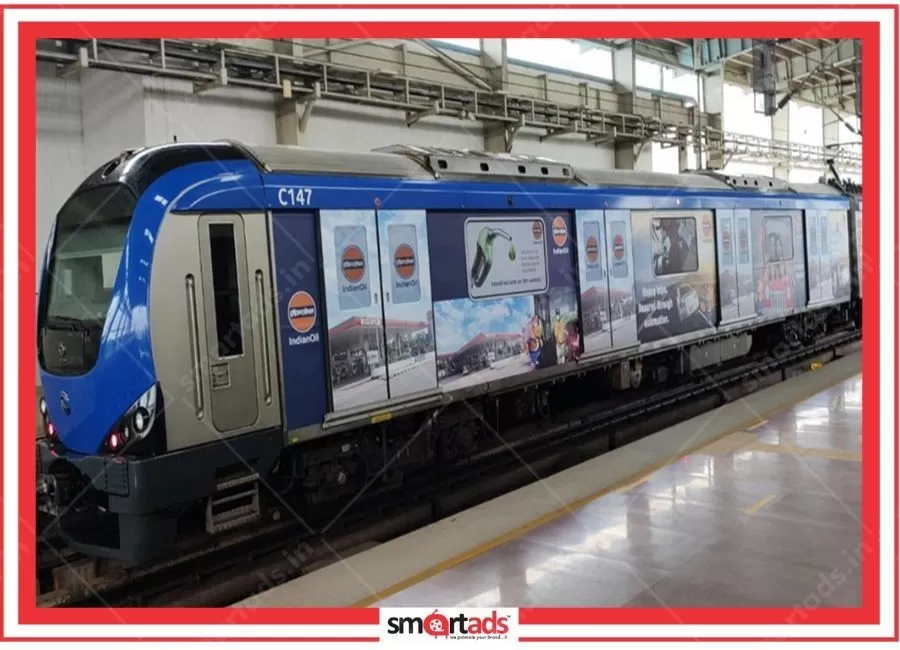
Exterior Metro Wrap
Custom
The advertisement spans the whole train,
Rate per Metro Display Cost / 1 Month
Route : Tirusulam To WIMCO Nagar
₹1000000.00
Showing 1 to 5 of 5 Results
MEDIA DETAILS
Custom
The advertisement spans the whole train,
Rate per Metro Display Cost / 1 Month
Route : Tirusulam To WIMCO Nagar
₹1000000.00
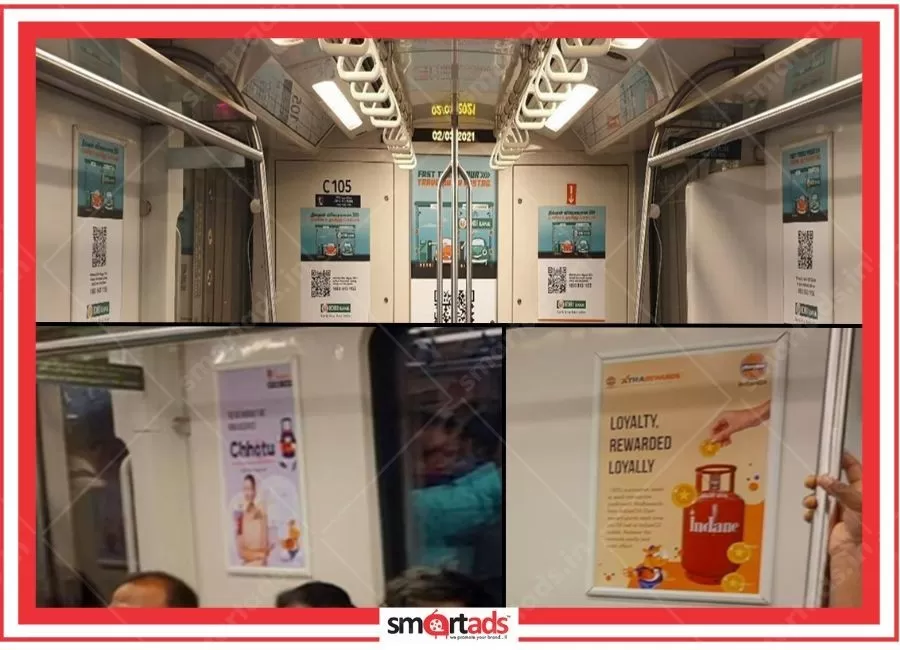
Custom
On the inside of the metro train the adv
Rate per Metro Display Cost / 1 Month
Route : Tirusulam To WIMCO Nagar
₹500000.00
20 Sec Audio
A jingle is a song or a phrase, and the
Rate per Metro Jingle Cost / 1 Month
Route :Tirusulam to WIMCO Nagar
₹400000.00

10 Sec Video
Digital screen on the metro station will
Rate per Metro Digital Display Cost / 1
Route :Tirusulam to WIMCO Nagar
₹600000.00

1 Metro Train
On the outside of the metro train the ad
Rate per Metro Display Cost / 1 Month
Route :Tirusulam to WIMCO Nagar
₹1500000.00
MEDIA REACH

MinimumQty :
1
EstimateReachPeople :
150000000
Most brands planning outdoor campaigns in the Mumbai Metropolitan Region still default to hoardings on the Eastern Express Highway or newspaper inserts in Thane editions — which means they are almost entirely missing the fastest-growing captive audience corridor in suburban Mumbai. The Kalyan Dombivali metro belt, served by MMRDA's Metro Line 5 and the upcoming Metro Line 12, is quietly becoming one of the most valuable transit advertising environments in the country, and the brands that move early will lock in rates and formats before this market gets crowded.
The thing is, most media planners we speak to still think of Kalyan Dombivali as a secondary market — a place where you run a few auto rickshaw wraps or distribute pamphlets near Kalyan Junction. That instinct is increasingly wrong. The Kalyan-Dombivali Municipal Corporation area, which covers one of the most densely populated urban belts in the Mumbai Metropolitan Region, has seen a significant shift in commuter behaviour since metro connectivity began expanding through the Thane–Bhiwandi–Kalyan corridor. Daily commuters here are not occasional travellers; they are working professionals, college students, and middle-income families who ride the metro with a regularity that makes them extraordinarily valuable for brand recall campaigns.
What makes metro train advertising in Kalyan Dombivali particularly effective is the dwell time factor, which is something that outdoor advertising on hoardings simply cannot replicate. A commuter standing on a platform or seated inside a metro coach is not driving past a billboard at 60 kilometres per hour; they are stationary, often without a pressing task, and their eyes naturally seek out visual stimulation. Our experience at SmartAds shows that interior train branding achieves an average dwell time of somewhere between four and eight minutes per journey, which — when multiplied across a commuter's monthly travel frequency — produces a brand exposure depth that most ATL channels struggle to match at comparable budgets. The GroupM TYNY Report has consistently highlighted transit media advertising as one of the fastest-growing OOH sub-categories in India, and the Kalyan Dombivali corridor is a textbook example of why that growth is happening.
On top of that, there is a geographic concentration argument that we find ourselves making repeatedly to clients who are targeting suburban Mumbai audiences. Metro train advertising in Kalyan Dombivali is inherently hyperlocal — the audience you reach is, almost by definition, living or working within the catchment area of the route. For a real estate developer launching a project in Dombivali MIDC, or an FMCG brand trying to build distribution in the KDMC zone, that geographic precision is worth a significant premium over mass-market OOH advertising that wastes impressions on audiences who will never visit the area.
Metro Line 5, officially designated the Thane–Bhiwandi–Kalyan metro corridor and sometimes referred to as the Orange Line, is the primary infrastructure currently serving this region under MMRDA's phased development plan. The route stretches across roughly 24 kilometres, connecting Thane to Kalyan through Bhiwandi, which means that brands advertising on this line are not just reaching Kalyan Dombivali residents — they are reaching the entire commuter flow across one of the busiest industrial and residential belts in the Mumbai Metropolitan Region. The stations along this corridor serve populations that include daily workers from Dombivali MIDC, traders from Kalyan APMC, and professionals commuting toward Thane and beyond.
Metro Line 12, the Kalyan–Dombivali–Taloja corridor, is the route that frankly excites us the most from an advertising opportunity standpoint. This line, being developed under MMRDA's expanded metro network, will directly connect Kalyan and Dombivali with the Taloja metro node — creating a continuous transit spine through areas that have historically been underserved by rapid transit. When this line becomes operational, it will open up an entirely new set of metro station branding and in-coach panel branding opportunities for brands targeting the working-class and middle-income demographic that dominates this geography. The Maha Mumbai Metro Operations Corporation (MMMOCL), which oversees operations for several of these newer lines, has been progressively opening advertising inventory to agencies, and the early-mover advantage for brands willing to commit to metro train advertising campaigns before full ridership peaks is substantial.
What a lot of people miss is that these two lines together create a connected advertising ecosystem rather than two isolated routes. A brand running a metro train branding campaign across both Line 5 and Line 12 effectively achieves 360-degree brand visibility across the entire Kalyan Dombivali urban cluster — from the Kalyan Junction interchange, which connects to Central Railway's suburban network, all the way through to the emerging residential and industrial zones near Taloja. At SmartAds, we always tell our clients that the real value in transit media advertising is the network effect: each additional route you add to your campaign does not just add impressions linearly — it multiplies the frequency of exposure for commuters who transfer between lines.
Exterior train branding is the format that generates the most immediate brand visibility, and for good reason — a full train wrap on a Mumbai Metro coach is essentially a moving billboard that travels the entire length of the route multiple times a day, generating impressions at every station, every level crossing, and every elevated metro corridor stretch where the train is visible from street level. The creative impact of a full train wrap is difficult to overstate; we worked with a consumer electronics brand that ran a full exterior wrap campaign on a Mumbai Metro corridor and reported that their brand recall scores in the target geography jumped by a number that surprised even their own research team. Exterior branding formats range from partial door wraps and panel sections to the full train wrap advertising format, which covers the entire exterior of one or more coaches.
Interior train branding, on the other hand, is where the dwell time advantage becomes most commercially significant. In-coach panel branding — which covers the overhead panels, door panels, and side wall panels inside the coach — puts your brand directly in the sightline of seated and standing passengers for the entire duration of their journey. Seatback advertising, which places brand messages directly at eye level for seated passengers, achieves a particularly high engagement rate because the viewing angle is natural and unavoidable. Audio ads on metro trains, where permitted by the operating authority, add a sensory layer that reinforces visual brand messages and is particularly effective for categories like financial services, education, and FMCG advertising where a call to action can be delivered verbally.
Beyond the train itself, metro station advertising encompasses a range of formats that complement in-train campaigns effectively. Platform screen door advertising, which wraps the glass panels separating the platform from the track, captures commuters during the waiting period — which is arguably the highest-attention moment in the entire metro journey. Digital screens at metro stations allow for dynamic creative that can be updated in real time, which makes them valuable for time-sensitive campaigns like festive season promotions or IPL-linked brand activations. Metro pillar advertising, which covers the structural columns at stations and along elevated metro corridors, adds ambient brand presence that reinforces recall for commuters who pass the same pillars daily. Metro station branding packages that combine multiple formats — platform screen doors, pillar wraps, digital screens, and entry gate panels — are what we typically recommend for brands that want to dominate a specific station or a cluster of stations along the Kalyan Dombivali route.
Frankly speaking, this is the question that every client asks first, and it is also the question where the most misinformation exists in the market. Metro advertising rates in India vary significantly depending on the format, the line, the duration, and whether you are booking directly through MMRDA or MMMOCL versus through a registered metro advertising agency. For the Kalyan Dombivali corridor specifically, our experience at SmartAds suggests that in-coach panel branding for a single coach runs somewhere in the ballpark of ₹80,000 to ₹1.5 lakh per month depending on the panel count and position — which, when you calculate the cost per thousand impressions against estimated daily ridership, works out to a CPM that is genuinely competitive with digital display advertising, and often significantly lower than premium outdoor advertising on the Eastern Express Highway or LBS Marg.
Full train wrap advertising, which is the highest-impact exterior format, is priced considerably higher — typically in the range of ₹3 lakh to ₹8 lakh per month for a full coach exterior, depending on the line and the operating authority's current rate card. To be fair, this is not a format for every budget; it is most appropriate for brands running large brand awareness campaigns where the visual impact and street-level visibility of a moving branded train justify the premium. Metro station branding packages, which bundle multiple station formats together, are often negotiated as packages and can range from ₹50,000 to ₹3 lakh per station per month depending on the station's footfall and the formats included. The minimum campaign duration for most metro advertising formats on Mumbai Metro lines is typically 30 days, though some operators offer 15-day windows for digital screen formats.
What we consistently find is that the metro advertising cost equation looks very different when you factor in the quality of the audience rather than just the raw impression count. A hoarding on a busy Kalyan road might generate higher raw impressions, but a significant portion of those impressions are from audiences who are not in the target demographic for most advertisers. Metro daily commuters in the Kalyan Dombivali region skew heavily toward working professionals, college students, and aspirational middle-income households — which is precisely the audience that real estate advertising, fintech metro branding, education brands, and FMCG advertising campaigns are trying to reach. When you factor that audience quality premium into the metro advertising cost calculation, the effective CPM becomes even more attractive.
The demographic profile of daily commuters on the Kalyan Dombivali metro corridor is one of the most commercially interesting audience compositions in the Mumbai Metropolitan Region, and it is one that most media plans systematically undervalue. The KDMC area has a population that skews younger than the Mumbai city average, with a high proportion of working professionals employed in Thane's commercial zones, Dombivali MIDC's industrial belt, and the expanding business districts along the Bhiwandi–Kalyan highway. These are not high-net-worth individuals in the Bandra or Worli sense; they are middle-income urban households with genuine purchasing power, brand consciousness, and the aspiration-driven consumption patterns that make them ideal targets for a wide range of product categories.
What makes this audience particularly valuable for commuter advertising is the regularity of their travel patterns. Unlike occasional metro users in tourist-heavy corridors, Kalyan Dombivali metro commuters typically ride the same route five or six days a week — which means a brand running a 30-day interior train branding campaign achieves somewhere between 20 and 25 exposures per commuter over the campaign period. That frequency of exposure is what drives brand recall from the awareness stage to the consideration stage, and it is something that a single hoarding or a short digital campaign simply cannot replicate. The IRS (Indian Readership Survey) data on suburban Mumbai audiences consistently shows that this demographic is highly responsive to brand messages in transit environments, partly because their commute time is one of the few periods in their day when they are not actively multitasking.
On top of that, the Kalyan Dombivali corridor has a specific audience segment that is often overlooked: the industrial and logistics workforce associated with Dombivali MIDC and the Bhiwandi warehousing cluster. This segment, while perhaps less glamorous than the white-collar professional demographic, represents significant purchasing power for categories like two-wheelers, consumer durables, financial services, and insurance — all of which are categories where metro train advertising campaigns in this corridor have historically delivered strong results. At SmartAds, we have found that campaigns targeting this mixed demographic perform best when the creative is aspirational but accessible — speaking to the urban ambition of the Kalyan Dombivali audience without the premium-brand detachment that sometimes alienates middle-income consumers.
This is a question we get asked constantly, and the honest answer is that it depends entirely on what you are trying to achieve — which sounds like a non-answer until you understand the fundamentally different mechanics of the two formats. Interior train branding is a depth play; it works by creating repeated, high-attention exposure for a captive audience that has nowhere else to look. Full train wrap advertising is a breadth play; it works by generating maximum brand visibility across the widest possible geographic footprint, reaching not just the commuters inside the train but also pedestrians, motorists, and residents who see the branded train passing through their neighbourhood along the elevated metro corridor.
For brands running brand awareness campaigns where the goal is to maximise reach and create a strong visual impression in the market, exterior train branding — and particularly the full train wrap format — is typically the right choice. We worked with a real estate developer launching a township project near Kalyan who ran a full train wrap on the Line 5 corridor for two months; the campaign generated significant walk-in traffic to their sales office from commuters who had seen the branded train and looked up the project on their phones during the journey. The combination of exterior visibility and the implicit credibility of metro association — which signals that the brand is established and serious — was particularly effective for a category where trust is a primary purchase driver.
Interior formats, on the other hand, are where we see the strongest performance for brands that need to communicate a more complex message — a fintech app that needs to explain its product, an education brand that wants to list its courses, or an FMCG brand running a promotional offer that requires the audience to read and retain specific information. In-coach panel branding and seatback advertising give the brand enough space and dwell time to deliver a multi-element creative, and the captive audience environment means that the message is actually read rather than glanced at. Our recommendation to most clients is to think of interior and exterior metro train branding not as competing options but as complementary layers — exterior for reach and street-level impact, interior for depth and message retention.
Real estate advertising is, without question, the category that has historically extracted the most value from metro train advertising in suburban Mumbai corridors. The logic is almost self-evident: the people riding the Kalyan Dombivali metro are, by definition, people who live or work in the area — which makes them the most precisely targeted audience a real estate developer could hope to reach. We have seen this work particularly well for developers launching affordable and mid-segment housing projects in the KDMC zone, where the aspirational middle-income commuter demographic aligns almost perfectly with the target buyer profile. A well-executed metro station branding campaign at Kalyan Junction or Dombivali station, combined with in-coach panel branding on the Line 5 trains, can generate a level of hyperlocal advertising saturation that no other medium in the area can match.
FMCG advertising is another category where metro train advertising in Kalyan Dombivali delivers disproportionate value, particularly for brands in the food, personal care, and household products segments that are trying to build or defend distribution in the suburban Mumbai market. The daily commuter audience for this corridor includes a high proportion of household decision-makers — the working women and men who stop at the local market on their way home from the metro station — which makes the metro environment an effective last-mile touchpoint before the purchase decision is made. Fintech metro branding has also emerged as a significant growth category in this corridor; digital payment apps, micro-lending platforms, and insurance aggregators have found that the Kalyan Dombivali commuter demographic is highly receptive to financial product messaging, particularly when the creative addresses the specific financial aspirations of the middle-income urban household.
Education brands — from coaching institutes and test-prep platforms to skill development programmes and online degree providers — are perhaps the most natural fit for metro train advertising in Kalyan Dombivali, given the high proportion of students and young working professionals in the commuter mix. We managed a campaign for an online certification platform that ran interior train branding across a Mumbai Metro corridor for six weeks; the campaign drove a measurable spike in app downloads and course enrolments from the target geography, with a cost-per-acquisition that was significantly lower than what the brand had been achieving through digital performance campaigns targeting the same demographic. The combination of high-frequency exposure and the undistracted attention of the metro environment is something that digital advertising, for all its targeting precision, struggles to replicate.
The booking process for metro train advertising in Kalyan Dombivali runs through two primary channels, and understanding the difference between them can save you both time and money. The first channel is direct booking through MMRDA or the Maha Mumbai Metro Operations Corporation (MMMOCL), which manages operations for several of the newer Mumbai Metro lines including those serving the Kalyan Dombivali corridor. Direct booking gives you access to the official rate card and ensures that your campaign materials meet the technical specifications required by the operating authority — but it also requires navigating a procurement process that can be slow and documentation-heavy for brands that do not have experience with government-linked media buying.
The second and, frankly, more efficient channel for most brands is booking through a registered metro advertising agency that holds a concession or empanelment with the relevant metro operating authority. Agencies like SmartAds, which operate across 500+ Indian cities and have established relationships with metro operators across the country, can typically secure faster approvals, negotiate package rates that are not available on the standard rate card, and manage the end-to-end campaign process — from creative specification guidance to installation supervision and post-campaign reporting. The creative specifications for metro train ads are more demanding than most brands expect; the materials need to meet specific substrate requirements, adhesive standards, and fire-retardancy certifications that vary between operating authorities, and getting these wrong can result in campaign delays or material rejection.
At SmartAds, we always recommend that clients planning their first metro train advertising campaign budget at least three to four weeks of lead time between campaign confirmation and go-live date — which accounts for creative approval, material production, and installation scheduling. Seasonal campaigns, particularly those timed around Diwali, Ganesh Chaturthi, or the IPL season, should be booked significantly earlier because metro advertising inventory in high-footfall periods is absorbed quickly, and the premium for last-minute bookings can be substantial. One practical tip that we share with clients is to consider multi-month bookings even if the initial plan is for a shorter campaign; the rate advantage for 90-day versus 30-day bookings is typically meaningful enough to justify the extended commitment, and the compounding brand recall benefit of a longer campaign almost always outperforms a shorter, more intensive burst.
BTL advertising in the Kalyan Dombivali market has traditionally meant a fairly predictable mix of auto rickshaw wraps, KDMT bus advertising, local cable channel spots, and hoardings along the Kalyan-Shilphata Road or the Dombivali station area. These formats have their place — auto rickshaw advertising, in particular, delivers genuine hyperlocal advertising reach in the narrow lanes and residential pockets that metro trains do not penetrate — but they share a fundamental limitation that metro train advertising does not: the audience is moving past the ad, not stationary in front of it. The dwell time advantage of metro transit advertising is not a minor incremental benefit; it is a structural difference in how the brand message is processed and retained.
To be fair, traditional OOH advertising in Kalyan Dombivali still offers advantages that metro formats cannot replicate. A large-format hoarding near Kalyan Junction or on the Dombivali flyover reaches an audience that includes non-metro users — auto-rickshaw passengers, private vehicle owners, pedestrians — which gives it a broader raw reach than a metro-only campaign. The cost of entry for traditional outdoor advertising is also generally lower than metro formats, which makes it accessible to smaller local businesses that cannot justify the minimum spend required for metro train advertising campaigns. What we typically recommend to clients with sufficient budgets is a layered approach: metro train branding for depth and audience quality, supplemented by outdoor advertising for broad reach and geographic coverage across the parts of the Kalyan Dombivali market that the metro network does not yet fully serve.
The comparison between metro advertising and digital advertising is one that comes up increasingly often in our planning conversations, and it is worth addressing directly. Digital performance advertising — Meta, Google, YouTube — offers targeting precision and measurability that metro formats cannot match; but it also suffers from ad fatigue, banner blindness, and the fundamental problem that audiences can scroll past or skip digital ads in a way that they cannot ignore a branded train coach that is right in front of them. The FICCI-EY Media and Entertainment Report has noted that non-traditional advertising formats, including transit media advertising, are growing precisely because brands are looking for environments where their messages cannot be blocked or skipped — and the metro train environment, with its captive audience and extended dwell time, is one of the most reliable such environments available in the Indian market.
Metro advertising ROI is a number that is genuinely difficult to calculate in isolation, which is something we are always honest about with clients — and which, frankly, applies equally to most brand-building media formats. What we can say with confidence, based on our campaign experience and the data available from BARC viewership and TAM AdEx tracking for transit environments, is that metro train advertising in Kalyan Dombivali consistently delivers strong performance on the metrics that matter most for brand-building: reach within the target geography, frequency of exposure, and brand recall lift. A campaign that runs interior train branding across a Mumbai Metro corridor for 60 days will typically achieve somewhere between 15 and 25 exposures per regular commuter — which is a frequency level that most digital campaigns would require a significantly higher budget to replicate.
One case study that illustrates the ROI potential well involved a fintech client we worked with who was launching a new digital lending product targeting salaried professionals in the suburban Mumbai market. The campaign ran in-coach panel branding and seatback advertising across a metro corridor serving the Thane–Kalyan belt for 45 days, with a total media investment in the ballpark of ₹12 lakh. The brand tracked app downloads and loan applications from the target geography during and after the campaign period, and the cost-per-acquisition from the metro campaign came out significantly lower than their concurrent digital campaign targeting the same audience — largely because the metro environment eliminated the ad fraud, viewability issues, and audience quality problems that inflate digital CPAs. The brand renewed the campaign for a second cycle, which is perhaps the most honest indicator of ROI we can offer.
The ROI calculation also needs to account for the brand equity dimension of metro advertising, which is harder to quantify but genuinely real. Being associated with a metro train — a piece of public infrastructure that represents modernity, urban progress, and civic investment — carries an implicit brand endorsement that is particularly valuable for newer brands trying to establish credibility in the market. We have seen this effect most clearly with fintech metro branding campaigns and real estate advertising campaigns, where the association with the metro environment appears to meaningfully reduce consumer hesitation. At SmartAds, we track this through brand lift studies where possible, and the results consistently show that metro train advertising campaigns generate higher brand trust scores than equivalent-budget campaigns on traditional outdoor advertising formats.
The honest answer is: it depends on the format, and the answer is more encouraging than most SMEs assume. The full train wrap format and multi-station branding packages are genuinely out of reach for most small businesses — a campaign of that scale requires a budget that is more appropriate for regional or national brands. But the metro advertising ecosystem includes formats that are accessible at much lower entry points; a single in-coach panel in one coach of a metro train, for example, can be booked for a monthly investment that is comparable to what a local business might spend on a mid-size hoarding in the area. For a coaching institute in Dombivali, a local retail chain in Kalyan, or a healthcare clinic targeting the KDMC catchment, a targeted in-coach panel campaign on the Line 5 corridor can deliver a level of brand visibility that would be difficult to achieve with the same budget on any other medium.
The key for small and medium businesses is to be strategic about format selection and station targeting rather than trying to replicate the broad-reach campaigns that larger brands run. A cluster of metro pillar advertising at the two or three stations most relevant to the business's location, combined with a modest in-coach panel booking, can create a disproportionate brand presence in the immediate catchment area at a total monthly investment that is manageable for a growing local business. We have worked with a chain of diagnostic centres in the Kalyan Dombivali area that ran exactly this kind of targeted metro station branding campaign — focusing on the stations closest to their clinic locations — and generated a measurable increase in new patient walk-ins that they directly attributed to the metro campaign based on patient intake surveys.
To be honest, the minimum viable budget for metro train advertising in Kalyan Dombivali for a meaningful campaign — one that runs for at least 30 days and includes enough format coverage to generate genuine brand recall — is somewhere in the range of ₹2 lakh to ₹5 lakh depending on the formats chosen. That is not pocket change for a small business, but it is also not the ₹20–30 lakh that many SMEs assume metro advertising requires. The key is working with a metro advertising agency that understands the local market and can design a campaign that maximises impact within a defined budget rather than simply selling the most expensive formats available.
The expansion of the Mumbai Metro network through MMRDA's phased development plan is, from an advertising perspective, one of the most significant structural changes happening in the suburban Mumbai OOH market. Metro Line 5, the Thane–Bhiwandi–Kalyan corridor, is progressively building ridership as more stations become operational and the route becomes integrated into the daily commute patterns of the region's working population. Each new station that opens adds not just footfall to the network but also new advertising inventory — new platform screen door panels, new metro pillar advertising positions, new digital screens — which means that the total advertising opportunity on this corridor is still expanding.
Metro Line 12, the Kalyan–Dombivali–Taloja corridor, represents an even more significant future opportunity for advertisers. This line will, when fully operational, connect two of the most densely populated and commercially active zones in the eastern MMR — Kalyan and Dombivali — with the Taloja metro node, which connects to the broader Navi Mumbai metro network. The advertising implications of this connectivity are substantial: brands will be able to run metro train advertising campaigns that reach audiences across a continuous corridor stretching from Kalyan through Dombivali to Taloja and beyond, creating a transit advertising spine through the eastern MMR that has no equivalent in the current OOH landscape. Early-stage advertising commitments on this line, made before full ridership peaks, will almost certainly be available at rates that will look very attractive in retrospect once the line is fully operational and inventory demand increases.
What we find most strategically interesting about the MMRDA expansion is the way it is changing the competitive dynamics of advertising in suburban Mumbai. Advertising in suburban Mumbai has historically been dominated by Central Railway's suburban train network — the local trains that carry millions of commuters daily and have supported a large ecosystem of train advertising formats. The metro network is not replacing that ecosystem, but it is adding a premium layer to it — one that offers better audience quality, higher dwell time, and more controlled creative environments than the suburban local train network. Brands that understand this distinction and allocate budget accordingly are, in our experience, consistently outperforming those that treat metro train advertising as just another version of local train advertising.
Q: What is metro train advertising in Kalyan Dombivali?
Metro train advertising in Kalyan Dombivali refers to brand promotion activities conducted on and around the metro trains and stations serving the Kalyan Dombivali urban cluster, primarily through MMRDA's Metro Line 5 (Thane–Bhiwandi–Kalyan) and the upcoming Metro Line 12 (Kalyan–Dombivali–Taloja). The formats available span the full spectrum from interior in-coach panel branding and seatback advertising to exterior full train wrap advertising, platform screen door advertising, metro pillar advertising, and digital screens at metro stations. It is a form of transit media advertising that combines the geographic precision of hyperlocal advertising with the high dwell time and captive audience environment that distinguishes metro environments from other OOH advertising formats. For brands targeting the middle-income, working-professional demographic that dominates the Kalyan Dombivali commuter base, it represents one of the most cost-efficient brand visibility channels available in the eastern Mumbai Metropolitan Region.
Q: Which metro lines serve the Kalyan Dombivali area for advertising?
The two primary metro lines serving the Kalyan Dombivali area are Metro Line 5, the Thane–Bhiwandi–Kalyan corridor which is the elevated metro line currently under progressive operationalisation by MMRDA, and Metro Line 12, the Kalyan–Dombivali–Taloja corridor which is in the advanced planning and construction phase. Metro Line 5 provides the most immediately available advertising inventory, with stations at key nodes along the Bhiwandi–Kalyan belt offering a combination of train-based and station-based advertising formats. Metro Line 12 will add a dedicated Kalyan–Dombivali axis to the network when operational, which will significantly expand the transit advertising coverage across the KDMC zone. Both lines are developed and overseen by MMRDA, with operational management handled by the Maha Mumbai Metro Operations Corporation (MMMOCL) for certain sections.
Q: How much does metro train advertising in Kalyan Dombivali cost?
Metro advertising rates in the Kalyan Dombivali corridor vary by format, duration, and the specific inventory position. In-coach panel branding for a single coach typically runs in the range of ₹80,000 to ₹1.5 lakh per month; full train wrap advertising for a complete coach exterior is generally priced somewhere between ₹3 lakh and ₹8 lakh per month; and metro station branding packages, which bundle multiple station formats, can range from ₹50,000 to ₹3 lakh per station per month depending on footfall and format mix. These are indicative benchmarks based on our agency experience — actual rates depend on the operating authority's current rate card, the campaign duration, and whether the booking is made directly or through a registered metro advertising agency. Longer campaign durations typically attract meaningful rate discounts, and package bookings that combine train and station formats often offer better value than single-format bookings.
Q: What types of metro train advertising formats are available in Kalyan Dombivali?
The format portfolio for metro train advertising in Kalyan Dombivali covers both train-based and station-based options. On the train itself, the primary formats are full train wrap advertising (exterior), partial exterior wraps, in-coach panel branding (overhead, side wall, and door panels), seatback advertising, and audio ads where the operating authority permits. At metro stations, the available formats include platform screen door advertising, metro pillar advertising, digital screens, entry gate panels, floor graphics, and comprehensive metro station branding packages that combine multiple formats for maximum impact. The specific formats available on the Line 5 and Line 12 corridors are subject to the operating authority's current concession agreements, and not all formats may be available at every station — which is why working with a knowledgeable metro advertising agency is important for campaign planning.
Q: Who should advertise on metro trains in Kalyan Dombivali?
Any brand whose target audience includes working professionals, college students, middle-income families, or aspirational urban consumers in the Kalyan Dombivali and broader eastern MMR catchment area should seriously consider metro train advertising as part of their media mix. The categories that have historically extracted the most value from this format in suburban Mumbai corridors include real estate advertising (particularly mid-segment and affordable housing), FMCG advertising, fintech metro branding, education and coaching brands, consumer durables, two-wheeler brands, healthcare and diagnostics, and retail chains. The format is also well-suited to government and public service campaigns targeting the KDMC population. Brands that are specifically trying to build hyperlocal advertising presence in the Kalyan Dombivali market — rather than reaching a broad Mumbai-wide audience — will find metro train advertising particularly efficient.
Q: How do I book a metro train advertising campaign in Kalyan Dombivali?
The booking process involves either direct engagement with MMRDA or MMMOCL for official rate card inventory, or booking through a registered metro advertising agency that holds empanelment with the relevant operating authority. The agency route is generally faster and more efficient for most brands, as it provides access to negotiated rates, creative specification guidance, installation management, and post-campaign reporting. The typical lead time from campaign confirmation to go-live is three to four weeks, accounting for creative approval, material production to metro-specification standards, and installation scheduling. Brands should submit their campaign brief, target geography, preferred formats, and budget range to the agency, which will then prepare a customised media plan and rate proposal. Festive season and high-demand periods require significantly earlier booking — ideally six to eight weeks in advance.
Q: What is the difference between interior and exterior metro train branding?
Interior train branding encompasses all advertising formats inside the metro coach — in-coach panel branding on overhead and side panels, seatback advertising, door panel wraps, and audio ads — and is characterised by high dwell time, a captive audience, and the ability to deliver detailed brand messages. Exterior train branding covers the outside of the coach, ranging from partial wraps on specific panels to
