
Exterior Metro Wrap
Size & Printing Cost as per actual
On the outside of metro Train, advertise
Rate per Metro Display Cost / 1 Month
Route:Thaltej gam To Vastral Gam
₹1000000.00
Showing 1 to 1 of 1 Results
MEDIA DETAILS
Size & Printing Cost as per actual
On the outside of metro Train, advertise
Rate per Metro Display Cost / 1 Month
Route:Thaltej gam To Vastral Gam
₹1000000.00
MEDIA REACH

MinimumQty :
1
EstimateReachPeople :
150000000
Ahmedabad's metro carries somewhere in the range of 1.5 to 2 lakh daily commuters on its operational corridors — and that number is climbing steadily as Phase II expansion pushes the network deeper into Gandhinagar and GIFT City. What surprises most brand managers we speak to is not the reach figure itself, but the quality of that reach: salaried professionals, college students, and upper-middle-class households who are essentially locked in a branded environment for eight to twenty minutes with nowhere else to look.
Most people think of metro advertising as a glorified poster — something you slap on a wall and forget about. The reality is considerably more interesting. Metro train advertising in Ahmedabad operates as a dynamic transit media system governed by Gujarat Metro Rail Corporation Limited (GMRCL), which controls all commercial branding rights across the operational network. Brands do not simply buy space; they enter a structured ecosystem where creative approval, material specifications, installation timelines, and dwell-time positioning are all coordinated through GMRCL's concessionaire framework.
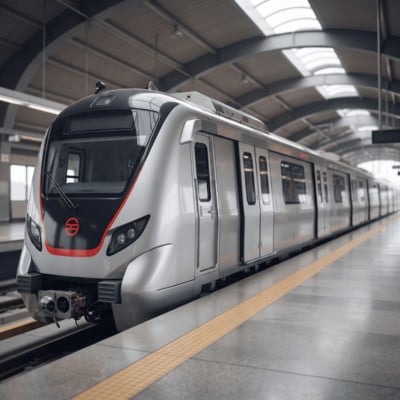
What makes this format genuinely different from static OOH advertising is the movement. A vinyl-wrapped metro train travelling the East-West Corridor from Thaltej Gam to Vastral Gam passes through densely populated residential zones, commercial hubs, and transit interchange points — which means the same branded train is seen by pedestrians, motorists, and platform commuters across the entire corridor, not just at a single fixed location. We describe this to our clients as a moving billboard that clocks impressions at every traffic signal, every station approach, and every platform stop, which is a fundamentally different impression model from a static hoarding.
The operational mechanics work like this: an advertiser selects a format — whether interior panels, exterior vinyl wraps, full train branding, or digital screens inside metro coaches — and the booking is processed either directly through GMRCL's authorised concessionaire or through a registered metro advertising agency in Ahmedabad. At SmartAds, we handle the end-to-end process for our clients, from format selection and creative compliance to installation supervision and campaign monitoring, which removes a considerable amount of operational friction that brands typically underestimate when they try to book directly.
The format menu for Ahmedabad metro advertising is broader than most marketers expect, and choosing the wrong format for the campaign objective is one of the most common mistakes we see. Interior train branding covers everything inside the coach — overhead panels above the windows, door panels, handrail branding, and the increasingly popular digital screens inside metro coaches that run looping video content. Interior branding is particularly effective for messaging that requires reading time, because the captive audience is seated or standing in a confined space with sustained dwell time that a roadside hoarding simply cannot replicate.
Exterior train branding is a different proposition entirely. A partial exterior wrap covers specific panels on the outer body of the train, while a full train branding or train wrap covers the entire exterior surface — roof, sides, and sometimes the front and rear faces — in a single continuous creative. The visual impact of a full train branding execution on the Ahmedabad metro is genuinely striking; when a branded train pulls into Gujarat University station or Kalupur Station, it commands attention in a way that no static format in the vicinity can match. We worked with a real estate developer from Ahmedabad who ran a full train branding campaign ahead of a major project launch, and the creative team designed the exterior wrap to look like the building's façade — which generated considerable organic social media attention as commuters photographed the train and shared it, effectively extending the campaign's reach beyond the physical corridor.
Beyond the train itself, metro station advertising forms an important complement to train-based formats. Platform signage, concourse displays, metro pillar branding at station entrances, and digital screens at ticketing areas all contribute to a corridor-based targeting strategy where the brand message is encountered at multiple touchpoints within a single commuter journey. Metro pillar branding at high-traffic stations like Kalupur Station or Mahatma Mandir is particularly valuable because these locations see both metro passengers and significant footfall from the surrounding catchment area.
Frankly speaking, this is the question every client asks first, and it is also the question that is most difficult to answer with a single number — because metro advertising rates in Ahmedabad vary significantly depending on format, duration, corridor, and whether you are booking a single train or a network-wide campaign. That said, we can share the ballpark figures that our media planning team works with, because vague answers do not help anyone make a budget decision.
For interior train branding — overhead panels and door panels across a single coach — the metro advertising cost works out to somewhere in the range of ₹40,000 to ₹80,000 per month per coach, depending on the number of panels and the specific format. A full coach interior package covering all available panel positions can go up to roughly ₹1.5 lakh per month, which sounds significant until you calculate the daily impressions that a heavily used corridor like the North-South Corridor delivers. Exterior train branding — a partial wrap covering one or two panels on the outer body — typically falls in the ballpark of ₹1.5 to ₹3 lakh per month, while a full train branding or complete train wrap is considerably more, often ranging from ₹8 lakh to ₹15 lakh per month depending on the train and the corridor it operates on. These are indicative figures based on our current market experience; actual metro advertising rates are subject to GMRCL's concessionaire pricing, which is revised periodically.
What a lot of people miss is the cost-per-impression calculation, which is where metro train advertising in Ahmedabad becomes genuinely compelling. If a single branded train on the East-West Corridor generates somewhere between 15,000 and 25,000 daily impressions across platform sightings, in-train views, and roadside exposures — which is a conservative estimate based on GMRCL ridership data — the effective CPM works out to a figure that compares very favourably with digital display advertising, where viewability and ad fraud are persistent concerns. One automotive brand we worked with ran a three-month exterior branding campaign on two trains operating the Line-1 Blue Line, and when we modelled the total impressions against the campaign spend, the effective CPM came out to roughly ₹12 to ₹15, which was meaningfully lower than what they were achieving on programmatic display.
The Ahmedabad metro network, operated by Gujarat Metro Rail Corporation Limited (GMRCL) under the MEGA framework, currently has two operational corridors with Phase II expansion underway. The East-West Corridor — running from Thaltej Gam to Vastral Gam — is the longer of the two operational lines and passes through some of Ahmedabad's most commercially active zones, including SG Highway, Gujarat University, and the old city area around Kalupur Station. The North-South Corridor connects APMC in the south to Motera Stadium in the north, passing through central Ahmedabad and intersecting with the East-West Corridor at Kalupur Station, which is the network's primary interchange hub.
For corridor-based targeting, the choice of line matters considerably depending on the brand's audience profile. The East-West Corridor tends to carry a higher proportion of working professionals commuting between the western residential suburbs — Thaltej, Sola, Chandkheda — and the commercial districts in the east; which makes it particularly effective for brands targeting upper-middle-income households, fintech advertising, edtech brands, and premium consumer categories. The North-South Corridor, by contrast, carries a more diverse ridership mix, including students, traders from the old city area, and government employees, which suits mass-market FMCG campaigns and hyperlocal marketing for businesses along the corridor.
The Phase II expansion — which will extend the network into Gandhinagar and connect to GIFT City — is a development that most brands have not yet factored into their media planning. When operational, this extension will bring the metro into one of India's most ambitious financial and administrative districts, delivering a commuter profile that is almost exclusively composed of high-income professionals, government officials, and financial sector employees. At SmartAds, we are already advising clients in the BFSI and real estate advertising categories to plan ahead for this corridor, because the advertising inventory will be limited and demand is likely to be high from the moment the extension opens.
The demographic profile of Ahmedabad metro daily commuters is one of the most underappreciated assets of this medium. Based on ridership studies and our own campaign experience, the metro's core audience skews toward the 22-to-45 age bracket, with a significant concentration of working professionals, college students, and middle-to-upper-middle-income households. This is not a mass-transit audience in the way Mumbai's local trains are — the Ahmedabad metro's fare structure and station locations mean that it predominantly serves an urban audience with disposable income and active consumption patterns.
The income profile is particularly relevant for brand managers making allocation decisions. A meaningful proportion of metro commuters in Ahmedabad fall in the monthly household income bracket of ₹30,000 to ₹1 lakh and above, which makes this an effective channel for categories like financial products, consumer electronics, automobiles, real estate advertising, premium apparel, and OTT platform promotion. The captive audience dynamic is also worth emphasising: unlike a commuter in a private vehicle who is focused on traffic, or a pedestrian who glances at a hoarding for a fraction of a second, a metro passenger has committed eight to twenty minutes to the journey with limited distraction — which creates a dwell time environment that is genuinely rare in out-of-home advertising.
What we tell our clients is that the Ahmedabad metro audience is not just large; it is concentrated and predictable. The same daily commuters travel the same routes at roughly the same times, which means high-frequency exposure is built into the format by design. A brand running interior train branding on a specific train for thirty days will reach the same core audience repeatedly across the campaign period, which drives brand recall in a way that a one-time hoarding impression simply cannot. BARC viewership research has consistently shown that frequency is one of the strongest predictors of brand recall, and metro transit media delivers frequency almost automatically.
To be fair, traditional OOH advertising in Ahmedabad — hoardings on SG Highway, BRTS shelter branding, auto rickshaw branding — has its own legitimate strengths, and we are not suggesting that metro advertising replaces these channels. What we are saying is that metro train advertising in Ahmedabad offers a specific combination of attributes that traditional OOH cannot replicate, and understanding that distinction is what separates effective media planning from budget allocation by instinct.
The most significant difference is the captive audience environment. A hoarding on SG Highway is seen by motorists travelling at 40 to 60 kilometres per hour, which gives the creative perhaps two to three seconds of exposure — which is why billboard creative must be simple, bold, and instantly readable. Interior train branding operates in a completely different attention environment: passengers are stationary, the coach is enclosed, and the panels are within arm's reach. This allows for richer messaging, longer copy, QR code integration, and even interactive elements like NFC-enabled panels, which are beginning to appear on metro advertising formats in Indian cities. We have run campaigns for edtech brands that used QR codes on interior panels to drive app downloads directly from the metro coach, which would be technically impossible on a roadside hoarding.
The non-traditional advertising dimension also matters from a brand differentiation standpoint. In Ahmedabad, traditional OOH advertising is heavily contested — SG Highway alone has dozens of competing hoardings in every kilometre — which means individual creatives struggle to stand out. A full train branding or metro wrap advertising execution, by contrast, is a singular visual event; there is only one branded train on the track at any given moment, and it carries no competing messages. This exclusivity is something that BTL advertising formats have always promised, and metro transit media delivers it at scale. The FICCI-EY Media Report has consistently highlighted transit media as one of the fastest-growing segments within the OOH advertising category in India, which reflects a broader industry recognition of exactly these advantages.
This is the section that competitors consistently skip, and it is also the section that causes the most operational headaches for brands that try to book metro train advertising in Ahmedabad without proper guidance. GMRCL approval is not optional — it is mandatory for every piece of creative that goes onto a metro train or station, and the process has specific requirements that differ from standard OOH creative submission.
The creative approval process begins with the submission of artwork in GMRCL-specified formats, which typically include high-resolution files at the exact dimensions of the panel or wrap surface, along with a physical mock-up or digital simulation showing how the creative will appear on the train body. GMRCL's concessionaire reviews the artwork for compliance with content guidelines — which prohibit political messaging, content that could be deemed offensive or misleading, and any creative that obscures safety signage or emergency exits on the train exterior. The approval timeline is generally somewhere between seven and fourteen working days for standard formats, though full train branding and exterior wraps may require additional review because they affect the train's visual profile in ways that GMRCL must assess from a safety and aesthetics standpoint.
Material specifications are equally important and are often overlooked. Exterior train branding must use vinyl wrap materials that meet GMRCL's durability and adhesion standards — typically a premium cast vinyl that can withstand the operational conditions of daily train service without peeling, fading, or affecting the underlying paint. Interior branding materials must be fire-retardant and comply with railway safety standards. At SmartAds, we maintain a current compliance checklist that we share with our clients' creative teams before production begins, which prevents the expensive problem of having to reprint materials because the substrate or finish does not meet GMRCL specifications. The installation itself must be carried out by GMRCL-approved installers during non-operational hours, which adds a logistical layer that brands need to account for in their campaign launch timelines.
Our experience across hundreds of transit media campaigns suggests that the answer to this question is more nuanced than most industry guides acknowledge. The obvious categories — real estate advertising, consumer durables, telecom — do well on metro transit media, but the reasons why they do well are instructive for brands in less obvious categories.
Real estate advertising performs strongly on Ahmedabad metro advertising because the audience profile aligns almost perfectly with the buyer profile for mid-to-premium residential projects. A working professional commuting on the Line-2 Red Line is, statistically, in the income bracket and life stage where home purchase is an active consideration; which means a well-placed interior panel or exterior wrap for a residential project in Chandkheda or Bopal reaches the right person at a moment when they have time to absorb the message. We ran a product launch campaign for a residential developer targeting the North-South Corridor, using interior branding with a QR code linked to a virtual site tour, and the campaign generated a measurable spike in qualified leads during the four-week flight period.
Fintech advertising and edtech brands have also found metro transit media to be a high-performing channel in Ahmedabad, precisely because the metro's urban audience skews young, digitally active, and financially aspirant. OTT platform promotion campaigns have used full train branding ahead of major content releases, turning the train itself into a moving teaser for an upcoming show — which generates earned media attention on social platforms in addition to the direct impressions. Beyond these categories, healthcare brands, insurance companies, automobile manufacturers, and premium FMCG labels have all run successful metro advertising campaigns in Ahmedabad; the common thread is that they are all targeting an urban, income-qualified audience with a message that benefits from repeated exposure.
Frankly speaking, ROI measurement for transit media is an area where the industry has historically been weaker than digital advertising, and we think it is important to be honest about that rather than making inflated claims. That said, the measurement toolkit for metro train advertising in Ahmedabad has improved considerably, and brands that approach the question systematically can build a credible performance picture.
The primary measurement framework we use at SmartAds combines ridership-based impression modelling with brand recall surveys and downstream conversion tracking. GMRCL publishes ridership data for its operational corridors, which provides the base number for impression calculations; we then apply standard OOH visibility factors — accounting for the proportion of passengers who are positioned to see a given panel, the average dwell time per journey, and the frequency multiplier for regular commuters — to arrive at a total campaign impression estimate. This is not a perfect science, but it is a defensible methodology that holds up to scrutiny from marketing directors who need to justify spend to their finance teams.
Brand recall surveys, conducted among metro commuters before and after a campaign flight, provide the qualitative layer that impression numbers alone cannot deliver. We have found that well-executed interior train branding campaigns in Ahmedabad typically generate unaided brand recall rates in the range of 25 to 40 percent among regular commuters on the branded route, which is a number that compares very favourably with recall benchmarks for digital display advertising. On top of that, digital-physical integration — QR codes on interior panels, NFC-enabled touchpoints, or dedicated campaign landing pages with UTM parameters — allows brands to track direct response actions that are directly attributable to the metro campaign, which provides a hard conversion metric alongside the softer awareness data. One retail client in Ahmedabad used a unique discount code printed on interior panels, which allowed them to track in-store redemptions and calculate a direct revenue attribution for the metro campaign — an approach that we now recommend as a standard practice for retail and e-commerce brands.
The booking process for metro train advertising in Ahmedabad is more structured than most brands expect, and the lead time required is longer than for most other OOH advertising formats. Understanding the timeline upfront prevents the frustration of missing a campaign window because the paperwork was not initiated early enough.
The process begins with format selection and availability confirmation — which requires checking with GMRCL's authorised concessionaire to determine which trains, corridors, and panel positions are available for the desired campaign period. Inventory on the Ahmedabad metro is finite; there are a limited number of trains operating each corridor, and popular formats like full train branding are often booked weeks or months in advance, particularly around high-demand periods like Navratri, IPL season, Diwali, and major product launch windows. We strongly recommend initiating the booking process at least six to eight weeks before the desired campaign start date for standard interior formats, and ten to twelve weeks for full train branding or exterior wraps that require material production and GMRCL approval.
Once the format and corridor are confirmed, the creative development and compliance phase begins. Artwork must be prepared to GMRCL specifications, submitted for approval, and revised if necessary before production can begin. Installation scheduling — which must occur during non-operational hours — is coordinated with the concessionaire and GMRCL's operations team. For brands running a product launch campaign or a time-sensitive promotion, this timeline discipline is non-negotiable; we have seen campaigns delayed by two to three weeks because the creative approval process was not started early enough. How to advertise on Ahmedabad metro train effectively is as much a question of process management as it is of creative quality, and working with an experienced metro advertising agency in Ahmedabad removes most of the operational risk from the equation.
The BTL advertising versus traditional OOH debate in Ahmedabad is one that we find ourselves having with clients regularly, and the honest answer is that it is the wrong question to ask in isolation. Metro train advertising in Ahmedabad occupies a genuinely hybrid position — it is classified as BTL advertising and non-traditional advertising in most media planning frameworks, yet it delivers the mass reach and brand awareness metrics that are traditionally associated with above-the-line formats.
What makes metro transit media distinct within the Ahmedabad BTL advertising landscape is its combination of scale and selectivity. Auto rickshaw branding in Ahmedabad can reach a broad geographic footprint, but the audience is essentially random; BRTS shelter advertising offers good reach along specific corridors, but the dwell time is minimal and the competitive clutter is significant. Metro train advertising in Ahmedabad delivers a defined, corridor-specific audience with measurable dwell time and controlled creative environments — which is a combination that hyperlocal marketing strategies can exploit with considerable precision. A brand targeting the working professional population of western Ahmedabad, for instance, can focus exclusively on the East-West Corridor without paying for impressions in areas that are irrelevant to their distribution or service footprint.
The Dentsu e4m Report and GroupM TYNY Report have both highlighted transit and out-of-home advertising as categories that are growing faster than the overall advertising market in India, driven partly by urbanisation and partly by the premium audience profiles that metro networks deliver. In Ahmedabad specifically, the metro's growth trajectory — from a nascent network to a city-defining infrastructure — mirrors what happened in Delhi and Bengaluru, where metro advertising eventually became one of the most sought-after OOH advertising formats in the respective markets. Brands that establish a presence on Ahmedabad metro advertising now, before Phase II expansion increases both ridership and inventory demand, are likely to benefit from both lower rates and less competitive creative environments.
Q: What is the cost of metro train advertising in Ahmedabad?
Metro advertising cost in Ahmedabad varies significantly by format and duration. Interior panel branding for a single coach works out to roughly ₹40,000 to ₹1.5 lakh per month depending on the number of panels and positions; exterior partial wraps fall somewhere in the ₹1.5 to ₹3 lakh per month range; and full train branding — which covers the entire exterior of a train — is typically in the ballpark of ₹8 to ₹15 lakh per month. These are indicative figures based on current market rates, and actual metro advertising rates are set by GMRCL's authorised concessionaire. Metro train advertising cost per month in Ahmedabad also depends on the specific corridor and the campaign duration, with longer bookings typically attracting better rates. We recommend requesting a formal quote through a registered metro advertising agency in Ahmedabad to get accurate current pricing.
Q: Which metro lines are available for advertising in Ahmedabad?
The Ahmedabad metro currently operates two corridors: the East-West Corridor running from Thaltej Gam to Vastral Gam, and the North-South Corridor running from APMC to Motera Stadium. Both corridors are available for advertising across multiple formats. The Phase II expansion — which will extend the network to Gandhinagar and GIFT City — is under development and will add new advertising inventory when operational. The Line-1 Blue Line and Line-2 Red Line designations apply to the current operational network, while Line-3 Yellow Line and Line-4 Violet Line designations are associated with the planned expansion phases.
Q: What are the different formats available for metro train advertising in Ahmedabad?
Ahmedabad metro train branding formats include interior train branding (overhead panels, door panels, handrail branding), exterior train branding (partial wraps and full train branding), digital screens inside metro coaches, platform signage at metro stations, metro pillar branding at station entrances and concourses, and metro station advertising across ticketing and waiting areas. Each format serves a different campaign objective — interior branding for dwell-time messaging and direct response, exterior wraps for mass brand awareness and moving billboard impact, and digital screens for video content and dynamic creative.
Q: How many daily commuters does the Ahmedabad Metro serve?
The Ahmedabad metro serves somewhere in the range of 1.5 to 2 lakh daily commuters across its operational corridors, with ridership growing steadily as the network matures and public awareness increases. This figure is expected to grow substantially as Phase II expansion brings the metro into Gandhinagar and GIFT City, adding new commuter populations to the network.
Q: How long does it take to launch a metro train advertising campaign in Ahmedabad?
For standard interior formats, a campaign can typically be launched within four to six weeks of booking confirmation, accounting for creative approval and installation scheduling. Full train branding and exterior wraps require a longer lead time — generally ten to twelve weeks — because of the material production requirements, GMRCL approval process, and installation logistics. Brands planning campaigns around specific events or product launch windows should initiate the process well in advance to avoid timeline pressure.
Q: Is GMRCL approval required for metro train branding in Ahmedabad?
Yes, GMRCL approval is mandatory for all advertising formats on the Ahmedabad metro network, including interior panels, exterior wraps, and station-based formats. The approval process covers creative content compliance, material specifications, and installation methodology. The timeline for creative approval is generally seven to fourteen working days for standard formats, with additional time required for full train branding. Working with an experienced metro advertising agency in Ahmedabad ensures that submissions meet GMRCL's requirements on the first pass, which avoids delays.
Q: What is the difference between interior and exterior metro train branding?
Interior train branding refers to advertising placed inside the metro coach — overhead panels, door panels, and digital screens — which reaches the captive audience of passengers during their journey. Exterior train branding refers to vinyl wraps applied to the outer body of the train, which are seen by pedestrians, motorists, and platform commuters as the train moves through the city. Interior branding delivers higher dwell time and is effective for detailed messaging; exterior branding delivers broader reach and functions as a moving billboard visible across the entire corridor.
Q: Can I target specific corridors or routes for my metro advertising campaign?
Yes, corridor-based targeting is one of the practical advantages of metro train advertising in Ahmedabad. Brands can select trains that operate specific corridors — for instance, focusing exclusively on the East-West Corridor to reach the western residential and commercial zones — which allows for geographic and demographic targeting that is not possible with network-wide OOH advertising. This makes metro advertising particularly effective for hyperlocal marketing and for brands whose products or services are relevant to specific catchment areas along the metro network.
Q: How much ad space is available inside and outside an Ahmedabad metro train?
Ad space per train varies by coach configuration, but a standard Ahmedabad metro coach typically offers somewhere between 20 and 40 interior panel positions across overhead, door, and partition surfaces, in addition to digital screen positions where installed. The exterior of a full train offers a substantial surface area — typically several hundred square feet across the side panels, front, and rear — which is why full train branding creates such a strong visual impact. The exact specifications are provided by GMRCL's concessionaire at the time of booking.
Q: Which industries are best suited for metro train advertising in Ahmedabad?
Real estate advertising, financial services, edtech brands, OTT platform promotion, consumer electronics, automobiles, premium FMCG, healthcare, and insurance are among the categories that have performed strongly on Ahmedabad metro advertising. The common thread is that these categories are targeting urban, income-qualified audiences who benefit from repeated high-frequency exposure — which is precisely what metro transit media delivers.
Q: How is metro train advertising different from traditional OOH or billboard advertising?
The fundamental difference is the captive audience environment and the moving billboard dynamic. A traditional hoarding is seen for two to three seconds by a passing motorist; interior train branding is seen for eight to twenty minutes by a stationary passenger. Exterior train branding moves through the city and generates impressions across the entire corridor rather than at a single fixed point. Metro train advertising also offers the possibility of digital-physical integration — QR codes, NFC elements, and digital screens — which static hoardings cannot support.
Q: Can small businesses afford metro train advertising in Ahmedabad?
Metro advertising for small businesses in Ahmedabad is more accessible than most assume, particularly for interior panel formats where individual panel positions can be booked at relatively modest monthly rates. A single overhead panel in a high-traffic coach on the East-West Corridor can be an effective and affordable brand awareness tool for a local business targeting the corridor's commuter population. Full train branding is more of an enterprise-level investment, but interior formats are genuinely accessible for businesses with a focused hyperlocal marketing brief.
Q: What is full train branding and how much does it cost in Ahmedabad?
Full train branding — also called a train wrap or metro wrap advertising — involves covering the entire exterior surface of a metro train with a continuous branded vinyl creative. It is the highest-impact format available on the Ahmedabad metro network, functioning as a large-scale moving billboard that is visible across the entire corridor. The cost is typically in the ballpark of ₹8 to ₹15 lakh per month, depending on the specific train, corridor, and campaign duration. Production and installation costs are additional.
Q: How do I measure the effectiveness of my metro train advertising campaign?
Effectiveness measurement combines ridership-based impression modelling (using GMRCL ridership data and standard OOH visibility factors), brand recall surveys among corridor commuters, and direct response tracking through digital integration elements like QR codes or campaign-specific landing pages. Some brands use unique promotional codes on interior panels to track in-store or online conversions directly attributable to the metro campaign. A structured measurement framework should be agreed upon before the campaign launches, not retrofitted after the fact.
Q: Does metro train advertising in Ahmedabad include digital screen options?
Yes, digital screens inside metro coaches are available on select trains and stations on the Ahmedabad metro network. These screens run looping video content and allow for dynamic creative that can be updated without physical reinstallation — which makes them particularly effective for OTT platform promotion, event-based campaigns, and time-sensitive product launch messaging. Platform-level digital screens at metro stations complement in-coach digital formats and extend the brand's presence across the full commuter journey.
There is a window of opportunity in Ahmedabad metro advertising that is closing faster than most brands realise. The network is growing, ridership is increasing, and Phase II expansion into Gandhinagar and GIFT City will bring a new category of high-income commuters into the system — which will inevitably drive up demand for advertising inventory and, with it, rates. Brands that establish a presence on the metro now, while the medium is still relatively underutilised compared to Delhi or Bengaluru, are buying into a channel that is appreciating in value.
What we have consistently observed across our campaigns is that metro train advertising in Ahmedabad delivers a quality of audience engagement that is genuinely difficult to replicate through any other single channel in the city. The combination of captive audience conditions, high-frequency exposure, corridor-based targeting precision, and the sheer visual impact of exterior train branding creates a media environment that works particularly hard for brand awareness and brand recall objectives. When integrated with digital response mechanisms and supported by complementary metro station advertising, the format becomes a full-funnel tool — not just a brand awareness vehicle.
The seasonal dimension is also worth building into any long-term media plan. Navratri in Ahmedabad transforms the city's commuter patterns, with ridership on both corridors spiking significantly as the festival draws people from across the metropolitan area; a well-timed metro campaign during this period reaches an audience that is already in a high-engagement, celebratory mindset. Similarly, IPL season, major product launch windows in Q4, and the pre-Diwali consumption period all represent moments when metro advertising inventory is particularly valuable and should be booked well in advance.
At SmartAds, we have spent years building the market knowledge, vendor relationships, and GMRCL compliance expertise that effective metro advertising campaigns require. Whether you are planning a product launch campaign that needs maximum impact in a short window, or a sustained brand-building effort across multiple months and corridors, we bring the media planning rigour and on-ground execution capability to make the campaign work. If you are considering metro train advertising in Ahmedabad as part of your next media plan, we would be glad to put together a customised proposal — reach out to us at SmartAds.in and let us show you what the right transit media strategy can do for your brand in this city.
