
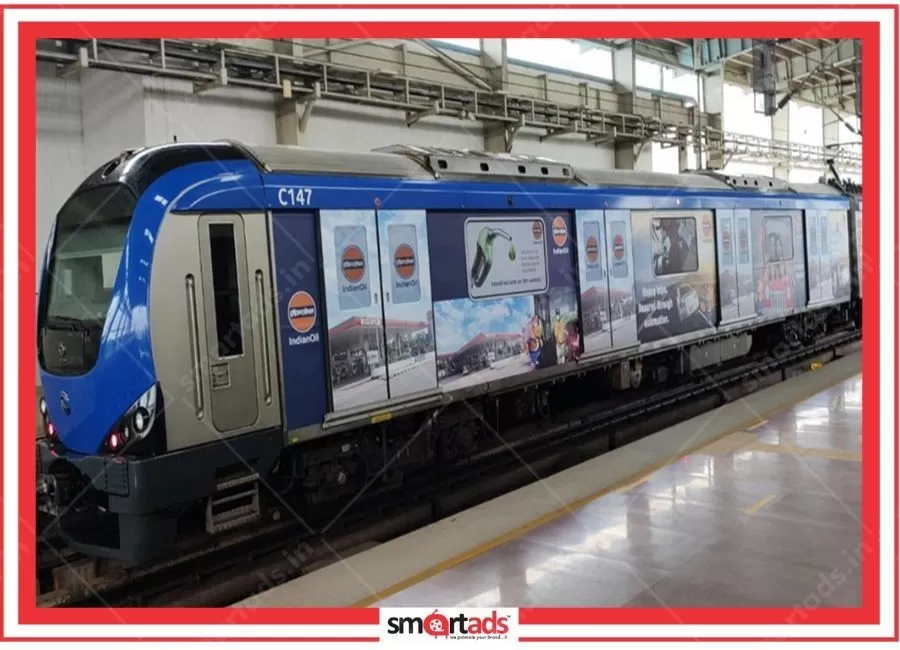
Exterior Metro Wrap
Size & Printing Cost as per actual
On the outside of metro Train, advertise
Rate per Metro Display Cost / 1 Month
Route : Tirusulam To WIMCO Nagar
₹660000.00
Showing 1 to 5 of 5 Results
MEDIA DETAILS
Size & Printing Cost as per actual
On the outside of metro Train, advertise
Rate per Metro Display Cost / 1 Month
Route : Tirusulam To WIMCO Nagar
₹660000.00
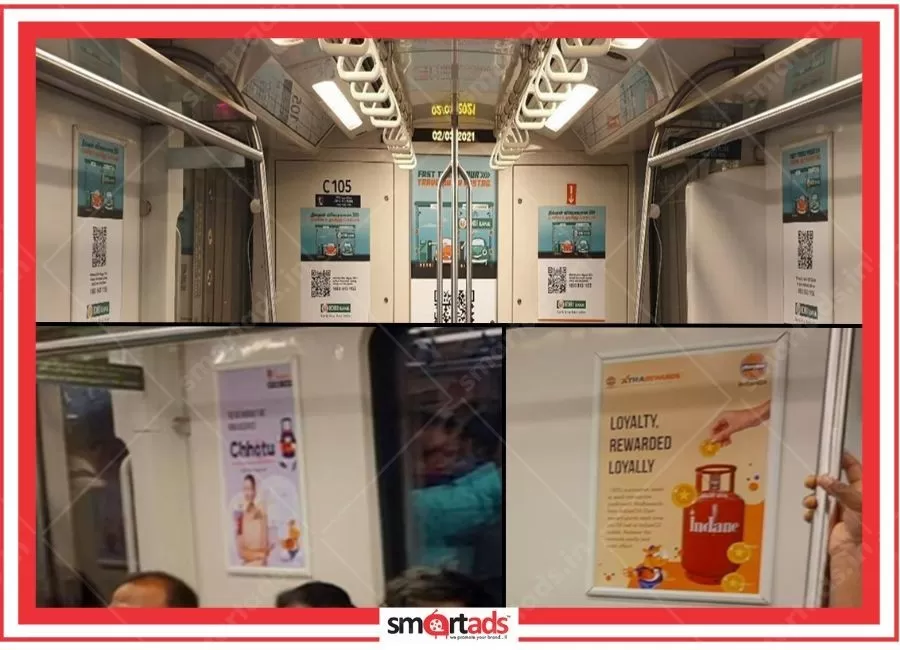
Size & Printing Cost as per actual
The Wrapping is done all over the Metro
Rate per Metro Display Cost / 1 Month
Route : Tirusulam To WIMCO Nagar
₹230000.00

10 Sec Video
Digital Screen is placed inside the metr
Rate per Metro Digital Display Cost / 1
Route :Tirusulam to WIMCO Nagar
₹4820.00
20 Sec Jingle
Jingles is the audio note which is heard
Rate per Metro Jingle Cost / 1 Month
Route :Tirusulam to WIMCO Nagar
₹600000.00

Size & Printing Cost as per actual
Exterior and Interior Metro Train Brandi
Rate per Metro Display Cost / 1 Month
Route :Tirusulam to WIMCO Nagar
₹780000.00
MEDIA REACH

MinimumQty :
1
EstimateReachPeople :
150000000
Most advertisers who come to us with a Chennai brief immediately think hoardings on Anna Salai or newspaper inserts in The Hindu. What they consistently underestimate is that the Chennai Blue Line metro carries somewhere in the ballpark of 111.9 million passenger journeys annually — a number which, when you break it down to a daily average, means roughly three lakh captive urban commuters are riding through this corridor every single day, many of them sitting in an enclosed space with nowhere to look except your advertisement.
That changes the conversation entirely.
Metro train advertising on the Chennai Blue Line refers to any paid brand placement on or inside the trains, platforms, and station infrastructure operated by Chennai Metro Rail Limited (CMRL) along Corridor-1 — the 32.65 km stretch running from Wimco Nagar Depot in the north all the way down to Chennai International Airport in the south. This corridor, which passes through some of the city's most commercially significant zones, is one of the most valuable transit media assets in Tamil Nadu, and frankly, it is still underpriced relative to what it delivers.
The Blue Line is not a single homogenous environment; it is actually two very different physical experiences stitched together. Roughly 17 km of the corridor runs underground — through dense, enclosed station environments where dwell time is high and ambient noise is controlled — while the remaining 15.65 km is elevated, offering a very different kind of visual exposure as the train moves above street level. This distinction matters enormously for advertisers, because the psychology of a commuter waiting on an underground platform at Chennai Central metro station is quite different from someone looking out a window on an elevated stretch near Koyambedu metro station. At SmartAds, we always tell our clients that these two environments call for different creative approaches, not just different formats.
The infrastructure itself is operated under the joint ownership of the Tamil Nadu Government and the Government of India, with CMRL functioning as the nodal authority. The rolling stock — the trains themselves — were supplied by Alstom, and the fleet currently comprises 52 metro trains running across the network. The exclusive advertising concessionaire for CMRL station inventory is Mark Metro, though brands working through an agency like SmartAds.in can access both station and train inventory through consolidated booking, which simplifies the process considerably and often yields better rates than going direct.
The range of metro advertising formats on the Chennai Blue Line is broader than most brand managers realise, and the mistake we see most often is brands defaulting to a single format when the real impact comes from layering two or three together. Interior train branding covers everything from seat back panel ads — the small panels mounted on the reverse of each seat — to overhead luggage rack panels, door wrap advertising on the inside of coach doors, and full interior coach wraps which essentially turn the entire inside of a train carriage into a branded environment. These interior formats benefit enormously from dwell time; the average Chennai metro commuter spends somewhere between 20 and 35 minutes on a single journey, which is a captive environment that most outdoor formats simply cannot replicate.
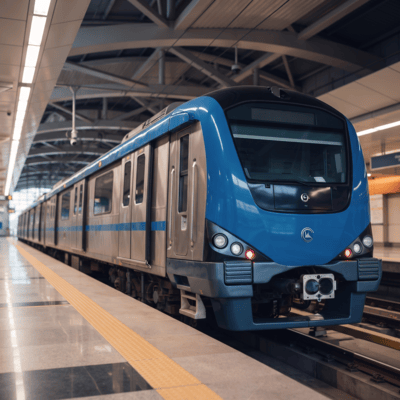
On the exterior side, exterior train branding ranges from partial vinyl wraps on specific panels to the full train wrap — the most visually arresting format available on the network, where the entire external surface of a train is covered in a single brand creative. A full train wrap Chennai deployment effectively turns the train into a moving billboard which travels the entire 32.65 km Blue Line corridor multiple times a day, generating impressions at every station, crossing, and elevated stretch it passes through. We worked with a consumer electronics brand that ran a full train wrap on the Blue Line for six weeks ahead of a product launch; their brand recall scores in post-campaign research came back significantly higher in Chennai than in comparable cities where they had run only static OOH advertising, and the client attributed a meaningful portion of that lift specifically to the train wrap format.
Beyond the trains themselves, station-level formats add another dimension to Blue Line metro train ads. Platform signage, entry exit gate branding, pillar wraps, and digital screen advertising metro installations at high-footfall stations like Alandur metro station and Meenambakkam metro station allow brands to intercept commuters at multiple touchpoints within a single journey. The newer DOOH metro Chennai installations — digital out-of-home screens at select underground stations — are particularly interesting because they allow dynamic content scheduling, which means a brand can run different creatives at morning peak, afternoon off-peak, and evening rush without any physical production changes. This is where transit media Chennai is genuinely evolving beyond what traditional OOH advertising Chennai can offer.
Pricing for metro train advertising in Chennai Blue Line is one of those areas where the internet is genuinely unhelpful — most pages either say "contact for rates" or list numbers so outdated they bear no resemblance to current market reality. What we can tell you, based on active campaigns we have planned and executed on this corridor, is that interior train branding for a single coach over a four-week period works out to roughly ₹40,000 to ₹60,000 depending on the specific format and placement, which is a number that surprises most clients when they compare it to what they are spending on digital display at equivalent reach.
A full train wrap on the Blue Line — which is the premium exterior format — sits somewhere between ₹8 lakh and ₹15 lakh for a four-week campaign, depending on the number of trains involved and the complexity of the vinyl production. That sounds like a significant number in isolation, but when you calculate the effective CPM against 111.9 million annual riders, the cost per thousand impressions works out to roughly ₹8 to ₹12 for exterior formats, which compares very favourably to what most brands are paying for premium digital video or print insertions. Platform-level station branding at high-traffic nodes like Koyambedu metro station or Chennai Central metro station can be booked independently at rates in the ballpark of ₹25,000 to ₹80,000 per month per format unit, with the variation driven primarily by station footfall tier and format size.
Metro advertising rates on the Blue Line are also structured differently from traditional OOH advertising — there is typically a minimum booking duration of four weeks for most formats, though some station-level digital screen advertising metro placements can be booked on shorter cycles of two weeks, which makes them useful for tactical or event-driven campaigns. Long-term commitments of three months or more generally attract meaningful discounts, and we have negotiated packages for clients where a six-month commitment on interior train branding came with complimentary station pillar wraps at two anchor stations — the kind of value-add which is rarely advertised but consistently available when you know how to structure the ask. Metro advertising cost also varies by season; the months around Pongal, Diwali, and the summer holiday period see higher demand and tighter inventory, so early booking is genuinely important for those windows.
The Blue Line is not just another metro line; it is the commercial spine of Chennai, connecting the city's northern industrial belt through its central business district and all the way to Chennai International Airport in the south. That single geographic fact — the airport connection — is what sets this corridor apart from almost every other transit media asset in Tamil Nadu. Brands targeting business travellers, frequent flyers, premium consumers, and the IT corridor workforce all find their audiences concentrated on this line in a way that no other single media vehicle in the city can replicate.
The Anna Salai corridor, which the Blue Line runs parallel to for a significant stretch, is arguably the most commercially dense artery in Chennai; it is lined with banks, insurance offices, automobile showrooms, and corporate headquarters, and the commuters who use the metro stations along this stretch tend to skew heavily towards salaried professionals and decision-makers. This is not an assumption — it is borne out by the audience data we have collected across multiple campaigns, and it aligns with what the FICCI-EY Media Report has consistently highlighted about metro rail audiences in Indian tier-1 cities being disproportionately urban, educated, and economically active relative to the general population.
On top of that, the Blue Line benefits from a captive audience advertising dynamic which is structurally different from roadside OOH. A commuter driving past a hoarding on Anna Salai has perhaps three seconds of exposure; a commuter sitting in a metro coach for 28 minutes is exposed to interior train branding repeatedly, in a low-distraction environment, with enough time to actually read and process brand messaging. We have found, across campaigns in Chennai and other Indian metro cities, that this dwell time advantage translates directly into higher brand recall — typically in the range of 40 to 60 percent unaided recall for interior formats run over a four-week period, compared to 15 to 25 percent for comparable static OOH placements.
Not all 26 metro stations Blue Line are equal from an advertiser's perspective, and understanding the footfall hierarchy is one of the most practically useful things a media planner can know before allocating budget. Chennai Central metro station is the undisputed anchor — as an interchange hub connecting to the Green Line and sitting adjacent to the main railway terminus, it handles a volume of commuters which is meaningfully higher than any other single station on the network; brands that want maximum impressions in minimum time almost always anchor their station branding here.
Alandur metro station is the second major interchange point, where the Blue Line meets the Green Line in the southern part of the city, and it draws a distinct commuter profile — largely IT sector employees heading to the OMR corridor, residents of the Guindy-Adambakkam belt, and travellers connecting onward toward the airport. Meenambakkam metro station and the Chennai International Airport metro station together form the airport cluster, which is exceptional for premium brands targeting high-income travellers; we worked with a luxury hospitality brand that ran a six-week campaign across these two stations and the connecting train interior, and the quality of engagement they reported — measured through QR code metro advertising scans embedded in the creative — was the highest of any transit media placement they had run nationally that year.
Koyambedu metro station deserves special mention because it sits adjacent to one of South India's largest wholesale markets and bus termini, which means its footfall profile is unusually broad — you get everything from daily wage workers and vegetable traders to suburban commuters and students, all in the same space. For FMCG brands, regional retailers, and educational institutions targeting a wide Chennai urban audience, Koyambedu is often the most cost-effective station-level investment on the Blue Line. Washermanpet metro station in the north, meanwhile, serves a dense residential and small-business catchment which is particularly relevant for telecom, banking, and consumer durables advertisers targeting the emerging middle-income segment.
The audience on the Chennai Blue Line is one of the most clearly defined in Indian transit media, and that clarity is precisely what makes metro train advertising in Chennai Blue Line so attractive for brands that have moved beyond spray-and-pray media strategies. The corridor's geography essentially segments the audience for you: the northern stations around Wimco Nagar Depot and Washermanpet serve industrial workers and dense urban residential populations; the central stretch through Egmore, Chennai Central, and the Anna Salai corridor carries office-goers and students, government employees, and corporate professionals; and the southern end, from Guindy through Alandur and down to Meenambakkam and Chennai International Airport, is dominated by IT workers, airport travellers, and premium suburban residents.
What the aggregate data shows — and this is consistent with what the GroupM TYNY Report and Dentsu e4m Report have both highlighted about metro rail audiences in Indian cities — is that daily commuters on urban metro networks skew significantly younger (18 to 45 years), more educated, and more digitally active than the general urban population. On the Chennai Blue Line specifically, the airport proximity means there is a meaningful overlay of high-income frequent travellers who are not regular commuters but who use the metro for airport access, and this segment is particularly valuable for brands in travel, finance, premium FMCG, and luxury categories. The 6.5 million reach Chennai metro figure that is often cited represents the estimated unique individuals who interact with the network monthly, which is a reach number that very few single-city media vehicles can match.
At SmartAds, we have found that the most effective campaigns on this corridor are those which acknowledge the audience's segmentation rather than treating all 26 stations as equivalent. A fintech brand targeting young professionals should concentrate their interior train branding on the central and southern stretch; a regional Tamil Nadu retailer looking for broad urban reach should weight their budget toward high-footfall interchange stations and the Koyambedu cluster. This kind of station-level audience planning is something we do as a matter of course for every Blue Line campaign we execute, and it consistently improves campaign efficiency by 20 to 30 percent compared to network-wide blanket bookings.
This is the question we get asked most often by clients new to metro advertising on the Blue Line, and the honest answer is that it depends on what you are trying to achieve — but there are some clear patterns which hold across the campaigns we have run. Interior train branding is fundamentally a messaging format; because commuters are physically inside the coach for an extended period, you have the time and the attention to communicate something complex — a product feature, a service explanation, a promotional offer with terms. Seat back panel ads, overhead panels, and door wrap advertising inside the coach all benefit from this extended exposure window, and they are particularly effective for brands in financial services, education, healthcare, and any category where the purchase decision requires some degree of deliberation.
Exterior train branding — and especially the full train wrap — is a pure awareness and impact format. It does not give you dwell time in the same way; a person on a platform sees the train arrive, has perhaps 15 to 30 seconds of exposure, and then boards. But what it does give you is scale, visual dominance, and the moving billboard effect as the train travels the entire 32.65 km Blue Line corridor. A full train wrap Chennai deployment is the kind of media placement that generates earned attention — people photograph it, share it on social media, and talk about it — in a way that a seat back panel simply does not. We have seen this work spectacularly for product launches, brand refreshes, and campaigns where the creative itself is strong enough to carry the weight of a single dominant visual.
The most effective campaigns we have executed on the Blue Line combine both approaches — exterior train branding for broad awareness and visual impact, interior train branding for message depth and conversion-oriented communication. A pharmaceutical brand we worked with ran a full train wrap on two coaches simultaneously with a coordinated interior campaign featuring QR code metro advertising that drove users to a health information microsite; the QR scan rate was nearly three times what they had achieved with comparable digital placements, which we attribute directly to the combination of exterior familiarity and interior dwell time working together. The budget for this kind of integrated approach works out to somewhere between ₹12 lakh and ₹20 lakh for a four-week campaign, which is significant but delivers a genuinely differentiated brand experience.
The comparison between metro train advertising Chennai and traditional out-of-home advertising is one that every media planner in this city eventually has to make, and the answer is more nuanced than the transit media evangelists would have you believe. Traditional OOH advertising Chennai — hoardings, unipoles, bus shelters — has genuine advantages in terms of raw geographic coverage and the ability to dominate specific micro-markets; a well-placed hoarding at a busy junction in T. Nagar or Velachery can deliver extraordinary local impact for a retail brand. But it has structural weaknesses which the Blue Line metro simply does not share.
The most significant weakness of traditional OOH is what the industry calls "drive-by" exposure — the three-to-five second window during which a commuter in a vehicle actually registers a hoarding. Attention research, including data cited in the TAM AdEx outdoor studies, consistently shows that recall rates for drive-by OOH are significantly lower than for captive environment placements. The Chennai Blue Line metro, by contrast, delivers a captive audience advertising environment where the average dwell time per journey is long enough for a commuter to read, process, and remember a brand message multiple times. On top of that, the demographic quality of the metro audience — predominantly urban, educated, and economically active — tends to be more precisely aligned with the target segments of most national and regional brands than the broad, undifferentiated audience of a roadside hoarding.
What a lot of people miss is the production cost differential. A premium billboard on Anna Salai requires not just the space rental but also significant production costs for large-format printing, installation, and maintenance; a full train wrap Chennai, while expensive in absolute terms, delivers a higher effective reach per rupee spent when the CPM is calculated honestly. That said, we do not recommend brands abandon traditional OOH entirely in favour of metro advertising — the two formats serve different functions in a media plan, and the brands which perform best in Chennai are typically those which use metro train branding for quality reach among urban professionals while using OOH advertising Chennai for geographic coverage and local market presence.
The short list of industries that have consistently delivered strong results on the Chennai Blue Line through our campaigns includes financial services, education, real estate, consumer electronics, healthcare, FMCG, and travel — but the reasoning behind each category is different, and understanding that reasoning helps in planning the right format mix. Financial services brands — banks, insurance companies, mutual fund houses, fintech apps — benefit from the corridor's concentration of salaried professionals and the extended dwell time which allows for message complexity; we have seen campaigns for banking products achieve conversion rates on QR code metro advertising that rival what the same brands were getting from paid search.
Education brands, particularly those targeting engineering and MBA aspirants, find the Blue Line's student population — which is substantial, given the number of colleges and coaching institutes accessible from stations in the central stretch — to be exceptionally responsive. One EdTech client we worked with ran a six-week interior train branding campaign targeting the Chennai Central to Alandur stretch and reported a 40 percent increase in app downloads from Chennai during the campaign period, which was their strongest single-city performance of the year. Real estate developers, particularly those with projects in the Guindy-Perungudi-OMR belt, find that Alandur metro station and the southern Blue Line stations deliver a highly relevant audience of IT professionals who are actively in the market for residential property.
Tamil Nadu-based regional brands often underestimate the Blue Line, assuming it is primarily a vehicle for national advertisers. That is a mistake. The corridor's northern stations serve dense working-class and lower-middle-income residential areas, while the central stretch covers the heart of Chennai's commercial activity; a regional consumer brand with distribution across Chennai can achieve meaningful BTL advertising Chennai impact through a well-planned station branding campaign at a fraction of what a citywide print or television campaign would cost. Non-traditional advertising Chennai is increasingly where regional brands are finding their most efficient media investments, and the Blue Line is a significant part of that story.
The booking process for metro train advertising in Chennai Blue Line involves a few more steps than buying a digital media placement, and brands that go in without understanding the process often find themselves frustrated by timelines. The first step is identifying whether you want train-level inventory — which means working with CMRL directly or through an authorised agency — or station-level inventory, which is managed by Mark Metro as the exclusive advertising concessionaire for CMRL station assets. In practice, most campaigns that combine both train and station formats are best handled through a single metro advertising agency which has relationships with both entities, because the approval processes and production timelines are different and need to be coordinated carefully.
Once the format and station or train selection is confirmed, the creative materials need to be submitted for CMRL approval — a process which typically takes somewhere between seven and fourteen working days for standard formats, and longer for full train wraps or any format involving digital screens. CMRL's guidelines require that all creative content be non-political, non-religious, and compliant with the Advertising Standards Council of India (ASCI) codes; any creative that references competitors, makes unsubstantiated claims, or uses imagery that could be considered offensive will be rejected at this stage. Production for vinyl wraps and interior panels, once approved, typically requires an additional five to seven working days, which means the total lead time from brief to live campaign is realistically four to six weeks — a timeline which surprises many clients who are used to the near-instant deployment of digital campaigns.
At SmartAds.in, we manage this entire process end-to-end for our clients — from format selection and rate negotiation through creative approval, production coordination, and post-installation verification. The value of working through an experienced metro advertising agency is not just the convenience; it is the accumulated knowledge of what CMRL approves quickly, which production vendors deliver on time, and how to structure a campaign brief to avoid the revision cycles that can push a launch date back by weeks. We have executed campaigns on the Blue Line for clients across financial services, real estate, FMCG, and education, and the difference between a smooth four-week launch and a chaotic eight-week one almost always comes down to process knowledge rather than budget.
Advertising ROI on the Chennai Blue Line is genuinely difficult to measure in isolation — which is true of most out-of-home advertising — but the data that exists is more compelling than most planners expect. Brand recall studies conducted across Indian metro networks, including data referenced in the FICCI-EY Media and Entertainment Report, consistently show that transit advertising in enclosed metro environments delivers unaided brand recall in the range of 35 to 55 percent for campaigns running four weeks or longer, which compares favourably to the 20 to 30 percent range typically reported for roadside OOH and the 15 to 25 percent range for digital display advertising at comparable frequency levels.
The ROI calculation for metro train advertising in Chennai Blue Line depends heavily on the brand's category and conversion funnel. For a brand where the purchase decision is made online — an e-commerce platform, a fintech app, an EdTech product — the integration of QR code metro advertising into interior train branding creates a measurable attribution bridge; the commuter sees the ad, scans the QR code during the journey, and the conversion can be tracked. We have run campaigns where this approach delivered cost-per-acquisition figures that were competitive with mid-funnel digital placements, which is a result that consistently surprises clients who had assumed metro advertising was purely an awareness vehicle. For brands where the purchase decision is offline — a real estate developer, a car showroom, a hospital — the ROI case is built on reach quality and brand recall rather than direct attribution, and the numbers still hold up well when benchmarked against the alternatives.
The 111.9 million annual ridership figure for the Chennai metro network translates, when weighted for the Blue Line's share of total ridership, to a monthly reach figure which makes this corridor one of the highest-reach single-media placements available in Tamil Nadu for urban audiences. A four-week full train wrap Chennai campaign on two trains, running the full 32.65 km Blue Line corridor multiple times daily, generates impression volumes that are genuinely difficult to replicate through any other single non-traditional advertising Chennai placement at a comparable cost. The Chennai metro phase 2 expansion, which will add 12 new stations to the network, is expected to increase this reach significantly over the next three to five years — which means brands that establish a presence on the Blue Line now are building equity in an asset that will only appreciate.
CMRL advertising is governed by a set of content and technical guidelines which are more detailed than most clients expect, and understanding them upfront saves significant time and frustration during the approval process. On the content side, all advertising on the Chennai Metro Rail Limited network must comply with ASCI guidelines, must not contain political messaging or religious content, and must not make comparative claims against competitors. Alcohol and tobacco advertising is prohibited entirely, as is any content which CMRL's review committee considers inconsistent with the public character of the metro network — a category which is applied somewhat subjectively but which in practice means that highly provocative or controversial creative approaches are likely to be rejected.
On the technical side, the specifications for metro train branding vary by format and are quite precise. Exterior vinyl wraps must use materials which are weather-resistant, non-reflective, and removable without damaging the train's surface finish; the Alstom rolling stock used on the Blue Line has specific surface characteristics which require particular vinyl grades, and production vendors who are not familiar with these specifications frequently produce materials that fail inspection. Interior formats have their own dimensional specifications for each panel type, and creative files must be submitted at specific resolutions — typically 150 to 300 DPI for large-format prints, with colour profiles specified in CMRL's production guidelines document. Working with a metro advertising agency that has executed multiple campaigns on this network is genuinely important here, because the technical requirements are not publicly documented in an easily accessible way.
The approval timeline, as mentioned earlier, is typically seven to fourteen working days for standard formats, but this can extend significantly if the creative requires revisions or if the campaign involves non-standard formats like station domination or naming rights, which require additional sign-off from CMRL's commercial division. Station domination packages — where a brand takes over all advertising inventory at a single station for a defined period — are available on the Blue Line and represent one of the most impactful formats in the CMRL advertising portfolio; Alandur metro station and Chennai Central metro station are the most sought-after for this format, and inventory is limited, so advance booking of three to four months is advisable for peak-season campaigns.
Q: What is metro train advertising on the Chennai Blue Line?
Metro train advertising on the Chennai Blue Line refers to any paid brand placement on the trains, platforms, stations, and associated infrastructure of CMRL's Corridor-1, which runs 32.65 km from Wimco Nagar Depot in the north to Chennai International Airport in the south, covering 26 metro stations across both underground and elevated sections of the network. It encompasses a wide range of formats — from interior seat back panel ads and door wrap advertising inside coaches to exterior full train wraps, platform signage, digital screen advertising metro installations, and entry exit gate branding at individual stations. It is classified as transit media and falls under the broader category of BTL advertising Chennai and non-traditional advertising Chennai.
Q: How much does it cost to advertise on the Chennai Blue Line metro train?
Metro advertising cost on the Blue Line varies significantly by format. Interior train branding for a single coach works out to roughly ₹40,000 to ₹60,000 for a four-week period; a full train wrap Chennai sits somewhere between ₹8 lakh and ₹15 lakh for four weeks depending on the number of trains and production complexity; and station-level platform signage at high-footfall stations like Koyambedu metro station or Chennai Central metro station ranges from approximately ₹25,000 to ₹80,000 per month per format unit. These are indicative market benchmarks based on our active campaign experience — actual rates are negotiated based on campaign duration, format combination, and seasonal demand.
Q: What ad formats are available for the Chennai Blue Line metro train?
The available formats span interior and exterior train placements as well as station-level options. Interior formats include seat back panel ads, overhead luggage rack panels, door wrap advertising, and full interior coach wraps. Exterior formats range from partial panel vinyl applications to the full train wrap, which covers the entire external surface of a train. At the station level, advertisers can book platform signage, pillar wraps, entry exit gate branding, inside panel advertising in concourses, and digital screen advertising metro (DOOH) installations at select underground stations. QR code metro advertising can be integrated into any interior format.
Q: How many trains and stations are available for advertising on the Blue Line?
The Blue Line currently operates across 26 metro stations Blue Line, spanning the full 32.65 km corridor from Wimco Nagar Depot to Chennai International Airport. The CMRL fleet comprises 52 metro trains across the network, of which a significant proportion operate on the Blue Line. Not all trains and all station formats are simultaneously available for advertising — inventory is managed through a booking system, and popular formats at high-footfall stations are frequently booked several months in advance.
Q: Who is the target audience for Chennai Blue Line metro train advertising?
The audience is predominantly urban, educated, and economically active — skewing toward the 18-to-45 age bracket with a significant representation of salaried professionals, IT sector employees, students, and airport travellers. The corridor's geography creates natural audience segments: northern stations serve industrial and dense residential populations; central stations along the Anna Salai corridor draw office-goers and students; and southern stations from Alandur to Chennai International Airport metro station serve IT professionals, premium suburban residents, and frequent flyers. This makes the Blue Line particularly valuable for financial services, real estate, education, consumer electronics, and travel brands.
Q: How do I book metro train advertising on the Chennai Blue Line?
The booking process involves selecting formats and station or train inventory, submitting creative materials for CMRL approval (which takes seven to fourteen working days), coordinating production of vinyl or printed materials, and scheduling installation. Train-level inventory is managed through CMRL directly or via authorised agencies; station-level inventory is managed by Mark Metro as the exclusive concessionaire. Working through a metro advertising agency like SmartAds.in consolidates this process and typically reduces the total lead time from brief to live campaign.
Q: What is the minimum campaign duration for Chennai Blue Line metro ads?
The standard minimum booking duration for most train and station formats is four weeks. Some digital screen advertising metro placements at select stations can be booked on two-week cycles, which makes them useful for tactical or event-driven campaigns. Long-term commitments of three months or more typically attract rate discounts and may include complimentary format upgrades or additional station placements as part of a negotiated package.
Q: What is the reach and footfall of the Chennai Metro Blue Line?
The Chennai metro network handles approximately 111.9 million passenger journeys annually, with the Blue Line accounting for a substantial share of that volume given its length and the density of the corridors it serves. The 6.5 million reach Chennai metro figure represents the estimated monthly unique audience across the network. High-footfall stations like Chennai Central metro station, Alandur metro station, and Koyambedu metro station individually handle tens of thousands of passengers daily, making them among the highest-reach single-location advertising placements in Tamil Nadu.
Q: Is interior or exterior train branding more effective on the Chennai Blue Line?
The answer depends on campaign objectives. Interior train branding delivers higher dwell time, message depth, and brand recall for complex communications — making it better suited for financial services, education, healthcare, and any brand that needs to communicate more than a single image and tagline. Exterior train branding, particularly the full train wrap, delivers visual impact, broad awareness, and the moving billboard effect across the entire 32.65 km corridor. The most effective campaigns combine both formats, using exterior branding for awareness and interior branding for message depth and conversion-oriented communication.
Q: What is the ROI of advertising on the Chennai Blue Line metro?
Brand recall studies across Indian metro networks show unaided recall rates of 35 to 55 percent for transit advertising campaigns running four weeks or longer, which compares favourably to roadside OOH and digital display at equivalent frequency. For brands using QR code metro advertising in interior formats, direct attribution is possible and has delivered cost-per-acquisition figures competitive with mid-funnel digital placements in campaigns we have executed. The effective CPM for exterior train formats works out to roughly ₹8 to ₹12 per thousand impressions, which is competitive with most premium digital and print alternatives.
Q: How is Chennai Blue Line metro advertising different from Green Line advertising?
The Blue Line (Corridor-1) runs north-south from Wimco Nagar Depot to Chennai International Airport, covering the city's commercial spine and airport corridor; the Green Line (Corridor-2) runs east-west from Chennai Central to St. Thomas Mount. The Blue Line's airport connection gives it a premium audience overlay of business travellers and frequent flyers which the Green Line does not have; it also covers a longer corridor with more stations. The Green Line, however, serves the Vadapalani and Ashok Nagar corridors which are important for retail and entertainment brands. For most national brands, the Blue Line delivers higher audience quality and broader geographic coverage; for brands targeting specific western Chennai catchments, the Green Line may be more relevant.
Q: Which industries benefit most from advertising on the Chennai Blue Line?
Financial services, real estate, education, consumer electronics, healthcare, FMCG, and travel and hospitality brands consistently deliver strong results on the Blue Line. Tamil Nadu-based regional brands in retail, consumer goods, and services also find strong value in station-level BTL advertising Chennai on this corridor, particularly at high-footfall interchange stations. The airport proximity makes the southern stretch of the Blue Line particularly valuable for premium and luxury brands targeting high-income travellers.
Q: What are the CMRL guidelines and permissions required for metro train advertising?
CMRL advertising guidelines require all content to comply with ASCI codes, prohibit political and religious content, and ban alcohol and tobacco advertising. Technical specifications for vinyl materials, print resolutions, and dimensional requirements vary by format and must be followed precisely to pass inspection. The approval process takes seven to fourteen working days for standard formats and longer for non-standard or station domination packages. Creative submissions must be made through the booking agency or directly to CMRL's commercial division, and revisions requested by the review committee must be addressed before production begins.
Q: Can I advertise on specific stations along the Chennai Blue Line?
Yes — station-level advertising inventory is available for individual stations, and brands can select specific stations based on footfall, audience profile, and geographic relevance. High-footfall stations like Alandur metro station, Chennai Central metro station, Koyambedu metro station, Meenambakkam metro station, and Washermanpet metro station are the most sought-after and typically command premium rates. Station domination packages — where a brand takes over all advertising inventory at a single station — are available at select stations and require advance booking of three to four months for peak periods.
