
Exterior Metro Wrap
Size & Printing Cost as per actual
The advertisement spans the whole train,
Rate per Metro Display Cost / 1 Month
₹1000000.00
Showing 1 to 5 of 5 Results
MEDIA DETAILS
Size & Printing Cost as per actual
The advertisement spans the whole train,
Rate per Metro Display Cost / 1 Month
₹1000000.00
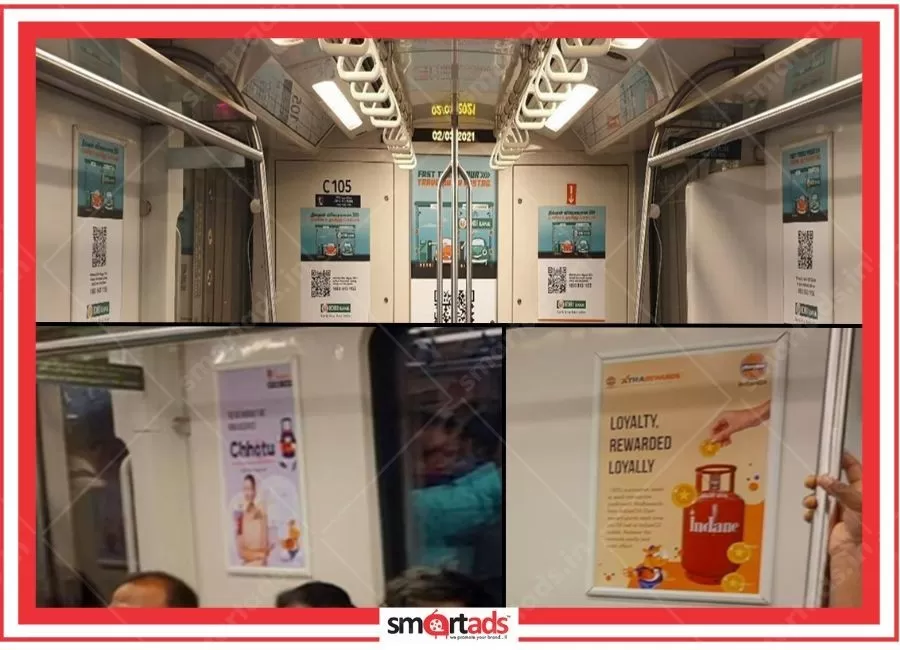
Size & Printing Cost as per actual
On the inside of the metro train the adv
Rate per Metro Display Cost / 1 Month
₹500000.00
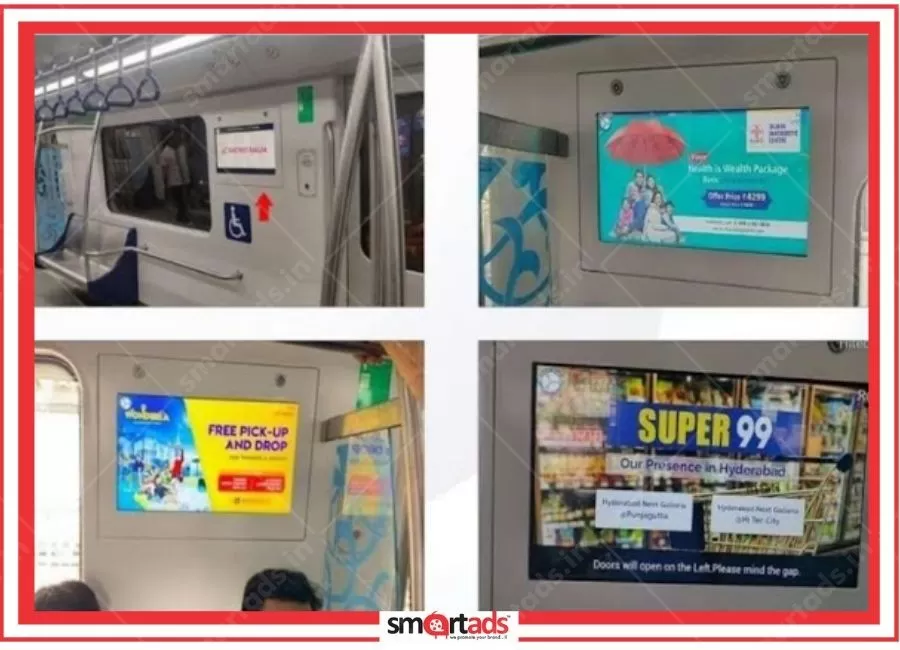
10 Sec Video
Digital screen on the metro station will
Rate per Metro Digital Display Cost / 1
₹600000.00
20 Sec Audio
A jingle is a song or a phrase, and the
Rate per Metro Jingle Cost / 1 Month
₹400000.00

Size & Printing Cost as per actual
On the outside of the metro train the ad
Rate per Metro Display Cost / 1 Month
₹1500000.00
MEDIA REACH

MinimumQty :
100
EstimateReachPeople :
1000000
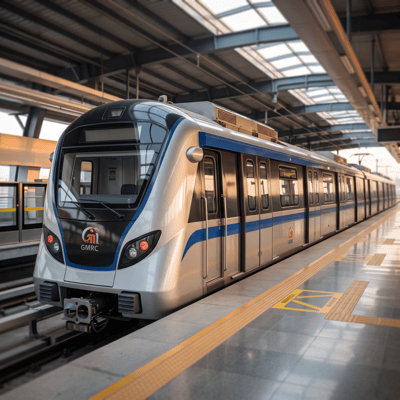
Most brands that come to us with Ahmedabad briefs are still thinking in terms of hoardings on SG Road and newspaper jackets in Gujarat Samachar — which is entirely understandable, given how those formats have dominated the city's media landscape for decades. What they are missing, frankly speaking, is that the Ahmedabad Metro Blue Line now carries upwards of 1.5 lakh passengers daily across its operational stretch, delivering a captive, urban, upwardly mobile audience that most traditional outdoor formats simply cannot replicate at the same cost efficiency.
The Blue Line — which runs from Vastral in the east to Thaltej Gam in the west, spanning roughly 40 kilometres and 32 stations — cuts through some of the most commercially significant corridors in Ahmedabad. It passes through APMC, Kankaria, Maninagar, Kalupur, Old City, Relief Road, Paldi, Nehru Nagar, Sarkhej, and eventually the GIFT City-adjacent zones near Thaltej; which means a single campaign placed along this corridor touches retail shoppers, office commuters, college students, and high-income residential clusters all within one media buy. That kind of geographic breadth is genuinely difficult to achieve with any single outdoor placement.
What a lot of people miss is the dwell time advantage. A commuter boarding at Vastral and alighting at Kalupur Railway Station is on the metro for somewhere between 18 and 22 minutes, which is a number that becomes very interesting when you consider that most roadside hoardings earn about 2 to 3 seconds of visual attention per pass. Inside a metro coach or on a platform, there is no competing traffic, no windshield glare, no speed differential — the audience is seated or standing in a fixed environment, which means your creative is being absorbed rather than merely glimpsed. At SmartAds, we always tell our clients that metro advertising is less like a billboard and more like a magazine spread that follows the reader for 20 minutes.
The Blue Line also has a ridership profile that skews strongly toward the SEC A and SEC B segments — which, for categories like banking, insurance, consumer electronics, real estate, and premium FMCG, is exactly the demographic that justifies a premium CPM. GMRC (Gujarat Metro Rail Corporation) ridership data, corroborated by independent audience studies, consistently shows that a significant share of Blue Line users are salaried professionals between 22 and 45 years of age; this cohort is precisely the one that most brands are trying to reach through digital channels at considerably higher cost-per-engagement.
The inventory on the Blue Line is more varied than most media planners assume when they first approach this medium. At the station level, you are looking at platform screen door (PSD) panels, which are the large-format backlit panels positioned directly at eye level as trains arrive and depart — these are arguably the highest-attention placements in the entire network because passengers standing on the platform have nothing else to look at. Then there are concourse-level lightboxes and wall wraps, entry and exit gate branding, and the increasingly popular pillar wraps which transform structural columns into 360-degree brand canvases.
Inside the trains themselves, the inventory breaks down into overhead panel cards (the horizontal panels above the windows on both sides of the coach interior), door panels, grab-handle danglers, full coach wraps, and the relatively newer digital screen placements which are now operational at select stations and inside certain rake sets. A full coach branding — which involves wrapping the interior of an entire train coach with your creative — is the format we recommend most often to brands that are launching a new product or running a time-sensitive campaign, because the immersive quality of that environment simply cannot be matched by any other OOH format at a comparable price point.
On top of that, there is exterior train branding — the full or partial wrap of the train's outer body — which delivers impressions not just to metro users but to everyone in the city who sees the train running on its elevated viaduct. One automotive brand we worked with chose a full exterior wrap on two rakes during their model launch window, and the earned media value from social sharing of the wrapped trains (people photographing and posting the branded rakes) added a layer of digital amplification that was never part of the original media plan. That kind of organic extension is something we have seen happen repeatedly with well-executed metro wraps.
Frankly speaking, this is the question that determines whether a brand books or walks away — and the answer is more accessible than most marketing managers expect. Platform panel placements on the Blue Line work out to somewhere in the ballpark of ₹25,000 to ₹60,000 per panel per month depending on station footfall and panel position, which is a number that surprises most clients when they compare it to what they are paying for a single premium hoarding on Ashram Road. Concourse lightboxes and wall wraps tend to be priced slightly lower, in the range of ₹15,000 to ₹40,000 per unit per month, which makes them an efficient choice for brands that want broad station coverage without concentrating spend on a single high-visibility format.
Train interior panels — the overhead cards inside coaches — are typically sold in sets rather than individually, with a set covering one full coach running at roughly ₹80,000 to ₹1.5 lakh per month depending on the rake and the campaign duration; longer bookings of three months or more generally attract discounts in the range of 15 to 20 percent, which is worth factoring into the planning conversation early. Full coach interior branding, where the entire interior surface of a coach is wrapped in your creative, is a premium format that runs somewhere between ₹3 lakh and ₹6 lakh per coach per month — and in our experience, the brands that use this format tend to see significantly higher recall scores in post-campaign surveys than those using individual panel placements.
Exterior train wraps are the most premium format in the Blue Line inventory and are priced accordingly, typically starting at ₹8 lakh to ₹15 lakh per rake per month for a full exterior wrap; partial wraps and half-body treatments are available at lower price points and can be a practical middle ground for brands with tighter budgets. What we tell our clients at SmartAds is that the cost-per-thousand (CPM) calculation on metro advertising tends to look very compelling once you factor in the dwell time multiplier — a passenger exposed to your panel for 20 minutes is not the same as a motorist who sees your hoarding for 3 seconds, and any honest media evaluation should weight those exposures differently.
Not all stations are created equal, and this is where the real value of working with an experienced media planning team shows up. Kalupur Railway Station — which serves as an interchange with the Indian Railways network and sees some of the highest footfall on the entire Blue Line — is the obvious anchor station for any campaign that wants sheer volume of impressions. Maninagar and Kankaria are strong performers for retail and FMCG brands given the residential density and market proximity; Paldi and Nehru Nagar serve a younger, student-heavy demographic which makes them attractive for ed-tech, fintech, and lifestyle categories.
At the western end of the corridor, stations like Thaltej and Sola Road are seeing growing footfall as the GIFT City and SG Highway office corridors mature — which means these stations are increasingly relevant for B2B brands, financial services, and premium real estate advertisers who want to reach decision-makers during their daily commute. The APMC station at the eastern end, on the other hand, draws a very different audience profile — traders, logistics professionals, and SME owners — which makes it surprisingly effective for commercial vehicle brands, B2B services, and banking products targeting the business community.
Our experience shows that the most efficient media plans are not necessarily the ones that book the highest-footfall stations; they are the ones that match station audience profiles to brand target groups. A retail client in Pune — who was running a pan-India metro campaign across five cities — initially wanted to concentrate their Blue Line budget entirely on Kalupur; after we ran an audience profiling exercise against their customer data, we reallocated roughly 40 percent of the budget to Paldi and Nehru Nagar, which resulted in a measurably higher response rate in those catchments during the campaign period. The station selection decision deserves as much strategic thought as the creative itself.
The honest answer is that metro advertising and traditional outdoor serve different functions, and the mistake most brands make is treating them as direct substitutes. A large-format hoarding on CG Road or the Sarkhej-Gandhinagar Highway delivers mass reach across a broad geographic catchment — which is valuable for brand awareness campaigns that need to blanket the city. Metro advertising, by contrast, delivers concentrated, repeated exposure to a specific audience segment along a defined corridor; which makes it more analogous to targeted digital advertising than to traditional OOH in terms of how you should plan and evaluate it.
The FICCI-EY Media and Entertainment Report has consistently highlighted transit advertising as one of the fastest-growing segments within the OOH category in India, driven precisely by the expansion of metro networks in cities like Ahmedabad, Surat, and Pune. TAM AdEx data on OOH spending patterns shows that brands in the BFSI, telecom, real estate, and consumer durables categories have been increasing their metro advertising allocations year-on-year, which aligns with what we are seeing in our own client briefs. The CPM on a well-placed metro panel, when calculated against verified footfall data rather than estimated traffic counts, tends to be lower than equivalent-quality outdoor placements in the same city — a fact that tends to shift budget conversations quite quickly once the numbers are laid out clearly.
To be fair, metro advertising does have constraints that traditional outdoor does not. You cannot reach audiences who do not use the metro — which, in a city like Ahmedabad where private vehicle usage remains high, is a real limitation for mass-market campaigns. The creative also needs to work in a different context: the audience is closer, more attentive, and has more time to read, which means that creative executions which work on a highway hoarding (big visual, three words) are not necessarily the ones that perform best inside a metro coach. We have seen this backfire when brands simply repurpose their outdoor creative for metro placements without adapting the messaging or format.
The proximity factor changes everything about how creative should be approached for metro placements. At a distance of 1 to 2 metres — which is the typical viewing distance for an overhead panel inside a coach — copy-heavy executions that would be completely unreadable on a highway hoarding become entirely viable; in fact, some of the best-performing metro campaigns we have run have used storytelling formats with 40 to 60 words of body copy, which would be absurd on any other OOH format. The audience has nowhere to be for the next 20 minutes; use that time.
For platform placements, the dynamic is slightly different — passengers are moving toward the platform, waiting for the train, or boarding, which means attention is available but not guaranteed. Here, bold visual contrast, a single strong claim, and a clear brand identity tend to outperform narrative formats; the PSD panels in particular benefit from high-contrast creative that reads instantly from 5 to 8 metres away. Digital screen placements, which are now available at select Blue Line stations, allow for animated creative and time-of-day targeting — which opens up possibilities for restaurant brands running lunch-hour promotions, or retail brands pushing weekend offers on Friday evenings.
One education brand we worked with ran a Blue Line campaign during admissions season that used the coach interior panels to tell a sequential story across six panels — each panel was a chapter in a student's journey from confusion to career clarity, which meant that passengers who rode the full length of the coach encountered a complete narrative arc. Post-campaign recall research showed aided awareness scores that were nearly double the benchmark for comparable OOH campaigns in the same city; the format worked because it respected the audience's intelligence and used the dwell time deliberately rather than defaulting to a single static message.
The booking process runs through GMRC's authorised advertising concessionaire, which holds the rights to sell and manage advertising inventory across the Blue Line network. Direct booking is possible in principle, but in practice most brands work through a media agency because the concessionaire's rate card is a starting point for negotiation rather than a fixed price — and the ability to negotiate meaningfully depends on campaign size, booking duration, and the agency's existing relationship with the concessionaire. Minimum booking durations are typically 30 days for most formats, with some premium formats requiring a 60-day minimum.
The production and installation of creative materials is a separate cost from the media space itself, which is a detail that catches many first-time metro advertisers off guard. Vinyl wraps, backlit panel prints, and digital content production all need to meet GMRC's technical specifications — which are stricter than those for standard OOH because of safety and aesthetic standards that apply inside a public transport environment. Production costs for a full coach interior wrap, for example, can run anywhere from ₹50,000 to ₹1.5 lakh depending on the complexity of the design and the number of surfaces being covered; this needs to be factored into the total campaign budget from the outset.
At SmartAds, our process involves running a full inventory audit before confirming any booking — which means we check actual availability against the client's preferred stations and formats, rather than presenting a plan based on theoretical inventory. We have found that availability at premium stations like Kalupur and Maninagar can be constrained during peak advertising periods (Diwali, New Year, IPL season), so advance booking of 6 to 8 weeks is strongly advisable for campaigns tied to specific seasonal windows. The brands that get the best placements are almost always the ones that plan ahead rather than the ones with the biggest budgets.
This is a question we get asked more often than almost any other, and the answer — which surprises most people — is yes, with the right format selection. A single concourse lightbox at a mid-tier station for 30 days can be booked for somewhere in the range of ₹15,000 to ₹25,000, which puts metro advertising well within reach of local retail chains, regional financial services brands, and mid-sized real estate developers. The key is not trying to replicate a large-format campaign on a small budget; instead, the strategy should focus on one or two high-relevance stations where the audience profile matches the brand's target customer, and on a format that delivers quality exposure rather than volume.
A regional jewellery brand we worked with in Ahmedabad — running a budget of approximately ₹3 lakh for a 45-day campaign — chose to concentrate entirely on three stations in the Maninagar-Kankaria corridor, using platform panels and concourse lightboxes at each location. Rather than spreading thin across the entire network, the concentrated presence at those three stations created a sense of brand ubiquity within that specific catchment; the brand's store footfall data for the campaign period showed a measurable uplift compared to the same period in the previous year, which the client attributed in part to the metro campaign running in parallel with a radio schedule on local FM stations.
The broader point here is that metro advertising scales in both directions — it is accessible to a local brand with a ₹2 lakh budget and relevant to a national brand with a ₹50 lakh OOH allocation. What changes is the scope, the format mix, and the station selection; the underlying logic of reaching a captive, urban, high-quality audience remains constant regardless of budget size.
The measurement conversation around metro advertising is one that the industry has been working to improve, and the tools available today are meaningfully better than they were even three years ago. GMRC publishes verified footfall data by station, which provides the foundation for impression calculations; on top of that, independent audience measurement studies — some of which reference IRS (Indian Readership Survey) demographic data to profile metro users — allow for a reasonably accurate reach-and-frequency calculation. The GroupM TYNY Report and Dentsu e4m Report both track OOH spending and effectiveness benchmarks which can serve as useful reference points when presenting ROI projections to management.
What a lot of people miss is that metro advertising's strongest ROI case is often made through brand tracking rather than direct response metrics. Unlike digital advertising, which can be tracked to a click or a conversion, metro advertising's primary effect is on brand awareness, recall, and consideration — which are metrics that require pre- and post-campaign survey methodology to measure properly. We recommend that any brand investing more than ₹5 lakh in a metro campaign budget for a structured brand health tracking exercise alongside the media buy; the data generated is useful not just for evaluating the current campaign but for building the evidence base that justifies future OOH investment to finance teams and senior management.
That said, we have seen direct response work effectively in metro environments when the creative and the call-to-action are designed for the format. QR codes on metro panels have shown meaningful scan rates when the offer is compelling and the placement is in a dwell-time-rich environment (coach interiors and waiting areas outperform gate panels significantly for QR engagement); one fintech client we worked with ran a metro campaign with a QR-led offer and tracked over 2,000 app downloads directly attributable to metro panel scans over a 60-day campaign period, which gave them a cost-per-acquisition that compared very favourably to their paid social benchmarks.
Q: What is the minimum budget required to start advertising on the Ahmedabad Metro Blue Line?
The practical entry point for a meaningful metro campaign on the Blue Line is somewhere around ₹50,000 to ₹75,000 for a 30-day booking, which would typically cover two to three concourse or platform panel placements at a single station. Below that threshold, the campaign footprint becomes too small to generate sufficient frequency for brand recall to build effectively; the general rule of thumb in transit advertising is that a consumer needs to see your message at least three to four times before it registers with any depth, which requires a minimum level of presence across the stations they use regularly. That said, a focused single-station campaign at a high-relevance location can deliver meaningful results for a local brand targeting a specific catchment, and we have structured effective campaigns at that budget level for regional clients.
Q: How far in advance do you need to book metro advertising space on the Blue Line?
For standard formats at non-peak periods, a booking lead time of three to four weeks is generally sufficient. However, for premium formats — full coach wraps, exterior train branding, and prime platform positions at high-footfall stations like Kalupur — we strongly advise booking six to eight weeks ahead, and for campaigns tied to major seasonal periods like Diwali, Navratri, or the IPL window, a 10 to 12 week advance booking is not excessive. Inventory at the most sought-after stations and in the most premium formats tends to be absorbed well ahead of the campaign period, and the brands that secure the best placements are consistently the ones that plan their OOH calendar quarterly rather than reactively.
Q: Can you run digital or animated advertising inside Ahmedabad Metro stations?
Yes — digital screen inventory is available at select Blue Line stations, and the network is being progressively expanded as GMRC upgrades its station infrastructure. Digital formats allow for animated creative, video content (typically without audio in public areas), and time-of-day scheduling, which opens up targeting possibilities that static formats cannot offer. A restaurant brand, for example, can schedule its creative to run with higher frequency during the morning and evening peak commute windows, or a retail brand can push a weekend offer exclusively on Friday evenings. The rates for digital screen placements are higher than for static formats, but the flexibility and the ability to change creative without reprinting costs can make the economics work favourably for campaigns with multiple messages or time-sensitive offers.
Q: Is metro advertising on the Blue Line effective for B2B brands, or is it primarily a B2C medium?
This is a more nuanced question than it might appear. The Blue Line's ridership does include a significant proportion of business professionals — particularly at stations serving the commercial corridors around SG Highway, Thaltej, and the GIFT City-adjacent zones — which makes it relevant for certain B2B categories. Financial services, commercial real estate, HR and recruitment platforms, logistics technology, and business banking are all categories where we have seen metro campaigns generate genuine business leads, because the audience at those specific stations skews heavily toward decision-makers and business owners. The key for B2B advertisers is station selection and creative strategy; a generic brand awareness execution is unlikely to move the needle, but a specific, problem-focused message aimed at the right professional audience at the right station can be surprisingly effective.
Q: How does the Ahmedabad Metro Blue Line advertising inventory compare to the Red Line?
The Blue Line — which is the older and more established of the two operational Metro lines in Ahmedabad — currently carries higher daily ridership and has a more mature advertising inventory with a wider range of available formats. The Red Line, running broadly north-south from Motera to APMC, serves a different set of catchments and audience profiles; the two lines intersect at Kalupur Railway Station, which is the single highest-footfall point in the entire Ahmedabad Metro network. For campaigns targeting the broadest possible metro audience in the city, a dual-line buy that covers both corridors is the most effective approach; for campaigns with specific geographic or demographic targeting requirements, the choice between lines should be driven by catchment analysis rather than a default preference for one over the other.
Q: What are the production specifications for metro advertising creatives in Ahmedabad?
Production specifications are set by GMRC and its authorised concessionaire, and they vary by format — which is why it is important to confirm the exact specifications before briefing your creative agency. In general terms, backlit panel formats require high-resolution print files (typically 720 DPI or higher at actual size) on specific vinyl substrates that meet fire safety standards for enclosed public spaces. Coach interior panels have strict dimensional requirements that vary by rake type. Digital screen content needs to meet resolution and file format specifications that differ from standard digital advertising specs. We always advise clients to get the technical specifications confirmed in writing before the creative production brief is issued, because reprinting costs due to specification errors are entirely avoidable and can add meaningfully to the campaign budget.
The Ahmedabad Metro Blue Line represents something genuinely valuable in the city's media landscape — a captive, urban, demographically desirable audience that is growing in size every quarter as the network's ridership matures and expands. What makes it particularly interesting as a media buy right now is that it is still in a period where demand from advertisers has not fully caught up with the quality of the audience being delivered; which means that brands willing to invest in this medium today are getting better value than they will in two or three years when the inventory becomes more contested.
The brands that get the most out of metro advertising are the ones that approach it as a distinct medium with its own creative logic, rather than treating it as an extension of their outdoor campaign. The dwell time is real, the audience proximity is real, and the demographic quality is real — but none of those advantages translate automatically into results if the creative is not designed to take advantage of them. A 20-minute captive audience deserves more than a repurposed highway hoarding; it deserves a message that respects the context, uses the space intelligently, and gives the viewer something worth reading or remembering.
At SmartAds, we have planned and executed metro advertising campaigns across Ahmedabad and several other Indian cities, and our consistent finding is that the medium rewards strategic thinking more than budget size. A well-planned ₹3 lakh campaign concentrated on the right stations with the right creative will outperform a ₹10 lakh campaign that is spread thin and executed without audience intelligence. The planning decisions — which stations, which formats, which creative approach, which campaign duration — matter enormously, and they are decisions that benefit from experience with how this specific network and its specific audience actually behave.
If you are considering metro train advertising on the Ahmedabad Metro Blue Line — whether for a brand launch, a seasonal push, or an ongoing presence campaign — the SmartAds media planning team is available to put together a customised plan with actual rate benchmarks, station-level audience data, and format recommendations tailored to your campaign objectives. You can reach us at SmartAds.in, where our team works across 500+ Indian cities and brings the kind of ground-level market intelligence that makes the difference between a media plan that looks good on paper and one that actually delivers.
