
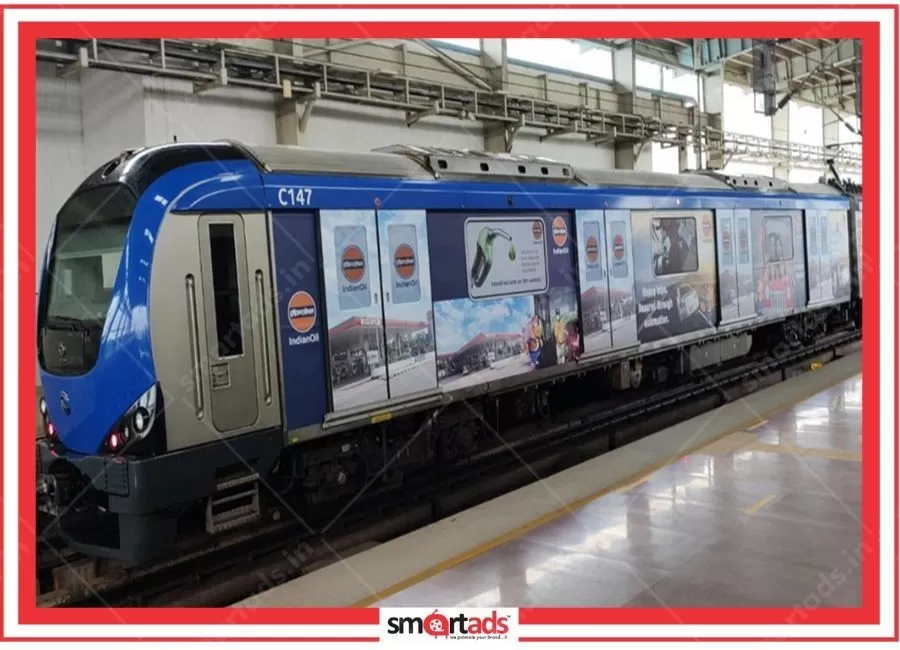
Exterior Metro Wrap
Custom
The advertisement spans the whole train,
Rate per Metro Display Cost / 1 Month
Route : Tirusulam To WIMCO Nagar
₹1000000.00
Showing 1 to 5 of 5 Results
MEDIA DETAILS
Custom
The advertisement spans the whole train,
Rate per Metro Display Cost / 1 Month
Route : Tirusulam To WIMCO Nagar
₹1000000.00
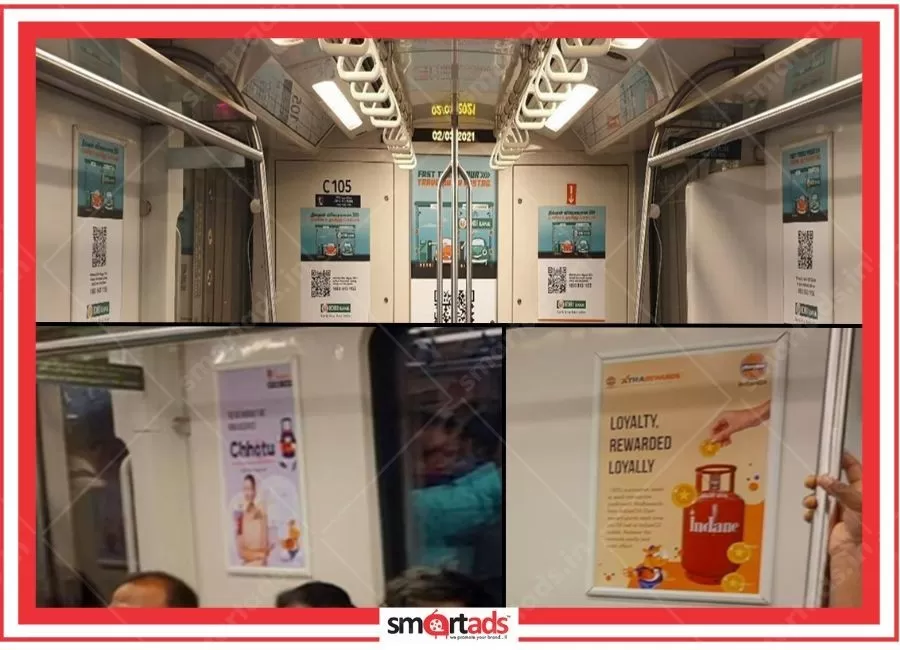
Custom
On the inside of the metro train the adv
Rate per Metro Display Cost / 1 Month
Route : Tirusulam To WIMCO Nagar
₹500000.00
20 Sec Audio
A jingle is a song or a phrase, and the
Rate per Metro Jingle Cost / 1 Month
Route :Tirusulam to WIMCO Nagar
₹400000.00

10 Sec Video
Digital screen on the metro station will
Rate per Metro Digital Display Cost / 1
Route :Tirusulam to WIMCO Nagar
₹600000.00

1 Metro Train
On the outside of the metro train the ad
Rate per Metro Display Cost / 1 Month
Route :Tirusulam to WIMCO Nagar
₹1500000.00
MEDIA REACH

MinimumQty :
100
EstimateReachPeople :
1000000

Kochi Metro's Yellow Line moves through some of the most economically active corridors in Kerala, connecting IT clusters, commercial hubs, and residential neighbourhoods in a single unbroken thread — and yet, most brands still treat it as an afterthought in their media mix. The daily ridership on the Kochi Metro network has crossed the one lakh mark on strong operational days, which means the captive audience available to advertisers here is larger, more urban, and more affluent than most outdoor formats in the region can claim. What we tell our clients at SmartAds, particularly those planning hyperlocal campaigns in Greater Kochi, is simple: if you are not on the metro, you are missing the most attentive commuter audience in the city.
Most people assume metro train advertising is just a poster inside a coach — and that assumption, frankly speaking, costs brands a significant amount of reach. Metro train advertising in Kochi Yellow Line is a transit advertising format that encompasses everything from full exterior train wraps to interior coach panels, door branding, window decals, seat back panels, and even concourse advertising at station entry and exit points. The Yellow Line, which forms the backbone of the Kochi Metro Rail Limited network, runs through Ernakulam's most commercially significant zones; it is the original Phase I corridor connecting Aluva in the north to Petta in the south, covering 25 stations across roughly 25 kilometres of elevated track.
What makes this format genuinely different from traditional OOH advertising is the dwell time. A commuter boarding at Aluva and travelling to MG Road spends somewhere between 35 and 45 minutes inside the coach, which is a duration no roadside hoarding, no cinema interval slide, and certainly no social media ad can compete with in terms of uninterrupted brand exposure. The creative sits right there — at eye level, on the window panel, on the seat back, on the door — and the commuter has nowhere else to look. We have seen brand recall scores from in-coach advertising campaigns in Indian metro systems run considerably higher than equivalent spends on traditional out-of-home advertising, a finding that aligns with what the FICCI-EY Media & Entertainment Report has consistently noted about transit formats gaining ground among urban advertisers.
Kochi Metro Rail Limited, the government entity that operates the network, has appointed exclusive concessionaires to manage advertising inventory across the system; Zero Degree Group has historically held significant rights over KMRL advertising space, which means the booking process runs through structured channels rather than informal negotiations. This is worth understanding before you approach the market, because the approval process has timelines and compliance requirements that can catch first-time advertisers off guard. At SmartAds, we have navigated this process for multiple clients and can say with confidence that the paperwork is manageable — but only if you start early.
The honest answer is that it depends almost entirely on your campaign objective, which is something a lot of brands get wrong when they fixate on one format without thinking through the audience journey. For pure brand awareness campaigns, a full train branding or exterior train wrap is unbeatable — the train becomes a moving billboard travelling through Kochi's busiest corridors, visible to pedestrians, motorists, and commuters at every station it passes through. A single full train wrap on the Kochi Metro Yellow Line generates impressions not just from passengers inside the coach but from the thousands of people who see the branded train pulling into Edapally, Kaloor, JLN Stadium, or MG Road station.
Interior train branding, on the other hand, is where the real conversion-oriented work happens. Window panel ads, which are placed on the glass panels between seats, create a repeated visual touchpoint throughout the journey; seat back panels reach commuters seated directly behind them for the entire duration of the ride; top strip panels running along the length of the coach ceiling are visible from virtually every position inside the coach. Door branding is a format we particularly recommend for brands that want a high-impact, unavoidable placement — every passenger entering or exiting the coach passes directly through that visual, which means the frequency of exposure per journey is exceptionally high. In-coach advertising of this kind works especially well for categories like fintech apps, OTT platforms, and real estate projects, where the call to action benefits from repeated visual reinforcement.
Beyond the train itself, platform signage and station branding at high-footfall stations like Ernakulam South, Vyttila Mobility Hub, and Edapally offer complementary touchpoints that extend the campaign's reach to non-riders as well. Concourse advertising at entry and exit points captures commuters in a transitional mindset — they are moving, alert, and often checking their phones — which makes this an interesting format for QR-code-driven campaigns. Smart card advertising through the Kochi1 card ecosystem is a newer, less-explored BTL touchpoint that we have begun recommending to clients who want to reach the metro's most frequent, most loyal commuters; the Kochi1 card database essentially represents the metro's core audience, and targeted messaging through that channel can complement a train branding campaign with remarkable precision.
Advertising rates on the Kochi Metro Yellow Line are not published in a single standardised rate card, which is one of the most common frustrations we hear from brand managers approaching this medium for the first time. The cost of metro train advertising in Kochi Yellow Line varies based on format, placement zone, campaign duration, and the number of coaches or trains involved; but we can share the general ballpark figures our clients have worked with, because opacity on pricing serves nobody.
For interior train branding — window panel ads, seat back panels, or top strip panels across a single coach — a monthly campaign typically works out to somewhere between ₹40,000 and ₹80,000 per coach depending on the specific format and the number of panels booked. A full coach interior branding package, which covers all available interior surfaces within one coach, is generally in the range of ₹1.5 lakh to ₹2.5 lakh per month, which is a number that surprises most clients when they realise how many impressions it generates compared to a single static hoarding in the same geography. Exterior train wrap advertising — the full train branding format that turns the entire exterior of one or more coaches into a moving billboard — is naturally a more significant investment, typically starting at somewhere around ₹5 lakh to ₹8 lakh per month for a partial wrap and going considerably higher for a full train exterior wrap across multiple coaches.
Door branding and entry-exit branding at specific stations are available at more accessible price points, often in the ballpark of ₹20,000 to ₹50,000 per station per month, which makes them a smart option for brands with tighter budgets that still want a presence on the Yellow Line. Platform signage and metro pillar advertising at stations like Aluva, Edapally, or Vyttila can be booked independently or as part of a bundled package; bundling, in our experience, always yields better value because the concessionaire has more incentive to negotiate when the total campaign value is higher. Campaign duration is a critical lever here — a 90-day campaign almost always comes with better per-unit rates than a 30-day campaign, and we routinely advise clients to commit to at least two months if the budget allows, because brand recall on transit advertising compounds significantly with repeated exposure over time.
This is the section that most competitor pages skip entirely, and frankly, it is the most important piece of information for any media planner deciding whether metro train advertising in Kochi Yellow Line is the right channel for their brand. The Yellow Line's ridership is not a homogeneous mass — it is a corridor-specific audience that changes character depending on which stretch of the line you are looking at, which is something we factor into every campaign we plan for this network.
The northern stretch of the Yellow Line, from Aluva through Edapally, serves a mix of daily wage workers, students travelling toward CUSAT and nearby institutions, and residents of Aluva and Kalamassery who commute into the city. Edapally is a particularly interesting station because it sits adjacent to LuLu Mall, one of the largest shopping destinations in Kerala, which means the footfall at this station includes a significant proportion of retail shoppers and leisure travellers — a demographic that is highly relevant for consumer brands, FMCG, fashion, and lifestyle categories. As the line moves south through Kaloor, JLN Stadium, and MG Road, the audience skews increasingly toward white-collar professionals, government employees, and urban young professionals who live and work in the heart of Ernakulam.
The southern stretch toward Kakkanad and Infopark is, in our assessment, the most commercially valuable stretch on the entire Yellow Line for certain categories of advertisers. Infopark Kakkanad is home to a large concentration of IT and ITES companies, which means the commuter audience on this stretch is disproportionately composed of young professionals aged 22 to 35, earning above-average salaries, and making independent financial and lifestyle decisions — precisely the audience that fintech brands, real estate developers, edtech platforms, and premium consumer goods brands want to reach. We worked with an edtech client targeting working professionals in Kochi, and the campaign we ran on the Yellow Line's Kakkanad corridor generated a cost-per-qualified-lead that was roughly 40% lower than what the same client was achieving through digital display advertising in the same geography.
The Kochi Metro Yellow Line, as it stands in its current operational form, runs from Aluva in the north to SN Junction (Petta) in the south, passing through 25 stations; the extension toward Kakkanad and Infopark — which forms part of the Phase II expansion — is the stretch that has generated the most advertiser interest in recent years, precisely because of the IT corridor demographics described above. Understanding the station-level footfall distribution is essential for anyone planning a targeted metro branding campaign, because not all stations are equal in terms of daily commuter volume or audience composition.
Edapally, MG Road, Aluva, Ernakulam South, and Vyttila Mobility Hub are consistently the highest-footfall stations on the network; Vyttila in particular functions as an interchange hub connecting metro commuters with bus services across Greater Kochi, which means the audience at Vyttila is broader and more diverse than at most other stations. MG Road station sits at the commercial heart of Ernakulam and draws a mix of shoppers, office workers, and tourists, making it one of the most sought-after locations for station branding and concourse advertising. Kaloor and JLN Stadium stations serve residential catchments with strong middle-class demographics, which makes them effective for categories like banking, insurance, and consumer durables.
What a lot of people miss is that the footfall at any given station is only part of the story — the in-train audience is actually larger and more valuable in terms of dwell time, because every passenger who boards at Aluva and alights at MG Road has been exposed to interior train branding for the full duration of their journey. Our experience shows that campaigns which combine station branding at two or three high-footfall stations with interior train branding across the full Yellow Line route consistently outperform campaigns that focus on just one format, because the audience encounters the brand at the point of entry, during the journey, and again at the point of exit.
The booking process for metro train advertising in Kochi Yellow Line is more structured than most BTL formats, which is both a feature and a limitation depending on how you look at it. KMRL has authorised specific concessionaires — Zero Degree Group being the primary rights holder for a significant portion of the inventory — to manage advertising bookings across the network; this means the first step is identifying the correct concessionaire for the specific format and station you want, which can be confusing if you are approaching the market without an agency partner.
The typical booking timeline for a Yellow Line metro advertising campaign runs between three and six weeks from initial inquiry to campaign launch, which is longer than most OOH formats and significantly longer than digital. The process involves submitting artwork for KMRL approval, which checks for compliance with content guidelines, material specifications, and safety standards; artwork that does not meet specifications is returned for revision, which can add another week or two to the timeline. We have seen campaigns delayed by four to six weeks simply because the client's creative agency was not familiar with the specific dimensions and material requirements for metro coach panels, which is why we always recommend involving a metro advertising agency with prior KMRL experience from the very beginning of the planning process.
At SmartAds, our standard process for clients booking Yellow Line metro advertising involves a three-stage approach: first, we confirm inventory availability for the desired format and campaign period, because popular formats like full train branding and Edapally station concourse panels can be booked out months in advance; second, we work with the client's creative team to ensure artwork is prepared to KMRL-compliant specifications before submission; third, we manage the approval correspondence with the concessionaire and KMRL directly, so the client is not navigating bureaucratic channels on their own. The minimum campaign duration for most Yellow Line formats is 30 days, though some station branding formats can be booked for as little as 15 days during specific promotional windows.
The comparison between BTL advertising on the metro and traditional out-of-home advertising is one we get asked about constantly, and the answer is more nuanced than either format's proponents would have you believe. A roadside hoarding on NH 66 or a billboard near Kaloor junction generates impressions from passing traffic, but those impressions are fleeting — a vehicle passing at 40 kilometres per hour gives the driver and passengers perhaps three to five seconds of exposure, which is rarely enough for a complex brand message to register. Metro train advertising, by contrast, delivers a captive audience with nowhere to go and nothing else to look at for the duration of their journey; the frequency of exposure within a single trip is multiple, and the cumulative brand recall across a 30-day campaign is substantially higher.
The CPM — cost per thousand impressions — for interior train branding on the Kochi Metro Yellow Line works out to roughly ₹8 to ₹15, which is a number that surprises most first-time advertisers when they compare it to what they are paying for Instagram reach or for roadside hoardings in equivalent Kochi locations. A well-placed hoarding near Edapally or MG Road can cost upward of ₹1.5 lakh per month; the same budget deployed in interior train branding covers multiple coaches and reaches a commuter audience that is, by definition, already inside the advertising environment with no ability to skip or scroll past the creative. The GroupM TYNY Report and Dentsu e4m Report have both noted the growing share of transit advertising in urban media budgets, which reflects exactly this kind of ROI calculus playing out across Indian cities.
To be fair, OOH advertising has advantages that metro branding cannot replicate — specifically, the sheer geographic spread and the ability to reach non-metro users across a wider catchment. The smart approach, which is what we recommend to most clients with budgets above ₹5 lakh for a Kochi campaign, is to use Yellow Line metro advertising as the high-frequency, high-recall core of the campaign and supplement it with two or three strategic outdoor hoardings at key junctions for broad reach. One retail client in Ernakulam ran exactly this combination during the Onam season — metro interior branding across six coaches paired with three hoardings near major shopping corridors — and reported a 28% increase in footfall at their Kochi stores compared to the previous Onam campaign, which had relied entirely on print and digital.
Not every category benefits equally from transit advertising, and we would rather be honest about that than oversell the format. The industries that consistently see the strongest returns from metro train advertising in Kochi Yellow Line are those whose target audience overlaps most directly with the metro's commuter profile — which, as established, skews toward urban professionals, students, and middle-to-upper-income households in Greater Kochi.
Real estate has been one of the most active categories on the Kochi Metro Yellow Line, which makes intuitive sense: the metro's commuter audience is exactly the demographic that is evaluating residential and commercial property purchases in Ernakulam district. A real estate developer we worked with for a project near Kakkanad ran a six-week interior train branding campaign on the Yellow Line, targeting the IT corridor commuters specifically; the campaign generated over 400 qualified enquiries during the campaign period, which the client's sales team attributed significantly to the metro branding's frequency of exposure among their target audience. OTT platforms, fintech apps, and edtech brands have also been heavy users of this format, because their target demographic — young professionals aged 22 to 38 — is precisely the audience riding the metro to and from Infopark and Kakkanad every day.
FMCG brands, banking and insurance companies, automobile manufacturers, and healthcare providers round out the list of consistent advertisers on the Yellow Line. The Kerala advertising market has some distinctive characteristics that are worth noting here: Kerala's high literacy rate and strong consumer awareness mean that brand messaging needs to be substantive rather than purely visual, which is why in-coach advertising — where the audience has time to actually read and absorb a detailed message — often outperforms quick-glance formats for this market. Seasonal advertisers, particularly those targeting the Onam, Vishu, and Christmas windows, have found the Yellow Line especially effective because metro ridership spikes during these festival periods as Kochi residents travel for shopping, dining, and entertainment.
The debate between exterior train wrap advertising and interior train branding is one of the most common conversations we have with clients, and the answer almost always comes down to a single question: are you trying to build brand awareness among the broadest possible Kochi audience, or are you trying to drive a specific action among the metro's commuter audience? These are meaningfully different objectives, and the format choice should follow directly from the answer.
An exterior train wrap — full train branding that covers the outside of one or more coaches with large-format vinyl graphics — is essentially a moving billboard that generates impressions across the entire Yellow Line route and at every station the train visits. The visual impact is enormous; a fully wrapped metro train pulling into Edapally or MG Road station is impossible to ignore, and the brand impression is made not just on the passengers inside but on the hundreds of people waiting on the platform, the commuters on adjacent platforms, and the pedestrians and motorists visible from the elevated track. For brand awareness campaigns, product launches, and large-scale brand awareness campaigns where the objective is maximum reach across Greater Kochi, exterior train wrap advertising is genuinely hard to beat.
Interior train branding, on the other hand, is where conversion-oriented messaging belongs. The commuter inside the coach is a captive audience with time to read, to think, and to act — they can scan a QR code, note a phone number, or make a mental decision to download an app or visit a website. Window panel ads and seat back panels work particularly well for messages that require more than three seconds to absorb; door branding works for high-impact, single-message creatives that benefit from unavoidable placement. Our experience shows that the most effective Yellow Line campaigns combine both — using the exterior wrap for broad reach and brand salience, while the interior panels carry a more specific call to action for the audience already inside the coach.
This is a question that comes up frequently as KMRL's network expands, and the honest answer is that the Yellow Line currently offers the most mature, most inventory-rich advertising environment of the three lines — though the comparison is evolving rapidly. The Blue Line, which refers to the water metro network operated under the Kochi Water Metro project connecting island communities to the mainland, serves a different audience profile: it is used more by residents of Bolgatty, Vypeen, and Willingdon Island, and the commute times are shorter, which affects the dwell time available for advertising. The Water Metro does offer interesting advertising opportunities — boat branding, terminal advertising, and smart card tie-ins — and we have recommended it to clients targeting specific island communities; but in terms of sheer daily commuter volume and advertising inventory depth, the Yellow Line metro train network is in a different league.
The Pink Line — KMRL's planned Phase III expansion — is still in development stages as of the time of writing, which means the advertising inventory on that corridor is not yet available for booking. When it does come online, it will extend the metro's reach into new catchment areas and open up fresh advertising opportunities; but for any brand planning a campaign in the near term, the Yellow Line is where the established audience, the proven formats, and the operational infrastructure exist. The Yellow Line also benefits from the longest operational history, which means the concessionaire relationships, the approval processes, and the creative specifications are all well-established — reducing the uncertainty that comes with advertising on a newer corridor.
What is worth noting is that the Yellow Line's extension into Kakkanad and the Infopark corridor has effectively created a new sub-market within the existing network; this stretch behaves differently from the original Aluva-to-Petta corridor in terms of audience demographics and advertiser demand, and brands that understand this distinction can make much more targeted format and placement decisions than those that treat the Yellow Line as a single homogeneous advertising environment.
KMRL guidelines for metro train advertising are more detailed than most advertisers expect, and non-compliance is not just a bureaucratic inconvenience — it can result in campaign rejection, material removal, or delays that cost the advertiser both time and money. The guidelines cover content standards, material specifications, installation procedures, and safety requirements; all of these are non-negotiable, which is why working with an experienced metro advertising agency that has prior KMRL approval experience is genuinely worth the agency fee.
On the content side, KMRL follows broadly the same standards as other government-operated metro systems in India: no political content, no content that could be deemed offensive or discriminatory, no misleading claims, and no content that could distract train operators or compromise passenger safety. Alcohol and tobacco advertising is not permitted on KMRL property, which is standard across Indian metro systems. Creative content must be submitted for approval before any production begins, which is a step that some clients skip in their eagerness to move quickly — and it is a step that we insist on, because producing materials before approval is confirmed is an expensive mistake we have seen happen more than once.
Material specifications for exterior train wraps are particularly stringent: the vinyl used must meet specific fire-retardancy standards, the adhesive must be approved for use on metro coach surfaces, and the installation must be carried out by KMRL-approved contractors during designated maintenance windows. Interior panel materials must similarly meet fire safety standards, and dimensions must be exact — a panel that is even a few millimetres off specification will be rejected at the installation stage. Creative specifications for the most common Yellow Line formats include coach side panels running approximately 1200mm x 800mm, window decals in the range of 600mm x 400mm, and door branding panels sized to the specific coach door dimensions; but these figures should be confirmed directly with the concessionaire at the time of booking, because specifications can vary by coach generation and are updated periodically.
We have already touched on the CPM comparison, but the cost-effectiveness question deserves a fuller treatment because ROI in advertising is never just about impressions — it is about the quality of those impressions and the action they drive. Metro train advertising in Kochi Yellow Line scores exceptionally well on quality metrics: the audience is captive, the dwell time is long, the demographic is urban and relatively affluent, and the frequency of exposure for regular commuters is high. A commuter who rides the Yellow Line five days a week will encounter the same interior panel branding 20 or more times in a single month, which is a frequency of exposure that no other single OOH format in Kochi can match at a comparable cost.
The comparison to print advertising is also instructive. A full-page advertisement in a leading Malayalam daily newspaper — which is a significant media buy in the Kerala advertising market — reaches a broad but passive audience; the reader's attention is divided across multiple pages and stories, and the ad competes with editorial content for a fraction of a second of attention. The cost of a full-page colour ad in a major Malayalam daily is in the ballpark of ₹2 lakh to ₹4 lakh per insertion, depending on the publication and the edition; for a similar or lower investment, a brand can run interior train branding across multiple Yellow Line coaches for an entire month, reaching a more targeted urban audience with a format that demands attention rather than competing for it. The TAM AdEx data on print advertising trends in Kerala shows that print remains strong in the state, but the urban young professional audience is increasingly difficult to reach through print alone — which is precisely where metro branding fills the gap.
One automotive brand we worked with in Kerala ran a parallel test across three media formats — Yellow Line metro interior branding, newspaper advertising in two Malayalam dailies, and digital display advertising on regional news portals — with equal budget allocations across all three. The metro campaign delivered the highest brand recall score in post-campaign research, the highest cost-per-recall efficiency, and the second-highest purchase intent lift after digital; the client subsequently shifted a meaningful portion of their Kerala OOH budget toward metro branding for the following year's campaign.
Measurement is the part of metro advertising that most agencies gloss over, and it is the part that brand managers are most often asked to justify to their management. The good news is that Kochi Metro advertising is more measurable than it might appear; the bad news is that the measurement frameworks are not as standardised as digital advertising, which requires some upfront agreement on what metrics matter and how they will be tracked.
Reach estimation for Yellow Line metro advertising is based on KMRL's published ridership data, which is available at the system level and, to some extent, at the station level; the daily commuter count for the overall Kochi Metro network, which has been reported in the range of 70,000 to over one lakh on peak days, provides the baseline for reach calculations. Frequency is calculated based on the average number of trips per commuter per week — regular commuters typically make two trips per day, five days a week, which means a 30-day campaign generates somewhere between 40 and 50 exposures for a regular commuter; this is an extraordinarily high frequency figure compared to any other single OOH format. Brand recall measurement requires primary research — either a pre-post survey among metro commuters or a brand tracker study — which we recommend for campaigns above a certain budget threshold because the data is genuinely useful for future planning decisions.
At SmartAds, we have developed a practical measurement framework for transit advertising campaigns that combines KMRL ridership data with post-campaign intercept surveys at key Yellow Line stations; this gives our clients a reasonably accurate picture of reach, frequency, and recall without the cost of a full-scale research study. For one FMCG client running a brand awareness campaign on the Yellow Line, post-campaign intercept research at Edapally and MG Road stations showed unaided brand recall of 34% among commuters who had been riding the line during the campaign period — a figure that compared favourably to the 18% unaided recall the same brand was achieving through its concurrent newspaper advertising in Kerala.
Q: What is metro train advertising on the Kochi Yellow Line?
Metro train advertising on the Kochi Yellow Line refers to the full range of brand communication formats available on and around the Yellow Line metro trains and stations operated by Kochi Metro Rail Limited. This includes exterior train wraps that cover the outside of metro coaches with large-format vinyl graphics, interior train branding formats such as window panel ads, seat back panels, top strip panels, and door branding, as well as station-level formats including platform signage, concourse advertising, metro pillar advertising, and entry-exit branding at key stations. The Yellow Line is the primary operational corridor of the Kochi Metro network, running from Aluva in the north through Edapally, Kaloor, MG Road, Ernakulam South, and Vyttila, with extensions into the Kakkanad and Infopark corridor; it is the most established and inventory-rich advertising environment within the KMRL system, offering brands access to a daily commuter audience of urban professionals, students, and middle-to-upper-income households across Greater Kochi.
Q: How much does it cost to advertise on Kochi Metro Yellow Line trains?
Advertising costs on the Kochi Metro Yellow Line vary considerably by format, placement, and campaign duration. Interior train branding across a single coach — covering window panels, seat back panels, or top strip panels — typically runs somewhere between ₹40,000 and ₹80,000 per coach per month, depending on the specific format and the number of panels involved. A full coach interior branding package is generally in the range of ₹1.5 lakh to ₹2.5 lakh per month. Exterior train wrap advertising — full train branding covering the outside of one or more coaches — starts at roughly ₹5 lakh to ₹8 lakh per month for a partial wrap and goes higher for full multi-coach wraps. Station-level formats like door branding and platform signage at individual stations are available in the range of ₹20,000 to ₹50,000 per station per month. These are indicative figures based on our experience booking campaigns on this network; actual rates depend on current inventory availability and the total campaign value, and bundled packages that combine train branding with station formats almost always yield better per-unit rates.
Q: Which advertising formats are available on the Kochi Metro Yellow Line?
The Yellow Line offers a wide range of advertising formats across two broad categories: train-level formats and station-level formats. Train-level formats include full exterior train wraps, partial exterior wraps, interior window panel ads, seat back panels, top strip panels running along the coach ceiling, door branding on coach entry and exit doors, and overhead handrail branding. Station-level formats include platform signage, concourse advertising at entry and exit points, metro pillar advertising at station structures, and entry-exit branding at station gates. Beyond these, the Kochi1 smart card ecosystem offers a supplementary BTL advertising touchpoint that reaches the metro's most frequent commuters through card-linked communication channels. The most impactful campaigns we have planned on the Yellow Line combine at least two or three of these formats — using exterior train branding for broad reach and interior formats for targeted, high-dwell-time messaging.
Q: How many daily commuters use the Kochi Metro Yellow Line?
The Kochi Metro network as a whole has reported daily ridership figures in the range of 70,000 to over one lakh on peak operational days, with the Yellow Line accounting for the majority of this ridership as the primary operational corridor. Ridership is higher on weekdays than weekends, and peaks during morning and evening rush hours — typically 8 to 10 AM and 5 to 8 PM — which are the periods when commuter concentration is highest and advertising exposure is most intense. Ridership also spikes significantly during Kerala's major festival periods, particularly Onam, Vishu, and Christmas, when metro usage increases as residents travel for shopping and leisure. The station-level footfall distribution is uneven, with Edapally, MG Road, Aluva, Ernakulam South, and Vyttila consistently recording the highest passenger volumes; these stations are accordingly the most sought-after for station branding and concourse advertising placements.
Q: What is the difference between interior and exterior train branding on Kochi Metro?
Interior train branding refers to advertising formats placed inside the metro coach — on windows, seat backs, ceiling strips, doors, and wall panels — where the audience is the commuter travelling inside the train. Exterior train branding, or exterior train wrap advertising, refers to large-format vinyl graphics applied to the outside surface of the coach, making the entire train a moving billboard visible to anyone who sees the train from outside — at stations, along the elevated track, and at grade crossings. The fundamental difference is audience: interior branding reaches commuters with long dwell times and high frequency of exposure, making it ideal for detailed messaging and conversion-oriented campaigns; exterior branding reaches a much broader audience including non-riders, making it better suited for brand awareness and reach-maximisation objectives. The two formats are not mutually exclusive — in fact, the most effective Yellow Line campaigns we have managed combine both, using the exterior for reach and the interior for depth of engagement.
Q: How do I book metro train advertising on the Kochi Yellow Line?
Booking metro train advertising on the Kochi Yellow Line involves working with KMRL's authorised advertising concessionaires, with Zero Degree Group being the primary rights holder for a significant portion of the network's advertising inventory. The process begins with confirming inventory availability for the desired format and campaign period, followed by creative submission for KMRL approval, which checks for content compliance and material specifications; once approval is received, production and installation are coordinated through KMRL-approved contractors during designated maintenance windows. The entire process from initial inquiry to campaign launch typically takes three to six weeks, which means booking well in advance — particularly for high-demand formats and peak festival periods — is essential. Working with an experienced metro advertising agency that has established relationships with the concessionaires and prior KMRL approval experience significantly reduces the timeline and the risk of delays due to specification or compliance issues.
Q: What are KMRL's guidelines and approval process for metro train advertising?
KMRL's advertising guidelines cover four main areas: content standards, material specifications, installation procedures, and safety requirements. On content, KMRL prohibits political advertising, content deemed offensive or discriminatory, misleading claims, and advertising for alcohol or tobacco products. All creative content must be submitted for KMRL approval before production begins — a step that is non-negotiable and which, if skipped, can result in expensive material waste if the creative is subsequently rejected. Material specifications are stringent, particularly for exterior train wraps, which must use fire-retardant vinyl with KMRL-approved adhesive and must be installed by approved contractors during designated maintenance windows. Interior panel materials must also meet fire safety standards, and dimensions
