
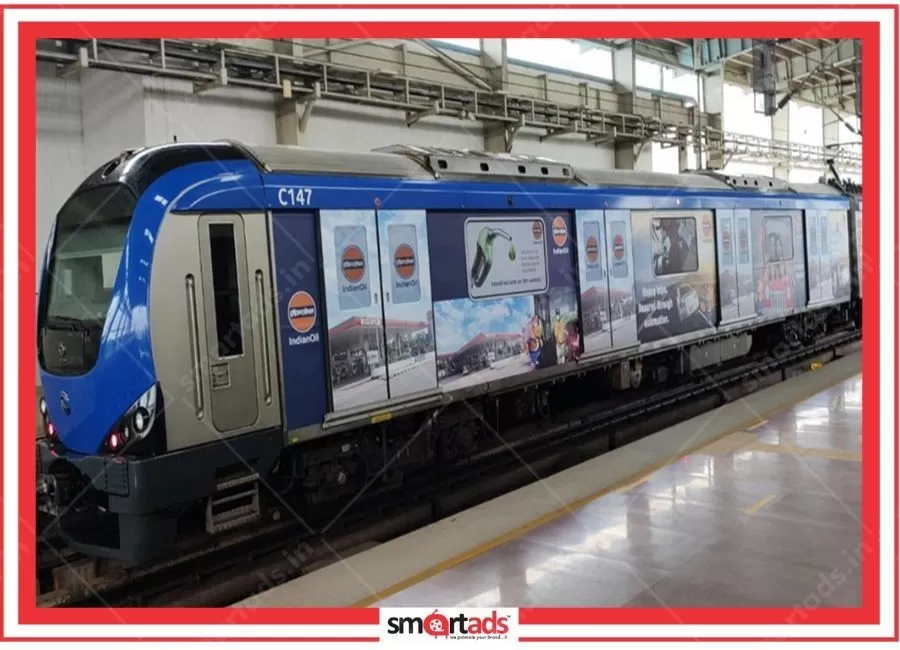
Exterior Metro Wrap
Custom
The advertisement spans the whole train,
Rate per Metro Display Cost / 1 Month
Route : Tirusulam To WIMCO Nagar
₹1000000.00
Showing 1 to 5 of 5 Results
MEDIA DETAILS
Custom
The advertisement spans the whole train,
Rate per Metro Display Cost / 1 Month
Route : Tirusulam To WIMCO Nagar
₹1000000.00
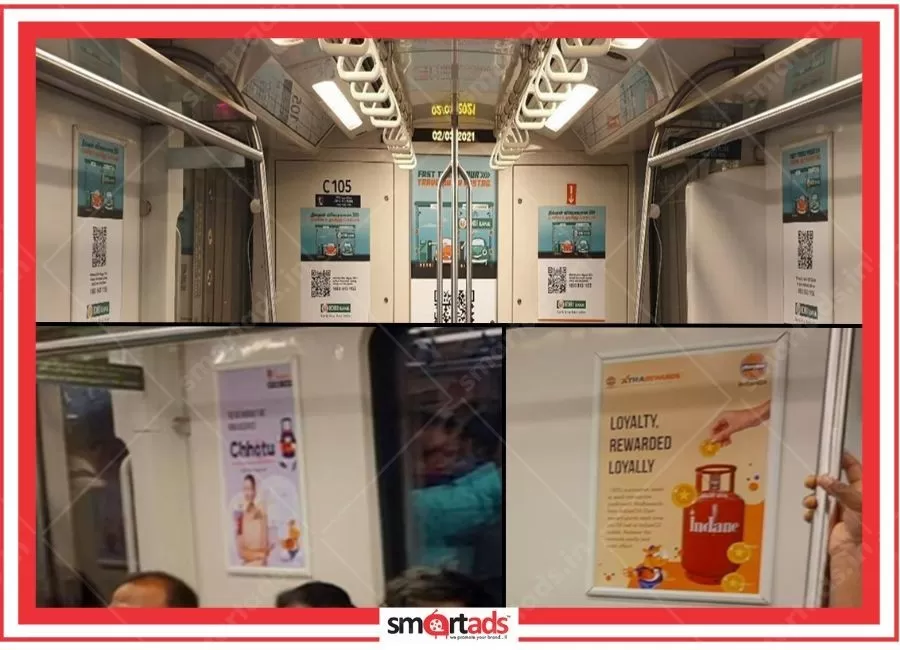
Custom
On the inside of the metro train the adv
Rate per Metro Display Cost / 1 Month
Route : Tirusulam To WIMCO Nagar
₹500000.00
20 Sec Audio
A jingle is a song or a phrase, and the
Rate per Metro Jingle Cost / 1 Month
Route :Tirusulam to WIMCO Nagar
₹400000.00

10 Sec Video
Digital screen on the metro station will
Rate per Metro Digital Display Cost / 1
Route :Tirusulam to WIMCO Nagar
₹600000.00

1 Metro Train
On the outside of the metro train the ad
Rate per Metro Display Cost / 1 Month
Route :Tirusulam to WIMCO Nagar
₹1500000.00
MEDIA REACH

MinimumQty :
1
EstimateReachPeople :
150000000

Kochi Metro's Green Line — running from Aluva in the north all the way down to Thrippunithura in the south — carries somewhere in the ballpark of 70,000 to 90,000 daily commuters on a strong weekday, which makes it one of the most concentrated urban audiences available to any brand operating in Kerala. What surprises most of our clients when they first look at the numbers is not the raw ridership figure itself, but the quality of that audience: salaried professionals, college students, retail shoppers, and tech-sector employees who are captive inside a clean, air-conditioned environment with nothing to do but look at your brand for an average dwell time of 25 to 35 minutes per journey. That is a media opportunity that most traditional OOH advertising — hoardings, bus panels, newspaper inserts — simply cannot replicate, and yet metro train advertising in Kochi Green Line remains dramatically underutilised by brands that should know better.
Frankly speaking, the question we hear most often from brand managers is whether metro advertising in Kochi is "worth it" compared to a hoarding on NH-66 or a newspaper quarter-page in Malayala Manorama. Our answer, after running campaigns across both formats for clients in Kerala, is that the comparison itself is slightly wrong — because metro train advertising on the Kochi Green Line does something that neither of those formats can do, which is hold an audience in physical proximity to your brand for an extended, uninterrupted period. A commuter standing inside a coach from Edapally to MG Road metro station is not scrolling past your ad; they are surrounded by it.
The Green Line corridor passes through some of the most commercially significant zones in Ernakulam district — Kaloor, which is a retail and residential hub; Palarivattom, which is a major junction connecting arterial roads; and Vytila, which functions as the interchange point between the metro and the city's bus network. This geographic concentration means that a brand running metro train advertising in Kochi Green Line is not just reaching commuters — it is reaching people who live, work, shop, and make purchase decisions in the city's most economically active neighbourhoods. The FICCI-EY Media & Entertainment Report has consistently flagged transit advertising as one of the fastest-growing segments within out-of-home advertising in India, and Kochi's metro network sits squarely at the centre of that growth story in Kerala.
At SmartAds, we always tell our clients that the Green Line is not just a transport corridor — it is a 25-kilometre brand experience channel that runs through the economic spine of Kochi. One FMCG brand we worked with, which had previously concentrated its Kerala advertising budget entirely on print and digital, shifted roughly 18 percent of its Kochi allocation to a full coach wrap on the Green Line for a 30-day Onam campaign; the brand recall scores they tracked through post-campaign surveys in the Ernakulam catchment area were nearly double what the print campaign had delivered in the same period. That outcome is not unusual in our experience — it is, if anything, fairly typical of what well-executed transit advertising can achieve when the audience profile matches the brand's target demographic.
The range of ad formats available for metro train advertising in Kochi Green Line is considerably wider than most advertisers initially assume, and the choice of format has a significant bearing on both cost and campaign impact. At the most visible end of the spectrum sits the full train wrap — sometimes called a full train branding or coach wrap — where the entire exterior surface of one or more coaches is covered in a single brand creative, effectively turning the train into a moving billboard that travels the full Aluva to Thrippunithura corridor multiple times a day. This is the format that generates the most street-level impressions, particularly at elevated stations and open-air stretches of the line.
Below the full train wrap, there are several exterior train wrap options that allow for partial coverage — typically the front panel, side panels, or door branding on selected coaches — which work well for brands that want strong visual presence without committing to a full train branding budget. On the interior side, the formats multiply considerably: seat back panels, window panel ads, overhead panels, floor sticker advertising, and door branding on the inside faces of coach doors are all available through KMRL's authorised advertising framework. Digital screen advertising is also present inside the coaches, with screens mounted at both ends of each compartment running a loop of brand content alongside KMRL's own announcements; this format is particularly effective for brands with video assets or animated creatives, since the captive audience has limited alternatives to looking at the screen during the journey.
What a lot of people miss is the station-level inventory that complements train-level formats — platform signage, concourse advertising, entry exit zone branding, and smart card (KMRL card) co-branding are all part of the green line metro advertising ecosystem managed under the KMRL framework. Podhigai Ads holds the exclusive train branding rights for Kochi Metro trains, which means that any agency — including SmartAds — working on train-specific formats coordinates through that framework; station-level inventory, on the other hand, involves other authorised partners. Understanding this distinction before you brief your agency saves a significant amount of time during the booking process, and it is something we walk every new client through at the start of any Kochi metro advertising engagement.
Advertising rates for metro train advertising in Kochi Green Line vary considerably depending on format, duration, and the number of coaches involved, which is why we are always cautious about giving a single number without context. That said, our clients consistently ask for ballpark figures before they can even frame a budget conversation internally, so here is what our experience shows. A full train wrap covering all coaches of a single Kochi Metro train typically runs somewhere between ₹8 lakh and ₹15 lakh per month, depending on the season, the specific train allocated, and whether the creative production cost is bundled into the rate — and Onam season, predictably, pushes rates toward the upper end of that range because demand from FMCG, jewellery, and retail brands spikes sharply.
Partial exterior branding — covering one or two coach sides or the front panel — works out to roughly ₹2 lakh to ₹5 lakh per month, which is a number that makes the format accessible to mid-sized regional brands and even well-funded SMEs who would not be in the conversation for a full train branding campaign. Interior formats are generally more affordable on a per-unit basis; seat back panels, for instance, are available in the ballpark of ₹15,000 to ₹30,000 per coach per month, and window panel ads tend to be priced similarly, which means a brand can achieve meaningful interior coverage across several coaches for a budget that would not even buy a single premium hoarding on Marine Drive. Platform signage and concourse advertising at high-footfall stations like Edapally, MG Road metro station, and Kaloor are priced separately and can range from ₹50,000 to ₹2 lakh per unit per month depending on the format and the station's commercial classification.
The thing is, metro train advertising rates per month are not always what they appear on a rate card, because the real cost-efficiency calculation has to account for the number of impressions delivered across the full Aluva to Thrippunithura run. When we work out the effective CPM for a full train wrap on the Green Line — factoring in daily ridership, the number of times the train completes the corridor in a day, and the street-level visibility at each station — it typically comes out somewhere in the range of ₹6 to ₹12 per thousand impressions, which is genuinely competitive with digital display advertising and far below what you would pay for comparable reach through print. That CPM figure is one we share with clients early in the planning conversation, because it reframes the rate card number entirely.
Not all stations on the Green Line are equal from an advertiser's perspective, and understanding the footfall hierarchy is essential for any brand considering station-level metro station advertising alongside or instead of train-level formats. Edapally station consistently ranks among the highest-footfall stops on the entire network, which is unsurprising given its location at the intersection of the metro line and the NH-66 bypass — it functions as a gateway station for commuters coming from Thrissur, Angamaly, and the airport corridor, and the retail density around the station, anchored by Lulu Mall, makes it a premium location for brands targeting upper-middle-class shoppers.
MG Road metro station occupies a different but equally valuable position in the footfall hierarchy; it serves the commercial heart of Ernakulam, drawing office workers, shoppers visiting the Broadway and MG Road retail strips, and tourists connecting to Fort Kochi and the waterfront. Kaloor station is significant for a different reason — it sits adjacent to the Jawaharlal Nehru International Stadium and the Kaloor commercial district, drawing a younger, more mixed demographic that includes college students from nearby institutions and sports event attendees. Vytila, which functions as the southern interchange hub connecting the metro to KSRTC and private bus services, sees a distinctive commuter profile: people who are mid-journey between the metro and onward destinations, which gives dwell time advertising at that station a slightly different character from a pure metro commuter audience.
Palarivattom station deserves specific mention because it is often underestimated in media plans; it sits at one of Kochi's most congested road junctions, which means that platform signage and entry exit zone branding at Palarivattom is visible not just to metro commuters but also to the significant road-level traffic passing the station structure. Our experience with a retail banking client that ran concourse advertising at Palarivattom alongside interior branding on two coaches showed that the station-level placement drove a measurably higher volume of branch walk-ins from the immediate catchment area than the train-level creative did — which reinforced for us that the station and train formats serve different awareness objectives and work best when planned together rather than as alternatives.
This is, genuinely, one of the most frequent strategic questions we field from clients planning advertising in Kochi metro train campaigns, and the honest answer is that the two formats are solving different problems rather than competing for the same outcome. Exterior train branding — whether a full train wrap or a partial exterior train wrap — is fundamentally a mass awareness play; the moving billboard effect of a wrapped coach travelling between Aluva and Thrippunithura generates street-level impressions at every station, every crossing, and every stretch of elevated track where the train is visible to pedestrians, motorists, and residents. The audience for exterior branding is not limited to metro commuters — it includes everyone who sees the train in motion, which substantially expands the effective reach of the campaign.
Interior branding, on the other hand, is a captive audience format in the most literal sense; the commuter inside the coach is physically enclosed with your creative for the duration of their journey, which on the Green Line averages somewhere between 20 and 40 minutes depending on their boarding and alighting stations. Seat back panels, window panel ads, and overhead panels work on a dwell time advertising logic — repeated exposure to the same creative across multiple journeys over a campaign period builds brand recall in a way that a single-glance hoarding impression cannot replicate. We have found, across multiple campaigns, that interior branding tends to outperform exterior formats on brand recall metrics, while exterior train wrap formats outperform on brand awareness and top-of-mind scores — which suggests that the ideal campaign uses both in combination.
To be fair, budget is a real constraint for many brands, and the choice between interior and exterior often comes down to what the campaign can afford rather than what would be strategically ideal. For brands with a tighter budget, we generally recommend starting with interior formats — specifically seat back panels and window panel ads across two to three coaches — because the cost-per-impression is lower and the recall impact is higher per rupee spent. For brands launching a new product or entering the Kerala market for the first time, the exterior train wrap's mass visibility makes it the stronger opening move, even if it requires a larger upfront commitment.
The ridership profile of the Kochi Metro Green Line is one of the most compelling arguments for transit advertising in this market, and it is a profile that a surprising number of brands have not fully studied before making their media decisions. KMRL's own passenger data, supplemented by independent surveys, consistently shows that the Green Line's daily commuters skew toward the 22-to-45 age bracket, with a significant proportion of salaried employees, IT and ITES professionals, healthcare workers, and students from the city's numerous engineering and management colleges. This is an urban audience with disposable income and active brand engagement — the kind of demographic that digital advertisers pay a premium to reach on social platforms, but which metro train advertising in Kochi Green Line delivers in a physical, high-attention environment.
The corridor's geographic range matters here as well. The northern end of the line, from Aluva through to Edapally, draws commuters from Thrissur and Angamaly who are travelling into the city for work or retail; the central section through Kaloor, Palarivattom, and MG Road metro station concentrates the office-going and commercial audience; and the southern section toward Vytila and Thrippunithura serves a more residential demographic with strong family and household purchasing behaviour. This means that the same train running the full Aluva to Thrippunithura corridor is sequentially passing through three distinct audience micro-segments in a single trip, which gives full train branding campaigns a breadth of audience reach that is genuinely unusual for a single media placement.
On top of that, the Green Line's commuter base has a higher-than-average digital literacy and smartphone penetration rate compared to the general Kerala population, which makes the metro an effective channel for campaigns that combine physical transit advertising with QR-code-driven digital activations or app download drives. We ran a campaign for a fintech client — a digital payments brand targeting Kochi's salaried workforce — that placed interior branding with QR codes on seat back panels across four coaches; the scan-through rate over a 45-day campaign period was substantially higher than the same brand's Instagram story swipe-up rate during the same period, which was a finding that genuinely surprised the client's digital team and reshaped how they thought about below-the-line marketing in urban transit environments.
Below-the-line marketing has always thrived on precision and proximity — the ability to place a brand message in the exact physical space where the target audience is present and receptive — and the Kochi Metro Green Line delivers both of those qualities in a format that most traditional OOH advertising cannot match. Transit advertising on the Green Line is, by its nature, non-traditional advertising in the sense that it operates outside the standard media buying categories of print, television, radio, and digital; it occupies a distinct space in the media mix that combines the mass reach of out-of-home advertising with the audience specificity of hyperlocal advertising, which is a combination that brand managers find increasingly difficult to achieve through conventional channels.
The BTL advertising logic of the metro is particularly strong for categories like banking and financial services, retail, real estate, education, healthcare, and consumer electronics — all of which have significant customer bases among Kochi's daily commuters. We have seen this work most effectively when the transit media placement is part of a multi-touchpoint campaign that also includes digital retargeting and on-ground activations at key stations; the metro branding creates the initial awareness impression, and the digital layer captures the audience again after they have left the train. This kind of integrated BTL advertising approach is something we design routinely for clients who want to maximise return on investment from their Kochi metro advertising spend.
The Green Line also offers something that most other non-traditional advertising formats in Kerala cannot — a guaranteed, measurable audience. Ridership data from KMRL is publicly reported and independently verifiable, which means that the reach figures used in media planning are not estimates or panel projections but actual passenger counts. For brand managers who are accountable to management for ROI justification on every media rupee, that verifiability is a significant advantage over formats like hoardings or transit shelters, where impression estimates are inherently approximate. The GroupM TYNY Report and Dentsu e4m Report have both flagged transit media's measurability as a key driver of its growing share in Indian advertisers' OOH budgets, and our experience in Kochi confirms that trend at the local level.
The booking process for metro train advertising in Kochi Green Line is more structured than most advertisers expect, primarily because Kochi Metro Rail Limited operates through an authorised concession framework rather than allowing direct open-market advertising sales. Podhigai Ads holds the exclusive train branding rights for KMRL's train exteriors and interiors, which means that all train-specific formats — full train wrap, partial exterior train wrap, interior branding, door branding, and coach wrap campaigns — are routed through their framework. Agencies like SmartAds work within this structure to plan, book, and execute campaigns on behalf of clients, handling the brief-to-execution process end-to-end so that the client does not need to navigate the concession framework directly.
The practical booking timeline for a metro train advertising campaign on the Green Line typically runs somewhere between 3 and 6 weeks from brief to launch, depending on the format and the creative production complexity. The process begins with a campaign brief that specifies the format, the duration, the target audience, and the budget range; this is followed by a media plan and rate proposal, creative approval by KMRL (which has specific guidelines around content, size, and material), production of the physical creative (vinyl wraps, printed panels, or digital assets), installation during a scheduled maintenance window, and finally campaign go-live. Creative approval is the step that most first-time advertisers underestimate — KMRL's compliance review can take 5 to 10 working days, and creatives that do not meet the guidelines are sent back for revision, which can delay the launch significantly if the timeline has not accounted for it.
At SmartAds, we manage the entire booking and compliance process for our clients, which is particularly valuable for brands that are new to transit media or to the Kerala advertising market. Our experience with KMRL's creative guidelines means that we brief the design team with the compliance requirements built in from the start, rather than discovering issues at the approval stage. For brands considering a campaign ahead of a major Kerala festival — Onam, Vishu, or Christmas — we strongly recommend initiating the booking process at least 8 weeks before the intended launch date, because train inventory fills up quickly in the October and April windows and KMRL's installation slots are limited.
KMRL's advertising guidelines are more detailed than those of most Indian metro systems, which reflects the organisation's strong emphasis on brand consistency and passenger experience — and frankly, that is a good thing for advertisers, because it means the inventory is well-maintained and the visual environment inside the trains is not cluttered or degraded. The core compliance requirements cover creative content (no political messaging, no content that could be construed as objectionable or divisive, no competitive comparative advertising), material specifications (vinyl wraps must meet specific thickness and adhesion standards to protect the train's exterior finish), and installation protocols (all installation must be carried out by KMRL-approved contractors during designated maintenance windows, typically between midnight and 4 AM).
For interior formats, the size and placement specifications are strictly defined — seat back panels, for instance, must fit within the standard panel dimensions of the coach's seat design, and any deviation requires a specific approval. Window panel ads must use perforated vinyl that maintains passenger visibility from inside the coach, which is a requirement that catches some advertisers off guard when they first encounter it; a solid opaque window graphic is not permitted under KMRL's guidelines, regardless of how visually impactful it might be. Digital screen content must be submitted in specific file formats and aspect ratios, and the content loop must include a minimum proportion of non-advertising content (KMRL announcements and public information), which affects the actual airtime available to brand content.
The thing is, these guidelines exist not to make the advertiser's life difficult but to protect the passenger experience that makes the metro a premium advertising environment in the first place; a poorly maintained or visually cluttered train is a worse advertising vehicle for every brand on it, not just the one whose creative is peeling at the edges. Our team at SmartAds has worked through enough KMRL compliance cycles to know exactly where the common pitfalls are, and we build those checks into the production brief so that the creative arrives at the approval stage already compliant. Brands that try to manage this process without an experienced metro branding agency in the loop frequently find themselves either delaying their campaign or compromising on creative quality to meet the compliance requirements under time pressure.
This is a comparison that comes up in almost every media planning conversation we have for Kerala campaigns, and the answer is more nuanced than a simple "metro is better" or "hoardings are cheaper" conclusion. OOH advertising on hoardings along NH-66, Seaport-Airport Road, or the Ernakulam town centre offers very high street-level visibility and is available at rates that, on a per-unit basis, are lower than a full train branding campaign on the Green Line; a large-format hoarding in a prime Kochi location might cost somewhere in the range of ₹1.5 lakh to ₹4 lakh per month, which is less than a full train wrap. However, the hoarding's audience is in motion — typically at 40 to 60 kilometres per hour — and the effective exposure time per impression is measured in seconds rather than the 25-to-35-minute dwell time that metro train advertising in Kochi Green Line delivers.
Bus advertising in Kerala, managed through KSRTC and private operators, offers wide geographic reach across the state and is genuinely cost-effective for brands that need to cover smaller towns and rural markets alongside urban centres; a bus panel campaign covering Ernakulam district can be executed for a fraction of the cost of a metro train advertising campaign. The trade-off is audience quality and environment — KSRTC buses serve a broader and more economically diverse ridership than the metro, and the advertising environment inside and outside the buses is significantly less controlled than KMRL's premium transit environment. For brands targeting the specific urban professional and upper-middle-class demographic that the Green Line concentrates, bus advertising is a complement rather than a substitute.
To be honest, the most effective campaigns we have planned for Kerala clients use metro train advertising on the Kochi Green Line as the premium anchor placement — delivering high-quality impressions to the core urban audience — and then extend reach through a combination of hoardings for mass street-level visibility and digital targeting for retargeting and conversion. The Kochi Water Metro, which KMRL also operates on the backwaters connecting Fort Kochi and Vypeen Island, offers an additional transit advertising channel that reaches a somewhat different audience (tourists, Fort Kochi residents, and waterfront commuters); combining Green Line metro advertising with Water Metro placements creates a transit media package that covers the full geographic and demographic spread of the Kochi urban agglomeration in a way that no single format can achieve alone.
The decision between a full train branding campaign and a partial exterior train wrap is, at its core, a question of how much visual dominance a brand needs to achieve its campaign objective — and the answer to that question depends on factors that go beyond budget alone. A full train wrap on the Kochi Metro Green Line turns the entire train into a moving brand statement; every coach, every surface, every door panel carries the campaign creative, which means that anyone who sees the train at any point along the Aluva to Thrippunithura corridor receives a complete, unambiguous brand impression. This is the format of choice for product launches, major brand campaigns, and seasonal pushes where the objective is maximum impact in a compressed timeframe.
Partial exterior branding — covering one or two coach sides, the front panel, or door branding on selected coaches — achieves a meaningful presence at a lower cost, and it can be highly effective when the creative is designed specifically for the partial format rather than adapted from a full wrap concept. The front panel of a metro coach, for instance, is the first thing a commuter on the platform sees as the train arrives; a well-designed front panel creative with a strong headline and visual can generate significant brand recall even without the full train wrap's comprehensive coverage. We have run partial exterior campaigns for clients in the ₹2 lakh to ₹4 lakh per month range that delivered brand visibility metrics comparable to what full wraps achieved at two to three times the budget, simply because the creative was designed to work within the partial format's constraints rather than fighting against them.
The coach wrap — which typically refers to a single coach fully wrapped, rather than the entire train — sits between these two options and represents what we consider the sweet spot for most mid-sized brands entering metro train advertising in Kochi for the first time. A single coach wrap gives the brand a complete, high-impact visual presence on one unit of the train while keeping the cost in a range that allows for a longer campaign duration; a 60-day single coach wrap often delivers better overall brand recall than a 15-day full train wrap at a similar total budget, because the repeated exposure effect of transit advertising compounds over time. This is a planning insight that we share early in every metro branding conversation, because most clients arrive with the assumption that bigger and shorter is always better — which is not what the data from our campaigns shows.
Campaign duration on the Kochi Metro Green Line is one of the variables that most significantly affects both cost and effectiveness, and the minimum booking period for most train-level formats is 30 days — which is KMRL's standard minimum term for exterior and interior train branding. That said, our experience strongly suggests that 30 days is the floor, not the optimal duration; the compounding recall effect of transit advertising means that a 45-to-90-day campaign delivers disproportionately higher brand recall per rupee spent compared to a 30-day campaign, because the commuter audience that sees the creative repeatedly over a longer period builds a stronger and more durable brand association.
For seasonal campaigns tied to Kerala's major festival calendar — Onam in August-September, Vishu in April, Christmas in December — the 30-to-45-day window around the festival period is the standard planning horizon, and these windows are also the most competitive for inventory. Brands that plan their Onam campaigns in June rather than July consistently get better train allocation, better installation slots, and occasionally better rates, because the demand spike has not yet hit the market. We have seen clients who came to us in late August for an Onam campaign find that the best train inventory was already committed, which is a frustrating situation that is entirely avoidable with earlier planning.
For brands running brand awareness campaigns rather than seasonal activations, a 90-day campaign duration is what we typically recommend as the starting point for meaningful brand recall impact among the Green Line's regular commuter base. The daily commuter — someone who takes the metro to work five days a week — will see a train-level creative roughly 40 to 60 times over a 90-day period, which is a frequency of exposure that builds genuine top-of-mind awareness in a way that most other single media placements cannot achieve. This is the dwell time advertising logic applied at the campaign level rather than the individual journey level, and it is one of the most compelling arguments for transit media as a brand-building channel in a market like Kochi.
The category mix of brands that have used metro train advertising in Kochi Green Line reflects the Green Line's audience profile almost perfectly — financial services brands (banks, insurance companies, fintech apps), real estate developers targeting Kochi's growing professional class, educational institutions (engineering colleges, MBA programmes, coaching centres), retail chains and shopping malls, healthcare providers, and consumer electronics brands have all been consistent users of the format. Jewellery brands, particularly during Onam and Akshaya Tritiya, have been among the most visually prominent advertisers on the Green Line's exterior train wrap inventory, which makes sense given that Kochi's gold and diamond jewellery retail market is one of the most competitive in India.
One automotive brand we worked with — a two-wheeler manufacturer launching a new commuter-segment model in Kerala — used a full train wrap on the Green Line for 45 days, timed to coincide with the model's Kerala launch event. The campaign creative was designed specifically for the train format, with the model's side profile running the full length of the coach exterior in a way that made the train itself look like the vehicle in motion; the brand's dealer network in Ernakulam reported a 34 percent increase in showroom walk-ins during the campaign period compared to the equivalent period in the previous year, which the brand attributed in significant part to the metro campaign's visibility among the commuter demographic that matched the model's target buyer profile.
A retail pharmacy chain that we helped plan a multi-touchpoint campaign for on the Green Line took a different approach — rather than a single high-impact exterior format, they combined interior branding across six coaches (seat back panels and overhead panels) with concourse advertising at Edapally, Kaloor, and MG Road metro stations, creating a campaign that touched commuters both inside the train and at the station level. The campaign ran for 60 days and was specifically designed to drive footfall to the chain's stores located within 500 metres of those three stations; the store managers reported a measurable uplift in new customer registrations during the campaign period, and the chain subsequently made metro station advertising a standard component of its annual Kerala media plan. That kind of outcome — where transit advertising drives directly measurable commercial results rather than just awareness metrics — is what makes metro train advertising in Kochi Green Line genuinely interesting for performance-oriented brand managers.
The upcoming Phase 2 expansion of Kochi Metro — the Pink Line running from JLN Stadium southward to Infopark in Kakkanad — is a development that forward-thinking advertisers should be factoring into their medium-term media planning now, even though the line is not yet operational. The Kakkanad-Infopark corridor is home to one of Kerala's largest concentrations of IT and ITES companies, including the Infopark campus which houses dozens of technology firms and employs tens of thousands of professionals; when the Pink Line opens, it will connect this tech-sector workforce directly to the Green Line network at JLN Stadium station, substantially expanding the total ridership of the Kochi Metro system and adding a high-income, digitally sophisticated audience segment to the transit advertising universe.
For brands targeting IT professionals, software engineers, and the broader tech-sector demographic in Kochi, the phase 2 Pink Line represents a pre-booking opportunity that is worth exploring now — KMRL's advertising framework typically allows for advance commitments on new inventory ahead of line openings, and brands that establish a presence on the network early tend to benefit from lower introductory rates and stronger inventory selection before demand from other advertisers catches up. The connection between the Pink Line and the existing Green Line at JLN Stadium also creates an interesting multi-line advertising opportunity, where a brand can maintain presence across both corridors simultaneously and reach commuters who transfer between the lines at the interchange station.
At SmartAds, we have already begun advising clients in the technology, financial services, and premium consumer goods categories to think about Phase 2 in their 2025-2026 media planning cycles. The Infopark catchment is a distinct audience from the Green Line's current commuter base in important ways — it skews younger, has higher average household income, and has a stronger propensity for digital brand engagement — and the transit advertising formats that work best for that audience may differ from what performs on the current Green Line. Getting ahead of that planning curve, rather than scrambling to book inventory after the line opens and demand spikes, is the kind of strategic advantage that separates effective media planning from reactive media buying.
Q: What is metro train advertising on the Kochi Green Line?
Metro train advertising on the Kochi Green Line refers to brand placements on the exterior and interior surfaces of Kochi Metro Rail Limited's trains operating on the Green Line corridor between Aluva and Thrippunithura. This includes full train wraps, partial exterior branding, coach wraps, interior formats like seat back panels and window panel ads, door branding, and digital screen advertising inside the coaches. The Green Line is Kochi's primary operational metro corridor, running approximately 25 kilometres through the commercial and residential heart of Ernakulam district, and it carries a daily ridership that makes it one of the most concentrated urban advertising environments in Kerala. Unlike static OOH formats, metro train advertising combines the mass visibility of a moving billboard with the captive audience dwell time of an enclosed environment, which is a combination that most other media formats in the Kerala market cannot replicate.
Q: How much does metro train advertising on Kochi Green Line cost per month?
The cost of metro train advertising in Kochi Green Line varies significantly by format. A full train wrap — covering all coaches of a single train — typically runs somewhere in the range of ₹8 lakh to ₹15 lakh per month, with rates at the higher end during peak festival seasons like Onam. A partial exterior train wrap or single coach wrap is more accessible, working out to roughly ₹2 lakh to ₹5 lakh per month depending on the coverage and the specific train allocated. Interior formats like seat back panels and window panel ads are priced in the ballpark of ₹15,000 to ₹30,000 per coach per month, making interior branding across multiple coaches achievable for brands with budgets in the ₹1 lakh to ₹3 lakh range. Platform signage and concourse advertising at high-footfall stations like Edapally and MG Road metro station are priced separately, typically between ₹50,000 and ₹2 lakh per unit per month. Production costs for vinyl wraps and printed panels are generally additional to the media rate and should be budgeted separately.
**Q:
