
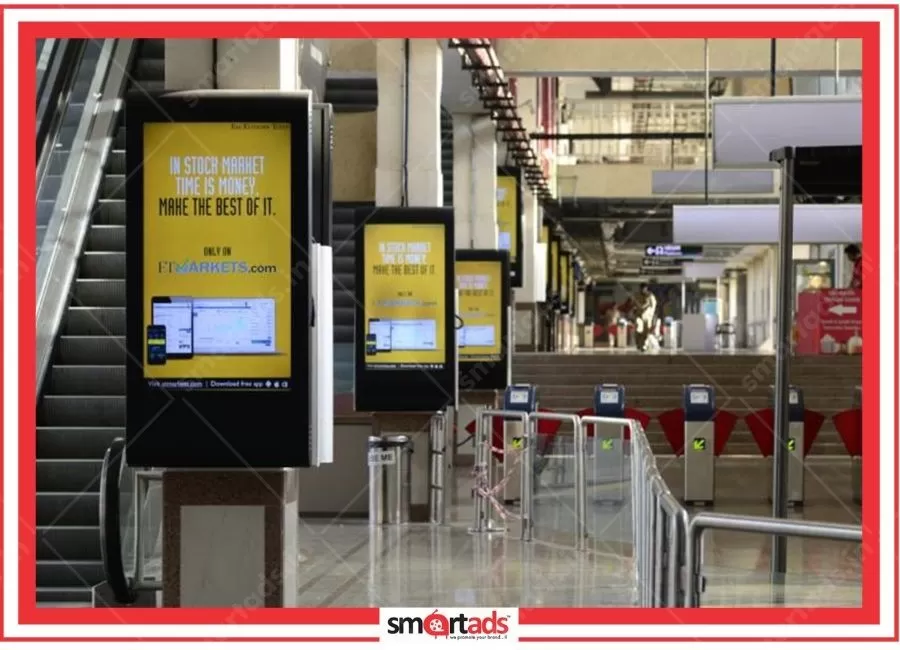
Entry Exit Panel
8 ft x 4 ft
Bright and vibrant multicolored letterin
Rate per Panel / Month
Min Requirement is 3 Panel.
₹48000.00
Showing 1 to 4 of 4 Results
MEDIA DETAILS
8 ft x 4 ft
Bright and vibrant multicolored letterin
Rate per Panel / Month
Min Requirement is 3 Panel.
₹48000.00
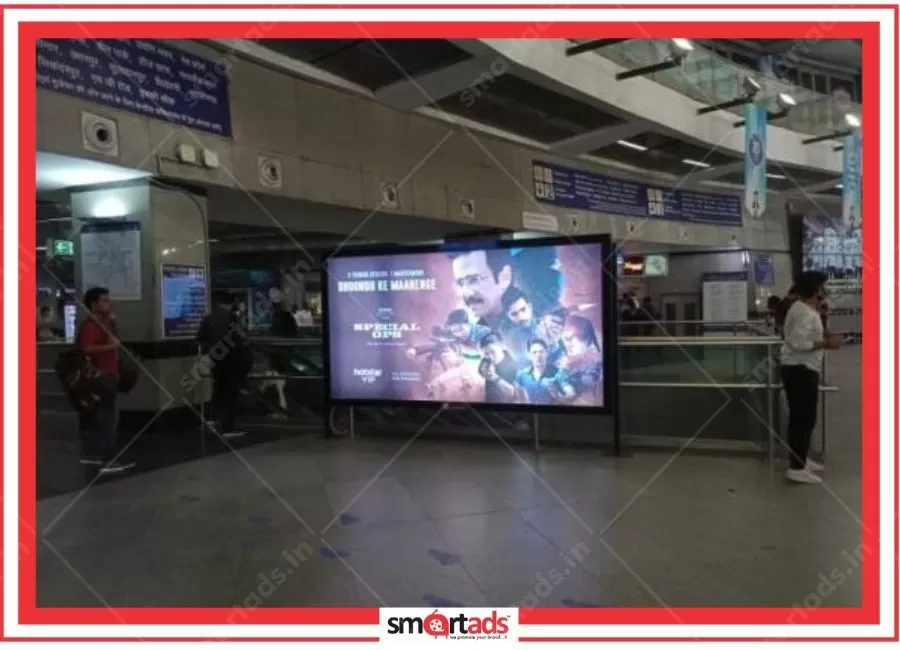
10 ft x 5 ft
A new wide wall system designed to accom
Rate per Panel / Month
Min Requirement is 3 Panel.
₹50000.00
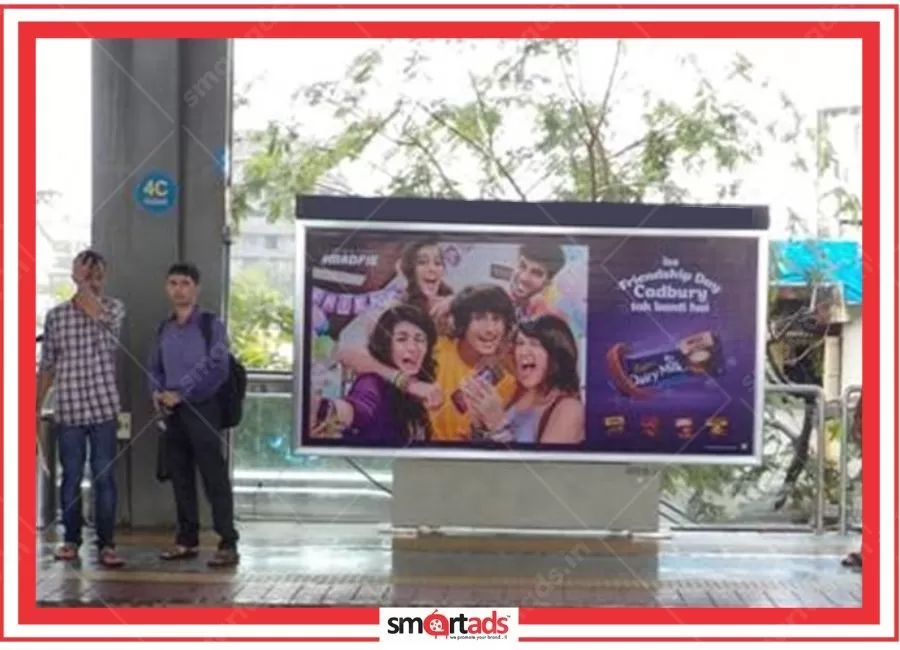
8 ft x 4 ft
A raised flooring or other horizontal su
Rate per Panel / Month
Min Requirement is 3 Panel.
₹35000.00
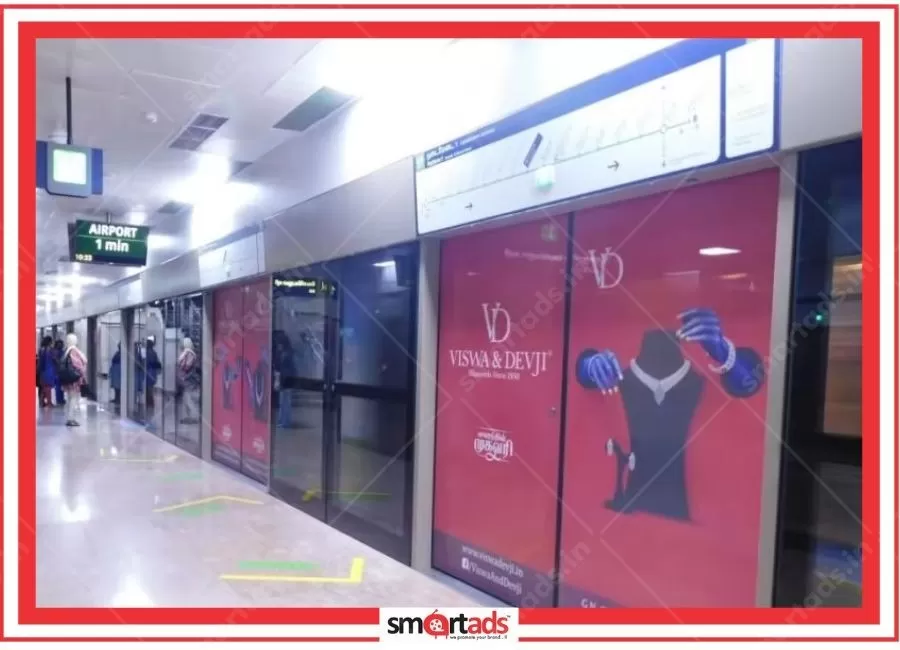
7 ft x 4 ft
Also known as platform edge doors (PEDs)
Rate per Plateform / Month
Min Requirement is 1 Stations.
₹1200000.00
MEDIA REACH

MinimumQty :
10
EstimateReachPeople :
15 Million
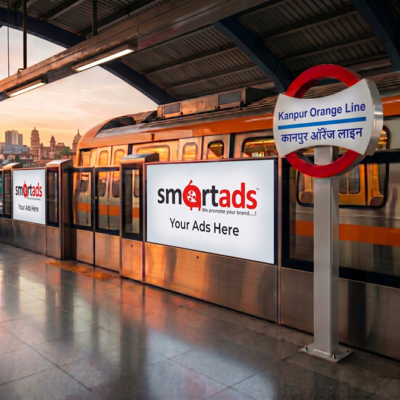
Kanpur Metro's Orange Line quietly crossed a milestone that most advertisers in Uttar Pradesh have not yet fully processed — the corridor now connects IIT Kanpur to Kanpur Central across 14 operational stations, carrying daily footfall figures that rival established metro markets in Lucknow and Jaipur. What surprises most brand managers we speak to is not the reach itself, but the quality of that reach: a captive audience of daily commuters who spend anywhere between eight and twenty-five minutes inside a station environment, with no scroll button to escape your message.
At SmartAds, we have been tracking the Kanpur Metro advertising inventory since the first phase of Corridor-1 went operational, and frankly speaking, the gap between what this medium offers and what most brands are currently spending on it is one of the more interesting inefficiencies we have seen in the Uttar Pradesh OOH market in recent years.
Kanpur is not a tier-2 city in any meaningful advertising sense — it is the largest city in Uttar Pradesh by population, a major industrial and commercial hub, and home to one of India's most prestigious technical institutions. The Orange Line, which runs as Corridor-1 under the Uttar Pradesh Metro Rail Corporation, cuts through the economic spine of the city, connecting the academic belt around IIT Kanpur in the west to the dense commercial and transit hub around Kanpur Central in the east. That geographic sweep means a single metro advertising campaign on this corridor reaches students, faculty, white-collar professionals, shoppers, railway passengers, and daily office commuters — often within the same station dwell window.
What a lot of people miss is that metro advertising in Kanpur operates on a fundamentally different attention economy than roadside hoardings or newspaper inserts. When a commuter is standing on a platform waiting for a train, or seated inside a coach, there is very little competing for their attention; the environment is controlled, the lighting is consistent, and the brand message — whether it is a wall wrap, a pillar branding unit, or a digital screen — commands a share of mind that outdoor formats simply cannot replicate. The GroupM TYNY Report and successive FICCI-EY Media & Entertainment reports have consistently flagged transit OOH advertising as among the fastest-growing segments within out-of-home advertising in India, and the Kanpur Metro Orange Line represents one of the more underpriced entry points into that segment right now.
Our experience at SmartAds shows that brands which commit to orange line metro advertising for a minimum of three months — rather than the one-month test campaigns that many first-timers book — see brand recall scores that are typically two to three times higher than equivalent spends on static roadside billboards in Kanpur. The reason is repeated exposure: a daily commuter who takes the same route five days a week will encounter your panel branding or concourse advertising somewhere between twenty and twenty-two times in a single month, which is a frequency level that most media planners struggle to achieve with any other single format in this market.
The Orange Line, which is formally designated as Corridor-1 by UPMRC, currently operates across fourteen stations that span roughly twenty-three kilometres of track. Understanding the station-by-station geography is essential before any media plan is finalised, because the audience profile, footfall intensity, and available ad formats vary considerably from one end of the corridor to the other.
Starting from the western terminus, IIT Kanpur metro station serves the academic catchment of IIT Kanpur, one of the country's premier engineering institutions, along with residential areas in the surrounding zone. Moving east, the corridor passes through Kalyanpur, Gurudev Chauraha, Vishwavidyalaya, Geeta Nagar, Rawatpur, Govind Nagar, Shyam Nagar, Juhi, Kanpur Central, Nayaganj, Naveen Market, Bada Chauraha, Chunniganj, and Moti Jheel, with Naubasta planned as a future extension point. The stations from Kanpur Central inward — including Nayaganj, Naveen Market, Bada Chauraha, and Chunniganj — are underground stations, which creates a distinctly different advertising environment from the elevated metro stations on the western stretch; underground stations have higher dwell time, more controlled lighting, and a greater density of captive audience moments, which makes them particularly valuable for interior branding and digital screen advertising.
At SmartAds, we always tell our clients that the underground stations on the Kanpur Metro Orange Line deserve a premium weighting in any media plan, not because the footfall is necessarily higher at every individual station, but because the environment is more immersive — there is nowhere else for a commuter's eye to travel. A retail client we worked with in the Naveen Market catchment ran a three-month concourse advertising campaign across the underground stations, and the in-store traffic attribution data they shared with us suggested a measurable uplift in footfall from metro-adjacent residential areas that had previously been underperforming for them.
Kanpur Central metro station is, by a significant margin, the highest-footfall point on the entire Orange Line; this is almost self-evident given that Kanpur Central railway station is one of the busiest rail junctions in northern India, handling hundreds of trains daily and serving millions of passengers annually. The metro station sits adjacent to this interchange, which means the advertising audience at Kanpur Central includes not just regular metro commuters but also railway passengers, visitors to the city, and the dense commercial traffic from the surrounding market areas — a combination that makes Kanpur Central metro station arguably the single most valuable advertising location in the city for brands seeking mass reach.
IIT Kanpur metro station, on the other hand, offers something qualitatively different: a highly educated, technically literate audience that skews younger, with a significant proportion of students, researchers, faculty, and the professional services ecosystem that has grown around the institution. For brands in the edtech, financial services, consumer electronics, and career development categories, the audience targeting precision available at IIT Kanpur station is genuinely difficult to replicate through any other single OOH format in Kanpur. The footfall at this station is lower in absolute numbers than at Kanpur Central, but the audience quality — in terms of purchasing intent, digital literacy, and lifetime value — is exceptionally high.
Stations like Chunniganj, Bada Chauraha, and Naveen Market serve the dense commercial and retail belt of central Kanpur, where footfall is driven by shoppers, traders, and the working population of the city's oldest commercial districts. Moti Jheel, which sits near one of Kanpur's most recognised public spaces, draws a more mixed demographic that includes families and leisure visitors alongside daily commuters. For brands planning station-specific buys rather than line-wide campaigns, we recommend treating these mid-corridor stations as the workhorse of a Kanpur Metro advertising plan — high footfall, diverse audience, and strong brand visibility during peak hours.
The inventory of ad formats available across the Kanpur Metro Orange Line is considerably more varied than most brand managers assume when they first approach metro advertising in Kanpur. UPMRC, which manages advertising rights for Corridor-1 as part of its non-fare box revenue strategy, has structured the inventory to accommodate everything from small-format panel branding to full-station co-branding and metro train advertising.
Platform advertising is the most commonly booked format, encompassing backlit panels, wall wraps, and pillar branding units positioned along the platform edge where commuters stand while waiting for trains. These formats benefit directly from dwell time — the average wait between trains on the Orange Line runs somewhere between four and eight minutes during peak hours, which is a sustained attention window that most roadside OOH formats never achieve. Concourse advertising covers the entry, exit, and ticketing zones of each station, which are high-traffic chokepoints where every commuter passes through at least twice per journey; wall wrap and panel branding in these zones deliver the highest frequency of exposure per campaign. Interior branding inside the train coaches — including overhead panels, door panels, and seat-back advertising — reaches commuters during the journey itself, which is where dwell time is longest and the environment is most controlled.
Digital screens and LED screen advertising are available at select stations on the Orange Line, and this is where the medium starts to intersect with what the industry is beginning to call programmatic DOOH — the ability to schedule, rotate, and target creative executions by time of day and audience context. DOOH inventory on the Kanpur Metro is still developing relative to more mature metro systems, but the direction of travel is clear; the FICCI-EY Media & Entertainment Report has consistently highlighted digital out-of-home advertising as the fastest-growing sub-segment of OOH in India, and UPMRC has been progressively upgrading its digital screen infrastructure across Corridor-1 stations. For brands that want to run time-sensitive creative — a morning commute message different from an evening one, for instance — the digital screen advertising options at key stations like Kanpur Central and Chunniganj are worth prioritising.
Metro train advertising on the Orange Line takes two primary forms: the full train wrap, which covers the exterior of an entire rake in brand creative and is arguably the most dramatic OOH format available in Kanpur, and the partial exterior branding option that covers specific panels on individual coaches. A full train wrap on the Kanpur Metro Orange Line essentially turns the train itself into a moving billboard that travels the entire twenty-three-kilometre corridor multiple times a day, delivering brand visibility not just inside stations but to the hundreds of thousands of people who see the train at elevated sections, road crossings, and station approaches. One automotive brand we worked with used a full train wrap on the Orange Line timed to their new model launch, and the combination of the exterior branding with interior branding inside the same rake created a brand immersion effect that their own tracking study rated significantly higher than any previous single-format OOH campaign they had run in Uttar Pradesh.
Pricing transparency is, frankly speaking, one of the biggest gaps in the publicly available information about metro advertising in Kanpur — and it is a gap that causes genuine frustration for brand managers trying to build a media plan without a starting point. What we can share from our experience at SmartAds is a realistic picture of the rate bands that apply to Orange Line advertising, with the caveat that UPMRC advertising rates are subject to tender cycles and MAG-based contract structures that mean the final cost depends on the specific format, station, duration, and negotiated terms.
For standard panel branding at a mid-corridor station, the monthly cost works out to somewhere in the ballpark of ₹15,000 to ₹40,000 per panel depending on size, location, and whether the panel is illuminated; at premium stations like Kanpur Central or Chunniganj, the rates are higher, often running between ₹40,000 and ₹80,000 per panel per month for high-visibility positions. Concourse advertising and wall wrap formats at underground stations command a premium over platform advertising, which reflects both the higher dwell time and the more immersive environment; a full concourse wrap at an underground station can range from roughly ₹1.5 lakh to ₹4 lakh per month depending on the station and the coverage area. Metro train advertising — particularly a full train wrap — sits in a different pricing tier entirely, with costs that can range from approximately ₹8 lakh to ₹20 lakh per month for a full rake wrap, which sounds significant until you calculate the effective CPM against the daily commuter reach and the additional visibility from people who see the train externally.
The Minimum Annual Guarantee framework, which is the MAG structure under which UPMRC licenses advertising rights to concessionaires, means that the most competitive rates are typically available to advertisers who commit to annual contracts or multi-station buys rather than single-station monthly bookings. What we tell our clients is that the advertising ROI on a twelve-month metro advertising commitment in Kanpur, when calculated against the frequency and quality of audience exposure, is typically more favourable than an equivalent annual spend spread across multiple short-duration roadside hoarding bookings. The metro advertising cost per effective reach is, in our experience, one of the better values available in the Kanpur OOH market right now — particularly for brands targeting the educated, urban, middle-income commuter segment.
The audience profile on the Kanpur Metro Orange Line is more nuanced than a simple demographic summary would suggest, and getting this wrong is where a lot of brands end up misallocating their metro advertising budget. The western end of the corridor — IIT Kanpur station through to Kalyanpur and Gurudev Chauraha — skews heavily toward students, academics, and the professional class associated with the educational and research institutions in that zone; this is an audience that is digitally native, brand-aware, and disproportionately influential in household purchase decisions relative to its size.
As the corridor moves east through Govind Nagar, Shyam Nagar, and Juhi, the audience broadens to include a larger share of white-collar office workers, small business owners, and middle-income families who have adopted the metro as their primary commute mode; this is the core daily commuters segment that delivers the frequency and repeated exposure numbers that make metro branding so effective for brand recall. The commercial stations — Kanpur Central, Naveen Market, Bada Chauraha, Chunniganj — add a layer of retail shoppers, traders, and transit passengers to the mix, which expands the total addressable audience but also means that creative messaging needs to work harder to cut through in a higher-stimulation environment.
What our audience targeting experience on the Kanpur Metro has taught us is that the most effective campaigns are those which treat the Orange Line not as a single homogeneous audience but as a corridor with distinct audience zones — and then build creative and format strategies that are calibrated to each zone. A financial services brand, for instance, might weight its budget toward IIT Kanpur station and Vishwavidyalaya for the student and young professional audience, while a consumer goods brand seeking mass reach would concentrate on Kanpur Central and the underground commercial stations. This kind of hyperlocal advertising thinking within a single metro line is something that most generic OOH plans miss entirely.
The booking process for metro station advertising in Kanpur operates through UPMRC's formal licensing and tender framework, which is more structured than the direct negotiation model that most brands are used to from roadside hoarding or mall advertising. UPMRC periodically floats tenders for advertising rights across Corridor-1 stations through the government e-procurement portal at etenders.gov.in, and the primary concessionaire who wins these tenders then sub-licenses individual formats and stations to advertisers and agencies.
For brand managers who want to book advertising on the Kanpur Metro Orange Line without going through the full tender process themselves, the practical route is to work through an authorised metro advertising agency that holds or has access to inventory under the current UPMRC concession. At SmartAds, we maintain active relationships with the licensed concessionaires for Kanpur Metro advertising, which means we can provide clients with direct access to available inventory, current rate cards, and campaign booking timelines without the delays that typically accompany cold approaches to the UPMRC system. The advertising booking process typically involves a creative brief, format selection, station selection, duration confirmation, and artwork submission — with UPMRC requiring creative approval before any material is installed at a station.
The artwork submission and approval process is one of the steps that most first-time metro advertisers underestimate in terms of lead time; UPMRC's advertising guidelines require that all creative materials meet specific size, resolution, and content standards, and the approval cycle can take anywhere from one to three weeks depending on the complexity of the format and the volume of concurrent approvals in the system. Our strong advice to any brand planning a metro advertising campaign in Kanpur is to build at least three to four weeks of pre-campaign lead time into the plan — factoring in creative development, UPMRC approval, and material production — rather than assuming the booking-to-installation timeline will mirror the faster turnarounds available in traditional OOH.
Station co-branding and semi-naming rights represent the premium end of the metro advertising inventory on the Kanpur Orange Line, and they are formats that most brands have not seriously evaluated — partly because the information about what is available and at what cost is not easily accessible in the public domain. Under the UPMRC non-fare box revenue framework, select stations on Corridor-1 are available for co-branding arrangements in which a brand's name or identity is associated with the station name in all official communications, signage, and announcements; this is distinct from full naming rights (which would replace the station name entirely) and represents a brand integration opportunity that delivers sustained, repeated brand recall across every mention of that station.
The value of semi-naming rights on a high-footfall station like Kanpur Central or Chunniganj is, frankly, difficult to quantify using standard OOH metrics — because the brand impression is not just visual but also auditory, delivered through PA announcements inside trains and on platforms every time a train approaches that station. For a brand that is specifically targeting the catchment area around a particular station, this level of brand integration creates an association between the brand and a specific geographic identity that no panel or wall wrap can replicate. The cost of co-branding arrangements on Kanpur Metro stations is typically structured as an annual contract with a significant minimum commitment, and the rates are negotiated directly with UPMRC through a formal proposal process.
Inside advertising rights — which cover the interior of train coaches across the entire Orange Line fleet — are another premium format that UPMRC licenses on a line-wide basis rather than station by station; this means that a brand which secures inside advertising rights gets exposure across every journey on Corridor-1, delivering interior branding to every commuter on every train throughout the contract period. We have seen this format work particularly well for brands in the insurance, banking, and education categories, where the longer dwell time inside the coach allows for more detailed messaging than a platform glance permits.
The comparison between metro station advertising on the Kanpur Orange Line and conventional billboard or hoarding advertising in Kanpur is one that comes up in almost every media planning conversation we have with clients in this market — and the answer is more nuanced than a simple cost-per-impression calculation would suggest. Roadside hoardings in Kanpur, particularly on high-traffic corridors like GT Road, Mall Road, and the Kanpur-Lucknow Expressway approach, offer very high raw impression numbers because of the volume of vehicular traffic; but the average viewing time for a roadside hoarding is measured in seconds, the audience is moving at speed, and there is no guarantee that the driver or passenger is actually attending to the message rather than the road.
Metro station advertising, by contrast, operates in an environment where the audience is stationary, the viewing distance is controlled, and the dwell time is measured in minutes rather than seconds; a commuter standing on a platform at Nayaganj or Bada Chauraha for six minutes is genuinely exposed to your brand message in a way that a driver passing a hoarding at sixty kilometres per hour simply is not. The CPM for a well-placed panel branding unit at a high-footfall Orange Line station works out to a figure that is broadly comparable to a mid-tier roadside hoarding in Kanpur — somewhere in the range of ₹6 to ₹15 per impression depending on the format and station — but the quality-adjusted CPM, which accounts for dwell time and attention, is substantially more favourable for the metro format.
Mall advertising in Kanpur — primarily concentrated around the major malls in the Kidwai Nagar and Vijay Nagar areas — offers a comparable controlled-environment advantage to metro advertising, but at a significantly higher cost per square foot of display area; and the audience reach of a mall is inherently limited to the catchment of that specific mall, whereas a line-wide metro advertising campaign on the Orange Line reaches commuters across the entire east-west corridor of the city. For brands that are choosing between these formats, our recommendation is that metro station advertising in Kanpur delivers a better combination of scale and audience quality than either roadside hoardings or mall advertising for most product categories — though the ideal media plan, in our view, uses all three in a coordinated way rather than treating them as mutually exclusive.
UPMRC, the Uttar Pradesh Metro Rail Corporation, maintains a formal set of advertising policy guidelines that govern all commercial advertising across Corridor-1 stations and rolling stock; these guidelines are not always easy to find in a single consolidated document, which is why we are covering them here in some detail. The guidelines cover content restrictions, creative specifications, installation standards, and the compliance framework that all advertisers must adhere to — and non-compliance at any stage can result in creative rejection, installation delays, or in serious cases, removal of installed material at the advertiser's cost.
On the content side, UPMRC follows the standard regulatory framework applicable to government-administered public spaces in India, which means that advertising content must comply with the Advertising Standards Council of India (ASCI) code, cannot contain political messaging, must not depict anything that could be considered offensive or inappropriate in a public transit environment, and must not make claims that conflict with government policy or public interest guidelines. The DAVP (Directorate of Advertising and Visual Publicity) standards are also referenced in the UPMRC framework for certain categories of public-facing advertising, which is relevant for brands in regulated categories like financial services, pharmaceuticals, and food and beverages.
Creative specifications for metro advertising on the Orange Line vary by format — platform panels, concourse displays, train exterior wraps, and digital screens each have their own size, resolution, and material requirements — and these specifications must be confirmed with the licensed concessionaire before artwork is commissioned. For digital screen advertising and DOOH formats, the specifications typically require high-resolution files in specific aspect ratios with no audio (unless specifically permitted for enclosed areas), and the content rotation schedule must be agreed upon in advance. What we always tell clients is that the UPMRC approval process, while occasionally time-consuming, is actually a quality filter that ensures the overall advertising environment inside Kanpur Metro stations remains premium — which is ultimately good for every brand that advertises there.
Campaign duration is one of those decisions that most brands make based on budget availability rather than strategic logic — and in our experience, that approach consistently underperforms. A one-month metro advertising campaign in Kanpur will generate some brand awareness, but it is unlikely to build the brand recall depth that justifies the production and booking costs; the economics of metro branding are structured around repeated exposure, and a single month simply does not give the frequency curve enough time to develop.
The sweet spot, based on what we have observed across multiple campaigns on the Kanpur Metro Orange Line, is somewhere between three and six months for a first campaign — long enough to build genuine brand recall among regular daily commuters, but short enough to allow for creative refreshes and strategic pivots based on mid-campaign performance data. Brands that have run continuous twelve-month campaigns on the Orange Line — typically larger FMCG, banking, and real estate advertisers — report that the brand association with the metro environment itself becomes a brand asset over time; commuters begin to associate the brand with their daily routine in a way that is qualitatively different from any other advertising relationship.
For smaller brands or those testing metro advertising in Kanpur for the first time, a three-month campaign concentrated on two or three high-footfall stations — Kanpur Central, Chunniganj, and one of the western corridor stations depending on the target audience — is a reasonable starting point that allows for meaningful performance evaluation without overcommitting budget. The campaign duration decision should also factor in seasonal patterns: the Kanpur Metro sees higher footfall during the October-to-March period when weather conditions make outdoor commuting more comfortable, and campaigns timed to this window typically deliver higher effective reach per rupee spent.
Transit advertising in Kanpur has a dimension that pure reach-and-frequency analysis tends to undervalue: the brand safety and contextual premium that comes from being associated with a government-administered, modern infrastructure asset. The Kanpur Metro is a relatively new addition to the city's landscape — it represents modernity, progress, and urban aspiration in a way that a roadside hoarding on a congested street corner simply does not — and brands that advertise on the Orange Line benefit from a halo effect that is real, even if it is difficult to quantify in standard media metrics.
The BTL advertising and non-traditional advertising advantages of metro station advertising extend to the measurability dimension as well; unlike roadside hoardings, where footfall and impression estimates are based on traffic surveys and modelling, metro advertising benefits from the UPMRC's own ticketing data, which provides a reasonably accurate picture of daily commuter volumes at each station. This means that advertising ROI calculations for metro campaigns in Kanpur can be grounded in actual ridership data rather than estimated traffic counts — a significant advantage when justifying media spend to management or clients. On top of that, the transit media environment is one of the few OOH contexts where brand recall research can be conducted with a defined, repeatable audience sample, which makes pre-post brand tracking studies more reliable than they would be for roadside formats.
Premium transit OOH advertising on the Kanpur Metro Orange Line also benefits from the network effect of a growing system: as ridership increases — and the trajectory of Kanpur Metro ridership since full Corridor-1 operations began has been consistently upward — the value of existing advertising inventory increases without any corresponding increase in advertising cost for brands on multi-month contracts. The Blue Line (the North-South corridor currently under construction) will, when operational, expand the UPMRC advertising inventory significantly and create new audience segments; brands that establish a presence on the Orange Line now are building institutional knowledge and vendor relationships that will give them a head start when that new inventory becomes available.
Q: What is Kanpur Metro Orange Line advertising and which stations are included?
Kanpur Metro Orange Line advertising refers to all commercial advertising placements across the fourteen operational stations of Corridor-1, which is managed by the Uttar Pradesh Metro Rail Corporation. The stations included run from IIT Kanpur in the west through Kalyanpur, Gurudev Chauraha, Vishwavidyalaya, Geeta Nagar, Rawatpur, Govind Nagar, Shyam Nagar, Juhi, Kanpur Central, Nayaganj, Naveen Market, Bada Chauraha, Chunniganj, and Moti Jheel, with Naubasta planned as a future extension. The advertising inventory covers platform panels, concourse displays, wall wraps, pillar branding, digital screens, train interior branding, and exterior train wraps across both the elevated metro stations on the western stretch and the underground stations from Kanpur Central inward.
Q: How much does metro station advertising on the Kanpur Orange Line cost in 2025–2026?
Rates vary significantly by format, station, and contract duration, but to give a working framework: standard panel branding at mid-corridor stations runs roughly ₹15,000 to ₹40,000 per panel per month, while premium positions at high-footfall underground stations like Kanpur Central or Chunniganj can run between ₹40,000 and ₹80,000 per panel per month. Concourse wall wraps at underground stations are typically in the ₹1.5 lakh to ₹4 lakh per month range, and full train wrap advertising sits in a significantly higher tier — roughly ₹8 lakh to ₹20 lakh per month for a full rake. Annual commitments and multi-station buys attract better rates under the UPMRC MAG framework, and working through an authorised metro advertising agency like SmartAds typically provides access to negotiated rate advantages that are not available to direct walk-in advertisers.
Q: What ad formats are available at Orange Line metro stations in Kanpur?
The full range of formats available on the Kanpur Metro Orange Line includes backlit platform panels, concourse wall wraps, pillar branding, standee advertising, digital screens and LED screen advertising at select stations, train interior branding (overhead panels, door panels, seat-back panels), and exterior train wrap advertising including full train wrap options. Underground stations — Kanpur Central, Nayaganj, Naveen Market, Bada Chauraha, and Chunniganj — offer the most immersive interior branding environments, while elevated stations on the western corridor offer exterior visibility advantages. Semi-naming rights and station co-branding are available as premium formats through direct UPMRC negotiation.
Q: How do I book advertising space at Kanpur Metro Orange Line stations through UPMRC?
The most practical route for most advertisers is to work through a licensed metro advertising agency that holds inventory access under the current UPMRC concession, rather than approaching UPMRC directly through the tender portal. The booking process involves format and station selection, duration confirmation, creative brief submission, artwork development to UPMRC specifications, creative approval (which typically takes one to three weeks), and material production and installation. UPMRC manages advertising rights through its non-fare box revenue framework, and the primary concessionaires handle day-to-day advertiser relationships. SmartAds can facilitate end-to-end booking for Kanpur Metro Orange Line campaigns, including creative development, UPMRC approval management, and installation coordination.
Q: What is the daily footfall at key Orange Line stations like IIT Kanpur and Kanpur Central?
Specific daily footfall figures are published periodically by UPMRC as part of their ridership reporting, and the numbers have been growing consistently since full Corridor-1 operations commenced. Kanpur Central metro station is the highest-footfall station on the line by a significant margin, given its adjacency to one of northern India's busiest railway junctions. IIT Kanpur station has lower absolute footfall but a distinctly premium audience profile. For current verified footfall data, we recommend requesting the latest UPMRC ridership report through the official channel or through an authorised metro advertising agency, as the figures are updated periodically and the most recent data will give a more accurate campaign planning baseline than any figure published in a static article.
Q: What is the difference between co-branding and inside advertising rights on Kanpur Metro?
Co-branding — or semi-naming rights — involves a brand's identity being associated with a specific station name in official signage, PA announcements, and communications, creating a persistent geographic brand association for the duration of the contract. Inside advertising rights, by contrast, cover the interior of the train coaches across the Orange Line fleet, giving a brand exclusive or shared ownership of the interior branding environment inside the trains themselves. Co-branding is station-specific and creates a local identity association; inside advertising rights are line-wide and deliver brand exposure during the journey rather than at the station. Both are premium formats that require direct negotiation with UPMRC or its authorised concessionaire, and both command annual contract structures with significant minimum commitments.
Q: How long should a metro advertising campaign on the Kanpur Orange Line run for best ROI?
Three months is the practical minimum for a campaign that aims to build genuine brand recall among regular daily commuters; anything shorter tends to underperform on the frequency curve that makes metro branding effective. Six months is the sweet spot for most mid-size brands, delivering strong recall depth while allowing for creative refreshes. Annual campaigns deliver the highest advertising ROI on a cost-per-effective-impression basis and are the format of choice for brands in categories like banking, insurance, real estate, and FMCG that are building sustained market presence in Kanpur. Campaign timing should also consider the October-to-March peak ridership window, which typically delivers higher footfall and therefore better reach per rupee spent.
Q: What is the UPMRC MAG (Minimum Annual Guarantee) framework for Orange Line advertising?
The Minimum Annual Guarantee framework is the commercial structure under which UPMRC licenses advertising rights to concessionaires for Corridor-1. Under this model, the concessionaire commits to paying UPMRC a minimum annual sum regardless of actual advertising revenue collected, which gives UPMRC a predictable non-fare box revenue stream. The concessionaire then sub-licenses individual formats and stations to advertisers, with the MAG structure influencing the minimum contract values and pricing floors that apply to individual bookings. For advertisers, the practical implication is that very short-duration or very small-scale bookings may not always be available or may carry a premium — which is one reason why annual or multi-month commitments tend to offer better value.
Q: Can small and medium businesses advertise on the Kanpur Metro Orange Line?
Yes — and this is a point that is more important than most people realise, because the perception that metro advertising is exclusively for large national brands is simply not accurate for the Kanpur Orange Line at this stage of its development. Smaller format options like individual platform panels or standee advertising at specific stations are accessible at monthly rates that are within reach of well-funded SMEs and local businesses, particularly those operating in the catchment area of specific stations. A local coaching institute near the IIT Kanpur corridor, a retail brand with stores in the Naveen Market area, or a real estate developer with projects along the Orange Line corridor — all of these are realistic metro advertising candidates at a budget level that does not require a national brand's media spend.
Q: What are the creative specifications and artwork guidelines for Orange Line metro station ads?
Creative specifications vary by format and must be confirmed with the licensed concessionaire before artwork is commissioned, as incorrect specifications are one of the most common causes of approval delays. Generally, backlit platform panels require high-resolution print-ready files (typically 300 DPI or higher at the print size) in PDF or AI format; digital screen content requires specific pixel dimensions and file formats (MP4 for video, high-resolution JPEG or PNG for static) with no audio for platform-facing screens; and train wrap artwork requires vector files that can be scaled to the exact dimensions of the coach
