
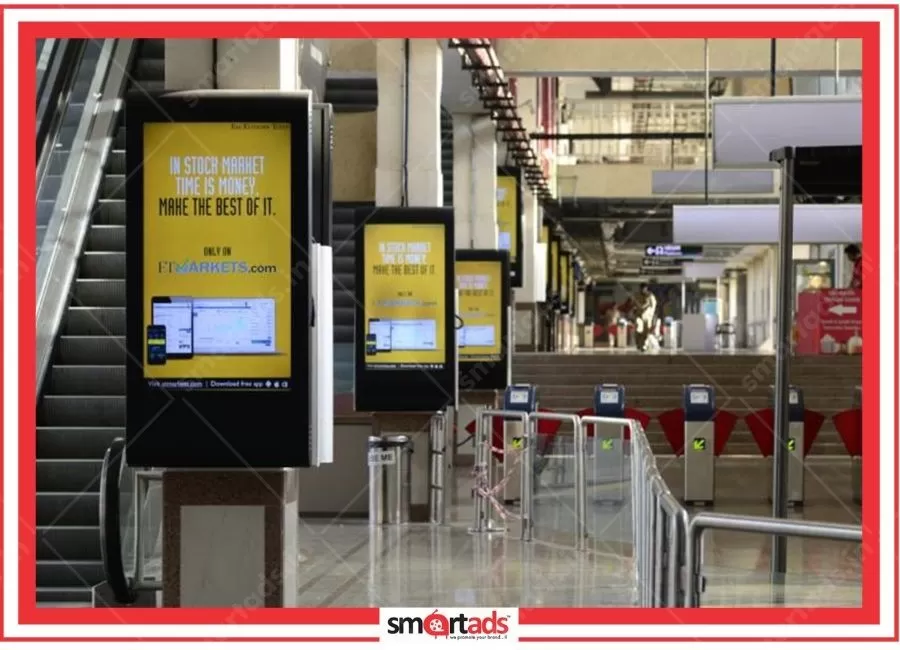
Entry Exit Panel
8 ft x 4 ft
Bright and vibrant multicolored letterin
Rate per Panel / Month
Min Requirement is 3 Panel.
₹48000.00
Showing 1 to 4 of 4 Results
MEDIA DETAILS
8 ft x 4 ft
Bright and vibrant multicolored letterin
Rate per Panel / Month
Min Requirement is 3 Panel.
₹48000.00
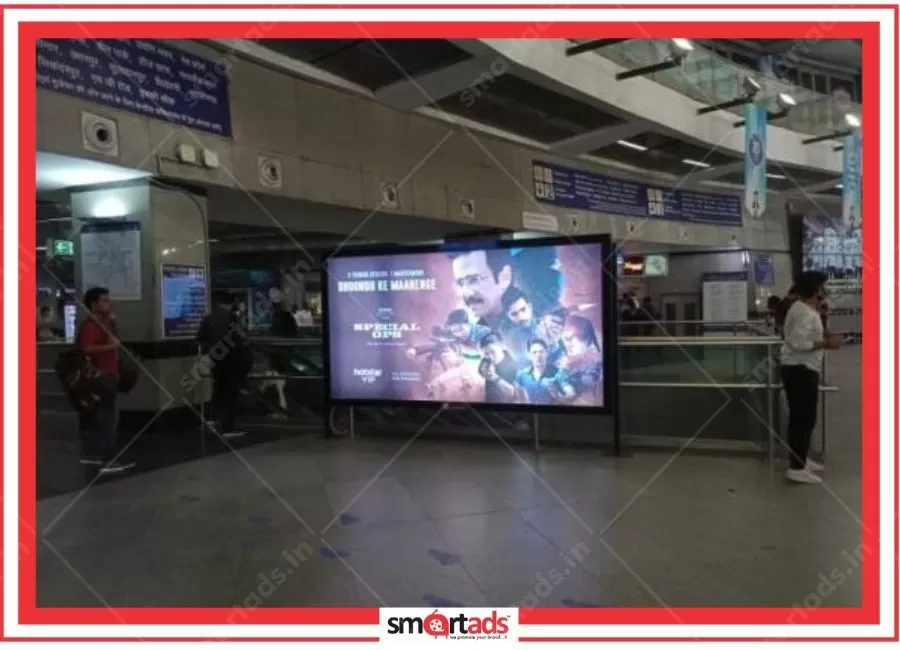
10 ft x 5 ft
A new wide wall system designed to accom
Rate per Panel / Month
Min Requirement is 3 Panel.
₹50000.00
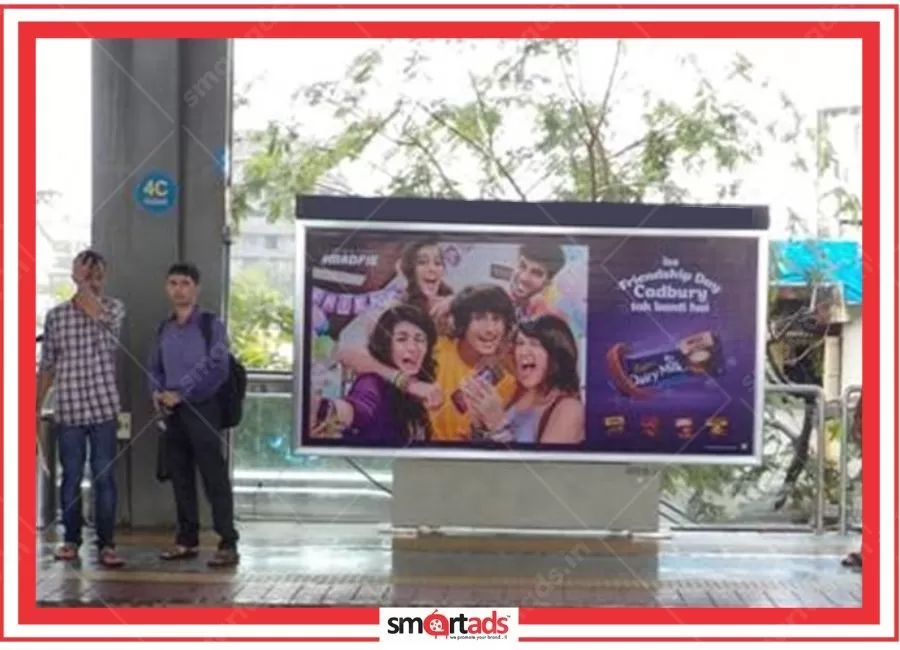
8 ft x 4 ft
A raised flooring or other horizontal su
Rate per Panel / Month
Min Requirement is 3 Panel.
₹35000.00
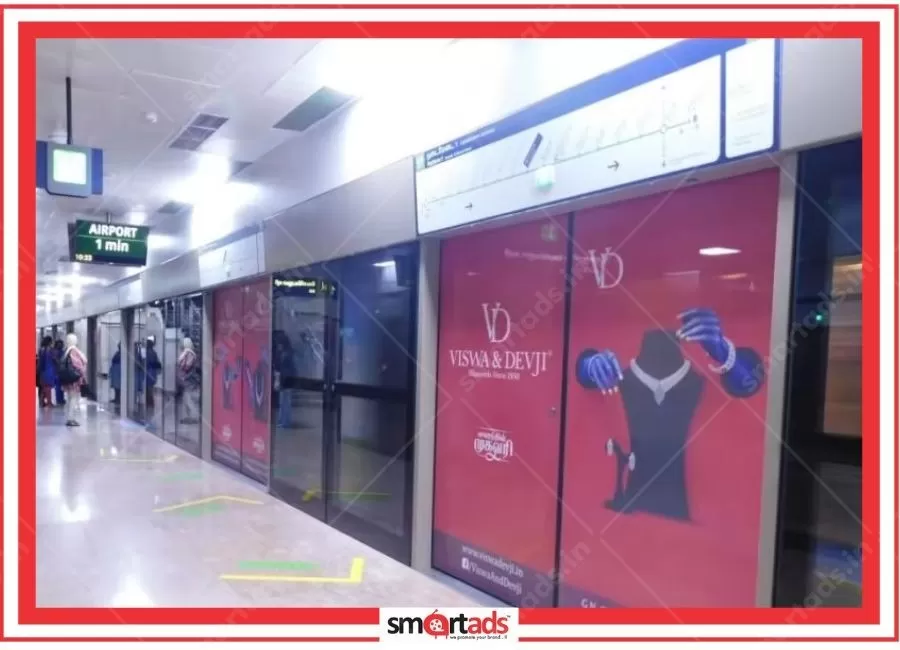
7 ft x 4 ft
Also known as platform edge doors (PEDs)
Rate per Plateform / Month
Min Requirement is 1 Stations.
₹1200000.00
MEDIA REACH

MinimumQty :
10
EstimateReachPeople :
15 Million
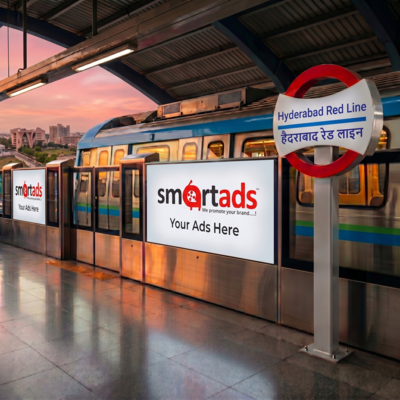
Hyderabad's Red Line — officially the Corridor 1 of the Hyderabad Metro Rail — carries somewhere in the ballpark of 1.5 lakh passengers daily across its 30-kilometre stretch from Miyapur to LB Nagar, which means that any brand placing its creative at the right station is essentially buying into one of the most captive, dwell-time-rich audiences in South India. What surprises most of our clients when we first walk them through this medium is not the reach — it is the quality of that reach. The commuter on Hyderabad Metro is not scrolling past your ad at 1.5x speed; they are standing on a platform, waiting, looking around, and your creative has their full attention for anywhere between two and eight minutes.
Frankly speaking, not all metro corridors are created equal, and the Red Line is where most serious advertisers want to be — at least when the objective is urban, working-professional reach in Hyderabad. The corridor runs through some of the city's most commercially active zones: Miyapur, HITEC City, Ameerpet, Punjagutta, Lakdi-ka-Pool, and LB Nagar, which collectively represent a cross-section of Hyderabad's IT workforce, retail consumers, college students, and daily office commuters. When we mapped audience profiles for a fintech client who was trying to reach salaried professionals between 25 and 40, the Red Line stations around HITEC City and Ameerpet came up as the single most efficient touchpoint in the city — more efficient, in fact, than the digital pre-roll we were running simultaneously on YouTube.
The thing is, the Red Line's geography is its biggest strategic asset. It connects the western IT corridor — where companies like Infosys, Wipro, and dozens of mid-sized tech firms operate — with the older commercial heart of the city around Ameerpet and Punjagutta, and then continues south toward LB Nagar, which is a densely populated residential and retail hub. This means the same corridor serves both the premium-income tech worker commuting from Miyapur and the value-conscious retail shopper heading toward Dilsukhnagar; a media planner who understands this can build a station selection strategy that targets very different audience segments on the same corridor without buying the entire network.
At SmartAds, we always tell our clients that the Red Line is not a single audience — it is a sequence of micro-audiences stitched together by a train route, and the brands that get the most out of this medium are the ones who treat each station cluster as its own targeting decision rather than buying the corridor as a block.
The stations are not equal in footfall, and this is where a lot of brands make their first mistake — assuming that buying any station on the Red Line gives them equivalent value. Our experience shows that HITEC City station consistently records among the highest daily entries and exits on the entire Hyderabad Metro network, which is a function of the sheer volume of IT employees, cab aggregators, and food delivery workers converging on that interchange point every weekday morning. Ameerpet, which serves as an interchange station connecting the Red Line with the Blue Line, sees a different kind of traffic — layered, multi-directional, and with significantly longer dwell times because passengers are transferring between lines and waiting on platforms.
Miyapur, at the western terminus, is underestimated by most planners; the thing is, terminus stations have a particular advertising advantage because passengers arriving or departing from a terminus tend to spend more time on the platform than those making mid-route stops. Punjagutta and Lakdi-ka-Pool serve a mix of government office workers, banking sector employees, and retail shoppers, which gives those stations a slightly older, more financially established demographic profile compared to the younger tech crowd at HITEC City. LB Nagar, the eastern terminus, is surrounded by one of Hyderabad's busiest residential and commercial clusters, making it particularly effective for FMCG brands, real estate advertisers, and educational institutions targeting families.
What we tell our clients when building a station selection shortlist is this: start with your audience profile, map it against the corridor's demographic gradient, and then let footfall data validate your shortlist — not the other way around.
The inventory at Hyderabad Metro stations is more varied than most outdoor planners expect, which is one reason this medium tends to be underutilised by brands that think of it simply as "big hoardings inside a station." The core formats include platform-level backlit panels, concourse-level wall wraps, pillar wraps, ticket counter surrounds, entry gate branding, lift and escalator branding, and full station domination packages — each of which serves a different creative and strategic purpose. Backlit panels on the platform are the workhorses of the format; they are seen by every passenger waiting for a train, they are illuminated consistently, and they are positioned at eye level in a way that outdoor hoardings rarely achieve.
Station domination — where a brand essentially owns every visible surface of a single station for a defined period — is a format we have seen work exceptionally well for product launches and brand repositioning campaigns. A consumer electronics brand we worked with chose to dominate Ameerpet station for a 30-day period around a flagship product launch; the creative was consistent across pillar wraps, platform panels, gate branding, and even the floor decals near the entry points, which created an immersive brand environment that passengers could not avoid engaging with. The brand reported a measurable spike in branded search queries from Hyderabad during that month, which the digital team attributed in part to the metro domination creating top-of-mind awareness that then converted to online search behaviour.
Digital screens — LED displays installed at high-traffic concourse points — are an increasingly important part of the Hyderabad Metro advertising inventory, and they offer the kind of dynamic content flexibility that static panels cannot. Advertisers can run time-of-day targeted content, which means a coffee brand can push a morning commute message between 7 and 10 AM and switch to an evening snack creative between 5 and 8 PM on the same screen, without paying for two separate placements.
This is the question every client asks within the first five minutes of a briefing, and to be honest, the answer is more nuanced than most rate cards suggest. A single backlit panel at a mid-tier Red Line station — say, SR Nagar or Erragadda — works out to roughly ₹40,000 to ₹60,000 per month, which is a number that surprises most clients when they compare it to what a single roadside hoarding in the same locality costs. A premium-location panel at HITEC City or Ameerpet can go somewhere between ₹80,000 and ₹1.5 lakh per month depending on the exact position, size, and whether it is a static backlit or a digital screen slot.
Full station domination packages — which bundle multiple format types across a single station — are typically priced in the ballpark of ₹5 lakh to ₹15 lakh per month for a major interchange station, though this varies considerably based on the scope of formats included and the duration of the campaign. The thing is, when you calculate the cost-per-thousand impressions for a station like Ameerpet, which sees upwards of 30,000 to 40,000 daily commuters passing through, the CPM works out to somewhere around ₹8 to ₹12 — a figure that holds up very well against comparable premium digital inventory in the same city. We have found that brands which approach metro advertising purely on a rate-card basis tend to undervalue it; the right comparison is not "what does this panel cost" but "what does it cost to reach this audience quality at this frequency anywhere else in Hyderabad."
At SmartAds, our media planning team negotiates consolidated buys across the Red Line network, which typically allows clients to access better positioning and added-value formats that are not available through single-station bookings. Duration also matters — a 90-day commitment almost always unlocks significantly better effective rates than a 30-day test, and we generally advise clients to treat their first metro campaign as a minimum 60-day exercise to allow for adequate frequency build.
Hyderabad has a rich outdoor advertising landscape — hoardings along the Outer Ring Road, bus shelter panels, mall media, and transit advertising on TSRTC buses — but metro station advertising occupies a distinct position in that ecosystem, which is worth understanding clearly before making budget allocation decisions. The fundamental difference is dwell time: a commuter driving past a hoarding on the ORR has roughly three to five seconds of exposure, whereas a passenger waiting on a Red Line platform has two to eight minutes of uninterrupted exposure to whatever is in their visual field. That difference in exposure duration is not marginal — it is the difference between an impression and an engagement.
To be fair, hoardings have their own advantages: they reach vehicle-owning audiences, they work at scale across the city, and large-format creatives on premium sites can create powerful brand presence. But for categories where message complexity matters — financial products, healthcare services, real estate, education — the extended dwell time of metro advertising allows brands to communicate more than just a logo and a tagline. One real estate developer we worked with used platform panels at three Red Line stations to run a creative that included a QR code linking to a virtual property tour; the scan rate was significantly higher than what the same QR code achieved on their newspaper insertions, which told us something important about the quality of attention the medium was generating.
What a lot of people miss is that metro advertising also delivers a frequency advantage that is difficult to replicate with other OOH formats. A daily commuter who uses the same station five days a week sees the same panel twenty times in a month, which is a frequency level that most media plans have to spend considerably more to achieve through other channels.
The audience profile of the Red Line commuter skews toward urban, educated, working professionals between the ages of 22 and 45, with a meaningful concentration of IT and tech sector employees particularly in the western stretch of the corridor. This makes the Red Line a natural fit for categories like banking and financial services, insurance, consumer electronics, ed-tech, health-tech, quick commerce, and premium FMCG — all of which are trying to reach exactly this demographic and often paying significantly more to reach them through digital channels. We have seen this work particularly well for brands in the mutual fund and investment category, where the combination of high dwell time and a financially literate audience creates a genuinely receptive environment for a slightly more detailed message.
That said, the Red Line is not exclusively a premium-audience medium. The eastern stretch toward LB Nagar and the residential stations in between serve a broader mass-market demographic, which makes the corridor relevant for FMCG brands, retail chains, educational institutions, and real estate developers targeting a wider Hyderabad audience. The key is matching the station selection to the audience objective rather than buying the entire corridor indiscriminately — a discipline that separates effective metro campaigns from wasteful ones.
Frankly speaking, the categories that should probably be advertising on the Red Line but are not yet doing so in significant numbers include D2C brands, health and wellness companies, and regional language content platforms — all of which have audiences that are heavily represented in the metro commuter base but have not yet made the shift from purely digital to integrated OOH-plus-digital strategies.
Creative strategy for metro advertising is genuinely different from what works in other OOH contexts, and this is where we see a lot of brands import their highway hoarding creative into a metro station without adjusting for the medium — which almost always underperforms. The extended dwell time means you can use more copy than a roadside hoarding allows; a platform panel can carry a headline, a supporting line, and a clear call-to-action, and a waiting passenger will read all three. The challenge is that the same creative needs to work at different distances — from fifteen metres away as a passenger walks down the platform, and from two metres away as they stand waiting for the train.
High-contrast visuals, bold typography, and a single dominant colour work best for the "far view" moment; the detail — the supporting copy, the QR code, the product specifications — is what gets read during the "near view" dwell period. We worked with an automotive brand that was launching a new two-wheeler model in Hyderabad; the creative they initially proposed was a full-bleed lifestyle image with very small text, which would have been invisible from platform distance. We redesigned the approach to use a large, clean product shot with a bold price-point headline visible from fifteen metres, and a secondary panel positioned closer to the waiting zone that carried the EMI details and a QR code for a test drive booking. The campaign generated a measurable increase in test drive enquiries from Hyderabad during the campaign period.
Digital LED screens at metro stations open up a different creative dimension entirely — motion graphics, countdown timers, contextual messaging based on time of day, and even integration with live data feeds like weather or sports scores are all technically possible. For brands with the creative resources to execute dynamic content, the digital inventory at Hyderabad Metro stations is genuinely underutilised and represents real competitive white space.
The booking process for Hyderabad Metro advertising runs through L&T Metro Rail Hyderabad Limited's authorised media concessionaire, which means the inventory is managed through a structured system rather than the more fragmented vendor landscape you encounter with traditional outdoor. Campaigns typically require a minimum booking period of 30 days, though 60 and 90-day packages offer meaningfully better value and are what we recommend for most brand campaigns. Lead time for creative production and installation is generally in the range of two to three weeks, which means campaign planning needs to begin at least a month before the intended go-live date — something that catches a lot of last-minute campaign requests off guard.
The practical steps involve station selection based on audience mapping, format selection based on creative objectives and budget, creative adaptation to the specific panel dimensions (which vary by location and format type), and then the installation and maintenance management during the campaign period. At SmartAds, we handle the full process — from station recommendation and rate negotiation through to creative adaptation, installation coordination, and campaign monitoring — which removes the operational complexity that often deters brands from exploring this medium for the first time.
One thing worth knowing: availability at premium stations like HITEC City and Ameerpet tends to be limited, particularly for the highest-visibility positions. We have seen clients lose preferred spots because they waited too long to confirm their bookings; for campaigns tied to product launches or seasonal events, we generally advise locking in station selection and creative formats at least six to eight weeks in advance.
Measurement is a legitimate challenge with metro advertising, as it is with most OOH formats, and we think it is important to be honest about this with clients rather than making inflated claims. Footfall-based reach estimates — which are derived from Hyderabad Metro's published ridership data and station-level entry-exit counts — give you a reasonable impression volume figure, but converting that into business outcomes requires some additional measurement infrastructure. The most effective approach we have seen is running metro campaigns in parallel with a digital component — typically paid search or social — and using branded search volume, QR code scan rates, or store visit attribution as proxy metrics for the metro campaign's contribution.
A retail client in Hyderabad's western corridor ran a 60-day Red Line campaign across five stations covering the HITEC City to Ameerpet stretch; during the campaign period, their Hyderabad store saw a roughly 22% increase in footfall compared to the same period in the prior year, and their branded search volume in Hyderabad grew by a figure that was meaningfully above the national trend for the same period. While we cannot attribute all of that to the metro campaign in isolation — there were other marketing activities running simultaneously — the directional evidence was strong enough that the client renewed for a second 90-day cycle.
The GroupM TYNY Report and the FICCI-EY Media and Entertainment Report have both highlighted transit and metro advertising as among the fastest-growing segments within the Indian OOH category, which reflects a broader industry recognition that the medium delivers audience quality and dwell time that is increasingly difficult to find elsewhere. Our own experience across campaigns in Hyderabad, Bengaluru, and Chennai metro networks confirms that the medium consistently outperforms initial client expectations when the station selection, creative, and measurement approach are properly aligned.
Q: What is the minimum budget required to start advertising on the Hyderabad Red Line?
The honest answer is that a meaningful metro campaign on the Red Line can be structured starting from somewhere around ₹1.5 lakh to ₹2 lakh per month, which would cover a small number of panels at mid-tier stations for a 30-day period. That said, our experience shows that campaigns with budgets in the ₹5 lakh to ₹10 lakh range for a 60-day period tend to generate significantly better results because they allow for multi-station presence, which builds frequency across the commuter base rather than relying on a single touchpoint. For brands testing the medium for the first time, we typically recommend starting with two or three strategically selected stations rather than spreading a limited budget too thin across the corridor.
Q: Can small and mid-sized businesses advertise on the Hyderabad Metro Red Line, or is it only for large brands?
Metro station advertising is genuinely accessible to mid-sized businesses, and frankly, some of the most effective campaigns we have executed on the Red Line have been for regional brands rather than national ones. A local chain of dental clinics targeting the HITEC City working professional audience, an ed-tech startup running a course promotion targeted at the Ameerpet student commuter cluster, a regional real estate developer promoting a project in the western suburbs — these are all examples of the kind of targeted, locally relevant campaigns that the Red Line's station-level buying structure makes possible. The key for smaller budgets is precision: pick two stations that perfectly match your audience rather than buying broadly.
Q: How far in advance do I need to book metro advertising space on the Red Line?
For standard positions at mid-tier stations, a three to four week lead time is generally workable, though it leaves little room for creative revisions or installation issues. For premium positions at high-demand stations like HITEC City, Ameerpet, or Miyapur, we recommend a minimum of six to eight weeks of advance booking, particularly if your campaign is tied to a specific launch date or seasonal window. The Diwali and year-end festive period, as well as the January-March quarter when many brands are executing annual budget campaigns, tend to see the highest competition for premium inventory — which is when advance planning becomes genuinely critical rather than just advisable.
Q: What creative specifications are required for Hyderabad Metro station panels?
Creative specifications vary by format type and station, which is one reason working with an experienced media partner matters more than it might seem. Standard backlit panels typically require high-resolution artwork at 300 DPI minimum, with bleed areas and safe zones that differ from standard outdoor specifications. Digital screen content has its own resolution requirements, aspect ratios, and file format specifications. Pillar wraps and non-standard formats require templates that account for the physical dimensions and curvature of the installation surface. At SmartAds, our creative adaptation team handles the technical specification process for all booked formats, which removes a significant operational burden from the client's internal team.
Q: Is metro advertising on the Red Line effective for digital-first brands that are new to offline media?
This is a question we get increasingly often, and our experience is that metro advertising can be an exceptionally effective bridge for digital-first brands making their first significant offline investment — precisely because the audience profile overlaps so strongly with the urban, tech-savvy consumer that most D2C and digital brands are already targeting online. The difference is that the metro environment reaches that audience in a context where they are not being bombarded by competing digital messages; there is no algorithm filtering your creative out of their feed, no ad blocker, and no skip button. One ed-tech brand we worked with used a Red Line campaign to support a new course launch; they found that the metro campaign drove a measurable lift in direct traffic to their website from Hyderabad during the campaign period, which suggested that the offline exposure was converting into online search and navigation behaviour — exactly the kind of cross-channel amplification that makes integrated campaigns more efficient than single-channel ones.
Q: How does Hyderabad Metro advertising perform compared to digital advertising for reaching the same audience?
The comparison is genuinely interesting, and the answer depends heavily on what metric you prioritise. On a pure CPM basis, metro advertising at well-trafficked Red Line stations works out to a CPM that is competitive with — and in some cases lower than — what brands are paying for premium digital placements targeting the same urban professional demographic in Hyderabad. The critical difference is the nature of the impression: a metro panel impression involves a physically present person with no ability to skip, scroll, or block the creative, which is a fundamentally different quality of exposure than a digital impression. What we tell brands is that the two channels are more complementary than competitive; a consumer who sees your creative on the metro platform and then encounters your retargeting ad on Instagram that evening is significantly more likely to convert than one who only sees the digital ad — and the metro impression is what makes the digital ad feel familiar rather than intrusive.
The Hyderabad Metro Red Line has, over the past several years, quietly become one of the most efficient premium audience touchpoints in South India — and the brands that recognised this early have been building frequency and familiarity with the city's most commercially valuable commuter base at a cost that is genuinely difficult to replicate through any other single medium. The corridor's geographic sweep from the IT west to the residential east means that a well-planned station selection strategy can reach multiple distinct audience segments within a single campaign budget, which is an efficiency that most media plans struggle to find elsewhere.
What we have consistently observed at SmartAds, across dozens of campaigns on the Hyderabad Metro network, is that the medium rewards strategic thinking more than budget size. A brand that invests thoughtfully in two or three precisely chosen stations, with creative that is genuinely adapted to the metro environment and a measurement framework that captures the medium's contribution to downstream digital behaviour, will almost always outperform a brand that spends three times as much on a poorly targeted corridor-wide buy. The Red Line is not a medium where you can simply throw money at it and expect results; it is a medium where intelligence in planning compounds into disproportionate returns.
If you are building a Hyderabad media plan for the next quarter and have not yet evaluated what the Red Line can contribute — either as a primary awareness driver or as a frequency-building complement to your digital spend — it is worth having a detailed conversation with a team that knows the network's inventory, audience data, and creative requirements from the inside. The SmartAds media planning team works with brands across budget sizes and categories to build metro campaigns on the Hyderabad Red Line that are grounded in real footfall data, honest rate benchmarks, and creative thinking that is specific to the medium. Reach out to us at SmartAds.in to explore what a Red Line campaign could look like for your brand.
