
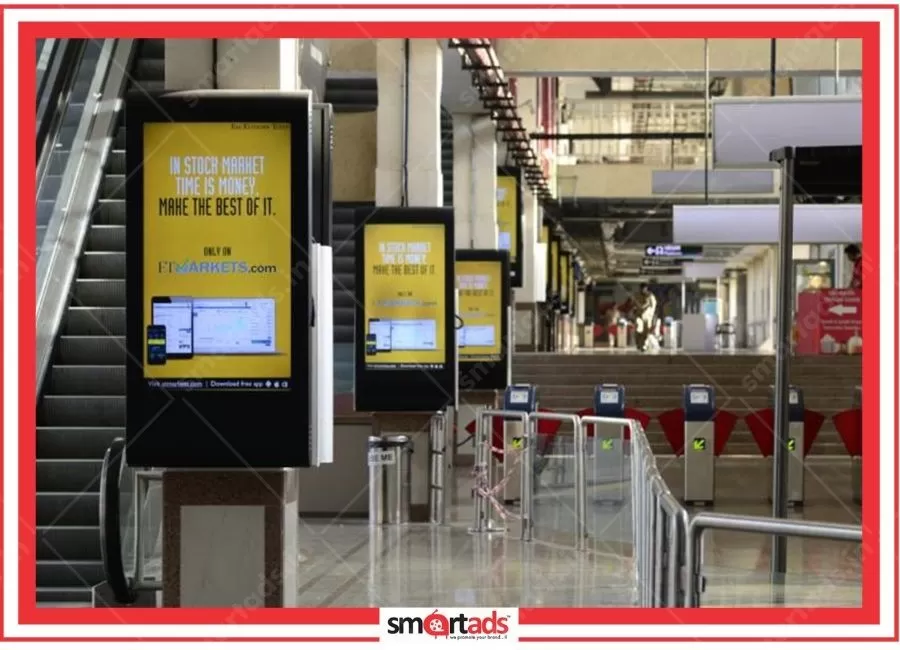
Entry Exit Panel
8 ft x 4 ft
Bright and vibrant multicolored letterin
Rate per Panel / 1 Month
Min Requirement is 3 Panel
₹48000.00
Showing 1 to 4 of 4 Results
MEDIA DETAILS
8 ft x 4 ft
Bright and vibrant multicolored letterin
Rate per Panel / 1 Month
Min Requirement is 3 Panel
₹48000.00
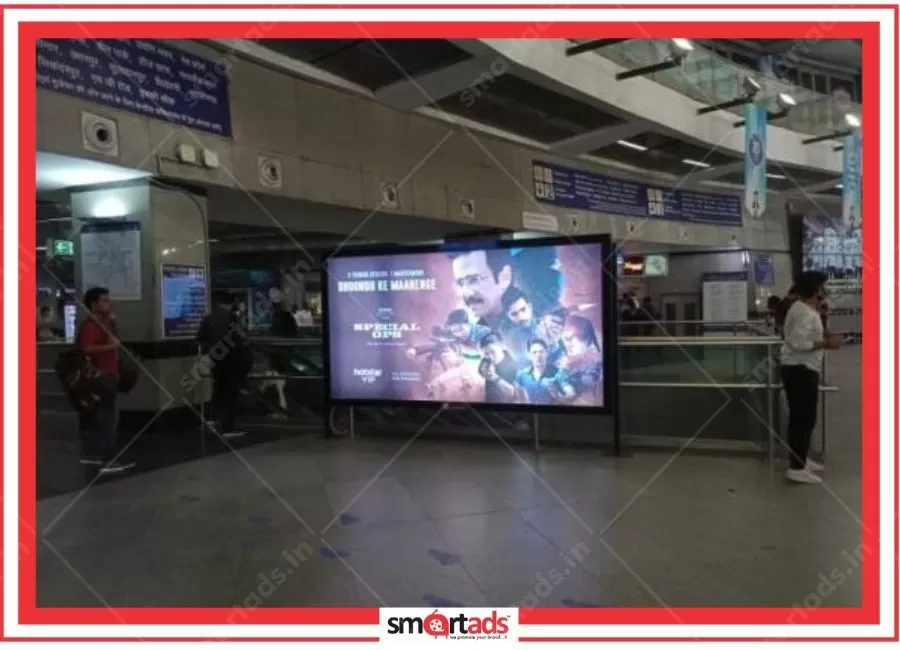
10 ft X 5 ft
A new wide wall system designed to acco
Rate per Panel / 1 Month
Min Requirement is 3 Panel
₹50000.00
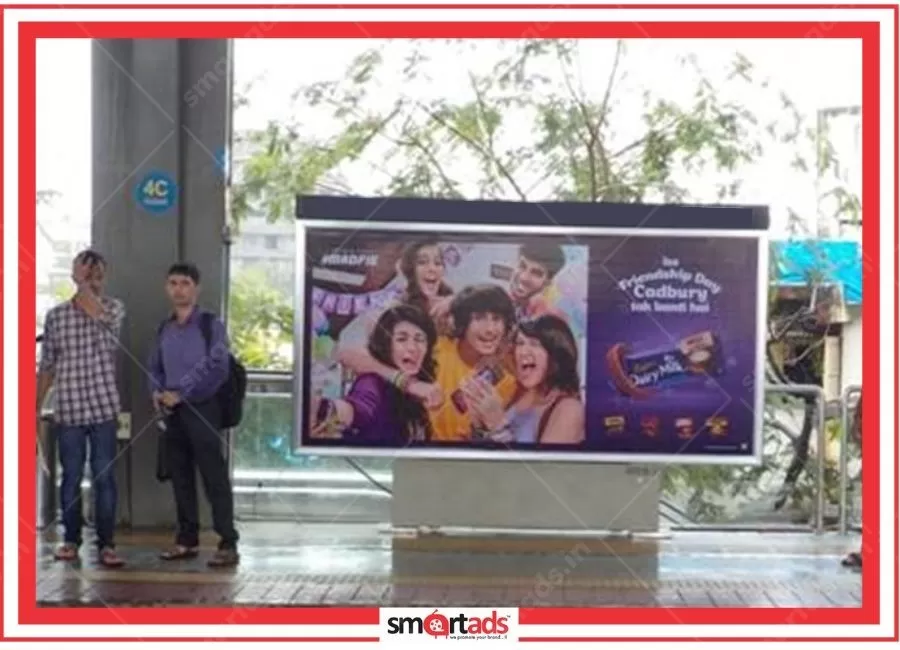
8 ft x 4 ft
A raised flooring or other horizontal su
Rate per Panel / 1 Month
Min Requirement is 3 Panel
₹35000.00
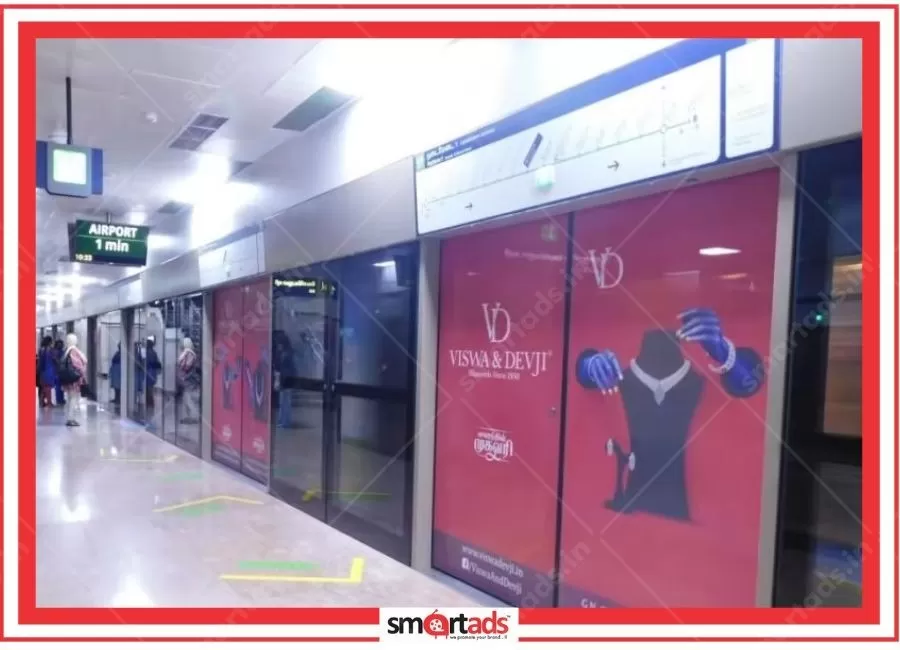
7 ft x 4 ft
Also known as platform edge doors (PEDs)
Rate per Plateform / 1 Month
Min Requirement is 1 Station
₹1200000.00
MEDIA REACH

MinimumQty :
10
EstimateReachPeople :
15 Million
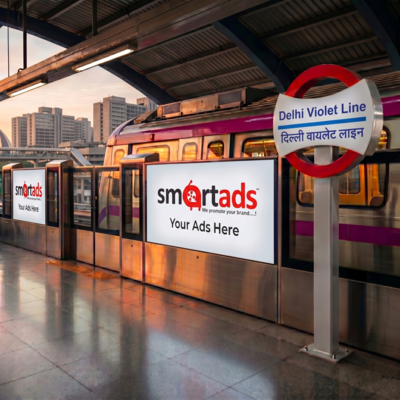
Most brands planning a Delhi BTL campaign instinctively gravitate toward the Yellow Line or the Blue Line — and frankly, we understand why. Those corridors get talked about more. But the Violet Line, which stretches from Kashmere Gate all the way down to Raja Nahar Singh in Ballabhgarh, quietly delivers one of the most economically diverse and geographically underrated commuter audiences in the entire DMRC network; and in our experience, the brands that figure this out early tend to get significantly better value for their spend.
The Violet Line — officially Line 6 of the Delhi Metro — covers roughly 46 kilometres and connects the heritage core of Old Delhi to the industrial and residential sprawl of Faridabad and Ballabhgarh in Haryana. That corridor, which passes through South Delhi's most commercially active neighbourhoods before crossing into NCR territory, carries daily commuters numbering in the hundreds of thousands, and yet the advertising inventory on this line remains less saturated than comparable stretches on the Yellow or Blue lines. That gap is exactly where smart brands should be placing their money.
The thing is, the Violet Line's value as an advertising corridor is not immediately obvious from a map — you have to look at who is actually riding it. The line passes through Mandi House, which is the cultural and institutional heart of Delhi; through ITO, which is surrounded by government offices, courts, and media houses; through Nehru Place, which is one of the largest IT and electronics markets in Asia; and then through Lajpat Nagar, which draws shoppers from across South Delhi and the NCR on a daily basis. Each of these stations represents a distinct audience cluster, which means a single Violet Line advertising campaign can reach government employees, tech professionals, retail shoppers, and Faridabad's industrial workforce — sometimes within the same creative placement.
What a lot of people miss is that the Violet Line also contains a stretch that DMRC designates as the Heritage Line, running between Kashmere Gate and ITO. This stretch, which passes near the Yamuna riverfront and some of Delhi's oldest institutional landmarks, carries a disproportionate share of tourism-adjacent traffic and government commuters; and because it is not as aggressively monetised as the interchange stations on the Yellow or Blue lines, the advertising rates here tend to be more accessible while the dwell time at platforms remains genuinely high. At SmartAds, we always tell our clients that the Heritage Line stretch is where you get the most bang for your branding rupee if your category has any relevance to government, culture, or civic audiences.
On top of that, the Violet Line's southern extension into Faridabad — covering stations like Badarpur Border, Escorts Mujesar, and eventually Raja Nahar Singh — opens up a Faridabad metro advertising opportunity that most Delhi-centric media plans completely ignore. Faridabad is an industrial city with a population exceeding 1.4 million, and its metro-riding population skews toward working-age adults with disposable income; the GroupM TYNY Report has consistently flagged NCR's satellite cities as high-growth consumer markets, and Faridabad is squarely in that category. Brands in real estate, consumer durables, FMCG, and financial services have found this audience particularly receptive.
Metro station advertising in Delhi Violet Line is considerably more varied than most advertisers assume when they first approach us. The format options span everything from static backlit panels on platforms to full digital display advertising screens at entry gates, from pillar advertising wraps at concourse level to platform screen door branding that passengers see every time a train arrives. The DMRC has structured its inventory across three broad categories — station-based formats, train-based formats, and ambient or experiential formats — and each of these carries different pricing, different dwell time characteristics, and different audience engagement profiles.
At the station level, the backlit panel remains the workhorse format; these are the illuminated displays you see on platforms, in concourses, and along fare gate corridors, and they work particularly well for brand visibility campaigns where the goal is repeated impression-building over a campaign period. Pillar advertising at stations like Nehru Place metro and Lajpat Nagar metro is especially effective because the pillars are positioned at natural pedestrian chokepoints where commuters slow down or pause; we have found that pillar wraps generate significantly higher unaided brand recall than equivalent-sized flat panels, simply because the three-dimensional format is harder to tune out. Digital display advertising screens, which are increasingly being installed at high-footfall stations across the DMRC Violet Line network, offer the additional advantage of time-of-day targeting — a feature that static formats simply cannot match.
Train-based formats are where the conversation gets genuinely interesting. Interior train branding — which covers the panels above seats, the door stickers, the overhead grab-rail zones, and the floor graphics inside coaches — gives advertisers an almost captive audience for the duration of the journey; the average in-train dwell time on the Violet Line, which runs long-distance from Kashmere Gate to Raja Nahar Singh, is considerably higher than on shorter metro lines, which translates directly into longer exposure per commuter. Exterior train branding, or the metro train wrap, is the most visually dramatic format available on the Delhi metro network; a fully wrapped Violet Line train essentially becomes a moving billboard that is seen not just by passengers but by platform crowds, road-level observers near elevated sections, and anyone in the vicinity of the depot. Metro jingle advertising — the short audio announcements played inside coaches — is a less-discussed but surprisingly effective format for brand recall, particularly for FMCG and consumer categories.
Advertising rates on the Violet Line are structured by DMRC through a combination of direct contracts and authorised concessionaires, and the numbers vary quite significantly depending on format, station tier, and campaign duration. To give you a realistic picture: a standard backlit panel at a mid-tier Violet Line station like Govindpuri metro station or Kalkaji Mandir station will typically work out to somewhere in the ballpark of ₹25,000 to ₹45,000 per panel per month, which is a number that surprises most first-time advertisers when they compare it to what they are paying for equivalent-reach digital display advertising on social platforms.
At premium stations — Nehru Place metro, Lajpat Nagar metro, and Mandi House station, which are the highest-footfall nodes on the line — the metro station advertising cost 2026 for a backlit panel climbs to somewhere between ₹60,000 and ₹1.2 lakh per panel per month, depending on the specific location within the station and whether the panel is on the platform or the concourse. Digital display advertising screens at these stations command a premium over static formats, typically running in the range of ₹80,000 to ₹1.8 lakh per screen per month; the premium is justified by the format's flexibility and the higher attention capture rate that digital screens achieve in high-footfall environments. Platform screen door branding, which is a relatively newer format on the DMRC network, is priced on a per-door or per-station basis and tends to be negotiated as part of a larger station package.
Interior train branding on the Violet Line is priced per coach, and a full-coach interior campaign — covering all panels, door stickers, and overhead zones — works out to roughly ₹80,000 to ₹1.5 lakh per coach per month, with discounts available for multi-coach or full-train bookings. A full metro train wrap for exterior train branding is a significantly larger investment, typically in the range of ₹8 lakh to ₹15 lakh per train per month, but the reach it generates — across every station the train visits throughout the day — makes the cost per impression metro calculation surprisingly competitive. At SmartAds, our media planning team has run the numbers on full train wraps for several clients, and the cost per thousand impressions typically works out to somewhere between ₹6 and ₹12, which compares very favourably against prime-time television CPMs in Delhi.
Frankly speaking, not all Violet Line metro stations are created equal from an advertising standpoint, and choosing the wrong station can mean paying for inventory that simply does not deliver the audience density your campaign needs. Based on DMRC footfall data and our own campaign experience across the line, the stations can be roughly clustered into three tiers of advertising priority.
The first tier — the stations where footfall and brand visibility are at their absolute peak — comprises Kashmere Gate metro station, Lajpat Nagar metro, and Nehru Place metro. Kashmere Gate is an interchange with the Yellow Line and the Red Line, which means it functions as a major transfer hub; the footfall here is not just Violet Line commuters but the entire interchange crowd, making it one of the highest-traffic stations in the DMRC network. Lajpat Nagar metro is a dual-line interchange with the Pink Line, and the surrounding market — one of Delhi's most visited retail destinations — drives footfall that extends well beyond typical commuter patterns. Nehru Place metro is perhaps the most commercially interesting station on the entire line; the market it serves is the epicentre of Delhi's IT hardware and electronics trade, which means the audience here skews heavily toward tech-savvy, upper-middle-income professionals.
The second tier of high-traffic stations for advertising on Delhi violet line stations includes Mandi House station, ITO metro station, Kalkaji Mandir station, and Central Secretariat metro station. Central Secretariat is an interchange with the Yellow Line and sits at the heart of the government district; the audience here is almost exclusively white-collar, which makes it particularly valuable for financial services, ed-tech, and premium consumer brands. Mandi House draws a culturally engaged, educated audience — theatre-goers, media professionals, and institutional workers — which is a demographic that is notoriously difficult to reach through mass media but responds well to well-crafted metro station branding. The third tier includes Govindpuri metro station, Badarpur Border station, and the Faridabad metro advertising corridor stations, which offer lower per-unit rates but deliver strong reach among working-class and lower-middle-income audiences — a segment that is extremely valuable for FMCG, affordable housing, and mass-market consumer brands.
The Violet Line's audience profile is, in our assessment, the most economically diverse of any single metro line in Delhi — and that is both its greatest strength and its most important planning consideration. The line essentially functions as a socioeconomic transect of the city, moving from the institutional and heritage core at Kashmere Gate, through the commercial and professional clusters of Central Secretariat, Mandi House, and ITO, into the mixed retail and residential belt of South Delhi around Lajpat Nagar and Kalkaji Mandir, and then into the working-class and industrial zones of Faridabad and Ballabhgarh. Each of these zones has a distinct commuter profile, which means the Violet Line is not a one-size-fits-all advertising environment.
The stretch from Kashmere Gate to ITO metro station carries a high proportion of government employees, legal professionals, and journalists — a demographic that tends to be well-educated, moderately to highly paid, and relatively difficult to reach through conventional mass media. The Central Secretariat to Nehru Place segment attracts IT professionals, corporate employees, and market traders; this is a high-purchasing-power segment with strong brand awareness and a demonstrated willingness to engage with premium products. The Lajpat Nagar metro to Kalkaji Mandir stretch draws a retail-oriented audience — shoppers, small business owners, and residents of South Delhi's dense residential colonies — who are active consumers across categories from fashion to home goods. South Delhi as a whole, which the Violet Line serves more comprehensively than any other metro line, is consistently ranked among Delhi's highest per-capita consumption zones by IRS data.
The Faridabad segment of the Violet Line — from Badarpur Border station through to Raja Nahar Singh — carries a predominantly working-age, aspirational audience; many of these daily commuters are first-generation metro users who have significant disposable income but are underserved by premium advertising. Faridabad metro advertising, in our experience, is particularly effective for real estate metro advertising (given the active residential development in the area), consumer durables, and financial products. One FMCG client we worked with specifically requested a campaign weighted toward the Faridabad stations of the Violet Line, and the brand recall scores from post-campaign surveys in that geography came back roughly 40% higher than their simultaneous campaign on a more saturated South Delhi corridor — a finding that genuinely surprised their marketing team.
The DMRC approval process for advertising on the Violet Line is more structured than most advertisers expect, and understanding it upfront saves a significant amount of time and frustration during campaign execution. DMRC manages its advertising inventory through a combination of directly contracted formats and formats allocated to authorised concessionaires; the specific concessionaire agreements for different station clusters and train formats are governed by tender processes, which means that the entity you need to work with — and the approval pathway — can differ depending on which format and which stations you are targeting.
For station-based formats like backlit panels, pillar advertising, and digital display advertising screens, the process typically involves submitting creative artwork for DMRC approval before installation; the approval review covers content compliance (DMRC prohibits advertising for alcohol, tobacco, and certain categories of political content), artwork specifications (resolution, dimensions, material standards), and in some cases brand category exclusivity checks if a competing brand has already secured exclusivity at that station. The timeline from artwork submission to DMRC approval is typically somewhere between 10 and 21 working days, though this can vary depending on the station tier and the complexity of the format. For train-based formats — particularly exterior train branding and full metro train wrap campaigns — the approval and installation timeline is longer, often running to 30-45 days from booking confirmation, because the wrap application itself requires the train to be taken out of service for a period.
At SmartAds, we manage the entire DMRC approval workflow on behalf of our clients, which eliminates the back-and-forth that typically consumes weeks of a brand team's time. What we tell our clients is that the single most common cause of campaign delays is artwork that does not meet DMRC's technical specifications on the first submission; getting the specifications right before you go into production — rather than discovering the issue after the artwork is printed — is the difference between a campaign that goes live on schedule and one that misses its launch window by three weeks. The DMRC approval process for the Violet Line also requires the advertiser or their authorised advertising agency to submit a formal booking application, which includes campaign dates, format details, station list, and proof of brand registration.
Choosing the right station — or combination of stations — for your Violet Line advertising campaign is a media planning decision that should be driven by audience alignment first and footfall numbers second. The two considerations are related but not identical; a station with very high footfall but the wrong audience profile will generate impressions but not conversions, while a station with moderate footfall but near-perfect audience alignment can deliver exceptional campaign ROI.
Our approach at SmartAds is to map each client's target consumer profile against the station-level audience clusters we have described above, and then layer footfall data on top to determine the optimal station mix. For a real estate metro advertising campaign targeting upper-middle-income homebuyers in South Delhi, we would typically anchor the campaign at Nehru Place metro and Lajpat Nagar metro, with supporting placements at Kalkaji Mandir station to capture the residential catchment south of the Ring Road. For an ed-tech brand metro campaign targeting working professionals looking to upskill, Central Secretariat metro station and Mandi House station represent the highest-value placements on the line, given the concentration of government and media professionals in those catchments. For metro advertising for FMCG brands with mass-market positioning, the Faridabad stations — particularly Badarpur Border station and the stations approaching Raja Nahar Singh — offer exceptional reach at rates that are meaningfully lower than equivalent-reach placements in central Delhi.
One automotive brand we worked with was launching a mid-size SUV and wanted to reach aspirational buyers across Delhi NCR; rather than concentrating the entire budget at one or two premium stations, we structured a campaign that covered Kashmere Gate metro station for the interchange audience, Nehru Place metro for the IT professional segment, and three Faridabad metro advertising stations for the NCR aspirational buyer — all within a single integrated booking. The campaign ran for 45 days across backlit panels and interior train branding, and the brand's own post-campaign tracking showed a 28% lift in aided awareness among Delhi NCR respondents who identified as metro commuters. The cross-station approach, which we have since replicated for several other clients, consistently outperforms single-station concentration for brands with a broad target demographic.
This is a question we get asked more often than you might expect, and the honest answer is: yes, but with some important caveats about how you structure the campaign. Metro station advertising on the Delhi Violet Line is not exclusively a large-brand game; the minimum budget required to run a meaningful campaign at a single mid-tier station — say, Govindpuri metro station or Kalkaji Mandir station — is in the range of ₹25,000 to ₹50,000 per month for a single backlit panel, which is well within the reach of a local business or a funded startup.
The caveat is that a single panel at a single station for a single month is unlikely to generate the kind of brand recall and frequency that makes metro station branding genuinely effective. What we recommend for smaller budgets is a concentrated approach: pick one station that is directly relevant to your business catchment, book multiple panels within that station to dominate the visual environment, and run the campaign for a minimum of 60 days to build the frequency that drives recall. A local coaching institute in Lajpat Nagar, for instance, would be far better served by owning three or four panels at Lajpat Nagar metro station for two months than by spreading a similar budget across six stations for a single month. Metro advertising for startups follows the same logic — concentration and duration beat dispersal and brevity every time.
To be fair, there are also some format innovations that make metro station advertising more accessible for smaller advertisers. Shared digital display advertising screens, where multiple brands rotate on the same screen, allow advertisers to participate in high-footfall stations at a fraction of the cost of a dedicated panel. Pillar advertising at smaller Violet Line stations can be booked for as little as ₹15,000 to ₹20,000 per pillar per month, which makes it one of the most cost-effective formats in the entire non-traditional advertising ecosystem in Delhi. The key is working with an authorised advertising agency that has existing relationships with DMRC concessionaires and can negotiate minimum bookings that would not be available to a direct advertiser approaching the process cold.
ROI metro advertising is a question that deserves a more nuanced answer than most vendors are willing to give. The return on a Violet Line advertising campaign depends heavily on your campaign objective, your category, your creative quality, and how well your station selection aligns with your target audience — and any agency that gives you a single ROI figure without asking those questions first is not being straight with you.
What we can say with confidence, based on our campaign experience and the available industry data, is that the cost per impression metro on the Violet Line compares very favourably against almost every other media format available in Delhi. The CPM for a well-planned backlit panel campaign at a high-footfall Violet Line station works out to somewhere between ₹4 and ₹10, depending on the station and the panel location; that range sits comfortably below the CPM for prime-time television in Delhi, which the FICCI-EY Media Report has consistently placed in the ₹15 to ₹25 range for general entertainment channels. Against outdoor advertising on Delhi's major arterials, where traffic-count-based CPMs can look attractive on paper but suffer from low dwell time and high creative clutter, the metro's captive audience environment delivers a quality of impression that is genuinely different.
The dwell time advantage is the factor that most ROI analyses underweight. A commuter waiting on a Violet Line platform for 3 to 5 minutes has nothing to do but look at the advertising around them; that is a fundamentally different engagement environment from a motorist passing a roadside hoarding at 60 kilometres per hour. A retail client in Pune — a brand that had previously run exclusively outdoor campaigns — ran a comparative test where they placed equivalent budgets in metro station advertising in Delhi Violet Line stations and on outdoor hoardings in comparable Delhi locations; the brand recall scores from the metro placements came back roughly 2.3 times higher than the outdoor placements, which was a result that shifted their media mix significantly in the following year.
The comparison between Violet Line advertising and traditional media formats — television, newspaper, radio — is one that comes up constantly in media planning conversations, and it is worth addressing directly rather than dancing around it. Television advertising in Delhi, which is typically planned through GEC and news channel buys, delivers very high reach but at CPMs that are significantly higher than metro advertising, with the additional disadvantage that viewers can and do skip, mute, or leave the room during ad breaks. Newspaper advertising in Delhi's English and Hindi dailies — which the ABC and IRS data show reaching a declining but still substantial readership — offers strong credibility and editorial adjacency but very limited dwell time and essentially no repeat exposure from a single insertion.
Radio advertising in Delhi, which is planned across stations like Radio Mirchi, Big FM, and Red FM, offers reasonable reach among commuter audiences — and here is where the comparison gets interesting, because radio's primary strength is the commuter context, which is exactly the same context that metro station advertising in Delhi Violet Line exploits. The difference is that radio is an audio-only medium competing with traffic noise and conversation, while metro station branding is a visual medium in a relatively controlled environment where the audience is stationary and attentive. We have found that brands which run coordinated campaigns across both radio and metro formats in Delhi see a synergistic recall lift that neither medium achieves independently; the audio brand cue from radio reinforces the visual brand impression from the metro, and vice versa.
Out-of-home advertising in Delhi — hoardings, unipoles, bus shelters — is the format most directly comparable to metro station advertising, and the honest assessment is that both have their place. OOH advertising Delhi is better for geographic coverage and reaching audiences who do not use the metro; transit advertising Delhi through the metro network is better for audience quality, dwell time, and brand recall. The FICCI-EY report on the Indian media and entertainment industry has noted that OOH advertising Delhi is recovering strongly post-pandemic, but the structural advantages of captive audience environments like metro stations are increasingly being recognised by brand managers who have grown frustrated with the attention fragmentation that characterises outdoor formats.
Measurement is the part of metro station advertising that most brands handle poorly, and frankly, the industry as a whole has been slow to develop the kind of granular attribution tools that digital advertising takes for granted. That said, there are several practical approaches to measuring the effectiveness of a Violet Line advertising campaign that go well beyond the basic "number of panels booked" metrics that some vendors still use as their primary reporting output.
The most straightforward measurement approach is footfall-based reach estimation, which uses DMRC's published footfall data for each station to calculate the total number of unique commuters exposed to your campaign over its duration. This gives you a gross impressions figure, which can then be used to calculate the cost per impression metro and compare it against your other media investments. More sophisticated measurement approaches include brand lift studies — pre- and post-campaign surveys among metro commuters in the relevant station catchments — which measure changes in aided awareness, brand consideration, and purchase intent. One ed-tech brand we worked with conducted a brand lift study across a 60-day Violet Line advertising campaign and measured a 19-percentage-point increase in aided brand awareness among daily commuters at the stations where the campaign ran, which translated into a measurable uptick in organic search volume for the brand's name in the relevant pin codes.
For retail and e-commerce brands, footfall attribution — tracking whether metro commuters who were exposed to the campaign subsequently visited a store or website — is increasingly feasible through mobile location data partnerships and QR code tracking on creative executions. We have implemented QR-based tracking for several Violet Line campaigns, embedding unique QR codes on platform panels and measuring scan rates as a proxy for active engagement; the scan rates we have observed at high-footfall stations like Nehru Place metro and Lajpat Nagar metro have been consistently higher than industry benchmarks for static OOH formats, which speaks to the quality of attention that the captive audience environment generates.
Q: What are the advertising options available at Delhi Metro Violet Line stations?
The advertising inventory at Violet Line metro stations covers a wide range of formats, which can be broadly categorised into station-based and train-based options. At the station level, advertisers can book backlit panels on platforms and concourses, pillar advertising wraps at pedestrian chokepoints, digital display advertising screens at entry gates and concourses, platform screen door branding, and ambient lit panels in corridors and stairwells. Station naming rights — where a brand co-brands a station's name in announcements and signage — are available at select stations and represent the highest-visibility format in the station inventory. At the train level, interior train branding covers coach panels, door stickers, and overhead zones, while exterior train branding or metro train wrap covers the full exterior of one or more coaches. Metro jingle advertising, which places a brand's audio message in the in-coach announcement system, is a less-used but effective format for brand recall.
Q: How much does metro station advertising on the Delhi Violet Line cost in 2026?
Metro station advertising cost 2026 on the Violet Line ranges quite significantly depending on format and station tier. A single backlit panel at a mid-tier station works out to somewhere between ₹25,000 and ₹45,000 per month; at premium stations like Nehru Place metro or Lajpat Nagar metro, the same format climbs to somewhere between ₹60,000 and ₹1.2 lakh per panel per month. Digital display advertising screens at premium stations are typically priced in the range of ₹80,000 to ₹1.8 lakh per screen per month. Interior train branding runs roughly ₹80,000 to ₹1.5 lakh per coach per month, while a full metro train wrap for exterior train branding is typically in the range of ₹8 lakh to ₹15 lakh per train per month. These are indicative ranges; the actual ad cost per month for any specific format and station combination depends on campaign duration, volume of formats booked, and the current concessionaire rate card.
Q: Which stations on the Violet Line have the highest footfall for advertising?
The highest-footfall stations on the Violet Line, based on DMRC data and our campaign experience, are Kashmere Gate metro station (which is a triple-line interchange with the Yellow and Red lines), Lajpat Nagar metro (an interchange with the Pink Line and a major retail destination), and Nehru Place metro (which serves one of Asia's largest IT and electronics markets). Mandi House station and ITO metro station are strong second-tier performers with highly specific and valuable audience profiles — government workers, media professionals, and legal practitioners. Central Secretariat metro station, which interchanges with the Yellow Line, is essential for campaigns targeting government and institutional audiences. For Faridabad metro advertising, Badarpur Border station is the highest-footfall station in the southern segment of the line.
Q: How do I book an advertisement at a Delhi Metro Violet Line station?
Booking metro station advertising in Delhi Violet Line involves working either directly with DMRC's authorised concessionaires or through an authorised advertising agency like SmartAds that has established relationships with the relevant concessionaires. The process begins with identifying your target stations and formats, after which a formal booking application is submitted along with campaign dates and creative specifications. Once the booking is confirmed and the space is reserved, artwork is submitted for DMRC approval — a process that typically takes 10 to 21 working days. After approval, production and installation are scheduled, and the campaign goes live. Working through an experienced agency significantly compresses this timeline, because the agency can manage the approval workflow, flag specification issues before production, and coordinate installation with the concessionaire's schedule.
Q: What is the DMRC approval process for placing ads on the Violet Line?
The DMRC approval process involves submitting creative artwork to DMRC's advertising department or the relevant concessionaire for content and technical review. DMRC evaluates the content against its advertising policy — which prohibits alcohol, tobacco, political content, and certain other categories — and checks the artwork against technical specifications for the specific format. For standard station formats, the approval timeline is typically 10 to 21 working days. For train-based formats, particularly exterior train branding, the process involves additional review and a longer installation window, often 30 to 45 days from booking confirmation. DMRC approval is non-negotiable; no advertising can be installed on Violet Line stations or trains without it, and installations that do not comply with approved artwork are removed immediately.
Q: What is the minimum budget required for Violet Line metro station advertising?
The minimum budget for a meaningful Violet Line advertising campaign is in the range of ₹25,000 to ₹50,000 per month for a single backlit panel at a mid-tier station — though we would generally recommend a minimum campaign duration of 60 days to build the frequency that drives brand recall. For a campaign that covers multiple formats or multiple stations, a realistic minimum budget is somewhere between ₹1.5 lakh and ₹3 lakh per month, which would allow for a combination of platform panels and pillar advertising at two or three stations. Metro advertising for startups and small businesses can be structured at the lower end of this range by concentrating on one or two stations and using shared digital display formats where available.
Q: How is the Violet Line audience different from other Delhi metro lines?
The Violet Line's audience is more economically diverse than the Yellow Line (which skews heavily toward Gurgaon's corporate commuters) and more geographically extensive than the Pink Line (which is primarily a South and East Delhi connector). The Violet Line's unique characteristic is that it connects the institutional heart of Delhi — government offices, courts, media houses — with South Delhi's retail and residential belt and then extends into Faridabad's industrial and working-class zones. This means a single Violet Line advertising campaign can reach multiple distinct consumer segments within one booking, which is a planning advantage that no other single line in the DMRC network quite replicates. The Heritage Line stretch between Kashmere Gate and ITO is particularly distinctive, carrying a high proportion of government employees and culturally engaged professionals who are underrepresented in most conventional media plans.
Q: Can I target only specific stations on the Violet Line for my campaign?
Yes — and in our view, station-specific targeting is almost always preferable to a blanket line-wide buy, unless your campaign objective is pure reach maximisation. DMRC's inventory structure allows advertisers to book formats at individual stations, which means you can concentrate your budget at the stations whose audience profile best matches your target consumer. A brand targeting IT professionals would concentrate at Nehru Place metro; a brand targeting government employees would prioritise Central Secretariat and ITO metro station; a brand targeting retail shoppers in South Delhi would anchor at Lajpat Nagar metro and Kalkaji Mandir station. Cross-line advertising packages — for instance, combining Violet Line placements at Lajpat Nagar metro with Pink Line placements at the same interchange — are also available and can significantly extend reach within a specific geographic catchment.
Q: What ad formats are available at Delhi Metro Violet Line stations?
The full range of advertising formats available at Violet Line stations includes backlit panels (in various standard sizes), ambient lit panels, digital display advertising screens, pillar advertising wraps, platform screen door branding, station entry gate branding, fare gate topper panels, floor graphics, and station naming rights at select locations. Train-based formats include interior train branding (coach panels, door stickers, overhead zones, floor graphics), exterior train branding (partial or full metro train wrap), and metro jingle advertising. Not all formats are available at all stations; the specific inventory at each station depends on the station's physical layout and the current concessionaire agreement covering that station.
Q: Is metro station advertising on the Violet Line effective for small businesses?
It can be, provided the campaign is structured correctly. The most effective approach for a small business is to concentrate the budget at the single station most relevant to the business's catchment area — a restaurant near Lajpat Nagar metro, for instance, would invest in two or three panels at that station rather than spreading the same budget across five stations. The key metrics that make metro station branding work for smaller advertisers are dwell time (which is high in metro environments) and repeat exposure (commuters who use the same station daily will see the same creative multiple times per week, building frequency organically). Metro advertising for startups follows the same logic — a focused, high-frequency presence at one or two stations will outperform a diluted presence across many.
Q: What is the expected ROI from advertising on the Delhi Violet Line?
ROI from Violet Line advertising varies by category, creative quality, and campaign structure, but the cost-efficiency metrics are strong across the board. The cost per impression metro on the Violet Line typically works out to somewhere between ₹4 and ₹12 depending on format and station, which compares favourably against prime-time television CPMs and most
