
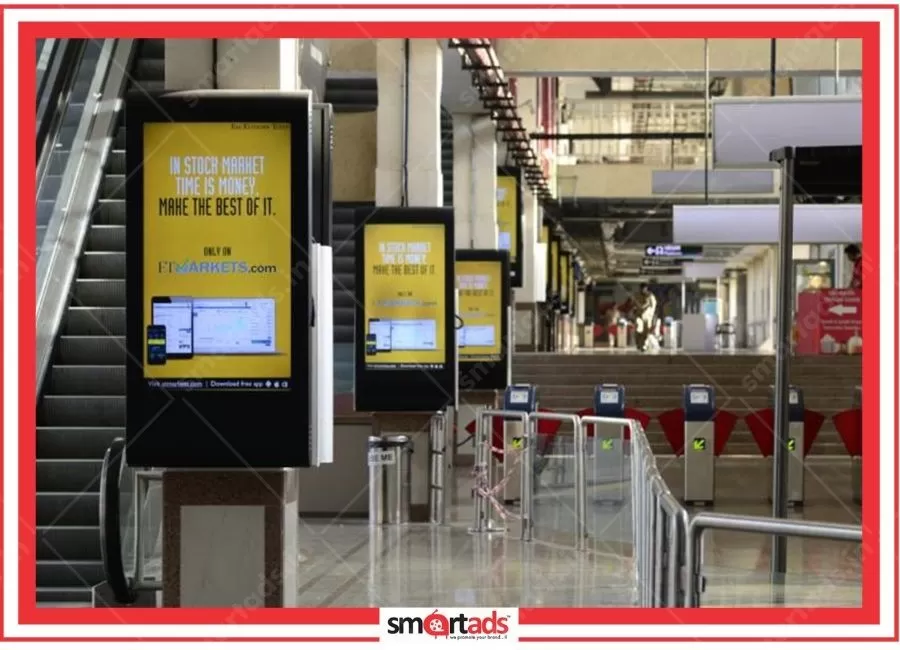
Entry Exit Panel
8 ft x 4 ft
Bright and vibrant multicolored letterin
Rate per Panel / 1 Month
Min Requirement is 3 Panel
₹48000.00
Showing 1 to 4 of 4 Results
MEDIA DETAILS
8 ft x 4 ft
Bright and vibrant multicolored letterin
Rate per Panel / 1 Month
Min Requirement is 3 Panel
₹48000.00
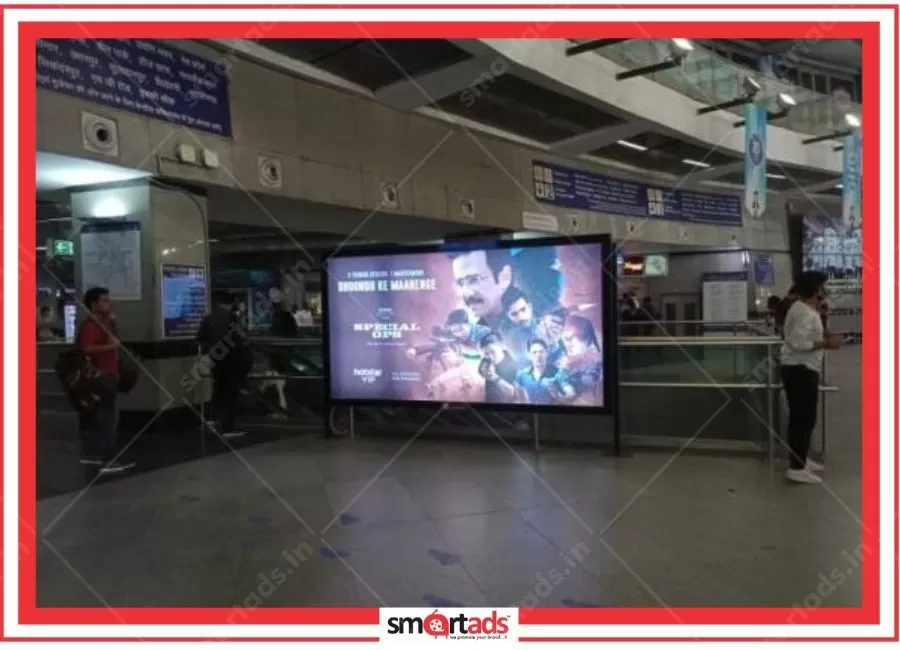
10 ft X 5 ft
A new wide wall system designed to acco
Rate per Panel / 1 Month
Min Requirement is 3 Panel
₹50000.00
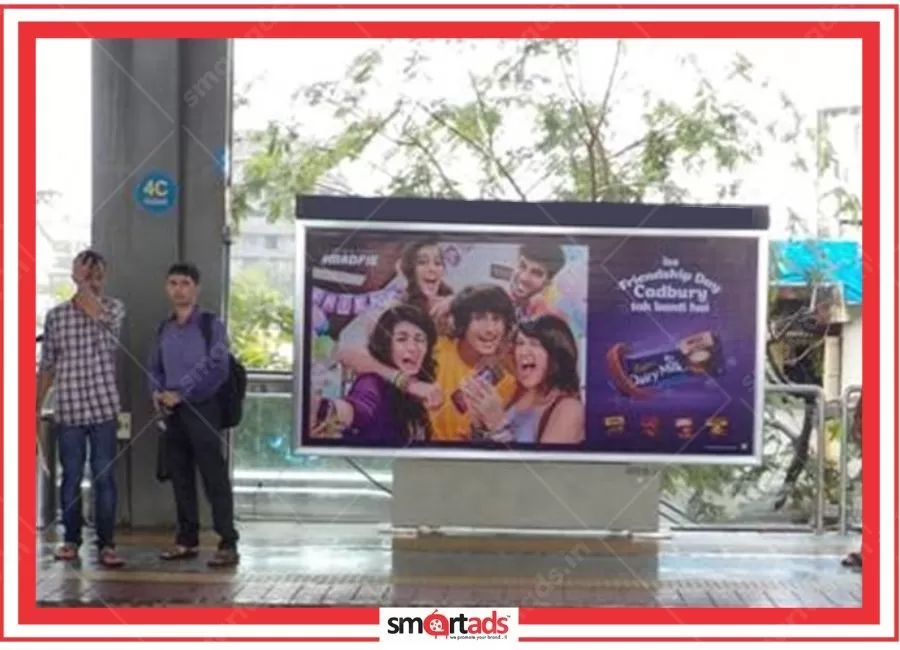
8 ft x 4 ft
A raised flooring or other horizontal su
Rate per Panel / 1 Month
Min Requirement is 3 Panel
₹35000.00
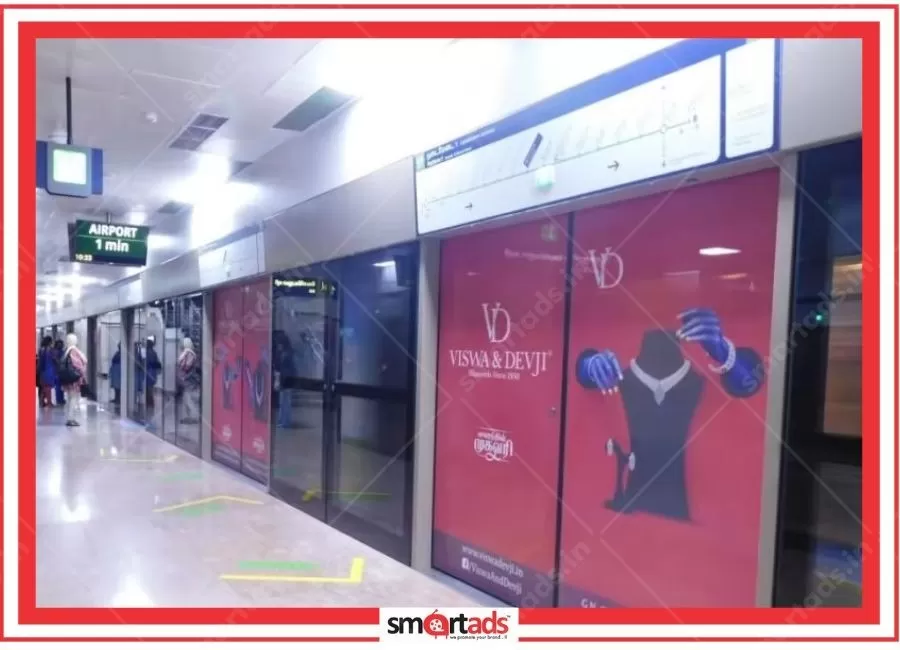
7 ft x 4 ft
Also known as platform edge doors (PEDs)
Rate per Plateform / 1 Month
Min Requirement is 1 Station
₹1200000.00
MEDIA REACH

MinimumQty :
10
EstimateReachPeople :
15 Million
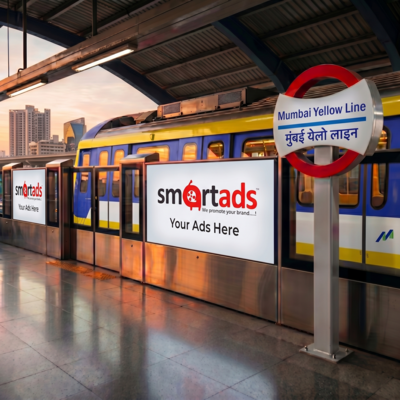
Mumbai's Yellow Line — the Versova-Andheri-Ghatkopar corridor — carries somewhere in the ballpark of 6 to 7 lakh daily commuters, which makes it one of the most concentrated audience pipelines in western India; yet most brands treat it like an afterthought, booking a panel or two without any real understanding of how the audience moves through these stations. That is a significant missed opportunity, and frankly speaking, one we see repeated across campaigns every quarter.
The Yellow Line is not simply a transit route; it is a cross-section of aspirational, working Mumbai — professionals commuting from Andheri and Jogeshwari, students from Ghatkopar heading toward colleges in the western suburbs, and retail consumers moving between some of the city's highest-footfall commercial zones. What a lot of people miss is that this corridor connects three distinct economic micro-markets — the eastern suburbs anchored by Ghatkodar, the central suburban belt around Andheri, and the coastal residential clusters near Versova — which means a single campaign running across the full line is effectively reaching audiences with very different purchase behaviours and income profiles.
Our experience at SmartAds shows that brands which approach the Yellow Line as a standalone OOH placement rarely extract its full value; the ones that see the best returns are those that think about station-level audience profiling before they book a single format. A food delivery brand we worked with in 2023 initially wanted blanket coverage across all 12 stations, but after we mapped peak-hour commuter density data against their delivery radius, we concentrated spend on just five stations — Andheri, Chakala, Ghatkopar, and two interchange points — and their cost-per-order from metro-influenced traffic dropped by roughly 34 percent compared to their previous outdoor campaign. The lesson there was not about spending less; it was about spending smarter.
To be fair, the Yellow Line also has a structural advantage that brands underestimate: it is one of the few transit corridors in Mumbai where the commuter is a captive audience for a predictable dwell time. Unlike a highway billboard viewed at 60 kilometres per hour, a commuter waiting on a platform or riding an escalator is stationary for anywhere between 90 seconds and four minutes, which is an eternity in advertising terms and more than enough time for a well-designed creative to register brand recall.
Metro station advertising on the Yellow Line operates through a concession model, where Mumbai Metro One Private Limited — the operating entity for Line 1 — has authorised specific vendors to manage advertising inventory across the network; this means the booking process is more structured than most outdoor formats and requires working with authorised partners rather than approaching the operator directly. The inventory itself is divided into several format categories: backlit panels on platforms, digital screens at entry and exit points, pillar wraps, concourse branding, escalator panels, and full station domination packages, which are the premium end of the offering.
What a lot of brands discover too late is that availability on this corridor is genuinely constrained, particularly for stations like Andheri — which functions as an interchange with the Western Railway suburban line — and Ghatkopar, which connects with the Harbour Line. These two stations alone see a disproportionate share of the daily footfall, and their premium inventory tends to get blocked months in advance by categories like BFSI, telecom, and real estate. At SmartAds, we always tell our clients that if you want Andheri or Ghatkopar, plan your booking at least eight to twelve weeks ahead; waiting for a last-minute slot is a strategy that consistently disappoints.
The format mix also matters more than most briefs acknowledge. A static backlit panel works well for brand recall and category presence, but if your objective is to drive an action — a QR scan, a store visit, an app download — then the digital screens near fare gates and escalator exits tend to outperform because they are positioned at decision points where the commuter is transitioning from transit mode to destination mode. This is where the real value lies, and it is a distinction that a purely rate-driven media plan will almost always miss.
Pricing on the Yellow Line varies considerably depending on format, station tier, and duration, which makes it difficult to quote a single number without knowing the campaign specifics; that said, we can share the ballpark ranges that our planning team works with regularly. A standard backlit panel at a mid-tier station like Jogeshwari or DN Nagar runs somewhere between ₹40,000 and ₹70,000 per month, while the same format at Andheri or Ghatkopar can push to ₹1.2 lakh or more depending on placement within the station. Digital screen slots at high-footfall stations are typically sold in 10-second spot packages, and a monthly package at a premium station works out to roughly ₹1.5 lakh to ₹2.5 lakh, which surprises most first-time metro advertisers when they compare it to what they are paying for equivalent reach on programmatic display.
Full station domination — where a single brand takes over all visible surfaces across one station for a defined period — is the format that generates the most memorable campaigns, and the cost for a station like Andheri works out to somewhere between ₹8 lakh and ₹15 lakh per month depending on the scope of formats included. That sounds significant, but when you calculate the cost per thousand impressions against the daily footfall, the CPM is actually in the ballpark of ₹12 to ₹18, which is competitive with mid-tier digital video placements and comes with the added weight of physical presence and environmental context that a screen ad simply cannot replicate.
One thing our team consistently negotiates for clients is value additions — extended duration, additional panels, or digital screen time added to a base package — which are more available on the Yellow Line than most advertisers realise, particularly in Q1 and the post-festive months of January and February when inventory pressure eases. A retail client we worked with in early 2024 got roughly 20 percent additional panel time added to their three-month package simply because we timed the booking during a low-demand window and negotiated proactively; that kind of planning discipline is what separates a good media buy from an average one.
This is genuinely a question that depends on your campaign objective, which is why we resist giving a one-size-fits-all answer even when clients push for one. Andheri station, as the busiest interchange point on the line, offers the highest raw footfall — estimates from the operator's own data suggest it handles upward of 1.2 lakh daily entries and exits — which makes it the default choice for reach-maximisation campaigns. Ghatkopar, at the eastern terminus, is the gateway for commuters from the eastern suburbs and Navi Mumbai who switch to the metro from the suburban rail network, which gives it a distinctly different audience profile — slightly older, more family-oriented, with strong purchase intent in categories like home improvement, insurance, and consumer durables.
The stations in the middle of the corridor — Chakala, Airport Road, Marol Naka — are often undervalued precisely because they sit between the two headline stations, but they serve some of Mumbai's densest commercial and IT park clusters, which means the audience walking through them between 8 AM and 10 AM is disproportionately composed of working professionals with above-average household incomes. An automotive brand we worked with specifically targeted Chakala and Marol Naka because their analytics showed that the catchment areas around those stations had the highest concentration of their target demographic — male professionals aged 28 to 42 with an annual household income above ₹12 lakh — and the campaign delivered a 28 percent higher test-drive inquiry rate compared to their simultaneous outdoor campaign on the Western Express Highway.
Versova, at the western terminus, is the station most brands overlook, and frankly speaking, that is sometimes an advantage. Because it sees lower footfall than Andheri or Ghatkopar, inventory there is more available and more negotiable; but the audience it does deliver is concentrated — residents of Versova, Andheri West, and Lokhandwala, which is one of Mumbai's highest-density upper-middle-class residential pockets. For categories like premium food delivery, luxury personal care, or premium OTT subscriptions, Versova can deliver a more surgically targeted audience than a higher-footfall station where the demographic is more diffuse.
The honest answer is that metro station advertising and traditional outdoor formats are not really competing for the same job, which is a distinction that gets lost when media planners are trying to allocate a fixed OOH budget. A highway hoarding on the Eastern Express Highway or the Western Express Highway gives you mass reach with very short exposure time; a Yellow Line station placement gives you lower raw reach but dramatically higher dwell time and a more captive audience. The FICCI-EY Media Report has consistently noted that transit advertising in Indian metros is growing faster than traditional OOH, driven precisely by this dwell-time advantage, and our own campaign data supports that directionally.
When we compare Yellow Line metro placements to, say, mall media in Andheri or Ghatkopar — which are the natural competing formats for a brand targeting the same geographic audience — the metro tends to win on cost efficiency for reach, while mall media tends to win on proximity to purchase decision. What we have found works best is a combination: use the metro to build frequency and brand salience during the commute, and use mall media or retail activations to convert that salience into action at the point of purchase. Treating them as substitutes rather than complements is one of the most common planning mistakes we see.
Compared to newspaper advertising in Mumbai — which, according to IRS data, still reaches a substantial daily readership in the city — metro station advertising delivers a younger, more urban, and more mobile-first audience; the two formats serve different psychographic profiles, which is why a truly integrated campaign often benefits from running both simultaneously rather than choosing between them.
Creative execution on the Yellow Line is an area where we have seen campaigns succeed and fail for reasons that had nothing to do with the media buy itself. The physical environment inside these stations — high ambient light, constant movement, moderate noise levels — means that creative which relies on fine print, complex messaging, or muted colour palettes tends to underperform significantly. What works is bold, high-contrast visual design with a single dominant message that can be absorbed in under three seconds, which is roughly the effective attention window for a commuter in motion.
Digital screens, which are increasingly common at the higher-footfall stations, allow for dynamic creative that can be rotated by time of day — a coffee brand running morning commute messaging between 7 AM and 10 AM and switching to an evening snack creative between 5 PM and 9 PM, for instance — and this dayparting capability is something that static OOH simply cannot offer. At SmartAds, we have found that campaigns which use dayparting on metro digital screens consistently outperform static campaigns on brand recall metrics, sometimes by a margin of 15 to 20 percentage points when post-campaign surveys are conducted in the station catchment areas.
Pillar wraps and escalator panels deserve a special mention because they are formats that create an immersive, almost unavoidable brand environment; a commuter ascending an escalator at Andheri during peak hour has approximately 45 to 60 seconds of uninterrupted exposure to whatever is displayed on the escalator side panels, which is a contact quality that no digital format can easily replicate. The creative challenge is designing for a vertical, sequential viewing experience — something that requires a different brief than a standard rectangular OOH panel, and something that a lot of creative agencies are not naturally set up to produce without specific guidance from the media planning team.
This is the question that comes up most often in client conversations, and to be honest, it is also the question that exposes the biggest gap between how metro advertising is sold and how it is evaluated. The standard metric offered by operators is footfall — total daily entries and exits at a station — which is a reach proxy rather than a direct measure of advertising impact; it tells you how many people could have seen your ad, not how many did, and certainly not how many took any action as a result.
What we have found more useful in practice is a combination of brand tracking surveys conducted in the station catchment areas before and after a campaign, mobile location data which can identify devices that were present at the stations during the campaign period and subsequently visited a brand's store or website, and direct response mechanics built into the creative itself — QR codes, short URLs, or specific offer codes that are exclusive to the metro campaign. The GroupM TYNY Report and similar industry publications have noted that transit OOH is increasingly being integrated with mobile retargeting, where commuters who are detected near metro stations are served follow-up digital ads; this kind of sequential cross-channel activation is something we actively build into Yellow Line campaigns for clients who have the digital infrastructure to support it.
A BFSI client we ran a Yellow Line campaign for in late 2023 used a dedicated landing page URL on their station creative and tracked direct traffic to that URL throughout the campaign period; they recorded roughly 4,200 unique URL visits over a six-week campaign, which translated to approximately 380 completed lead forms — a conversion rate that their digital team described as significantly better than their equivalent paid search campaigns for the same product. The metro campaign cost was in the ballpark of ₹9 lakh for the six-week period, which worked out to a cost per lead of roughly ₹2,370 — a number that, in the context of a high-value financial product, was well within their acceptable acquisition cost range.
The administrative side of metro advertising is something that catches first-time advertisers off guard, and frankly speaking, it is an area where working with an experienced agency saves a significant amount of time and friction. Mumbai Metro One has specific content guidelines which prohibit certain categories outright — political advertising, tobacco products, and content that could be deemed offensive in a public transit environment — and all creatives must be submitted for approval before installation, with a lead time that typically runs between 10 and 15 working days for standard formats.
The physical production of metro advertising materials is also more demanding than standard OOH, because the materials need to meet specific substrate and fire-retardancy standards mandated by the metro operator; this means that a creative produced for a highway hoarding cannot simply be reprinted and used inside a metro station without reformatting and potentially re-producing on compliant materials. At SmartAds, we manage this production coordination as part of our end-to-end service, which means clients do not have to navigate the vendor ecosystem independently — a process that can add two to three weeks to a campaign timeline if it is not managed proactively.
Campaign durations on the Yellow Line are typically sold in monthly blocks, with a minimum booking period of one month for most formats; however, shorter-duration packages are sometimes available for digital screen placements, particularly around specific events or festivals, and these can be negotiated directly through the authorised vendor network. The booking process requires a formal purchase order, advance payment or a credit arrangement with the vendor, and submission of creative materials within a defined window — all of which sounds straightforward but has a way of compressing timelines when a client is working to a campaign launch date that was decided independently of the media booking process.
The Yellow Line works best when it is not asked to carry the full weight of a campaign on its own, which is a principle that applies to almost every individual media format but is especially true for transit advertising. What we tell our clients is that the metro is an exceptional frequency builder and a powerful tool for geographic concentration — if you want to dominate the mindshare of the Andheri-to-Ghatkopar corridor, there is arguably no more efficient way to do it — but it needs to be supported by formats that extend reach beyond the commuter audience and formats that drive conversion at the point of decision.
A well-structured Mumbai media plan for a brand targeting the Yellow Line corridor might combine metro station advertising for frequency and brand salience, with radio on stations that index strongly with the same demographic — Radio Mirchi and Radio City both have strong listenership in the western and central suburbs — and digital retargeting that follows the metro commuter from the station to their mobile screen during the evening. This kind of cross-channel sequencing, where the metro ad creates the first impression and the digital ad reinforces it later in the day, is something that the TAM AdEx data on cross-media exposure has consistently shown to outperform single-channel campaigns on both recall and purchase intent metrics.
On top of that, the Yellow Line corridor has a natural retail and commercial geography that makes it ideal for integration with hyperlocal digital campaigns — specifically, campaigns that use geo-fencing around individual metro stations to serve mobile ads to users who are physically present in or near the station. We have run this kind of integrated campaign for an e-commerce client where the metro creative drove brand awareness and the geo-fenced mobile ad served a same-day discount offer to users detected within 200 metres of the station; the combined campaign delivered a 41 percent higher conversion rate than either channel running independently, which is the kind of outcome that makes a strong case for integration over isolation.
Q: What is the minimum budget required to run a campaign on the Yellow Line?
A meaningful campaign on the Yellow Line — one that runs for a full month and covers at least two or three stations with a mix of formats — typically requires a minimum budget in the ballpark of ₹3 lakh to ₹5 lakh; below that threshold, the reach and frequency are generally too limited to generate measurable brand impact. That said, a single-station, single-format placement at a mid-tier station can be executed for as little as ₹40,000 to ₹70,000 per month, which makes the format accessible even for smaller brands or regional advertisers who want to test the medium before committing to a larger buy. What we generally advise is to think of the first campaign as a learning exercise — use it to establish baseline metrics, test creative formats, and understand which stations deliver the most relevant audience for your category — and then scale the investment based on what the data tells you.
Q: How far in advance do I need to book metro station advertising on the Yellow Line?
For premium stations like Andheri and Ghatkopar, and for high-demand periods like the festive quarter from September to November, a booking lead time of eight to twelve weeks is not just advisable — it is essentially necessary if you want your preferred format and placement. For mid-tier stations and off-peak periods, four to six weeks is usually sufficient, though even that window can compress quickly if multiple advertisers are targeting the same category period. The practical reality is that the Yellow Line has a finite inventory — there are only so many platform panels and digital screens across 12 stations — and that inventory is increasingly being recognised as valuable, which means the days of last-minute availability at good rates are largely behind us. Our recommendation is always to start the conversation with the planning team as early as possible, even if the campaign brief is still being finalised.
Q: Can small and medium businesses afford metro station advertising, or is it only for large brands?
Metro station advertising on the Yellow Line is more accessible to small and medium businesses than most people assume, particularly at the single-station level; a local business in Andheri or Ghatkopar with a catchment area that naturally aligns with the station's footfall zone can run a month-long backlit panel campaign for a budget that is comparable to a modest digital campaign. The key for SMBs is to be surgical rather than broad — pick one station that is closest to your business or most relevant to your customer base, choose a format with good dwell time like a platform panel or escalator display, and run a creative that gives commuters a specific reason to act. What we have seen work particularly well for local businesses is combining a metro panel with a geo-fenced mobile campaign around the same station, which creates a two-touchpoint system that is affordable even for businesses with monthly marketing budgets in the range of ₹1 lakh to ₹2 lakh.
Q: What categories of advertisers perform best on the Yellow Line?
From our campaign experience and from the broader patterns visible in the TAM AdEx transit advertising data, the categories that consistently perform well on the Yellow Line are BFSI — particularly mutual funds, insurance, and credit cards — real estate, telecom, consumer electronics, e-commerce, food and beverage, and education. These categories align well with the demographic profile of the Yellow Line commuter, which skews toward urban working professionals and students in the 22 to 45 age bracket with above-average disposable income and high smartphone usage. Categories that tend to underperform are those with very niche or narrow target audiences that do not map well to the general commuter profile, or those that require a longer, more complex message to drive consideration — the metro environment rewards simplicity and emotional immediacy, not detailed product specifications.
Q: How does the Yellow Line audience differ from the Blue Line or Monorail audience?
The Yellow Line — the original Line 1 corridor — has a more established and predictable commuter base than the newer metro lines in Mumbai, partly because it has been operational since 2014 and has had time to become genuinely integrated into the daily commute patterns of the western and central suburbs. The Blue Line (Line 2A and 7) which runs through Dahisar to DN Nagar and Andheri to Dahisar, serves a somewhat different catchment — more residential, with a higher proportion of family-oriented commuters — while the Monorail, which operates in a more limited corridor, has a distinctly different and smaller audience. The Yellow Line's unique advantage is the Andheri interchange, which creates a convergence of commuters from multiple transit systems and generates a footfall density that no other metro corridor in Mumbai currently matches; for a brand that wants to reach the broadest possible cross-section of aspirational urban Mumbai in a single corridor, the Yellow Line remains the first choice.
Q: What kind of creative specifications do I need for Yellow Line metro advertising?
Creative specifications vary by format, but the general principle is that metro advertising materials need to be produced at higher resolution than standard print — typically 150 DPI or above for large-format backlit panels — and on substrates that meet the fire-retardancy standards specified by the metro operator. Digital screen creatives need to be supplied in specific aspect ratios and file formats that vary by screen manufacturer and location within the station, which is why it is important to get the exact specifications from the vendor before briefing your creative agency. Beyond the technical requirements, the practical creative guidance we always give is to design for a three-second read — one dominant visual, one headline, one call to action — because the commuter environment does not reward complexity. Brands that try to carry too much information on a metro panel consistently underperform compared to those that commit to a single, bold message.
The Yellow Line is, in our view, one of the most underutilised premium media properties in Mumbai — not because brands are unaware of it, but because most campaigns treat it as a simple OOH placement rather than as a strategic audience environment that rewards careful planning and creative discipline. The corridor's combination of captive dwell time, a well-defined demographic profile, and a physical presence in some of the city's most commercially active zones makes it genuinely distinctive; the brands that extract the most value from it are those that come in with a clear audience hypothesis, a creative approach designed specifically for the transit environment, and a plan to integrate the metro placement with complementary formats that extend reach and drive conversion.
What we have learned across years of planning campaigns on this corridor is that the medium itself is not the variable — the planning rigour is. A well-planned Yellow Line campaign with a modest budget consistently outperforms a poorly planned one with a generous budget, which is a principle that sounds obvious but is violated regularly when media decisions are made on the basis of rate negotiation alone rather than strategic fit.
If you are evaluating metro station advertising on the Yellow Line as part of your next Mumbai campaign, the SmartAds media planning team works with clients across categories and budget sizes to build plans that are grounded in real footfall data, station-level audience intelligence, and creative guidance that is specific to the transit environment. Reach out to us at SmartAds.in to discuss your campaign objectives, and we will put together a station-by-station recommendation that is built around your audience rather than around inventory availability.
