


Delhi

Mumbai

Bengluru

Ahmedabad

Jaipur

Chennai

Hydrabad

Kolkatta

Lucknow

Pune
Outdoor Mobile Van Advertising | OOH Mobile Van Advertising Services India | Mobile Van Branding, LED Van Advertising India, Canter Advertising Agency India, Mobile Billboard Advertising India, PAN India Van Advertising
This article contains actual rate benchmarks, city-wise pricing intelligence, format comparisons, GPS monitoring protocols, and anonymised campaign data from SmartAds campaigns across 500+ Indian cities — the kind of specific, actionable information that most agency pages deliberately leave out.
What Is Outdoor Mobile Van Advertising and How Does It Work in India?
Most people who encounter a branded van crawling through a busy market in Lucknow or Coimbatore think of it as a local, small-budget tactic — which is a significant underestimation of what outdoor mobile van advertising actually delivers at scale. The format is, at its core, a moving billboard: a vehicle — ranging from a compact Tata Ace to a full-sized canter van — wrapped in brand messaging, equipped with audio systems, LED screens, or static flex panels, and routed through pre-planned high-traffic areas to generate impressions across multiple locations in a single day. What separates it from every other OOH format is the fundamental advantage of mobility; a static hoarding reaches whoever passes by, while a mobile van advertising unit goes to wherever the audience is.
The operational mechanics are straightforward, but the planning behind them is where the real craft lies. A campaign begins with route mapping — identifying the localities, market clusters, residential zones, or commercial corridors that index highest for the target demographic — which is then followed by vehicle configuration (choosing between LED display van, flex van, or canter van based on budget and objective), creative production, and finally deployment with a driver and, in most cases, a brand promoter. In metro markets like Delhi, Mumbai, and Bangalore, most operators run vans on 8-to-10-hour shifts; in Tier 2 cities India, a 6-hour route often covers the entire relevant commercial geography of a city like Nagpur or Vadodara. At SmartAds, we always tell our clients that the route plan is the campaign — the creative is secondary to getting the van in front of the right eyes at the right time of day.
The India OOH market, valued at roughly USD 469.7 million as of 2024 according to industry estimates, has seen mobile van advertising grow as a proportion of total out-of-home advertising spend, particularly as brands seek formats that can be deployed quickly, adjusted mid-campaign, and targeted to specific pin codes rather than fixed locations. This flexibility — which static billboard advertising simply cannot offer — is why FMCG brands, real estate developers, political parties, and e-commerce players have all increased their mobile van advertising budgets meaningfully over the past two years. The format is also one of the few OOH vehicles that works equally well as a standalone brand awareness driver and as a BTL activation platform, which makes it unusually versatile for integrated campaign planning.
What Are the Different Types of Mobile Van Advertising Available in India?
The terminology around mobile van advertising in India is genuinely confusing — "canter activity," "LED van," "flex van," "roadshow van," "advertising van" — and a lot of first-time buyers end up booking the wrong format for their objective, which is a waste of both budget and opportunity. Broadly speaking, the formats divide along two axes: vehicle size and display technology. On the vehicle side, the most commonly deployed units are the Tata Ace (a compact mini-truck ideal for narrow lanes and dense urban markets), the Mahindra Maximo, the Tata 407, and the Eicher 609, which is the workhorse of large-format canter advertising and the vehicle most commonly associated with roadshow advertising for product launches and political campaign advertising.
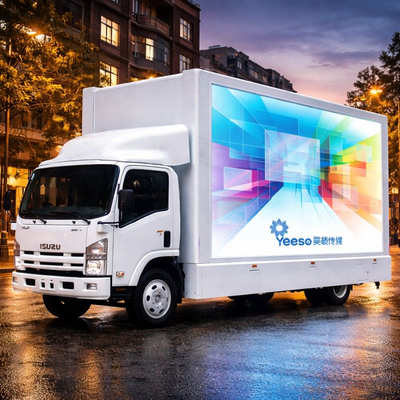
On the display technology side, the distinction between LED van advertising and static flex van advertising is the most commercially significant choice a planner will make. A flex van — sometimes called a T-shape van or L-shape box van depending on the panel configuration — uses printed vinyl or flex panels mounted on the vehicle's body; it is cheaper to produce, easier to deploy across multiple cities simultaneously, and perfectly adequate for brand promotion campaigns where the creative is largely static. An LED display van, by contrast, carries a high-brightness LED screen (typically ranging from 6×4 feet on a Tata Ace to 10×6 feet or larger on a canter van) that can display video content, animated graphics, and even live feeds — which makes it the format of choice for product launch advertising, brand activation events, and election campaign van deployments where dynamic content drives crowd engagement. The audio systems advertising van adds another dimension: a van equipped with a PA system and a brand promoter with a microphone, which is particularly effective in smaller markets where personal address still carries significant persuasive weight.
There is also a hybrid category that has emerged over the past couple of years — the digital mobile van, which combines LED display capability with integrated Bluetooth speakers, QR code van advertising panels, and sometimes even a small stage platform on the vehicle bed — which is increasingly being used for product sampling campaigns and brand activation in Tier 2 cities India where experiential marketing infrastructure is limited but consumer curiosity is high. We have worked with a pharmaceutical client in Rajasthan who used this format specifically because it allowed a doctor to address a crowd via the PA system while the LED screen displayed clinical data; the campaign covered 14 towns in 21 days and generated footfall at local pharmacy counters that the client's sales team tracked directly against the van's route log.
How Much Does Outdoor Mobile Van Advertising Cost in India?
Frankly speaking, the pricing opacity in mobile van advertising is one of the things that frustrates us most about how this medium is sold in India — most vendors quote vague "packages" without explaining what drives the cost, which leaves brand managers unable to benchmark or negotiate effectively. The cost of mobile van advertising in India is determined by four primary variables: vehicle type and size, display technology (LED vs flex), city tier, and campaign duration. Understanding how these interact gives you a meaningful framework for evaluating mobile van advertising rates before you speak to any vendor.
In a Tier 1 market like Delhi or Mumbai, a basic flex van (Tata Ace, static panels, no audio) runs somewhere in the ballpark of ₹3,500 to ₹5,500 per day, which includes the vehicle, driver, and creative mounting but not the creative production itself. A full-sized canter van with static flex panels in the same markets works out to roughly ₹6,000 to ₹9,000 per day. LED van advertising — the format that commands a premium because of screen hardware, power equipment, and technical operator costs — typically falls somewhere between ₹8,000 and ₹18,000 per day in metro markets, depending on screen size and whether the campaign includes video content management. In Bangalore and Hyderabad, rates tend to run about 10 to 15 percent lower than Delhi and Mumbai for equivalent formats, which reflects both lower operational costs and a slightly more competitive vendor market. In Tier 2 cities India like Jaipur, Indore, Coimbatore, or Bhubaneswar, a flex van can often be booked for as little as ₹2,000 to ₹3,500 per day — which is a number that surprises most first-time advertisers when they compare it to what they are paying for digital display reach in the same markets.
Mobile van advertising packages for multi-city PAN India campaigns introduce significant economies of scale; a 30-day PAN India van advertising campaign running across 20 cities simultaneously — which is the kind of deployment we manage regularly at SmartAds — can bring the effective per-city per-day cost down by 25 to 40 percent compared to booking each city independently. The cost per thousand impressions (CPM) for mobile van advertising, when calculated against a conservative estimate of 15,000 to 25,000 impressions per day in a metro market, works out to somewhere between ₹15 and ₹35 — which compares very favourably to digital display advertising CPMs in Indian markets, which routinely run higher while delivering significantly lower attention quality. One FMCG client we worked with in the biscuits category ran a 45-day mobile van advertising campaign across 35 cities for a total budget of approximately ₹42 lakh; the campaign generated an estimated 1.8 crore impressions, which their brand tracking study subsequently confirmed had produced a 14-point lift in brand recall in the campaign markets versus control markets.
What Are the Advantages of Mobile Van Advertising Over Hoardings and Billboards?
The comparison between mobile van advertising and static hoarding advertising is one that comes up in almost every planning conversation we have, and the honest answer is that they serve different purposes — but mobile van advertising wins on dimensions that are increasingly important to modern campaign objectives. A hoarding in Connaught Place or Andheri reaches a massive audience, but it reaches the same audience repeatedly; a mobile van advertising unit, by contrast, can cover 8 to 12 distinct localities in a single day, which means the impressions per day figure is spread across a genuinely diverse cross-section of the target market rather than concentrated in one location.
The flexibility advantage of mobile billboard advertising is not just about geography — it is also about timing. A static billboard cannot be repositioned if a competitor puts up a hoarding next to it, cannot follow a festival crowd from one venue to another, and cannot be redirected to a new market if the original plan underperforms. A mobile van advertising campaign can be rerouted within 24 hours, which gives brand managers a level of tactical control that out-of-home advertising has historically never offered. We have seen this flexibility save campaigns on multiple occasions — most memorably, a retail client in Pune whose van campaign was originally planned around a new mall opening, which got delayed; we rerouted the vans to the existing high-street markets in Kothrud and Aundh within a day, and the campaign actually outperformed the original plan because the audience density in those markets was higher than projected.
The cost-effective advertising case for mobile van advertising versus hoarding advertising is also compelling when you examine it at the market level rather than the format level. A premium hoarding on a key arterial road in Mumbai or Delhi can cost anywhere from ₹2 lakh to ₹8 lakh per month for a single face — which delivers high impressions but zero flexibility, zero audio capability, and zero ability to generate direct engagement. A canter van advertising campaign in the same market, running for 30 days, can be executed for a fraction of that cost while covering multiple localities, incorporating audio messaging, and enabling brand promoters to conduct on-ground sampling or demonstrations. For brand awareness campaigns where reach breadth matters more than frequency at a single location, mobile van advertising consistently delivers a better cost-per-reach outcome.
Which Cities Are Best for Mobile Van Advertising Campaigns in India?
The cities that work best for mobile van advertising are not always the ones you would expect — which is a point worth making clearly, because a lot of campaign briefs default to Delhi and Mumbai without considering whether the brand's actual consumer base is concentrated in those markets or in the Tier 2 cities India where mobile van branding often delivers disproportionately higher impact per rupee. That said, Delhi remains the single most active market for outdoor mobile van advertising in India, both because of the sheer scale of its population and because the city's diverse geography — from the dense lanes of Chandni Chowk to the planned sectors of Dwarka — creates natural route variety that maximises impressions across different audience segments.
Mumbai is the second most active market, though the city's traffic conditions require more careful route planning; vans running through Andheri, Borivali, or Thane during peak hours can generate exceptional impressions per day, while poorly planned routes that get stuck in the Bandra-Kurla Complex or the Western Express Highway during rush hour can waste 3 to 4 hours of deployment time. Bangalore presents a different challenge — the city's rapid expansion means that areas like Koramangala and MG Road are saturated with advertising stimuli, while newer corridors in Whitefield, Sarjapur Road, and Hebbal offer high-density residential and commercial audiences that are significantly less cluttered from an OOH advertising standpoint. Hyderabad has emerged as one of the most efficient markets for mobile van advertising in recent years, particularly for FMCG advertising India and real estate advertising outdoor, because the city's relatively grid-like layout makes route planning more predictable and the cost of van deployment remains lower than in the four major metros.
The case for Tier 2 cities India — and we make this case to clients regularly — is often the strongest of all. A mobile van advertising campaign in a city like Lucknow, Kanpur, Surat, Rajkot, Nashik, or Coimbatore can achieve near-total market coverage in 5 to 7 days of deployment, because the commercial and residential geography is compact enough that a single van can touch every significant locality in a week. The brand visibility impact in these markets is also qualitatively different; in a city where outdoor advertising India is less saturated, a well-branded canter van with audio and LED capability generates genuine curiosity and crowd engagement that is difficult to replicate in a metro environment. For PAN India van advertising campaigns, we typically recommend allocating 40 to 50 percent of the van fleet to Tier 2 and Tier 3 cities India, because the cost efficiency and relative impact are both significantly higher than the metro markets on a per-rupee basis.
LED Van vs Flex/Static Van: Which Mobile Advertising Format Is Right for You?
The choice between LED van advertising and a static flex van is fundamentally a question of what you want the van to do — and most brands, in our experience, default to LED because it sounds more impressive without fully accounting for the operational trade-offs that come with it. LED van advertising is genuinely superior for campaigns where dynamic content is the point: product launch advertising where a video TVC needs to play in a market, election campaign van deployments where a candidate's speech or testimonial reel needs to be broadcast to a crowd, or brand activation events where the van is a destination rather than a moving unit. The high-brightness LED display van creates a spectacle that draws attention even in daylight, which is its primary advantage over flex; in a crowded market or at an evening event, an LED screen running video content will out-perform a static panel on every engagement metric.
The flex van — whether configured as a T-shape (panels on three sides of the vehicle) or an L-shape box van — has advantages that are frequently underestimated. Production costs are dramatically lower; a set of flex panels for a Tata Ace can be produced for ₹8,000 to ₹15,000, while an LED van campaign requires either renting a van that already has the screen infrastructure or investing in content that is optimised for outdoor LED display, which adds production cost and time. Flex vans are also easier to deploy across multiple cities simultaneously for PAN India van advertising, because the creative can be printed and shipped to any city in India within 48 to 72 hours; LED vans, by contrast, are locally sourced and their availability varies significantly by market. For mobile van branding campaigns where the objective is sustained brand awareness over a 30-to-60-day period across many markets, the flex van typically delivers a better total campaign ROI because the lower daily rate allows for longer deployment or wider geographic coverage on the same budget.
To be fair, the right answer for most mid-size campaigns is a combination of both formats — which is the approach we recommend at SmartAds for clients with budgets above ₹10 lakh for a mobile van advertising campaign. The LED display van serves as the campaign flagship in the top 3 to 5 priority markets, creating high-impact moments and generating social media content; the flex van fleet covers the broader geographic footprint at lower cost. One automotive brand we worked with used exactly this approach for a new model launch across 18 cities: 3 LED vans in Delhi, Mumbai, and Bangalore handled the high-visibility roadshow advertising, while 15 flex canter vans covered the remaining markets — the campaign generated over 2.2 crore impressions in 21 days, and the client's dealer network reported a 22 percent increase in walk-in enquiries during the campaign period compared to the same period in the previous year.
Canter Van Advertising: The Bigger Format Option
Canter advertising occupies a specific and important niche in the mobile van advertising ecosystem — it is the format that commands the most attention, generates the largest visual footprint, and is most commonly associated with high-impact roadshow advertising and product launch advertising in India. A canter van, typically built on an Eicher 609 or Tata 407 chassis, offers a significantly larger body surface than a Tata Ace or Mahindra Maximo; the side panels on a standard canter van advertising configuration can run to 14 to 16 feet in length and 6 to 7 feet in height, which creates a visual impact that is genuinely comparable to a mid-size hoarding advertising unit — except that it moves through the market rather than sitting at a fixed point.
Canter van branding is the format of choice for campaigns where the creative needs to be seen from a distance and where the sheer scale of the vehicle is part of the brand statement. FMCG advertising India campaigns for new product launches, political campaign advertising during election season, and real estate advertising outdoor for project launches all tend to favour canter van branding because the format communicates scale and seriousness in a way that a smaller Tata Ace simply cannot. The canter van also offers more surface area for multi-panel creative configurations — front, rear, and both sides can carry different creative messages, which allows a single vehicle to serve multiple communication objectives simultaneously; a real estate developer, for instance, might use the side panels for project imagery and the rear panel for a QR code van advertising panel that drives traffic to a digital enquiry form.
Canter advertising rates in metro markets typically run somewhere between ₹7,000 and ₹12,000 per day for static flex configurations, and between ₹15,000 and ₹25,000 per day for LED-equipped canter van branding units — numbers that reflect both the larger vehicle operating costs and the higher impact the format delivers. In Tier 2 cities India, canter van advertising can often be sourced for 30 to 40 percent less than metro rates, which makes it an exceptionally cost-effective advertising option for brands that want large-format impact without metro market pricing. The minimum campaign duration for canter advertising is typically 7 days in most markets, though we have managed shorter deployments for specific event-linked activations.
How Do You Plan and Execute a Mobile Van Advertising Campaign Step by Step?
Planning a mobile van advertising campaign that actually delivers against its objectives — rather than just generating activity reports — requires a level of strategic rigour that most brands do not apply to what they perceive as a "simple" OOH format. The first and most critical step is audience mapping: identifying not just the city or market, but the specific localities, time windows, and route corridors where the target consumer is physically present in sufficient density to justify deployment. This means going beyond broad demographic data to understand the daily movement patterns of the target audience — which residential areas they live in, which markets they shop in, which arterial roads they commute on, and at what times of day those locations are most densely populated.
The second step — which is where a lot of campaigns go wrong — is the permit and permissions process. Mobile van advertising in India operates under a patchwork of municipal, RTO, and state-level regulations that vary significantly by city; in Delhi, for instance, the Municipal Corporation of Delhi (MCD) requires prior permission for advertising vans operating within the city limits, and there are specific restrictions on sound system usage in certain zones and during certain hours. Mumbai's BMC has its own permit framework, and many Tier 2 cities have their own local body requirements. The RTO registration of the vehicle must also be verified to ensure it is classified appropriately for commercial advertising use. At SmartAds, we manage the entire permissions process for our clients as part of campaign execution — which is not a trivial service, because a van operating without proper permits can be impounded, which brings a campaign to an abrupt halt and creates legal liability for the advertiser.
Creative production, route finalisation, vehicle deployment, and daily monitoring constitute the execution phase — which, in a well-managed campaign, runs on a daily operations protocol that includes GPS tracking mobile van data, geo-tagged campaign monitoring reports, and daily photographic evidence of deployment. The route plan should be reviewed and adjusted weekly based on performance data; if a particular locality is generating strong engagement (measured by promoter interactions, QR code scans, or simply crowd response) while another route is underperforming, the campaign plan should be flexible enough to reallocate deployment time accordingly. We have found that campaigns which build in a formal weekly review and route optimisation step consistently outperform those that run a fixed route for the entire campaign duration — the difference in effective impressions per day between an optimised and an unoptimised route plan can be as high as 30 to 40 percent over a 30-day campaign.
How Is Campaign Performance Tracked and Monitored for Mobile Van Advertising?
The monitoring question is the one that used to make mobile van advertising difficult to justify to sceptical CFOs and marketing directors — "how do we know the van actually went where it was supposed to go?" — and the answer, in 2025, is considerably more satisfying than it was even five years ago. GPS tracking mobile van systems are now standard practice for professionally managed outdoor mobile van advertising campaigns; every vehicle in a well-run campaign carries a GPS device that logs real-time location data at intervals of 1 to 5 minutes, which produces a complete route trace that can be overlaid on a city map and verified against the planned route. Geo-tagged campaign monitoring takes this further by requiring the driver or brand promoter to submit time-stamped, location-tagged photographs at specified checkpoints throughout the day — which provides visual confirmation that the van was present at the agreed locations at the agreed times.
Beyond route compliance, the more meaningful measurement challenge is quantifying impressions and brand recall — which requires a combination of estimation methodology and primary research. The impressions per day figure for a mobile van advertising unit is estimated using traffic count data for the routes covered, adjusted for the proportion of pedestrian versus vehicular traffic (since pedestrian audiences have higher dwell time and therefore higher recall probability), and further adjusted for the van's average speed and stopping frequency. A conservative estimate for a metro market route covering 8 to 10 localities over a 10-hour shift is somewhere between 15,000 and 30,000 impressions per day — a figure that the GroupM TYNY Report and similar industry analyses support as a reasonable benchmark for well-planned mobile van advertising campaigns in dense urban markets. For campaigns where brand recall measurement is a specific objective, we recommend commissioning a simple aided recall survey in the campaign markets at the midpoint and end of the campaign, using a matched control market for comparison — which is exactly the methodology we used for the FMCG campaign referenced earlier, and which produced the 14-point recall lift figure that justified the client's continued investment in the format.
QR code van advertising panels have added a new layer of directly measurable engagement to mobile van advertising campaigns; when a QR code is prominently featured on the van's creative and linked to a campaign-specific landing page, the scan data provides a direct, unambiguous measure of audience interaction that no other OOH format can match. We have seen QR code scan rates on mobile van advertising panels ranging from 0.3 to 1.2 percent of estimated impressions — which sounds small but translates to thousands of direct, intentional brand interactions per campaign, each of which represents an audience member who was sufficiently engaged to take out their phone and scan a code on a moving vehicle.
Can Mobile Van Advertising Reach Tier 2 and Tier 3 Cities in India?
This is, frankly, where mobile van advertising has its strongest competitive advantage over almost every other OOH format — and it is an advantage that is systematically underutilised by brands that think of outdoor advertising India as a metro-only medium. The infrastructure constraints that limit billboard advertising India in smaller markets — the shortage of premium hoarding sites, the limited availability of large-format transit advertising inventory — simply do not apply to mobile van advertising, because the format creates its own infrastructure by bringing the advertising unit to the market rather than waiting for the market to come to the advertising unit.
In a Tier 3 city India like Muzaffarpur, Bhagalpur, Tirunelveli, or Bilaspur, a single well-deployed mobile van advertising unit can achieve what would require 20 to 30 static hoarding sites to replicate in terms of geographic coverage — and at a fraction of the cost. The brand visibility impact in these markets is also qualitatively different from what brands experience in metros; in a city where branded van advertising is still relatively novel, a canter van with LED display and audio systems generates genuine community attention that translates into strong brand recall. We have managed PAN India van advertising campaigns for FMCG clients that specifically prioritised Tier 2 and Tier 3 cities India, and the brand tracking data from those campaigns consistently shows higher recall lift in the smaller markets than in the metros — which is counterintuitive to most brand managers but makes complete sense when you consider the lower advertising noise levels in those environments.
The logistics of running mobile van advertising in smaller markets have also improved significantly; most Tier 2 cities India now have established local operators who can be coordinated through a national mobile van advertising agency, which eliminates the need for brands to manage city-by-city vendor relationships independently. At SmartAds, our network covers 500+ Indian cities, which means we can execute a simultaneous 50-city PAN India van advertising deployment with a single point of contact, unified reporting, and consistent creative standards across every market — which is the kind of operational capability that makes the difference between a mobile van advertising campaign that feels professionally managed and one that feels like a collection of local experiments.
What Industries Benefit Most from Mobile Van Advertising in India?
The honest answer is that mobile van advertising works for almost any category that needs to build brand awareness or drive trial in a geographically specific market — but there are industries where the format delivers disproportionately strong results, and it is worth understanding why. FMCG advertising India is the single largest category for mobile van advertising by volume, and for good reason: FMCG brands need to reach consumers at the point of purchase consideration, which means being present in the markets, lanes, and residential areas where shopping decisions are made — exactly the territory that mobile van advertising covers most effectively. Product sampling campaigns, in particular, are almost always executed using van advertising as the distribution and awareness vehicle, because the van can carry stock, a promoter, and the brand messaging simultaneously.
Real estate advertising outdoor has become a major growth category for mobile van advertising over the past three years, driven by the boom in residential project launches in Tier 2 cities India and the need to reach buyers who are not necessarily consuming digital advertising at the frequency that metro buyers do. A real estate developer launching a project in a city like Nagpur or Coimbatore will typically use canter van advertising to cover the residential localities and office corridors where potential buyers are concentrated, combining the van campaign with a QR code van advertising panel that drives traffic to the project's digital enquiry form — which creates a measurable bridge between the OOH campaign and the digital lead generation funnel. Political campaign advertising is another significant category, particularly during election season; election campaign van deployments are one of the most intensive uses of the format in India, with parties and candidates running multiple canter vans simultaneously across constituencies for weeks at a time.
Healthcare, education, and e-commerce have all increased their mobile van advertising spend meaningfully in recent years. Healthcare brands — particularly pharmaceutical companies launching OTC products and hospital chains promoting speciality services — find the format effective for reaching specific residential clusters and market areas. Educational institutions use mobile van advertising for admission season campaigns, particularly in Tier 2 cities India where the target audience is often more effectively reached through on-ground presence than through digital channels. E-commerce brands, somewhat counterintuitively, have found mobile van advertising effective for driving app downloads and first-purchase behaviour in markets where digital advertising alone has not broken through — the combination of a physical brand presence and a QR code van advertising panel that links directly to the app store has proven particularly effective for this objective in several campaigns we have managed.
What Are the Latest Trends in Mobile Van Advertising in India for 2025–2026?
The most significant trend reshaping mobile van advertising in India right now is the integration of the format into omnichannel OOH campaign planning — which means treating the mobile van not as a standalone below-the-line advertising unit but as a connected node in a broader campaign ecosystem that includes digital, social, and programmatic DOOH elements. A mobile van advertising campaign that is planned in isolation delivers brand awareness; a mobile van advertising campaign that is coordinated with a simultaneous digital retargeting campaign, a WhatsApp-based engagement mechanic, and a social media amplification strategy delivers brand awareness and measurable conversion — which is a fundamentally different value proposition for the brand manager trying to justify the spend.
Electric van advertising is emerging as a genuine trend in the sustainability-conscious segment of the OOH market, and we expect it to become significantly more mainstream over the next 18 to 24 months. Several operators in Delhi and Bangalore have already begun deploying electric vehicle-based advertising vans — which reduce operational costs (fuel being a significant component of mobile van advertising rates), eliminate exhaust emissions in dense urban environments, and allow brands to communicate a sustainability positioning as part of the campaign narrative. The electric van advertising format is particularly relevant for brands in the FMCG, consumer electronics, and lifestyle categories that have made sustainability commitments and want their media choices to reflect those commitments.
The integration of data analytics into route planning and performance measurement is another trend that is changing how professional mobile van advertising campaigns are planned and evaluated. GPS tracking mobile van data, combined with third-party footfall analytics and mobile location data, now allows campaign planners to identify the specific routes and time windows that deliver the highest quality impressions — not just the highest volume — which is a meaningful step forward from the manual route planning that characterised the format even five years ago. At SmartAds, we have been integrating mobile location data into our route planning process for PAN India van advertising campaigns, which has allowed us to improve effective impressions per day by 20 to 35 percent compared to routes planned using traditional traffic count methods alone — and that improvement translates directly into better campaign ROI for our clients.
How Does Mobile Van Advertising Integrate with Digital and BTL Marketing?
The integration question is one that we get asked more frequently than any other in planning conversations — and it reflects a broader shift in how sophisticated brand managers think about their media mix. Mobile van advertising, which was historically treated as a purely BTL advertising tactic, is now being planned as part of integrated campaigns where the van serves as the physical touchpoint in a journey that the consumer continues digitally. The simplest and most effective integration mechanic is the QR code van advertising panel — a prominently placed QR code on the van's creative that links to a campaign landing page, a WhatsApp chat, an app download link, or a product enquiry form; the scan data from these codes provides a direct measure of the van campaign's ability to drive digital action, which is the kind of cross-channel attribution data that brand managers increasingly need to justify OOH spend.
Brand activation events — where the mobile van serves as the centrepiece of a physical experience — are another powerful integration point between mobile van advertising and digital marketing. A van that carries a product demonstration unit, a sampling station, or an interactive game creates content that can be captured and shared on social media by both the brand and the consumers who engage with it; this user-generated content extends the reach of the van campaign well beyond the physical impressions it generates, and it does so in a format (social video and photography) that carries significantly higher credibility than brand-produced advertising. We have managed several brand activation campaigns where the social media content generated by van events in Tier 2 cities India reached audiences in metros who had never seen the van — which is a form of earned media that no other OOH format generates as naturally.
Below-the-line advertising integration also extends to product sampling campaigns, where the van is simultaneously the awareness vehicle and the distribution mechanism — a model that is particularly effective for FMCG advertising India in markets where trial is the primary barrier to purchase. One consumer goods client we worked with in the personal care category used a fleet of 12 Tata Ace vans across 8 cities to distribute product samples while simultaneously running the brand's audio messaging through the van's PA system; the campaign reached an estimated 4.8 lakh consumers over 30 days, and the client's retail sell-through data in the campaign cities showed a 31 percent increase in the month following the campaign compared to the same month in the prior year — a result that the client's marketing team attributed primarily to the trial generated by the van sampling activity.
Frequently Asked Questions About Mobile Van Advertising
Q: What is outdoor mobile van advertising and how does it work in India?
Outdoor mobile van advertising is a form of out-of-home advertising in which a branded vehicle — ranging from a compact Tata Ace to a large canter van — is driven through pre-planned routes in target markets to generate impressions across multiple locations in a single day. The vehicle carries brand messaging on its exterior panels (either static flex/vinyl or LED display screens), and may also be equipped with audio systems, brand promoters, and product sampling capability. The campaign works by combining route planning (identifying the localities, market corridors, and residential areas where the target audience is concentrated) with creative execution (designing panels or video content that communicates the brand message clearly at vehicle speed) and daily deployment with GPS tracking and geo-tagged monitoring to ensure route compliance. In India, mobile van advertising is used across every major category — from FMCG and real estate to healthcare and political campaigns — and operates across both metro markets and Tier 2 and Tier 3 cities India with equal effectiveness.
Q: How much does mobile van advertising cost in India per day?
Mobile van advertising cost in India varies by vehicle type, display technology, and city tier. In metro markets like Delhi and Mumbai, a basic Tata Ace flex van runs somewhere in the ballpark of ₹3,500 to ₹5,500 per day, while a canter van with static flex panels works out to roughly ₹6,000 to ₹9,000 per day. LED van advertising in metro markets typically falls between ₹8,000 and ₹18,000 per day depending on screen size and content complexity. In Tier 2 cities India, rates are generally 30 to 40 percent lower than metro rates for equivalent formats. Multi-city PAN India van advertising campaigns negotiated through a professional mobile van advertising agency can achieve meaningful volume discounts — typically 25 to 40 percent below individual city rates — which makes the format significantly more cost-effective advertising for brands with national distribution objectives.
**Q: What is the difference between a canter van and
