


Delhi

Mumbai

Bengluru

Ahmedabad

Jaipur

Chennai

Hydrabad

Kolkatta

Lucknow

Pune
Glowsign Outdoor Advertising, Glow Sign Board & Illuminated Sign Board Services Across India | OOH Advertising | LED Backlit Signage | Custom Glow Sign | Brand Visibility | Outdoor Advertising India
This article draws on SmartAds' direct campaign experience across 500+ Indian cities, real glow sign board pricing data from metro and Tier 2 markets, audience measurement benchmarks, and a practical buyer's guide that most agency pages simply do not provide. If you are trying to decide whether glowsign outdoor advertising belongs in your next media plan — or how to execute it without overpaying — you are in the right place.
What Is Glowsign Outdoor Advertising and How Does It Work?
Most people have walked past a glowsign board hundreds of times without consciously registering the name for what they were looking at — which is, frankly, one of the most telling endorsements of the format's effectiveness. A glow sign board is an illuminated sign board, typically front-lit or backlit, constructed using a rigid frame — most commonly Aluminium Composite Panel (ACP) or acrylic — with a light source embedded behind or around the face of the display, which allows the brand message to remain clearly visible well after sundown. The illumination source has evolved considerably over the past decade; older installations relied on fluorescent tubes, while virtually every new glowsign outdoor advertising installation today uses energy-efficient LED strips or LED modules, which consume a fraction of the power and last several times longer.
The mechanics are straightforward, but the strategic logic behind the format is worth unpacking. A glowsign board works on the principle of continuous passive exposure — the sign does not demand attention the way a digital ad does, but it accumulates impressions over days, weeks, and months at a fixed high-traffic location, which means the cost per impression drops dramatically the longer the installation remains in place. At SmartAds, we have found that clients who treat glowsign outdoor advertising as a long-duration brand visibility tool — rather than a short-burst campaign medium — consistently report stronger brand recall scores in post-campaign surveys. The format is particularly powerful in retail corridors, commercial high streets, and highway stretches, where the same audience passes the same sign repeatedly, reinforcing the brand message with each exposure.
What distinguishes glowsign outdoor advertising from a painted wall or a standard flex hoarding is the night visibility advertising advantage, which becomes especially significant in Indian cities where peak shopping hours often extend well into the evening. A well-designed LED glow sign on a commercial street in Noida or a retail strip in Bengaluru is effectively running a 24-hour campaign; the daytime impressions come from foot traffic and vehicular movement, while the evening and night hours often deliver the highest quality impressions because the illuminated sign board stands out against darker surroundings. This dual-shift visibility is something we consistently emphasise to clients who are comparing glowsign advertising rates India against daytime-only formats.
Types of Glow Sign Boards Used in Outdoor Advertising
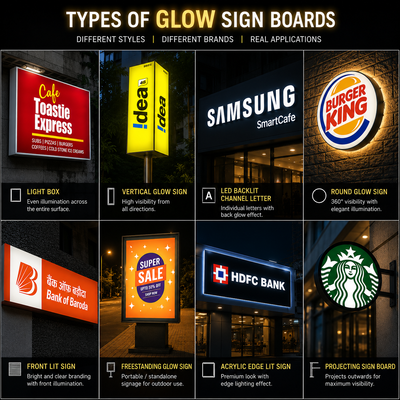
The category of glow sign boards is considerably more varied than most brand managers realise when they first approach an outdoor advertising campaign — and choosing the wrong type for a specific location or objective is one of the more common and avoidable mistakes we see. The most widely deployed variant in Indian outdoor advertising is the ACP glow sign board, which uses an Aluminium Composite Panel face with LED modules or strips mounted behind a translucent vinyl or acrylic overlay; this construction is durable, relatively lightweight, and handles the thermal stress of Indian summers reasonably well, which is why it dominates retail branding applications from Delhi NCR to Chennai.
The acrylic glow sign board is the format of choice when the priority is premium aesthetics — particularly for corporate signage, luxury retail, and building facade signage in high-visibility commercial zones. Acrylic panels transmit light more evenly than vinyl-faced ACP boards, producing a cleaner, more uniform glow that reads as higher-quality to the viewer; the trade-off is that acrylic is more fragile and somewhat more expensive to fabricate and install, which makes it better suited to sheltered or semi-sheltered locations rather than exposed highway advertising sites. We have executed acrylic glow sign installations for a pharmaceutical retail chain across Gurgaon and Noida, and the visual consistency across thirty-plus locations was a significant factor in the client's decision to extend the campaign duration.
Beyond these two dominant types, the market includes several specialised variants that are gaining traction in specific contexts. The 3D LED signage format — where individual channel letters or logo elements are fabricated with depth and independently illuminated — is increasingly popular for corporate signage and mall entrance branding, where the three-dimensional effect creates a premium brand impression that a flat board simply cannot match. Neon sign boards, which experienced a period of decline with the rise of LED technology, have seen something of a revival in the hospitality and food and beverage sectors, where the warm aesthetic of neon aligns with brand personality; modern neon-effect LED flex tubes replicate the look at a fraction of the energy cost. The backlit sign board — where the light source sits behind a translucent face panel rather than around the edges — is the standard for indoor outdoor sign board applications in malls and airports, while front-lit advertising boards, where the light source illuminates the face from the front, remain common for large-format outdoor signage on building facades and highway-facing structures.
Key Benefits of Glowsign Advertising for Your Business
The outdoor advertising ROI conversation tends to focus on hoardings and unipole billboards, which are the formats that attract the most media spend and therefore the most measurement attention; what a lot of people miss is that glowsign outdoor advertising frequently delivers a more favourable cost-per-impression equation, particularly for brands that need sustained local presence rather than broad-reach burst campaigns. The CPM outdoor advertising calculation for a well-placed glow sign board in a high-traffic location — say, a busy intersection in Mumbai's western suburbs or a commercial corridor in Hyderabad — works out to somewhere in the ballpark of ₹4 to ₹12 per thousand impressions when amortised over a three-month campaign, which is a number that tends to surprise clients who have been paying significantly more for digital display reach without the same physical presence or brand recall impact.
Brand visibility is the most obvious benefit, but the brand recall dimension is where glowsign outdoor advertising genuinely earns its place in a media mix. Research consistently cited in the FICCI-EY Media Report has shown that out-of-home advertising formats with illumination — particularly those placed at eye level or slightly above in pedestrian-heavy zones — generate substantially higher unaided recall than non-illuminated outdoor signage; the illumination essentially functions as a salience signal, drawing the eye even when the viewer is not consciously looking for advertising. At SmartAds, we always tell our clients that a glow sign board is not just a sign — it is a location-based brand anchor that works continuously without any ongoing media spend beyond the initial installation and a modest electricity cost.
The practical benefits for retail businesses are particularly compelling. A glow sign board for shops in a busy market or commercial complex serves simultaneously as wayfinding, brand communication, and competitive differentiation — a shop with a well-designed LED sign board on a street where competitors have older, dimmer, or less maintained signage has a measurable footfall advantage, which translates directly to revenue. We worked with a quick-service restaurant chain expanding into Tier 2 cities across Rajasthan and Madhya Pradesh; replacing their existing painted boards with standardised ACP glow sign boards across twelve locations produced an average footfall increase of roughly 22% in the first sixty days, which the client attributed primarily to improved night visibility advertising and the perception of brand professionalism that the illuminated sign boards conveyed.
Materials Used in Outdoor Glow Sign Boards: ACP, Acrylic & More
The material specification of a glow sign board has a direct bearing on its durability, visual quality, energy consumption, and total cost of ownership — which is why we spend a disproportionate amount of time on this conversation with clients who are accustomed to treating outdoor signage as a commodity purchase. Aluminium Composite Panel, the material that dominates the ACP glow sign board category, is a sandwich construction: two thin aluminium sheets bonded to a polyethylene or fire-retardant core, which produces a panel that is rigid, lightweight, and resistant to the kind of warping and corrosion that plagued older sheet metal sign boards in coastal markets like Mumbai and Chennai. The surface of an ACP panel accepts UV printing directly, or it can be overlaid with printed vinyl, which makes it highly versatile for custom sign board applications where the design needs to be updated periodically.
Acrylic — technically polymethyl methacrylate, though nobody in the industry calls it that — is the premium alternative, and its optical properties are genuinely superior for backlit sign board applications; light passes through acrylic more evenly and with less colour distortion than through vinyl-faced panels, which is why acrylic glow sign boards are the standard specification for corporate signage, luxury retail, and any application where colour accuracy matters. The material is available in cast and extruded grades, with cast acrylic being the higher-quality option for illuminated applications; it is also available in a range of thicknesses, with 3mm to 6mm being typical for sign faces and thicker grades used for structural elements. UV-resistant signage grades of acrylic are specified for outdoor applications, which helps the material retain clarity and colour over several years of sun exposure — a genuine concern in Indian conditions where UV intensity is significantly higher than in European markets where many of the original material specifications were developed.
The illumination component deserves equal attention. Energy-efficient LED strips and modules have largely displaced fluorescent tubes in new glowsign outdoor advertising installations, and the operational economics justify the slightly higher upfront cost very quickly; a standard fluorescent-tube glow sign board might consume somewhere between 150 and 300 watts depending on size, while an equivalent LED glow sign installation typically runs at 40 to 80 watts, which translates to meaningful electricity cost savings over a multi-year installation. The LED modules used in quality outdoor signage are rated for IP65 or higher weather resistance, which means they are sealed against dust ingress and water jets — a specification that matters enormously for weather-resistant sign board performance in monsoon-heavy markets. Polycarbonate is sometimes used as an alternative to acrylic for applications requiring higher impact resistance, particularly in locations where vandalism or physical contact is a concern; it is less optically clear than acrylic but considerably tougher, which makes it a pragmatic choice for shop sign board applications in busy street-level locations.
How Much Does Glowsign Outdoor Advertising Cost in India?
Frankly speaking, the absence of transparent pricing information is one of the most frustrating aspects of the outdoor advertising category in India — and it is something we have consciously tried to address in how we work with clients at SmartAds. The glow sign board price per sq ft varies considerably based on material specification, illumination type, fabrication complexity, and city of installation; a basic ACP glow sign board with single-colour LED illumination in a Tier 2 city might be fabricated and installed for somewhere between ₹150 and ₹250 per square foot, while a premium acrylic glow sign board with full-colour backlit printing and high-density LED modules in a metro city like Mumbai or Delhi NCR will typically run in the range of ₹350 to ₹600 per square foot, with 3D LED signage and channel letter installations going considerably higher depending on complexity.
The glow sign advertising cost calculation needs to account for several components beyond fabrication: the media rental or space cost (if the sign is being placed on a third-party property rather than the advertiser's own premises), the municipal permission fees which vary significantly by city and location, the installation cost which depends on height and access complexity, and the ongoing electricity and maintenance costs. In Delhi NCR — particularly in high-visibility commercial zones like Connaught Place, Rajiv Chowk, or the major arterial roads of Noida and Gurgaon — the space rental component alone can add ₹5,000 to ₹25,000 per month for a prominent location, which is a cost that many first-time advertisers do not factor into their initial budget. Mumbai's commercial corridors command premium rates, with sought-after locations in Bandra, Andheri, or Lower Parel fetching space rentals that can make the fabrication cost look modest by comparison.
The thing is, the cost conversation is incomplete without the duration context. A glow sign board is not a perishable media placement like a newspaper ad or a digital impression; once fabricated and installed, the marginal cost of each additional month of exposure is essentially just the electricity bill and any required maintenance, which means the effective glow sign advertising cost per impression falls continuously over the life of the installation. Our experience shows that campaigns running for a minimum of three months begin to show meaningful brand recall improvements, while installations maintained for twelve months or more in high-traffic locations often deliver outdoor advertising ROI that is difficult to match with any other format at equivalent spend levels. For a retail client in Pune who maintained glowsign board advertising services across eight high-street locations for eighteen months, the blended CPM outdoor advertising figure — accounting for all costs including fabrication, space rental, permissions, and electricity — worked out to roughly ₹6 per thousand impressions, which compared very favourably against the ₹18 to ₹25 CPM the same client was paying for programmatic digital display.
Best Locations for Glowsign Advertising in India
Location selection is where most outdoor advertising campaigns either succeed or waste money — and the criteria for a strong glowsign board placement are somewhat different from those that govern hoarding advertising or billboard advertising, because the format's strengths are best exploited in specific contexts. High-traffic location selection for glowsign outdoor advertising should prioritise pedestrian density alongside vehicular traffic, because the format's relatively smaller size compared to a unipole billboard means it is most effective when viewers have the dwell time to register the brand message; a glow sign board on a busy commercial street where pedestrians are walking and browsing is often more effective than the same board on a highway where vehicles pass at 80 kilometres per hour.
Metro cities India — Delhi NCR, Mumbai, Bengaluru, Hyderabad, Chennai, Kolkata — offer the highest density of quality glowsign advertising locations, but they also carry the highest costs and the most complex municipal permission environments. In Delhi NCR, the areas around Rajiv Chowk, Karol Bagh, Lajpat Nagar, and the commercial sectors of Noida and Gurgaon are consistently strong performers for retail branding and corporate signage applications; the pedestrian footfall in these areas is substantial, and the audience profile tends to skew toward the urban middle class and upper-middle class demographics that most consumer brands are targeting. Mumbai's western suburbs — Andheri, Goregaon, Malad — and the eastern commercial corridors offer strong outdoor branding opportunities, particularly for brands targeting the large working population that commutes through these areas daily. Bengaluru's technology corridors and the retail-dense areas of Indiranagar, Koramangala, and MG Road are particularly valuable for brands targeting the city's large young professional population.
What a lot of people miss is the opportunity in Tier 2 cities, where glowsign outdoor advertising delivers disproportionately strong impact relative to cost. In cities like Jaipur, Lucknow, Indore, Nagpur, Coimbatore, and Visakhapatnam, the outdoor advertising market is less saturated, which means a well-placed glow sign board faces less visual competition and achieves higher share-of-voice at a fraction of the cost of an equivalent placement in a metro. The PAN India advertising potential of glowsign outdoor advertising — the ability to roll out a consistent brand identity across hundreds of locations simultaneously — is something that national retail chains, banking institutions, and telecom brands have exploited very effectively; we have executed glowsign board advertising services campaigns covering 200-plus locations across 80 cities for a financial services client, and the consistency of brand visibility achieved across metro and Tier 2 markets simultaneously was something that no other single OOH format could have delivered at the same budget. Highway advertising locations, petrol pump signage placements, and glow sign board for malls applications round out the location universe, each with distinct audience characteristics and cost structures.
Which Industries Benefit Most from Glowsign Outdoor Advertising?
The honest answer is that glowsign outdoor advertising is one of the more format-agnostic tools in the OOH advertising toolkit — it works across a remarkably wide range of industries, which is part of why it has maintained its relevance through multiple cycles of media disruption. That said, certain sectors extract disproportionate value from the format, and understanding why helps in making the case for budget allocation internally. Retail branding is the clearest use case: a glow sign board for shops is simultaneously a wayfinding tool, a brand identity statement, and a competitive signal, which means the investment serves multiple commercial objectives at once; for retail chains rolling out new locations, a standardised LED sign board specification is often one of the first elements of the brand standards document, because it establishes visual presence before any other marketing activity has had time to take effect.
The food and beverage sector — from standalone restaurants to large QSR chains — relies heavily on glowsign outdoor advertising for a combination of reasons that are specific to the category. A glow sign board for restaurants functions as a hunger trigger as much as a brand identifier; the warm, bright illumination of a well-designed LED glow sign on a food street or commercial complex activates attention and appetite in ways that are difficult to replicate with other formats. The hospitality sector more broadly — hotels, resorts, banquet halls — uses illuminated sign boards for both wayfinding and brand positioning, with the quality of the signage serving as a proxy signal for the quality of the establishment itself. Pharmaceutical retail, which operates under specific advertising regulations that restrict mass media options, has become one of the most consistent users of outdoor signage and glow sign board for shops applications across India; the format allows pharmacy chains to establish strong local presence without the regulatory complications that apply to product-level advertising.
Corporate signage is a distinct application that deserves separate consideration. Large organisations — IT companies, banks, insurance firms, manufacturing conglomerates — use building facade signage, 3D LED signage, and corporate glow sign board installations not primarily for customer acquisition but for brand authority, employee pride, and stakeholder perception management; the investment in premium custom sign board fabrication at corporate campuses and office buildings in technology parks across Bengaluru, Hyderabad, and Noida is substantial, and it is driven by a different ROI logic than retail advertising. The education sector — schools, colleges, coaching institutes — is another significant user of glowsign outdoor advertising, particularly in Tier 2 cities where competition for student enrolment is intense and outdoor signage remains one of the primary channels through which institutions communicate their presence and quality signals to prospective students and parents.
Glowsign vs LED Billboard vs Hoarding: Which OOH Format Is Right for You?
This is a question we field regularly, and the answer is almost always "it depends on what you are trying to achieve" — which sounds like a non-answer but is actually the only honest starting point for the comparison. Glowsign outdoor advertising, hoarding advertising, and LED billboard advertising serve meaningfully different strategic purposes, and the mistake most brands make is choosing a format based on familiarity or cost alone rather than matching the format's characteristics to the campaign objective. A hoarding or unipole billboard is a reach format — it is designed to generate maximum impressions across a broad audience in a short period, which makes it well-suited for product launches, event promotions, and brand awareness campaigns where the priority is raw scale. A glow sign board is a presence format — it is designed to establish and maintain brand visibility at a specific location over an extended period, which makes it better suited for retail presence, local market penetration, and brand anchoring objectives.
The comparison with DOOH advertising is where it gets interesting, particularly given the rapid growth of digital signage and programmatic outdoor in Indian metro markets. DOOH advertising — the category that encompasses LED screens, digital billboards, and programmatically served outdoor placements — offers capabilities that static glowsign outdoor advertising simply cannot match: dynamic content, dayparting, audience-triggered messaging, and real-time campaign optimisation. The GroupM TYNY Report has consistently highlighted DOOH as the fastest-growing segment within the OOH market India, and the investment in digital signage infrastructure across metro cities has accelerated significantly. However, DOOH comes with a cost premium that is not always justified for every campaign objective; the CPM for a quality DOOH placement in a metro city is typically three to five times higher than an equivalent glowsign board placement, and for brands whose primary need is sustained local presence rather than dynamic content, the premium is difficult to justify.
To be fair, the most effective outdoor advertising campaign India strategies we have executed have combined formats rather than choosing between them — using glowsign outdoor advertising for sustained local presence and brand anchoring while deploying hoarding advertising or DOOH advertising for burst reach around key campaign moments. An automotive brand we worked with used this approach during a new model launch in Delhi NCR and Bengaluru: a network of LED glow sign boards at dealership locations and high-traffic retail corridors maintained brand visibility throughout the campaign period, while a concentrated two-week hoarding advertising burst around the launch date generated the reach spike needed for awareness; the combination delivered measurably stronger brand recall than either format alone would have achieved at the same total budget.
How to Design an Effective Glowsign Outdoor Ad Campaign
The design principles for glowsign outdoor advertising are different from those that apply to print or digital, and this is an area where we see brands make avoidable mistakes with some regularity. The fundamental constraint of any outdoor signage — and glow sign boards are no exception — is that the viewer has a very limited time to register the message; even in a pedestrian context where dwell time is higher than on a highway, the effective window for communication is rarely more than three to five seconds, which means the design must communicate the essential brand message instantly. The rule we apply at SmartAds is the "squint test": if you cannot identify the brand and the primary message when squinting at the design from across a room, the design will not work in an outdoor context where competing visual stimuli are constant.
Colour selection is particularly critical for illuminated sign boards, because the relationship between the printed colour and the illuminated colour is not always intuitive; colours that look vibrant in a print proof can look washed out or distorted when backlit, while other colours that appear unremarkable in print can become visually dominant when illuminated. We always recommend physical material samples with the actual LED specification before approving a final design for a glow sign board campaign — a step that adds a small amount of time to the production process but prevents the far more expensive problem of fabricating and installing signs that do not look right in situ. The contrast between the background and the foreground elements is the single most important design variable for night visibility advertising effectiveness; high-contrast combinations — white or yellow on dark backgrounds, or dark text on white or light-coloured illuminated backgrounds — consistently outperform low-contrast designs in readability studies.
The campaign duration question deserves more strategic attention than it typically receives. Our experience shows that a minimum campaign duration of three months is necessary for a glowsign outdoor advertising campaign to generate meaningful brand recall improvements — shorter durations can build awareness among the most frequent passers-by, but the broader audience does not accumulate sufficient exposures to shift recall metrics. For retail branding and corporate signage applications, where the sign is effectively a permanent installation rather than a campaign placement, the duration question is moot; but for brands using glowsign board advertising services as a campaign medium — deploying signs at third-party locations for a defined period — we recommend thinking in terms of quarters rather than weeks, and building the media plan accordingly.
Why Is Glowsign Advertising Still Relevant in the DOOH Era?
There is a version of the media planning conversation where DOOH advertising is positioned as the inevitable replacement for static outdoor formats — and we understand why that narrative is appealing, because it maps neatly onto the broader digital transformation story. The reality, as we have observed across hundreds of outdoor advertising campaign India executions, is considerably more nuanced. DOOH advertising is growing rapidly and deservedly so; the OOH market India, according to data referenced in the FICCI-EY Media Report, has seen digital formats capture an increasing share of total outdoor advertising spend, and the investment in digital signage infrastructure in metro cities has been substantial. But static glowsign outdoor advertising has not declined in response — it has held its ground and in some markets grown, which tells you something important about the format's enduring utility.
The reason, frankly, comes down to economics and geography. DOOH advertising infrastructure is concentrated in metro cities and major Tier 1 markets; the economics of installing and maintaining digital screens in Tier 2 cities and smaller markets have not yet worked out in favour of widespread deployment, which means that for brands pursuing PAN India advertising coverage, glowsign outdoor advertising remains the only format that can deliver consistent brand visibility across the full geography at a manageable cost. The Smart Cities Mission has accelerated some investment in digital outdoor infrastructure in secondary cities, but the rollout has been uneven, and the gap between metro and non-metro DOOH availability remains large. For a national brand that needs outdoor branding presence in 300 cities simultaneously, a network of glow sign boards is not a fallback option — it is the primary vehicle.
On top of that, there is a permanence and tactility to a well-fabricated glow sign board that digital screens cannot replicate. A quality LED sign board at a prominent location becomes part of the visual landscape of that street or area; it is associated with the location itself, which creates a kind of place-based brand equity that is genuinely difficult to achieve with rotating digital content. We have seen this play out most clearly in the retail sector, where customers navigate to stores partly by reference to the signage — "the one with the blue glowing sign on the corner" — which means the sign is doing brand work that goes beyond advertising into the territory of identity and wayfinding. The energy efficiency of modern LED glow sign technology has also addressed one of the historical sustainability objections to the format; an energy-efficient LED glow sign board consumes power comparable to a few household light bulbs, which makes the environmental cost argument against the format considerably weaker than it was in the fluorescent tube era.
Glowsign Advertising Services Across India: How SmartAds Plans and Executes
Executing a glowsign outdoor advertising campaign at scale — across multiple cities, with consistent quality, proper permissions, and measurable outcomes — requires a level of coordination that goes well beyond simply ordering sign boards from a signage manufacturer. The municipal permission landscape alone is a significant operational challenge; different cities operate under different regulatory frameworks for outdoor advertising, with some municipal corporations — Delhi's MCD, Mumbai's BMC, Bengaluru's BBMP — operating formal licensing systems with defined fee structures, while others have less formalised processes that require local knowledge and established relationships to navigate efficiently. Failing to secure proper permissions before installation is not just a compliance risk; it exposes the advertiser to the cost of forced removal and reinstallation, which can easily double the effective cost of a campaign.
At SmartAds, our network across 500+ Indian cities means we have established relationships with local vendors, sign board manufacturers, and municipal authorities in markets ranging from Delhi NCR and Mumbai to smaller cities where most national agencies simply do not have operational presence. Our media planning team approaches glowsign board advertising services not as a fabrication-and-install exercise but as a full campaign planning process: identifying locations based on audience data and traffic counts, specifying materials appropriate to the climate and context of each location, managing the permissions process, overseeing fabrication quality, and tracking campaign performance through impression estimates derived from traffic data — which gives clients the kind of accountability metrics that are typically associated with digital advertising rather than outdoor. The out-of-home advertising measurement methodology we apply draws on traffic data, footfall counts, and where available, BARC and TAM AdEx audience data for the relevant markets, which allows us to produce CPM outdoor advertising figures that clients can use for cross-media budget allocation decisions.
The vendor ecosystem for glowsign outdoor advertising in India is large and varied — from established players with national capabilities to local sign board manufacturers who offer competitive pricing in specific markets — and navigating it without experience can be costly. Quality varies enormously; a glow sign board fabricated with inferior LED modules, inadequate weatherproofing, or low-grade ACP panels will look fine on installation day and begin to deteriorate within six to twelve months, which is a false economy that we have seen clients experience when they have gone directly to the lowest-cost vendor without adequate specification oversight. Our role as an advertising agency India partner is partly to protect clients from these false economies — specifying materials correctly, vetting fabricators, and ensuring that the weather-resistant sign board performance holds up over the campaign duration. For brands considering their first outdoor advertising campaign India or expanding an existing outdoor branding programme, the difference between a well-managed campaign and a poorly managed one is often the difference between a format that delivers strong ROI and one that generates frustration.
Frequently Asked Questions About Glowsign Outdoor Advertising
Q: What is glowsign outdoor advertising and how is it different from a regular hoarding?
Glowsign outdoor advertising refers to the use of illuminated sign boards — typically constructed with ACP or acrylic faces and LED light sources — as an out-of-home advertising medium, either at the advertiser's own premises or at third-party locations in high-traffic areas. The fundamental difference from a regular hoarding or billboard advertising placement is scale, context, and illumination mechanism. A hoarding is typically a large-format structure — 10x20 feet or larger — designed for maximum reach from vehicular traffic at distance; a glow sign board is typically smaller, designed for closer-range visibility in pedestrian and retail contexts, and its defining characteristic is the built-in illumination which provides night visibility advertising capability that a standard flex hoarding does not offer. Hoardings are rented media placements; glow sign boards are often owned assets that the advertiser fabricates and installs, which changes the economics considerably over a multi-year horizon.
Q: What are the different types of glow sign boards used in outdoor advertising in India?
The main types in active use across Indian outdoor advertising markets include ACP glow sign boards, which use Aluminium Composite Panel faces with LED illumination and are the most widely deployed format for retail branding and corporate signage; acrylic glow sign boards, which offer superior light transmission and are preferred for premium applications; backlit sign boards, where the illumination source sits behind the display face; front-lit advertising boards, where external light sources illuminate the face from the front; 3D LED signage with channel letters or dimensional logo elements; neon sign boards and their modern LED-flex equivalents; and indoor outdoor sign board formats designed for mall, airport, and commercial complex environments. Each type has a different cost profile, visual characteristic, and optimal application context, which is why material and format specification should precede vendor selection rather than following it.
Q: How much does glowsign outdoor advertising cost per square foot in India?
The glow sign board price per sq ft varies considerably based on material, illumination type, location, and fabrication complexity. For a standard ACP glow sign board with LED illumination, fabrication and installation costs in Tier 2 cities typically fall somewhere between ₹150 and ₹250 per square foot; in metro cities like Mumbai, Delhi NCR, and Bengaluru, the same specification runs in the range of ₹250 to ₹400 per square foot due to higher labour and logistics costs. Premium acrylic glow sign boards with high-density LED modules and UV-resistant signage specifications are priced in the ballpark of ₹350 to ₹600 per square foot in metro markets. These figures cover fabrication and installation only; if the sign is being placed at a third-party location, space rental costs — which vary from a few thousand rupees per month in Tier 2 cities to ₹20,000 or more per month in premium metro locations — need to be added to arrive at the total glow sign advertising cost. Municipal permission fees, which vary by city and sign size, are an additional variable that is often overlooked in initial budget estimates.
Q: What materials are used to make outdoor glow sign boards?
The primary structural materials are Aluminium Composite Panel (ACP) — a sandwich of aluminium sheets and a polyethylene or fire-retardant core — and acrylic (polymethyl methacrylate), each with distinct performance characteristics. ACP is more durable and impact-resistant, making it the preferred choice for exposed outdoor locations; acrylic offers superior light transmission and is preferred for backlit sign board applications where colour accuracy and even illumination are priorities. The illumination component is almost universally LED in new installations — either strip LEDs for edge-lit and backlit applications or LED modules for direct-view and front-lit configurations. UV-resistant signage grades of both materials are specified for outdoor use, which helps the installation maintain visual quality over several years of sun exposure. Polycarbonate is used in applications requiring higher impact resistance than acrylic; aluminium extrusions and steel frameworks provide the structural support for larger installations; and high-quality UV-resistant vinyl or direct UV-printed graphics provide the visual face of the sign.
Q: How far can a glowsign board be visible from a distance?
Visibility distance depends on the size of the board, the brightness of the illumination, the ambient light conditions, and the viewing angle — but as a general benchmark, a well-fabricated LED glow sign board of 4x2 feet is typically legible from 15 to 25 metres in daylight and from 30 to 50 metres after dark, when the illumination creates a significant contrast advantage against the surrounding environment. Larger format illuminated sign boards — 8x4 feet or above — can achieve legibility distances of 50 to 100 metres or more in good conditions, which makes them effective for highway advertising and building facade signage applications where the audience is approaching at vehicular speeds. The design variables — particularly font size, contrast, and the simplicity of the message — have as much influence on effective visibility distance as the physical size of the board, which is why design review is a non-negotiable step in any professional outdoor advertising campaign India execution.
Q: Are glow sign boards suitable for outdoor advertising in all Indian weather conditions?
A properly specified and fabricated weather-resistant sign board should perform reliably across the full range of Indian weather conditions — from the extreme heat of Rajasthan summers to the heavy monsoon rainfall of coastal markets and the cold winters of northern cities. The key specifications that determine weather performance are the IP rating of the LED modules (IP65
