


Delhi

Mumbai

Bengluru

Ahmedabad

Jaipur

Chennai

Hydrabad

Kolkatta

Lucknow

Pune
Gantry Outdoor Advertising in India: The Complete Guide to OOH Brand Visibility, High-Traffic Highway Billboards & Overhead Advertising That Actually Works
This article contains city-wise gantry advertising cost benchmarks, standard size specifications, municipal approval processes, and three anonymized SmartAds campaign case studies — the kind of data that most OOH guides deliberately leave out. If you are planning a gantry advertising campaign in India and need actual numbers to work with, you are in the right place.
What is Gantry Outdoor Advertising? Definition, Structure & How It Works
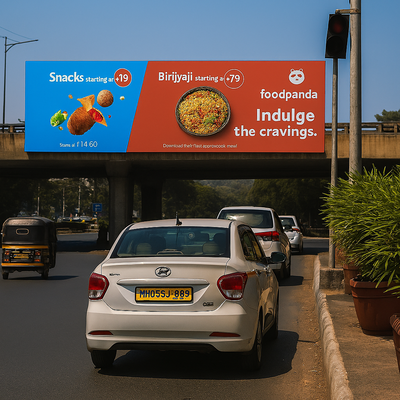
Most people who ask us about gantry outdoor advertising have already seen hundreds of them without knowing the name. That large-format display spanning the full width of a highway or arterial road — mounted on two steel columns, positioned overhead so that every vehicle passing beneath it cannot look away — that is a gantry billboard, and it is one of the most powerful formats in the out-of-home advertising toolkit.
The structure itself is what sets gantry advertising apart from every other OOH format. Unlike a unipole or a wall-mounted hoarding, a gantry is an overhead advertising structure that physically bridges the road, which means the display panel is positioned directly in the line of sight of commuters, motorists, and pedestrians rather than sitting to the side of their peripheral vision. The steel or aluminium frame is anchored into the ground on both sides of the road, with the display face — which can range from a simple flex print to a full LED screen — suspended between the two columns at a height that varies between fifteen and twenty-five feet depending on the road classification and municipal regulations. This overhead positioning is not an aesthetic choice; it is a strategic one, because a driver approaching a gantry billboard has no choice but to engage with it for the three to eight seconds it takes to pass beneath it.
What a lot of people miss is that gantry outdoor advertising works through repeated, unavoidable exposure rather than through a single moment of impact. A commuter who uses the Western Express Highway in Mumbai every morning will see the same gantry hoarding anywhere between twenty-two and thirty times in a single month, which is a frequency figure that most digital campaigns would require significant budget to replicate. At SmartAds, we always tell our clients that the real power of a gantry advertising campaign is not the single impression — it is the cumulative brand recall that builds over weeks of daily exposure to the same audience segment.
Types of Gantry Advertising in India: Static, Digital, LED & Custom Formats
The gantry format has evolved considerably over the past decade, and the distinction between a static gantry and a digital gantry is now one of the most important decisions a brand manager will make when planning an outdoor advertising campaign in India.
A static gantry — sometimes called a non-lit gantry during the day or a backlit gantry when it carries internal fluorescent or LED illumination — carries a single fixed creative for the duration of the campaign, which typically runs between one and three months. The creative is printed on vinyl flex or digital print media and mounted on the frame; a backlit gantry uses a translucent face with rear illumination to maintain visibility after dark, while a non-lit gantry relies entirely on ambient light. The illuminated gantry variant is significantly more effective for brands that want 24/7 exposure, particularly in cities like Delhi and Mumbai where peak commute hours extend well into the evening. A double-sided gantry, which carries display panels on both faces of the structure to capture traffic moving in both directions, is a particularly efficient buy when the location sits on a bidirectional arterial road; we have found that a double-sided gantry in a well-chosen location can effectively double the impression count without doubling the cost.
Digital gantry advertising — and its subset, LED gantry advertising — represents the more dynamic end of the spectrum. An LED gantry carries a full-colour digital screen which can display multiple creatives in rotation, typically cycling through four to six advertisers on a loop of thirty to sixty seconds per slot. This format has grown sharply in India's metro cities, driven partly by the expansion of digital out-of-home (DOOH) infrastructure and partly by brands wanting the flexibility to update creatives in real time — during IPL season, for instance, when a sports brand might want to swap in a match-day creative at short notice. The programmatic OOH buying model, which allows advertisers to purchase time slots on digital gantry screens based on audience data and traffic patterns, is still nascent in India but is gaining traction in Mumbai, Delhi, and Bangalore; industry projections from the FICCI-EY Media and Entertainment Report suggest that DOOH's share of total OOH advertising spend in India will cross twenty-five percent within the next three years.
Custom gantry formats — including shaped structures, extended wing panels, and three-dimensional brand elements mounted on the gantry frame — are used less frequently but can generate disproportionate attention when the creative execution is strong. One automotive brand we worked with installed a life-size vehicle model on the gantry frame above a major Pune flyover, which generated significant organic social media coverage in addition to the standard impressions; the earned media value from that single installation was estimated to be roughly three times the cost of the installation itself.
Top Benefits of Gantry Outdoor Advertising for Indian Brands
Frankly speaking, the case for gantry advertising in India is not difficult to make — the harder conversation is usually about why brands underinvest in it relative to the reach it delivers. The most immediate benefit is sheer unavoidability; a gantry billboard positioned on a high-traffic arterial road in a metro city reaches an audience that cannot skip, scroll past, or close the ad, which is a quality of attention that digital advertising has been steadily losing ground on.
Brand visibility on a gantry is also inherently contextual in a way that most other formats cannot replicate. A gantry hoarding positioned at the entry point of an industrial zone reaches business decision-makers on their daily commute; one positioned near a hospital cluster reaches healthcare consumers at a moment of relevance; one on the approach road to an airport reaches a premium, high-income audience segment. This contextual alignment between location and audience is something our media planning team at SmartAds spends considerable time analysing before recommending a location to a client, because a poorly placed gantry — even one with a brilliant creative — will underperform a well-placed one with a simpler design every single time.
The brand recall figures associated with gantry advertising are also worth taking seriously. Research cited in the Outdoor Advertising Association of India's (OAAA India) periodic industry reviews suggests that large-format out-of-home advertising generates brand recall rates that are meaningfully higher than standard digital display, particularly for audiences who encounter the same creative repeatedly over a campaign period. The 24/7 exposure that an illuminated gantry provides — round-the-clock visibility across morning rush, afternoon lull, evening peak, and late-night traffic — means that the effective reach of a single gantry placement compounds over time in a way that a one-week digital burst simply cannot match.
How Much Does Gantry Advertising Cost in India? (City-Wise Breakdown)
This is the question that almost every competitor page on gantry advertising avoids answering, and the avoidance is frustrating for anyone trying to plan a real campaign with a real budget. We will give you actual benchmarks, with the caveat that gantry advertising rates vary significantly based on location quality, traffic count, illumination type, and the specific municipal zone — so treat these as planning estimates rather than fixed rate cards.
In Mumbai, which remains the most expensive OOH market in India, a premium static gantry on a high-traffic corridor like the Western Express Highway, the Eastern Freeway, or near Mahim Causeway will typically cost somewhere between ₹3 lakh and ₹8 lakh per month, with the most sought-after locations — particularly those near entry and exit points of major flyovers — pushing toward the higher end of that range. An LED gantry slot in Mumbai, where you are buying airtime on a shared digital screen rather than exclusive ownership of the face, works out to roughly ₹1.5 lakh to ₹4 lakh per month for a standard slot share, which is a number that surprises many clients when they realise they are getting prime Mumbai real estate for a fraction of the static cost.
Delhi's gantry advertising cost per month India benchmarks are broadly comparable to Mumbai, with premium locations on NH-48 (the Delhi-Gurugram expressway), the Outer Ring Road, and major arterial roads in South Delhi commanding rates in the ballpark of ₹2.5 lakh to ₹7 lakh per month for static formats. Bangalore, which has seen significant OOH infrastructure investment following BBMP's regularisation of outdoor media structures, typically runs somewhere between ₹1.5 lakh and ₹4.5 lakh per month for a well-located static gantry on ORR or Hosur Road. Hyderabad and Pune, which are strong second-tier metro markets for gantry advertising, generally come in at ₹80,000 to ₹2.5 lakh per month depending on the specific corridor and traffic count, which makes them attractive markets for brands that want metro-quality visibility at a more manageable cost. Tier-2 cities — Ahmedabad, Jaipur, Lucknow, Indore — can offer gantry placements in the range of ₹40,000 to ₹1.2 lakh per month, which represents exceptional value for brands with a regional or national distribution footprint.
The gantry advertising cost structure also includes production costs, which are often underestimated. A standard flex print for a static gantry will cost roughly ₹15,000 to ₹40,000 depending on size and print quality; a backlit or illuminated gantry requires a higher-grade translucent material, which pushes production costs up by thirty to forty percent. Installation, de-installation, and any structural maintenance charges are typically borne by the media owner, but it is worth confirming this in the booking contract — we have seen situations where brands were surprised by additional charges that were not clearly itemised upfront.
Standard Sizes and Dimensions of Gantry Billboards in India
One of the genuine content gaps in most gantry advertising guides is the absence of actual size specifications, which matters enormously for creative briefing and production. The most common gantry billboard dimensions used across Indian highways and urban arterial roads are 50 feet wide by 7 feet tall and 40 feet wide by 8 feet tall, both of which are designed to span a standard two-to-three lane road while maintaining the minimum clearance height required by NHAI and municipal authorities. Wider roads — four-lane and six-lane national highways — often carry gantry structures in the 60x8 ft or 70x8 ft range, which are classified as large-format display units and command a premium in both production and space rental costs.
For urban locations where the road width is narrower or where the gantry is positioned above a single-direction carriageway, a 25x8 ft or 30x7 ft format is more common, particularly in tier-2 cities and on secondary arterial roads. Digital LED gantry screens, which are modular by design, are typically configured in sizes ranging from 20x8 ft to 40x10 ft, though custom configurations are possible and are increasingly being requested by brands that want a non-standard aspect ratio for creative reasons. At SmartAds, our creative team always recommends that the design brief be developed with the final installed dimensions as the starting point, not retrofitted from a standard print layout — the difference in visual impact between a creative designed for the format and one that has been stretched to fit is immediately apparent to anyone standing on the road.
How to Choose the Best Locations for Gantry Ads in India
Location selection is where most gantry advertising campaigns are won or lost, and it is the area where working with an experienced outdoor advertising agency makes the most tangible difference. The obvious criteria — traffic volume, road classification, visibility distance — are necessary but not sufficient; the subtler factors, which include the approach angle of the gantry relative to the traffic flow, the presence of competing visual clutter in the immediate environment, and the demographic profile of the commuters using that corridor, are what separate a good location from a great one.
Traffic data is the foundation of any location decision, and the most reliable source for Indian road traffic counts is the NHAI's published traffic surveys for national highways, supplemented by city-specific data from municipal transport departments. A gantry on a corridor carrying seventy thousand vehicles per day will deliver roughly twice the impressions of one on a thirty-five thousand vehicle corridor, but the quality of those impressions matters as much as the quantity — a gantry on a slow-moving urban arterial road where vehicles are typically travelling at twenty to thirty kilometres per hour will generate longer dwell times and higher brand recall than one on a fast-moving expressway where vehicles pass at eighty kilometres per hour. Peak hours versus off-peak traffic patterns also affect the effective reach calculation significantly; a gantry on a corporate corridor that carries heavy morning and evening commuter traffic but is relatively quiet on weekends will have a very different audience profile from one on a highway connecting two cities, which carries consistent traffic across the week.
The strategic placement decision should also account for the campaign objective. For a real estate brand launching a new project, a gantry on the approach road to the project site — capturing potential buyers who are already in the relevant geography — will outperform a more prestigious but geographically misaligned location. For an FMCG brand building national brand awareness, the priority shifts to sheer reach and frequency across multiple corridors. We worked with a retail client in Pune who was initially focused on the highest-traffic location in the city; after analysing the commuter profile of their target consumer, we recommended a slightly lower-traffic corridor that indexed significantly higher on the income and age demographics they were targeting, and the campaign delivered measurably stronger footfall attribution than their previous outdoor advertising campaigns on more prominent but less targeted locations.
Gantry Advertising vs Unipole vs Hoarding: Which OOH Format Wins?
The honest answer is that no single OOH format wins universally — each has a specific role in the media mix, and the comparison only becomes meaningful when you anchor it to a specific campaign objective, budget, and geography. That said, the structural differences between gantry advertising, unipole advertising, and traditional hoardings have real implications for reach, visibility, and cost efficiency that are worth understanding clearly.
A unipole is a single-column structure, typically carrying a large display panel at height, which is visible from a distance and is particularly effective for brand awareness campaigns on highways and open stretches of road where the panel can be seen from several hundred metres away. The gantry, by contrast, is positioned overhead and is most impactful at close range — the ten to thirty metres immediately before the vehicle passes beneath it — which is why gantry advertising excels at delivering high-frequency, high-attention impressions to a captive audience rather than the long-distance brand signalling that a unipole does well. A traditional hoarding or wall-mounted display sits to the side of the road, which means it competes with the driver's peripheral attention rather than commanding their direct line of sight; hoardings are cost-effective and widely available, but the attention quality is generally lower than either a gantry or a well-positioned unipole.
In terms of gantry vs unipole advertising cost efficiency, a unipole on a premium highway location will often cost more than a comparable gantry in the same city, because the long-distance visibility of a unipole commands a premium in high-competition markets. A bus shelter, which delivers close-range pedestrian impressions at a much lower cost, is a complementary format rather than a direct competitor to the gantry — we often recommend combining gantry advertising with bus shelter placements in the same corridor to create a surround-sound effect for commuters who encounter the brand both overhead and at eye level. The gantry wins decisively on the metric of unavoidable attention; the unipole wins on long-distance visibility; the traditional hoarding wins on cost and availability, particularly in markets where gantry inventory is limited.
Which Industries Benefit Most from Gantry Advertising in India?
The industries that consistently extract the most value from gantry outdoor advertising in India share a common characteristic: they are selling to audiences who are already in motion, already making decisions, and already contextually primed by their physical location. This is not a coincidence — it is the fundamental logic of out-of-home advertising, and gantry formats amplify it.
Gantry advertising for automobile brands is perhaps the most natural fit in the format. A car or two-wheeler brand that places a gantry billboard on the approach to a dealership cluster, on a highway that its target buyers use regularly, or near a petrol station where vehicle-related decisions are already being made, is reaching an audience that is demonstrably interested in the product category at the moment of exposure. The automotive sector has historically been one of the largest spenders in OOH advertising India, and gantry formats account for a significant share of that spend because the large-format display does justice to the visual appeal of vehicle advertising in a way that smaller formats cannot. One automotive brand we worked with ran a gantry advertising campaign across six highway corridors in Maharashtra ahead of a new model launch, and the dealer inquiry data from those corridors showed a lift of roughly thirty-five percent compared to the control corridors where no outdoor advertising was running.
Gantry advertising for real estate brands is similarly well-suited to the format, because real estate decisions are inherently geography-specific and the gantry's location-based targeting is a natural match. A developer launching a residential project in Whitefield, Bangalore, who places gantry hoardings on the ORR and the Whitefield-Marathahalli corridor, is reaching exactly the audience of IT professionals and upper-middle-class commuters who represent the primary buyer profile for that project. Gantry advertising for FMCG brands works differently — here the objective is typically mass brand awareness and brand recall rather than location-specific targeting — and the format's strength in delivering high-frequency impressions to a broad urban audience makes it well-suited to brand-building campaigns for categories like packaged foods, beverages, personal care, and consumer durables. Education brands, particularly those targeting students and parents in the run-up to admissions season, healthcare brands building awareness of hospital or diagnostic services, and financial services brands promoting insurance and investment products to the working-age commuter demographic all represent strong use cases for gantry advertising in India.
Regulatory & Municipal Compliance for Gantry Ads in India
This is the section that most brands and even some outdoor advertising agencies treat as an afterthought, which is a mistake that can result in campaign delays, financial penalties, and in extreme cases, forced removal of structures. The regulatory landscape for gantry advertising in India is fragmented — it varies significantly between national highways (which fall under NHAI jurisdiction), state highways (which are regulated by state PWD departments), and urban arterial roads (which are governed by the relevant municipal corporation).
For gantry structures on national highways, NHAI's guidelines specify minimum clearance heights (typically five-and-a-half metres for standard roads, higher for underpasses and flyover approaches), setback distances from the road edge, and structural safety standards that the installation must meet. Municipal permissions for urban gantries are managed by the relevant civic body — the Brihanmumbai Municipal Corporation (BMC) in Mumbai, the Municipal Corporation of Delhi (MCD) in Delhi, BBMP in Bangalore, and their equivalents in other cities — and the documentation required typically includes a structural stability certificate from a licensed engineer, proof of land ownership or lease for the column footings, a creative approval submission showing the proposed design, and payment of the applicable licence fee, which varies by city and location category. The BBMP, for instance, has published a detailed outdoor advertising policy that specifies permissible zones, maximum structure dimensions, and the process for obtaining a no-objection certificate, which is a prerequisite for installation.
At SmartAds, we manage the entire municipal permissions and regulatory compliance process on behalf of our clients as part of our end-to-end service, because the documentation requirements and approval timelines vary enough between cities that navigating them without local expertise is genuinely time-consuming. The approval timeline for a new gantry structure can range from two weeks in a cooperative municipal environment to six to eight weeks in cities with more complex approval processes; for brands working with existing licensed structures (which is the case for most commercial gantry advertising bookings), the compliance burden falls on the media owner rather than the advertiser, but it is still worth verifying that the structure you are booking has current, valid permissions before committing to a campaign.
Creative Design Best Practices for High-Impact Gantry Ads
The single most common mistake we see in gantry advertising creatives is the attempt to communicate too much. A gantry billboard is seen by a motorist travelling at forty to eighty kilometres per hour; the effective viewing window is somewhere between three and eight seconds, which means the creative has one job: make one point, make it visually unmissable, and make it memorable. Everything else is noise.
The design principles that work consistently well for gantry billboards are rooted in this constraint. High contrast between the background and the key visual is non-negotiable — a dark background with a bright, saturated brand colour will outperform a busy, multi-element design every single time in a real-world viewing environment. Typography should be limited to a maximum of seven to eight words, which is roughly the amount of text a driver can process in a three-second glance; the font size should be large enough to be legible from at least thirty metres, which typically means the primary text element should occupy no less than twenty percent of the total panel height. Brand logos and product images should be positioned in the upper two-thirds of the panel, because the lower section of a gantry face is often partially obscured by the vehicle in front of the viewer, particularly in slow-moving urban traffic.
For LED gantry and digital gantry formats, the creative considerations shift somewhat — animation is possible and can increase attention, but the movement should be purposeful rather than decorative, and the key brand message should be legible even in the first frame of the animation loop in case the viewer passes the gantry before the full sequence plays. Colour temperature and brightness calibration matter significantly for outdoor LED screens, which need to be visible in direct sunlight during the day and not blindingly bright at night; most reputable digital gantry operators manage this automatically, but it is worth confirming. At SmartAds, our creative team has developed a gantry-specific design brief template that we share with clients and their agencies at the start of every campaign, which addresses all of these parameters and has meaningfully reduced the number of creative revisions required before final installation.
How to Measure ROI and Campaign Effectiveness of Gantry Advertising
The ROI question is the one that makes some OOH advocates uncomfortable, and frankly speaking, the discomfort is sometimes justified — the measurement infrastructure for out-of-home advertising in India has historically lagged behind digital and broadcast media. But the picture has improved considerably, and there are now several credible methodologies for measuring the return on investment of a gantry advertising campaign that go beyond the anecdotal.
The foundation of any gantry campaign measurement is the traffic count and impression calculation. Using verified traffic data from NHAI surveys or municipal transport departments, combined with the visibility duration of the specific gantry location, it is possible to calculate a daily and monthly impression figure which can then be translated into a cost-per-thousand (CPM) metric. The CPM for a well-located static gantry in a metro city typically works out to somewhere between ₹8 and ₹25, which is a number that surprises most first-time advertisers when they compare it to what they are paying for Instagram reach or programmatic display — particularly when you factor in the attention quality differential between an unavoidable overhead billboard and a skippable digital ad. TAM AdEx data and the GroupM TYNY Report have both tracked the relative cost efficiency of OOH formats versus digital and broadcast, and the consistent finding is that large-format OOH delivers competitive CPM at significantly higher attention levels.
Beyond impressions, the more sophisticated measurement approaches include brand recall surveys (pre and post campaign, using matched samples of exposed and unexposed audiences), footfall attribution studies (which use mobile location data to measure whether campaign exposure correlates with visits to retail locations or dealerships), and sales lift analysis (which compares sales data in gantry-covered corridors against control corridors). We ran a brand recall study for a healthcare client in Bangalore whose gantry advertising campaign ran for eight weeks across four BBMP-approved locations on the ORR; the post-campaign survey showed a brand recall lift of roughly twenty-eight percent among respondents who commuted regularly through the campaign corridors, compared to a control group of non-exposed respondents, which translated into a measurable increase in outpatient registrations at their facilities in those geographies. Campaign monitoring through periodic site visits, photographic documentation, and — for digital gantry formats — play-log reports from the screen operator are also standard components of a responsible campaign management process.
Top Cities for Gantry Outdoor Advertising in India
Mumbai and Delhi are the undisputed leaders in gantry advertising inventory and demand, which is a reflection of both their population density and their road infrastructure. Mumbai's gantry advertising ecosystem is concentrated on the Western Express Highway, the Eastern Express Highway, the Bandra-Worli Sea Link approach roads, and key arterial corridors in the suburbs; the Mahim Causeway location, in particular, is one of the most sought-after gantry advertising sites in the country, capturing traffic moving between South Mumbai and the western suburbs in both directions. Delhi's premium gantry locations are concentrated on NH-48 (the Delhi-Gurugram expressway corridor), the Outer Ring Road, and the arterial roads connecting the major commercial districts of South and Central Delhi.
Bangalore has emerged as a particularly strong market for gantry outdoor advertising over the past five years, driven by the city's expanding road network and the BBMP's structured outdoor advertising policy which has brought greater regulatory clarity to the market. The ORR, Hosur Road, Sarjapur Road, and the NH-44 corridor toward Electronic City are the highest-demand locations, reflecting the concentration of IT campuses and residential developments in those areas. Hyderabad's PVNR Expressway and the Outer Ring Road are the premium gantry corridors, while Pune's Expressway approach roads and the Hinjewadi corridor — which connects the city to its major IT park — are the most consistently in-demand locations for brands targeting the tech and corporate professional demographic.
Pan-India, the expansion of gantry advertising into tier-2 cities has been one of the more significant trends in outdoor advertising India over the past three years; cities like Ahmedabad, Surat, Jaipur, Lucknow, Kochi, and Coimbatore have seen meaningful investment in new gantry structures, driven partly by infrastructure development and partly by brands recognising that the cost-per-impression in these markets is substantially lower than in the metros while the audience quality — particularly for categories like real estate, automobiles, and consumer durables — is increasingly comparable.
The Rise of Digital Gantry Advertising and DOOH in India
The shift from static to digital gantry formats is one of the most consequential structural changes in OOH advertising India over the past five years, and it is accelerating. The FICCI-EY Media and Entertainment Report has tracked consistent double-digit growth in DOOH investment, driven by brands that want the creative flexibility of digital combined with the reach and unavoidability of large-format out-of-home advertising.
Digital out-of-home on gantry structures offers several capabilities that static formats simply cannot match. Real-time creative updates — which allow a brand to swap in a different message based on time of day, weather conditions, or a live event — are increasingly being used by brands in categories like food and beverage (promoting hot drinks on cold mornings, cold drinks on hot afternoons), financial services (updating interest rate offers in real time), and retail (promoting flash sales or time-limited offers). The programmatic OOH buying model, which is being rolled out by several DOOH operators in India, allows brands to purchase audience-targeted time slots on digital gantry screens based on aggregated mobile location data and demographic profiling, which brings a level of targeting precision to outdoor media buying that was previously only available in digital channels.
The eco-friendly gantry advertising conversation is also gaining momentum, particularly as municipal bodies and brand sustainability teams pay more attention to the environmental footprint of OOH structures. Solar-powered LED gantries, which use photovoltaic panels to offset the energy consumption of the display screen, are being piloted in several Indian cities; recycled and biodegradable flex materials are increasingly available as alternatives to standard PVC vinyl for static gantry prints. At SmartAds, we have been actively recommending these options to clients with sustainability commitments, and we have found that the cost premium over conventional materials has narrowed significantly as supply has scaled up.
How to Plan a Successful Gantry Advertising Campaign Step-by-Step
The planning process for a gantry advertising campaign is more structured than most brands expect, and the quality of the upfront planning work is the single biggest determinant of campaign effectiveness. The process begins with a clear brief — not just the creative brief, but a media brief that specifies the campaign objective (awareness, consideration, or conversion), the target audience profile, the geographic footprint, the campaign duration, and the budget envelope. Without these parameters, location selection becomes guesswork.
Location identification and evaluation comes next, which involves pulling traffic data for candidate corridors, conducting site visits to assess visibility, competitive clutter, and structural condition, and mapping the audience profile of each corridor against the target demographic. This is followed by rate negotiation and booking, which — particularly for premium locations in Mumbai and Delhi — should ideally be done six to eight weeks in advance, since the best sites are frequently committed months ahead, especially during peak advertising seasons like Diwali, IPL, and the pre-festive quarter (October to December). Production and installation typically requires a lead time of seven to ten days for static gantries and two to five days for digital gantry creative uploads; campaign monitoring should be scheduled at regular intervals throughout the flight, with photographic proof-of-posting documentation maintained for billing verification.
The integrated marketing dimension of gantry advertising planning is something we have increasingly built into our recommendations at SmartAds. A gantry advertising campaign that runs in isolation delivers good results; one that is synchronised with a concurrent digital campaign — using the same creative platform, with the digital component retargeting audiences who have been exposed to the OOH placement based on mobile location data — delivers measurably stronger brand awareness and purchase intent outcomes. The DOOH and mobile retargeting integration model is now well-established in markets like Mumbai and Delhi, and we have seen it deliver CPM efficiencies that make the combined OOH-plus-digital buy more cost-effective than either channel alone.
Frequently Asked Questions About Gantry Outdoor Advertising in India
Q: What is gantry outdoor advertising and how does it work in India?
Gantry outdoor advertising refers to large-format display panels mounted on overhead structures that span the full width of a road or highway, supported by two vertical columns anchored on either side of the carriageway. The structure positions the display directly in the line of sight of all commuters and motorists passing beneath it, which is what distinguishes it from side-mounted hoardings or unipoles. In India, gantry advertising is regulated at both the national level (by NHAI for highway locations) and the municipal level (by civic bodies like BMC, MCD, and BBMP for urban locations), and commercial gantry spaces are sold by outdoor media owners either as exclusive static placements or as time-shared slots on digital LED screens. The format works through repeated, high-frequency exposure to a captive audience that cannot avoid the display, which builds brand recall and brand awareness over the duration of the campaign.
Q: What is the difference between a gantry and a hoarding or unipole?
The structural and functional differences are significant. A gantry is an overhead advertising structure that spans the road and positions the display directly above the traffic flow, delivering close-range, unavoidable impressions to every vehicle passing beneath it. A unipole is a single-column structure that positions a display panel at height beside the road, which is visible from a greater distance but competes with the driver's peripheral attention rather than commanding their direct line of sight. A traditional hoarding is typically a wall-mounted or frame-mounted display at or near road level, positioned to the side of the traffic flow; it is widely available and cost-effective but delivers lower attention quality than either a gantry or a unipole. The gantry format is generally preferred for high-frequency brand recall campaigns in urban environments; the unipole is preferred for long-distance brand visibility on highways; the hoarding is preferred for cost-efficient coverage across multiple locations.
Q: How much does gantry advertising cost per month in India?
Gantry advertising rates vary significantly by city, location quality, format type, and illumination. In Mumbai, premium static gantry locations on major arterial roads cost somewhere between ₹3 lakh and ₹8 lakh per month; in Delhi, comparable locations run in the range of ₹2.5 lakh to ₹7 lakh per month. Bangalore and Hyderabad typically offer gantry placements in the range of ₹1.5 lakh to ₹4.5 lakh per month, while Pune and tier-2 cities like Ahmedabad and Jaipur can offer quality locations in the ₹40,000 to ₹2.5 lakh per month range. Digital LED gantry time slots, which are shared among multiple advertisers, are generally available at lower monthly costs than exclusive static placements. Production costs for static gantries (flex printing and installation) typically add ₹15,000 to ₹40,000 to the total campaign cost depending on size and material quality.
Q: Which cities in India have the highest demand for gantry advertising?
Mumbai and Delhi consistently record the highest demand and the highest rates for gantry advertising, driven by their population density, road traffic volumes, and the concentration of national brand advertisers in those markets. Bangalore has grown rapidly as a gantry advertising market, particularly on the ORR and the Hosur Road corridor, while Hyderabad's PVNR Expressway and Outer Ring Road are among the most competitive gantry locations in South India. Pune, Chennai, Ahmedabad, and Surat represent the next tier of demand, with strong growth in gantry advertising inventory and advertiser interest over the past three years. Pan
