


Delhi

Mumbai

Bengluru

Ahmedabad

Jaipur

Chennai

Hydrabad

Kolkatta

Lucknow

Pune
PMT Bus Advertising in Pune: PMPML Transit Media, OOH Rates, Moving Billboard Formats & Best Low-Cost Brand Visibility Guide 2025
This article contains actual rate benchmarks, depot-wise coverage data, audience demographic insights, and campaign case studies from bus advertising in Pune — information that most agency pages either withhold or simply do not have. If you are a brand manager or media planner evaluating PMT bus advertising or PMPML bus advertising for a 2025 campaign, you will find specific numbers, strategic guidance, and booking process details here that are genuinely hard to find elsewhere.
What Is PMT Bus Advertising and How Does It Work in Pune?
Most people searching for "PMT bus advertising" are actually looking for advertising on PMPML buses — and the confusion is entirely understandable, because the two names refer to the same physical fleet at different points in history. PMT, or Pune Municipal Transport, was the original civic bus service operated by the Pune Municipal Corporation; it was merged with the Pimpri-Chinchwad Municipal Transport in 2007 to form PMPML — the Pune Mahanagar Parivahan Mahamandal Ltd — which today operates the unified bus network across both PMC and PCMC jurisdictions. The name PMT stuck in popular usage the way "Bombay" stuck for Mumbai, and so when someone says PMT bus advertising, they almost always mean advertising on the PMPML fleet, which is the entity that actually issues permits, manages depot allocations, and signs off on creative approvals today.
The mechanics of how bus advertising in Pune actually works are worth understanding before you commit budget. Advertisers do not approach PMPML directly in most cases; instead, they work through an authorised bus advertising agency that holds a concession agreement with PMPML for specific depots or route clusters. The agency handles the permit paperwork, coordinates vinyl printing and installation with PMPML's depot supervisors, and ensures the creative complies with the Advertising Standards Council of India's guidelines as well as PMPML's own internal policies on content. What this means practically is that your campaign timeline — from brief to bus — is typically somewhere between ten and twenty-one working days, depending on the format and the number of buses involved.
What a lot of people miss is that bus advertising in Pune is fundamentally a moving billboard format, which means the impression count compounds in a way that static outdoor advertising simply cannot replicate. A single bus operating on a high-frequency route like Swargate to Hinjewadi IT Park or Hadapsar to Wakad will pass through multiple micro-markets in a single day, exposing the brand to daily commuters, pedestrians, auto-rickshaw passengers, and motorists across several distinct neighbourhoods. At SmartAds, we have tracked impression data across PMPML campaigns and consistently found that a single full-wrapped bus on a busy corridor generates somewhere between 40,000 and 60,000 visual impressions per day — a number that surprises most clients when they hear it for the first time, especially when they compare it to what a static hoarding on the same corridor delivers.
PMT vs PMPML: Understanding Pune's Bus Advertising Networks
The transition from PMT to PMPML is not just a branding change — it fundamentally altered the geographic scope and administrative structure of bus advertising in Pune city. Under the old PMT framework, advertising rights were managed within the PMC limits only; under PMPML, the network now covers Pimpri-Chinchwad, Hadapsar, Kothrud, Wakad, and the broader Pune Metropolitan Region Development Authority zones, which means a single campaign can now reach audiences across both the old city core and the rapidly expanding IT and residential corridors in the west and north. For any brand trying to reach Pune's working population, this expanded footprint is genuinely significant.
To be fair, the administrative complexity that came with the merger has also made the booking process slightly more layered than it was under the old PMT structure. PMPML operates out of multiple depots — Swargate, Kothrud, Hadapsar, Pimpri, Nigdi, Vishrantwadi, and others — and advertising rights are often managed depot-by-depot rather than as a single city-wide contract. This is actually an advantage for media planners who want route-based advertising or depot-wise advertising precision; you can, for instance, run a campaign exclusively out of the Hinjewadi depot to target the IT corridor audience, or concentrate on the Hadapsar and Mundhwa depots to reach the industrial and residential belt in the east. What we tell our clients at SmartAds is that this granularity is one of PMPML bus advertising's most underused strengths.
For comparison, BEST bus advertising in Mumbai and BMTC bus advertising in Bengaluru operate under similarly fragmented depot structures, and DTC bus advertising in Delhi has its own set of zonal concession arrangements; the point is that transit media advertising across Indian cities tends to reward planners who understand the operational geography, not just the reach numbers. PMPML's fleet, which stood at roughly 2,100 to 2,400 buses as of recent operational data, covers somewhere in the ballpark of 350 to 400 routes across Pune city and its extended metropolitan corridors — making it one of the larger transit advertising networks in Maharashtra outside of MSRTC's intercity operations.
Types of PMT Bus Ad Formats: From Full Wraps to Back Panels
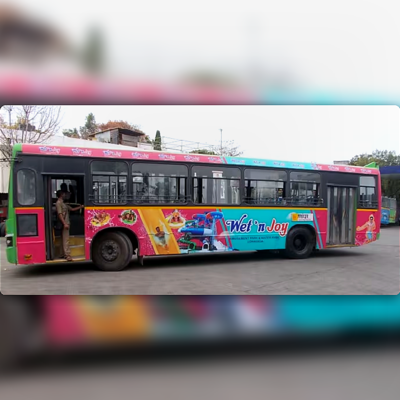
The format decision is where most campaigns either get the economics right or get them badly wrong. A full bus wrap — which involves vinyl printing on the entire exterior surface of the bus, including the sides, rear, and sometimes the front — is the most visually dominant option and the one that genuinely functions as a moving billboard; it commands attention in traffic, at bus stops, and in congested junctions in a way that no partial format can replicate. The production cost for a full bus wrap in vinyl printing is a meaningful line item, but when amortised over a three-month campaign duration, the cost per impression works out to numbers that would make most digital planners reconsider their media mix.
Bus back panel advertising is, frankly, the format we recommend most often to clients who are working with tighter budgets but still want high-frequency impressions, because the back panel faces the traffic directly behind the bus — which, in Pune's notoriously congested road conditions, means a captive audience of motorists sitting in traffic for extended dwell times. A bus back panel ad on a route like FC Road to Shivajinagar or Kothrud to Deccan can achieve dwell times of thirty seconds to two minutes per vehicle per encounter, which is an engagement metric that most digital advertising formats cannot come close to matching. Bus side panel advertising, which covers one or both flanks of the bus, works best for high-footfall corridors where pedestrian traffic is significant alongside vehicular movement.
Interior bus advertising — which includes overhead rack ads, window highlight advertising, and seat-back panels — targets a captive audience of actual passengers rather than external observers, and the brand recall dynamics are quite different. A passenger riding from Pimpri to Swargate for forty-five minutes is exposed to interior bus advertising repeatedly throughout the journey, which creates a depth of impression that exterior formats cannot achieve; we have found that interior formats work particularly well for categories like education sector advertising, healthcare brand advertising, and financial services, where the message requires more than a glance to register. Bus rack ads, which are placed in the overhead luggage area visible to seated passengers, and window highlight advertising, which uses translucent vinyl on windows, round out the interior format options — and together, they give media planners a genuinely layered toolkit for working with the PMPML fleet.
PMT Bus Advertising Rates in Pune (2025 Updated Cost Guide)
Transparent pricing is something the bus advertising industry in India has historically been reluctant to publish, which is why most agency pages say "contact for rates" and leave media planners none the wiser. Our experience at SmartAds, working across bus advertising campaigns in Pune and other cities, gives us a reasonable basis to share benchmark figures — with the caveat that actual rates vary by depot, route demand, format, campaign duration, and the specific concession holder you are working through.
For a full bus wrap on a PMPML bus, the monthly rate works out to somewhere between ₹25,000 and ₹45,000 per bus depending on the route and whether it is a standard non-AC bus or one of the newer electric bus branding units from PMPML's growing EV fleet; the electric buses, which tend to operate on premium corridors and attract a slightly higher-income ridership, command a modest premium of roughly fifteen to twenty percent over standard non-AC bus advertising rates. Bus back panel advertising, which is the most popular format in terms of volume booked, runs in the ballpark of ₹8,000 to ₹15,000 per bus per month — a number that surprises most first-time advertisers when they compare it to what they are paying for a single digital display ad placement with far lower dwell time. Bus side panel advertising rates typically fall somewhere between ₹12,000 and ₹22,000 per bus per month for a full-side panel, while interior bus advertising formats like bus rack ads and window highlight advertising are generally priced in the range of ₹3,000 to ₹7,000 per bus per month.
PMT bus advertising rates per month for a minimum campaign — which most concession holders define as a fleet of ten to fifteen buses over a period of one to three months — would therefore start at roughly ₹1.2 lakh to ₹2.5 lakh for a back panel campaign on fifteen buses, scaling up to ₹6 lakh to ₹9 lakh for a full bus wrap campaign on the same fleet size. The cost per impression on these campaigns, when calculated against verified daily ridership and route traffic data, works out to somewhere in the range of ₹0.15 to ₹0.40 per impression — which, frankly speaking, is among the lowest cost per impression figures available in any outdoor advertising Pune format, including bus shelter advertising and most hoarding advertising placements. Production costs for vinyl printing and installation are typically charged separately, adding roughly ₹8,000 to ₹20,000 per bus depending on the format and the printing vendor used.
Top Benefits of Advertising on PMT Buses in Pune
The case for bus advertising in Pune rests on a combination of reach, frequency, and cost efficiency that is genuinely difficult to replicate through any other single out-of-home advertising format in the city. PMPML carries an estimated 12 to 15 lakh passengers daily across its network — a figure drawn from PMPML's own operational reporting — which means the daily commuters on this system represent a cross-section of Pune's working population that spans income groups, age brackets, and geographies in a way that no targeted digital campaign can truly replicate. Brand visibility on a PMPML bus is not passive; it is repeated, route-specific, and embedded in the daily rhythm of the city.
One of the things we have consistently observed across transit media advertising campaigns is that the brand recall rates for bus advertising significantly outperform static formats, and the reason is intuitive: a moving billboard is harder to tune out than a static one, because it appears in contexts where the viewer is not expecting advertising — at a traffic signal, outside a school gate, at a market junction. A retail client in Pune's Kothrud area ran a three-month PMPML bus advertising campaign for a new store launch, concentrating on routes through Kothrud, Karve Nagar, and Warje; by the end of the campaign, footfall tracking showed a measurable uplift in store visits from customers who specifically mentioned having seen the bus advertisement, which validated the route-based advertising strategy we had recommended. The brand awareness generated in a localised geography through bus branding is, in our experience, faster and more cost-effective than equivalent digital spend targeting the same pin codes.
On top of that, the demographic profile of PMPML bus commuters is more diverse and, in many corridors, more economically active than the stereotype of "public transport users" might suggest. Routes connecting Hinjewadi IT Park, Baner, Wakad, and Aundh carry significant numbers of IT professionals and young urban consumers; routes through Hadapsar and Kharadi serve the eastern IT and manufacturing belt; and routes through the old city core — Shivajinagar, Deccan, Swargate — reach a dense, high-footfall commercial audience. This geographic and demographic range means that PMPML bus advertising can be calibrated to reach very specific audience profiles through intelligent depot-wise advertising and route selection, which is something we spend considerable time on during the media planning phase at SmartAds.
Which Industries Get the Best ROI from PMT Bus Advertising?
Frankly speaking, not every category extracts equal value from bus advertising in Pune, and a good media planner should be honest about this rather than selling it as a universal solution. The categories that consistently deliver strong bus advertising ROI in our experience are those where the target audience overlaps heavily with daily commuters, where the message can be communicated in a short visual exposure, and where geographic concentration matters — because bus routes are, by nature, geographically specific.
FMCG advertising is perhaps the most natural fit, because FMCG brands need mass reach at low cost per impression, and PMPML's daily ridership delivers exactly that; we have seen FMCG campaigns on PMPML buses achieve effective reach figures that compare favourably with regional television spots at a fraction of the cost. Real estate advertising outdoor is another strong performer, particularly for projects located along or near specific bus corridors — a developer in Wakad, for instance, would find considerable value in advertising on routes that connect Hinjewadi and Baner to the Wakad-Bhosari corridor, because those routes carry exactly the IT professional demographic that is the target buyer for mid-segment residential projects. Education sector advertising — coaching institutes, universities, skill development centres — works exceptionally well on routes that pass through student-dense areas like FC Road, Karve Road, and Viman Nagar, where the captive audience includes a high proportion of the eighteen to twenty-five age group.
Healthcare brand advertising, particularly for hospital networks, diagnostic chains, and pharmaceutical brands with OTC products, benefits from the sheer frequency of impressions that bus branding delivers across mixed-income neighbourhoods; one healthcare client we worked with ran a campaign for a new diagnostic centre across fifteen PMPML buses on routes through Hadapsar, Magarpatta, and Kharadi, and the centre reported a meaningful increase in walk-in enquiries from those catchments within the first six weeks of the campaign going live. Beyond these categories, financial services, telecom brands, and retail chains have all found PMPML bus advertising to be a productive component of their outdoor advertising Pune strategy — particularly when combined with bus shelter advertising at key stops to create a layered out-of-home advertising presence.
How to Book a PMT Bus Advertising Campaign: Step-by-Step
The booking process for PMPML bus advertising is more structured than many advertisers assume, and understanding it upfront saves considerable time and frustration. The first step is identifying an authorised bus advertising agency that holds a valid concession agreement with PMPML for the depots and routes you want to cover; this is important because not every vendor claiming to offer PMT bus advertising actually has current authorisation, and campaigns booked through unauthorised intermediaries can face mid-campaign removals or permit disputes. At SmartAds, we work with verified concession holders across PMPML's depot network, which is something we verify before recommending any vendor to a client.
Once the agency and depot selection is confirmed, the next stage involves submitting the campaign brief — specifying the format, the number of buses, the preferred routes or depots, and the campaign duration — along with a creative brief or finished artwork for review. PMPML requires that advertising creatives comply with ASCI guidelines and that they do not contain content that is political, religious, or otherwise restricted under the concession terms; the approval process typically takes three to seven working days, after which the concession holder coordinates with the depot for installation scheduling. Vinyl printing for bus ads requires artwork at a minimum resolution that accounts for the large-format output — typically 720 DPI at a reduced scale, with final file sizes and panel dimensions varying by format — and the printing and installation phase adds another five to ten working days to the timeline.
The minimum booking quantity for most PMPML bus advertising campaigns is in the range of five to ten buses, though some concession holders will accommodate smaller bookings for local or small business advertisers; the minimum campaign duration is typically one month, with three-month and six-month campaigns attracting meaningful discounts on the monthly rate. What we tell our clients is that a three-month campaign is the practical minimum for building brand recall through bus branding, because the first month is largely about establishing recognition, and the recall and response effects compound in the second and third months. Payments are generally structured as advance payment for the first month, with subsequent months billed in advance on a rolling basis, and production costs are invoiced separately upon artwork approval.
PMT Bus Advertising Routes and Depot Coverage in Pune
Understanding the depot and route geography of PMPML is, in our view, one of the most important and least-discussed aspects of planning a bus advertising campaign in Pune. PMPML operates from a network of depots spread across the city, each of which serves a cluster of routes covering specific geographic corridors; the major depots include Swargate, Kothrud, Hadapsar, Vishrantwadi, Pimpri, Nigdi, Katraj, and Shivajinagar, among others, and each depot's fleet covers a distinct set of Pune bus routes that a media planner can use to target specific audience geographies.
The Swargate depot, which is one of the largest and most centrally located, covers routes that pass through the old city core — Laxmi Road, Budhwar Peth, Bajirao Road — as well as arterial routes connecting the city centre to Katraj and Kondhwa in the south; advertising out of this depot reaches a dense, mixed-income urban audience with high footfall and strong commercial activity. The Hinjewadi and Wakad corridors, which are served by routes out of the Kothrud and Pimpri depots, carry a predominantly IT professional and young urban demographic, which makes them particularly valuable for brands targeting the twenty-five to forty age group with disposable income. Hadapsar and Kharadi, served by the Hadapsar depot, cover the eastern IT and industrial belt, which has seen significant residential growth and represents a high-value audience for real estate advertising outdoor, retail, and financial services brands.
Depot-wise advertising also allows for geographic exclusivity in certain cases — a brand can negotiate to be the sole advertiser in a specific category on buses out of a given depot, which enhances the competitive advantage of the campaign and prevents category clutter. Route-based advertising, where specific high-frequency routes are selected based on audience composition data, is the approach we favour at SmartAds for campaigns with defined target demographics; for pan-India bus advertising clients who are also running campaigns in other cities — comparing, say, BEST bus advertising in Mumbai or BMTC bus advertising in Bengaluru — the depot-wise structure in Pune is actually more flexible and granular than what most other city networks offer. GPS-tracked bus advertising, which is an emerging capability where route compliance and impression delivery can be verified through GPS data from the bus fleet, is beginning to be offered by some concession holders on the PMPML network, and we expect this to become standard practice within the next two to three years.
How Does PMT Bus Advertising Compare to Hoardings and Metro Ads?
The comparison between bus advertising in Pune and hoarding advertising is one that comes up in almost every media planning conversation we have, and the honest answer is that they serve different functions rather than being direct substitutes. A hoarding advertising placement on a premium site — say, the Pune-Mumbai Expressway junction or the Baner-Pashan Road — delivers a single high-impact impression to a large number of vehicles passing that specific point; the impression is powerful but geographically fixed, and the audience is defined by who passes that location. PMPML bus advertising, by contrast, distributes impressions across the entire route geography, reaching audiences at multiple points throughout the day and creating a sense of brand omnipresence that a single static site cannot replicate.
On cost, the comparison is instructive. A premium hoarding on a high-traffic Pune corridor might cost somewhere between ₹1.5 lakh and ₹4 lakh per month, depending on the location and the site owner; for the same budget, a bus branding campaign on fifteen to twenty PMPML buses with back panel advertising would deliver a significantly larger total impression count, spread across multiple routes and geographies. The cost per impression on bus advertising in Pune, as we noted earlier, works out to a fraction of what equivalent hoarding placements deliver — and this is a number that we have used to justify transit media advertising to more than one sceptical CFO. To be fair, hoardings offer a permanence and a scale of individual impression that bus ads cannot match; a well-placed hoarding becomes a landmark, while a bus ad is one element in a moving visual environment.
The comparison with Pune Metro advertising is more nuanced and, frankly, more interesting. Pune Metro Rail, which has been expanding its network through the PMRDA corridor, offers station branding and in-train advertising that reaches a captive, predominantly urban professional audience; the demographic profile of Metro commuters skews higher-income and more educated than the average PMPML bus commuter, which makes Metro advertising more appropriate for premium brand positioning. However, PMPML bus advertising covers a far wider geographic footprint — including areas that the Metro does not yet reach — and delivers significantly higher total impression volumes at a lower cost per impression. Our recommendation for most brands is to treat these as complementary rather than competing formats within a broader OOH advertising strategy; a campaign that combines bus branding for mass reach with Metro station advertising for premium audience engagement will typically outperform either format used in isolation.
Measuring the Impact of Your PMT Bus Advertising Campaign
The ROI measurement question is one that the outdoor advertising industry has historically struggled to answer convincingly, and bus advertising in Pune is no exception — but the tools and methodologies available have improved considerably, and a well-structured campaign can now generate meaningful performance data. The most straightforward metric is reach, which for PMPML bus advertising is estimated using a combination of daily ridership data, route traffic counts, and pedestrian footfall figures; a campaign running fifteen buses on high-frequency routes in Pune city would be expected to generate somewhere in the range of 6 to 9 lakh impressions per day across all exposure types, which over a thirty-day campaign works out to total impressions in the range of 1.8 to 2.7 crore.
Brand recall measurement, which is the more meaningful metric for most advertisers, requires primary research — typically a pre-campaign and post-campaign survey of the target audience in the relevant geographies. We have conducted these for clients and found that well-executed bus branding campaigns in Pune consistently deliver brand recall uplifts of twenty to thirty-five percent among commuters on the relevant routes, which is a figure that compares favourably with the recall data published in industry reports like the FICCI-EY Media Report and the Dentsu e4m Report for comparable OOH advertising formats. One automotive brand we worked with ran a four-month PMPML bus advertising campaign across twenty-five buses on routes connecting Hinjewadi, Baner, and Aundh; a post-campaign survey showed that unaided brand recall among respondents who used those routes had increased by twenty-eight percent, and dealer enquiries from those pin codes showed a statistically significant uplift during the campaign period.
GPS-tracked bus advertising is beginning to change the measurement landscape for transit media advertising in India, because it allows campaign managers to verify that buses are actually operating on the contracted routes and to calculate impression delivery against actual GPS-tracked movement data rather than estimated route schedules. DOOH digital out-of-home formats, including digital panels on buses and at bus shelters, add another layer of measurability through play-log data; while programmatic OOH is still in its early stages on the PMPML network specifically, the broader transit advertising India market is moving in this direction, and we expect Pune to follow the trajectory set by larger metro networks over the next few years. Bus advertising ROI, measured as the ratio of incremental revenue or brand equity uplift to campaign cost, consistently comes out favourably in the analyses we have conducted — particularly for local and regional brands for whom the cost efficiency of low-cost outdoor advertising is a primary consideration.
Frequently Asked Questions About PMT Bus Advertising in Pune
Q: What is PMT bus advertising and is it the same as PMPML bus advertising?
PMT bus advertising and PMPML bus advertising refer to advertising on the same physical fleet of buses that operates across Pune city and the Pimpri-Chinchwad area. PMT — Pune Municipal Transport — was the original civic bus service operated by the Pune Municipal Corporation, which was merged with the Pimpri-Chinchwad Municipal Transport in 2007 to form PMPML, the Pune Mahanagar Parivahan Mahamandal Ltd. The name PMT persisted in popular usage even after the merger, which is why both terms are used interchangeably by advertisers and agencies. For all practical purposes, when you are booking PMT bus advertising today, you are booking advertising on PMPML buses, and the permits, approvals, and concession agreements are all managed under the PMPML framework. There is no separate PMT fleet or PMT advertising network operating independently of PMPML.
Q: How much does PMT bus advertising cost per month in Pune?
PMT bus advertising rates per month vary by format, route, and the specific concession holder managing the depot. As a benchmark, bus back panel advertising runs in the range of ₹8,000 to ₹15,000 per bus per month, which is the most commonly booked format; bus side panel advertising is priced somewhere between ₹12,000 and ₹22,000 per bus per month, while a full bus wrap — which covers the entire exterior — costs in the ballpark of ₹25,000 to ₹45,000 per bus per month. Interior bus advertising formats like bus rack ads and window highlight advertising are generally in the range of ₹3,000 to ₹7,000 per bus per month. Production costs for vinyl printing and installation are charged separately, typically adding ₹8,000 to ₹20,000 per bus depending on the format. A minimum campaign on fifteen buses with back panel advertising would therefore start at roughly ₹1.2 lakh to ₹2.5 lakh per month, excluding production.
Q: What are the different ad formats available on PMT/PMPML buses?
The PMPML fleet supports a range of bus advertising formats that span both exterior and interior placements. On the exterior, the main formats are the full bus wrap, which covers the entire outer surface of the bus; bus side panel advertising, which covers one or both flanks; and bus back panel advertising, which covers the rear face visible to following traffic. On the interior, advertisers can use bus rack ads placed in the overhead luggage area, window highlight advertising using translucent vinyl on windows, and seat-back panel advertising. Some newer PMPML buses, particularly the electric bus branding units, also offer space for digital display panels inside the cabin, though this format is not yet universally available across the fleet. Each format has different creative dimension requirements, and artwork must be prepared to the specific panel dimensions provided by the concession holder for the relevant depot.
Q: How many people does a PMT bus advertisement reach daily?
A single PMPML bus on a high-frequency route in Pune city generates somewhere between 40,000 and 60,000 visual impressions per day when you account for both passenger ridership and external exposure to pedestrians and motorists along the route. This figure is derived from a combination of PMPML's daily ridership data, which puts total system ridership at roughly 12 to 15 lakh passengers per day across the network, and traffic count data for the major corridors. For a campaign running on fifteen buses across multiple routes, the daily impression total would be in the range of 6 to 9 lakh, which over a thirty-day campaign period accumulates to a total reach figure in the range of 1.8 to 2.7 crore impressions. These are not audited figures in the way that BARC viewership data is audited for television, but they are consistent with the estimation methodologies used across the transit advertising India industry.
Q: How do I book a PMT bus advertising campaign in Pune?
Booking a PMT bus advertising campaign involves working through an authorised bus advertising agency or concession holder that has a current agreement with PMPML for the depots and routes you want to cover. The process begins with a campaign brief specifying the format, fleet size, preferred routes or depots, and campaign duration; the agency then confirms availability and provides a rate card for the relevant placements. Creative artwork is submitted for PMPML approval, which typically takes three to seven working days, after which vinyl printing and installation are scheduled with the depot — adding another five to ten working days. The full timeline from brief to buses on road is typically between ten and twenty-one working days. Payment is generally structured as advance payment for the first month, with production costs invoiced separately. SmartAds manages end-to-end booking for PMPML bus advertising campaigns across Pune, handling everything from depot selection and permit coordination to creative production and campaign monitoring.
Q: Which bus routes or depots are available for PMT bus advertising?
PMPML operates from depots including Swargate, Kothrud, Hadapsar, Vishrantwadi, Pimpri, Nigdi, Katraj, Shivajinagar, and several others, each covering a distinct cluster of Pune bus routes. Advertising availability is managed depot-by-depot, and specific route availability depends on the concession agreements in place with the authorised vendors for each depot. Key high-value corridors include the Hinjewadi IT Park routes, the Hadapsar-Kharadi IT belt, the Kothrud-Deccan corridor, the Swargate-Katraj route, and the Pimpri-Chinchwad industrial and residential routes. Depot-wise advertising allows for geographic targeting, and in some cases, category exclusivity can be negotiated for specific depots. A media buying agency with current PMPML relationships — like SmartAds — will be able to provide up-to-date availability across depots and recommend the optimal route selection based on your target audience profile.
Q: What is the minimum duration for a PMT bus advertising campaign?
The minimum campaign duration for PMPML bus advertising is typically one month, though most concession holders prefer a minimum of three months for standard campaigns. A one-month campaign is available for advertisers with event-specific or promotional objectives, but the rate per bus per month is generally higher for shorter durations, as the volume discount structure rewards longer commitments. Our recommendation at SmartAds is a minimum of three months for any brand awareness or brand recall objective, because the research consistently shows that bus branding campaigns reach their peak recall effectiveness in the second and third months of exposure; a one-month campaign will generate awareness but is unlikely to drive the depth of recall that justifies the production investment.
Q: Is PMT bus advertising effective for small and local businesses in Pune?
It is, and this is actually one of the strongest arguments for bus advertising as a format — the minimum entry point is accessible for local businesses in a way that premium hoarding advertising is not. A small business in Kothrud or Hadapsar can run a back panel campaign on five to ten buses covering their local routes for a monthly investment that starts at roughly ₹40,000 to ₹1.5 lakh including production, which is a budget that many local retailers, coaching institutes, clinics, and restaurants can accommodate. The geographic targeting capability of depot-wise advertising means that a local business can concentrate its campaign on routes that pass through its catchment area, rather than paying for city-wide reach that is irrelevant to its customer base. We have worked with several small and medium businesses in Pune on PMPML bus advertising campaigns, and the consistent finding is that the local brand visibility generated by even a modest bus branding campaign has a disproportionate impact on walk-in enquiries and local brand recall.
Q: What permissions or approvals are required for advertising on PMPML buses?
Advertising on PMPML buses requires approval from PMPML through the authorised concession holder for the relevant depot. The creative content must comply with ASCI guidelines — which prohibit misleading claims, offensive content, and advertising for restricted categories — as well as PMPML's own content policy, which restricts political, religious, and certain commercial categories. The concession holder manages the approval submission and coordinates with PMPML's advertising department; advertisers do not typically need to interact with PMPML directly. For categories like alcohol, tobacco, and certain financial products, additional regulatory restrictions apply and should be confirmed with the agency before artwork is finalised. The approval process generally takes three to seven working days from the submission of final artwork.
Q: How does PMT bus advertising compare to billboard/hoarding advertising in Pune?
The fundamental difference is mobility versus fixity. A hoarding delivers a single high-impact impression at a fixed geographic point, while bus advertising in Pune distributes impressions across the entire route geography throughout the day. On cost efficiency, bus back panel advertising at ₹8,000 to ₹15,000 per bus per month compares very favourably with premium hoarding sites in Pune, which can cost ₹1.5 lakh to ₹4 lakh per month for a single location; the total impression count delivered by a fifteen-bus back panel campaign will typically exceed what a single premium hoarding delivers, at a lower total cost. The trade-off is that hoardings offer a permanence and a scale of individual impression that bus ads cannot match — a landmark hoarding becomes associated with a location in a way that a moving bus ad does not. For most brand awareness and brand visibility objectives, the combination of both formats in a mixed OOH advertising strategy outperforms either used alone.
Q: Can I target specific areas or neighbourhoods in Pune through bus advertising?
Yes, and this is one of the most valuable capabilities of PMPML bus advertising for media planners. By selecting specific depots and routes, advertisers can concentrate their campaign on particular neighbourhoods,
