


Delhi

Mumbai

Bengluru

Ahmedabad

Jaipur

Chennai

Hydrabad

Kolkatta

Lucknow

Pune
Outdoor Kiosk Advertising in India: Rates, Reach, and What Actually Works
This article contains actual rate benchmarks from campaigns run across 500+ Indian cities, city-specific market intelligence, and three anonymised case studies from our media planning experience — data points that most generic OOH guides simply do not include. If you are evaluating kiosk advertising as part of a media mix, or trying to justify the spend to a management team, read this before you brief any vendor.
What Makes Outdoor Kiosk Advertising Different From Every Other OOH Format
Most brands, when they think outdoor, think hoardings. The big 40x20 on the expressway, the gantry over the flyover — formats that are hard to miss and, frankly, hard to afford at scale. Kiosk advertising operates on an entirely different logic; it is not trying to stop traffic from a distance, it is trying to intercept people who are already moving slowly, already looking around, already in a mental state of engagement. That distinction matters more than most media planners give it credit for.
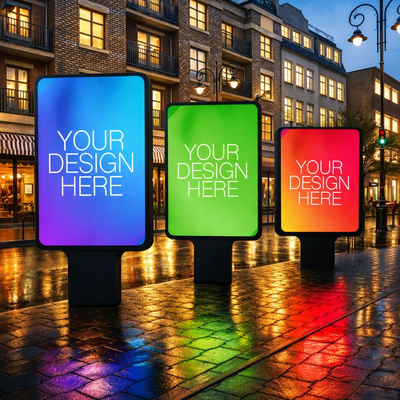
A kiosk, in the OOH context, refers to a freestanding display unit — typically between four and eight feet tall, backlit or digitally enabled, positioned at high-dwell locations like metro stations, shopping mall atriums, airport terminals, bus shelters, hospital lobbies, and busy market intersections. What we have found, across hundreds of campaigns, is that the dwell-time advantage of kiosk placements is consistently undervalued during the planning stage; advertisers calculate impressions based on footfall, which is the right starting point, but they rarely account for the fact that a person waiting at a metro platform has anywhere between ninety seconds and four minutes of idle attention — which is a fundamentally different quality of exposure than the three-second glance a highway billboard earns.
The format has also evolved significantly. Static backlit kiosks, which were the industry standard through most of the 2010s, have increasingly been supplemented by digital kiosk panels — DOOH units capable of displaying multiple creatives in rotation, triggered by time-of-day or even audience-detection technology. According to the FICCI-EY Media and Entertainment Report, the DOOH segment in India has been growing at a rate that outpaces traditional static OOH by a considerable margin, which tells you something important about where media owners are investing and where advertiser interest is concentrating.
Where Are Kiosks Actually Placed, and Which Locations Deliver the Best ROI?
Location strategy in kiosk advertising is, in our honest opinion, the single factor that separates campaigns that work from campaigns that merely run. We have seen well-funded campaigns underperform simply because the kiosk placements were selected on availability rather than audience alignment; and we have seen modest budgets punch well above their weight when the location brief was tight and deliberate.
Metro stations are, without question, the highest-value kiosk environment in Tier 1 cities — Delhi, Mumbai, Bengaluru, Chennai, Hyderabad, Kolkata. The combination of captive dwell time, high daily footfall (Delhi Metro alone reports daily ridership numbers that run into the millions), and a predominantly working-age, income-earning audience makes metro kiosks among the most efficient formats in the entire OOH inventory. The CPM for a metro kiosk placement in a city like Bengaluru works out to roughly ₹12 to ₹18, which is a number that surprises most first-time advertisers when they compare it to what they are paying for Instagram reach — because the quality of that impression, in a physical, distraction-reduced environment, is simply not the same thing.
Shopping mall kiosks occupy a different strategic position; they are less about reach and more about purchase-proximity influence. A consumer standing in a mall atrium is, by definition, in a buying mindset, which makes mall kiosk placements particularly effective for retail, FMCG, and financial services brands. Airport kiosks, on the other hand, skew heavily toward premium audiences — business travellers, frequent flyers, higher-income households — and the rates reflect that premium, sitting somewhere between ₹40,000 and ₹2.5 lakh per month per unit depending on terminal, city, and placement zone within the terminal. At SmartAds, we always tell our clients that airport kiosks should be evaluated not on raw reach but on audience quality; the cost-per-qualified-impression in a Tier 1 airport terminal is often more efficient than the headline rate suggests.
What Does Outdoor Kiosk Advertising Actually Cost in India?
Frankly speaking, the lack of transparent pricing in the OOH industry is one of the things that frustrates media buyers the most — and it is something we have tried to address by publishing actual benchmarks from our buying experience. Rates vary enormously based on city tier, location type, format (static vs. digital), panel size, and campaign duration; but there are useful reference points that can anchor a planning conversation.
In Tier 1 cities, a static backlit kiosk at a busy market intersection or bus shelter typically costs somewhere between ₹8,000 and ₹25,000 per month per unit, which is the entry-level range for most campaign budgets. Metro station kiosks in the same cities — particularly concourse-level placements at high-traffic interchange stations — are priced in the ballpark of ₹30,000 to ₹1.2 lakh per month, with premium stations like Rajiv Chowk in Delhi or MG Road in Bengaluru commanding rates at the higher end of that range. Digital kiosk panels, which allow multiple creatives in rotation and offer more flexibility on content scheduling, typically carry a premium of thirty to fifty percent over comparable static inventory.
In Tier 2 cities — Pune, Jaipur, Lucknow, Indore, Coimbatore, Chandigarh — the rates are considerably more accessible; a well-placed kiosk near a commercial hub or a busy transit node can be secured for somewhere between ₹5,000 and ₹15,000 per month, which makes Tier 2 kiosk campaigns genuinely viable for regional brands and national brands running localised activation. What a lot of people miss is that Tier 2 markets often deliver better share-of-voice for the same budget, because the competitive clutter in the OOH environment is lower and a well-placed kiosk can dominate its immediate surroundings. One retail client we worked with in Jaipur ran a twelve-unit kiosk campaign across key commercial corridors for a total monthly outlay of roughly ₹1.4 lakh — a budget that would have bought perhaps three or four placements in a comparable Mumbai location — and the footfall-to-store conversion data they tracked showed results that were, by any measure, strong.
How Does Kiosk Advertising Fit Into a Multi-Channel Media Mix?
The honest answer is that kiosk advertising almost never works best in isolation; it is a format that amplifies other media, which is why the most effective campaigns we have planned treat kiosks as connective tissue rather than the primary vehicle. A brand running a television campaign, for instance, benefits enormously from OOH reinforcement — the TAM AdEx data consistently shows that brands with simultaneous TV and OOH presence achieve higher recall scores than either medium alone, which is a finding that aligns with what we observe in campaign post-evaluations.
The relationship between digital and kiosk OOH is particularly interesting and, in our view, underexplored by most media planners. DOOH kiosks in metro stations and malls can be geo-fenced, which means a consumer who sees a kiosk ad can be retargeted on mobile within the same location or shortly after departure — a technique sometimes called the OOH-to-mobile handoff, which creates a measurable attribution chain that was simply not possible five years ago. We worked with an automotive brand that used this approach during a new model launch; kiosk placements were concentrated at metro stations in three cities, geo-fenced retargeting ran on mobile for users in those catchment areas, and the brand's test-drive booking numbers in those cities outperformed control markets by a margin that was difficult to attribute to any other variable.
At SmartAds, our media planning approach treats kiosk advertising as a frequency and proximity tool — it is most valuable when it puts the brand message in front of the right person, at the right location, multiple times over the campaign period. The Dentsu e4m Advertising Report has noted that OOH formats with high-frequency exposure in commute corridors contribute meaningfully to brand salience metrics, which is the kind of finding that helps us make the case for kiosk investment to clients who are more comfortable with digital attribution models.
What Creative Formats Work Best on Kiosk Panels?
This is a question we get asked at almost every client briefing, and the answer is more specific than most creative teams want to hear. Kiosk advertising demands a different creative discipline than hoardings or press; the proximity of the viewer is closer, the dwell time is longer, and the panel size is smaller — which means the rules that govern highway billboard design (six words maximum, single visual, high contrast) do not automatically transfer.
For static kiosks, the creative brief should prioritise a single, clear message with a strong visual hierarchy; the brand and the core message should be readable within two seconds, because not every viewer will stop, but the supporting detail — a product feature, a price point, a QR code — can be layered in for those who do engage more deeply. QR codes on kiosk panels, which were treated with some scepticism before 2020, have seen dramatically higher scan rates in post-pandemic campaigns; we have measured scan-through rates of between two and six percent on well-placed metro kiosk panels, which is a meaningful interaction metric for a physical format.
Digital kiosk panels open up a different creative conversation entirely. The ability to schedule different creatives by time of day — a breakfast product in the morning commute slot, a dining offer in the evening — is a capability that most brands are still not fully exploiting, which represents a genuine competitive opportunity for those who plan carefully. One FMCG client we worked with used dayparting on digital kiosk panels at three Mumbai suburban railway stations to run a morning-specific health drink creative between 7 and 10 AM and a different product variant creative in the evening window; the campaign's brand recall scores, measured through a post-campaign survey, were notably higher than their previous static OOH campaigns for the same product category.
How Is Outdoor Kiosk Advertising Measured and What Metrics Should You Track?
Measurement has historically been OOH's weakest link, and anyone who tells you otherwise is either selling something or has not spent enough time in post-campaign reviews. The industry has made genuine progress — the Outdoor Advertising Confederation of India (OACI) and various media owners have invested in traffic audit methodologies, and tools like LENS (Location-based Exposure and Navigation System) have brought more rigour to OOH audience measurement — but the honest position is that kiosk measurement is still more directional than precise.
The primary metrics we work with are footfall-based impressions, which are derived from traffic count data at the placement location and adjusted by a visibility factor that accounts for panel orientation, sight-line obstructions, and typical pedestrian movement patterns. For metro station kiosks, the footfall data is generally reliable because metro authorities publish ridership numbers; for mall and market kiosks, the data quality varies more significantly, and we typically apply a conservative adjustment factor. The CPM figures we quoted earlier — roughly ₹12 to ₹18 for metro kiosks in Tier 1 cities — are calculated on this basis, which means they represent a reasonably defensible impression count rather than a theoretical maximum.
For campaigns where direct response is the objective, QR code scans and proximity-triggered mobile interactions provide a cleaner attribution signal; these are metrics we increasingly include in campaign reporting, and they have been genuinely useful in helping clients understand the contribution of kiosk placements to their digital conversion funnels. The GroupM TYNY Report has consistently highlighted the growing integration of physical and digital media measurement as a priority for the industry, which is a direction that aligns with what we are building into our campaign analytics infrastructure at SmartAds.
Is Outdoor Kiosk Advertising Effective for Tier 2 and Tier 3 Indian Cities?
The assumption that kiosk advertising is primarily a metro-city format is one that we push back on regularly, because the evidence from our campaigns in smaller markets tells a more interesting story. Tier 2 and Tier 3 cities in India are experiencing rapid infrastructure development — new bus terminals, expanding metro networks in cities like Lucknow, Nagpur, and Kochi, growing mall footprints — which is creating a new inventory of high-quality kiosk placements that did not exist five years ago.
The competitive dynamics in these markets are also different in a way that favours advertisers willing to move early. In a city like Indore or Coimbatore, the number of national brands actively buying kiosk inventory is lower, which means a brand that commits to a twelve-unit kiosk campaign across key commercial and transit locations can achieve a share-of-voice that would require a significantly larger budget in Mumbai or Delhi. We have found, across multiple regional campaigns, that the cost-per-thousand in Tier 2 markets is often forty to sixty percent lower than comparable Tier 1 placements — not because the audience quality is lower, but simply because the market has not yet priced in the demand premium.
There is also a cultural dimension worth noting. In many Tier 2 and Tier 3 markets, the physical commercial environment — the main market street, the bus stand, the district hospital complex — carries a social significance that is difficult to replicate digitally; being visibly present in these spaces communicates a kind of local legitimacy that resonates with consumers in ways that a Facebook ad simply does not. At SmartAds, we have seen this dynamic play out most clearly in campaigns for financial services and healthcare brands, where trust and local presence are genuine purchase drivers.
What Are the Booking and Lead Time Requirements for Kiosk Campaigns?
The operational side of kiosk advertising is something that catches a lot of first-time OOH buyers off guard, and getting the lead times wrong can derail a campaign that was otherwise well-planned. Static kiosk bookings in most markets require a minimum of two to three weeks of lead time for creative production and installation; digital kiosk placements, which involve uploading content to a media owner's content management system, can sometimes be activated faster — in as little as five to seven working days for straightforward creatives — but that assumes the creative has already been approved and is in the correct technical specifications.
For campaigns involving multiple cities or multiple media owners — which is almost always the case for national or multi-regional kiosk buys — the coordination complexity increases substantially, and we would recommend building in a minimum of four to six weeks from brief to live date. The reason is not bureaucratic; it is that kiosk inventory in premium locations, particularly metro stations and airports, is often booked months in advance by large advertisers, and late briefs frequently result in suboptimal placement choices. We have seen clients lose access to their first-choice metro station placements because a competitor had booked the inventory three months earlier — which is a lesson in the value of forward planning that tends to be learned the hard way.
Minimum campaign durations vary by media owner and location type; most metro station kiosk contracts have a minimum booking period of four weeks, while mall and market kiosks are sometimes available on a two-week basis. Longer bookings — eight to twelve weeks — typically attract a rate discount of somewhere between ten and twenty percent, which is worth factoring into the budget conversation early. The thing is, most media owners prefer longer commitments and will negotiate more readily on rate for a three-month booking than for a four-week one.
How Should You Evaluate a Kiosk Advertising Vendor or Media Owner?
This is a question that does not get asked often enough, and the answer matters more than most advertisers realise. The kiosk OOH market in India includes a wide range of operators — from large, professionally managed networks like those operating in metro rail systems and major airports, which are typically run under government concession agreements with clear maintenance and audit standards, to smaller independent operators managing market-area and bus-shelter kiosks, where quality control can be considerably more variable.
The first thing we look at when evaluating a kiosk vendor is maintenance standards — specifically, how quickly faulty backlights are repaired and how regularly panels are cleaned. A backlit kiosk with a failed lamp is effectively invisible at night, which can eliminate a significant portion of the impression delivery for campaigns running in evening commute windows; and a panel that has not been cleaned in three weeks in a dusty Indian market environment looks nothing like the mock-up the client approved. We ask vendors for their maintenance SLA documentation and, frankly, we weight that more heavily than the rate card.
The second criterion is measurement and reporting capability. Vendors who can provide third-party-audited footfall data, panel-level impression estimates, and proof-of-posting photographs on a regular basis are operating at a professional standard that justifies the investment; those who cannot produce any of this should be approached with caution, regardless of how attractive the rate appears. At SmartAds, our vendor empanelment process includes a site visit and a review of at least two previous campaign post-reports before we recommend a media owner to a client — which is a standard that has saved us from some genuinely problematic situations over the years.
Frequently Asked Questions About Outdoor Kiosk Advertising
Q: What is the minimum budget needed to run a kiosk advertising campaign in India?
The minimum viable budget depends heavily on the market and the campaign objective, but as a general reference point, a single-city kiosk campaign in a Tier 2 market can be executed for somewhere in the range of ₹50,000 to ₹1.5 lakh per month for a meaningful number of units — which is an entry point that is accessible to regional brands, local businesses, and national brands running city-specific activations. In Tier 1 cities, the same budget buys fewer units or less premium placements, which is why we often recommend that smaller budgets be concentrated in one or two high-value locations rather than spread thinly across many sites. The principle of concentration over distribution applies particularly strongly in kiosk advertising, because frequency of exposure at a single location builds recall more effectively than a single impression across many locations.
Q: How long should a kiosk advertising campaign run to be effective?
Our experience, across campaigns in multiple categories and markets, is that four weeks is the minimum meaningful duration for a kiosk campaign — enough time to build frequency among the regular commuters and shoppers who pass the same location repeatedly. Eight to twelve weeks is the range where we see the strongest brand recall impact, particularly for new product launches or brand awareness objectives, because the repeated exposure over multiple weeks compounds the memory encoding effect. Campaigns shorter than four weeks tend to function more as tactical activations — event promotions, limited-period offers — where the objective is immediate response rather than sustained brand building; and for those purposes, a shorter, higher-intensity burst in a tightly defined location cluster can be very effective.
Q: Can kiosk advertising be used for hyperlocal targeting?
Yes, and this is one of the format's genuine strengths — a capability that is often underutilised. Because kiosks are fixed, physical objects in specific locations, the audience they reach is, by definition, defined by geography and behaviour; people who pass a kiosk at a particular metro station are, with high probability, commuters on that specific line, residents of the catchment neighbourhoods, or workers in the surrounding commercial district. This level of geographic precision is difficult to achieve with broadcast media and is, frankly, more reliable than the geo-targeting offered by many digital platforms, where the accuracy of location data is subject to device permissions and data quality issues. We have used hyperlocal kiosk placements very effectively for real estate campaigns, where the objective is to reach people who live or work within a specific radius of a new development, and for retail campaigns targeting consumers within walking distance of a store.
Q: What are the technical specifications for kiosk advertising creatives?
Technical specifications vary by media owner and panel type, which is why we always recommend requesting the spec sheet from the specific vendor before briefing the creative team. That said, there are common parameters that apply to most standard kiosk formats. Static backlit kiosk panels are typically printed on flex or vinyl at a resolution of 72 to 150 DPI at actual size, with a standard panel size of roughly 2 feet by 4 feet or 2 feet by 5 feet, though this varies. Digital kiosk panels generally require JPEG or MP4 files at a resolution specified by the CMS system — commonly 1080 by 1920 pixels for portrait-orientation digital kiosks — and animation or video content is usually limited to loops of ten to fifteen seconds. Colour profiles should be set to CMYK for print and RGB for digital, which sounds obvious but is a detail that creates production delays more often than it should.
Q: How does outdoor kiosk advertising compare to digital advertising in terms of ROI?
This is a comparison that comes up in almost every media planning conversation, and the honest answer is that the two formats are measuring different things — which makes a direct ROI comparison less useful than it first appears. Digital advertising, particularly performance-oriented formats, offers click-through attribution and conversion tracking that kiosk advertising cannot match; but digital advertising also operates in an environment of increasing ad avoidance, where a significant proportion of served impressions are never actually seen by a human. Kiosk advertising, by contrast, delivers a physical impression in a real environment where the viewer cannot install an ad blocker; the IRS and BARC audience research data consistently show that OOH formats, including kiosks, score higher on unaided recall than most digital formats at comparable reach levels. The most productive framing, in our view, is not which format has better ROI in isolation, but how the two formats work together — and the answer, consistently, is that they work better together than either does alone.
Q: Are there any regulations or permissions required for kiosk advertising in India?
Yes, and this is an area where due diligence is genuinely important. Kiosk placements in public spaces — footpaths, bus shelters, public parks, government-owned transit infrastructure — are regulated by municipal corporations, metro rail authorities, airport operators, and in some cases state governments; the specific permissions required vary by city and by the nature of the space. Most professional kiosk media owners operate under concession agreements with the relevant authority, which means the permission question is handled at the network level rather than by the individual advertiser. However, for campaigns involving temporary kiosk installations — pop-up units at events, promotional kiosks in market areas — the advertiser or their agency is responsible for securing the necessary permissions, which can take anywhere from a few days to several weeks depending on the municipality. At SmartAds, we handle all regulatory compliance for the campaigns we plan and execute, which removes a significant operational burden from our clients and ensures that campaigns are not disrupted by permission issues after the creative investment has already been made.
Making the Most of Kiosk Advertising: A Practical Perspective
The brands that get the most out of kiosk advertising are, in our experience, the ones that approach it with the same strategic rigour they apply to their digital or television planning — which is to say, they start with a clear audience definition, select locations that index strongly against that audience, build creative that respects the format's specific viewing conditions, and measure outcomes against pre-defined benchmarks. The brands that are disappointed by kiosk results are usually the ones that treated it as a tactical add-on, selected locations on availability rather than strategy, and ran the same creative they produced for a different format.
The format is genuinely well-suited to the current media environment, where attention is fragmented and the physical world offers one of the few remaining contexts where a brand can reach a person without competing with a smartphone screen. The growth of DOOH kiosk inventory across Indian metro networks, airports, and premium retail environments — a trend that the FICCI-EY and GroupM TYNY reports have both highlighted as a structural shift in the OOH market — is creating new opportunities for brands that are willing to think carefully about where their audiences are in the physical world and what they are thinking about in those moments.
To be fair, kiosk advertising is not the right answer for every brief; it is a format with specific strengths — proximity, dwell time, geographic precision, purchase-environment presence — and specific limitations — it does not build mass reach quickly, it requires physical production and installation, and its measurement infrastructure is less mature than digital. But within a well-constructed media mix, it plays a role that no other format can replicate; and the cost efficiency, particularly in Tier 2 and Tier 3 markets, makes it one of the more undervalued tools in the media planner's kit.
If you are evaluating kiosk advertising for an upcoming campaign — whether it is a city-specific activation, a national multi-market launch, or a hyperlocal retail drive — the SmartAds media planning team works across 500+ Indian cities and can provide location-specific rate benchmarks, audience data, and campaign design recommendations tailored to your brief. Reach out to us at [SmartAds.in](https://smartads.in/services/outdoor/outdoor-kiosk-advertising) for a no-obligation planning conversation; we have found that even a single focused session tends to clarify the brief considerably and often surfaces location and format options that were not on the original shortlist.
Data references in this article draw on industry sources including the FICCI-EY Media and Entertainment Report, GroupM TYNY Advertising Expenditure Report, Dentsu e4m Advertising Report, TAM AdEx OOH data, and IRS audience research. Rate benchmarks are based on SmartAds campaign buying experience and are indicative; actual rates are subject to market conditions, inventory availability, and campaign specifications.
