


Delhi

Mumbai

Bengluru

Ahmedabad

Jaipur

Chennai

Hydrabad

Kolkatta

Lucknow

Pune
Outdoor Traffic Signal Advertising in India: OOH Branding at Busy Intersections for Maximum Brand Visibility | PAN India Traffic Junction Advertising | Cost-Effective High Dwell Time Campaign Rates
This article contains actual rate benchmarks across Indian cities, regulatory guidance most agencies won't share, DOOH format comparisons, and campaign measurement frameworks drawn from real SmartAds planning experience — if you are evaluating traffic signal advertising as part of your media mix, the data here will save you weeks of vendor conversations.
What Is Outdoor Traffic Signal Advertising in India?
There is a moment — repeated hundreds of millions of times every single day across Indian roads — where a vehicle stops, the driver looks up, and for the next sixty to ninety seconds, they have absolutely nothing else to do. No scroll to escape to, no notification pulling their attention sideways, no competing screen demanding priority. Outdoor traffic signal advertising exists precisely to own that moment; and when it is planned well, it is one of the most efficient forms of out-of-home advertising available in the country.
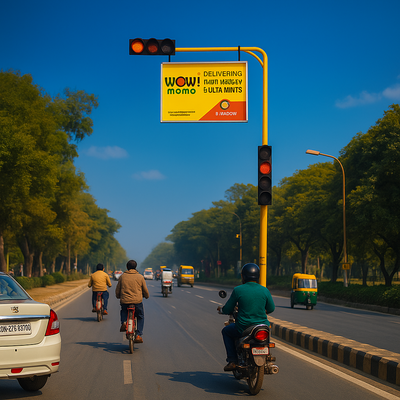
At its core, traffic signal advertising refers to brand communication placed at or around traffic signal junctions — on signal poles, traffic booths, barricades, countdown timer panels, and increasingly on digital LED screens integrated into the signal infrastructure itself. Unlike a hoarding on a flyover which a commuter passes at sixty kilometres per hour, traffic signal branding is consumed at zero speed, which changes the entire calculus of attention. The audience is not moving; the brand is not competing with motion blur or split-second glances. Dwell time at a busy intersection can run anywhere from sixty seconds to over two minutes during peak hours, which is a figure that tends to surprise brand managers who are accustomed to thinking in terms of five-second pre-roll skips.
What a lot of people miss is that outdoor traffic signal advertising in India has evolved considerably from the simple pole banner of the early 2000s. Municipal corporations across metro cities and increasingly across Tier-2 cities have formalised vendor empanelment processes, brought in IOAA-aligned guidelines, and in many smart cities, begun integrating digital OOH infrastructure directly into signal hardware. The result is a media format that sits at the intersection — quite literally — of traditional out-of-home advertising and modern programmatic delivery, which makes it relevant to brand managers across virtually every category.
Why Do Vehicles Stopped at Red Lights Make the Perfect Captive Audience?
We have run campaigns across dozens of media formats over the years, and the one thing that consistently stands out about traffic signal advertising is the quality of the audience contact — not just the quantity. A commuter stopped at a busy intersection in Bengaluru's Outer Ring Road or at the Bandra-Kurla Complex junction in Mumbai is not a passive viewer in the way that a television audience member might be; they are present, alert, and with their eyes at street level, which is exactly where traffic signal branding lives.
The average red-light cycle in Indian metro cities runs between sixty and one hundred and twenty seconds, which translates to a dwell time that most digital formats would struggle to match at comparable cost. At a junction handling thirty thousand vehicles per day — which is a conservative estimate for a major intersection in Delhi-NCR or Chennai's Mount Road — the opportunity-to-see (OTS) figure across a single month of campaign duration can cross the nine lakh mark, depending on the number of signal cycles and the visibility angle of the format. Frankly speaking, very few out-of-home advertising formats outside of prime highway gantry advertising can deliver that kind of frequency to a geographically concentrated audience.
On top of that, the audience composition at traffic signal junctions tends to skew towards commuters who are economically active — car owners, two-wheeler riders, auto-rickshaw passengers, and pedestrians waiting to cross, all of whom represent distinct consumer segments that can be mapped against a brand's target profile. At SmartAds, we always tell our clients that traffic signal advertising is not a mass-reach play in the way that a television spot is; it is a frequency and familiarity play, where the goal is to become part of a commuter's daily visual landscape until brand recall becomes almost automatic. One FMCG client we worked with in Pune ran a three-month traffic signal branding campaign across fourteen junctions in the Kothrud and Aundh corridors, and their aided brand recall in those micro-markets jumped by a figure that their research agency described as statistically significant — which, for a brand that had been present in the city for years without a dedicated OOH push, was a meaningful outcome.
What Are the Key Formats Used in Traffic Signal OOH Advertising?
The format question is where most first-time buyers of traffic signal advertising get confused, because the category is broader than it appears from the outside. Traffic signal pole banners are the most commonly recognised format — fabric or flex panels mounted on signal poles at eye level for motorists and pedestrians, typically sized between two feet by four feet and four feet by six feet, which makes them readable at close range without requiring the large-format production budgets of a billboard or unipole. These are cost-effective, fast to fabricate, and can be deployed across a large number of junctions simultaneously, which is why they remain the workhorse format for campaigns that need PAN India reach within a constrained budget.
Traffic booth advertising, on the other hand, wraps the traffic police booth itself — the small cabin at the centre of a busy intersection where the traffic constable is stationed — in brand graphics, which gives the advertiser a 360-degree visibility surface that is visible from all four directions of the junction simultaneously. This is a format that a lot of brands overlook, and we think that is a mistake; the traffic booth sits at the geometric centre of the intersection, which means every vehicle approaching from any direction has a line of sight to the brand. Traffic barricade advertising uses the metal barricades that divide lanes or pedestrian crossings as brand surfaces, typically through printed panels or vinyl wraps, and these are particularly effective for pedestrian-facing campaigns because they sit at exactly the right height and angle for someone standing on a footpath.
Beyond these three primary formats, there is pole kiosk advertising — which involves branded kiosks or information panels mounted on signal poles and which often include public utility information alongside brand messaging — and increasingly, digital OOH integration through LED countdown timer panels and dedicated digital traffic pole screens, which we will cover separately. Gantry advertising at signal junctions, where a branded arch or frame spans the road above the signal, is also used at select high-traffic locations in cities like Hyderabad's Hitech City corridor and Mumbai's Western Express Highway, though these tend to be priced closer to premium hoarding advertising given the fabrication complexity involved.
How Much Does Traffic Signal Advertising Cost in India?
Pricing is the section that most agency pages either skip entirely or bury in a "contact us for rates" deflection, which we find genuinely unhelpful for anyone trying to build a media plan. So here is what the market actually looks like, based on our direct buying experience across cities.
Traffic signal pole banners in Tier-2 cities — places like Jaipur, Lucknow, Coimbatore, and Ahmedabad — typically cost somewhere in the ballpark of eight thousand to fifteen thousand rupees per pole per month, which includes fabrication and installation; in metro cities like Mumbai, Delhi, and Bengaluru, the same format at a premium junction can run anywhere from twenty thousand to forty-five thousand rupees per pole per month, with the variation driven by junction traffic count, municipality empanelment category, and the exclusivity of the site. Traffic booth advertising is priced differently — because each booth is a single, high-visibility unit, rates tend to be negotiated on a per-booth basis and can range from thirty thousand to over one lakh rupees per month at a prime junction in a metro city, which sounds steep until you calculate the OTS and compare it against what you would pay for equivalent reach through bus shelter advertising or a small hoarding.
Traffic barricade advertising is generally the most cost-effective entry point into the traffic signal advertising category; a set of barricades across a junction can be secured for as little as five thousand to twelve thousand rupees per month in Tier-2 cities, and in the range of fifteen thousand to thirty-five thousand rupees in metros, which makes it accessible even for small businesses and startups that are working with monthly OOH budgets under two lakhs. For a brand looking to run a PAN India traffic signal advertising campaign across fifty to one hundred junctions simultaneously — which is a scale we have executed for quick commerce and fintech clients — the blended cost per junction, factoring in a mix of metro and Tier-2 city placements, typically works out to somewhere between eighteen thousand and thirty thousand rupees per junction per month, inclusive of production. To put that in context, the cost per thousand impressions (CPM) at a well-selected traffic signal junction in a city like Hyderabad or Chennai works out to roughly eight to twelve rupees, which is a number that tends to stop brand managers mid-sentence when they compare it to what they are currently paying for programmatic display or even radio spots in the same markets.
Which Cities and Junctions Offer the Best Traffic Signal Ad Placements?
The honest answer is that the best placement is the one that sits on the daily commute route of your target consumer — but since that varies by brand, let us talk about the markets and junctions that consistently deliver the highest OTS and brand recall metrics in our experience.
Mumbai is the most expensive market for traffic signal advertising in India, but also the most rewarding for brands targeting upper-middle-class consumers; junctions around Bandra, the BKC approach roads, and the Western Express Highway signal points see some of the highest vehicle density in the country, and the audience profile skews strongly towards working professionals and business owners. Delhi-NCR offers a different kind of scale — the sheer number of junctions across the NCR region means that a well-planned campaign can achieve both high reach and high frequency simultaneously, with key placements in Connaught Place, Karol Bagh, Noida Expressway junctions, and the Gurugram Cyber City corridors all performing consistently well. Bengaluru's MG Road, Koramangala, and the Outer Ring Road tech corridor are particularly valuable for brands targeting the startup and technology professional segment, which is a demographic that is notoriously difficult to reach through traditional media.
Hyderabad's Jubilee Hills and Gachibowli junctions have emerged as premium placements over the last three years, driven by the rapid commercial development of the western corridor; Chennai's T Nagar and Mount Road remain the gold standard for reaching Tamil Nadu's retail consumer, and the pedestrian density at these junctions makes barricade and booth advertising particularly effective. What we consistently recommend to clients, however, is not to ignore Tier-2 cities — Pune's Shivajinagar and Kothrud junctions, Ahmedabad's SG Highway intersections, and Lucknow's Hazratganj area offer traffic signal branding opportunities at a fraction of metro prices, with audience concentration levels that are often comparable to second-tier metro junctions. The smart cities India programme has also accelerated infrastructure upgrades at signal junctions in cities like Bhopal, Indore, and Coimbatore, which has opened up new digital OOH inventory that was simply not available three years ago.
What Are the Benefits of Advertising at Traffic Signals vs Other OOH Formats?
The comparison question comes up in almost every media planning conversation we have, and the answer is more nuanced than a simple format ranking. Traffic signal advertising's primary advantage over hoarding advertising and unipole formats is proximity — a pole banner or booth wrap is seen at a distance of two to fifteen metres, which is close enough for detailed brand messaging to register, whereas a hoarding is typically designed to be read at fifty to two hundred metres, which forces creative to be stripped down to a logo and a tagline. This proximity advantage is what makes traffic signal branding particularly effective for campaigns that need to communicate a specific offer, a phone number, a QR code, or a product feature — elements that simply cannot be executed on a large-format outdoor media format.
Compared to bus shelter advertising, traffic signal advertising reaches a broader cross-section of vehicle types — not just bus passengers but car owners, two-wheeler riders, and cab users — which makes it more versatile for mass consumer brands. Gantry advertising at signal junctions combines the proximity of signal-level formats with the visual impact of overhead placement, but at a cost premium that is typically three to five times higher than pole banner advertising for the same junction; we have found that gantry works best for brand launches or high-impact awareness campaigns where budget is not the primary constraint. The dwell time advantage over all of these formats is the consistent differentiator: while a commuter might glance at a hoarding for two to three seconds at highway speed, the same commuter stopped at a red light has sixty to ninety seconds of enforced attention — which, in media terms, is an extraordinary gift.
To be fair, traffic signal advertising does have limitations that brand managers should understand before committing budget. The format size constraints mean that creative complexity is limited; a traffic signal pole banner is not the right vehicle for a nuanced brand story or a detailed product comparison. Visibility is also weather-dependent in a way that indoor formats are not — monsoon season in Mumbai or Chennai can significantly reduce the effective visibility of flex-based signal formats, which is one reason we often recommend scheduling traffic signal advertising campaigns to avoid peak monsoon months or to use weather-resistant materials and digital formats where available.
How Is a Traffic Signal Advertising Campaign Planned and Executed?
The campaign process is something that most agency pages describe in vague terms, which leaves clients unsure of what they are actually buying and when. At SmartAds, we follow a structured eight-stage process for every traffic signal advertising campaign, and understanding this process helps clients set realistic expectations for timelines and deliverables.
The process begins with a brief and catchment mapping exercise — which involves overlaying the client's target consumer profile against traffic density data, junction OTS estimates, and competitive brand presence at potential sites. This is not a simple Google Maps exercise; it involves working with municipal corporation site lists, traffic police data where accessible, and our own proprietary database of junction performance metrics built across years of campaign execution. Once a site list is agreed upon, the permissions and regulatory clearance stage begins — which in most cities involves coordinating with the municipal corporation's outdoor advertising department, the traffic police authority, and in some cases the Smart Cities Mission implementation agency for junctions that fall under smart city infrastructure. This stage typically takes seven to twenty-one days depending on the city, which is a timeline that surprises clients who expect the process to work like a digital ad buy.
Fabrication and installation follow permissions, with production timelines of three to seven days for flex-based formats and longer for digital OOH integrations; once installed, our team conducts geo-tagged proof of display documentation — photographs and GPS coordinates for every installed unit — which is shared with the client as a campaign delivery report. Monitoring continues throughout the campaign duration, with mid-campaign checks to identify any units that have been damaged, removed, or obscured, and replacement or repair is coordinated within forty-eight hours of identification. An automotive brand we worked with on a pan-India launch campaign across eighty-seven junctions in twelve cities found this monitoring process particularly valuable — three units in Chennai were partially obscured by newly installed civic signage within the first two weeks, and our team had replacements up within thirty-six hours, which is the kind of execution detail that makes the difference between a campaign that delivers its planned impressions and one that falls short.
How Do You Measure Brand Recall and ROI from Traffic Signal Ads?
OOH campaign measurement is an area where the industry has historically underperformed, and traffic signal advertising is no exception — but the measurement toolkit available today is considerably more sophisticated than it was even five years ago, and brands that use it properly can build a credible ROI case for their management teams.
The most direct measurement approach for traffic signal advertising is the OTS-based reach and frequency model, which uses junction traffic count data — typically sourced from municipal corporation records or traffic police surveys — combined with the average dwell time and the estimated percentage of stopped vehicles with a line of sight to the ad unit. This gives a monthly impressions figure which can be converted to a CPM for comparison against other media formats. Beyond this baseline, we recommend layering in brand recall surveys — conducted in the catchment area of the campaign junctions, typically through intercept interviews or panel-based research — which measure aided and unaided brand recall among commuters who use the relevant routes. One fintech client we worked with in Bengaluru ran a pre and post recall study across the Koramangala and Indiranagar junction clusters, and the unaided recall improvement of fourteen percentage points over a sixty-day campaign was the data point that secured their next quarter's OOH budget internally.
QR code integration on traffic signal ads has emerged as a direct response measurement tool which, while limited by the practical difficulty of scanning a QR code while stopped at a junction, does provide a trackable signal of audience engagement; we have found it works better on traffic booth advertising and barricade formats where pedestrians are the primary audience, since they have both the time and the physical ability to scan. Branded search uplift — measuring the increase in Google searches for the brand name in the geographic areas covered by the campaign — is another proxy metric which is increasingly being used by sophisticated advertisers to triangulate the impact of their OOH campaign measurement alongside traditional recall studies. Store visit lift analysis, using mobile location data from platforms like Moving Walls India and AdOnMo, can also be applied to traffic signal advertising campaigns to measure whether exposure to the ad correlates with increased footfall at nearby retail locations, which is a particularly compelling metric for quick service restaurants, retail chains, and bank branches.
What Permissions and Regulations Apply to Traffic Signal Advertising in India?
This is the question that separates informed buyers from those who end up with campaigns that get pulled down within the first week. Traffic signal advertising in India operates under a layered regulatory framework, and the specific requirements vary by city — but there are national-level guidelines from the IOAA (Indian Outdoor Advertising Association) and municipal-level rules that apply broadly.
The IOAA's Code of Best Practices for Outdoor Advertising (COBPS) includes specific provisions for advertising at or near traffic signals, the most important of which is the requirement that advertising materials must not obscure, mimic, or interfere with official traffic signage. There is a mandated separation distance — typically a minimum of ten centimetres between any advertising material and the edge of an official traffic sign — and advertising content cannot use the same colours, shapes, or symbols as regulatory road signs, which rules out red circles, octagonal shapes, and certain warning colour combinations. Municipal corporations like the BMC in Mumbai, the BBMP in Bengaluru, and the NDMC and MCD in Delhi all have their own empanelment systems for traffic signal advertising vendors, and brands must work through empanelled vendors to ensure their campaigns are legally compliant — which is one reason we strongly advise against working with unlicensed local contractors who may offer lower rates but expose the brand to the risk of campaign removal and reputational damage.
The Smart Cities Mission has added another layer of governance in cities where signal infrastructure has been upgraded under the programme; in these locations, advertising rights are often bundled into the infrastructure concession agreement, which means that only the concessionaire or their authorised partners can sell advertising on the upgraded signal hardware. Traffic police authorities in most cities also have a say in approvals, particularly for formats that are placed on or adjacent to the signal pole itself; the approval process typically requires submission of creative artwork for review, which must demonstrate that the advertising does not create visual confusion for drivers. Frankly speaking, the permissions process is the part of traffic signal advertising that most brands underestimate in their planning timelines, and it is where working with an experienced advertising agency India partner makes the most material difference to campaign delivery.
Which Industries Get the Best Results from Traffic Signal Branding?
Not every category performs equally well in this format, and we think it is worth being direct about that rather than claiming that traffic signal advertising works for everyone. The categories that consistently see the strongest results in our experience are those where the purchase decision is geographically proximate to the ad exposure — meaning the consumer can act on the brand message within the same journey during which they saw the ad.
Quick commerce and food delivery brands have been among the most aggressive adopters of traffic signal advertising over the last three years, and for good reason; a commuter stopped at a junction near a dark store or restaurant cluster who sees a branded message with a discount code or a QR code is, in that moment, a highly qualified lead. Real estate developers have long used traffic signal branding in the catchment areas around their project sites — a site-specific campaign at junctions within a five-kilometre radius of a project launch can drive site visits in a way that city-wide hoarding advertising simply cannot replicate. FMCG brands use traffic signal advertising primarily for brand awareness and brand recall reinforcement rather than direct response, and the high frequency that comes from daily commuter exposure to the same junction makes it an effective complement to television and digital campaigns.
Healthcare brands — hospitals, diagnostic chains, and pharmacy networks — have found traffic signal advertising particularly effective in Tier-2 cities where digital penetration is lower and the local commuter population is the primary target audience; a diagnostic chain we worked with in Ahmedabad ran a campaign across twenty-two junctions near their collection centres and saw a measurable increase in walk-in appointments that their operations team attributed, at least in part, to the OOH visibility. Fintech and banking brands use the format for product launches and branch awareness campaigns, while automotive brands — particularly two-wheeler and entry-level car manufacturers — use it to reach aspirational consumers at the moment when they are literally surrounded by the product category. The one category we would caution against over-investing in traffic signal advertising is luxury goods, not because the format cannot deliver reach but because the proximity and format constraints make it difficult to communicate the brand values that luxury positioning requires.
How Is Digital OOH (DOOH) Changing Traffic Signal Advertising in India?
The evolution of digital OOH at traffic signal junctions is, in our view, the most significant structural change happening in outdoor advertising India right now — and it is happening faster than most brand managers realise. LED countdown timer panels, which display the seconds remaining on the red light cycle, have been installed at thousands of junctions across metro cities and smart cities India under various municipal and Smart Cities Mission programmes; these panels represent a DOOH inventory that sits directly in the eyeline of every stopped motorist, which makes them among the most valuable advertising surfaces in the out-of-home advertising category.
Digital traffic pole screens — standalone LED screens mounted on signal poles — are being deployed by companies like AdOnMo and Moving Walls India across cities including Bengaluru, Hyderabad, and Pune, and these screens enable dynamic content delivery, dayparting, and in some implementations, programmatic advertising buying. The ability to serve different creative messages at different times of day — a breakfast offer during the morning commute, a dinner deal in the evening — is a capability that static traffic signal advertising simply cannot match, and it is driving significant interest from quick service restaurants, fintech brands, and e-commerce players. The DOOH market in India is growing at a compound annual rate estimated by various industry observers at somewhere between twenty and twenty-five percent, which is a trajectory that reflects both the infrastructure investment being made and the growing comfort of brand managers with measurement and accountability in the format.
Geo-targeted campaign delivery through DOOH traffic signal screens is also enabling a level of audience precision that was previously impossible in out-of-home advertising; a brand can now buy inventory specifically at junctions within a defined catchment area — a particular pin code cluster, a retail trade area, or the approach roads to a competitor's location — and serve creative that is relevant to that specific audience segment. The integration of DOOH with mobile retargeting — where a consumer who has been exposed to a DOOH ad at a junction is subsequently served a related digital ad on their mobile device — is being explored by several technology platforms in the Indian market, which represents the next frontier of traffic signal advertising measurement and attribution. LED screen advertising at signal junctions is currently priced at a premium over static formats — typically two to four times the equivalent static rate — but the ability to run multiple creatives, update content without fabrication costs, and measure exposure more precisely makes the premium justifiable for brands with the budget to invest.
How to Get Started with Outdoor Traffic Signal Advertising Today?
The entry point is lower than most brands expect, which is one of the more pleasant surprises in this category. A campaign covering five to ten junctions in a single city, running for thirty days, can be executed for a total budget — including permissions, fabrication, installation, and monitoring — of somewhere between two and five lakhs, depending on the city and the formats selected; this is a budget that is accessible to mid-sized businesses, regional brands, and startups, not just large national advertisers. For brands that want to test the format before committing to a larger campaign, we typically recommend a four-to-six junction pilot in a single catchment area, run for forty-five to sixty days, with a brand recall survey built into the campaign design so that there is a measurable outcome to evaluate at the end.
Site selection is the most critical decision in the campaign planning process, and it is where experience matters most; a poorly selected junction — one with low traffic count, poor visibility angles, or a competitive clutter problem — will underperform regardless of how strong the creative is. At SmartAds, our site selection process involves physical reconnaissance of every shortlisted junction, not just a review of the municipality's site list, because ground conditions — trees, infrastructure, competing signage, road geometry — can dramatically affect the effective visibility of an ad unit in ways that no database can capture. The campaign duration question is one we get asked frequently, and our honest answer is that traffic signal advertising requires a minimum of forty-five days to begin building meaningful brand recall among the commuter audience; a thirty-day campaign is better than nothing, but sixty to ninety days is where the frequency effect really kicks in and brand recall numbers start to move.
Frequently Asked Questions About Outdoor Traffic Signal Advertising
Q: What is outdoor traffic signal advertising in India?
Outdoor traffic signal advertising in India refers to brand communication placed at traffic signal junctions — on signal poles, traffic booths, barricades, countdown timer panels, and digital screens — to reach commuters, motorists, and pedestrians during the time they are stopped at red lights. It is a form of out-of-home advertising that uses the enforced dwell time of a red light cycle — typically sixty to one hundred and twenty seconds — to deliver brand messages to a captive audience at close range. The format has been in use across Indian cities for over two decades, but has evolved significantly with the introduction of digital OOH infrastructure and smart city signal upgrades.
Q: How does advertising at traffic signals capture audience attention?
The mechanism is straightforward but powerful: a vehicle stopped at a red light has nowhere to go and nothing to do, which creates a window of enforced attention that most advertising formats cannot replicate. Unlike a hoarding seen at highway speed or a digital ad that can be skipped, a traffic signal ad is in the direct line of sight of every stopped motorist for the full duration of the red light cycle. The proximity of the format — typically two to fifteen metres from the viewer — means that detailed brand messaging, including offers, phone numbers, and QR codes, can be communicated effectively, which is a significant creative advantage over large-format outdoor media.
Q: What are the different formats available for traffic signal OOH advertising?
The main formats are traffic signal pole banners, traffic booth advertising, traffic barricade advertising, pole kiosk advertising, and digital OOH screens integrated into signal infrastructure. Each format has different visibility characteristics, audience angles, and price points; pole banners are the most widely available and cost-effective, while traffic booth advertising offers 360-degree visibility from all approaches to the junction. Digital formats including LED countdown timer panels and dedicated digital traffic pole screens are available at select junctions in metro cities and smart cities, and these enable dynamic content delivery and dayparting.
Q: How much does traffic signal advertising cost in India?
Traffic signal pole banners in Tier-2 cities typically cost somewhere between eight thousand and fifteen thousand rupees per pole per month, inclusive of fabrication and installation. In metro cities like Mumbai, Delhi, and Bengaluru, premium junction placements can run from twenty thousand to forty-five thousand rupees per pole per month. Traffic booth advertising at a prime metro junction can range from thirty thousand to over one lakh rupees per month, while traffic barricade advertising — the most accessible entry point — can be secured for as little as five thousand rupees per month in smaller cities. Digital OOH formats at signal junctions are priced at a premium of two to four times the equivalent static rate.
Q: What is the minimum budget required to start a traffic signal ad campaign?
A meaningful pilot campaign — covering five to ten junctions in a single city, running for thirty days, using barricade or pole banner formats — can be executed for a total budget in the ballpark of two to five lakhs, inclusive of permissions, fabrication, installation, and monitoring. For brands with budgets below two lakhs, a hyper-local campaign covering three to five junctions in a specific catchment area is still possible in Tier-2 cities, though the reach and frequency will be limited. The minimum viable campaign, in our experience, is one that covers enough junctions to create a sense of brand presence in the target area — which typically means a minimum of five to seven sites.
Q: Is traffic signal advertising legal and what permissions are required in India?
Traffic signal advertising is legal in India when conducted through empanelled vendors and with the required municipal and traffic police approvals. The IOAA's COBPS guidelines set national-level standards, including requirements around separation distance from official traffic signs and prohibition on using regulatory sign colours and shapes. Municipal corporations — the BMC in Mumbai, BBMP in Bengaluru, MCD and NDMC in Delhi — have their own empanelment and approval processes, and traffic police authorities must also clear the creative and placement. Working through an unlicensed vendor is the primary source of campaign removal risk; brands should always verify that their agency is working through properly empanelled operators.
Q: How long should a traffic signal advertising campaign run to build brand recall?
Our experience consistently shows that forty-five days is the minimum effective campaign duration for traffic signal advertising to begin registering in brand recall surveys; sixty to ninety days is where the frequency effect becomes statistically meaningful, and campaigns of three months or longer tend to produce the strongest recall outcomes. The daily repetition of the same commuter seeing the same brand at the same junction is the mechanism through which traffic signal advertising builds recall, and this mechanism requires time to accumulate. Brands that run thirty-day campaigns and then measure recall are often disappointed; the same campaign run for ninety days typically produces recall numbers that are two to three times higher.
Q: Which cities in India offer the best traffic signal advertising locations?
Mumbai, Delhi-NCR, Bengaluru, Hyderabad, and Chennai offer the highest-traffic and most professionally managed traffic signal advertising inventory in India. Within these cities, specific corridors — BKC and Bandra in Mumbai, Connaught Place and Gurugram in Delhi-NCR, MG Road and Koramangala in Bengaluru, Jubilee Hills and Gachibowli in Hyderabad, T Nagar and Mount Road in Chennai — consistently deliver the highest OTS figures. Tier-2 cities including Pune, Ahmedabad, Jaipur, Lucknow, and Coimbatore offer strong value for brands targeting regional markets, with lower rates and less competitive clutter than metro markets.
Q: How is traffic signal advertising different from billboard or hoarding advertising?
The fundamental difference is proximity and dwell time. A hoarding or billboard is designed to be seen at fifty to two hundred metres by a viewer moving at speed; the creative must be stripped down to a logo and a headline because that is all the viewer has time to absorb. A traffic signal ad is seen at two to fifteen metres by a viewer who is stationary for sixty to ninety seconds, which allows for more detailed messaging, offer communication, and even QR code integration. Hoarding advertising delivers higher raw reach across a broader geographic area; traffic signal advertising delivers higher frequency and message depth to a geographically concentrated commuter audience.
Q: Can traffic signal advertising be targeted to a specific locality or pin code?
Yes — this is one of the format's genuine strengths. Because traffic signal junctions are fixed geographic points, selecting junctions within a specific pin code cluster, trade area, or catchment radius is entirely possible and is standard practice in campaign planning. Digital OOH formats at signal junctions take this further by enabling geo-targeted content delivery, where different creatives can be served at different junctions based on the audience profile of that location. For brands with hyper-local objectives — a new store opening, a neighbourhood service launch, a competitive conquest campaign — traffic signal advertising offers a level of geographic precision that most other out-of-home advertising formats cannot match.
Q: How do I measure the ROI and effectiveness of a traffic signal advertising campaign?
The measurement framework should include at minimum: OTS-based reach and frequency calculations using junction traffic count data; geo-tagged proof of display documentation for all installed units; and a brand recall survey conducted pre and post campaign in the catchment area. Additional measurement layers can include QR code scan tracking, branded search uplift analysis in the campaign geography, store visit lift measurement using mobile location data, and sales correlation analysis in the catchment area. The combination of these methods gives a multi-dimensional view of campaign effectiveness that is credible enough to support budget justification to senior management.
Q: What creative design guidelines should I follow for traffic signal ads?
The three-second rule applies even though dwell time is longer — the primary brand message must be readable and comprehensible in three seconds, because that is the attention window before a viewer's eye moves on. High-contrast colour combinations — dark text on light backgrounds or vice versa — are essential for visibility in varying light conditions. Font size should be large enough to be read comfortably at ten metres; as a rough guide, a minimum of eight centimetres of character height for the primary headline. A single, clear call to action is more effective than multiple messages competing for attention; and the brand logo should be placed in the upper portion of the creative where it is visible even if the lower portion is partially obscured by vehicles or infrastructure.
Q: What is traffic booth advertising and how is it different from traffic signal pole banners?
Traffic booth advertising wraps the traffic police cabin at the centre of a junction in brand graphics, giving the advertiser a 360-degree visibility surface that is seen from all four approaches to the junction simultaneously. This is fundamentally different from a pole banner, which has a defined facing direction and is visible primarily to vehicles approaching from one direction. The traffic booth is also positioned at the geometric centre of the intersection, which is the point of maximum visibility convergence; every vehicle at the junction, regardless of direction, has a line of sight to the booth. The trade-off is that traffic booth advertising is available at fewer locations — not every junction has a staffed booth — and is priced at a premium reflecting its superior visibility.
Q: Can small businesses and startups afford traffic signal advertising in India?
