


Delhi

Mumbai

Bengluru

Ahmedabad

Jaipur

Chennai

Hydrabad

Kolkatta

Lucknow

Pune
Outdoor Glass Facade Advertising | OOH Glass Facade Branding India | Glass Facade Advertising Rates India | Glass Facade Hoarding Advertising | Building Glass Facade Advertising Agency India
This guide contains actual rate benchmarks, city-specific location intelligence, permit requirements, ROI measurement frameworks, and a technical comparison of vinyl vs. transparent LED formats — data points that most glass facade advertising agency pages simply do not publish. If you are a brand manager or media planner trying to evaluate this format seriously, you will find more actionable information here than anywhere else.
What Is Outdoor Glass Facade Advertising and How Does It Work?
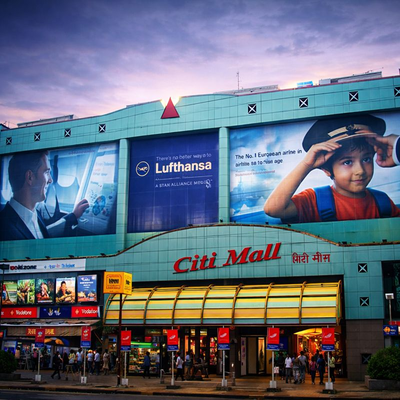
Most people who ask this question have already seen it — they just did not know it had a name. That enormous branded wrap covering the glass exterior of a commercial tower in BKC Mumbai, or the backlit vinyl stretching across the atrium glass of Select CityWalk in Delhi — that is outdoor glass facade advertising, and it is one of the most underutilised formats in the Indian OOH advertising mix. The format works by treating the glass surface of a building — whether a mall, a corporate tower, an airport terminal, or a retail showroom — as a large-format advertising canvas, using either printed media or digital display technology to transform what would otherwise be a transparent or reflective surface into a high-impact brand statement.
The mechanics depend on the material chosen. Static campaigns typically use perforated vinyl or one-way vision film, which is a micro-perforated adhesive material that allows people inside the building to see out while presenting a solid, full-colour graphic to viewers outside; this is the most widely deployed technology for glass facade branding across Indian metros. Digital campaigns, on the other hand, use transparent LED screens or LED mesh panels that are mounted directly onto or behind the glass, creating a luminous display that is visible day and night without blocking natural light entirely. What a lot of people miss is that the glass surface itself becomes part of the creative — the translucency, the reflections, and the interplay of light are all design elements that a skilled media planner will factor into the campaign brief.
At SmartAds, we always tell our clients that glass facade advertising is not simply a bigger hoarding; it is a different medium with different physics. The viewing geometry is different — a facade is typically seen at a shallower angle than a billboard, which means creative needs to be designed for horizontal sweep rather than the vertical hierarchy that works on a traditional hoarding. The illumination dynamics are different too, because a south-facing facade in Chennai or Hyderabad will be washed out by afternoon sunlight unless the campaign uses back-lit or digital formats, while a north-facing facade in Delhi or Gurgaon may need front-lit illumination to compensate for reduced natural light exposure. These are the details that separate a campaign that performs from one that simply exists.
What Are the Different Types of Glass Facade Advertising in India?
The format has more variety than most brand managers realise when they first come to us, and the right type depends on the building, the budget, the campaign duration, and the creative intent. The broadest distinction is between static media and digital media, but within each category there are meaningful technical differences that affect both cost and performance.
Static glass facade advertising covers three primary material types. One-way vision film — also called perforated vinyl — is the workhorse of the format; it is printed on a micro-perforated substrate that typically has a perforation ratio of somewhere between 50/50 and 60/40 (meaning 50 to 60 percent of the surface is printed material and the remainder is open holes), which preserves outward visibility for building occupants while delivering a near-solid graphic to external viewers. Standard cast vinyl wraps, which are used on opaque or semi-opaque glass sections, offer richer colour saturation and are better suited for short-duration campaigns where maximum visual impact is the priority. Frosted or etched vinyl window graphics occupy a different niche — they are used more for retail storefronts and showroom facades where the brand wants a premium, architectural feel rather than a loud advertising statement, and we have seen this format work particularly well for luxury retail and automotive showroom branding.
Digital glass facade advertising is where the format is evolving most rapidly. Transparent LED displays — sometimes called see-through LED screens or transparent LED screens — are panels with a transparency ratio of roughly 70 to 90 percent, which means they allow most of the natural light and outward view to pass through while displaying vivid video or motion graphics content; the technology has come down significantly in cost over the last three years, making it accessible for campaigns in the ballpark of six to twelve months rather than only long-term installations. LED mesh, which is a more open-structure version of the same technology, is used on large commercial building facades where full transparency is less critical than sheer display size. Programmatic DOOH on glass facades is an emerging sub-category — where digital signage on glass is connected to a demand-side platform and content is served dynamically based on time of day, weather, audience data, or real-time triggers — and while adoption in India is still early, operators like Times OOH and JCDecaux India have begun deploying programmatic-ready inventory in Mumbai and Delhi.
Why Should Brands Choose Glass Facade Advertising Over Traditional Hoardings?
Frankly speaking, the comparison is not always straightforward, and we resist the instinct to declare one format superior to the other — they serve different strategic purposes. That said, there are specific scenarios where glass facade advertising delivers outcomes that traditional hoarding advertising simply cannot match, and understanding those scenarios is what should drive the media planning decision.
The first and most obvious advantage is sheer scale combined with architectural integration. A glass facade on a landmark commercial building in Connaught Place Delhi or Cyber Hub Gurgaon can cover anywhere from a few hundred to several thousand square feet of continuous branded surface, which creates a visual presence that is qualitatively different from a billboard mounted on a pole or a rooftop hoarding. The brand does not just appear in the environment — it becomes part of the built environment for the duration of the campaign, which drives brand recall in a way that is difficult to replicate with conventional formats. A retail brand we worked with in Pune — a mid-premium fashion label launching a new collection — ran a three-month glass facade campaign on a high-footfall commercial complex and reported a 34 percent increase in walk-in traffic during the campaign period compared to the same quarter in the previous year; the store manager attributed a significant portion of that lift directly to the facade visibility, which was the first thing shoppers saw when they entered the complex.
The second advantage is dwell time and contextual relevance. Traditional hoarding advertising is consumed in motion — a driver passing a billboard on the Western Express Highway in Mumbai has perhaps three to five seconds of exposure. A glass facade on a mall or commercial building, by contrast, is seen by people who are already in the vicinity, already slowing down, already in a purchase-relevant mindset; the dwell time can be several minutes for someone waiting outside, walking through a parking lot, or sitting in a cafe with a view of the facade. On top of that, the context of the building itself lends credibility — a brand appearing on the facade of a premium commercial tower in BKC or a luxury mall in Bengaluru benefits from the association with that address in a way that a standalone hoarding cannot provide.
How Much Does Glass Facade Advertising Cost in India?
This is the question that every media plan eventually comes down to, and it is also the question that most glass facade advertising agency pages refuse to answer directly. We will try to be more useful than that. The honest answer is that glass facade advertising cost per sq ft varies considerably based on location, building type, illumination, and campaign duration — but there are ballpark ranges that a media planner can use for budgeting.
For static vinyl or one-way vision film campaigns, the rental cost in a Tier 1 city like Mumbai or Delhi works out to roughly ₹15 to ₹40 per square foot per month for a standard commercial building facade, while premium locations — think BKC Mumbai, Connaught Place Delhi, or MG Road Bengaluru — can push glass facade advertising rates in Mumbai and Delhi to somewhere between ₹50 and ₹120 per square foot per month depending on the specific property and the negotiated deal. Glass facade advertising rates in Delhi for mall properties like Select CityWalk or DLF Promenade tend to be quoted on a monthly package basis rather than per square foot, and those packages can range from roughly ₹2 lakh to ₹8 lakh per month for a prominent facade position. Printing and mounting costs — which are separate from the media rental — typically add somewhere between ₹8 and ₹25 per square foot depending on material quality, and this is a line item that brands frequently underestimate when building their campaign budgets. In Tier 2 cities like Ahmedabad, Pune, Jaipur, or Lucknow, the rental rates are considerably more accessible, often in the ballpark of ₹8 to ₹25 per square foot per month, which makes glass facade branding a realistic option for regional campaigns with tighter budgets.
For transparent LED screen advertising, the economics are structured differently. The technology involves a significantly higher capital investment from the media owner, which is reflected in the advertising rates; a transparent LED display campaign on a prominent commercial building facade in Gurgaon or Hyderabad is likely to be priced somewhere between ₹3 lakh and ₹15 lakh per month depending on the screen size, the number of spots per hour, and the exclusivity of the booking. What we tell our clients is that the CPM for digital glass facade advertising — when you divide the monthly cost by the estimated impressions based on traffic counts — often works out to roughly ₹12 to ₹25, which is a number that surprises many brand managers when they realise it is competitive with mid-tier digital display advertising while delivering a physical-world, unskippable brand experience. Campaign duration typically has a significant impact on the effective rate; a twelve-month booking on a static facade can attract a discount of somewhere between 20 and 35 percent compared to a one-month rate, and this is a negotiation lever that an experienced glass facade advertising agency will always use.
Which Are the Best Locations for Glass Facade Advertising in Mumbai, Delhi & Bengaluru?
Location selection is where the real value lies in glass facade OOH planning, and it is also where we see the most mistakes made by brands trying to book independently without proper market intelligence. The instinct is always to go for the biggest building or the most famous address, but the actual performance of a glass facade campaign depends on a combination of traffic volume, traffic composition, viewing angle, competing visual clutter, and the relevance of the surrounding environment to the target audience.
In Mumbai, the BKC cluster is the most sought-after zone for corporate and premium brand glass facade advertising, with commercial towers housing financial institutions, tech companies, and luxury offices generating a daily footfall of professionals whose demographic profile is attractive to BFSI, automotive, and premium consumer brands. The Andheri-Kurla corridor is a high-volume alternative that offers somewhat lower glass facade advertising rates in Mumbai while still delivering strong reach among the city's working population. Lower Parel — with its concentration of media companies, agencies, and premium retail — is another micro-market where glass facade branding on commercial buildings tends to generate strong brand recall among a media-literate, brand-conscious audience. For outdoor glass facade advertising for malls, Phoenix Palladium and Palladium Mumbai offer premium positions, though inventory is limited and typically booked months in advance.
In Delhi and the NCR, the geography of glass facade advertising is shaped by the corridor between Connaught Place and Gurgaon's Cyber Hub, which together represent the highest concentration of premium commercial real estate in North India. Select CityWalk in Saket, DLF Promenade in Vasant Kunj, and the Gold Souk Mall in Gurgaon are among the most-requested mall advertising positions, while the corporate campuses along Golf Course Road and NH-48 in Gurgaon offer large-format facade opportunities that are particularly relevant for B2B brands targeting senior decision-makers. In Bengaluru, the MG Road-Brigade Road corridor and the Whitefield-ITPL tech corridor represent the two dominant micro-markets, with the latter being especially effective for technology, SaaS, and D2C brands targeting the city's large tech-employed consumer base. Chennai's Anna Salai and Nungambakkam, Hyderabad's Hitech City and Banjara Hills, and Ahmedabad's SG Road are the equivalent premium zones in their respective cities, and we have found that well-chosen glass facade positions in these markets can deliver reach numbers that rival much more expensive Mumbai or Delhi placements.
How Does One-Way Vision Film Work for Glass Facade Branding?
One-way vision film is, in our experience, the most misunderstood material in the outdoor advertising toolkit — clients frequently ask whether it really works, whether it blocks too much light, and whether the perforation makes the graphic look dotty from close up. The answers are more nuanced than a simple yes or no, and understanding the technology properly helps brands make better creative decisions.
The film works on a principle of differential light intensity. From outside the building, where ambient light is bright, the printed surface of the perforated vinyl dominates the visual field and the small holes are effectively invisible to the naked eye beyond a viewing distance of roughly two to three metres; this is why a well-produced one-way vision film installation looks like a solid, high-quality printed graphic from the street. From inside the building, where ambient light is lower than the exterior, the holes dominate the visual field and the printed surface recedes, allowing occupants to see out with reasonable clarity — though not with the same transparency as unobstructed glass. The perforation ratio matters enormously here; a 60/40 perforation (60 percent printed, 40 percent open) delivers stronger graphic impact but reduces interior visibility more than a 50/50 ratio, and the choice should be made in consultation with the building management as well as the brand.
Products like Contra Vision's perforated window film and 3M India's window graphic solutions are the industry benchmarks for quality in this category, and the difference between premium and budget materials is visible — literally — in the colour saturation, the adhesive performance, and the longevity under Indian weather conditions. We worked with an FMCG advertising client in Chennai who initially opted for a lower-cost perforated vinyl to save on printing and mounting costs, only to find that the film began peeling and fading within six weeks of installation due to the combination of direct sunlight and coastal humidity; the remediation cost more than the savings on the original material, which is a lesson we now share proactively with every client briefing us on glass facade campaigns in coastal cities.
What Is Transparent LED Screen Advertising on Glass Facades?
Transparent LED display technology is the format that generates the most excitement in client meetings, and to be fair, the excitement is warranted — when it is executed well, a transparent LED screen on a commercial building facade creates a visual experience that is genuinely unlike anything else in the out-of-home advertising landscape. The technology uses LED modules mounted on a transparent or semi-transparent substrate, with the LEDs spaced apart enough to allow light and visibility through the panel while still delivering a bright, high-resolution display; the transparency ratio of most commercial transparent LED screens available in India today is somewhere between 70 and 85 percent, which means the building interior remains visible and natural light continues to enter.
The practical implications for advertisers are significant. Unlike conventional LED billboards, which are opaque and can only be used where blocking the view behind them is acceptable, transparent LED screens can be installed on glass facades of occupied buildings without requiring the occupants to sacrifice natural light or outward views; this dramatically expands the inventory of buildings where digital signage on glass becomes feasible. The brightness specifications matter enormously for Indian conditions — a screen rated at 3,500 to 5,000 nits is generally considered the minimum for good daytime visibility in direct sunlight, while screens below 2,500 nits will appear washed out during peak daylight hours in cities like Hyderabad, Chennai, or Ahmedabad. Lumina Display Systems and several other vendors operating in the Indian market have been deploying transparent LED installations in commercial buildings across Mumbai, Delhi, and Bengaluru, and the format is beginning to appear in smart city advertising projects in Tier 1 cities where municipal authorities are actively seeking to monetise premium public-facing building surfaces.
At SmartAds, we have been tracking the adoption curve of transparent LED screen advertising across our pan India network, and what we are seeing is that the format is moving from being a novelty reserved for flagship launches and premium brand activations to becoming a more mainstream component of annual OOH media plans for brands in the automotive, luxury, technology, and real estate categories. An automotive brand we worked with on a pan India campaign used transparent LED displays on three commercial building facades in Delhi, Mumbai, and Bengaluru simultaneously for a new model launch, running a 30-second creative loop that included motion graphics designed specifically for the transparency effect — the campaign generated a brand recall score of 68 percent among exposed audiences in post-campaign research, which was significantly higher than the benchmark for conventional billboard advertising in the same markets.
How Do You Book a Glass Facade Advertising Campaign Step by Step?
The booking process for glass facade advertising is more involved than booking a conventional hoarding, and brands that approach it without a clear process tend to lose time and sometimes lose the best positions to faster-moving competitors. The process has several distinct stages, each of which requires specific expertise and market knowledge.
The first stage is location identification and availability check. Glass facade advertising inventory in India is not consolidated on a single platform the way digital advertising inventory is — it is distributed across hundreds of property owners, mall management companies, and outdoor media operators including Times OOH, JCDecaux India, Laqshya Media Group, and dozens of regional operators. A brand trying to book independently will spend weeks making calls and receiving inconsistent information; a glass facade advertising agency with an established network can compress this to days. At SmartAds, our inventory relationships across 500+ cities mean we can typically provide availability and indicative rates for shortlisted locations within 48 to 72 hours of a brief. The brief itself should specify the target geography, the target audience profile, the approximate size requirement, the campaign duration, and the budget range — the more specific the brief, the faster and more accurate the options we can present.
The second stage is permit and regulatory compliance, which is an area that most glass facade advertising agency pages do not address at all — and which, in our experience, is the single most common source of campaign delays. In Mumbai, the MCGM (Municipal Corporation of Greater Mumbai) requires a licence for any outdoor advertising display above a certain size, and glass facade installations on commercial buildings require both the property owner's NOC and a structural safety certificate; the process can take anywhere from two to six weeks depending on the zone and the workload of the licensing department. In Delhi, the NDMC and MCD have their own licensing frameworks, and the Delhi Metro Rail Corporation (DMRC) has a separate approval process for any advertising visible from metro corridors. Chennai, Hyderabad, and Bengaluru have their own municipal frameworks, and the specifics vary enough that a pan India campaign requires city-by-city compliance management. Brands should factor permit timelines into their campaign launch planning — a campaign intended to coincide with a product launch or a festive season needs to begin the permit process at least six to eight weeks in advance.
The third stage covers creative production, printing, and mounting. Once the location is confirmed and permits are in process, the creative artwork needs to be adapted to the specific dimensions and technical requirements of the facade — which means working with the exact measurements of the glass panels, accounting for structural elements like mullions and frames that will interrupt the visual, and producing print-ready files at the correct resolution for the viewing distance. Printing and mounting for large-format glass facade campaigns is a specialised operation; the installation typically requires working at height with appropriate safety equipment, and the quality of the installation — how cleanly the film is applied, how well the seams are managed, how the edges are finished — has a significant impact on the final visual quality.
Which Industries Get the Best Results from Glass Facade OOH Campaigns?
Not every category performs equally well on glass facade advertising, and we think it is worth being honest about this rather than claiming the format is universally ideal for every brand. The categories that consistently deliver strong ROI outdoor advertising outcomes from glass facade campaigns share a few common characteristics: they have a target audience that is concentrated in or around premium commercial and retail locations, they benefit from high-impact visual brand statements rather than detailed information delivery, and they have a brand identity that translates well to large-format, high-visibility creative.
Real estate advertising is perhaps the most natural fit — a developer launching a premium residential or commercial project benefits enormously from appearing on the facade of a landmark building in the same market, because the medium itself signals quality and scale in a way that is directly relevant to the purchase decision. Automotive brands — particularly in the premium and luxury segments — have been consistent users of glass facade branding in India's Tier 1 cities, using the format for new model launches and brand positioning campaigns that require a visual presence commensurate with the product's premium positioning. FMCG advertising brands, particularly in the personal care, beverages, and packaged food categories, use glass facade campaigns in high-footfall mall environments to drive top-of-mind awareness at the point closest to the purchase decision; outdoor glass facade advertising for malls in this context functions almost as an extension of in-store marketing. Retail brand advertising — both for fashion and electronics — uses the format extensively in mall environments, where a facade wrap on the building that houses the store creates a seamless visual journey from the car park to the checkout.
The BFSI sector — banking, financial services, and insurance — has been increasing its allocation to glass facade advertising in corporate business districts, targeting the high-income professional audience that populates buildings in zones like BKC Mumbai, Cyber Hub Gurgaon, and Whitefield Bengaluru. Technology companies, particularly those targeting enterprise clients, use building facade branding on commercial towers in these same zones to build brand credibility among decision-makers who literally pass the building every day. What we tell our clients in the luxury category — watches, jewellery, premium spirits, high-end hospitality — is that glass facade advertising in the right location is one of the few out-of-home advertising formats that can genuinely match the brand's quality standards, because the architectural context and the production quality of a well-executed facade installation communicate premium values in a way that a standard hoarding simply cannot.
What Is the Future of Digital Glass Facade Advertising (DOOH) in India?
The FICCI-EY Media and Entertainment Report has consistently identified out-of-home advertising as one of the fastest-recovering and fastest-growing segments of the Indian media industry in the post-pandemic period, and within OOH, digital out-of-home is the segment attracting the most investment and innovation. Glass facades are at the intersection of these two trends — they are the premium inventory surface on which the most sophisticated DOOH technology is being deployed, and the convergence of transparent LED technology, programmatic OOH buying, and smart city infrastructure is creating a category that looks quite different from the static vinyl campaigns that dominated the format five years ago.
Programmatic DOOH on glass facades is the development we are watching most closely at SmartAds. The ability to serve different creative content to different audiences based on real-time data — time of day, weather conditions, audience composition data from mobile signals, even integration with retail sales data — transforms the glass facade from a static brand statement into a dynamic, data-driven communication channel. The IMARC Group's research on the India DOOH market projects significant growth in programmatic inventory over the next three to five years, and while glass facades currently represent a small fraction of total programmatic DOOH inventory, the premium nature of the locations and the audience quality make them disproportionately valuable. A retail client we worked with in Bengaluru piloted a programmatic DOOH campaign on a transparent LED installation at a premium commercial complex, serving different creative messages during morning commute hours (targeting office-going professionals), afternoon hours (targeting shoppers), and evening hours (targeting diners and entertainment-seekers); the campaign delivered a 22 percent improvement in cost-per-relevant-impression compared to a static booking on the same surface.
The sustainability dimension of glass facade advertising is also evolving, and it is a conversation that more clients are initiating. Eco-friendly printing options — including water-based inks, PVC-free substrates, and recyclable mounting materials — are becoming more widely available from Indian print vendors, and building owners in the LEED-certified and green-rated commercial real estate segment are increasingly requiring that advertising installations meet certain environmental standards. Digital glass facade advertising sidesteps many of these concerns by eliminating the print and waste cycle entirely, which is one reason we expect the shift from static to digital formats to accelerate over the next few years. The Outdoor Advertising Association of India (OAAI) has been working on industry guidelines for sustainable OOH production, and brands that get ahead of this trend will find it easier to access premium building inventory as property owners become more selective about the advertising partners they allow on their facades. 360-degree advertising campaigns that integrate glass facade DOOH with mobile retargeting and experiential marketing activations represent the direction the most forward-thinking brands are already moving, and the measurement infrastructure to support these integrated campaigns — combining footfall tracking, mobile audience data, and brand lift surveys — is becoming more accessible and more standardised across the Indian market.
FAQs on Glass Facade Advertising in India
Q: What is outdoor glass facade advertising and how is it different from a regular hoarding?
Outdoor glass facade advertising uses the glass exterior surface of a building — a mall, a corporate tower, a retail showroom, or an airport terminal — as an advertising medium, either through printed vinyl materials applied directly to the glass or through digital LED display technology mounted on or behind the glass surface. The difference from a regular hoarding is both physical and strategic. A hoarding is a freestanding structure built specifically to carry advertising, mounted on a pole or a rooftop; a glass facade advertisement is integrated into the architecture of an existing building, which means it carries the visual authority and location prestige of that building. The scale is typically larger — a facade can cover thousands of square feet of continuous surface — and the viewing context is different, because the audience is not just passing by at speed but is often in the immediate vicinity of the building for an extended period. The creative requirements are also different; a glass facade campaign needs to account for the transparency of the medium, the structural elements of the facade, and the interaction between the printed or digital content and the building's architectural character.
Q: How much does glass facade advertising cost in India per square foot or per month?
Glass facade advertising cost per sq ft in India varies considerably based on city, location quality, and format. For static one-way vision film or vinyl campaigns, rental rates in Tier 1 cities like Mumbai and Delhi range from roughly ₹15 to ₹120 per square foot per month depending on whether the location is a standard commercial building or a landmark premium property; printing and mounting costs add another ₹8 to ₹25 per square foot as a one-time production expense. For mall advertising positions in premium properties, monthly package rates are often in the range of ₹2 lakh to ₹8 lakh for a prominent facade position. Transparent LED screen campaigns are priced differently, typically as monthly packages ranging from ₹3 lakh to ₹15 lakh or more depending on screen size and location. In Tier 2 cities like Ahmedabad, Pune, or Jaipur, rates are meaningfully lower — often 40 to 60 percent of the equivalent Tier 1 city rate — which makes glass facade branding accessible for regional campaigns. Campaign duration affects the effective rate significantly; longer bookings attract discounts that can be in the ballpark of 20 to 35 percent.
Q: Which cities in India have the best glass facade advertising locations?
Mumbai, Delhi-NCR, and Bengaluru have the deepest and most varied glass facade advertising inventory, with premium positions in BKC and Lower Parel in Mumbai, the Connaught Place-Gurgaon corridor in Delhi-NCR, and the MG Road and Whitefield corridors in Bengaluru. Hyderabad's Hitech City and Banjara Hills, Chennai's Anna Salai and Nungambakkam, Pune's Koregaon Park and Baner Road, and Ahmedabad's SG Road and Prahlad Nagar are the leading micro-markets in their respective cities. The best locations share a combination of high daily footfall, a premium audience demographic, low competing visual clutter, and good viewing angles from the primary traffic flow; a glass facade advertising agency with pan India experience will be able to identify which specific properties within each market consistently deliver the strongest campaign performance.
Q: What types of materials are used for glass facade branding — vinyl, LED, or one-way vision film?
The three primary material categories are perforated vinyl (one-way vision film), standard cast vinyl, and transparent LED displays. One-way vision film — products like those from Contra Vision and 3M India — is the most widely used for large-format glass facade campaigns because it allows interior visibility while delivering a solid graphic to exterior viewers; it is best suited for campaigns of one to twelve months duration. Standard cast vinyl is used for opaque or semi-opaque glass sections and delivers richer colour saturation but blocks interior views entirely. Transparent LED screens are the digital alternative, offering dynamic content capability and high nighttime visibility at a higher cost point; they are increasingly used for flagship brand campaigns, product launches, and programmatic DOOH applications. Frosted and etched vinyl window graphics are used for a more architectural, premium aesthetic in retail showroom and luxury brand contexts.
Q: How do I book a glass facade advertising campaign across multiple cities in India?
Booking a pan India glass facade campaign requires working with an agency that has established relationships with building owners, mall management companies, and outdoor media operators across multiple cities — because the inventory is fragmented and not available on any single centralised platform. The process involves briefing the agency with your target cities, audience profile, size requirements, campaign duration, and budget; receiving a curated shortlist of available positions with indicative rates; selecting locations and negotiating final rates; managing permit and regulatory approvals in each city; overseeing creative adaptation, printing, and installation; and monitoring the campaign during its run. At SmartAds, we manage this entire process across our network of 500+ cities, which means a brand can brief us once and receive a coordinated pan India glass facade campaign rather than managing multiple city-by-city vendor relationships independently.
Q: Is glass facade advertising effective for brand visibility in malls and commercial buildings?
The evidence from campaigns we have managed and from industry research consistently supports glass facade advertising as a high-impact format for brand visibility in both mall and commercial building environments. The combination of large physical scale, high-footfall locations, and extended dwell time creates conditions for strong brand recall — post-campaign research on glass facade campaigns in mall environments typically shows brand recall scores in the range of 55 to 70 percent among exposed audiences, which compares favourably with other OOH formats. The contextual relevance is a significant factor; a brand appearing on the facade of a mall is reaching shoppers who are already in a purchase-oriented mindset, which increases the likelihood that the brand exposure translates into consideration and purchase intent.
Q: What is the minimum duration for a glass facade advertising campaign?
Most building owners and media operators in India set a minimum campaign duration of one month for static glass facade advertising, though some premium mall positions have minimum commitments of three months due to the installation complexity and the demand for those positions. For transparent LED screen advertising, minimum durations are sometimes as short as one week for spot bookings, though monthly commitments are more common and attract better rates. From a media planning perspective, we generally recommend a minimum of two to three months for a static campaign to justify the printing and mounting costs and to allow sufficient frequency build among the target audience; a one-month campaign on a high-traffic facade can deliver reach, but the frequency may not be sufficient to drive meaningful brand recall improvement.
Q: How is transparent LED display advertising different from vinyl-based glass facade advertising?
The fundamental difference is between static and dynamic content. Vinyl-based glass facade advertising — whether one-way vision film or standard cast vinyl — displays a fixed image for the duration of the campaign; it is a single creative execution that does not change unless the material is replaced. Transparent LED display advertising shows video, animation, or dynamic content that can be updated remotely and in real time, which allows brands to run multiple creative executions, adapt messaging to different times of day, and respond to real-world events or triggers. The cost structure is different — vinyl campaigns have a higher upfront production cost (printing and mounting) and a lower monthly rental, while LED campaigns have a lower production cost (digital file upload) but a higher monthly rental that reflects the technology investment. The visual impact is also different; LED displays are significantly brighter and more attention-grabbing at night, while high-quality vinyl can actually deliver superior colour accuracy in daylight conditions.
Q: What permits or approvals are required to advertise on building glass facades in Indian cities?
This is one of the most practically important questions in glass facade campaign planning, and the answer varies by city. In Mumbai, the MCGM requires an outdoor advertising licence for any display above a specified size threshold, and glass facade installations additionally require a structural safety certificate and the building owner's NOC; the licensing process typically takes four to six weeks. In Delhi, the NDMC and MCD have separate jurisdictions depending on the location, and campaigns visible from DMRC metro corridors require additional DMRC approval. In Bengaluru, the BBMP (Bruhat Bengaluru Mahanagara Palike) administers outdoor advertising licences, while in Chennai the GCC (Greater Chennai Corporation) is the relevant authority. Most state capitals have their own municipal frameworks, and the specific requirements — fees, documentation, approval timelines — differ enough that city-by-city compliance management is essential for pan India campaigns. Working with a glass facade advertising agency that has established relationships with municipal licensing departments in each city is the most reliable way to ensure compliance without campaign delays.
Q: Can glass facade advertising be measured for ROI, and what metrics are used?
Campaign measurement for glass facade advertising has improved significantly with the adoption of mobile audience data and digital measurement tools. The primary metrics used are estimated impressions (based on traffic count data from the location, typically sourced from municipal traffic surveys or third-party mobility data), reach (the number of unique individuals estimated to have been exposed to the campaign), and frequency (the average number of times each individual was exposed). Brand lift measurement — using pre- and post-campaign surveys to measure changes in brand awareness, consideration, and purchase intent among exposed versus unexposed audiences — is increasingly used for campaigns with sufficient budget to justify the research investment. For glass facade campaigns in mall or retail environments, footfall tracking using WiFi or Bluetooth sensors can provide data on the number of people who passed the facade and subsequently entered the
