
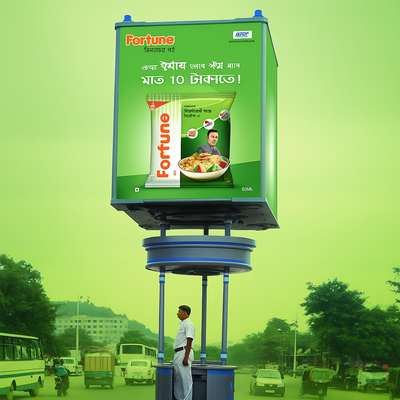


Delhi

Mumbai

Bengluru

Ahmedabad

Jaipur

Chennai

Hydrabad

Kolkatta

Lucknow

Pune
Outdoor Police Booth Advertising in India: OOH Brand Visibility at High-Traffic Locations, Traffic Booth Branding, and Cost-Effective PAN India Outdoor Advertising
This article draws on SmartAds.in's campaign experience across 500+ Indian cities to give you actual rate benchmarks, city-specific location intelligence, permit process breakdowns, and creative specifications that most agency pages simply refuse to publish. If you are evaluating police booth advertising as a media option — whether for a national campaign or a hyperlocal push — the data and strategic perspective here will save you significant planning time.
What Is Outdoor Police Booth Advertising and How Does It Work in India?
Most people have walked past a police booth a hundred times without consciously registering it — which is precisely what makes it such an interesting advertising medium. The booth itself is unavoidable. It sits at the intersection, the market entry point, the busy junction; it is surrounded by pedestrian traffic and vehicular traffic simultaneously, and unlike a hoarding that competes with the skyline, a police booth advertisement sits at eye level, directly in the sightline of someone waiting at a red light or crossing the road. That proximity is the whole point.
Outdoor police booth advertising refers to the placement of brand creatives — whether static flex vinyl, backlit panels, or increasingly LED display formats — on the exterior surfaces of police control booths and traffic booths that are positioned at major road intersections, market squares, and public gathering points across Indian cities. These structures are maintained by the Traffic Police Department and municipal bodies, and the advertising rights are typically auctioned or licensed through formal agreements with the respective municipal corporation or police department. The advertiser's creative is mounted on one or more faces of the booth, which can range from a single-sided panel to four-sided visibility depending on the booth's design and the agreement in place. What makes this format genuinely different from conventional hoarding advertising is the civic authority that the booth itself carries — people look at it, traffic stops near it, and it anchors a specific geographic point in the viewer's mental map of the city.
At SmartAds, we always tell our clients that police booth branding is one of the most underestimated formats in the OOH advertising toolkit. The booth is not competing for attention the way a billboard is; it is already the focal point of an intersection. A traffic booth advertising placement at a busy crossroads in Lucknow or Kanpur, where vehicular traffic queues at red lights for 60 to 90 seconds, delivers a captive audience experience that very few other out-of-home advertising formats can replicate at anywhere near the same cost. The format has been used across India for decades, but the last five years have seen it evolve considerably — from simple flex prints to backlit advertising panels, and now to digital out-of-home screens embedded within booth structures in select metros.
What Are the Key Benefits of Advertising on Police Booths?
The first thing that strikes most brand managers when they see the numbers is how dramatically police booth advertising outperforms their expectations on reach. A single booth placed at a major intersection in a city like Mumbai or Delhi — Andheri junction, say, or Connaught Place — can generate audience impressions in the range of several lakh per month, which is a figure that tends to raise eyebrows when it is placed alongside the cost of that placement. The OOH market in India was valued at somewhere in the ballpark of INR 4,140 crore, as referenced in FICCI-EY media reports, and a meaningful portion of that growth is being driven by street furniture advertising formats like police booths, bus shelter advertising, and pole kiosk advertising — precisely because they offer localized advertising reach that large-format hoardings cannot deliver at the neighbourhood level.
The benefits extend well beyond raw impressions. Police booth advertising delivers 24/7 advertising exposure, which is a phrase that gets used loosely in OOH but genuinely applies here — the booth is lit through the night in most backlit advertising configurations, and the structure itself remains visible even when the creative is not illuminated. Brand recall tends to be significantly higher for eye-level advertising formats compared to elevated hoardings, a finding that aligns with what we have seen across our own campaign data at SmartAds. When a commuter stops at the same intersection twice a day, five days a week, the advertising frequency builds in a way that no single media burst can replicate; the brand becomes associated with that location, that neighbourhood, that daily routine. This is the real engine of brand awareness through police booth branding — not a single high-impact impression, but accumulated, repeated exposure to a consistent target audience.
On top of that, the civic trust dimension is worth taking seriously. A brand displayed on a police booth benefits from a subtle halo effect — the authority and permanence of the structure lends a degree of legitimacy to whatever is advertised on it, which is something we have observed anecdotally across campaigns for financial services brands and healthcare advertisers who specifically requested police booth placements for this reason. To be fair, this effect should not be overstated, but it is real, and it is one of the reasons why unconventional advertising formats like traffic booth advertising often outperform conventional hoarding advertising on brand trust metrics in post-campaign surveys.
What Types of Ad Formats Are Available on Police Booths?
The format landscape for police booth advertisement has expanded considerably over the past decade, and what is available in a given city depends heavily on the booth's age, the municipal corporation's infrastructure investment, and the specific licensing agreement in place. The most widely available format remains the non-lit flex vinyl creative — a printed flex or vinyl sheet mounted on one or more panels of the booth's exterior — which is the entry-level option and the one most commonly associated with cost-effective advertising for smaller budgets. These non-lit advertising panels are typically replaced every 30 to 90 days depending on campaign duration, and the creative dimensions vary by city and booth design, though a standard panel tends to run somewhere between 4 feet by 6 feet and 6 feet by 8 feet per face.
Backlit advertising is the next tier up, and it represents a significant jump in impact. A backlit panel on a police booth is illuminated from behind, which means the creative remains vivid and visible through the night — a meaningful advantage in high-footfall areas like market districts and entertainment zones where evening pedestrian traffic is as heavy as daytime vehicular traffic. The printing for backlit advertising typically uses translucent vinyl or backlit flex material, and the CDR PDF artwork specifications need to account for the translucency of the medium, which is a detail that gets missed more often than it should be. We have had campaigns where a client submitted artwork designed for a non-lit format and the backlit version looked washed out and flat — the colour profiles are genuinely different, and the design team needs to know which format they are working with from the outset.
Then there is the LED display advertising category, which is where police booth branding starts to overlap with digital out-of-home and DOOH territory. LED screens embedded in or mounted on police booth structures are available in select cities — primarily metros and large Tier-1 markets — and they allow for dynamic creative rotation, time-of-day targeting, and in some configurations, remote content management. This is the fastest-growing segment of the format, and while it currently represents a smaller share of total police booth inventory than static formats, the trajectory is clear. A few cities have also experimented with 360-degree branding configurations where all four faces of a booth carry coordinated creative, which creates an immersive brand presence at the intersection that is genuinely hard to ignore.
How Much Does Police Booth Advertising Cost in India?
Frankly speaking, the lack of transparent pricing in this category is one of the most frustrating things about how police booth advertising is sold in India — most vendors either refuse to publish rates or quote figures so vague as to be useless for planning purposes. We are going to be more direct about this, because our clients deserve to walk into a planning conversation with realistic benchmarks rather than discovering the actual numbers three weeks into a negotiation.
In metro markets like Mumbai, Delhi, and Bengaluru, a single non-lit police booth panel for a 30-day campaign period typically costs somewhere between ₹3,000 and ₹8,000 per face per month, depending on the location's traffic density and the specific licensing arrangement. A backlit advertising panel at a premium intersection in these cities — think Linking Road in Mumbai or MG Road in Bengaluru — can run anywhere from ₹8,000 to ₹20,000 per face per month, which works out to a CPM that most experienced media planners find surprisingly competitive when they run the numbers against digital display alternatives. In cities like Chennai, Hyderabad, and Kolkata, the rates tend to sit at the lower end of this range; a well-located backlit booth panel in Chennai's T. Nagar district, for instance, is likely to be negotiated in the ₹6,000 to ₹12,000 range per face per month.
In Tier-2 markets — Lucknow, Kanpur, Ahmedabad, Pune, and similar cities — the economics become even more compelling. A non-lit booth panel in a busy Lucknow market intersection can be secured for somewhere in the ballpark of ₹1,500 to ₹4,000 per face per month, while backlit options in prime locations tend to top out around ₹7,000 to ₹10,000. On top of the space cost, advertisers need to budget for printing and mounting, which typically adds ₹500 to ₹1,500 per panel depending on the size and material — and GST on advertising services at 18% applies to the total invoice, which is a line item that sometimes catches smaller advertisers off guard. LED display advertising on police booths, where available, is priced differently — usually on a per-slot or per-10-second-spot basis, with monthly packages starting around ₹15,000 to ₹40,000 per screen in metro markets. At SmartAds, our media buying team negotiates across all these tiers simultaneously, which allows us to build PAN India advertising campaigns that optimise budget allocation across city categories rather than paying metro rates for every market.
Which Cities and Locations Are Best for Police Booth Advertising?
The honest answer is that the best locations depend entirely on your target audience and campaign objective — which sounds like a dodge but is actually the most useful framing. A brand targeting working professionals in the financial services sector will find that police booths near business district intersections in Mumbai, Delhi, and Bengaluru deliver a fundamentally different audience profile than booths near wholesale markets in Kanpur or Lucknow, which tend to attract small business owners, traders, and a more price-sensitive consumer segment. The location intelligence matters as much as the city choice.
That said, some cities and location typologies consistently outperform across campaign categories. In Mumbai, the intersections along the Western Express Highway, the booths near major railway stations like Dadar and Andheri, and the market-adjacent booths in areas like Malad and Borivali generate exceptional footfall and vehicular traffic volumes. Delhi's crossroads advertising opportunities are concentrated around Connaught Place, Karol Bagh, Lajpat Nagar, and the arterial roads connecting major residential colonies to commercial hubs. Bengaluru's police booth inventory near Koramangala, Indiranagar, and the Outer Ring Road tech corridor reaches a disproportionately high concentration of young, urban, digitally-active consumers — a profile that several FMCG and fintech brands have found extremely valuable for outdoor branding campaigns. Chennai's Anna Salai and T. Nagar corridors, Hyderabad's Hitech City and Banjara Hills areas, and Kolkata's Gariahat and Park Street intersections all represent premium police booth advertising locations with consistently high audience impressions.
What a lot of people miss is the opportunity in Tier-2 cities, where the combination of lower advertising rates, less cluttered OOH environments, and high local brand recall creates a return on investment profile that can actually exceed metro market performance for the right campaign. We ran a localized advertising campaign for a regional FMCG client across police booth locations in Kanpur, Lucknow, and Agra — roughly 45 booths across the three cities — and the brand recall lift measured in post-campaign surveys was 23 percentage points higher than what the same brand had achieved with a comparable hoarding advertising spend in Delhi. The booths in these markets sit at market intersections where pedestrian traffic is dense and dwell time is high; the audience is not rushing past at highway speed, they are navigating a market on foot or waiting at a busy junction, which changes the quality of the impression dramatically.
How Does Police Booth Advertising Compare to Billboards and Hoardings?
This is a comparison that comes up in almost every planning conversation we have, and the answer is more nuanced than most people expect. Billboard advertising and hoarding advertising offer scale and visual dominance — a large-format hoarding on a highway or an elevated road commands attention through sheer size, and for brand awareness campaigns targeting a broad urban audience, that scale has genuine value. But the comparison breaks down when you look at the cost-per-impression and the quality of the audience engagement, which are where police booth advertising consistently holds its own.
A standard unipole advertising structure in a metro market can cost anywhere from ₹80,000 to several lakh per month, depending on size and location; the CPM on that spend, when calculated against actual audience impressions, is often not dramatically better than what a well-placed police booth network delivers — and the booth network has the advantage of geographic distribution, which means you are reaching multiple neighbourhoods rather than concentrating spend on a single point. Street furniture advertising formats like police booths, bus shelter advertising, and pole kiosk advertising collectively create a presence across a city's fabric that a handful of large hoardings simply cannot replicate. The formats serve different strategic purposes, and the most effective outdoor advertising campaigns we have executed at SmartAds combine both — using large-format hoardings for awareness and visual impact, and police booth branding for frequency and neighbourhood-level reinforcement.
The eye-level advertising dimension is genuinely significant and tends to be underweighted in planning conversations. A hoarding is viewed from a distance and from below; the viewer's relationship to it is passive and brief. A police booth advertisement is encountered at close range, often by someone who is stationary — waiting at a red light, crossing the road, or browsing a nearby market — which means the creative has time to be read rather than merely seen. This is where the brand recall advantage of police booth advertising becomes measurable; the format rewards creative that includes a message, a phone number, a QR code advertising element, or any call to action, because the audience actually has the time and proximity to engage with it.
How Do You Book an Outdoor Police Booth Advertising Campaign?
The booking process for outdoor police booth advertising in India involves more moving parts than most clients anticipate, which is why working with an experienced outdoor advertising agency makes a material difference to both the timeline and the final cost. The process begins with location identification — which requires knowing not just which intersections are available but which booths have active advertising licenses, which faces are already occupied, and which locations fall within the specific geographic targeting the campaign requires. This inventory intelligence is not publicly available in any consolidated form; it exists in the relationships that agencies maintain with municipal licensing bodies and local vendors across each city.
Once locations are confirmed, the booking typically involves a formal agreement with the licensing entity — which may be the municipal corporation, the traffic police department, or a private concessionaire that holds the advertising rights for a cluster of booths in a given area. The campaign duration is agreed upon at this stage, with most campaigns running for a minimum of 30 days; shorter durations are sometimes available but tend to carry a premium, and the economics of printing and mounting make anything under 30 days difficult to justify on a cost-per-impression basis. Creative artwork — typically submitted as CDR PDF artwork at the specified creative dimensions — must be approved before printing begins, and the printing and mounting timeline adds roughly 7 to 10 days to the campaign launch schedule, which is a buffer that needs to be built into any planning timeline.
At SmartAds, our campaign execution process for police booth advertising begins with a site survey — either physical or through our network of local partners — which allows us to provide clients with verified location data, traffic count estimates, and competitive audit information before any booking is confirmed. For PAN India advertising campaigns spanning multiple cities, we coordinate the booking, printing, mounting, and compliance documentation centrally, which eliminates the coordination burden that brands face when trying to manage multiple local vendors simultaneously. The media planning phase, where we match location selection to target audience profiles and campaign objectives, is where we add the most value — because the difference between a well-planned police booth network and a poorly planned one is not the cost of the space, it is the quality of the location decisions.
What Are the Permit and Regulatory Requirements for Police Booth Ads in India?
The regulatory landscape for police booth advertising in India is genuinely complex, and it varies significantly by city — which is one of the reasons why brands attempting to execute campaigns without local expertise often run into delays or compliance issues. The fundamental principle is that advertising on police booths is a licensed activity; the booth structure is public property managed by either the traffic police department or the municipal corporation, and any commercial use of its exterior surfaces requires formal authorization from the relevant authority.
In most cities, the advertising rights for police booths are either directly managed by the municipal corporation — which issues advertising permits and collects licensing fees — or have been tendered out to private concessionaires who hold exclusive rights for a defined period and sub-license individual placements to advertisers. Mumbai's advertising rights, for instance, are managed through the Brihanmumbai Municipal Corporation's advertisement department, while Delhi's traffic booth inventory falls under a combination of Delhi Traffic Police and NDMC jurisdiction depending on the location. Chennai, Bengaluru, and Hyderabad each have their own municipal advertising permit frameworks, and the documentation requirements — which typically include a creative approval submission, a copy of the advertising agreement, and in some cases a no-objection certificate from the local police station — differ across these jurisdictions. GST on advertising at 18% is uniformly applicable across all these markets and must be factored into the total campaign cost from the outset.
What we tell our clients is that the permit process, while bureaucratic, is manageable when you have the right local contacts and understand the documentation requirements in advance. The most common cause of campaign delays is not the approval process itself but the failure to submit compliant creative artwork at the right dimensions and in the correct format — which then triggers a revision cycle that pushes the launch date back. Municipal permission for content is also a consideration; political content, content that references government bodies, and certain categories of health and financial advertising are subject to additional scrutiny in most cities, and the creative approval stage needs to account for this. At SmartAds, our compliance team manages the permit documentation across all cities where we operate, which means clients do not need to navigate these processes independently.
Can Small and Medium Businesses Benefit from Police Booth Advertising?
The short version is yes, and more emphatically than most small and medium businesses realise. The persistent perception that out-of-home advertising is exclusively a large-brand game — that it requires crore-level budgets and national campaign infrastructure — is one that the economics of police booth advertising directly contradict. A single booth placement in a well-chosen Tier-2 city location can cost less than a month's worth of moderately-targeted social media advertising, and it delivers a form of brand visibility that digital formats simply cannot replicate in terms of physical presence and local credibility.
We have seen this work particularly well for businesses whose target audience is geographically concentrated — a real estate developer in Pune whose projects are in specific neighbourhoods, a retail chain in Lucknow expanding into new market areas, a local hospital in Kanpur looking to build awareness among residents of a particular catchment zone. For these advertisers, hyperlocal branding through a cluster of police booth placements near their target locations delivers a cost-effective advertising result that is difficult to achieve through any other medium at a comparable budget. The localized advertising nature of the format — the fact that you can select specific intersections rather than buying a broad city-level reach — is precisely what makes it suitable for businesses with defined geographic targets and limited budgets.
To be honest, the main challenge for small and medium businesses in this category is not the cost but the execution complexity — managing vendor relationships, creative production, permit documentation, and campaign monitoring across even a handful of locations requires time and expertise that most small businesses do not have in-house. This is where an outdoor advertising agency relationship pays for itself; the agency's existing vendor network, permit process knowledge, and creative production capabilities allow a small business to execute a professional campaign without building that infrastructure from scratch. At SmartAds, we work with clients at a range of budget levels — from single-city campaigns with five or six booth placements to PAN India advertising programs spanning hundreds of locations — and the planning discipline we apply is the same regardless of the budget scale.
How to Measure the ROI of Your Police Booth Advertising Campaign?
Measuring advertising ROI on out-of-home advertising has historically been the category's Achilles heel, and anyone who tells you otherwise is being optimistic. The honest position is that OOH measurement is improving significantly but is still not as precise as digital attribution — which does not mean it cannot be measured, it means you need to use the right methodology and set realistic expectations about what the data will and will not tell you.
The primary measurement framework for police booth advertising involves a combination of audience impressions estimation, brand recall surveys, and — increasingly — digital integration through QR code advertising and mobile location data. Audience impressions for a given booth location are estimated using traffic count data, which in India is available through a combination of municipal traffic surveys, BARC mobility data, and proprietary footfall measurement tools that some agencies have developed. The OOH Advertising Association of India, known as the IOAA, has been working on standardised measurement frameworks for the category, and the adoption of these frameworks is gradually improving the comparability of impression data across vendors and formats. A well-located booth at a major intersection in a metro city might generate somewhere between 50,000 and 2,00,000 audience impressions per month — a range that reflects the significant variation in traffic density across different locations and times of day.
Brand recall surveys, conducted before and after a campaign, remain the most reliable method for measuring the actual communication impact of police booth advertising, and they are the methodology we recommend to clients who need to justify OOH spend to internal stakeholders. We ran a pre-post brand recall study for an automotive accessories brand that ran a 60-day police booth advertising campaign across 30 locations in Mumbai and Pune; the unaided brand recall in the campaign geographies increased by 18 percentage points over the campaign period, while control geographies showed no statistically significant movement. QR code advertising integration on booth creatives provides a direct digital attribution mechanism — the number of QR code scans from a specific booth location can be tracked precisely, which gives advertisers a concrete behavioural data point to work with alongside the impression estimates. Phygital advertising approaches like this, which bridge the physical OOH placement with measurable digital engagement, are becoming increasingly standard in well-planned police booth campaigns.
What Is DOOH and How Is It Transforming Police Booth Advertising?
Digital out-of-home, or DOOH, is the fastest-growing segment of the OOH market in India, and its intersection with police booth branding represents one of the more interesting developments in the outdoor advertising space over the past three years. The GroupM TYNY report and the Dentsu e4m report have both flagged DOOH as a significant growth driver within the broader OOH market, and the infrastructure investment being made in digital screens across Indian cities is beginning to reach the police booth inventory in select markets.
What DOOH on police booths actually means in practice is the replacement of static flex or backlit panels with LED display advertising screens that can show dynamic content — rotating creatives, time-of-day targeted messaging, and in some configurations, real-time content triggered by weather, traffic conditions, or other contextual data. A food delivery brand, for instance, could run a creative that changes between breakfast, lunch, and dinner messaging based on the time of day; a retail brand could display different offers on weekdays versus weekends. This kind of dynamic creative capability, which has been standard in digital advertising for years, is now becoming available in the physical out-of-home environment through DOOH infrastructure on police booths and other street furniture formats. The programmatic DOOH category — where digital out-of-home inventory is bought and managed through automated platforms similar to programmatic digital display — is still nascent in India but is developing rapidly, with several technology platforms now offering programmatic access to LED display advertising inventory in metro markets.
The thing is, DOOH on police booths also introduces a new set of planning considerations. The cost structure is different from static formats — you are buying time slots rather than exclusive panel occupancy, which means your creative shares the screen with other advertisers' content and the effective exposure per campaign rupee needs to be calculated differently. The creative specifications for LED display advertising are also distinct from static formats; the artwork needs to be designed for motion and legibility at the screen's specific resolution, and the CDR PDF artwork standards that apply to static flex printing do not translate directly to digital screen content. At SmartAds, our media planning team has developed a DOOH planning framework that accounts for these differences and helps clients understand the true cost-per-impression comparison between static and digital police booth formats before committing budget.
Which Brands Have Successfully Used Police Booth Advertising in India?
The brand categories that have historically found the most value in police booth advertising are ones where the target audience is geographically concentrated and the purchase decision is influenced by repeated local exposure — which covers a surprisingly wide range of sectors. Financial services brands, particularly insurance companies and banking institutions looking to build presence in specific residential and commercial corridors, have been consistent users of traffic booth advertising across Indian cities. FMCG brands with regional distribution strategies, real estate developers, educational institutions, healthcare providers, and telecom companies have all used police booth branding effectively at various scales.
Brands like Swiggy and IndiGo Airlines have used street furniture advertising formats — including police booths — as part of broader OOH campaigns that combine large-format hoardings with high-frequency, eye-level placements to build both awareness and recall. The logic is straightforward: the hoarding creates the impression of scale and brand confidence, while the police booth placement at the neighbourhood level creates the frequency and proximity that drives brand recall. Google has also used outdoor advertising formats including street furniture in Indian cities as part of product launch campaigns, recognising that the physical presence of a brand in a commuter's daily environment reinforces digital messaging in ways that are difficult to replicate through online channels alone.
One campaign we executed at SmartAds that illustrates this dynamic well involved a fintech startup looking to build brand awareness in Tier-2 cities ahead of a product launch. The client had a modest outdoor advertising budget — in the range of ₹12 to ₹15 lakh — and needed to create meaningful brand visibility across six cities simultaneously. We built a campaign around police booth advertising locations near banking districts, university areas, and busy market intersections, using backlit advertising panels with a clean, high-contrast creative that included a QR code advertising element linking to the product's app download page. Over a 45-day campaign duration, the booth network generated an estimated 85 lakh audience impressions across the six cities, the QR code was scanned over 4,200 times — which is a direct attribution data point that the client's management team found compelling — and the post-campaign brand awareness survey showed a 21-point lift in unaided awareness among the target demographic in campaign geographies. The total cost per verified QR scan worked out to roughly ₹357, which compared favourably to the client's cost-per-install on digital channels during the same period.
FAQ: Outdoor Police Booth Advertising in India
Q: What is outdoor police booth advertising and how is it different from billboard advertising?
Outdoor police booth advertising involves placing brand creatives on the exterior surfaces of police control booths and traffic booths positioned at road intersections, market areas, and public gathering points across Indian cities. The fundamental difference from billboard advertising lies in the scale, proximity, and audience engagement dynamic. A billboard is a large-format structure viewed from a distance, typically from a moving vehicle, which means the viewer's exposure is brief and the creative must communicate instantly. A police booth advertisement is encountered at eye level, at close range, often by a stationary audience — someone waiting at a red light or crossing an intersection — which means the creative has time to be read, a phone number can be noted, a QR code can be scanned. The cost structure is also dramatically different; a single billboard in a metro market can cost several lakh per month, while a police booth panel at a comparable location costs a fraction of that, making police booth advertising a genuinely cost-effective advertising option for brands that need local presence without large-format budgets.
Q: How much does police booth advertising cost in India?
The cost varies by city tier, location quality, and format type. In metro markets like Mumbai, Delhi, and Bengaluru, non-lit flex panels on police booths run somewhere between ₹3,000 and ₹8,000 per face per month, while backlit advertising panels at premium intersections can reach ₹8,000 to ₹20,000 per face per month. Tier-2 cities like Lucknow, Kanpur, Ahmedabad, and Pune offer significantly lower rates — non-lit panels in the ₹1,500 to ₹4,000 range and backlit options up to roughly ₹7,000 to ₹10,000 per face per month. LED display advertising on digital police booths, where available, is priced on a per-slot basis and typically starts around ₹15,000 to ₹40,000 per screen per month in metro markets. Printing and mounting costs add ₹500 to ₹1,500 per panel, and GST on advertising at 18% applies to the total invoice. These figures represent market benchmarks; actual rates depend on specific location negotiations and campaign volume.
Q: Which cities in India offer the best police booth advertising locations?
Metro cities — Mumbai, Delhi, Bengaluru, Chennai, Hyderabad, and Kolkata — offer the highest traffic volumes and audience impressions per booth, with premium locations near railway stations, market districts, and major arterial road intersections delivering the strongest reach. Within these cities, specific micro-locations matter enormously; a booth at Andheri junction in Mumbai or Koramangala in Bengaluru will outperform a booth in a quieter residential area by a factor of several times on raw impressions. Tier-2 cities like Lucknow, Kanpur, Pune, and Ahmedabad offer a compelling ROI profile because the combination of lower rates and less cluttered OOH environments produces higher brand recall per rupee spent. For hyperlocal branding campaigns targeting specific consumer segments, Tier-2 and Tier-3 city police booth locations often deliver better outcomes than metro placements at significantly lower cost.
Q: What ad formats are available for police booth branding (backlit, LED, flex, digital)?
The available formats range from non-lit flex vinyl creative — the most widely available and most cost-effective option — to backlit advertising panels, which use illuminated translucent material for 24/7 visibility, to LED display advertising screens embedded in or mounted on booth structures. Non-lit formats are suitable for daytime-heavy locations and budget-conscious campaigns; backlit advertising is the preferred format for high-footfall evening and night-time locations like entertainment districts and market areas; and LED display advertising, which falls under the DOOH category, allows for dynamic content rotation and is available in select metro markets. Four-sided visibility configurations, where all faces of the booth carry coordinated brand creative, are available at some locations and create a 360-degree branding impact that is particularly effective for product launches and brand identity campaigns.
Q: How do I book a police booth advertising campaign across multiple cities in India?
Booking a multi-city police booth advertising campaign requires coordinating with licensing entities — municipal corporations, traffic police departments, or private concessionaires — across each city, which involves different documentation requirements, permit processes, and creative approval timelines in each market. The practical approach for most brands is to work with an outdoor advertising agency that has established relationships and vendor networks across the cities in question. The booking process involves location selection and availability confirmation, agreement execution with the relevant licensing body, creative submission and approval, printing and mounting coordination, and campaign monitoring. For PAN India advertising campaigns, centralised coordination through an agency eliminates the need to manage multiple local vendor relationships simultaneously and typically results in better negotiated rates through consolidated volume.
Q: What permits and permissions are required for police booth advertising in India?
Police booth advertising requires formal authorization from the relevant municipal corporation or traffic police department, depending on the city and the specific booth's administrative jurisdiction. The documentation typically includes a formal advertising agreement with the licensing authority, a creative approval submission for content review, and in some cities a no-objection certificate from the local police station. GST registration and invoicing compliance are required for all commercial advertising transactions. Content restrictions apply in most cities — political content, content referencing government bodies, and certain health and financial advertising categories are subject to additional scrutiny. The permit process timeline varies by city but typically adds 7 to 14 days to the campaign launch schedule, which needs to be factored into planning timelines.
Q: How long should a police booth advertising campaign run for maximum impact?
The minimum effective campaign duration for police booth advertising is generally 30 days, which is the standard billing period for most licensing agreements and the minimum duration needed to build meaningful advertising frequency with a regular commuter audience. For brand awareness objectives, we recommend a minimum of 60 days, which allows the frequency to build to a level where brand recall becomes measurable in post-campaign surveys. For product launch campaigns or seasonal campaigns tied to events like Diwali or IPL, a concentrated 30 to 45-day burst can be effective if the creative is strong and the locations are well-chosen. Campaign duration extensions are typically available and should be confirmed at the booking stage; reprinting may be required for extensions beyond the original creative's wear period, which adds to the total campaign cost.
Q: Can small and medium businesses afford police booth advertising in India?
Yes, and the economics are more accessible than most small and medium businesses assume. A campaign of five to ten booth placements in a Tier-2 city can be executed for a total monthly investment — including space, printing and mounting, and agency fees — that is comparable to a modest digital advertising budget, and the local brand visibility it delivers is qualitatively different from what digital formats provide. The key for small businesses is precise location selection — concentrating placements near the specific geographic areas where their target audience lives, works, or shops — rather than trying to achieve broad city-level coverage. An outdoor advertising agency relationship is particularly valuable for small businesses because it eliminates the vendor management complexity that would otherwise make small-scale OOH campaigns impractical.
**Q: What is the typical reach
