


Delhi

Mumbai

Bengluru

Ahmedabad

Jaipur

Chennai

Hydrabad

Kolkatta

Lucknow

Pune
Outdoor Platform Panel Advertising in India: Railway Platform Panel Ads, Rates, Booking & Strategy Guide
Railway Platform Panel Advertising Agency India | Platform Panel OOH Advertising India | Outdoor Platform Panels for Brand Visibility India
This guide contains what most media planning conversations skip entirely — actual rate benchmarks broken down by city tier and station category, a frank comparison of backlit versus LED formats, the real booking process through Indian Railways concessionaires, and three campaign case studies from our own work across Indian railway stations. If you are allocating budget to transit media or evaluating outdoor platform panels advertising for the first time, this is the briefing you need before you sign anything.
What Are Outdoor Platform Panels in Advertising and How Do They Work?
Most people who have stood on a railway platform waiting for a delayed train have absorbed more advertising than they realise — which is precisely the point. Outdoor platform panels are fixed advertising display units installed along the length of railway station platforms, on pillars, on foot over bridges (FOBs), at entry and exit gates, and along the concourse areas of Indian railway stations. These panels come in several formats — backlit panels, non-lit static panels, LED display panels, glow sign boards, and increasingly, digital DOOH screens — and they are operated either through direct concession agreements with Indian Railways, through the Rail Land Development Authority (RLDA), or through authorised media concessionaires who hold rights to specific station clusters.
The mechanics of how outdoor platform panels advertising actually works are worth understanding before you spend a rupee. A commuter arriving at a busy junction station like Pune, Lucknow, or Coimbatore will typically spend somewhere between eight and twenty-five minutes on the platform — a dwell time that is dramatically higher than what you get from a roadside hoarding, which commands perhaps three to five seconds of attention at 60 kmph. That extended dwell time is the foundational argument for railway platform advertising, and it is one we make repeatedly to clients who are used to thinking about OOH advertising purely in terms of traffic impressions. The audience is not moving past your message; they are standing in front of it, often repeatedly, across multiple journeys in a week.
At SmartAds, we always tell our clients that the real value of outdoor platform panels is not just the raw footfall number — it is the quality of the attention. A commuter waiting for a train is not distracted by driving; they are not scrolling a phone (at least not exclusively); they are present in the physical environment in a way that makes brand recall measurably higher than most other out-of-home advertising formats. The FICCI-EY Media & Entertainment Report has consistently flagged transit media as one of the fastest-growing segments within the broader OOH advertising ecosystem in India, and railway station advertising specifically has been identified as a high-frequency, high-dwell-time environment that delivers cost-efficient impressions at scale.
Types of Platform Panel Formats Available at Indian Railway Stations
There is considerably more variety in railway platform advertising formats than most brand managers realise when they first approach the medium, and choosing the wrong format for your campaign objective is one of the more common — and expensive — mistakes we see. The broadest distinction is between static panels and dynamic digital screens, but within static formats alone, there are meaningful differences in impact, cost, and suitability depending on your creative and your audience.
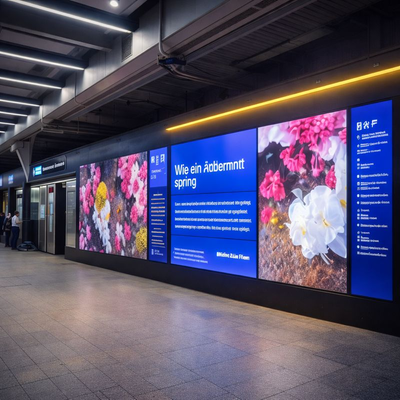
Backlit panels — sometimes called backlit flex boards or illuminated display panels — are the workhorse of train platform advertising in India. These are typically fabricated with a translucent vinyl or flex material stretched over a lightbox frame, which allows the creative to be evenly illuminated from behind, making them visible and impactful even in the low-light conditions of covered platforms and underground sections. Standard backlit panel sizes at Indian railway stations typically run from around 4 feet by 3 feet for pillar-mounted units up to 10 feet by 5 feet or larger for platform-facing display frames; the exact platform panel sizes vary by station and by the concessionaire's inventory specifications. Non-lit panels, by contrast, are printed flex or vinyl boards installed in frames without illumination — they are significantly cheaper, which makes them the format of choice for tier-2 city advertising and for campaigns that need geographic spread without a premium budget. Glow sign boards, pole kiosks, and platform flex boards are variations within this family, each suited to slightly different placement contexts within the station environment.
Foot over bridge panels — FOB advertising, as it is known in the trade — deserve a separate mention because they occupy a genuinely premium placement. Every passenger crossing from one platform to another passes through the foot over bridge, which means FOB panels capture cross-platform traffic rather than just the commuters on a single platform; the impression multiplier is real, and it is one of the reasons FOB inventory tends to be priced higher and booked out faster at major stations. Transparent sheet panels, which use a perforated or mesh vinyl material on glass or mesh surfaces, are used in specific architectural contexts — entry gates, concourse windows, and certain covered bridge sections — and they offer a visually distinctive format that stands out precisely because it is used less frequently. Vinyl stickers on railway property, including floor graphics and pillar wraps, round out the static inventory, and when used as part of a station domination strategy, they can create an immersive brand environment that is genuinely hard to ignore.
Why Railway Platform Panels Deliver Unmatched Captive Audience Reach
The word "captive" gets used loosely in advertising, but railway platforms are one of the few environments where it is genuinely accurate. Indian Railways carries somewhere in the ballpark of 13 to 14 million passengers daily — a number that is staggering when you set it against the reach figures for any single television channel or digital platform. A major junction station in a city like Mumbai, Delhi, or Chennai will see footfall figures that rival the daily active users of several mid-sized apps combined; Mumbai's suburban railway network alone, managed partly through the Mumbai Railway Vikas Corporation (MRVC), moves roughly 7.5 million commuters on a typical weekday, which makes Mumbai railway advertising one of the most efficient mass-reach plays available in the Indian media market.
What a lot of people miss is the frequency dimension. Unlike a roadside hoarding that a commuter might pass twice a day on their regular route, a platform panel advertising unit at a commuter's home station or interchange station gets seen multiple times per week — sometimes multiple times per day for daily office commuters. That accumulated frequency is what drives brand recall in ways that single-exposure media cannot replicate, and it is the reason that FMCG brands, telecom companies, and financial services advertisers have historically been heavy users of commuter advertising at railway stations. The Pitch-Madison Advertising Report has noted that OOH advertising, and transit media specifically, continues to punch above its weight in brand awareness metrics relative to its share of total advertising spend — a finding that aligns closely with what we observe in our own campaign measurement work.
One campaign that illustrates this well involved a BFSI outdoor advertising client — a mid-sized insurance brand — that was trying to build awareness in three tier-2 cities in Maharashtra. We placed outdoor platform panels advertising across six stations in those cities, running a combination of backlit panels on the main platforms and FOB advertising at the two highest-footfall stations. Over a twelve-week campaign duration, the brand's unaided awareness scores in those markets moved by roughly eleven percentage points in post-campaign research, which was a result that surprised even the client's own marketing team. The cost per thousand impressions worked out to somewhere in the ballpark of ₹6 to ₹8, which is a number that tends to stop media planners in their tracks when they compare it to what they are paying for equivalent reach on social media platforms.
Backlit Panels vs. LED Digital Screens: Choosing the Right Platform Format
Frankly speaking, this is the question we get asked most often by clients who are new to outdoor platform panels advertising, and the honest answer is that it depends on what you are trying to achieve — which sounds evasive but is actually a meaningful distinction once you understand the trade-offs. Backlit panels are the proven, cost-efficient format; LED display panels and digital platform panels are the premium, flexible format. Neither is universally superior, and a well-designed campaign often uses both.
The case for backlit panels rests on three things: cost, ubiquity, and creative impact. A backlit panel at a mid-tier station in a city like Nagpur or Bhopal will cost a fraction of what an LED screen at a major junction commands, which means your budget stretches further in terms of geographic coverage and campaign duration. The creative is printed at high resolution and illuminated consistently, which gives you reliable visual impact without the variability that can affect LED screens in outdoor environments. On top of that, the inventory of backlit panels across Indian railway stations is vastly larger than the current inventory of LED display panels, which means availability is rarely an issue for backlit campaigns even at relatively short notice. The limitation, of course, is that the creative is fixed for the duration of the campaign — you cannot update messaging, run dayparted content, or A/B test different executions without a physical change-out, which adds cost and lead time.
LED display panels and digital platform panels address all of those limitations, and here is where it gets interesting for brands that want to run contextually relevant or time-sensitive campaigns. A digital platform panel can display multiple creatives in rotation, which means a single screen can serve different brand messages at different times of day — a breakfast cereal brand running morning-commute creatives, a quick-service restaurant brand running evening-commute offers. The ability to update creative remotely and rapidly is particularly valuable during festive campaign periods — Diwali, Holi, IPL season — when messaging needs to shift quickly. The DOOH advertising ecosystem at Indian railway stations is still developing, but it is developing fast; the Smart Cities Mission has accelerated digital screen installation at upgraded stations, and the introduction of Vande Bharat Express services has brought with it a new generation of premium station environments where digital platform panels are becoming standard inventory. The trade-off is cost — LED display panels at major stations in Mumbai, Delhi, or Bengaluru railway advertising markets can command rates that are three to five times higher than equivalent backlit inventory — and the fact that your creative is sharing screen time with other advertisers in a rotation loop, which reduces the exclusive impact you get from a static panel.
How Much Does Platform Panel Advertising Cost in India? (2025–2026 Rates)
This is the section that most agency websites deliberately leave vague, and it is one of the reasons clients come to us frustrated after spending weeks trying to get a straight answer. We will be as specific as the market allows, with the caveat that rates vary by station category, panel placement, format type, and campaign duration — and that the figures below represent our current market intelligence rather than a fixed rate card, since railway advertising rates are negotiated through concessionaires and are subject to revision.
For non-lit static panels at smaller stations in tier-2 and tier-3 cities, monthly rates typically work out to somewhere between ₹3,000 and ₹8,000 per panel — which makes this format genuinely accessible for regional brands and small and medium businesses running localised campaigns. Backlit panels at the same tier of stations run higher, generally in the range of ₹8,000 to ₹20,000 per panel per month, depending on placement (platform-facing panels command a premium over pillar-mounted units). At A-category and A1-category stations — the major junctions and metropolitan terminals that Indian Railways classifies at the top of its station hierarchy — backlit panel rates climb considerably; a well-placed backlit panel on the main platform at a high-footfall A1 station in Mumbai or Delhi will typically cost somewhere between ₹25,000 and ₹60,000 per month, with FOB advertising at those stations often priced at a premium above that range. LED display panels and digital platform panels at premium stations are priced on a per-slot or per-campaign basis rather than a flat monthly rate, and costs at major metropolitan stations can range from roughly ₹50,000 to ₹2 lakh or more per month depending on screen size, location, and rotation frequency.
The thing is, these headline rates are rarely what a well-negotiated campaign actually costs. Volume discounts for multi-station bookings, longer campaign durations, and off-peak seasonal windows can bring effective rates down by twenty to thirty percent, which is where experienced media buying genuinely earns its value. A retail client in Bengaluru that we worked with on a pan-India advertising campaign across forty-two stations found that by consolidating their booking through a single agency rather than approaching individual concessionaires station by station, they achieved an effective rate that was roughly twenty-five percent lower than the sum of individual station quotes — a saving that ran to several lakhs over the campaign duration. The cost per impression for a well-planned outdoor platform panels advertising campaign, when calculated honestly against verified footfall data, is often more competitive than clients expect; at major stations, CPM figures in the range of ₹5 to ₹12 are achievable, which compares favourably with many digital display formats when you factor in viewability and attention quality.
Top Cities for High-Impact Platform Panel Campaigns in India
Station selection is where media planning for railway platform advertising either earns its keep or wastes budget, and the hierarchy is not always obvious. The instinct is to go straight to Mumbai and Delhi — and those are genuinely important markets, with Mumbai railway advertising and Delhi railway advertising representing some of the highest-footfall outdoor advertising environments in the world — but the calculus changes significantly depending on your brand's target audience, geographic focus, and budget.
Mumbai's suburban rail network, with its extraordinary daily commuter volumes, makes it the single most impactful environment for mass-reach train platform advertising in India; stations like Dadar, Thane, Andheri, and CST (Chhatrapati Shivaji Maharaj Terminus) see footfall figures that make even large-format hoarding advertising look modest by comparison. Delhi's rail environment is more complex, combining Indian Railways mainline stations — New Delhi, Hazrat Nizamuddin, Old Delhi — with the extensive Delhi Metro Rail Corporation (DMRC) network, which adds metro station advertising inventory to the mix and allows for a layered transit media strategy that covers both long-distance and daily commuter audiences. Chennai Central, Howrah, Secunderabad, Pune, Ahmedabad, and Bengaluru City Station are the next tier of high-impact railway station advertising environments, each with daily footfall figures that justify significant campaign investment for brands targeting those regional markets.
What a lot of brands overlook — and what we consider one of the more interesting strategic opportunities in the current market — is the tier-2 city advertising opportunity. Stations like Nagpur, Indore, Lucknow, Coimbatore, Patna, Bhubaneswar, and Jaipur are seeing rapidly growing commuter volumes as those cities expand, and the advertising inventory at those stations is significantly less contested than at the metros. For a brand trying to build awareness in emerging markets, outdoor platform panels advertising in tier-2 cities offers a combination of high relative reach, lower competition for audience attention, and rates that make a meaningful campaign achievable on a regional marketing budget. The Pitch-Madison Advertising Report has noted the growing share of OOH advertising spend flowing toward non-metro markets, which reflects exactly this dynamic; brands that got into tier-2 railway advertising early are finding that the cost-efficiency metrics are genuinely compelling.
Which Industries Benefit Most from Railway Platform Panel Advertising?
The honest answer is that almost any consumer-facing brand can find a productive application for platform panel advertising — but some categories have a structural fit with the railway commuter audience that makes the medium particularly effective, and it is worth being specific about why. FMCG advertising OOH has always been a natural match for railway platforms because the daily commuter is also a daily consumer of packaged goods, and the high-frequency exposure that platform panels deliver maps directly onto the purchase cycle for categories like personal care, beverages, and snack foods. A single commuter seeing the same backlit panel twice a day, five days a week, accumulates thirty to forty exposures over a month — which is a frequency that most digital campaigns would struggle to achieve at comparable cost.
Real estate outdoor ads have historically been heavy users of railway platform advertising, and the logic is straightforward: the commuter audience skews toward working professionals in the twenty-five to forty-five age bracket, which overlaps strongly with the primary home-buying demographic. Education sector OOH — coaching institutes, universities, ed-tech brands — follows a similar logic, with the additional advantage that railway stations near university towns and examination centres concentrate a highly relevant audience in a specific geographic context. BFSI outdoor advertising — banks, insurance companies, mutual fund brands, payment apps — has grown significantly as a category within railway platform advertising, driven partly by the financial inclusion agenda and partly by the reality that the commuter audience represents a broad cross-section of urban and semi-urban India that financial services brands need to reach efficiently.
Telecom brands, automobile manufacturers running awareness campaigns for new models, healthcare and pharmaceutical brands running OTC product campaigns, and quick-service restaurant chains have all been consistent users of outdoor platform panels advertising in our experience. One automotive brand we worked with used a combination of backlit panels at six major junction stations and LED display panels at two premium metropolitan stations to support a new model launch; the campaign ran for eight weeks and was credited in the brand's post-launch analysis with contributing meaningfully to awareness scores in the target markets, particularly in the tier-2 cities where the railway stations represented the highest-reach single OOH environment available. The high-impact advertising environment of a busy railway platform — the combination of dwell time, footfall, and the absence of competing digital distractions — creates conditions that are genuinely favourable for brand awareness campaign objectives across a wide range of categories.
How to Book and Launch an Outdoor Platform Panel Campaign in India
The booking process for railway platform advertising is more structured — and more bureaucratically layered — than booking a roadside hoarding, which is something brands and their agencies need to account for in their campaign timelines. Indian Railways advertising inventory is managed through a combination of RLDA (Rail Land Development Authority) concessions, IRCTC-managed properties, and private media concessionaires who hold long-term rights to advertising at specific stations or station clusters; the entity you deal with depends on the station, the format, and the specific panel inventory you are targeting.
The practical starting point for most campaigns is identifying an authorised media concessionaire or an outdoor advertising agency India with established relationships across the railway advertising ecosystem. Concessionaires hold the rights to specific station inventories and are the entities that can actually confirm availability, provide rate cards, and execute the booking; going directly to Indian Railways without a concessionaire relationship is rarely productive for individual campaign bookings. Once a concessionaire is identified and inventory is confirmed as available, a booking involves submitting creative artwork for approval — which is a step that many advertisers underestimate in terms of time and importance. Indian Railways has content guidelines that prohibit certain categories of advertising and require that creative materials meet specific technical specifications for size, resolution, and material type; campaigns that skip the approval process or submit non-compliant artwork face delays that can push a campaign's launch back by weeks.
Platform panel booking timelines for major stations in metro cities should ideally be initiated four to six weeks before the intended campaign start date, particularly for premium placements and during high-demand periods like Diwali, the IPL season, or election cycles when competition for inventory intensifies sharply. For tier-2 and tier-3 city stations, lead times are generally shorter — two to three weeks is typically sufficient — but the principle of booking early still applies, particularly for FOB advertising and other premium placements that have limited inventory. At SmartAds, we manage the end-to-end platform panel booking process for our clients — from site selection and concessionaire negotiation through creative compliance checking and installation monitoring — which eliminates the coordination overhead that makes multi-station campaigns particularly complex to manage in-house.
What Are the Permit and Compliance Requirements for Railway Platform Ads in India?
This is a topic that competitors almost never address in detail, and it is one that causes real operational pain for brands and agencies that encounter the compliance requirements for the first time mid-campaign. Advertising on Indian railway property is governed by a combination of Indian Railways' own advertising policy, RLDA guidelines for commercial development of railway land, and in some cases, state-level municipal regulations that apply to advertising structures visible from public roads. The key principle is that no advertising can be installed on railway property without explicit authorisation from the relevant railway authority or their authorised concessionaire — which sounds obvious but is frequently violated by brands that assume a concessionaire's verbal confirmation is sufficient.
The Centre for Railway Information Systems (CRIS) plays a role in the digital advertising infrastructure at railway stations, particularly for DOOH advertising and digital platform panels that are connected to station management systems; any digital screen installation at a railway station needs to meet technical specifications that are coordinated through the relevant zonal railway administration. Creative content is subject to review and must comply with the Advertising Standards Council of India (ASCI) guidelines as well as Indian Railways' own content policy, which restricts advertising for tobacco products, certain categories of alcohol, and content that could be considered objectionable or politically sensitive. Structural compliance for panel installation — including the use of approved materials, proper anchoring to prevent safety hazards, and compliance with platform clearance requirements — is the responsibility of the concessionaire, but brands and agencies should confirm that their concessionaire has current, valid installation approvals for the specific sites being used.
For pan-India advertising campaigns spanning multiple railway zones, the compliance picture becomes more complex because each zonal railway (Central, Western, Southern, Northern, etc.) has its own administrative processes, and a concessionaire's rights in one zone do not automatically extend to another. This is one of the practical arguments for working with an agency that has established relationships across multiple concessionaires and zones, rather than trying to coordinate a multi-city campaign through separate bilateral relationships with each zone's authorised vendors.
How Do You Measure the ROI of Platform Panel Advertising?
ROI measurement for out-of-home advertising has historically been the medium's Achilles heel, and it is fair to acknowledge that directly attributing sales outcomes to a specific backlit panel at a specific station is genuinely difficult. That said, the measurement toolkit for OOH advertising has improved substantially in recent years, and railway platform advertising in particular has some structural advantages for measurement that roadside hoarding advertising does not.
The foundation of any measurement framework for platform panel advertising is footfall data — the verified count of passengers using a station over the campaign period, which Indian Railways provides through its own ticketing and passenger data systems and which is increasingly supplemented by mobile location data from third-party measurement providers. Footfall data allows you to calculate gross impressions and, with some assumptions about panel visibility and audience attention, to derive a cost per impression figure that can be compared against other media. The CPM figures we have seen for well-placed outdoor platform panels advertising at major stations — somewhere in the range of ₹5 to ₹15 depending on station tier and format — are competitive with many digital display formats and significantly more competitive than premium print or television on a pure impression basis.
Brand recall studies — either standalone post-campaign surveys or as part of a broader brand tracking programme — are the most direct way to measure the awareness impact of a platform panel campaign, and we recommend them to any client running a campaign of meaningful scale. QR code outdoor ads offer a more direct attribution mechanism; a creative that includes a QR code linking to a specific landing page or offer creates a trackable conversion pathway that can be measured precisely, and we have seen QR code integration on platform panels generate scan rates that are meaningfully higher than QR codes on roadside hoardings — a function, again, of the dwell time advantage. Mobile retargeting based on location data is an emerging measurement and amplification strategy; by identifying mobile devices that have been detected at specific stations during a campaign period, brands can retarget those audiences with digital ads, which creates a cross-channel attribution loop that is increasingly being used to justify OOH advertising investment to management. Programmatic OOH is beginning to enable more sophisticated audience targeting OOH and measurement capabilities, particularly for digital platform panels, and while the infrastructure is still maturing in India, it is developing quickly enough that media planners should be building it into their planning frameworks now.
Platform Panels vs. Hoardings, Bus Shelters, and Metro Ads: A Comparison
The comparison between outdoor platform panels advertising and other OOH formats is one that comes up in almost every media planning conversation we have, and the honest answer is that each format has a distinct role rather than a clear overall winner. Hoarding advertising — large-format unipole advertising and billboard advertising on roadsides and highways — delivers the highest single-unit reach in terms of daily traffic impressions, but the exposure duration is measured in seconds rather than minutes; a driver passing a hoarding at highway speed has perhaps three to four seconds of exposure, compared to the eight-to-twenty-five-minute dwell time of a railway platform commuter. For brand awareness campaigns where frequency and attention depth matter more than raw traffic volume, outdoor platform panels typically deliver superior brand recall per rupee spent.
Bus shelter advertising sits somewhere between the two in terms of dwell time — commuters waiting at a bus stop have a few minutes of exposure, which is more than a moving vehicle but less than a railway platform — and it tends to be more geographically granular, allowing hyper-local targeting in specific neighbourhoods. Metro station advertising, managed through entities like DMRC in Delhi, offers a commuter audience that skews younger and more affluent than the general railway commuter profile, which makes it particularly valuable for premium consumer brands; the trade-off is that metro station advertising rates reflect that premium positioning, and the geographic coverage is limited to the metro network's footprint. Railway platform advertising, by contrast, reaches a broader socioeconomic cross-section and extends to cities and towns that metro networks do not serve — which is a significant advantage for brands with pan-India advertising objectives or a focus on tier-2 city advertising markets.
The format comparison that surprises most clients is between outdoor platform panels and digital media. When you calculate the cost per verified impression for a well-placed backlit panel at a major railway station and compare it to the cost per thousand impressions for a mid-funnel digital display campaign — accounting honestly for viewability rates, ad fraud, and the attention quality differential between a physical environment and a scrolling feed — the OOH figure is often more competitive than expected. This is not an argument against digital advertising; it is an argument for treating transit media as a complementary reach builder rather than a secondary option, which is the media mix philosophy we advocate at SmartAds.
The Rise of Digital Platform Panels: How DOOH Is Transforming Railway Advertising
The shift from static to digital platform panels at Indian railway stations is happening faster than most media plans account for, and brands that are still thinking about railway advertising exclusively in terms of backlit panels are missing a genuinely significant format evolution. DOOH advertising at railway stations — digital out-of-home screens installed on platforms, in concourses, at entry gates, and along foot over bridges — is being driven by a combination of infrastructure investment from Indian Railways and the Smart Cities Mission, commercial pressure from media concessionaires who recognise the revenue premium that digital inventory commands, and advertiser demand for the flexibility and targeting capabilities that digital platform panels enable.
The technical specifications of digital platform panels matter more than most advertisers realise. Outdoor LED display panels at railway stations need to meet specific brightness standards — typically a minimum of 5,000 nits for direct sunlight environments and somewhat lower for covered platform contexts — to ensure visibility across the range of lighting conditions that a railway station presents through the day. Pixel pitch, which determines the resolution of the display at typical viewing distances, is an important consideration for creative quality; a panel with a pixel pitch of P6 or P8 (meaning 6mm or 8mm between LED pixels) is appropriate for most platform viewing distances, while a P4 or finer pitch is needed for close-viewing concourse environments. IP rating — the panel's resistance to dust and moisture — is particularly important for open-air platform environments, and any digital platform panel in an exposed location should carry a minimum IP65 rating to ensure reliable operation. These are specifications that a brand manager would not normally need to know, but they matter for evaluating whether a concessionaire's digital inventory is genuinely premium or simply a lower-spec screen dressed up as a premium product.
The programmatic OOH opportunity at railway stations is still early-stage in India but is developing along the lines of what has already happened in more mature markets. Moving Walls India and other programmatic OOH technology providers are building the infrastructure for audience-based buying of DOOH inventory, which will eventually allow brands to buy railway station digital panel exposure based on audience characteristics — commuter demographics, time of day, weather conditions — rather than simply buying a fixed panel for a fixed period. Vande Bharat advertising represents a specific premium opportunity within this evolution; the upgraded station environments associated with Vande Bharat Express services are being developed with modern digital advertising infrastructure, and the passenger profile on these services — more affluent, more urban, more likely to be in a purchase consideration mindset — makes them particularly attractive for premium brand campaigns.
FAQ: Outdoor Platform Panel Advertising in India
Q: What are outdoor platform panels in advertising?
Outdoor platform panels are fixed advertising display units installed at railway station platforms, including on platform walls, pillars, foot over bridges, entry and exit gates, and concourse areas. They come in several formats — backlit panels, non-lit static panels, LED digital screens, glow sign boards, and transparent sheet panels — and are operated through authorised media concessionaires who hold rights from Indian Railways, RLDA, or IRCTC. The defining characteristic of platform panel advertising, which distinguishes it from most other OOH formats, is the extended dwell time of the audience; commuters waiting for trains are exposed to panel advertising for several minutes per visit, which drives significantly higher brand recall than roadside formats.
Q: How much does railway platform panel advertising cost in India?
Rates vary considerably by station category, panel format, placement, and city. Non-lit static panels at tier-2 and tier-3 city stations typically cost somewhere between ₹3,000 and ₹8,000 per panel per month; backlit panels at the same tier run roughly ₹8,000 to ₹20,000 per month. At A1-category metropolitan stations in Mumbai, Delhi, or Chennai, well-placed backlit panels can cost ₹25,000 to ₹60,000 per month, with FOB advertising priced at a premium above that. LED digital platform panels at major stations are priced on a per-campaign or per-slot basis and can range from ₹50,000 to ₹2 lakh or more per month depending on screen size, location, and rotation frequency. Volume bookings across multiple stations and longer campaign durations typically attract discounts of twenty to thirty percent.
Q: What is the difference between backlit and LED platform panels?
Backlit panels use a printed vinyl or flex creative illuminated from behind by fluorescent or LED tubes within a lightbox frame; the creative is fixed for the duration of the campaign and cannot be updated without a physical change-out. LED display panels are digital screens that can display multiple creatives in rotation, update content remotely, and run time-sensitive or contextually relevant messaging. Backlit panels are cheaper, more widely available, and offer exclusive static display; LED panels are more flexible and premium but cost significantly more and typically share screen time with other advertisers in a rotation loop. For brand awareness campaigns with a fixed creative, backlit panels offer better cost efficiency; for campaigns requiring creative flexibility, dayparting, or multiple message variants, LED digital platform panels are the appropriate choice.
Q: Which railway stations in India have the highest footfall for platform panel ads?
The highest-footfall environments for railway platform advertising in India are the major metropolitan junction stations — Mumbai CST, Dadar, Thane, and Andheri within the suburban network; New Delhi, Hazrat Nizamuddin, and Old Delhi on the mainline network; Chennai Central, Howrah, Secunderabad, Pune Junction, and Ahmedabad Junction. Among these, Mumbai's suburban stations collectively represent the single largest commuter advertising environment in India, with daily footfall figures that are unmatched by any other transit media environment in the country. For tier-2 city campaigns, stations like Nagpur, Lucknow, Indore, Coimbatore, Patna, and Jaipur offer high relative reach within their markets with significantly less competition for audience attention.
Q: How do I book platform panel advertising space on Indian Railways?
Booking is done through authorised media concessionaires who hold rights to advertising inventory at specific stations or station clusters — not directly through Indian Railways for most standard campaign bookings. The process involves identifying available inventory through a concessionaire or an outdoor advertising agency with concessionaire relationships, confirming rates and campaign duration, submitting creative artwork for compliance review and approval, and executing a formal booking agreement. Lead times for major metropolitan stations should be four to six weeks; tier-2 city stations typically require two to three weeks. Creative must comply with Indian Railways' content guidelines and ASCI standards, and structural installation must meet the concessionaire's technical specifications.
Q: What are the standard sizes available for railway platform advertising panels?
Platform panel sizes are not fully standardised across Indian railway stations — they vary by station, by the concessionaire's installed infrastructure, and by panel placement type. Common backlit panel sizes include approximately 4 feet by 3 feet for pillar-mounted units, 6 feet by 4 feet for standard platform-facing frames, and 10 feet by 5 feet or larger for premium platform display positions. FOB advertising panels are typically larger, often running 10 feet by 6 feet or more depending on the bridge structure. LED digital screens vary more widely, from smaller 55-inch to 65-inch display units in concourse areas to large-format outdoor LED panels of 10 feet by 6 feet or larger on open platforms. Specific size availability should be confirmed with the relevant concessionaire for the stations in question.
Q: How long does a typical platform panel advertising campaign run?
The standard minimum campaign duration for most platform panel bookings is one month, though some concessionaires offer two-week minimum bookings for certain formats and stations. Most brand awareness campaigns run for a minimum of four to eight weeks to achieve meaningful frequency and recall; longer durations of three to six months are common for brands using railway platform advertising as a sustained brand-building medium rather than a short-term activation. Festive campaign periods — Diwali, Holi, IPL season — often see brands book for the duration of the festive window, which typically runs four to six weeks. Longer campaign durations generally attract better rates, and multi-month bookings are worth negotiating even if the creative will be changed out partway through.
Q: Is platform panel advertising effective for small and medium businesses?
Yes — particularly for SMBs with a strong regional or local focus. The availability of non-lit and backlit panel inventory at tier-2 and tier-3 city stations at rates starting from around ₹3,000
