
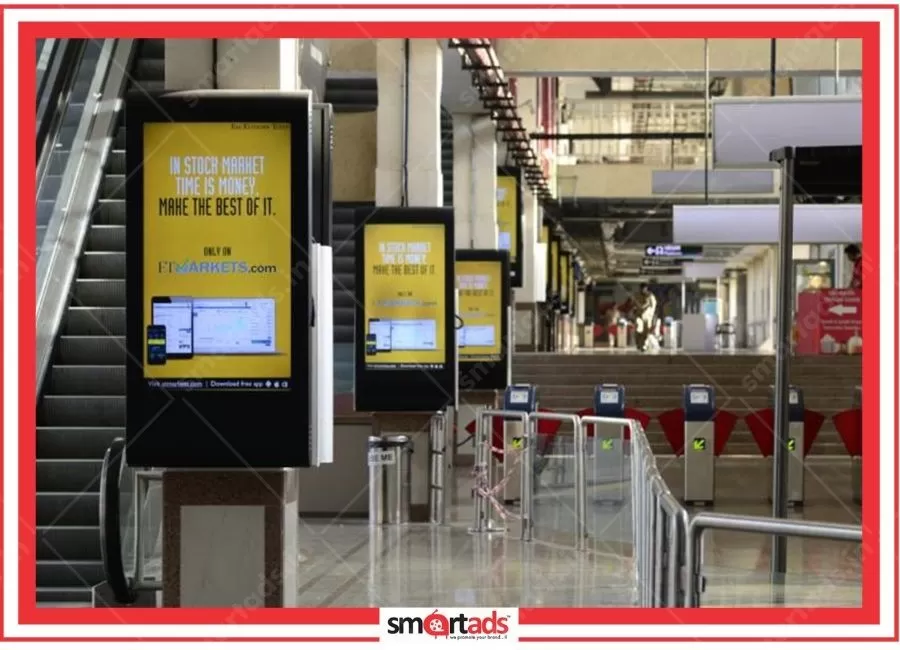
Entry Exit Panel
8 ft x 4 ft
Bright and vibrant multicolored letterin
Rate per Panel / 1 Month
Min Requirement is 3 Panel
₹48000.00
Showing 1 to 4 of 4 Results
MEDIA DETAILS
8 ft x 4 ft
Bright and vibrant multicolored letterin
Rate per Panel / 1 Month
Min Requirement is 3 Panel
₹48000.00
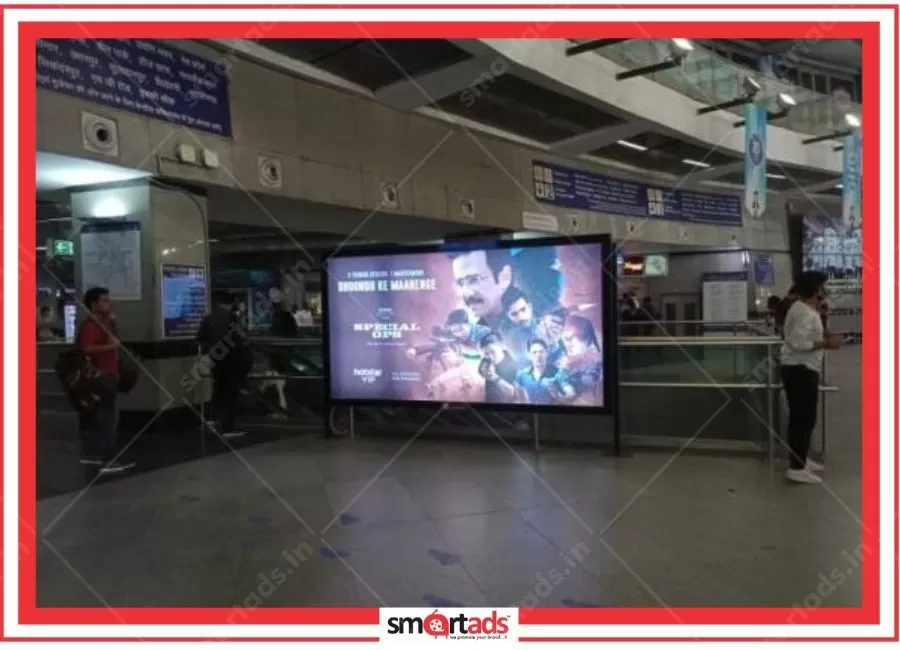
10 ft X 5 ft
A new wide wall system designed to accom
Rate per Panel / 1 Month
Min Requirement is 3 Panel
₹50000.00
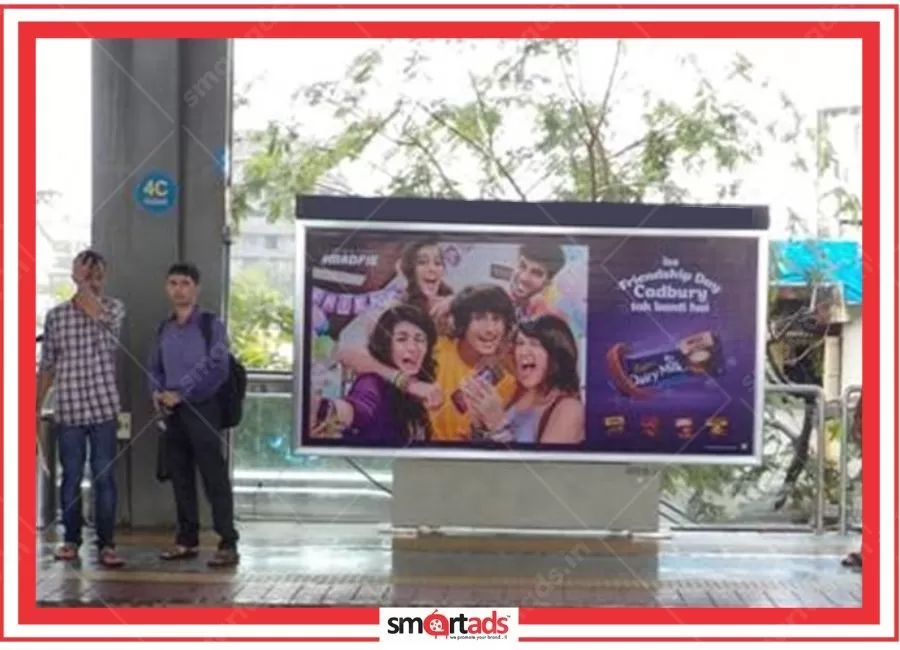
8 ft x 4 ft
A raised flooring or other horizontal su
Rate per Panel / 1 Month
Min Requirement is 3 Panel
₹35000.00
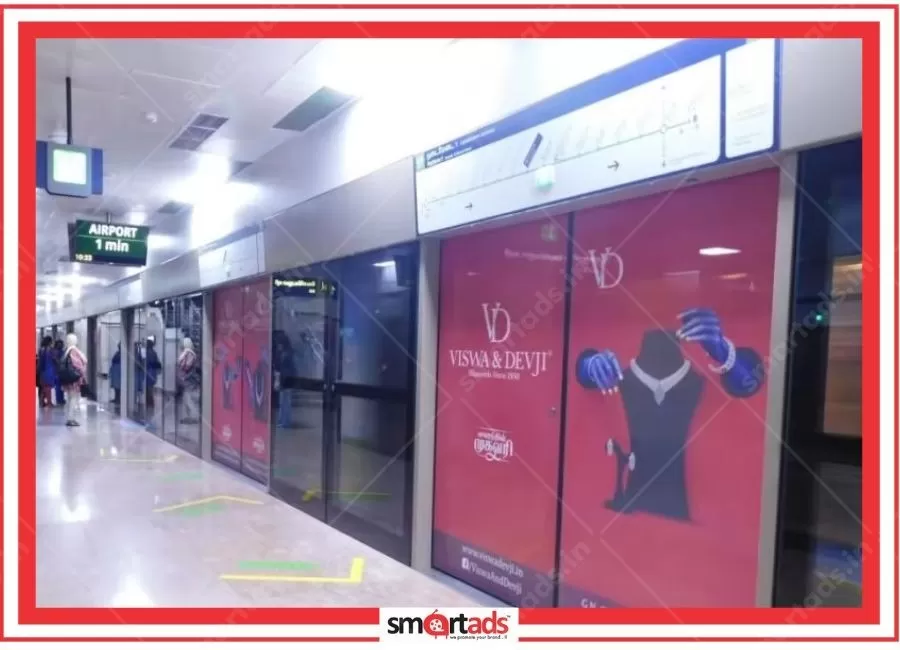
7 ft x 4 ft
Also known as platform edge doors (PEDs)
Rate per Plateform / 1 Month
Min Requirement is 3 Panel
₹1200000.00
MEDIA REACH

MinimumQty :
10
EstimateReachPeople :
15 Million
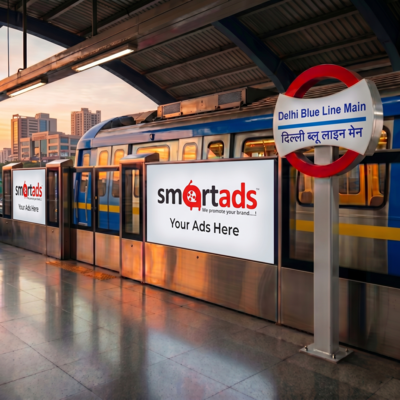
Few advertising corridors in India carry the sheer demographic weight of the Delhi Metro Blue Line Main Line — a 56 km route stretching from Dwarka Sector 21 in the west to Noida Electronic City and Vaishali in the east, threading through the commercial heart of the capital with roughly 4.5 million daily commuters passing through its stations every single day. What surprises most brand managers when they first look at the numbers is not just the scale, but the quality of that audience — salaried professionals, college students, frequent shoppers, and decision-makers who spend anywhere between eight and twenty-five minutes inside a station environment with very little else competing for their attention. At SmartAds, we have planned and executed campaigns across this corridor for clients ranging from fintech startups to national FMCG brands, and the one thing we tell every new client is this: the Blue Line is not just a transit route — it is one of the most powerful BTL advertising environments in the country.
The honest answer, based on what we have seen across hundreds of campaigns, is that no other single transit corridor in India combines reach, audience quality, and dwell time the way the Blue Line does. The route — technically operating as Line 3 (Dwarka Sector 21 to Yamuna Bank, and then branching as Line 4 toward Vaishali and Noida Electronic City) — passes through Rajiv Chowk, which consistently ranks as one of the busiest interchange stations in the entire DMRC network, handling upward of three to four lakh passenger trips on a normal weekday. That is not a number you can replicate with a single outdoor hoarding or a digital banner, which is why brands that understand transit media keep returning to this corridor year after year.
What a lot of people miss is the structural advantage that metro station advertising holds over almost every other form of OOH advertising in Delhi NCR. When a commuter enters a station, they pass through AFC gates, walk along concourses, wait on platforms, and ride escalators — each of these touchpoints is a controlled environment where the brand message cannot be skipped, scrolled past, or blocked. The dwell time at a station like Karol Bagh or Connaught Place, where passengers often wait for connecting trains or exit through crowded concourses, works out to somewhere between eight and fifteen minutes on average, which is an extraordinary amount of passive exposure time compared to the two-to-three-second glance a highway hoarding typically receives. The FICCI-EY Media and Entertainment Report has consistently highlighted transit media as one of the fastest-growing OOH sub-categories in India, and the Delhi Metro Blue Line is the primary reason that segment keeps growing.
From a non-traditional advertising standpoint, the Blue Line also offers something that purely digital channels cannot — physical presence in a space that urban audiences trust and use daily. The Dwarka to Noida corridor cuts through residential zones, commercial hubs, and educational clusters, which means a single campaign placed intelligently across five to seven stations can effectively cover the entire socioeconomic cross-section of Delhi's working population. At SmartAds, we always tell our clients that the Blue Line Main Line is not just a media buy — it is a statement of market presence, and brands that appear here are perceived as established, credible players in the Delhi NCR market.
The range of ad formats available on the Delhi Blue Line is broader than most advertisers initially expect, and frankly speaking, this is where a lot of first-time DMRC advertising buyers get overwhelmed. The formats span everything from static backlit panels on platforms to full train wrap executions that turn an entire rake into a moving billboard; each format serves a different strategic purpose, and the choice between them should be driven by campaign objective rather than budget alone. Platform branding — which involves placing backlit panel units along the length of the platform wall — is the most commonly booked format, partly because it offers high visibility during the dwell time when passengers are waiting for trains, and partly because it is available at a wider range of price points than the more premium formats.
Concourse advertising occupies the transitional zones between entry gates and platforms, which is where footfall is most concentrated and where passengers are still in a relatively alert state before they settle into the waiting routine. Pillar advertising, which wraps branded creative around the structural columns of a station, is particularly effective at high-footfall stations like Rajiv Chowk and Karol Bagh because passengers naturally orient themselves around pillars as spatial landmarks. Entry gate branding — which places creative directly on or around the AFC gates — is one of the most underutilised formats on the Blue Line, yet in our experience it delivers some of the highest recall scores because every single passenger must physically pass through those gates. Escalator wraps are another format that tends to get overlooked, but a well-designed escalator wrap at a station like Akshardham or Janakpuri West creates an immersive tunnel-like experience that is genuinely difficult to ignore.
Train wrap advertising and interior train branding represent the premium end of the format spectrum. A full train wrap on a Blue Line rake — which covers the entire exterior surface of a six or eight-car train — is one of the most dramatic brand visibility statements available in Indian transit media, because that train travels the entire 56 km route multiple times a day, passing through all 50 stations and being seen by both platform-side audiences and trackside observers. Interior train branding, which covers overhead panels, door panels, and grab-handle danglers inside the coaches, targets the captive audience that is already seated or standing inside the train — typically for journeys of ten to thirty minutes — which creates an unusually long and uninterrupted exposure window. Station domination, which combines multiple formats across a single station to create an end-to-end brand environment, is the format we recommend most strongly for product launch campaigns and high-impact brand awareness drives, and we will address that in more detail later in this article.
Not all 50 stations on the Delhi Blue Line Main Line are created equal from an advertising standpoint, and this is a distinction that most generic metro advertising agency pitches tend to gloss over. At SmartAds, we segment Blue Line stations into three tiers based on footfall, interchange value, and audience composition — and the campaign strategy we recommend varies quite significantly depending on which tier a client chooses to focus on.
Tier-1 stations — Rajiv Chowk, Karol Bagh, and Connaught Place — are the undisputed heavy hitters of the corridor. Rajiv Chowk, which serves as the interchange between the Blue Line and the Yellow Line, handles passenger volumes that are genuinely staggering on weekdays and weekends alike; the station is so busy that DMRC periodically restricts entry during peak hours, which tells you something about the density of the audience available there. Karol Bagh is a commercial hub with strong retail and middle-class consumer footfall, making it particularly valuable for FMCG, fashion, and consumer electronics brands; Connaught Place, which is technically the Rajiv Chowk station's commercial catchment, draws a disproportionately high proportion of corporate professionals and high-income consumers. For fintech brands, insurance companies, and premium consumer services, the Connaught Place corridor — spanning roughly from Patel Chowk to Barakhamba Road — is where we consistently recommend concentrating spend.
Tier-2 stations include Akshardham, Janakpuri West, Yamuna Bank, and Dwarka Sector 21, each of which serves a distinct audience cluster. Akshardham draws significant tourist and religious visitor traffic in addition to daily commuters, which makes it interesting for hospitality, travel, and lifestyle brands. Janakpuri West is a dense residential and commercial node in West Delhi, with strong middle-class family audience composition — real estate brands targeting first-time homebuyers, education brands, and health insurance advertisers have found this station particularly productive in campaigns we have run. Dwarka Sector 21, being the western terminus and an interchange with the Airport Express Line, carries a mix of frequent flyers, IT professionals, and upscale residential audiences that skews slightly higher on the income scale. Noida Electronic City and Vaishali, at the eastern end of the corridor, are natural targets for brands addressing the Noida tech workforce — a demographic that is young, digitally active, and relatively high-earning.
Tier-3 stations — the residential and transitional stations between the major nodes — are often underestimated, but they serve a specific strategic purpose. For hyperlocal advertising campaigns targeting a neighbourhood-level audience, a cluster of three to four Tier-3 stations can deliver more relevant reach than a single Tier-1 station at a significantly lower cost. A real estate developer we worked with, targeting buyers for a residential project in Dwarka, booked platform branding across five stations in the Dwarka sub-corridor and achieved a cost-per-qualified-lead that was roughly forty percent lower than what the same client had achieved with outdoor advertising in the same geography.
Advertising rates on the Delhi Blue Line are governed by DMRC's non-fare revenue framework, and they are revised periodically — which means the figures we share here are indicative benchmarks based on our current booking experience rather than fixed tariffs. The important thing to understand about DMRC advertising rates is that they are structured around format, station tier, and campaign duration, and the final cost of a campaign depends heavily on how intelligently these three variables are combined.
For a standard backlit panel at a Tier-1 station like Rajiv Chowk, the monthly rate works out to somewhere in the ballpark of ₹80,000 to ₹1,20,000 per panel, depending on panel size and exact placement within the station — which sounds steep until you calculate the cost per thousand impressions, which typically comes out to somewhere between ₹8 and ₹15, a number that surprises most first-time advertisers when they compare it to what they are paying for Instagram reach or programmatic display. Platform branding packages at Tier-2 stations like Akshardham or Janakpuri West are priced more accessibly, generally in the range of ₹40,000 to ₹70,000 per panel per month, which makes them an attractive entry point for brands with tighter budgets. Concourse advertising and pillar advertising are typically priced slightly lower than platform panels at equivalent stations, though the premium for high-traffic pillar positions at Rajiv Chowk can push rates back up toward the Tier-1 range.
Train wrap advertising is a different category entirely — a full exterior train wrap on a Blue Line rake is a significant investment, with costs running somewhere between ₹15 lakh and ₹30 lakh per month depending on the number of coaches and the duration of the booking, but the reach justification is equally significant because that train is seen by every passenger at every station across the entire corridor multiple times a day. Interior train branding — which covers panels inside the coaches — is available at considerably lower rates, generally in the range of ₹2 lakh to ₹6 lakh per month for a full-coach interior package, and it delivers exceptionally long dwell time exposure to a captive audience that is literally a captive audience. Station domination packages, which bundle multiple formats across a single station, are negotiated as a package and can range from ₹5 lakh to ₹25 lakh per month depending on the station tier and the number of formats included; for a product launch campaign, the economics of station domination often work out better than booking individual formats piecemeal, which is something we always flag for clients who are planning high-impact launches.
Audio advertising — which involves brand messages being broadcast over the in-station PA system — is an emerging format that DMRC has been expanding, with a 2025 tender reportedly covering Blue Line stations as part of a broader audio advertising rollout. The rates for audio spots are still being standardised, but early indications suggest they will be priced in the range of ₹15,000 to ₹40,000 per station per month for a defined number of daily spot plays, which makes them an interesting complement to visual formats for brands that want to reinforce a message through multiple sensory channels. Station naming rights — which allow a brand to co-brand an entire station with its name — represent the most premium tier of DMRC advertising and are available at select stations on the Blue Line, with annual co-branding initiative fees running into several crore; this is a format typically pursued by large financial institutions, telecom companies, and infrastructure brands.
The demographic profile of the Delhi Metro Blue Line Main Line audience is one of the strongest arguments for investing in this corridor, and the data from DMRC's own ridership studies — corroborated by IRS audience research — paints a picture that most brand managers find genuinely compelling. The Blue Line skews heavily toward working professionals between the ages of 22 and 45, with a significant concentration of IT and services sector employees particularly on the eastern end of the corridor between Yamuna Bank and Noida Electronic City; this is an audience that is digitally active, brand-aware, and makes purchasing decisions across categories ranging from financial products to consumer electronics to lifestyle services.
The Dwarka to Rajiv Chowk segment of the corridor carries a strong mix of government employees, private sector workers, and students, with household incomes that span the middle to upper-middle range — which makes this segment particularly valuable for insurance brands, EdTech platforms, consumer durables advertisers, and retail chains. What we have found in our media planning work is that the Blue Line audience is also disproportionately represented among early adopters of digital financial services; a fintech client we worked with ran a platform branding campaign across six stations on the Connaught Place corridor and saw app download rates from Delhi NCR increase by roughly 60% over the two-month campaign period, which was a return on investment that justified a significantly larger follow-on booking.
The captive audience dynamic is worth emphasising again, because it is genuinely different from almost every other media environment. Daily commuters on the Blue Line are not scrolling past your ad; they are standing in front of it, sitting beside it, or walking through it for several minutes at a time. The dwell time advantage, combined with the frequency of exposure for regular commuters who use the same route every weekday, means that brand recall scores for metro station advertising consistently outperform comparable OOH advertising formats in independent measurement studies. The urban audience reached through this corridor is also a relatively affluent, educated demographic — which is precisely the profile that most premium and mid-premium brands are trying to reach, and which makes the CPM comparison with digital media even more favourable when audience quality is factored in.
The booking process for Delhi Blue Line metro advertising is more structured than most advertisers expect, and understanding it upfront saves a significant amount of time and frustration. DMRC's advertising inventory is managed through authorised concessionaires — entities that have been awarded the rights to sell and manage advertising across specific station clusters or format categories — and bookings are made either directly through these concessionaires or through a metro advertising agency that has established relationships with them. At SmartAds, we manage the entire booking process on behalf of our clients, which means we handle concessionaire negotiations, rate optimisation, artwork submission, and DMRC approval coordination as a single integrated service.
The first step in any booking is an availability check, because popular formats at Tier-1 stations — particularly backlit panels at Rajiv Chowk and train wrap slots — tend to book out weeks or even months in advance, especially around festive season periods like Diwali, Navratri, and the pre-Republic Day window. We always advise clients to initiate the booking process at least six to eight weeks before their intended campaign start date, and for station domination or train wrap campaigns, a lead time of ten to twelve weeks is more realistic. The booking is confirmed through a purchase order or agreement with the concessionaire, after which the artwork submission and DMRC approval process begins — and this is where campaigns most commonly get delayed if the creative has not been prepared according to DMRC's specifications.
Artwork specifications for Blue Line advertising are specific and non-negotiable: DMRC requires high-resolution print-ready files (typically 300 DPI or higher for static formats), adherence to content guidelines that prohibit certain categories of advertising (including tobacco, alcohol, and content deemed inappropriate for a public environment), and in some cases a physical mock-up or proof for large-format executions. The creative approval process typically takes seven to fourteen working days, and any revisions required by DMRC reset that timeline — which is why having an experienced media planning partner who knows the guidelines in advance is genuinely valuable. We have seen campaigns delayed by three weeks simply because the creative team was not aware that certain colour specifications or content elements required modification.
DMRC's approval process for advertising on the Blue Line is a formal multi-step procedure that involves both the advertising concessionaire and DMRC's internal review committee, and it is worth understanding in detail because it directly affects campaign timelines and execution. Once a booking is confirmed and the purchase order is in place, the advertiser or their metro advertising agency submits the creative artwork along with a campaign brief that specifies the stations, formats, duration, and content category. The concessionaire then submits this package to DMRC for review, which involves checking the content against DMRC's advertising policy guidelines — a document that covers everything from content appropriateness to visual design standards.
DMRC's guidelines are particularly strict around a few categories: political advertising requires special clearance and is subject to Election Commission regulations during election periods; healthcare and pharmaceutical advertising must comply with CDSCO guidelines; and any creative that features imagery of the metro infrastructure itself (trains, stations, CISF personnel) requires explicit permission. For most mainstream commercial advertisers, the approval process is relatively straightforward, but the timeline — seven to fourteen working days as mentioned — is fixed and cannot be expedited. DMRC approval is required before any physical installation begins, and installation itself is managed by DMRC-approved vendors who operate within defined maintenance windows to avoid disruption to train operations.
The campaign execution phase, which involves physical installation of creatives across the booked formats, is coordinated between the concessionaire, the installation vendor, and DMRC's station operations team. For large-format executions like train wraps, installation typically happens during non-operational hours — usually between midnight and 4 AM — which adds a logistical dimension that requires careful coordination. At SmartAds, our campaign execution team manages this entire process, including on-site verification that installations match the approved artwork and that all formats are live before the campaign start date. Post-installation, we also conduct a photographic audit of all placements, which we share with clients as part of our standard campaign execution reporting.
This is probably the question we get asked most often by clients who are new to DMRC advertising, and the honest answer is that "best" depends entirely on what the campaign is trying to achieve — but we do have strong opinions based on what we have seen work and what we have seen underperform. Station domination is, in our view, the most powerful format for brand awareness campaigns and product launch campaigns because it creates an immersive brand environment that is genuinely unavoidable; when a passenger enters a station that has been fully branded — with backlit panels, pillar advertising, concourse advertising, escalator wraps, and entry gate branding all carrying the same creative — the cumulative impact on brand recall is substantially higher than any single format could achieve independently.
Train wrap advertising delivers something different — it is primarily a reach play rather than a depth play. A branded train running the full Dwarka to Noida Electronic City route is seen by tens of thousands of people who never enter the stations where it stops; it is visible from roads, bridges, and residential areas along the elevated sections of the track, which means it effectively functions as a moving outdoor advertising unit in addition to its transit media value. One automotive brand we worked with used a full train wrap on the Blue Line to support a new model launch, and the combination of the moving exterior wrap with interior train branding across the same rake created a coherent brand experience that was visible both outside and inside the train simultaneously — which generated significant organic social media coverage from commuters who photographed and shared the wrap.
Platform branding, on the other hand, is the workhorse of Blue Line metro advertising — it is the format that delivers the most consistent, measurable brand visibility at a price point that is accessible to a much wider range of advertisers. A well-placed backlit panel on a busy platform at Karol Bagh or Akshardham, renewed across a three-month campaign, will accumulate an Opportunity to See count that rivals much more expensive formats, simply because of the sheer volume of daily commuters who pass through these stations. The OTS metric for a Tier-1 station backlit panel, calculated on the basis of DMRC's published ridership data, works out to somewhere in the range of 25 to 40 lakh impressions per month — which, when divided by the monthly panel cost, produces a CPM that is genuinely competitive with most digital display formats, and considerably cheaper than premium digital video.
The comparison between metro station advertising on the Delhi Blue Line and other OOH advertising or BTL advertising options in Delhi NCR is one that we make regularly in media planning conversations, and the numbers consistently favour the metro for campaigns targeting the urban, working-age demographic. A large-format outdoor advertising hoarding on a major Delhi arterial road — say, on the Ring Road or NH-48 — might cost somewhere between ₹3 lakh and ₹8 lakh per month depending on size and location, which sounds comparable to metro advertising until you factor in the dwell time difference. A driver passing a highway hoarding has perhaps two to three seconds of exposure; a commuter waiting on a Blue Line platform has eight to fifteen minutes, which is a difference of several orders of magnitude in terms of message absorption.
Digital advertising — particularly programmatic display and social media advertising — offers geo-targeting capabilities that metro advertising cannot fully match, but the quality of attention is dramatically different. Digital ads are served to users who are actively engaged with other content and who have developed significant ad-blindness; metro station advertising is served to an audience that has relatively little else to look at and which is in a physical environment that reinforces the brand message through repetition across multiple visits. The CPM comparison is also more favourable to metro advertising than most digital-native marketers expect — when we have run side-by-side CPM analyses for clients, Blue Line metro advertising typically comes out at a CPM of somewhere between ₹8 and ₹20 for verified physical impressions, which compares very favourably to the ₹40 to ₹80 CPM range that premium digital video commands in the Delhi NCR market.
Non-traditional advertising formats like mall activations, cinema advertising, and radio advertising each serve specific purposes in a media mix, but none of them offers the combination of scale, frequency, and audience quality that the Blue Line provides. Radio advertising in Delhi can reach a large audience, but it lacks the visual impact and the captive audience dynamic; cinema advertising delivers high impact but limited frequency and reach. For brands that want to build brand awareness rapidly across the Delhi NCR urban audience — particularly the working professional demographic — the Blue Line Main Line is, in our assessment, the single most efficient BTL advertising investment available in the market.
The Blue Line's audience profile makes it a natural fit for a specific set of brand categories, and understanding this fit is important for media planning decisions. Financial services brands — banks, insurance companies, mutual fund platforms, and fintech apps — are among the most consistent and sophisticated advertisers on the Blue Line, and for good reason: the corridor's concentration of working professionals with disposable income and active financial needs makes it one of the highest-quality environments available for this category. The Connaught Place and Barakhamba Road corridor, which sits at the commercial centre of the Blue Line, is particularly valuable for financial services brands targeting corporate decision-makers and high-income consumers.
Real estate brands have found the Blue Line extremely productive for hyperlocal advertising campaigns, particularly when the creative and station selection are aligned with the geography of the project being marketed. A developer promoting a project in Dwarka or Dwarka Expressway, for instance, would logically concentrate spend on stations in the Dwarka sub-corridor — Janakpuri West, Dwarka Mor, Dwarka, Dwarka Sector 10, Dwarka Sector 14, and Dwarka Sector 21 — where the daily commuters are already residents or potential buyers in that catchment. This kind of geo-targeting through station selection is one of the most powerful features of metro advertising that purely digital channels cannot replicate with the same physical presence and credibility. EdTech platforms, consumer electronics brands, e-commerce players, healthcare services, and FMCG companies have all found productive use cases on the Blue Line, and the corridor's east-west span means that a single campaign can effectively cover both the Noida tech cluster and the West Delhi residential market simultaneously.
Experiential marketing and in-station activation campaigns — which involve setting up interactive brand experiences within station concourses — represent an emerging category of Blue Line advertising that we have seen generate exceptional engagement metrics. A consumer electronics brand we worked with ran a product demonstration activation at Rajiv Chowk during a product launch campaign, combining the in-station activation with platform branding across five adjacent stations, and the combination produced footfall at the activation booth that exceeded projections by roughly 35%. This kind of integrated approach — combining static formats with live brand experiences — is something that only a transit media environment can support at this scale, and it is an area where we expect to see significant growth in Blue Line advertising activity over the next two to three years.
Q: What is the cost of metro station advertising on the Delhi Blue Line in 2025–26?
Advertising rates on the Delhi Blue Line vary significantly by format, station tier, and campaign duration, so any single figure would be misleading without context. For a standard backlit panel at a Tier-1 station like Rajiv Chowk or Karol Bagh, monthly rates are currently in the ballpark of ₹80,000 to ₹1,20,000 per panel; at Tier-2 stations like Akshardham or Janakpuri West, the same format runs somewhere between ₹40,000 and ₹70,000 per month. Train wrap advertising — which covers the exterior of a full Blue Line rake — is a significantly larger investment, with monthly costs ranging from roughly ₹15 lakh to ₹30 lakh depending on the number of coaches and duration. Station domination packages, which bundle multiple formats at a single station, are priced between approximately ₹5 lakh and ₹25 lakh per month depending on the station and the scope of formats included. These are indicative benchmarks based on current market conditions; actual rates are confirmed at the time of booking and may vary based on availability and negotiation.
Q: Which stations on the Delhi Metro Blue Line Main Line get the highest footfall?
Rajiv Chowk consistently records the highest footfall on the Blue Line, functioning as the primary interchange between Line 3 and the Yellow Line and handling several lakh passenger trips daily; DMRC periodically implements entry restrictions at this station during peak hours, which itself is an indicator of the volume. Karol Bagh and Connaught Place (the commercial catchment around Rajiv Chowk) follow closely, with strong working professional and retail consumer footfall. On the eastern corridor, Noida Electronic City and Vaishali draw significant IT workforce traffic; on the western end, Dwarka Sector 21 — the Airport Express Line interchange — carries a premium travel and corporate audience. For campaign planning purposes, we segment stations into three tiers and recommend station selection based on the advertiser's target audience geography and demographic profile rather than footfall alone.
Q: What ad formats are available for advertising on the Delhi Metro Blue Line?
The Blue Line offers one of the widest ranges of transit media formats available on any single corridor in India. Static formats include backlit panels on platforms, pillar advertising, concourse advertising, entry gate branding, and escalator wraps. Dynamic formats include digital screens at select stations, which support video and animated creative content. Train-based formats include full exterior train wraps, interior train branding (overhead panels, door panels, grab-handle danglers), and coach wraps. Premium formats include station domination packages, which combine multiple formats across a single station, and station naming rights or co-branding initiative arrangements for select stations. Audio advertising — in-station PA announcements — is an emerging format being expanded across the Blue Line network as part of DMRC's 2025 audio advertising initiative.
Q: How do I book an ad campaign on the Delhi Metro Blue Line?
Bookings are made through DMRC's authorised advertising concessionaires, either directly or through a metro advertising agency that manages the process end-to-end. The practical steps involve an availability check for your preferred formats and stations, followed by a rate negotiation and purchase order, artwork submission according to DMRC's technical specifications, DMRC creative approval (which takes seven to fourteen working days), and then physical installation coordinated by approved vendors. Working through an experienced agency like SmartAds significantly simplifies this process, as we manage concessionaire relationships, handle DMRC approval submissions, and coordinate installation and post-campaign auditing on behalf of our clients.
Q: What is the minimum duration for a Blue Line metro advertising campaign?
The standard minimum booking period for most static formats on the Blue Line is one month, though some concessionaires offer two-week packages for specific formats at select stations. Train wrap advertising typically requires a minimum booking of one month due to the production and installation costs involved. Station domination packages are generally booked for a minimum of one month, with discounts available for longer durations of three months or more. For audio advertising spots, the minimum booking period is typically one month with a defined number of daily plays per station.
Q: How many daily commuters does the Delhi Metro Blue Line Main Line serve?
The Delhi Metro Blue Line Main Line — spanning the Dwarka Sector 21 to Noida Electronic City and Vaishali corridor — serves approximately 4.5 million daily commuters across its 50 stations, making it one of the highest-ridership transit corridors in Asia. This figure represents a combination of Line 3 (the main Blue Line from Dwarka to Yamuna Bank) and Line 4 (the branch lines to Vaishali and Noida Electronic City), and it has been recovering strongly post-pandemic, with DMRC's published ridership data showing the network approaching and in some months exceeding pre-2020 levels.
Q: What is the DMRC approval process for Blue Line station advertising?
Once a booking is confirmed, the advertiser submits print-ready artwork along with a campaign brief to the concessionaire, who forwards it to DMRC's advertising review committee. DMRC checks the content against its advertising policy guidelines — covering content appropriateness, category restrictions (tobacco, alcohol, and certain political content are prohibited), and technical specifications. The review process takes seven to fourteen working days, and any content revisions reset the timeline. Following approval, installation is coordinated through DMRC-approved vendors during non-operational hours. The entire process from booking confirmation to campaign go-live typically takes three to four weeks for standard formats and five to six weeks for complex executions like train wraps.
Q: Can I target specific stations on the Delhi Metro Blue Line for my ad campaign?
Yes — and this is one of the most powerful features of metro station advertising on the Blue Line. Unlike broadcast media, which delivers reach across a broad and largely undifferentiated audience, Blue Line advertising allows you to select specific stations that align with your target audience's geography, commute patterns, or demographic profile. A real estate brand targeting Dwarka buyers would concentrate on western corridor stations; a fintech brand targeting corporate professionals would focus on the Connaught Place and Barakhamba Road cluster; an EdTech brand targeting students might prioritise stations near university clusters. This station-level geo-targeting capability makes the Blue Line one of the most precise hyperlocal advertising tools available in the Delhi NCR market.
Q: What is the difference between station branding and train wrap advertising on the Blue Line?
Station branding refers to advertising placements within a fixed station environment — platform panels, pillar advertising, concourse advertising, entry gate branding, and escalator wraps — which target passengers who are physically present at that specific station. Train wrap advertising, by contrast, covers the exterior or interior of a train rake, which travels the entire Blue Line route and is seen by audiences at every station the train passes through as well as by people outside the metro system along elevated track sections. Station branding delivers depth of exposure and dwell time at specific locations; train wrap advertising delivers breadth of reach across the entire corridor. The most effective campaigns we have executed combine both — using station branding at key nodes for depth and a train wrap for corridor-wide reach.
Q: Is Delhi Metro Blue Line advertising effective for hyperlocal brand targeting?
Highly effective — and this is one of the most underappreciated advantages of metro station advertising on the Blue Line. Because you can select specific stations within a defined geographic cluster, you can effectively target the daily commuter population of a specific neighbourhood, commercial zone, or residential area with a precision that outdoor advertising hoardings cannot match. The Blue Line's east-west span means that a campaign targeting, say, the Noida tech corridor can be entirely separated from a campaign targeting the Dwarka residential market, even though both are on the same line. For brands with distinct geographic audience segments — real estate developers, hyperlocal retail chains, neighbourhood service providers — this station-level targeting capability makes the Blue Line one of the most effective hyperlocal advertising tools available in Delhi NCR.
Q: What types of businesses benefit most from advertising on the Delhi Metro Blue Line?
Financial services brands (banks, insurance, fintech, mutual funds), real estate developers, EdTech platforms, consumer electronics and durables brands, e-commerce and quick commerce platforms, FMCG companies, healthcare services, automobile brands, and premium retail chains have all demonstrated strong ROI from Blue Line metro advertising in our experience. The corridor is particularly valuable for brands targeting the 22-45 working professional demographic, for brands with a Delhi NCR urban audience focus, and for brands that benefit from high-frequency, repeated exposure to the same audience — which the daily commuter dynamic naturally delivers. Brands launching new products or
