
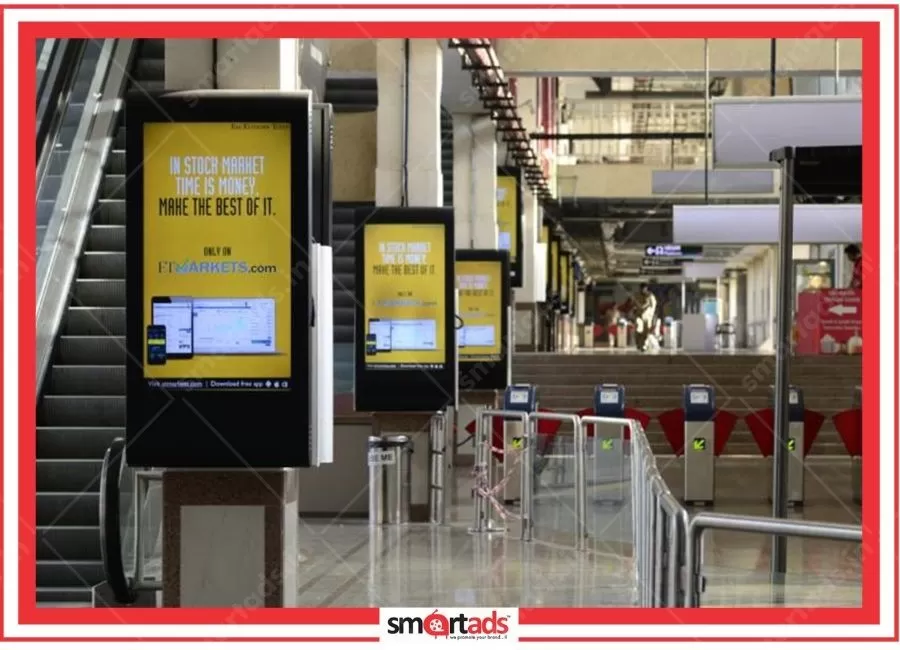
Entry Exit Panel
8 ft x 4 ft
Bright and vibrant multicolored letterin
Rate per Panel / Month
Min Requirement is 3 Panel.
₹48000.00
Showing 1 to 4 of 4 Results
MEDIA DETAILS
8 ft x 4 ft
Bright and vibrant multicolored letterin
Rate per Panel / Month
Min Requirement is 3 Panel.
₹48000.00
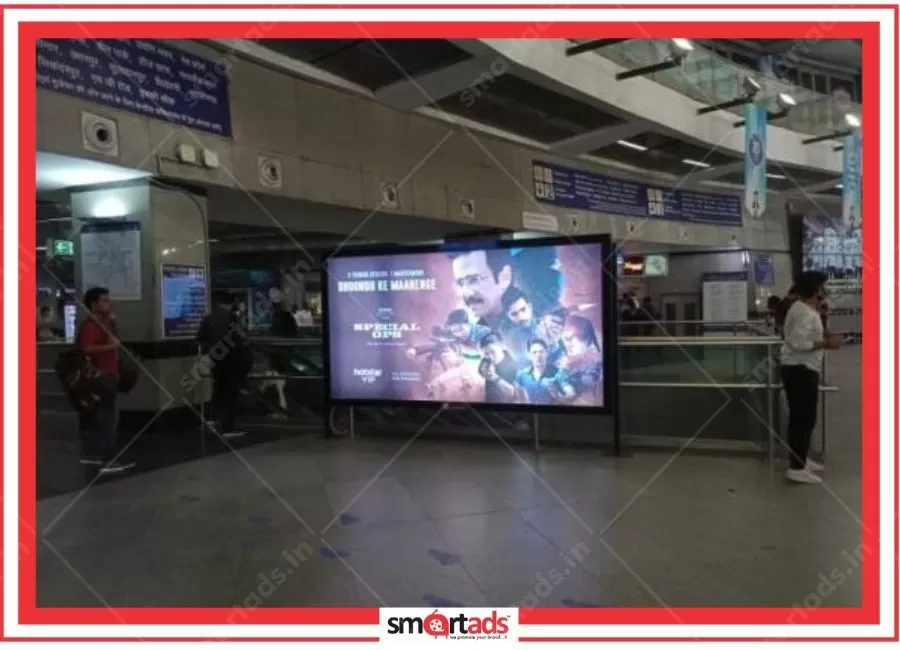
10 ft x 5 ft
A new wide wall system designed to accom
Rate per Panel / Month
Min Requirement is 3 Panel.
₹50000.00
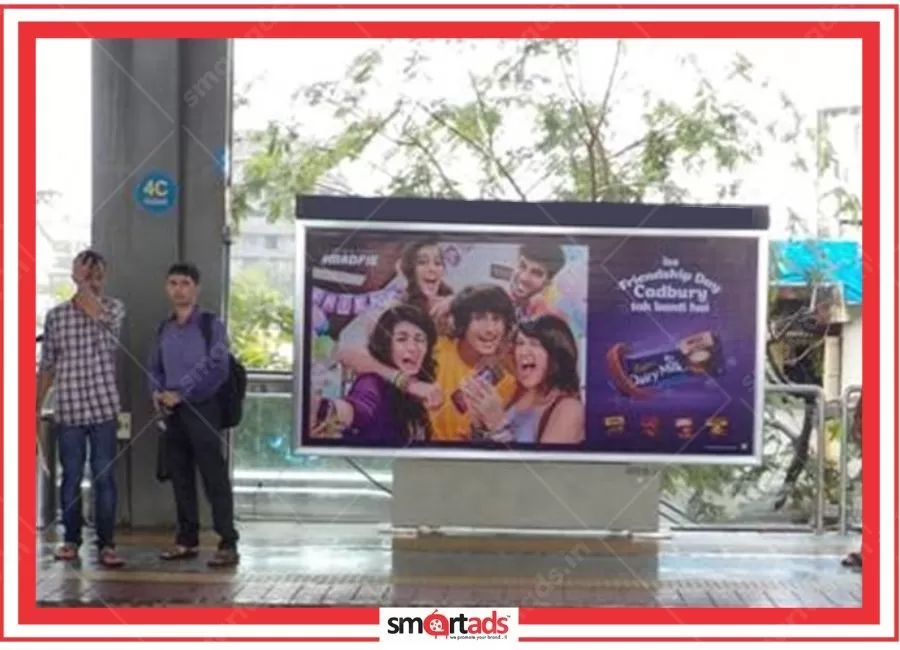
8 ft x 4 ft
A raised flooring or other horizontal su
Rate per Panel / Month
Min Requirement is 3 Panel.
₹35000.00
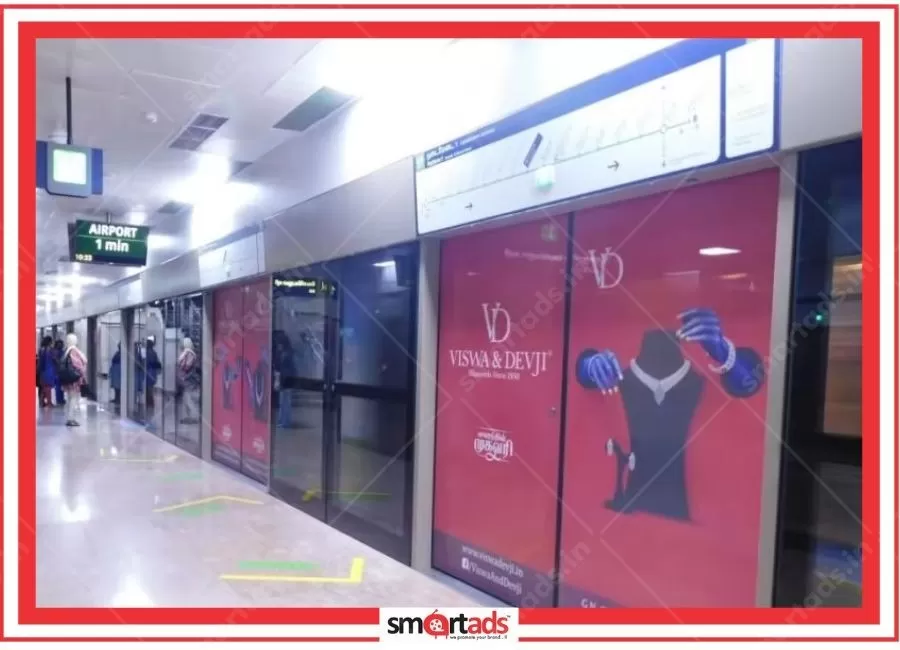
7 ft x 4 ft
Also known as platform edge doors (PEDs)
Rate per Plateform / Month
Min Requirement is 1 Stations.
₹1200000.00
MEDIA REACH

MinimumQty :
10
EstimateReachPeople :
15 Million
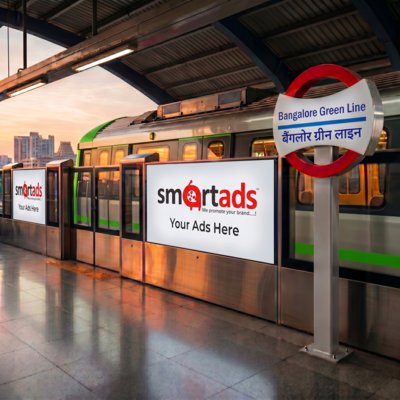
Most advertisers who approach us about Namma Metro Green Line advertising are surprised by one thing — not the cost, not the formats, but the sheer quality of the audience they're buying. The Green Line carries somewhere in the ballpark of 2.5 to 3 lakh commuters daily across its north–south corridor, and a significant proportion of that ridership consists of working professionals, students, and upper-middle-class households who are notoriously difficult to reach through conventional television or print. What we tell our clients at SmartAds is this: if you're trying to build brand recall among Bangalore's aspirational urban consumer, metro station advertising on the Bangalore Green Line is one of the most underpriced media options available to you right now.
The Green Line — formally the north–south corridor of BMRCL — stretches from Madavara in the north all the way to Silk Institute in the south, passing through some of Bangalore's densest commercial and residential zones. What makes this corridor particularly valuable from a media planning standpoint is the sheer diversity of catchment areas it covers; you have industrial belts near Peenya and Yeshwanthpur in the north, the commercial heart of the city at Majestic, and established residential neighbourhoods like Jayanagar and Banashankari as you move southward. An advertiser running a campaign across even a handful of these stations is effectively speaking to a cross-section of Bangalore that no single newspaper zone or radio frequency can replicate.
What a lot of people miss is the dwell time factor. Metro commuters in Bangalore — much like their counterparts in Delhi or Mumbai — spend anywhere from three to twelve minutes on a platform waiting for a train, which means your creative has a genuine opportunity to be read, processed, and remembered. This is fundamentally different from a billboard on Outer Ring Road, where the average vehicular exposure lasts perhaps two to four seconds. Our experience with BTL advertising in Bangalore shows that brand recall scores from metro station branding campaigns tend to run significantly higher than equivalent-spend outdoor advertising campaigns, particularly among the 25-to-40 age group that dominates Green Line ridership.
On top of that, the captive audience dynamic of metro advertising is something that brands consistently undervalue until they experience it firsthand. A commuter standing on the platform at Rajajinagar or waiting for a connecting train at Majestic metro station has no ability to scroll past your ad, change the channel, or look away — they are, for all practical purposes, in a room with your brand for several minutes. This quality of forced, uninterrupted exposure is what transit advertising in Bangalore offers that most other formats simply cannot, and it's the reason we have seen even relatively modest metro advertising campaigns generate disproportionate brand awareness lifts.
The range of formats available for Namma Metro Green Line advertising is considerably wider than most brands realise when they first approach us. Platform panel advertising is the most familiar entry point — these are the backlit panel advertising units that line the walls of both underground and elevated station platforms, and they come in a variety of sizes ranging from roughly two feet by four feet for smaller panels to large-format units that can span six feet by four feet or more. Backlit panel advertising at underground stations like Majestic has a particular visual intensity because the controlled lighting environment makes the illuminated panels dramatically more visible than anything you'd achieve with a printed billboard in open daylight.
Beyond platform panels, metro station branding in Bangalore extends to concourse advertising — the large-format displays in the ticketing and entry zones that every single passenger must pass through — as well as entry exit zone branding, which captures both inbound and outbound commuters at the most attention-rich moments of their journey. Interior panel advertising inside the train coaches themselves is another strong format; these are the panels positioned above the seating rows and near the doors, which commuters face directly for the entire duration of their ride. Digital screen advertising in metro stations has also grown substantially on the Green Line, with DOOH Bangalore metro units now present at several major stations, offering the flexibility of time-of-day scheduling and dynamic creative rotation that static panels cannot match.
Then there are the more immersive formats that genuinely shift the conversation — train wrap advertising, which covers the exterior of an entire metro train with a brand's creative, is among the most dramatic and high-impact options available in OOH advertising in Bangalore. A full train wrap on the Green Line covers roughly 5,300 square feet of advertising space, which is an extraordinary canvas by any standard; when that train pulls into a station or runs elevated through a busy corridor, it functions as a moving billboard visible to thousands of people who never even board the metro. Metro pillar branding, metro standee advertising near entry points, kiosk activation in metro concourse areas, and smart card co-branding are additional touchpoints that allow brands to build a genuinely immersive presence across the Green Line ecosystem. Station domination advertising — where a single brand takes over all available inventory at one station — is the most premium expression of this, and we have executed several such campaigns for clients who needed to make an unmistakable impression at a specific geographic catchment.
Frankly speaking, metro advertising rates in Bangalore are one of the more misunderstood areas of the media market, largely because most published rate cards are either outdated or stripped of context. What we can tell you from our active buying experience is that platform panel advertising at standard Green Line stations typically works out to somewhere between ₹25,000 and ₹60,000 per panel per month, depending on the station's footfall tier, the panel's size and position, and whether it's a backlit or non-illuminated unit. Majestic metro station advertising, which sits at the interchange with the Purple Line and commands the highest footfall on the network, carries a premium that puts it at the upper end of that range — and during festive season metro advertising windows like Diwali or Dasara, that premium can add another 20 to 30 percent on top of the base rate.
Train wrap advertising costs are in a different category entirely. A full train wrap on the Green Line — which covers the complete exterior of a six-coach rake — is priced in the ballpark of ₹8 to ₹12 lakh per month, which sounds significant until you calculate the cost-per-impression. When you factor in that a single Green Line train makes dozens of trips daily, is visible to platform crowds at every station it serves, and generates exterior impressions from pedestrians and motorists near elevated sections, the CPM works out to a number that surprises most first-time advertisers when they compare it to what they are paying for Instagram reach among a similarly affluent urban audience. Interior panel advertising rates are more accessible, typically running somewhere between ₹15,000 and ₹40,000 per coach panel per month depending on placement and coach position.
Digital screen advertising at metro stations — the DOOH Bangalore metro units — is priced differently again, usually on a per-slot basis where a 10-second spot in a looping sequence might cost somewhere in the range of ₹3,000 to ₹8,000 per station per week, which makes it one of the more flexible entry points for brands that want metro advertising without committing to a full-month panel booking. Metro advertising costs in Bangalore across all formats are negotiable when booked through an authorised agency, and volume deals across multiple stations or formats routinely yield discounts in the 15 to 25 percent range — which is something we at SmartAds actively negotiate on behalf of our clients rather than accepting published rack rates.
Not all 32 stations on the Green Line are created equal from an advertising standpoint, and choosing the right stations is arguably more important than choosing the right format. Majestic metro station — the Kempegowda Interchange — is the undisputed anchor of the network; it is the only point where the Green Line and Purple Line intersect, which means it captures not just Green Line ridership but also interchange passengers transferring between corridors, making it the highest-footfall station on the entire Namma Metro network. Majestic metro station advertising is consequently the most sought-after inventory on the Green Line, and it is the first to sell out during peak campaign periods.
Yeshwanthpur metro advertising is another category of its own — the station serves a major commercial hub, a large residential catchment, and is proximate to several wholesale markets and the ISRO campus, which gives it an audience mix that is particularly valuable for brands targeting both business owners and educated professionals. Jayanagar metro advertising, further south on the corridor, reaches one of Bangalore's most established and affluent residential neighbourhoods; the catchment around Jayanagar skews toward homeowners, families, and consumers with significant disposable income, which makes it a natural fit for real estate, financial services, and premium consumer goods advertisers. Banashankari metro advertising similarly reaches a dense, established residential zone that is underserved by most conventional OOH advertising in Bangalore.
Rajajinagar metro branding is worth particular attention for brands targeting the city's large trading and business community, while stations along the Tumakuru Road corridor — Peenya, Peenya Industry, Jalahalli — reach a predominantly working-class and industrial audience that is valuable for FMCG, telecom, and affordable consumer durables brands. At the southern end, the Silk Institute station serves the Bangalore IT corridor's southern edge and captures a younger, tech-professional audience; Madavara to Silk Institute advertising across the full corridor gives brands a genuine north-to-south sweep of Bangalore's urban population. Our recommendation is always to map station selection to the brand's target consumer geography rather than defaulting to Majestic simply because it has the highest raw numbers.
The daily ridership figure for Namma Metro as a whole has been climbing steadily, with the network crossing the 7 to 8 lakh daily trips mark on strong weekdays as of the most recent BMRCL operational data — and the Green Line accounts for a substantial share of that, given that it covers the longer north–south distance and passes through more densely populated zones than the Purple Line's east–west corridor. For media planning purposes, what matters even more than the raw ridership number is the weekly cumulative reach, which for a campaign running across five or six key Green Line stations works out to somewhere in the range of 15 to 20 lakh unique individuals over a 30-day period, depending on station selection and format placement.
The audience composition is what makes daily ridership on Namma Metro Green Line particularly interesting from a brand perspective. BARC viewership data and IRS audience profiles for Bangalore's metro-using population consistently show a skew toward SEC A and SEC B households, with a median age somewhere between 24 and 38 years — which is precisely the demographic that is most elusive on traditional television and most expensive to reach on digital platforms. A significant proportion of Green Line commuters are Bangalore IT professionals, students from the city's numerous colleges and universities, and government employees travelling to the Vidhana Soudha and central government office zones near Majestic. This is a captive audience advertising opportunity that, in our experience, very few brands have fully exploited relative to its potential.
The GroupM TYNY Report and the FICCI-EY Media Report have both noted the growing importance of transit advertising in India's Tier 1 cities as a premium reach vehicle, particularly as urban consumers spend more time commuting and less time with traditional media. Bangalore, with its notorious traffic conditions, has seen metro ridership grow at a pace that consistently outstrips initial projections; the implication for advertisers is that the audience available through Namma Metro Green Line advertising is not static but expanding, which means the cost-per-impression on this medium is effectively declining even as absolute rates hold steady.
Metro advertising versus billboard is a comparison we are asked about constantly, and the honest answer is that they serve different strategic purposes rather than being direct substitutes. A large-format hoarding on Outer Ring Road or Hosur Road can achieve extraordinary visibility in terms of raw impression numbers — outdoor advertising in Bangalore on premium corridors can deliver 50,000 to 80,000 daily impressions from vehicular traffic — but those impressions are fleeting, uncontrolled, and skewed toward whoever happens to be driving past at that moment. Metro station advertising on the Bangalore Green Line, by contrast, delivers a smaller but far more defined and engaged audience; the commuter who stands in front of your backlit panel at Jayanagar for four minutes while waiting for a train is a fundamentally different quality of impression than the driver who glances at your hoarding for two seconds on Bannerghatta Road.
The cost-per-impression comparison, when calculated honestly, often favours metro station branding in Bangalore over equivalent-spend outdoor advertising, particularly when you account for the quality and dwell-time differential. OOH advertising in Bangalore on premium hoardings can run anywhere from ₹1.5 lakh to ₹5 lakh per month for a single site, which sounds comparable to a multi-panel metro campaign — but the metro campaign delivers verified footfall data from BMRCL, a controlled viewing environment, and a demographically superior audience profile. Non-traditional advertising in Bangalore through the metro also benefits from a clutter advantage; unlike the visual chaos of a busy arterial road where your hoarding competes with dozens of others, a well-placed platform panel at a metro station has relatively few competing creatives in its immediate visual field.
One automotive brand we worked with ran a parallel campaign — identical creative, comparable spend — across traditional outdoor advertising in Bangalore and Namma Metro Green Line advertising simultaneously over a 60-day period. The brand recall survey we conducted at the end of the campaign showed that the metro placements generated recall scores roughly 40 percent higher than the outdoor placements among the 25-to-40 age cohort, which was the primary target demographic. Below the line advertising in Bangalore through metro channels also offers something that traditional OOH cannot — the ability to contextualise the message within a specific commuter journey, which creates a natural relevance that ambient outdoor placements rarely achieve.
BMRCL advertising guidelines are one of the most frequently overlooked aspects of metro campaign planning, and we have seen campaigns delayed by two to three weeks simply because brands submitted creatives without understanding the regulatory requirements. The most critical — and most commonly missed — guideline is the Kannada creative requirement for metro ads: BMRCL mandates that a minimum of 60 percent of the text content on any advertisement displayed within the metro system must be in Kannada script. This applies to platform panels, concourse advertising, interior panels, and all other static formats; digital screen advertising has slightly different provisions but is subject to the same spirit of the guideline. Brands that arrive with English-only or Hindi-heavy creatives are sent back to revise, which costs time and sometimes money if the campaign window is time-sensitive.
Beyond the language requirement, BMRCL guidelines for metro advertising in Bangalore specify content standards — no political advertising, no content deemed to be in conflict with public interest, and no creatives that might cause distraction or safety concerns at platform level. The approval process typically involves submission of creatives to BMRCL's designated advertising concessionaire — Avinashi Ads holds the exclusive advertising rights for Green Line train advertising, and they are the primary point of contact for train wrap and interior panel bookings — followed by a review period that, under normal circumstances, takes somewhere between seven and fourteen working days. Brands planning festive season metro advertising campaigns should factor in additional lead time, as the approval queue tends to lengthen significantly during October and November when demand peaks.
Creative specifications are another area where brands frequently stumble. Backlit panel advertising requires high-resolution artwork — typically a minimum of 150 DPI at print size, submitted in PDF or AI format — while digital screen advertising at DOOH Bangalore metro installations requires MP4 or MOV files at specific resolutions that vary by screen manufacturer. Train wrap advertising has the most demanding specifications of all, given the large format and the curvature of the train body; a full train wrap brief requires precise template files that account for door positions, window cutouts, and panel joins, which is why we always recommend working with an agency like SmartAds that has executed these formats before and maintains current specification documents from the concessionaires.
This is a question we get from a surprisingly wide range of clients — not just startups and small businesses, but also established regional brands that assume metro advertising is exclusively a large-budget game. The honest answer is that metro advertising for startups in Bangalore is more accessible than most people assume, particularly if the campaign is planned intelligently rather than defaulted to the most expensive formats and stations. A single platform panel at a mid-tier Green Line station — say, Nagasandra or Sandal Soap Factory — can be booked for a month at a cost that is genuinely competitive with a mid-sized newspaper display advertisement, and it delivers a more targeted, higher-dwell-time audience than most print placements.
The minimum budget required to run a meaningful Namma Metro Green Line advertising campaign — one that achieves genuine frequency and recall rather than a token presence — is somewhere in the range of ₹1.5 to ₹3 lakh for a 30-day campaign across two or three panels at well-chosen stations. This is not a negligible sum for a small business, but it is far from the ₹20-lakh-plus investment that brands assume when they hear "metro advertising." Metro advertising for startups in Bangalore has become a genuine strategic option precisely because the format allows hyperlocal advertising in Bangalore — you can choose stations that are geographically proximate to your store, office, or service area, which means you're spending your media budget on the specific catchment you actually serve rather than broadcasting to the entire city.
A retail client in Pune — a homegrown apparel brand expanding into Bangalore — came to us with a budget of ₹2.5 lakh for their Bangalore launch. Rather than spreading that across multiple channels and achieving nothing particularly well, we concentrated the entire budget on three Green Line stations that were within two kilometres of their new store locations. The campaign ran for six weeks, and the client reported that a significant proportion of their first-month walk-in customers mentioned having seen the metro advertising — a piece of anecdotal evidence that, combined with the footfall data, convinced them to double their metro spend in the subsequent quarter. Hyperlocal advertising in Bangalore through the metro is, frankly, one of the most efficient tools available to brands with constrained budgets and specific geographic targets.
Multi-station metro campaigns are where the real strategic leverage lies, and they require a level of planning sophistication that goes beyond simply booking more panels at more stations. The starting point is always audience mapping — understanding which stations on the Green Line serve the specific consumer profile the brand needs to reach, and then building a station selection that maximises reach within that profile rather than simply maximising total impressions. A fintech brand targeting young professionals, for instance, would weight their station selection toward Yeshwanthpur, Majestic, and the southern IT corridor stations rather than the industrial stations along the Peenya stretch; conversely, an FMCG brand seeking mass urban reach would want to include those industrial stations precisely because they deliver a different but equally valuable audience segment.
The format mix within a multi-station campaign is the second strategic variable, and it's one where we have seen brands make expensive mistakes by defaulting to a single format across all stations. Our experience shows that a campaign which combines platform panel advertising at high-footfall stations with interior panel advertising for in-train engagement, and adds digital screen advertising at interchange stations for frequency building, consistently outperforms single-format campaigns at equivalent spend. The logic is simple: different formats catch the commuter at different moments of their journey — the platform panel is seen while waiting, the interior panel is seen while riding, and the concourse advertising is seen while entering or exiting — which means a multi-format campaign builds multiple exposures across a single journey rather than relying on a single touchpoint.
The booking process for a multi-station BTL advertising campaign in Bangalore across the Green Line involves coordinating with BMRCL's authorised concessionaires — Avinashi Ads for train formats, and the station advertising concessionaire for platform and concourse inventory — which is a process that can become genuinely complex when multiple formats and stations are involved. At SmartAds, we manage this coordination on behalf of our clients, consolidating the booking, creative submission, and approval process into a single managed workflow that typically reduces the time from brief to live campaign by one to two weeks compared to brands attempting to manage it directly. Metro advertising campaign booking through an experienced agency also provides negotiating leverage that individual brands rarely have access to, particularly for multi-station packages where volume discounts are available but rarely advertised.
ROI measurement for metro advertising is an area where the industry has historically been weak, and frankly, a lot of agencies have used that weakness as cover for not being accountable. The good news is that BMRCL footfall data — which is available at a station level and is audited against ticketing system records — provides a verified impression base that is considerably more reliable than the estimated traffic counts used for most outdoor advertising in Bangalore. When you know that a specific station processed 18,000 entries on a given day, and your panel is positioned at the entry gate, you have a defensible impression number that you can use to calculate a genuine CPM — which, for most Green Line stations, works out to a figure that compares very favourably with digital CPMs for equivalent urban professional audiences.
Brand recall measurement is the second layer of ROI for metro advertising, and it's one that we actively recommend to clients running campaigns of ₹5 lakh or more. A simple pre-and-post survey among metro commuters at the target stations — asking about brand awareness, message recall, and purchase intent — can provide statistically meaningful data on campaign effectiveness within a budget of ₹50,000 to ₹80,000, which is a small fraction of the total campaign cost. One FMCG brand we ran a Green Line campaign for saw their unaided brand awareness among metro commuters in the 25-to-35 age bracket increase by 22 percentage points over a 45-day campaign period, which was a result that justified the entire campaign spend on its own terms — before any sales attribution was even attempted.
The TAM AdEx data and FICCI-EY Media Report findings on transit advertising effectiveness consistently show that commuter advertising in India generates above-average brand recall compared to static outdoor formats, which aligns with what we observe in our own campaign tracking. The captive audience dynamic, the dwell time, and the absence of competing media during the commute all contribute to an environment where advertising messages are processed more deeply than in most other contexts. ROI for metro advertising, when measured properly, tends to surprise clients who came in expecting it to be a vanity medium — and that surprise, in our experience, is what converts one-campaign clients into long-term metro advertising partners.
Q: What is the cost of metro station advertising on the Bangalore Green Line?
Metro advertising rates on the Bangalore Green Line vary considerably by format, station, and campaign duration, but to give you a working framework: platform panel advertising at standard stations runs somewhere between ₹25,000 and ₹60,000 per panel per month, with Majestic metro station advertising commanding the upper end of that range due to its interchange status and exceptional footfall. Train wrap advertising for a full exterior wrap is in the ballpark of ₹8 to ₹12 lakh per month, while interior panel advertising per coach typically falls between ₹15,000 and ₹40,000 monthly. Digital screen advertising at DOOH Bangalore metro installations is priced on a per-slot basis and can start from as low as ₹3,000 per station per week, which makes it the most accessible entry point for brands testing the medium. These are indicative figures; actual metro advertising costs in Bangalore depend on negotiation, volume, and seasonal demand, and we would always recommend getting a current rate card through an authorised agency rather than relying on published figures that may be 12 to 18 months out of date.
Q: Which are the best stations on the Namma Metro Green Line to advertise?
The answer depends entirely on your target audience, which is a point we make to every client who asks us this question. Majestic metro station is the highest-footfall station on the network and the logical choice for brands seeking maximum reach across all demographics; Yeshwanthpur metro advertising is ideal for brands targeting business owners, professionals, and the educated middle class of north Bangalore; Jayanagar metro advertising and Banashankari metro advertising serve some of Bangalore's most affluent residential catchments and are strong choices for premium consumer, real estate, and financial services brands. For brands targeting Bangalore IT professionals specifically, the southern corridor stations near the Silk Institute end of the line are worth prioritising. Rajajinagar metro branding works well for brands targeting the city's trading and business community. Our recommendation is always to map your consumer data to station catchments before making a selection, rather than defaulting to the most obvious high-footfall choice.
Q: What advertising formats are available at Green Line metro stations in Bangalore?
The Green Line offers a genuinely wide range of formats across the station and train environment. At the station level, you have platform panel advertising in both backlit and non-illuminated variants, concourse advertising in the ticketing and entry zones, entry exit zone branding at gate positions, metro pillar branding on structural columns, metro standee advertising near entry points, digital screen advertising through DOOH Bangalore metro installations, and kiosk activation spaces in larger stations. On the train itself, interior panel advertising above seating rows and near doors is available, as is the premium train wrap advertising format which covers the full exterior of a rake. Station domination advertising — where a single brand takes all available inventory at one station — is available at most major stations and represents the most immersive brand experience the network offers. Smart card co-branding is a less conventional but genuinely interesting BTL activation format that places brand messaging on the physical metro smart cards distributed to commuters.
Q: How many passengers travel on the Namma Metro Green Line daily?
The Green Line accounts for a substantial share of Namma Metro's total daily ridership, which has been tracking in the range of 7 to 8 lakh trips on strong weekdays across the full network. The Green Line's share of that total is significant given its longer corridor and the density of the catchment areas it serves; for media planning purposes, a reasonable working estimate for daily ridership on the Green Line is somewhere between 2.5 and 3.5 lakh commuter trips, though this figure fluctuates with day of week, season, and ongoing network expansion. These numbers are derived from BMRCL operational data and are audited against ticketing records, which makes them considerably more reliable as an audience base than the estimated traffic counts used for most outdoor advertising formats.
Q: Who holds the exclusive advertising rights for Namma Metro Green Line trains?
Avinashi Ads holds the exclusive advertising rights for Green Line train advertising — specifically for the exterior train wrap advertising and interior panel advertising formats on the Green Line rakes. This is an important distinction for brands to understand: the station advertising inventory (platform panels, concourse, digital screens) is managed separately through BMRCL's station advertising concessionaires, while the train-format inventory goes through Avinashi Ads. Brands or agencies that approach BMRCL directly for train advertising will typically be directed to Avinashi Ads as the authorised rights holder. Working through an experienced metro advertising agency in Bangalore that has established relationships with both the station concessionaires and Avinashi Ads is the most efficient way to access the full range of Green Line inventory without navigating multiple separate booking processes.
Q: How long does it take to get BMRCL approval for metro station advertising in Bangalore?
Under normal circumstances, the BMRCL approval process for metro advertising takes somewhere between seven and fourteen working days from the date of creative submission, assuming the artwork meets all technical and content guidelines on the first submission. The most common reason for delays is creative non-compliance — particularly the Kannada creative requirement that mandates a minimum of 60 percent Kannada text content — which requires revision and resubmission and can add another five to seven working days to the timeline. During peak campaign periods — Dasara, Diwali, and the IPL season — the approval queue lengthens, and brands should plan for a three-to-four-week lead time during these windows. We always advise clients to begin the creative development and approval process at least four weeks before their intended campaign launch date, and six weeks if the campaign involves train wrap advertising, which has additional technical review requirements.
Q: What is the minimum budget required to start a metro advertising campaign on the Green Line?
A meaningful Namma Metro Green Line advertising campaign — one that achieves sufficient frequency and presence to generate genuine brand recall rather than a token impression — can be executed for a minimum of roughly ₹1.5 to ₹2 lakh for a 30-day period, covering two or three platform panels at well-chosen stations. This is the practical floor for a campaign that has a realistic chance of moving the needle on brand awareness; below this level, the presence is too thin to generate the frequency needed for recall. For brands that want to include train advertising, the minimum budget increases substantially — a partial train wrap or interior panel package on a single rake starts at somewhere around ₹3 to ₹4 lakh per month. Metro advertising for startups in Bangalore is genuinely viable at these budget levels, particularly when station selection is guided by hyperlocal relevance to the brand's actual service area rather than a desire for maximum network coverage.
Q: Can I advertise on both Green Line and Purple Line metro stations in Bangalore simultaneously?
Yes, and in our experience, cross-line campaigns that span both the Green Line and Purple Line can be highly effective for brands seeking city-wide reach across Bangalore's urban professional population. The two lines serve distinctly different geographic corridors — the Green Line covers the north–south axis through industrial, commercial, and residential zones, while the Purple Line covers the east–west axis connecting the IT clusters of Whitefield and Electronic City with the city centre — which means a combined campaign reaches a much broader cross-section of the city than either line alone. The audience demographics also differ in useful ways: the Purple Line skews more heavily toward Bangalore's IT professional community given its Whitefield and Electronic City endpoints, while the Green Line offers a more mixed audience profile. Booking a cross-line campaign requires coordinating with the respective concessionaires for each line, which is a process that an experienced metro advertising agency in Bangalore can manage as a consolidated brief.
Q: What are the creative guidelines for advertising on Namma Metro Green Line stations?
The most important creative guideline — and the one most frequently overlooked — is the BMRCL requirement that a minimum of 60 percent of text content in any metro advertisement be in Kannada script. Beyond this, BMRCL guidelines prohibit political content, content deemed contrary to public interest, and any creative that might cause distraction or safety concerns in the platform environment. Technical specifications vary by format: backlit panel advertising requires high-resolution artwork at a minimum of 150 DPI at print size, submitted in PDF or Adobe Illustrator format; digital screen advertising requires MP4 or MOV video files at resolutions specified by the screen manufacturer at each station; and train wrap advertising requires precise template files that account for door positions, window cutouts, and panel joins across the full rake length. All creatives must be submitted to the relevant concessionaire — Avinashi Ads for train formats, the station concessionaire for platform inventory — for approval before production, which is a step that brands sometimes skip and then find themselves with printed materials that cannot be installed.
Q: Is metro station advertising on the Bangalore Green Line effective for local and hyperlocal brands?
It is, and this is arguably one of the most underappreciated aspects of Namma Metro Green Line advertising. The ability to select specific stations that are geographically proximate to a brand's store, office, or service area makes metro station advertising a genuinely hyperlocal advertising tool in Bangalore — one that allows a neighbourhood restaurant, a local real estate developer, or a regional retail chain to concentrate their media spend on the exact catchment they serve. A brand operating in Jayanagar, for instance, can book Jayanagar metro advertising and Banashankari metro advertising exclusively, reaching the specific residential community they need without paying to reach the rest of the city. The captive audience and dwell-time advantages of metro advertising apply equally to local brands as to national advertisers; in some ways, local brands benefit more because their message has an immediate geographic relevance to the audience seeing it, which increases the likelihood of a direct response.
Q: What is the difference between a train wrap and interior panel advertising on the Green Line?
Train wrap advertising covers the exterior of a metro train — the full outer surface of the coaches, including sides, ends, and sometimes the roof — with a brand's creative, creating a moving billboard that is visible to everyone who sees the train in motion or at a station, whether or not they are a passenger. A full train wrap on the Green Line covers approximately 5,300 square feet of advertising space, which makes it one of the largest single-unit advertising formats available in OOH advertising in Bangalore. Interior panel advertising, by contrast, is placed inside the train coaches — above the seating rows, near the doors, and in the overhead panels — and is visible exclusively to passengers who are riding the train. The two formats serve different strategic purposes: train wrap advertising maximises external visibility and generates impressions from a much wider audience including pedestrians and motorists near elevated sections, while interior panel advertising delivers a more intimate, longer-duration exposure to the specific audience of commuters who are riding the train. Many brands use both formats simultaneously to achieve both external visibility and in-journey engagement, which is a combination that we have found to be particularly effective for product launches and brand repositioning campaigns.
Q: How do I book a metro station advertising campaign on the Bangalore Green Line?
The booking process begins with defining your campaign objectives, target audience, budget, and preferred campaign duration — ideally four to six weeks before the intended launch date to allow for creative approval and production. The next step is station and format selection, which should be guided by audience mapping rather than defaulted to the most expensive or most obvious options. Once the campaign plan is confirmed, creatives must be developed in compliance with BMRCL guidelines — including the Kannada language requirement — and
