
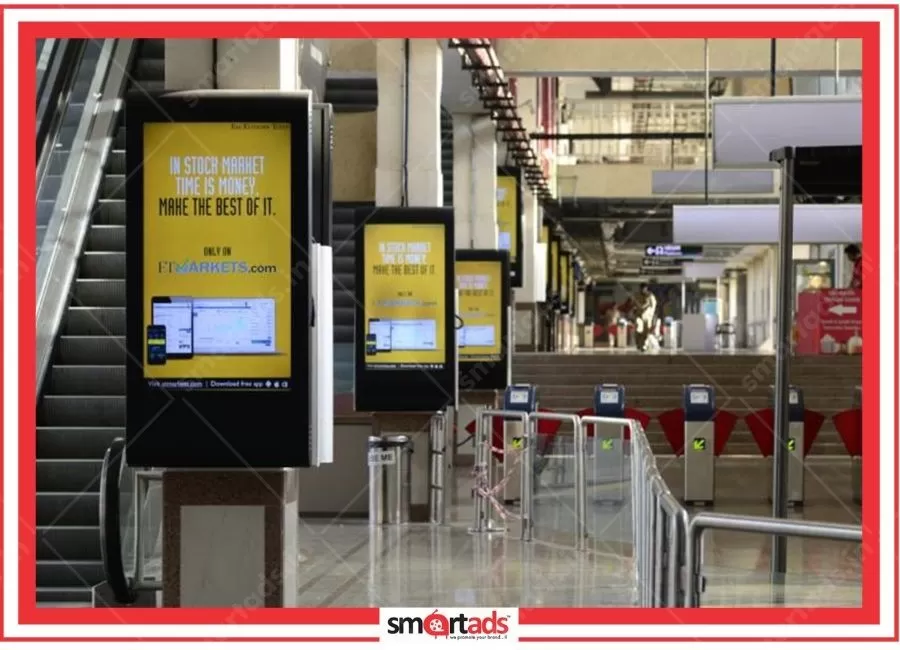
Entry Exit Panel
8 ft x 4 ft
Bright and vibrant multicolored letterin
Rate per Panel / Month
Min Requirement is 3 Panel.
₹48000.00
Showing 1 to 4 of 4 Results
MEDIA DETAILS
8 ft x 4 ft
Bright and vibrant multicolored letterin
Rate per Panel / Month
Min Requirement is 3 Panel.
₹48000.00
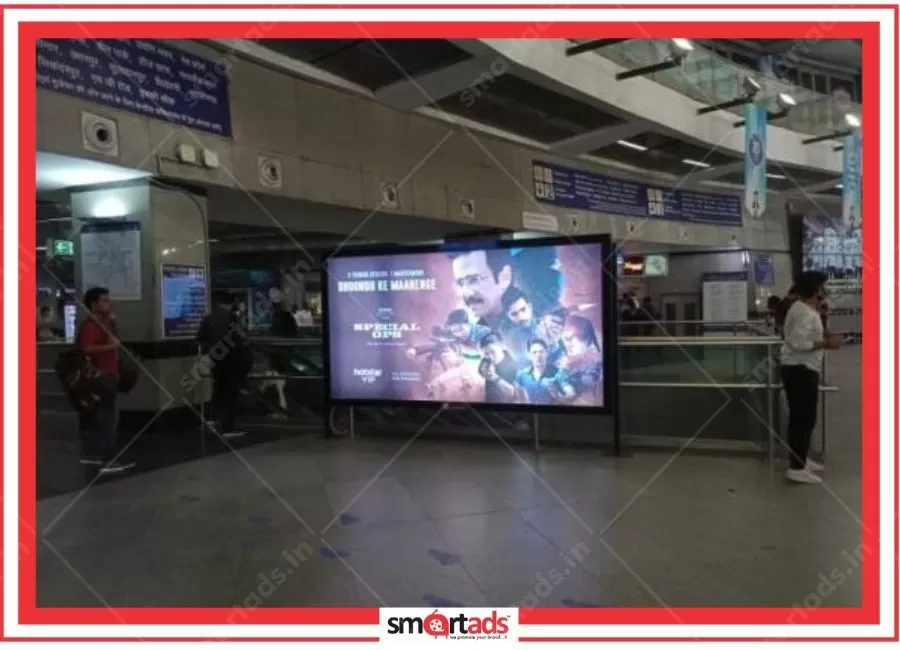
10 ft x 5 ft
A new wide wall system designed to accom
Rate per Panel / Month
Min Requirement is 3 Panel.
₹50000.00
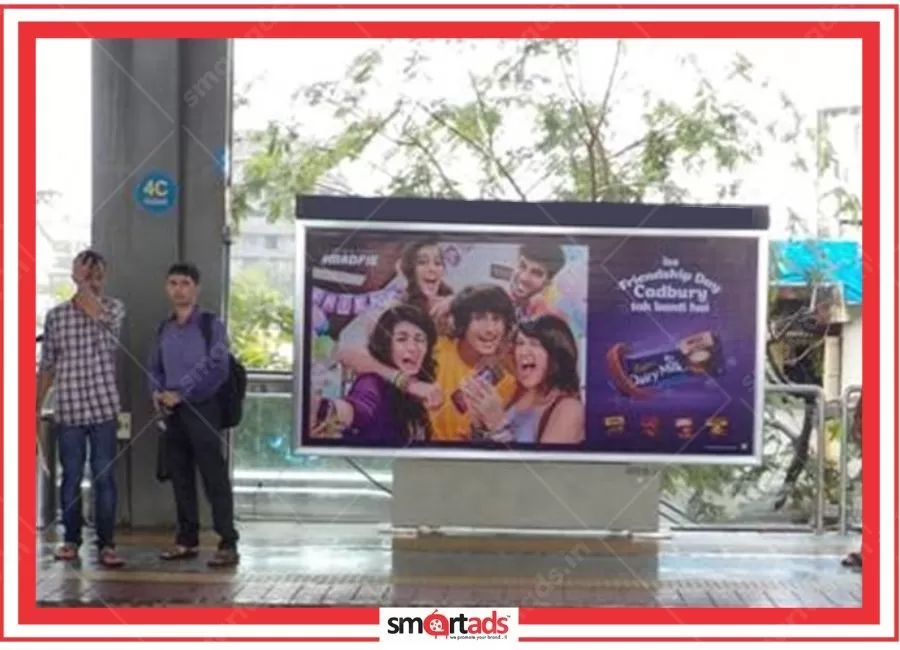
8 ft x 4 ft
A raised flooring or other horizontal su
Rate per Panel / Month
Min Requirement is 3 Panel.
₹35000.00
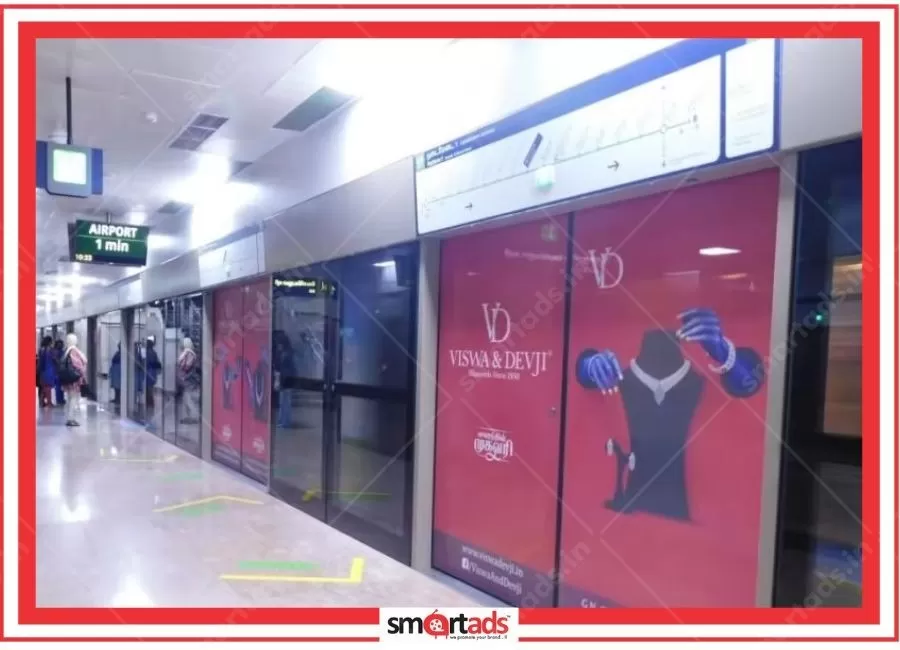
7 ft x 4 ft
Also known as platform edge doors (PEDs)
Rate per Plateform / Month
Min Requirement is 1 Stations.
₹1200000.00
MEDIA REACH

MinimumQty :
10
EstimateReachPeople :
15 Million
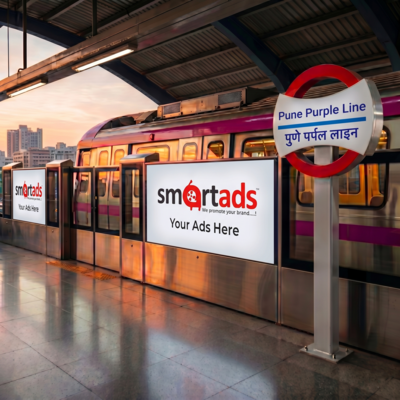
Pune's Purple Line carries somewhere in the range of 1.5 to 2 lakh daily commuters through 14 stations stretching from PCMC Bhavan in the north to Swargate in the south — and most brands still haven't figured out that this corridor is one of the most underpriced, high-attention advertising environments in the entire Pune Metropolitan Region. The audience is captive, the dwell time is real, and the formats available go far beyond what most media planners imagine when they hear the words "metro advertising." What we tell our clients at SmartAds is this: the Purple Line isn't just a transit corridor — it's a 23-kilometre brand channel that runs through the economic spine of Pune.
There's a version of out-of-home advertising that most brands are familiar with — the highway hoarding, the bus shelter panel, the mall facade. And then there's metro station advertising, which operates by a completely different set of rules. The fundamental difference is dwell time; a commuter driving past a hoarding on the Pune-Mumbai Expressway has perhaps three seconds of exposure, whereas a commuter waiting on the platform at Shivajinagar metro station has anywhere from four to eight minutes of enforced attention, with nowhere else to look. That's not a small distinction — it's the entire premise of why BTL advertising inside metro environments consistently outperforms traditional OOH advertising on brand recall metrics.
The Pune Purple Line, officially Line 1 of MahaMetro's Pune network, runs from PCMC Bhavan in Pimpri Chinchwad through to Swargate, connecting two of the most commercially active municipal jurisdictions in Maharashtra — the Pimpri Chinchwad Municipal Corporation zone and the Pune Municipal Corporation zone. This corridor passes through Khadki, Range Hills, Shivajinagar, Civil Court, Kasba Peth, and Mahatma Phule Mandai, which means it cuts through a cross-section of urban commuters that includes IT professionals, government employees, students, traders, and daily wage workers all sharing the same physical space. For a brand trying to reach working professionals in Pune without paying the premium rates that television or digital platforms demand, this is where the real value lies.
Our experience at SmartAds shows that brands often underestimate the non-traditional advertising potential of metro environments because they're comparing it to digital CPMs, which is the wrong benchmark entirely. Station branding on the Purple Line delivers what we would call 360-degree brand exposure — you're reaching the same commuter at the entry gate, on the escalator, at the platform, inside the train, and again at the exit — which creates a frequency of impression that no single digital touchpoint can replicate at a comparable cost. The FICCI-EY Media and Entertainment Report has consistently noted that transit advertising in Indian metros is growing at a faster clip than traditional OOH advertising, precisely because of this captive audience dynamic.
Not all 14 stations are created equal, and frankly speaking, this is where a lot of media plans go wrong — brands either book the cheapest stations or the most obvious ones, without understanding the actual footfall patterns and audience composition at each stop. The interchange stations are, predictably, the highest-traffic points; Civil Court metro station sits at the intersection of Line 1 (Purple) and Line 2 (Aqua), which makes it the single busiest node on the entire Pune metro network, with commuters transferring between lines, entering from the adjacent District Court complex, and connecting to the broader Deccan-Shivajinagar commercial belt.
Shivajinagar metro station deserves special attention from any brand targeting urban professionals and students, because it serves not just the Shivajinagar residential and commercial area but also draws footfall from Fergusson College Road, the Symbiosis cluster, and the Deccan Gymkhana neighbourhood — all of which are high-income, high-education-level catchment areas. Swargate metro station, at the southern underground terminus, is equally significant because it connects to one of Pune's busiest bus interchanges, which means the daily ridership at Swargate includes a large proportion of commuters from PMC's southern suburbs who are transferring between metro and bus. Khadki metro station is another station we frequently recommend to clients in the defence, education, and FMCG sectors, given its proximity to the Khadki Cantonment and the Khadki railway station interchange.
On the northern end, the PCMC Bhavan station and the Nashik Phata corridor stations serve the industrial and residential populations of Pimpri Chinchwad — which is a distinct audience from the Pune city commuters further south. The Dapodi and Kasarwadi stations sit in a zone that connects to the Dapodi railway station and the heavy industrial belt, which makes them relevant for brands targeting blue-collar and lower-middle-income urban commuters. What a lot of people miss is that the five underground stations — which include Kasba Peth, Mahatma Phule Mandai, and Swargate — have a structurally different advertising environment from the elevated stations; the enclosed, climate-controlled spaces create higher dwell time and better lighting conditions for backlit panels and digital screens, which translates directly into better brand visibility metrics.
The range of formats available for metro station advertising on the Pune Purple Line is considerably wider than most brands realise when they first approach us. At the most basic level, you have static backlit panels and unlit flex displays positioned at platforms, concourses, and entry/exit zones — these are the bread-and-butter of station branding and remain the most cost-accessible entry point for brands with modest budgets. But the format inventory goes considerably further than that; pillar branding, which involves wrapping the structural columns of elevated and underground stations in branded vinyl, is one of the most visually dominant formats available, because pillars are unavoidable — a commuter walking through the station simply cannot miss a fully branded pillar, which is why we consistently recommend it for brand awareness campaigns.
Escalator branding and staircase branding are formats that we have found to be chronically underbooked relative to their actual impact; the reason is simple — a commuter on an escalator is stationary for 20 to 45 seconds, facing a fixed direction, with nothing to do but read what's in front of them. That is arguably better dwell time than a television commercial. Lift branding works on a similar principle, particularly at stations with significant elderly and differently-abled commuter traffic. Entry gate branding, which involves branded panels or vinyl wraps on the AFC (Automatic Fare Collection) gate structures, is another high-frequency touchpoint because every single commuter passes through the entry gates — there is no way to avoid it, which makes it one of the highest-impression formats in the entire station environment.
For brands with larger budgets and longer campaign timelines, the more premium formats become available: full train branding, which wraps the exterior of entire train rakes in brand graphics, is the most visible format on the entire Purple Line network because the branded train travels through all 14 stations multiple times daily; interior train branding covers the panels, overhead spaces, and door surrounds inside the coaches, targeting the captive audience during the ride itself. Platform screen door branding, available at the underground stations, offers a premium static display opportunity that faces commuters waiting on the platform. DOOH (Digital Out-of-Home) screens at key stations including Civil Court and Shivajinagar metro station allow for dynamic content, multiple brand rotations, and time-of-day targeting, which brings metro station advertising considerably closer to the flexibility of digital advertising. Floor sticker advertising, metro card branding, and audio advertising through branded station announcements round out a format mix that, taken together, enables genuine 360-degree brand exposure within a single station environment.
This is the question every client asks first, and the honest answer is that purple line metro advertising rates vary quite significantly depending on the format, the station, the campaign duration, and the negotiation — but we can give you meaningful benchmarks. For a standard backlit panel at a mid-tier Purple Line station, the monthly cost works out to somewhere in the range of ₹8,000 to ₹18,000 per panel, which surprises most first-time advertisers when they compare it to what they're paying for equivalent reach on Instagram or Google Display. The premium stations — Civil Court metro station, Shivajinagar metro station, and Swargate metro station — command a premium of roughly 30 to 50 percent over mid-tier stations, which is entirely justified by the footfall differential.
Pillar branding, which is one of the most visually impactful formats, typically runs in the ballpark of ₹25,000 to ₹60,000 per pillar per month depending on size and location within the station, with the concourse-level pillars at interchange stations sitting at the higher end of that range. Digital screens, or DOOH placements, are priced differently because they're sold on a per-slot or per-rotation basis rather than exclusive display; a 10-second slot on a DOOH screen at a high-footfall station might cost somewhere between ₹15,000 and ₹40,000 per month for a fixed number of daily plays, which makes the effective CPM surprisingly competitive when you factor in the quality of the captive audience. Full train branding — the exterior train wrap — is a premium product that typically starts at roughly ₹3 to ₹5 lakh per month for a full rake, which sounds significant until you calculate how many station entries that branded train makes across a month of operations.
The advertising rates for escalator branding and lift branding are, in our experience, among the best value propositions in the entire Purple Line advertising inventory; a full escalator wrap at a busy station can be secured for somewhere in the range of ₹20,000 to ₹45,000 per month, which delivers what is effectively guaranteed dwell time that no other format can promise in quite the same way. Entry gate branding tends to be packaged as a station-level buy rather than individual units, with station packages at mid-tier stations starting around ₹40,000 to ₹80,000 per month. It's worth noting that MahaMetro periodically revises its rate cards, and the figures we've shared here are indicative benchmarks from our recent campaign experience — actual rates should be confirmed at the time of booking, and there is generally room for negotiation on multi-station or multi-month campaigns.
The demographic composition of Purple Line daily commuters is one of the strongest arguments for metro station advertising in Pune, and it's a story that the raw ridership numbers alone don't fully tell. The corridor from PCMC to Swargate passes through one of the highest concentrations of working professionals in the Pune Metropolitan Region; the Pimpri Chinchwad end of the line serves the auto-industrial belt — Tata Motors, Bajaj Auto, and their extensive vendor ecosystems — which means a significant proportion of northern-corridor commuters are skilled manufacturing workers, engineers, and middle-management professionals with stable incomes. As the line moves south through Khadki, Range Hills, and into Shivajinagar, the audience composition shifts toward IT professionals, government employees, defence personnel, and the student population associated with the university belt.
The underground stations from Kasba Peth through to Swargate serve the older commercial heart of Pune — the Mandai market area, the District Court complex, and the Swargate bus terminus — which brings in a different audience profile: traders, small business owners, legal professionals, and commuters from the southern suburbs of Pune. What this means for a media planner is that the Purple Line is not a homogeneous audience; it's a segmented corridor, and the smart approach is to match your creative and format selection to the station-level audience rather than running a uniform campaign across all 14 stations. A fintech advertising campaign, for instance, would be better concentrated at Shivajinagar metro station and Civil Court metro station, where the professional commuter density is highest; an FMCG metro advertising campaign targeting household decision-makers might find better traction at the Mandai and Swargate stations.
Income-level data from IRS (Indian Readership Survey) and NCCS classification studies consistently show that metro commuters in Tier-1 Indian cities skew toward SEC A and SEC B households, with a significant proportion of urban commuters in the 25-to-45 age bracket — which is precisely the demographic that edtech metro advertising, real estate advertising metro campaigns, and consumer electronics brands are chasing. The captive audience dynamic amplifies this; these are not passive scroll-past impressions, but active, physically present human beings who are in a relatively calm, non-distracted state compared to, say, driving or walking. That's a media environment that most brands, frankly speaking, are not fully exploiting.
The booking process for metro station advertising on the Pune Purple Line runs through MahaMetro (Maharashtra Metro Rail Corporation Limited), which is the governing authority that controls all advertising rights within the Pune metro network. The process is more structured than booking a traditional hoarding or a cinema screen, and it requires a bit more lead time — which is something we always flag early in our media planning conversations with clients. The standard lead time from initial inquiry to campaign go-live is typically somewhere between three and six weeks, depending on the format complexity and the volume of approvals in the pipeline at the time.
The documentation required for MahaMetro approval generally includes a formal application with campaign brief, brand/advertiser details, creative artwork in the specified format and resolution, a declaration of content compliance (MahaMetro has content guidelines that prohibit certain categories of advertising, including tobacco, alcohol, and politically sensitive content), and in some cases, a structural assessment certificate for three-dimensional or non-standard installations. The creative artwork must meet specific technical specifications — resolution, bleed margins, material specifications for vinyl and backlit media — which vary by format and are provided in MahaMetro's vendor guidelines. We have seen campaigns delayed by two to three weeks simply because the artwork was submitted in the wrong format or at insufficient resolution, which is an entirely avoidable problem if the production brief is set up correctly from the start.
At SmartAds, our campaign execution process includes a dedicated compliance and approvals track that runs parallel to the creative production track, so that by the time artwork is finalised, the approval paperwork is already in motion. For brands working through an authorised media buying agency, the process is considerably smoother because the agency maintains an existing relationship with MahaMetro's advertising division and understands the submission protocols. The minimum campaign duration for most Purple Line formats is 30 days, though some premium formats like full train branding and naming rights are typically contracted for a minimum of three months; co-branding and station naming rights, which are the longest-commitment formats, are negotiated directly with MahaMetro on a case-by-case basis.
The comparison between Purple Line metro advertising and Aqua Line advertising is one that comes up regularly in our media planning discussions, and the honest answer is that they serve somewhat different audience profiles despite both being part of the same Pune metro network. The Aqua Line (Line 2) runs from Vanaz in the west to Ramwadi in the east, passing through Baner, Aundh, Shivajinagar, and the Pune railway station corridor — which means its audience skews heavily toward the IT and BFSI professional segments concentrated in the western Pune tech corridor. The Purple Line, by contrast, covers the industrial-commercial-civic corridor from PCMC to Swargate, which gives it a broader, more socioeconomically diverse audience. The Aqua Line interchange at Civil Court metro station is the point where both audiences converge, which is precisely why that station commands the highest advertising rates on either line.
Against traditional out-of-home advertising — hoardings, bus shelters, wall wraps — metro station advertising on the Purple Line offers a fundamentally different value proposition. A hoarding on a busy Pune road like Fergusson College Road or the Pune-Nashik Highway delivers high-frequency impressions but very low dwell time; the effective attention window is measured in seconds. A backlit panel or pillar branding installation at Shivajinagar metro station, by contrast, is seen by the same commuter multiple times per week, for multiple minutes per exposure, in a relatively calm and uncluttered environment. The TAM AdEx data on OOH advertising effectiveness consistently shows that transit advertising environments outperform roadside hoardings on brand recall metrics, particularly for urban commuter audiences. The CPM for metro station advertising, when calculated against verified footfall data, is often lower than equivalent-reach hoarding campaigns in the same geography — which is a number that surprises most clients when we put it in front of them.
Hyperlocal advertising is another dimension where metro station advertising has a structural advantage over traditional OOH advertising; because each station has a defined catchment area, brands can target specific neighbourhoods or commercial zones with station-level precision that a hoarding network simply cannot replicate. A real estate advertising metro campaign for a project in Khadki, for instance, would target Khadki metro station and the adjacent Range Hills station specifically, reaching commuters who live or work within the project's natural catchment — which is a level of geographic precision that makes the media buying far more efficient.
The honest answer is that the Purple Line works for a wider range of brand categories than most people expect, but it works best for brands whose target customers are urban commuters in the 22-to-45 age bracket with regular transit habits. The category that has historically been most active in Pune metro advertising is real estate; the corridor from PCMC through Khadki to Shivajinagar passes through some of the most active residential development zones in the Pune Metropolitan Region, and developers have found that station branding at stations adjacent to their project locations drives measurable inquiry volume. We worked with a real estate developer in the Khadki-Dapodi belt who ran a six-week pillar branding and entry gate branding campaign at three Purple Line stations, and the campaign generated roughly 40 percent of the project's total inquiry volume during that period — a result that significantly outperformed their concurrent digital campaign on a cost-per-lead basis.
FMCG metro advertising is another category where we've seen strong results on the Purple Line, particularly for brands in the food, personal care, and household products segments targeting the mass-market urban commuter. The Mandai and Swargate stations, which serve the trading and lower-middle-income commuter population, are particularly effective for FMCG brands with broad demographic appeal. Fintech advertising metro campaigns — mobile wallets, UPI payment apps, insurance aggregators, and neo-banking products — have been among the most active categories on the Purple Line in recent years, driven by the high smartphone penetration and digital payment adoption among the working professional commuter base. Edtech metro advertising has also grown significantly, with test-prep platforms, upskilling apps, and professional certification courses targeting the student and early-career professional segments concentrated at the Shivajinagar and Civil Court stations.
Sampling and demonstrations are a format category that is often overlooked in metro advertising discussions but which MahaMetro does permit at designated station zones under specific approval conditions; we have executed activation campaigns for FMCG and personal care brands at Purple Line stations where the combination of static station branding and live sampling created a significantly higher brand recall outcome than either element would have achieved independently. The key is planning the activation well in advance and securing the necessary permissions from MahaMetro, which typically requires an additional approval track beyond the standard advertising application. Seasonal campaign timing also matters more on the Purple Line than most brands account for; ridership spikes significantly during Ganesh Chaturthi, Diwali, and the summer school admission season, which are the windows when campaign investment on the Purple Line delivers the highest return.
ROI measurement for metro station advertising is an area where a lot of brands either give up entirely — deciding it's "unmeasurable" — or rely on vanity metrics like impression counts that don't connect to business outcomes. Neither approach is satisfactory, and frankly speaking, the measurement toolkit available for Purple Line metro advertising has improved considerably over the past two to three years. The starting point is always verified footfall data; MahaMetro publishes daily ridership figures, and the station-level footfall estimates used in media planning are derived from these figures combined with entry/exit gate data, which gives a reasonably accurate basis for calculating total impressions and reach.
Beyond raw impressions, the most reliable ROI measurement approaches we use at SmartAds involve a combination of brand recall surveys, geo-tagged campaign monitoring, and digital integration. Brand recall surveys — conducted with commuters at the station or through mobile panels — provide a direct measure of whether the campaign is registering with the target audience; a well-executed station branding campaign on the Purple Line typically achieves aided recall rates in the range of 60 to 75 percent among regular commuters, which is considerably higher than the recall rates for comparable digital display campaigns. Geo-tagged campaign monitoring, which uses mobile location data to identify devices that have been physically present at the advertised stations and then tracks their subsequent digital behaviour, allows brands to connect metro advertising exposure to downstream actions like website visits, app downloads, or store visits — which is where the lead generation story becomes quantifiable.
QR code integration is a practical tool that we consistently recommend for Purple Line metro campaigns because it creates a direct, measurable bridge between the physical advertising environment and digital conversion; a commuter who scans a QR code on a platform panel or escalator branding is expressing active intent, which is a far more valuable signal than a passive impression. One edtech client we worked with ran a two-month campaign combining backlit panels at four Purple Line stations with QR codes linking to a free trial offer; the campaign generated over 2,200 QR code scans, which converted at a rate of roughly 18 percent to free trial sign-ups — a cost-per-acquisition that was significantly lower than their Google Search campaigns during the same period. That's the kind of number that makes the ROI conversation with management considerably easier.
The Katraj extension is, in our view, one of the most significant upcoming developments in Pune metro advertising, and brands that start planning for it now will have a meaningful first-mover advantage when the new stations come online. The Purple Line extension southward from Swargate toward Katraj is expected to add several new stations — including Market Yard, Padmavati, and Katraj — which will extend the corridor into some of Pune's most densely populated residential and commercial neighbourhoods. Market Yard, in particular, is one of the largest agricultural produce markets in Maharashtra, with enormous daily footfall from traders, transporters, and buyers; a metro station at Market Yard would create an advertising environment unlike anything currently available on the Purple Line, with a unique audience profile that would be highly relevant for agricultural input brands, logistics companies, and financial services targeting the trading community.
The Padmavati and Katraj stations, if developed as planned, will serve the rapidly growing southern residential belt of Pune — an area that has seen significant real estate development over the past decade and is home to a large population of middle-income families and first-generation urban professionals. This demographic is precisely the audience that FMCG metro advertising, consumer durables, and financial products are targeting, and the extension will bring these commuters into the metro advertising ecosystem for the first time. The Katraj extension will also increase the total daily ridership on the Purple Line, which will improve the economics of station branding across the entire corridor — including at the existing 14 stations — by increasing the frequency with which the same commuter encounters branded environments.
What we tell clients who are thinking about long-term brand building in Pune is that the time to establish a presence on the Purple Line is before the extension opens, not after; the brands that build recognition with the existing commuter base will carry that awareness advantage into the expanded network. The non-traditional advertising landscape in Pune is evolving quickly, and the metro network is at the centre of that evolution; the Pink Line (Line 3), which is currently under construction, will add another dimension to the transit advertising matrix when it becomes operational, potentially creating multi-line campaign opportunities that don't yet exist. For now, the Purple Line from PCMC to Swargate remains the primary transit advertising artery in Pune, and it is, in our considered opinion, significantly undervalued relative to the audience quality it delivers.
We've run enough campaigns on the Purple Line to have a clear sense of what works, what doesn't, and where the real surprises are. One campaign that stands out involved a fintech startup — a digital lending platform targeting salaried professionals — which came to us with a modest budget of roughly ₹8 lakh for a two-month campaign. We recommended concentrating the spend at three high-footfall stations: Civil Court metro station, Shivajinagar metro station, and Khadki metro station, using a combination of pillar branding, backlit panels, and digital screens. The campaign ran through a peak commuter season, and the brand tracked app downloads and loan application initiations through UTM-tagged QR codes on the station creatives; over the two-month period, the campaign drove approximately 3,400 app installs that were directly attributable to metro station exposure, at a cost-per-install that was roughly 35 percent lower than their concurrent performance marketing campaigns on Meta.
A second campaign that illustrates the hyperlocal advertising potential of the Purple Line involved a residential real estate developer launching a project in the Dapodi-Kasarwadi micro-market. Rather than running a city-wide hoarding campaign, we recommended a concentrated metro station advertising buy at the three stations closest to the project site, combined with interior train branding on the Purple Line rakes. The logic was straightforward: commuters who regularly travel through Dapodi and Kasarwadi are, by definition, already familiar with the neighbourhood and more likely to be interested in a residential project there. The three-month campaign generated over 1,100 site visit inquiries, of which roughly 28 percent cited the metro advertising as their first point of contact with the brand — a brand recall and lead generation outcome that significantly exceeded the developer's projections.
A third case involved an FMCG brand in the packaged foods category that was launching a new product variant targeting the urban working professional segment. The campaign used a combination of station branding at six Purple Line stations, sampling and demonstrations at Shivajinagar metro station and Civil Court metro station on two consecutive weekends, and floor sticker advertising at the underground stations. Post-campaign brand recall surveys showed that 68 percent of surveyed commuters who regularly used the Purple Line could recall the brand unprompted — which is a top-of-mind awareness metric that the brand's digital campaigns, running simultaneously, could not come close to matching on a per-rupee basis. These are the kinds of outcomes that make metro station advertising on the Purple Line a genuinely compelling media buy, not just an interesting experiment.
Q: What is metro station advertising on the Pune Purple Line?
Metro station advertising on the Pune Purple Line refers to the placement of brand communications — in static, digital, or experiential formats — within the 14 stations of MahaMetro's Line 1, which runs from PCMC Bhavan in Pimpri Chinchwad to Swargate in central Pune. It is a form of BTL advertising and transit advertising that targets the captive audience of daily commuters, offering formats ranging from backlit panels and pillar branding to full train branding, DOOH screens, and live activations. The Purple Line is operated by Maharashtra Metro Rail Corporation Limited (MahaMetro), which controls all advertising rights and approvals within the network.
Q: Which are the best stations on the Purple Line for high-footfall advertising?
Civil Court metro station is the highest-footfall station on the Purple Line because it serves as the interchange with the Aqua Line, effectively doubling the audience pool at that node. Shivajinagar metro station ranks second for its catchment of urban professionals, students, and commercial visitors from the Deccan-Shivajinagar belt. Swargate metro station is significant for its bus interchange connectivity, which brings in commuters from the southern suburbs of Pune, while Khadki metro station serves both the cantonment population and the Khadki railway station interchange traffic. On the northern end, PCMC Bhavan station and Nashik Phata serve the Pimpri Chinchwad industrial and residential population, which is a distinct and commercially valuable audience segment.
Q: What ad formats are available for metro station advertising on the Pune Purple Line?
The format inventory at Purple Line stations includes backlit panels, unlit flex displays, pillar branding, escalator branding, staircase branding, lift branding, entry gate branding, platform screen door branding, floor sticker advertising, DOOH digital screens, interior train branding, exterior train wrap (full train branding), metro card branding, and audio advertising through branded station announcements. The availability of specific formats varies by station, with the underground stations offering platform screen door branding and the elevated stations offering different pillar configurations. Premium formats like full train branding and station naming rights or co-branding are available through direct negotiation with MahaMetro.
Q: How much does it cost to advertise at a Pune Purple Line metro station?
Advertising rates vary by format and station tier. Standard backlit panels at mid-tier stations run roughly ₹8,000 to ₹18,000 per panel per month; premium stations like Civil Court and Shivajinagar command a 30 to 50 percent premium. Pillar branding is in the ballpark of ₹25,000 to ₹60,000 per pillar per month; escalator and lift branding runs somewhere between ₹20,000 and ₹45,000 per station per month. DOOH screen slots at high-footfall stations range from roughly ₹15,000 to ₹40,000 per month for a fixed daily play rotation. Full train branding (exterior wrap) typically starts at around ₹3 to ₹5 lakh per month per rake. These are indicative benchmarks; actual rates should be confirmed with MahaMetro or through an authorised media buying agency at the time of booking.
Q: What is the minimum quantity and duration for booking Purple Line metro station ads?
The minimum campaign duration for most standard formats is 30 days, though some premium formats like full train branding and co-branding arrangements require a minimum commitment of three months. There is no fixed minimum quantity for static formats — a brand can book a single panel at a single station — but multi-station and multi-format packages offer significantly better value and are what we typically recommend for brands seeking meaningful reach and frequency. For activations and sampling and demonstrations, minimum durations and zone restrictions apply and are governed by MahaMetro's activation guidelines.
Q: Who approves metro station advertising on the Pune Purple Line?
All advertising on the Pune Purple Line is approved by MahaMetro — Maharashtra Metro Rail Corporation Limited — which manages the advertising rights for the entire network. Applications must be submitted with creative artwork, brand details, and content compliance declarations; MahaMetro reviews submissions against its content policy, which prohibits tobacco, alcohol, politically sensitive, and certain other content categories. The approval timeline is typically two to four weeks for standard formats, and longer for non-standard or three-dimensional installations. Working through an authorised media buying agency in Pune that has an established relationship with MahaMetro's advertising division significantly streamlines this process.
Q: What permissions are required from MahaMetro for metro advertising in Pune?
Beyond the standard advertising application, brands may need structural assessment certificates for three-dimensional or heavy installations, fire safety compliance documentation for certain materials, and specific activation permits for live events, sampling and demonstrations, or audio advertising. All creative content must comply with MahaMetro's advertising guidelines, which are aligned with the Advertising Standards Council of India (ASCI) code. For co-branding and naming rights, a separate commercial agreement with MahaMetro is required, which involves a more detailed approval process and typically a longer lead time.
Q: What is the daily ridership and reach for the Pune Purple Line?
The Pune Purple Line carries an estimated 1.5 to 2 lakh daily commuters across its 14 stations, with ridership continuing to grow as the network matures and urban commuter habits shift. The total monthly reach — accounting for the fact that regular commuters encounter station advertising multiple times per week — is considerably higher than the raw daily ridership figure suggests, because the same audience is exposed to the same campaign repeatedly, building frequency and brand recall over the campaign period. MahaMetro publishes periodic ridership updates, and station-level footfall estimates are available through MahaMetro's advertising division and authorised media buying agencies.
Q: How is metro station advertising on the Purple Line different from train branding?
Metro station advertising refers to placements within the station environment — platforms, concourses, entry zones, escalators, pillars — while train branding refers to placements on or inside the train rakes themselves. The key difference is audience exposure pattern; station advertising reaches commuters who are stationary and waiting, with higher dwell time per impression, while train branding — particularly exterior train wrap — reaches audiences at every station the train passes through, including people on the platform who are not boarding that train. Interior train branding targets the captive audience during the journey itself. The two categories are complementary rather than competitive, and the most effective Purple Line campaigns typically combine both.
Q: Can small businesses and startups advertise at Pune Purple Line stations?
Yes, and in our experience, the Purple Line is one of the most accessible high-quality advertising environments for small businesses and startups in Pune, precisely because the entry-level formats — single backlit panels, small-format pillar wraps — are available at rates that are competitive with or lower than equivalent-reach digital campaigns. A startup with a monthly advertising budget of ₹50,000 to ₹1 lakh can run a meaningful station br
