
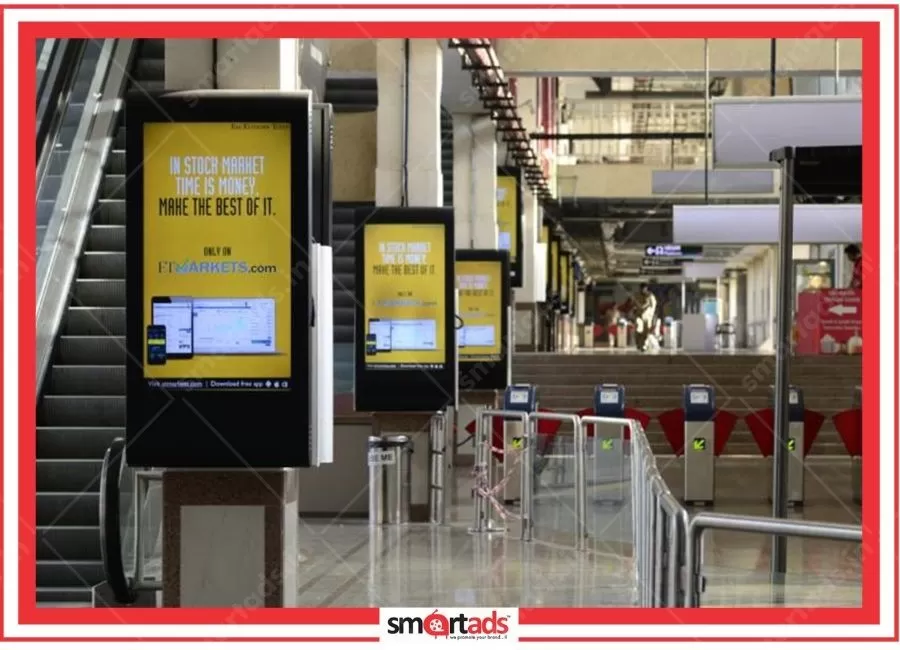
Entry Exit Panel
8 ft x 4 ft
Bright and vibrant multicolored letterin
Rate per Panel / Month
Min Requirement is 3 Panel.
₹48000.00
Showing 1 to 4 of 4 Results
MEDIA DETAILS
8 ft x 4 ft
Bright and vibrant multicolored letterin
Rate per Panel / Month
Min Requirement is 3 Panel.
₹48000.00
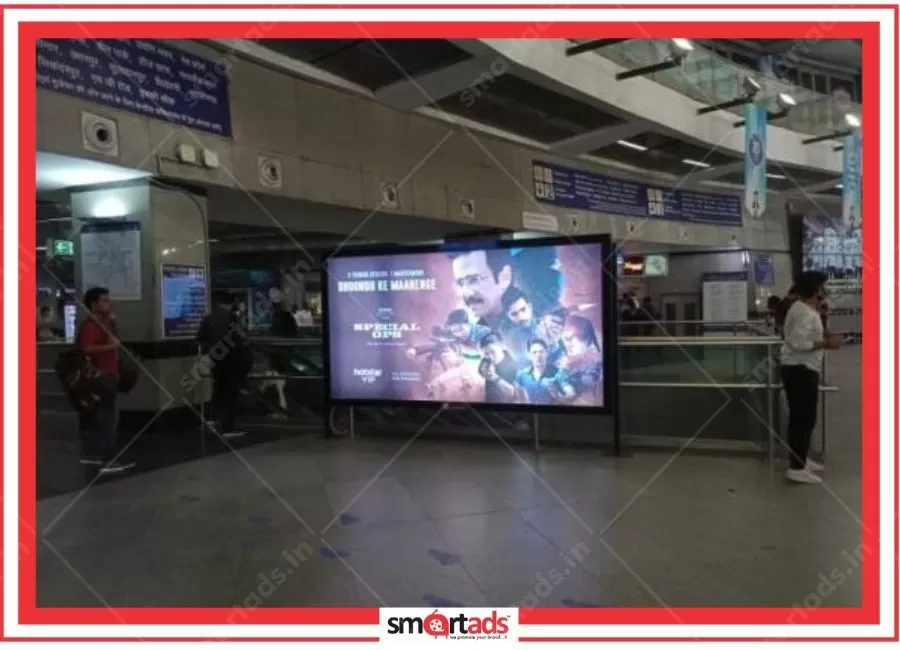
10 ft x 5 ft
A new wide wall system designed to accom
Rate per Panel / Month
Min Requirement is 3 Panel.
₹50000.00
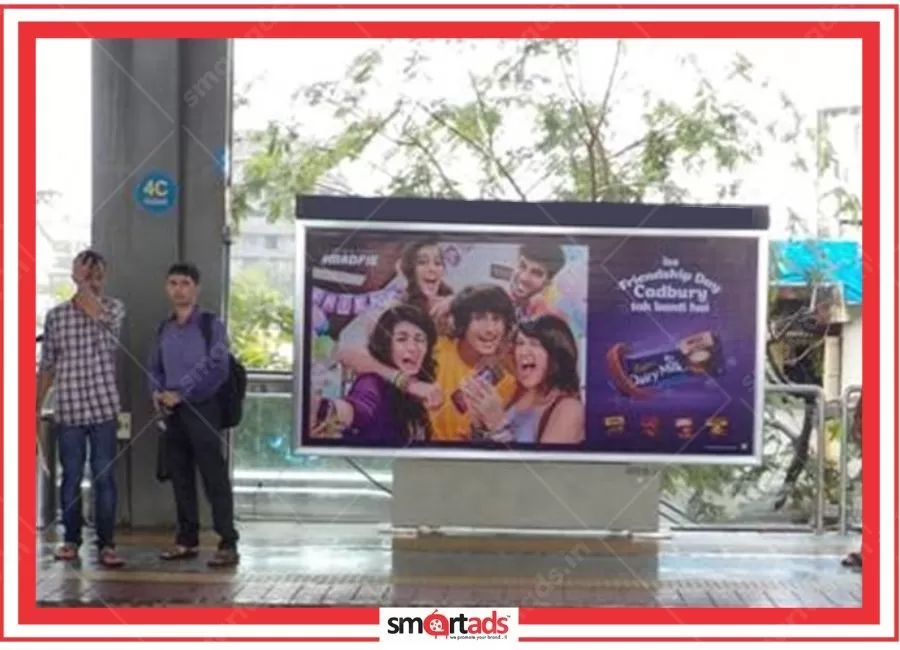
8 ft x 4 ft
A raised flooring or other horizontal su
Rate per Panel / Month
Min Requirement is 3 Panel.
₹35000.00
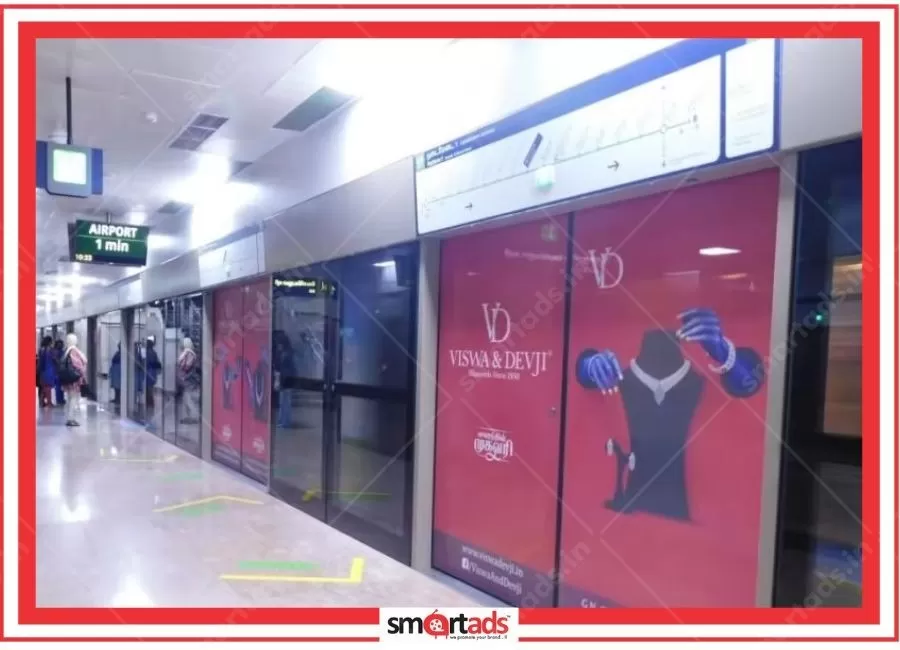
7 ft x 4 ft
Also known as platform edge doors (PEDs)
Rate per Plateform / Month
Min Requirement is 1 Stations.
₹1200000.00
MEDIA REACH

MinimumQty :
10
EstimateReachPeople :
15 Million
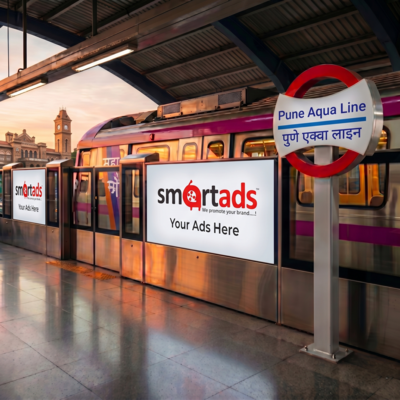
Pune's metro is moving faster than most advertisers realise — and the brands that figured this out early are quietly building some of the strongest urban recall numbers we have seen outside of Mumbai in the last three years. The Aqua Line, connecting Pimpri-Chinchwad to Swargate through the heart of Pune's commercial and residential spine, carries a captive, upwardly mobile audience that most outdoor campaigns simply cannot reach with the same precision or dwell time.
Frankly speaking, most brands still think of Pune outdoor advertising as hoardings on the Pune-Mumbai Expressway or unipoles along FC Road — and that instinct is understandable, because those formats have been around for decades. But the Aqua Line changes the equation in a way that static roadside formats cannot, because the audience is not passing by at 60 kilometres per hour; they are standing on a platform, waiting, scrolling, looking around, and — this is the part that matters most — they are doing this every single day on the same route.
The Aqua Line currently spans from PCMC station in Pimpri-Chinchwad down through stations like Kasarwadi, Phugewadi, Dapodi, Bopodi, Khadki, Range Hills, Shivajinagar, Civil Court, Budhwar Peth, Mandai, and Swargate, which means a single campaign placed across key stations touches both the manufacturing and IT workforce in the north and the commercial and retail heartland in the south. What we tell our clients at SmartAds is that this corridor is essentially a cross-section of Pune's working population — and that is not a claim you can make about most single OOH placements in the city. The dwell time at a metro station, which averages somewhere between four and eight minutes depending on peak versus off-peak hours, is simply not comparable to a roadside hoarding that gets a two-second glance.
Our experience shows that advertisers who approach metro station advertising with the same mindset as a highway hoarding tend to underutilise the format. The Aqua Line audience is not just seeing your creative; they are reading it, processing it, and in many cases pulling out their phones to act on it — which is a behaviour pattern we have tracked across multiple campaigns where QR code scans were used as a conversion metric.
Not all stations are created equal, and this is where a lot of independent media buyers get the allocation wrong. Shivajinagar station, for instance, sits at one of Pune's most critical interchange points — it connects commuters heading to the old city, the university area, and the central business district, which makes it consistently one of the highest-footfall stations on the entire line. Pimpri and PCMC stations, on the other hand, serve a very different audience: the industrial and manufacturing workforce of the Pimpri-Chinchwad Municipal Corporation area, which is home to companies across automotive, engineering, and pharma sectors.
Civil Court and Budhwar Peth stations draw a mix of legal professionals, traders, and daily commuters from the densely populated older parts of the city; Swargate, as the southern terminus, functions almost like a transit hub where passengers transfer to buses and autos, which means the dwell time there tends to be longer than at intermediate stations. Mandai station is particularly interesting for FMCG and grocery brands because of its proximity to one of Pune's largest wholesale vegetable markets — a detail that most generic OOH plans would never factor in, but which can make a meaningful difference in message relevance.
At SmartAds, we always tell our clients that station selection should be driven by audience-to-message fit, not just footfall numbers in isolation. A luxury real estate brand, for example, would be better served concentrating spend at Shivajinagar and Range Hills rather than spreading thinly across every station; conversely, a mass-market FMCG brand looking for sheer volume of impressions would do well to anchor at PCMC, Pimpri, Dapodi, and Swargate simultaneously. The footfall data published by Pune Metro Rail Corporation (Maha-Metro) gives a reasonable baseline, but the real intelligence comes from understanding who those footfalls are — which is something our on-ground planning team maps before recommending any station mix.
The format variety inside a metro station environment is genuinely wider than most advertisers expect when they first enquire. Platform screen door panels — those large-format backlit panels positioned directly at eye level as trains arrive and depart — are arguably the most premium inventory on the Aqua Line, because they are impossible to avoid; every passenger waiting on the platform is looking directly at them as the train pulls in. Concourse-level lightboxes, which are positioned in the entry and exit zones, catch commuters at the moment they are transitioning between the outside world and the metro environment, which tends to be a moment of slightly higher attentiveness.
Pillar wraps are a format that we have found to be consistently underestimated — a well-designed pillar wrap at a busy station like Shivajinagar creates a 360-degree brand environment that passengers walk through rather than past, which is a fundamentally different brand experience from a flat panel. Ticket counter surrounds and entry gate branding are particularly effective for brands that want to associate themselves with the act of commuting itself — financial services brands, transit apps, and daily-use consumer products tend to perform well in these placements. Digital screens, which are now present at most major Aqua Line stations, allow for time-of-day targeting and creative rotation, which opens up possibilities for brands running multiple messages or time-sensitive offers.
Train body wraps — where the exterior of an entire metro train is branded — represent the most visible format on the network, because the train travels between stations and is seen by road users, pedestrians, and other commuters across the entire corridor. One automotive brand we worked with used a full train wrap on the Aqua Line alongside station panels at five key stations; the combination created a frequency and scale that their standalone hoarding campaign in Pune had never achieved, and the brand recall scores in post-campaign research came back roughly 40 percent higher than their benchmark from the previous quarter's hoarding activity.
This is the question that comes up in every first conversation, and to be honest, the answer is more nuanced than a simple rate card. Platform screen door panels at premium stations like Shivajinagar work out to somewhere in the ballpark of ₹80,000 to ₹1.5 lakh per panel per month, depending on the station tier, the panel position, and whether the inventory is booked directly through Maha-Metro's concessionaire or through an agency that has negotiated bulk rates. Concourse lightboxes tend to be priced somewhat lower — roughly ₹40,000 to ₹80,000 per month per unit — which makes them an attractive option for brands working with tighter budgets but still wanting the metro environment.
Digital screen slots, which are sold in time blocks rather than as exclusive monthly placements, can be accessed for considerably less; a 10-second slot running across a daypart at a single station might work out to somewhere between ₹15,000 and ₹35,000 per month depending on the frequency of rotation, which is a number that surprises most first-time metro advertisers when they compare it to what they are paying for equivalent digital out-of-home in Mumbai or Bengaluru. Train body wraps are a different category entirely — a full train wrap on the Aqua Line is typically priced in the range of ₹8 lakh to ₹15 lakh per month, which sounds significant until you calculate the number of impressions generated across the entire corridor over 30 days, at which point the CPM often comes out more favourably than many premium hoarding locations in Pune.
What a lot of people miss is that metro advertising rates are almost always negotiable when booked through an experienced media buying agency, particularly for multi-station campaigns or longer booking periods. We have consistently secured 15 to 25 percent better effective rates for clients who commit to three-month or six-month campaigns compared to month-on-month bookings — and that saving, compounded across a multi-format plan, can fund additional creative production or a supporting digital layer without increasing the overall budget.
The demographic profile of Pune Metro's Aqua Line ridership is something that most brands find genuinely encouraging when they see the data. The core ridership skews toward the 22-to-45 age bracket, which aligns with the working-age population of Pimpri-Chinchwad's industrial zones and Pune's expanding IT and services sector; the SEC A and B concentration is notably higher than what you would find on a typical city bus route, which makes the format relevant for a wider range of product categories than conventional mass transit advertising. The FICCI-EY Media and Entertainment Report has consistently highlighted metro rail as one of the fastest-growing out-of-home sub-categories in India, and the ridership data from Maha-Metro suggests that the Aqua Line has been adding daily ridership at a pace that outstrips initial projections.
Female ridership on the Aqua Line is also meaningfully higher than on many other transit formats in Pune, partly because of the perceived safety and reliability of metro travel — which makes the network particularly relevant for categories like personal care, financial services, education, and retail fashion. Students travelling to colleges in the Shivajinagar and Deccan areas form a distinct sub-segment, particularly relevant for edtech, food delivery, and lifestyle brands. A retail client in Pune that we worked with — a mid-market apparel brand targeting women aged 25 to 40 — ran a three-month campaign anchored at Shivajinagar and Civil Court stations, and the footfall tracking data from their nearest stores showed a measurable uplift in walk-ins during the campaign period, which they attributed at least partially to the metro station exposure.
The thing is, metro audiences are also disproportionately smartphone-active compared to the general urban population; the combination of commute time, reliable mobile connectivity inside metro stations, and the habit of checking phones while waiting creates a natural bridge between an out-of-home impression and a digital follow-up action. This is why we recommend that brands running Aqua Line campaigns always have a parallel digital layer — whether that is social media retargeting, search advertising, or performance display — to capture the intent that the metro creative generates.
Pune has a genuinely competitive OOH market — the city's hoarding inventory along key corridors like Baner Road, Aundh, Viman Nagar, and Koregaon Park is well-established, and rates on premium locations can be steep. A large-format hoarding on Baner Road, for instance, might cost somewhere between ₹1.5 lakh and ₹3.5 lakh per month, which delivers visibility to vehicular traffic but with the significant limitation of a very short exposure window — most drivers and passengers process a roadside hoarding in under three seconds. The metro station environment, by contrast, delivers that four-to-eight-minute dwell time we mentioned earlier, which is a fundamentally different quality of attention even if the absolute impression numbers look similar on paper.
Bus shelter advertising in Pune, which is managed through the PMPML network, offers broad geographic coverage at relatively lower cost — typically in the range of ₹8,000 to ₹25,000 per shelter per month — but the audience quality and environment are considerably less controlled than a metro station. Shopping mall advertising in Pune's major malls offers a premium environment with good dwell time, but the reach is geographically concentrated and the cost-per-thousand can be high for brands seeking city-wide coverage. The Aqua Line sits in an interesting middle ground: it offers the environmental quality and dwell time of mall advertising combined with the geographic corridor coverage of outdoor formats, which is a combination that is difficult to replicate through any single alternative format.
We have seen this comparison play out most clearly in the automotive category, where test drive enquiry campaigns need both visibility and a degree of audience quality assurance. One two-wheeler brand we worked with ran a split test — half their Pune budget went into traditional hoardings and half into a metro station package on the Aqua Line; the cost-per-enquiry from the metro component came in roughly 30 percent lower than from the hoarding component, which was a result that surprised even the brand's own marketing team and led to a significant reallocation in the following quarter.
Not every campaign objective is equally well-served by metro station advertising, and being honest about this is something we consider part of giving clients good advice. Brand awareness and recall campaigns are almost perfectly suited to the format — the repeated daily exposure that a regular commuter gets to a well-placed station panel creates a frequency of contact that builds brand memory in a way that is difficult to achieve through sporadic media touchpoints. Product launches, particularly in the consumer goods, financial services, and real estate categories, benefit enormously from the metro environment because the audience is in a relatively receptive state and the creative has enough time to communicate a substantive message.
Promotional campaigns with a specific call to action — a QR code, a short URL, or a phone number — also perform well in the metro environment, particularly on digital screens where the creative can rotate and reinforce the message across multiple exposures during a single commute. What we have found less effective is hyper-localised tactical advertising that requires very precise geographic targeting below the station level; in those cases, hyperlocal digital formats or on-ground activations tend to serve the objective better. Event advertising, however, is one of the strongest use cases — concerts, exhibitions, and cultural events at venues along the Aqua Line corridor have used metro station advertising with very high efficiency, because the audience is already in the habit of using the metro to reach those venues.
At SmartAds, our experience shows that the campaigns which perform best on the Aqua Line are the ones where the creative is designed specifically for the metro environment rather than adapted from a television or print execution. The aspect ratios, the reading distance, the ambient light conditions, and the dwell time dynamics of a metro station are all different from other media environments; a creative that was built for a 30-second television spot will almost never translate effectively to a platform screen door panel without significant reworking.
The booking process for Aqua Line advertising runs through Maha-Metro's authorised concessionaires, which are the entities that hold the advertising rights for different station zones and formats. Direct booking is technically possible for large advertisers, but the process involves navigating multiple approval layers, format specifications, and production requirements that can be time-consuming without prior experience. Most brands find it considerably more efficient to work through an agency that already has established relationships with the concessionaires and understands the inventory availability cycle — particularly for premium formats like platform screen door panels, which tend to be booked out several months in advance at high-footfall stations.
The lead time for a metro station campaign on the Aqua Line is typically somewhere between three and six weeks from booking confirmation to live display, accounting for creative approval, production, and installation. Creative specifications vary by format — platform panels have specific size and resolution requirements, digital screens have file format and duration constraints, and train wraps require a detailed technical brief from the concessionaire before production can begin. Getting these specifications wrong at the production stage is one of the most common and avoidable sources of delay and cost overrun that we see in campaigns booked without proper agency support.
Payment terms with Maha-Metro's concessionaires typically require a portion of the campaign value upfront — usually somewhere between 50 and 100 percent depending on the campaign size and the client's relationship history. For first-time metro advertisers, building in adequate lead time and working with an agency that can provide production guidance alongside media buying is genuinely important; we have seen campaigns delayed by two to three weeks simply because the creative files were submitted in the wrong format, which is a frustrating and entirely preventable outcome.
Measurement is the area where metro advertising has historically lagged behind digital formats, and it is worth being direct about that. Traditional metro station advertising does not come with the click-through rates and conversion dashboards that digital marketers are accustomed to; the primary measurement tools are reach and frequency estimates based on ridership data, brand recall studies, and — increasingly — mobile location data that can track device movements through metro stations and correlate them with downstream digital behaviour.
The Outdoor Advertising Confederation of India (OAAI) and various research bodies have been working on standardised measurement frameworks for transit OOH, and the use of mobile data panels to validate reach figures is becoming more common in Indian OOH measurement. For campaigns where a direct response mechanism is included — a QR code or a unique URL — the measurement becomes considerably more tractable; we have run campaigns where QR code scan rates from metro station panels have been tracked in real time, providing a daily performance signal that allows for creative optimisation mid-campaign. One edtech brand we worked with on the Aqua Line used a dedicated landing page URL printed on their concourse lightbox panels; over a six-week campaign, the URL generated a volume of organic visits that the brand's analytics team was able to isolate and attribute to the metro campaign with reasonable confidence.
The honest reality is that metro station advertising, like most brand-building media, delivers its strongest return when it is part of an integrated campaign where the total effect is measured rather than trying to isolate the contribution of a single format. The GroupM TYNY Report and the Dentsu e4m Report both consistently highlight the multiplier effect of combining out-of-home with digital media — and our own campaign data supports this; brands that run coordinated metro and digital campaigns in Pune typically see awareness and consideration metrics move more than brands running either format in isolation.
Q: What is the minimum budget required to run a metro station advertising campaign on the Pune Aqua Line?
The minimum viable investment depends heavily on what you are trying to achieve and which formats you are considering. A single concourse lightbox at a mid-tier station for one month can be accessed for somewhere in the range of ₹40,000 to ₹60,000, which makes the format accessible even for smaller brands or localised campaigns. However, a campaign that is designed to generate meaningful reach and frequency across the corridor — which is what most brand-building objectives require — would more realistically need a budget in the range of ₹3 lakh to ₹8 lakh for a month-long multi-station, multi-format package. What we tell clients who are working with tighter budgets is to concentrate spend at one or two high-footfall stations rather than spreading thinly across the entire line; depth of presence at Shivajinagar or PCMC will almost always outperform a diluted presence across eight stations at the same total spend.
Q: Can small and medium-sized businesses advertise on the Pune Aqua Line, or is it only for large national brands?
This is a question we get asked more often than you might expect, and the answer is genuinely yes — metro station advertising on the Aqua Line is accessible to SMEs, not just large national advertisers. The format mix includes options at various price points, and a local business with a strong geographic concentration along the Aqua Line corridor — a real estate developer in Pimpri-Chinchwad, a retail chain with stores near Shivajinagar, an educational institution near Civil Court — can build very targeted campaigns that are highly efficient relative to their reach. The key for SMEs is to work with an agency that can negotiate appropriately and help with creative production, because the production requirements for metro formats are more demanding than for a newspaper or radio ad, and getting the creative right is essential to making the media spend work.
Q: How far in advance should a campaign on the Pune Aqua Line be booked, especially for peak periods?
Premium inventory — particularly platform screen door panels at Shivajinagar, PCMC, and Swargate — gets booked out quickly, and during high-demand periods like the festive season (October to December), the period around major Pune events, and the January-March quarter when many brands are spending their annual budgets, availability can become genuinely constrained. Our strong recommendation is to plan at least eight to twelve weeks ahead for premium formats during these periods. For digital screen slots and concourse lightboxes at mid-tier stations, the lead time requirement is somewhat shorter — four to six weeks is usually sufficient — but even here, leaving it to the last moment carries the risk of getting less desirable positions or time slots. The brands that consistently get the best inventory on the Aqua Line are the ones that plan their annual OOH calendar in advance and hold options on premium positions before the peak booking season begins.
Q: Is it possible to run a campaign only during specific times of day on the Aqua Line, and does that affect pricing?
Time-of-day targeting is available on the Aqua Line's digital screen network, which allows brands to concentrate their message during morning peak hours (roughly 8 to 10 AM), evening peak hours (roughly 6 to 9 PM), or specific dayparts that align with their audience's commute patterns. This is a capability that static formats — lightboxes, platform panels, pillar wraps — obviously do not offer, since they are displayed continuously throughout the day. The pricing for digital screen daypart targeting reflects the demand for peak slots; morning and evening peak slots are priced at a premium compared to off-peak daytime or late-evening slots, which can actually create interesting opportunities for brands whose audience is active during non-peak hours — a food delivery brand targeting late-evening commuters, for instance, might find that off-peak digital slots on the Aqua Line represent excellent value relative to their audience timing.
Q: What kind of creative works best in the metro station environment on the Aqua Line?
The creative principles that work in the metro environment are somewhat different from other media, and this is a point we feel strongly about because we have seen well-funded campaigns underperform simply because the creative was not built for the context. The most effective metro station creatives tend to have a single, clear visual hierarchy — one dominant image or message that can be absorbed in two to three seconds by a commuter who is moving through the concourse, while also rewarding the longer dwell time of a platform-waiting passenger with more detail. High contrast, large typography, and minimal copy density are almost always the right direction; a creative that tries to communicate five product features will lose to a creative that communicates one compelling idea with confidence. Localisation matters enormously on the Aqua Line — references to Pune landmarks, local cultural moments, or even Marathi language elements have consistently outperformed generic national creatives in the campaigns we have run, because they signal to the audience that the brand understands their context.
Q: How does metro station advertising on the Aqua Line integrate with digital marketing campaigns?
The integration between metro station advertising and digital marketing is, frankly, one of the most exciting strategic opportunities that the Aqua Line presents. The most straightforward integration is through QR codes on static panels or digital screens that drive directly to a landing page, an app download, or a product page — and the metro environment, where passengers have their phones in hand and a few minutes to spare, is one of the better out-of-home contexts for QR code engagement. Beyond direct response, the more sophisticated integration involves using mobile location data to build custom audiences of people who have been detected at Aqua Line stations, and then retargeting those audiences with coordinated digital advertising across social media and programmatic display. This kind of OOH-to-digital audience bridging is becoming more available in the Indian market through data platform providers, and we have used it with good results for clients who want to close the measurement loop between their metro investment and downstream digital conversions.
The Pune Metro Aqua Line is not a novelty format or a prestige buy for brands that want to appear innovative — it is, at this point, a mature and measurable component of a serious Pune media plan, which is a status that it has earned through consistent ridership growth and a demonstrated ability to deliver quality audiences at competitive CPMs. The corridor it covers is not peripheral to Pune's economic activity; it runs through the industrial heartland of Pimpri-Chinchwad, the commercial centre of Shivajinagar, and the historic trading districts of Budhwar Peth and Mandai, which means a well-planned Aqua Line campaign touches the city's economic life at multiple points rather than at a single geographic node.
What we have consistently found at SmartAds, across the campaigns we have planned and executed on the Aqua Line, is that the brands which treat metro station advertising as a core channel rather than a supplementary one tend to get disproportionately strong results. The format rewards commitment — both in terms of campaign duration, where the frequency build-up over weeks and months creates genuine brand memory, and in terms of creative investment, where the brands that put real effort into metro-specific creative consistently outperform those that repurpose existing assets. The Aqua Line is also still in a phase of network maturity where the inventory is not yet as competitive as metro networks in Mumbai or Delhi, which means there is a window of opportunity for brands to establish strong positions before the market becomes more crowded.
If you are a brand manager or media planner evaluating Pune OOH options, the Aqua Line deserves a serious place in your planning conversation — not because it is the newest thing, but because the fundamentals of audience quality, dwell time, and corridor coverage make it genuinely strong. At SmartAds.in, we work with brands across categories to build integrated Pune media plans that include the Aqua Line as part of a broader strategy — and if you want a customised plan with current rate cards, station-level audience data, and creative guidance built around your specific objectives, our media planning team would be glad to put one together for you.
