
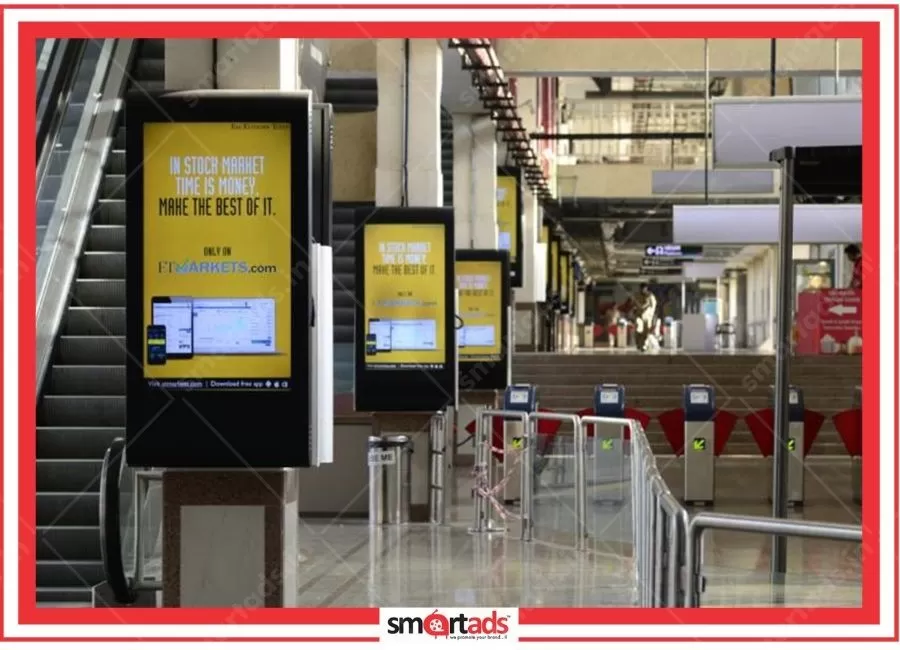
Entry Exit Panel
8 ft x 4 ft
Bright and vibrant multicolored letterin
Rate per Panel / 1 Month
Min Requirement is 3 Panel
₹48000.00
Showing 1 to 4 of 4 Results
MEDIA DETAILS
8 ft x 4 ft
Bright and vibrant multicolored letterin
Rate per Panel / 1 Month
Min Requirement is 3 Panel
₹48000.00
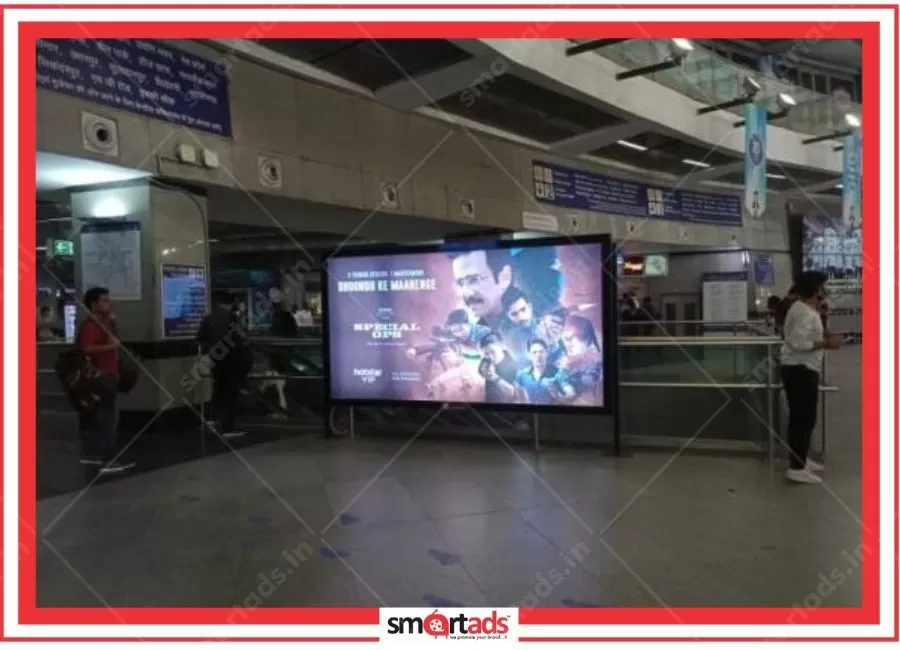
10 ft X 5 ft
A new wide wall system designed to accom
Rate per Panel / 1 Month
Min Requirement is 3 Panel
₹50000.00
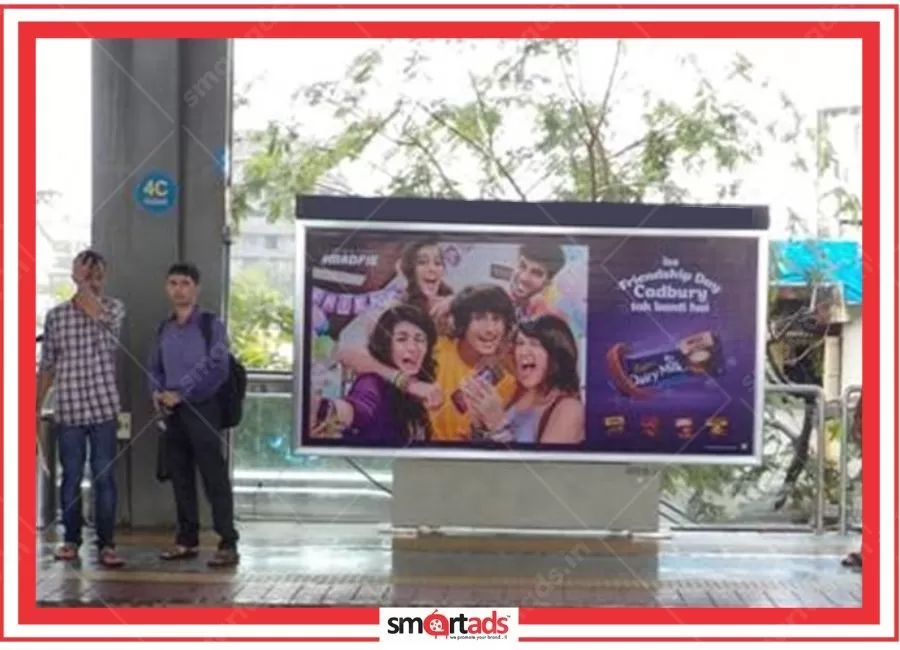
8 ft x 4 ft
A raised flooring or other horizontal su
Rate per Panel / 1 Month
Min Requirement is 3 Panel
₹35000.00
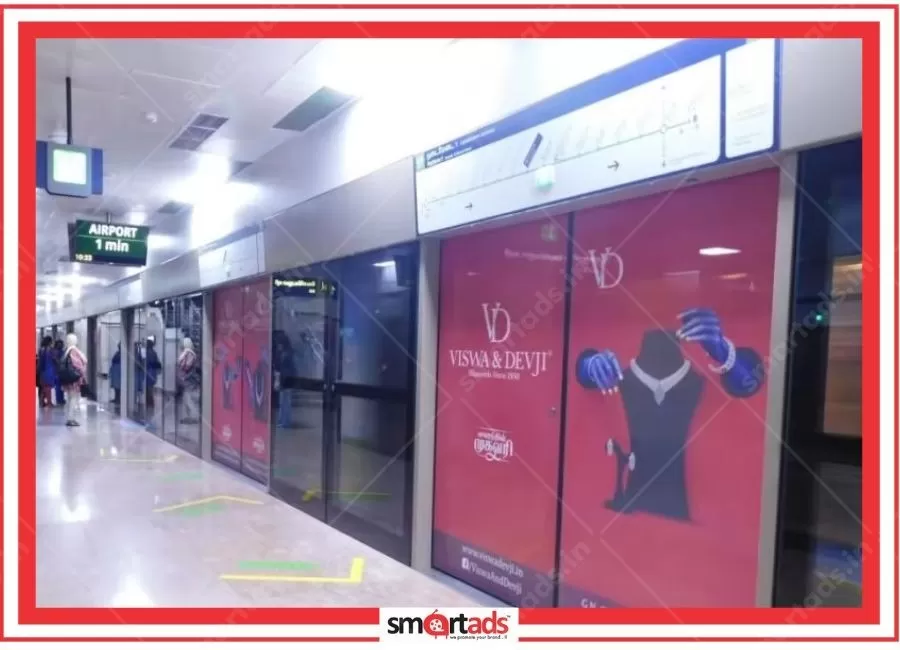
7 ft x 4 ft
Also known as platform edge doors (PEDs)
Rate per Plateform / 1 Month
Min Requirement is 1 Station
₹1200000.00
MEDIA REACH

MinimumQty :
10
EstimateReachPeople :
15 Million
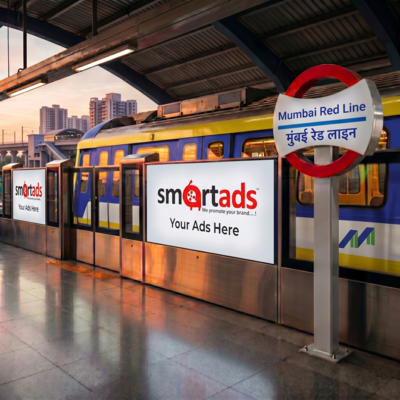
Most brands chasing Mumbai audiences are still fighting over the same billboards on the Western Express Highway or bidding against each other on Instagram CPMs — and in doing so, they are completely overlooking a corridor that carries tens of thousands of upwardly mobile suburban commuters past their brand messaging every single day. Mumbai Metro Line 7, the Red Line running from Dahisar East to Andheri East, has quietly become one of the most efficient transit advertising environments in the entire Mumbai Metropolitan Region, yet the conversation around it remains thin compared to what it deserves. At SmartAds, we have been placing clients on this corridor since its commercial operations began, and what we see consistently is that brands which discover it tend to double down — because the numbers simply work.
Metro station advertising on the Mumbai Red Line refers to the placement of brand communication across the physical and digital touchpoints within and around the stations of Mumbai Metro Line 7, which runs entirely elevated through the eastern suburbs of the city from Dahisar East in the north to Andheri East in the south, covering a stretch of roughly 16.5 kilometres across 13 stations. This is not conventional out-of-home advertising in the sense of a static roadside hoarding; it is a captive environment where daily commuters wait, walk, and ride in close proximity to brand messaging for extended dwell times that most outdoor formats simply cannot replicate. The advertising rights on Line 7 are governed by MMMOCL — Maha Mumbai Metro Operation Corporation Ltd. — which operates the line and manages the concession framework under the broader infrastructure authority of MMRDA, the Mumbai Metropolitan Region Development Authority.
What makes this form of BTL advertising genuinely interesting from a media planning standpoint is the nature of the environment itself. Passengers on the Mumbai Red Line are not driving past a billboard at 60 kilometres per hour; they are standing on a platform for two to four minutes, riding an escalator, waiting near turnstiles, or sitting in a coach — all of which creates repeated exposure to brand messaging that is physically unavoidable. The dwell time at a typical Red Line station works out to somewhere between three and six minutes per visit, which is a figure that media planners often find difficult to achieve with any other non-traditional advertising format at a comparable cost. This is, frankly speaking, where the real value lies for brands willing to think beyond the standard media mix.
At SmartAds, we always tell our clients that metro station advertising in Mumbai is not just an ambient medium — it is a frequency medium. A commuter who travels on the Red Line five days a week will encounter your brand messaging somewhere between fifteen and twenty-five times in a single month, which is an ad frequency that most digital campaigns struggle to achieve without significant budget escalation. That kind of repeated exposure, built over weeks and months, is what drives brand recall in a way that a one-week burst campaign on social media simply cannot.
The honest answer is that not all 13 stations on Mumbai Metro Line 7 are equal from an advertising value perspective, and most brands — and frankly, some agencies — get this wrong by treating the corridor as a uniform inventory. Dahisar East sits at the northern terminus of the line and functions as a critical interchange hub where the Red Line connects with the Yellow Line 2A (Metro Line 2A, which runs from Dahisar to DN Nagar), which means the station sees a compounded footfall from two metro lines simultaneously; this interchange dynamic makes Dahisar East one of the premium advertising locations on the entire corridor, and pricing at this station reflects that premium. On the southern end, Andheri East is the terminus that connects the Red Line to one of Mumbai's busiest suburban rail junctions, feeding commuters arriving from the Central and Western Railway networks into the metro system, which gives it a disproportionately high daily footfall relative to mid-corridor stations.
Mid-corridor stations like Goregaon East, Kandivali East, and Borivali East serve densely populated residential and commercial micro-markets in the suburban north Mumbai belt, and these stations tend to attract a consistent working professional demographic that is highly attractive to categories like banking, insurance, real estate advertising, and consumer electronics. Gundavali station is particularly interesting because it serves as the interchange point with the Blue Line (Metro Line 1), which runs east-west connecting Versova to Ghatkopar; this convergence of two major metro lines at a single station creates a footfall multiplier effect that makes Gundavali arguably the most strategically valuable station on the Red Line for brands seeking maximum reach within the metro network. Stations like Akurli, Shimpoli, Kurar, and Dindoshi are lower-footfall stations by comparison, but they serve hyperlocal advertising purposes exceptionally well — particularly for real estate advertising, local retail, and FMCG advertising targeting specific residential catchments.
Our experience at SmartAds shows that a campaign which concentrates on Dahisar East, Gundavali, Borivali East, and Andheri East simultaneously captures somewhere in the range of 55 to 65 percent of the total daily commuters on the Red Line, which means a four-station buy can deliver near-corridor-wide reach without the cost of a full station domination package. Jogeshwari East, while not an interchange station, deserves a mention because it serves a mixed residential-commercial micro-market that has seen significant commercial development in recent years, making it increasingly relevant for brands in the financial services and education categories.
The format inventory on Mumbai Red Line stations is considerably richer than most advertisers expect when they first approach the medium. Platform advertising — the backlit flex panels and static lightboxes positioned along platform walls and at the ends of platforms — is the most widely available and entry-level format, offering brand visibility to every passenger who boards or alights at a station. These panels typically run in standard sizes of 4x6 feet and 6x4 feet, though larger custom formats are available at select stations, and they are sold on a per-panel-per-month basis which makes them accessible even for tighter budgets.
Beyond platform advertising, the Red Line offers concourse advertising across the ticketing and entry-exit zones, which is arguably the highest-dwell-time location within the station since passengers must pass through this area and often pause to purchase tickets or validate smart cards. Pillar wraps are another format that generates strong brand recall because they occupy the full height of structural columns within the station, creating an unavoidable visual presence that passengers encounter from multiple angles; these are particularly effective for brand visibility campaigns where the objective is sheer impressions rather than a specific call to action. Escalator wraps — adhesive branding applied to the side panels and risers of escalators — are a format we have found to be disproportionately effective for brand recall relative to their cost, because passengers on an escalator have nothing else to look at and their gaze naturally falls on the branding surface for the full duration of the ride.
Digital screen advertising and DOOH (Digital Out-of-Home) formats are available at select Red Line stations, primarily at Dahisar East, Gundavali, Borivali East, and Andheri East, where MMMOCL has installed digital display panels in the concourse and platform areas. These screens allow for dynamic content, multiple creatives in rotation, and time-of-day targeting, which makes them particularly attractive for brands that want to serve different messages during morning peak hours versus evening commute periods. Train wrap advertising — full or partial exterior branding of BEML rolling stock coaches — is also available on the Red Line and delivers exterior branding across the entire corridor as the train moves between stations, generating impressions not just from commuters but also from pedestrians, motorists, and residents in the elevated corridor's line of sight. Platform screen door branding, which involves applying brand graphics to the glass panels of the automatic platform screen doors, is a premium interior branding format that places the brand message directly in the eyeline of waiting passengers — and in our experience, it consistently outperforms standard platform panels for brand recall in post-campaign surveys.
Full station domination packages, which involve exclusive branding across all available surfaces within a single station for a defined period, are available on the Red Line and represent the highest-impact option for launches, product introductions, or high-frequency brand visibility campaigns. Interior branding of coach panels — the overhead panels, door surrounds, and grab-handle areas inside the train — rounds out the format portfolio and delivers repeated exposure to a captive audience for the full duration of the journey.
Advertising rates on the Mumbai Red Line are, to be honest, one of the more frequently misunderstood aspects of this medium — partly because there is very little transparent pricing in the public domain, and partly because rates vary significantly based on station, format, duration, and whether the booking is made directly through MMMOCL's concession framework or through an authorised metro advertising agency. A standard backlit platform panel at a non-interchange station like Akurli or Shimpoli works out to roughly ₹15,000 to ₹25,000 per month, which is a number that surprises most first-time advertisers when they compare it to what they are paying for a comparable-sized static hoarding in the same neighbourhood — because the metro panel delivers a captive audience rather than a drive-by glance. At interchange stations like Dahisar East or Gundavali, the same format commands a premium that puts it somewhere in the ballpark of ₹35,000 to ₹60,000 per panel per month, reflecting the higher footfall and the dual-line audience.
Digital screen advertising on the Red Line — the DOOH formats at premium stations — is priced differently, typically on a per-spot-per-loop basis, and a 10-second spot in a 60-second loop at a high-footfall station works out to somewhere between ₹40,000 and ₹80,000 per month depending on the number of screens and the station tier. Train wrap advertising, which covers the exterior of a full BEML rake, is a significantly larger investment — in the ballpark of ₹8 lakh to ₹15 lakh per month for a full exterior wrap — but the reach it delivers across the entire corridor, combined with the impressions generated from non-commuter audiences who see the train from street level, makes the per-impression cost surprisingly competitive when calculated properly. Pillar wraps and escalator wraps at mid-tier stations tend to fall in the ₹20,000 to ₹45,000 per unit per month range, while platform screen door branding at premium stations is priced as a premium interior branding format and typically negotiated as part of a larger station package.
Full station domination on a mid-corridor station like Goregaon East or Kandivali East — covering all platform panels, pillar wraps, concourse advertising, and escalator wraps simultaneously — is typically packaged in the range of ₹3 lakh to ₹6 lakh per month, which is a figure that sounds significant until you calculate the number of daily commuters passing through that station and work out the effective cost per thousand impressions. The CPM for a well-executed station domination package on the Red Line works out to roughly ₹8 to ₹15, which is a number that consistently surprises clients who are used to paying ₹80 to ₹150 CPM for equivalent reach on programmatic display. These are indicative benchmarks based on our current media buying experience at SmartAds; actual rates are subject to MMMOCL's official rate card and negotiation through authorised concessionaires, and we strongly recommend getting a customised quote rather than working from any single published figure.
The Red Line's value as a BTL advertising corridor is rooted in a demographic reality that is easy to state but genuinely important to understand: the suburban north Mumbai belt — Dahisar, Borivali East, Kandivali East, Malad East, Goregaon East — is one of the most densely populated middle-to-upper-middle-class residential zones in the entire Mumbai Metropolitan Region, and the Red Line is the primary rapid transit spine that connects this population to the rest of the city. According to data referenced in the FICCI-EY Media and Entertainment Report, transit media in Indian metros has been growing at a compound rate that outpaces traditional OOH, driven precisely by the kind of captive, high-dwell-time environment that metro stations provide. The urban audience on the Red Line skews heavily toward working professionals between 22 and 45 years of age, with household incomes that make them relevant targets for a wide range of categories — from financial services and real estate advertising to consumer electronics, lifestyle brands, and ed-tech platforms.
What a lot of people miss is that the Red Line's catchment is not just the passengers who ride it — it is also the enormous residential population that lives within walking distance of its stations and sees the elevated structure, the station exteriors, and the train wraps as part of their daily visual environment. This is exterior branding that functions almost like a neighbourhood landmark, and brands that have run train wrap campaigns on the Red Line have reported recognition rates among non-commuters in the corridor that are meaningfully higher than what you would expect from a standard roadside hoarding. The dwell time advantage, combined with the demographic quality of the audience, is what makes metro station advertising in Mumbai — and on the Red Line specifically — a genuinely strong proposition for brands that care about both reach and audience quality.
One automotive brand we worked with ran a three-month campaign across Dahisar East, Borivali East, and Andheri East stations using a combination of platform advertising, pillar wraps, and a partial train wrap; the post-campaign brand recall survey showed unaided recall among Red Line commuters at 34 percent, compared to 11 percent in a matched control group in the same geography who did not use the metro — a multiplier that the client's marketing head described as the best they had seen from any single out-of-home advertising execution in that financial year.
The psychographic profile of the Red Line commuter is something we have spent considerable time studying at SmartAds, because it is genuinely distinct from the audience on other Mumbai metro lines and that distinction matters for campaign planning. The Borivali–Dahisar–Kandivali East corridor is characterised by a large Gujarati and Marathi middle-class population — Maharashtra audience demographics that skew toward family-oriented purchasing decisions, strong brand loyalty, and high engagement with categories like home improvement, financial products, jewellery, and consumer durables. This is not a homogeneous audience, but the dominant psychographic is aspirational suburban professional: someone who has moved from a smaller flat to a larger one in the past five years, who is making considered decisions about insurance, mutual funds, and the next family car, and who is highly receptive to brand messaging that speaks to quality and value simultaneously.
The morning peak commute on the Red Line — roughly 8 AM to 10:30 AM — skews toward office-going professionals heading toward Andheri East and beyond, which makes it an ideal window for financial services, B2B brand visibility, and professional services advertising. The evening peak, running from approximately 6 PM to 9 PM, sees a more mixed demographic that includes both returning professionals and leisure travellers, which opens the window for lifestyle, retail, and entertainment brands. Daily commuters on the Red Line represent a high-frequency, high-dwell-time audience that is genuinely difficult to reach at this level of concentration through any other single media format in the same geography.
A retail client in Pune expanding into the Mumbai market ran a hyperlocal advertising campaign specifically targeting Kandivali East and Borivali East stations to support the launch of two new stores in those micro-markets; by concentrating the media budget on platform advertising and concourse advertising at these two stations over a six-week period, they achieved a 28 percent increase in store walk-ins from the metro catchment area compared to their baseline from a previous launch in a comparable Mumbai suburb where they had used only digital advertising. The hyperlocal advertising precision of metro station advertising in Mumbai is something that broad-reach OOH advertising formats simply cannot replicate.
This is a question we get asked regularly, and the honest answer is that each Mumbai metro line serves a different audience profile and a different geographic catchment — so the comparison is less about which line is "better" and more about which line aligns with your target audience's movement patterns. The Blue Line (Metro Line 1), running from Versova to Ghatkopar, is the oldest and highest-footfall line in the Mumbai metro network, with daily ridership figures that have consistently exceeded the Red Line's current numbers; it connects the western suburbs to the eastern suburbs through a central east-west axis, which gives it a broader, more diverse audience profile but also means its advertising inventory is more contested and, frankly, more expensive. Mumbai Metro Line 7 advertising, by contrast, offers a more concentrated north-south suburban audience at pricing that is, in our experience, somewhere between 20 and 35 percent more cost-efficient per impression than comparable formats on the Blue Line.
The Yellow Line (Line 2A), which runs from Dahisar to DN Nagar and shares the Dahisar East interchange with the Red Line, serves a slightly different demographic corridor — the western suburbs of Borivali West, Kandivali West, Malad West, and Goregaon West — which tends to skew toward a higher-income residential profile in areas like Lokhandwala and Andheri West. Red Line metro advertising reaches the eastern suburban belt, which is characterised by higher residential density, a stronger middle-class profile, and significant commercial activity around the eastern highway corridor. For brands targeting the mass-market suburban professional, the Red Line is arguably the stronger choice; for premium lifestyle brands targeting the upper-income western suburbs, the Yellow Line may be more appropriate — and for brands that want both, the Dahisar East interchange station offers a single-station buy that reaches passengers from both lines simultaneously.
The upcoming Line 7A — the underground extension from Andheri East to CSIA Terminal 2 (the Chhatrapati Shivaji Maharaj International Airport) — is a development that deserves particular attention from media planners. When operational, Line 7A will connect the Red Line directly to the Aqua Line (Metro Line 3) at CSIA T2, creating a continuous metro corridor from Dahisar East to Bandra-Kurla Complex and beyond; this will dramatically increase the strategic value of Red Line advertising by extending its audience reach into the airport traveller and BKC professional segments, which are among the most premium advertising demographics in Mumbai. CSIA airport metro advertising on Line 7A, when it becomes available, will command premium rates that reflect this audience quality — and brands that establish a presence on the Red Line now will be well-positioned to extend their campaigns into this premium inventory when it opens.
This is the content gap that almost no one in the metro advertising space is talking about, and it represents what we believe is a genuinely significant opportunity for forward-thinking brands. Mumbai Metro Line 9, the northward extension of the Red Line corridor from Dahisar East toward Mira-Bhayandar, entered commercial operations in April 2026, extending the effective reach of the Red Line metro advertising ecosystem into the Mira-Bhayandar Municipal Corporation area — a rapidly urbanising zone with a large, underserved population of working professionals and families who have historically been outside the reach of Mumbai's metro advertising network. Line 9 brings the Red Line's total corridor length to a significantly extended footprint, and the advertising inventory on Line 9 stations is, at this point, relatively uncrowded — which means early-mover brands can establish strong brand visibility in a new catchment before competition for inventory intensifies.
The Mira-Bhayandar demographic is particularly interesting for categories like real estate advertising, banking and financial services, consumer durables, and ed-tech, because the area is characterised by a large first-generation urban professional population that is making significant financial decisions — home purchases, insurance, investment products — for the first time. This is a Maharashtra audience segment that is highly aspirational, brand-conscious, and increasingly connected to the Mumbai metropolitan economy through the metro corridor. The daily commuters on Line 9 who travel into Mumbai for work represent a captive audience with high dwell times and strong purchase intent in exactly the categories that advertisers on the Red Line have historically targeted.
At SmartAds, we have already begun advising clients in the financial services and real estate advertising categories to consider Line 9 inventory as a strategic extension of their Red Line campaigns, because the cost-per-impression on new stations is typically lower in the early phases of operation before the concession framework reaches full commercial maturity. The combination of Line 7 and Line 9 inventory — marketed collectively as the Red Line corridor — creates a continuous transit advertising spine from Mira-Bhayandar through Dahisar, Borivali East, Kandivali East, Goregaon East, and Jogeshwari East to Andheri East, which is a reach profile that no single OOH advertising format in the western suburban corridor can match.
The booking process for metro station advertising on the Mumbai Red Line runs through MMMOCL's official advertising concession framework, which designates authorised media partners and concessionaires who hold the rights to sell specific inventory categories across Line 7 stations. Direct booking through MMMOCL is technically possible for large-format or station domination packages, but in practice, most brands and media planners work through an authorised metro advertising agency because the process involves format specifications, artwork approvals, installation coordination, and compliance with MMMOCL's brand guidelines — all of which require familiarity with the system that a specialist agency brings. Vendors who have operated in this space include established transit media players, and the booking lead time for standard formats is typically three to four weeks from artwork approval to installation, though this can extend to six to eight weeks for custom formats like train wraps or full station domination packages.
The artwork requirements for Red Line station formats are specific and non-negotiable: platform panels require print-ready files at 300 DPI minimum, with bleed areas and safe zones that vary by station and format size; digital screen advertising requires files in specific aspect ratios and video formats that comply with the display hardware installed at each station; and train wrap artwork must account for the curvature and panel breaks of BEML rolling stock, which means a generic flat design will not translate well without proper adaptation. We have seen campaigns go wrong — and budgets wasted — when brands submit artwork that was designed for a different format and then adapted hastily for the metro environment; the visual quality suffers, and the brand recall impact is significantly reduced. Getting the creative right for the specific format and station environment is as important as the media buy itself.
For brands working through SmartAds, the booking process is managed end-to-end — from rate negotiation and inventory selection through artwork specification, vendor coordination, and post-campaign reporting. What we tell our clients is that the minimum meaningful campaign duration on the Red Line is 30 days for standard platform advertising, because the brand recall benefits of repeated exposure only begin to accumulate meaningfully after the first two weeks of the campaign; shorter durations can generate impressions but rarely move the needle on unaided brand recall in the way that a sustained 60 or 90-day campaign does.
Frankly speaking, the category fit for Red Line metro advertising is broader than most brands initially assume, but there are industries where we have consistently seen the strongest return on investment. Real estate advertising is perhaps the most natural fit — developers with projects in the Borivali, Kandivali, Dahisar, and Mira-Bhayandar micro-markets are essentially advertising to the exact population that lives in or near their project catchments, and the repeated exposure that platform advertising delivers over a 60 or 90-day campaign period aligns well with the long consideration cycles of property purchase decisions. Financial services — banking, insurance, mutual funds, and credit card products — benefit from the working professional demographic and the high dwell time that allows for slightly more information-dense creative executions than a roadside billboard permits.
FMCG advertising on the Red Line works best for brands in the personal care, packaged foods, and household products categories that are targeting the mass-market suburban household; the sheer volume of daily commuters and the frequency of exposure make this an efficient awareness-building medium for categories where brand recall drives purchase decisions at the point of sale. Ed-tech platforms and professional education brands have been among the more aggressive advertisers on the Red Line corridor in recent years, targeting the young professional demographic that is actively seeking upskilling and career development opportunities — and the morning commute, in particular, is a moment when this audience is mentally in a professional mindset and receptive to messaging about career advancement. Consumer electronics, automobile brands, and lifestyle retail have also found strong results on the Red Line, particularly when campaigns are timed around seasonal peaks like Diwali, Navratri, and the January-March financial year-end period when consumer spending and investment decisions are both elevated.
One ed-tech client we worked with ran a 45-day campaign across five Red Line stations — Dahisar East, Borivali East, Kandivali East, Goregaon East, and Andheri East — using a combination of platform advertising and concourse advertising; the campaign generated over 1.2 crore impressions across the corridor, and the client reported a 22 percent increase in organic app downloads from the Mumbai north-suburban geography during the campaign period, which they attributed in part to the brand recall effect of the metro campaign reinforcing their concurrent digital advertising. The synergy between metro station advertising and digital retargeting is something we actively build into campaign structures for clients where both channels are available.
Seasonal timing matters enormously on the Red Line, and it is something that most generic media planning guides completely ignore. The Navratri and Diwali period — typically September through November — sees a measurable spike in metro ridership as the suburban north Mumbai population travels for shopping, family visits, and festive events; this is the single highest-impact window for consumer brands on the Red Line, and inventory at premium stations like Dahisar East and Borivali East gets booked out several months in advance. Brands that wait until October to book Diwali inventory on the Red Line will find that the best stations and formats are already committed, which is why we advise clients to plan festive campaigns by July at the latest. The IPL season — March through May — is another high-engagement window, particularly for categories like consumer electronics, beverages, and financial products, because metro ridership remains strong and the audience's media consumption is elevated across all channels simultaneously.
The question of whether to concentrate budget at one or two premium stations or spread it across multiple mid-tier stations is one that depends entirely on the campaign objective. For brand visibility and awareness campaigns where reach is the primary KPI, spreading across five to seven stations — including at least one interchange station — delivers the broadest possible audience coverage within the corridor. For hyperlocal advertising campaigns tied to a specific store opening, project launch, or event, concentrating the entire budget at the one or two stations closest to the activation point delivers far higher frequency to the relevant catchment and drives stronger footfall outcomes. We have seen brands make the mistake of spreading a modest budget too thin across the entire corridor and ending up with insufficient frequency at any single station to drive meaningful brand recall — the rule of thumb we use is that a minimum of three to four panels per station is needed to create a genuine presence rather than a token appearance.
Programmatic DOOH is an emerging capability on the Red Line that is worth understanding for brands with dynamic creative requirements. While full programmatic DOOH buying — the kind of real-time audience-triggered ad serving that is available on some international metro networks — is not yet uniformly available across all Red Line stations, select digital screen advertising locations at premium stations are beginning to support time-of-day scheduling and creative rotation, which is a meaningful step toward the audience-responsive transit advertising model. Brands in categories like food delivery, banking, and retail can use this capability to serve contextually relevant messages during morning commute hours versus evening peak periods, which our experience suggests can improve message relevance and brand recall compared to a single static creative running across all dayparts.
Q: What is metro station advertising on Mumbai Red Line?
Metro station advertising on the Mumbai Red Line refers to the placement of brand communication — across static panels, digital screens, pillar wraps, escalator wraps, train wraps, and other formats — within the stations and rolling stock of Mumbai Metro Line 7, which runs from Dahisar East to Andheri East across 13 elevated stations in the eastern suburban corridor. It is a form of transit advertising and out-of-home advertising that targets the captive audience of daily commuters and occasional riders who pass through the station environment, and it is governed by MMMOCL under the broader MMRDA infrastructure framework. The medium is classified as BTL advertising or non-traditional advertising in most media planning frameworks, though its scale and reach on a high-footfall corridor like the Red Line give it characteristics that are closer to mass-reach OOH advertising than to conventional below-the-line formats.
Q: Which stations on the Mumbai Red Line (Line 7) are best for advertising?
The stations that consistently deliver the highest advertising value are Dahisar East, Gundavali, Borivali East, Kandivali East, Goregaon East, and Andheri East. Dahisar East and Gundavali carry a footfall premium because they are interchange stations — Dahisar East connects to the Yellow Line 2A, while Gundavali connects to the Blue Line (Line 1) — which means they serve passengers from multiple metro lines simultaneously. Andheri East is a terminus with a strong connection to the suburban rail network, making it a high-traffic entry and exit point. For hyperlocal advertising campaigns, mid-corridor stations like Kandivali East and Goregaon East offer strong value because they serve densely populated residential catchments with high purchase-intent demographics.
Q: How much does it cost to advertise at a Mumbai Red Line metro station?
Advertising costs on the Mumbai Red Line vary considerably by format, station tier, and campaign duration. A standard backlit platform panel at a non-interchange station works out to roughly ₹15,000 to ₹25,000 per month, while the same format at an interchange station like Dahisar East or Gundavali is in the ballpark of ₹35,000 to ₹60,000 per month. Digital screen advertising on DOOH formats at premium stations is priced per spot per loop and typically works out to ₹40,000 to ₹80,000 per month. A full station domination package at a mid-corridor station is typically in the range of ₹3 lakh to ₹6 lakh per month. These are indicative benchmarks; actual advertising rates are subject to MMMOCL's official rate card and the terms of the authorised concession, and we recommend obtaining a customised quote through a specialist metro advertising agency.
Q: What ad formats are available at Mumbai Red Line metro stations?
The format portfolio on the Red Line includes platform advertising (backlit panels and lightboxes), concourse advertising, pillar wraps, escalator wraps, platform screen door branding, digital screen advertising and DOOH formats, train wrap advertising (exterior branding on BEML rolling stock), interior branding of coach panels, and full station domination packages. Each format has specific creative specifications and installation requirements, and availability varies by station. Digital formats are concentrated at premium stations, while static formats are available across all 13 stations on the line.
Q: Who is the official concessionaire for advertising on Mumbai Metro Red Line?
The advertising rights on Mumbai Metro Line 7 are managed under a concession framework operated by MMMOCL (Maha Mumbai Metro Operation Corporation Ltd.), which is the operating entity for the Red Line under the broader authority of MMRDA. MMMOCL designates authorised advertising concessionaires and media partners who hold the rights to sell specific inventory categories. Brands and agencies looking to book space on the Red Line should work through an authorised metro advertising agency or approach MMMOCL directly for large-format or station domination bookings. The concession framework is structured to ensure quality control over creative content, installation standards, and brand compliance across the station environment.
Q: How do I book advertising space on the Mumbai Red Line metro?
Booking metro station advertising on the Mumbai Red Line involves identifying the target stations and formats, obtaining availability and rate information from an authorised metro advertising agency or directly from MMMOCL's commercial team, submitting artwork for approval against the specified creative guidelines, completing the booking and payment process, and coordinating installation with the station operations team. The typical lead time from booking confirmation to installation is three to four weeks for standard formats, extending to six to eight weeks for custom executions like train wraps or full station domination. Working through an experienced advertising agency in Mumbai that has an established relationship with MMMOCL significantly streamlines this process.
Q: What is the daily footfall on Mumbai Metro Red Line stations?
The Red Line has seen steady ridership growth since its commercial launch, with total daily ridership across the corridor reaching significant levels as the line has matured and feeder connectivity has improved. While MMMOCL publishes periodic ridership data, the figures vary by station and time of day; interchange stations like Dahisar East and Gundavali see footfall that is meaningfully higher than the corridor average, while mid-corridor stations like Akurli or Shimpoli see lower but still commercially significant daily passenger counts. For media planning purposes, the relevant metric is not just total footfall but the number of unique daily commuters — the regular riders who generate the repeated exposure that drives brand recall — and this figure is best obtained from MMMOCL's official data or through a media planning partner with access to current ridership reports.
Q: What is the difference between train wrap advertising and station advertising on the Red Line?
Station advertising refers to any format placed within the physical station environment — platform panels, pillar wraps, concourse advertising, escalator wraps, digital screens, and so on — and its audience is the passengers who enter and use that specific station. Train wrap advertising, by contrast, involves branding applied to the exterior of BEML rolling stock coaches, and its audience includes not only the passengers riding the train but also
