
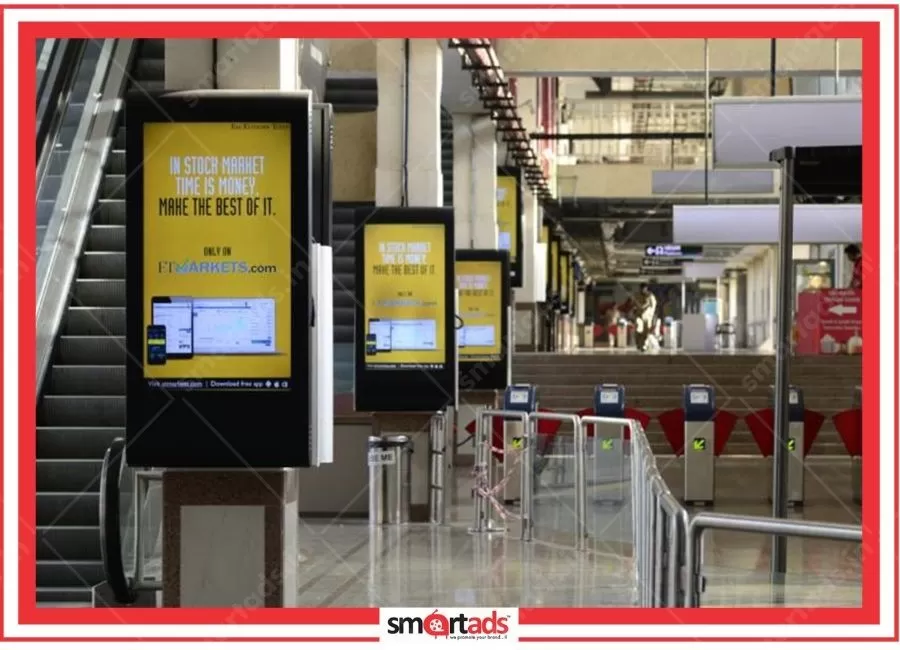
Entry Exit Panel
8 ft x 4 ft
Bright and vibrant multicolored letterin
Rate per Panel / 1 Month
Min Requirement is 3 Panel
₹48000.00
Showing 1 to 4 of 4 Results
MEDIA DETAILS
8 ft x 4 ft
Bright and vibrant multicolored letterin
Rate per Panel / 1 Month
Min Requirement is 3 Panel
₹48000.00
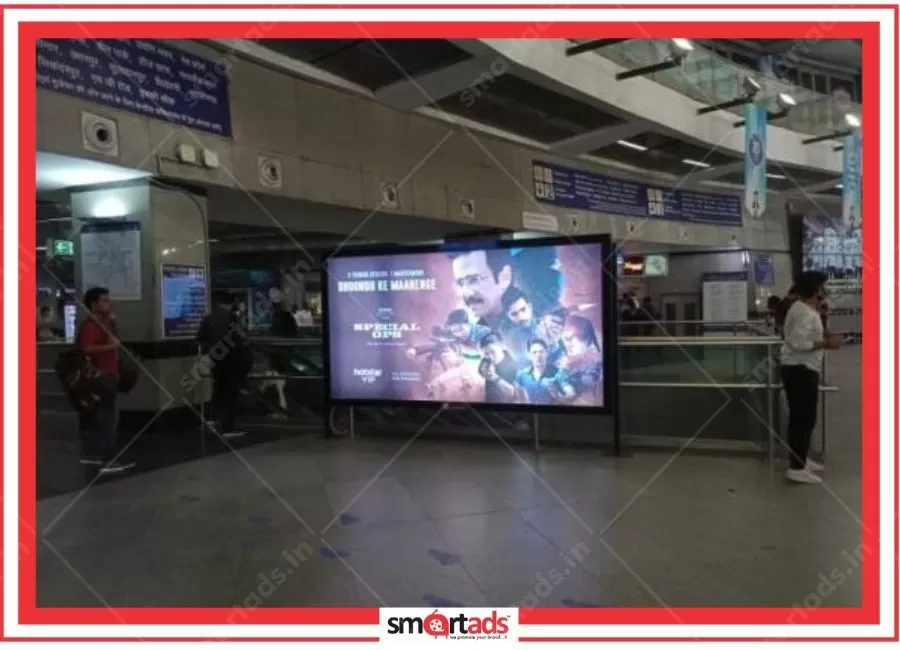
10 ft x 5 ft
A new wide wall system designed to acco
Rate per Panel / 1 Month
Min Requirement is 3 Panel
₹50000.00
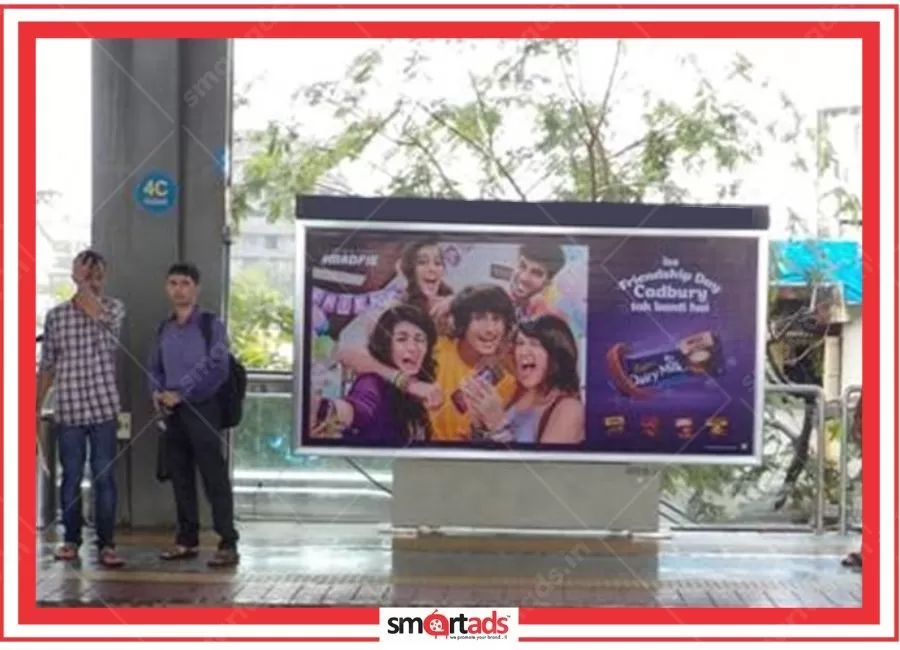
8 ft x 4 ft
A raised flooring or other horizontal su
Rate per Panel / 1 Month
Min Requirement is 3 Panel
₹35000.00
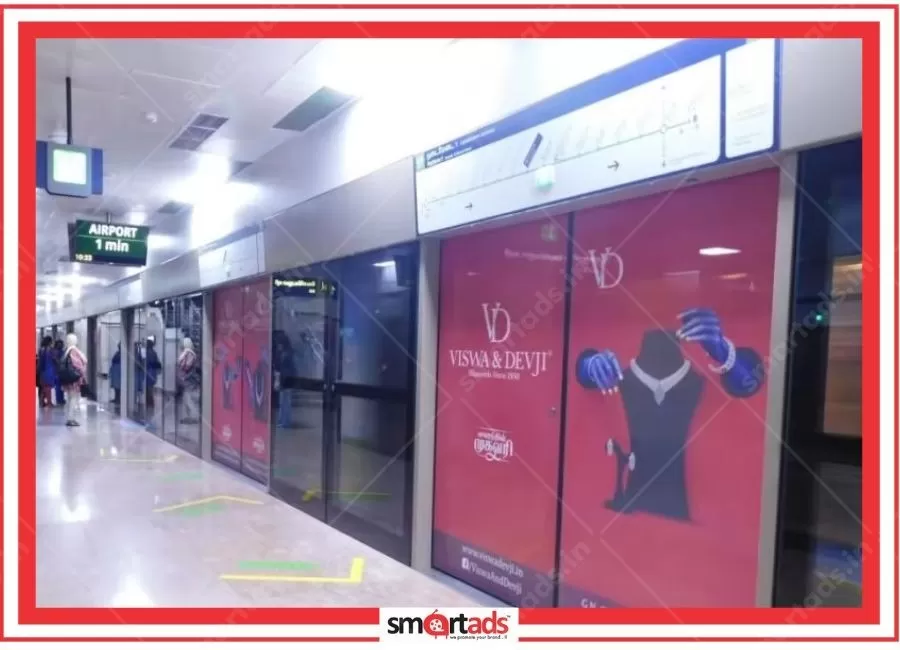
7 ft x 4 ft
Also known as platform edge doors (PEDs)
Rate per Plateform / 1 Month
Min Requirement is 1 Station
₹1200000.00
MEDIA REACH

MinimumQty :
10
EstimateReachPeople :
15 Million
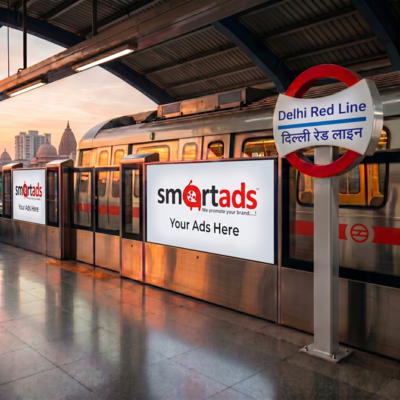
The Delhi Metro Red Line moves somewhere in the ballpark of 600,000 to 700,000 commuters every single day — a number which, when you break it down to individual station-level dwell time and captive exposure windows, represents one of the most underutilised advertising corridors in the entire NCR region. Most brands fixate on the Yellow Line or the Blue Line when thinking about metro advertising in Delhi, which means the Red Line remains a genuinely competitive space where your brand is not fighting for attention against forty other advertisers doing the same thing. We have found, repeatedly, that the brands which discover the Red Line early tend to own it — and that kind of category ownership is difficult to replicate once a competitor moves in.
The Delhi Metro Red Line, officially designated as Line 1, runs approximately 34 kilometres from Rithala in the northwest to Shaheed Sthal (New Bus Adda) in Ghaziabad — which makes it one of the few DMRC lines that crosses the Delhi-NCR state boundary and pulls in commuters from both Uttar Pradesh and Delhi simultaneously. That cross-state catchment is something most media planners do not fully price into their planning; when you advertise at a station like Welcome or Shaheed Sthal, you are not just reaching Delhi residents but a significant slice of Ghaziabad's working and middle-class population, which tends to skew younger and more aspirational in its consumption patterns.
What makes the Red Line particularly interesting from a BTL advertising standpoint is its corridor composition. The line passes through some of Delhi's densest residential belts — Rohini, Pitampura, Kohat Enclave, Inderlok — before connecting into the central interchange at Kashmere Gate, which is arguably one of the busiest transit nodes in the entire DMRC network. This mix of residential catchment at the western end and commercial-transit density at the eastern end creates two distinct audience profiles within a single line, which is something that a well-structured metro station branding campaign can exploit by placing different creatives at different stations rather than running one uniform execution across all 29 stops.
At SmartAds, we always tell our clients that the Red Line is best understood as two campaigns in one: a residential-reach play in the Rohini-Pitampura-Rithala stretch, and a high-frequency transit-audience play in the Kashmere Gate-Welcome-Shahdara corridor. The below the line advertising opportunity here is significant precisely because the dwell time at stations — particularly at interchange points — runs between four and eight minutes on average, which is a window that most outdoor formats simply cannot replicate. Transit media advertising, by its nature, benefits from forced proximity; a commuter waiting on a platform has very few places to look, and a well-placed backlit panel advertising unit captures that attention without any opt-out mechanism.
The range of formats available for metro station advertising in Delhi Red Line is considerably wider than most first-time advertisers expect, and the choice of format has a disproportionate impact on both cost and campaign effectiveness. The most common entry point is the backlit panel advertising unit — typically a 4x6 foot or 6x4 foot illuminated display placed on station concourses, platforms, and entry-exit corridors — which offers consistent visibility across all 29 stations on the line. Backlit panels are the workhorses of Red Line station branding because they are available at virtually every station, they are relatively straightforward to book through DMRC's authorised channels, and the production cost is manageable enough that even mid-sized brands can run them across multiple locations without breaking their BTL budget.
Beyond standard panels, pillar branding metro is one of the formats we recommend most enthusiastically to clients who want high-frequency recall without the premium cost of a station domination package. The structural pillars at Red Line stations — particularly at elevated stations like Netaji Subhash Place, Pitampura, and Rohini sectors — offer large, curved branding surfaces which wrap around the pillar and are visible from multiple angles simultaneously. Pillar branding works especially well for brands that have a strong visual identity or a single powerful message, because the format does not lend itself to copy-heavy executions; it is a brand visibility play, not an information delivery play. Platform branding, which covers the walls and overhead fascia of the platform level, operates on a similar logic — it is about creating an immersive brand environment rather than a single point of contact.
For brands with larger budgets, train interior branding and train exterior branding open up a different dimension of metro line 1 branding entirely. Train interior branding — which covers the overhead panels, door stickers, and sometimes the entire interior of a coach — delivers repeated exposure to the same commuter over the duration of their journey, which on the Red Line can be anywhere from 15 minutes to nearly an hour for end-to-end travellers. Full train wrap, the most premium format in the transit media advertising toolkit, turns the entire exterior of a DMRC train into a moving billboard that is seen not just by passengers inside but by thousands of people at every station the train passes through. We have seen full train wrap campaigns generate brand recall scores that are, frankly, difficult to achieve with any static format — the novelty factor alone drives attention in a way that a standard panel simply cannot. Digital screens metro and DOOH advertising are also available at select Red Line stations, particularly at Kashmere Gate and Netaji Subhash Place, offering dynamic content capabilities which allow brands to rotate multiple messages across the day.
Advertising rates on the Delhi Metro Red Line are, to be honest, one of the most frequently misquoted figures in the Indian OOH advertising market — partly because DMRC revises its rate cards periodically and partly because the final cost depends heavily on format, station tier, campaign duration, and whether you are booking directly or through an authorised agency. That said, we can give you working benchmarks that reflect what we are actually paying in 2025–2026, which is more useful than the vague "contact for pricing" that most competitor pages offer.
For a standard backlit panel advertising unit at a mid-tier Red Line station — say, Inderlok or Rohini Sector 18 — the monthly advertising cost works out to somewhere between ₹15,000 and ₹35,000 per panel, depending on size and exact placement. At premium interchange stations like Kashmere Gate, that figure climbs considerably; a single well-positioned panel at Kashmere Gate can run in the ballpark of ₹50,000 to ₹80,000 per month, which surprises a lot of clients until they realise the footfall differential between a mid-tier station and an interchange node. Pillar branding metro rates tend to be slightly higher per unit than standard panels because of the larger surface area and the multi-angle visibility; expect to budget somewhere between ₹40,000 and ₹90,000 per pillar per month at premium locations.
Platform branding and concourse advertising packages are typically sold as zone packages rather than individual units, which means the advertising cost structure is different — you are buying a defined zone of visibility rather than a single panel. These zone packages at high-footfall Red Line stations can range from roughly ₹1.5 lakh to ₹4 lakh per month, depending on the station and the extent of coverage. Train interior branding for a single coach runs in the ballpark of ₹80,000 to ₹1.5 lakh per month; a full train wrap, which is the most premium format available, can cost anywhere between ₹8 lakh and ₹15 lakh per month — a number which sounds large until you calculate the impression volume and compare it to what you would spend on an equivalent reach through digital or print. The minimum campaign duration for most Red Line station formats is 30 days, though some digital screens metro placements can be booked on shorter cycles; we will cover the booking process in detail in a later section.
Kashmere Gate station is, without question, the single most valuable advertising location on the entire Red Line — and arguably one of the top five locations in the entire DMRC network. It serves as an interchange connecting the Red Line with the Yellow Line and the Violet Line, which means the daily footfall at Kashmere Gate is a multiple of what any single-line station sees; estimates from DMRC operational data suggest the station handles upwards of 1.5 to 2 lakh passenger entries and exits on a typical weekday, which makes it a high-footfall station of the first order. For brands that want maximum metro advertising Delhi reach from a single location, Kashmere Gate is the obvious starting point.
Netaji Subhash Place station, commonly known as NSP, is the second anchor point on the Red Line for advertisers; it serves as an interchange with the Pink Line and sits at the heart of one of northwest Delhi's busiest commercial and retail corridors. The catchment around NSP includes a large working professional population from Pitampura, Shalimar Bagh, and Ashok Vihar, which makes it particularly valuable for categories like financial services, real estate, and consumer electronics. Welcome station, at the eastern end of the line near the Delhi-UP border, is another high-footfall station that tends to be overlooked by advertisers who focus on the western corridor; it connects with the Pink Line and draws a significant volume of commuters from East Delhi and Ghaziabad, which is a demographic that is genuinely underserved by most mainstream advertising campaigns.
Beyond these three anchor stations, Inderlok — which connects with the Green Line — and Shahdara, which serves as a gateway for East Delhi commuters, both carry footfall levels that justify premium placements. Rohini and Pitampura stations, while not interchange nodes, benefit from the sheer residential density of their catchment areas; the Rohini belt alone is one of Delhi's most populous planned residential zones, and the commuter audience at these stations tends to be highly consistent in its daily patterns, which means your brand gets repeated exposure to the same individuals over the course of a campaign — a property which is enormously valuable for brand recall building. Rithala, at the northwestern terminus, draws a more localised audience but is worth considering for brands targeting the outer northwest Delhi and Rohini Sector 25-28 residential market.
The metro advertising booking process for Red Line stations runs through DMRC's authorised concessionaire system, which means you cannot simply walk into a station and negotiate a placement directly with the station manager. DMRC has empanelled specific advertising concessionaires who hold the rights to sell and manage advertising inventory across different lines and station zones; working through an authorised metro advertising agency is not just convenient but actually mandatory if you want your campaign to go live without compliance issues. The booking lead time is something that catches a lot of first-time advertisers off guard — for standard formats like backlit panels and pillar branding, you should plan for a minimum of three to four weeks from booking confirmation to installation, and for larger formats like train wraps or station domination packages, six to eight weeks is a more realistic planning horizon.
The process itself involves several steps which need to be managed carefully. First, you identify the stations and formats you want, confirm availability with the concessionaire, and receive a rate confirmation; availability at premium stations like Kashmere Gate and Netaji Subhash Place can be genuinely limited, particularly in the October-to-February festive and winter season when demand spikes. Second, your creative artwork needs to be submitted in the correct specifications — DMRC has specific requirements around file formats, resolution, and content guidelines which we will cover in the DMRC approval section — and this artwork goes through an internal review before printing or installation can begin. Third, once the artwork is approved and the campaign is confirmed, the installation is carried out by DMRC-approved vendors, which means you cannot use your own production team for the physical installation.
At SmartAds, we handle the entire metro advertising booking process end-to-end for our clients — from identifying the right stations and formats based on their target audience profile, to coordinating with concessionaires on availability and rates, to managing the artwork submission and DMRC approval workflow. What we have found is that clients who try to navigate this process independently often lose two to three weeks to back-and-forth on creative specifications or concessionaire coordination, which effectively shortens their campaign window. Having an experienced metro advertising agency manage the process means your campaign goes live on schedule, and the savings in time and frustration are real.
Station domination is exactly what it sounds like — a brand takes over the majority of visible advertising surfaces at a single metro station, creating an immersive brand environment which makes it virtually impossible for a commuter to pass through without engaging with the brand's messaging. On the Delhi Metro Red Line, station domination packages are available at most of the 29 stations, though the most sought-after locations are, predictably, Kashmere Gate, Netaji Subhash Place, and Welcome — the high-footfall interchange stations where the sheer volume of daily commuter audience justifies the premium investment.
A typical station domination package on the Red Line covers the concourse level, the platform level, the entry and exit corridors, and often the pillars and overhead fascia — which means a commuter encounters your brand from the moment they enter the station to the moment they board the train. This format is particularly effective for product launches, brand repositioning campaigns, and high-stakes seasonal pushes like Diwali or back-to-school periods, because the immersive environment creates a level of brand recall that individual panel placements simply cannot match. We worked with a real estate developer targeting the Rohini and Pitampura residential market who ran a station domination at Netaji Subhash Place for six weeks; the developer reported a measurable uptick in site visits from northwest Delhi postcodes during the campaign period, which aligned directly with the station's catchment geography.
The cost of station domination on the Red Line varies considerably based on station tier and package scope; at a mid-tier station, a full domination package might be in the ballpark of ₹6 lakh to ₹10 lakh per month, while a premium interchange station like Kashmere Gate can command ₹15 lakh to ₹25 lakh per month for a comprehensive takeover. These are not small numbers, but the impression volume and the exclusivity — no competing brand messaging within the same station environment — make the ROI calculation more favourable than it might appear at first glance. For brands that can justify the investment, station domination remains one of the most powerful BTL advertising formats available in the Delhi NCR market.
The commuter audience on the Delhi Metro Red Line is not a monolith, and treating it as one is a mistake that we see brands make repeatedly. The western corridor — from Rithala through Rohini, Pitampura, and Inderlok — runs through some of Delhi's most densely populated planned residential colonies, which means the audience here skews heavily towards middle-class and upper-middle-class families, with a significant proportion of government employees, small business owners, and college students. The daily ridership in this stretch tends to be high on weekday mornings and evenings, with a notable peak of college-going commuters between 8 AM and 10 AM — a window which is particularly valuable for edtech brands, coaching institutes, and consumer goods companies targeting the 18-30 demographic.
The eastern corridor — from Kashmere Gate through Shahdara, Welcome, and into Ghaziabad — draws a different profile: a higher proportion of working professionals commuting between NCR and central Delhi, a significant volume of inter-state travellers using the line as a connection to bus terminals and railway stations, and a growing segment of young professionals from the Ghaziabad and East Delhi residential markets. This makes the eastern end of the Red Line particularly relevant for categories like financial services, insurance, mobile handsets, and fast food — brands which need to reach aspirational urban consumers who are price-conscious but brand-aware. The NCR advertising reach of the Red Line, which extends into Ghaziabad through the Shaheed Sthal terminus, is a genuine differentiator compared to lines that stay entirely within Delhi's administrative boundaries.
What a lot of people miss is the gender composition of the Red Line commuter audience, which tends to be more balanced than many advertisers assume; the presence of women's colleges, government offices, and retail employment centres along the corridor means female commuters make up a meaningful share of daily ridership. This has implications for categories like fashion, beauty, healthcare, and financial products targeting women — all of which have historically underinvested in transit media advertising relative to their actual audience concentration on lines like the Red Line. The captive audience dynamic is also worth emphasising: unlike digital advertising where a user can scroll past your ad in 0.3 seconds, a commuter standing on a platform or sitting in a train is exposed to your brand message for the full duration of their wait or journey, which translates into significantly higher brand recall per impression.
The DMRC approval process is one of those areas where a lack of preparation can derail an otherwise well-planned campaign, and we have seen this happen even with experienced advertisers who underestimate the specificity of DMRC's content and technical requirements. On the content side, DMRC prohibits advertising for tobacco products, alcohol, and content which could be considered politically sensitive or religiously offensive — which is standard across most transit media environments in India. However, DMRC also has specific guidelines around the depiction of competitive claims, which means comparative advertising copy needs to be reviewed carefully before submission; anything that could be construed as disparaging a competitor or making unsubstantiated claims about product superiority is likely to be flagged.
On the technical side, the creative specifications for Red Line station formats are format-specific and fairly precise. Backlit panel advertising artwork typically needs to be submitted as a high-resolution PDF or TIFF file at a minimum of 150 DPI at actual size, with bleed margins as specified by the concessionaire for each format. Pillar branding and platform branding formats have their own dimension specifications which vary by station, because the physical dimensions of pillars and platform walls are not uniform across all 29 stations on the line. This is one of the reasons we always recommend getting the exact specifications from the concessionaire before your design team begins work — adapting artwork to different dimensions after the fact adds time and cost that could easily be avoided. The DMRC approval timeline, once a complete artwork submission is made, is typically five to seven working days for standard formats; larger or more complex formats like train exterior branding or station domination may take ten to fifteen working days.
CISF clearance is a separate layer of the process that applies specifically to certain installation activities within the station security perimeter; while this is generally managed by the authorised concessionaire and their installation teams, it is worth being aware of as a factor that can add time to the installation schedule if not coordinated properly. The practical implication for campaign planning is that your artwork should be finalised and submitted at least three weeks before your desired campaign start date — four weeks if you are running a station domination or any format that requires custom installation. Brands that have worked with SmartAds on Red Line campaigns know that we build these timelines into the planning calendar from day one, which is why our campaigns consistently go live on schedule even during the peak festive season when DMRC approval queues are longer than usual.
The comparison between metro station advertising in Delhi Red Line and traditional OOH advertising Delhi — hoardings, unipoles, gantries — is one that comes up in almost every media planning conversation we have, and the honest answer is that they are not competing formats so much as complementary ones which serve different functions in a campaign architecture. A large-format hoarding on the NH-58 or the Ring Road delivers broad reach and high visibility to vehicular traffic, but it offers almost no dwell time; a driver passing a hoarding at 60 kilometres per hour has perhaps two to three seconds of exposure, which is enough for brand awareness but not for message comprehension. A commuter standing on the platform at Netaji Subhash Place, by contrast, has four to eight minutes of exposure to the brand messaging around them — which is a fundamentally different quality of contact.
The CPM comparison is also instructive. A well-placed hoarding in a premium Delhi location might deliver a CPM — cost per thousand impressions — in the ballpark of ₹12 to ₹25, depending on location and traffic count. Metro station branding on the Red Line, when you calculate the CPM against verified daily ridership figures, often works out to somewhere between ₹6 and ₹15 per thousand impressions — which is a number that surprises most first-time advertisers when they compare it to what they are paying for premium OOH advertising Delhi placements, let alone digital display. The key qualifier is that metro impressions are not equivalent to drive-by impressions; the captive audience dynamic means each metro impression carries more cognitive weight, which is why brand recall studies consistently show higher recall scores for transit media advertising compared to roadside OOH at equivalent CPM levels.
Where traditional OOH advertising retains a clear advantage is in reach breadth — a hoarding on a major arterial road reaches every vehicle that passes, regardless of whether those individuals use the metro. For categories like automotive, fuel, and certain retail formats where the audience is inherently vehicular, OOH remains the primary medium. For categories where the audience is urban, commuter-oriented, and concentrated in specific geographic corridors — real estate, financial services, edtech, consumer electronics, quick service restaurants — metro advertising for real estate and similar categories often delivers better ROI than an equivalent spend on roadside OOH. The non-traditional advertising Delhi proposition of the Red Line is, ultimately, about quality of engagement rather than raw reach — and for brands that understand the difference, it is a powerful argument.
Frankly speaking, the answer to this question is more nuanced than most generic metro advertising guides suggest. The industries which consistently see the strongest returns from metro station advertising in Delhi Red Line are those whose target audience profile aligns closely with the Red Line's commuter demographics — and that alignment is tighter for some categories than others. Metro advertising for edtech is perhaps the most obvious fit: the Red Line's western corridor passes through or near several major educational institutions and coaching hubs, and the 18-28 age cohort which makes up a significant share of daily ridership is precisely the audience that online learning platforms, competitive exam coaching institutes, and skill development programmes are trying to reach. We have run campaigns for edtech brands on the Red Line which delivered cost-per-lead figures that were, to be honest, significantly better than what the same brands were achieving through digital channels at the time.
Metro advertising for real estate is another category which has found the Red Line particularly productive, for reasons that are almost self-evident once you think about them: the people who commute on the Red Line are, by definition, already familiar with the corridor's geography, which means a real estate project advertised at Rohini or Pitampura is being shown to people who already live in or regularly pass through the area — a level of geographic targeting that is very difficult to replicate with a roadside hoarding. Financial services — banking, insurance, mutual funds, and credit cards — have historically been among the heaviest spenders on DMRC advertising across all lines, and the Red Line is no exception; the aspirational middle-class demographic of the Rohini-Pitampura corridor is a core target for most retail financial products. Quick service restaurants, mobile handsets, and consumer electronics round out the list of categories which have consistently delivered strong results from line 1 metro advertising in our experience.
One category that is increasingly discovering the value of Red Line metro advertising is healthcare — specifically, diagnostic chains, pharmacy networks, and hospital groups which are expanding their footprint in northwest Delhi and Ghaziabad. The ambient advertising metro environment at stations like Inderlok, Rohini, and Shaheed Sthal reaches a health-conscious, middle-income audience which is actively seeking quality healthcare options in their immediate geography; a well-placed backlit panel advertising a diagnostic chain at Rohini station, for instance, is reaching people who live within the chain's service radius and are in the right life stage to be thinking about preventive health checks. The phase 4 metro expansion advertising opportunity — as the proposed Rithala-Narela-Kundli corridor potentially comes online — will extend this reach further into the outer northwest Delhi and Haryana border areas, which are currently underserved by organised healthcare and retail brands.
Q: What types of advertising formats are available at Delhi Metro Red Line stations?
The format inventory at Red Line stations covers a wide range, from the most accessible to the most premium. Backlit panel advertising is available at all 29 stations and represents the entry point for most campaigns; these illuminated displays are placed on concourses, platforms, and entry-exit corridors and are available in multiple sizes. Pillar branding metro wraps the structural columns at stations and is particularly effective at elevated stations with high dwell time. Platform branding covers the wall and fascia surfaces at the platform level, while concourse advertising addresses the ticketing and circulation zones where commuters spend time before boarding. Train interior branding and train exterior branding — including full train wrap — are available through DMRC's authorised concessionaires and represent the highest-reach formats on the network. Digital screens metro and DOOH advertising are available at select premium stations, particularly Kashmere Gate and NSP. AFC gate branding, escalator wrap advertising, and metro smart card advertising round out the more specialised formats which are available at specific locations.
Q: How much does it cost to advertise at a Delhi Metro Red Line station?
The advertising cost varies significantly by format, station tier, and campaign duration. As a working benchmark for 2025–2026, a standard backlit panel at a mid-tier Red Line station runs somewhere between ₹15,000 and ₹35,000 per month; at a premium interchange station like Kashmere Gate, the same format can be in the ballpark of ₹50,000 to ₹80,000 per month. Pillar branding at premium stations ranges from roughly ₹40,000 to ₹90,000 per month per pillar. Platform branding and concourse zone packages at high-footfall stations typically range from ₹1.5 lakh to ₹4 lakh per month. Train interior branding for a single coach runs roughly ₹80,000 to ₹1.5 lakh per month, while a full train wrap can cost between ₹8 lakh and ₹15 lakh per month. Station domination packages at mid-tier stations start from around ₹6 lakh per month and can reach ₹25 lakh or more at premium interchange stations. These figures are indicative and subject to revision; actual rates depend on current DMRC rate cards and concessionaire pricing.
Q: Which stations on the Delhi Metro Red Line have the highest footfall for advertising?
Kashmere Gate station is the highest-footfall location on the Red Line by a considerable margin, serving as a triple interchange with the Yellow Line and Violet Line and handling an estimated 1.5 to 2 lakh passenger entries and exits on a typical weekday. Netaji Subhash Place is the second most valuable location, serving as an interchange with the Pink Line and sitting at the heart of the northwest Delhi commercial corridor. Welcome station, connecting with the Pink Line at the Delhi-UP border, is the third major interchange node and is particularly valuable for brands targeting the Ghaziabad and East Delhi NCR advertising audience. Beyond these three, Inderlok (Green Line interchange), Shahdara, Rohini, and Pitampura are all high-footfall stations within their respective catchment zones, and Shaheed Sthal in Ghaziabad anchors the eastern terminus audience.
Q: How do I get DMRC approval to place an advertisement on the Red Line?
The DMRC approval process runs through authorised advertising concessionaires who hold the rights to sell and manage inventory on the Red Line. You cannot approach DMRC directly for a booking; instead, you work with an authorised metro advertising agency or concessionaire who submits your artwork and booking request on your behalf. The content review checks for compliance with DMRC's advertising guidelines — which prohibit tobacco, alcohol, and politically sensitive content, among other restrictions. The technical review checks your artwork against the specific creative specifications for the format and station you have booked. Once both reviews are cleared, DMRC issues an approval which authorises the installation. The DMRC approval process typically takes five to seven working days for standard formats and up to fifteen working days for complex or large-format installations.
Q: What is the minimum booking period for metro station advertising on the Red Line?
The minimum campaign duration for most static formats — backlit panels, pillar branding, platform branding — is 30 days, which is the standard booking unit across DMRC advertising inventory. Some digital screens metro placements at premium stations can be booked on shorter cycles, sometimes as little as two weeks, though availability for short-cycle bookings is limited and tends to be snapped up quickly. For station domination packages, the minimum booking period is typically 30 days, though most brands running domination campaigns book for 45 to 90 days to maximise the brand recall benefit. It is worth noting that the booking lead time — the time between confirming your booking and your campaign going live — is separate from the campaign duration; you should plan for three to four weeks of lead time for standard formats and six to eight weeks for complex formats.
Q: What is station domination advertising on the Delhi Metro Red Line?
Station domination is a format in which a single brand takes over the majority of available advertising surfaces at a metro station, creating an environment in which the brand is the only — or overwhelmingly dominant — advertising presence a commuter encounters from entry to boarding. On the Red Line, a station domination package typically covers the concourse level, platform level, entry and exit corridors, pillars, and overhead fascia. The format is most effective for product launches, major brand campaigns, and high-stakes seasonal activations because the immersive environment drives brand recall at a level that individual panel placements cannot match. Station domination is available at all 29 Red Line stations, though the most commercially valuable locations — Kashmere Gate, Netaji Subhash Place, and Welcome — command the highest premiums and require the longest booking lead times.
Q: How many passengers travel on the Delhi Metro Red Line daily?
The Delhi Metro Red Line carries an estimated 600,000 to 700,000 passengers on a typical weekday, based on DMRC operational data and ridership trends reported in recent years. This figure has been recovering and growing since the post-pandemic normalisation of commuting patterns, and the daily ridership on the Red Line is expected to increase further as the proposed phase 4 expansion — the Rithala-Narela-Kundli corridor — potentially adds new stations and catchment areas to the line. For advertisers, the relevant metric is not just total daily ridership but station-level footfall, which varies considerably from the high-traffic interchange stations to the quieter residential terminus stations; campaign planning should account for this variation rather than applying a single network-wide average.
Q: Can small businesses advertise on the Delhi Metro Red Line within a limited budget?
Yes — and this is something that metro advertising for small business is genuinely viable for, provided the planning is done carefully. A single backlit panel at a mid-tier Red Line station for 30 days can be booked for somewhere between ₹15,000 and ₹35,000, which is within reach of many local businesses, coaching institutes, and neighbourhood service providers. The key for small businesses is to choose a station whose catchment geography aligns tightly with their service area — a coaching institute in Rohini advertising at Rohini station, for instance, is reaching its exact target audience without paying for the premium of an interchange station. Pooling a modest budget into a single high-impact placement rather than spreading it thinly across multiple stations is usually the smarter approach for budget-constrained advertisers.
Q: What is the difference between interior train panel ads and station platform ads on the Red Line?
Station platform branding reaches commuters during their dwell time on the platform — typically four to eight minutes — and delivers high-frequency exposure to a broad audience that includes both boarding and alighting passengers. Train interior branding, by contrast, reaches only the passengers who are actually travelling in the train, but it delivers a longer and more sustained exposure window — anywhere from 15 minutes to nearly an hour for commuters travelling longer distances on the Red Line. The two formats serve different strategic purposes: platform branding is better for broad awareness and high-frequency brand recall, while train interior branding is better for message comprehension and detailed communication because the commuter has time to read and absorb the content. A well-structured metro line 1 branding campaign often uses both formats in combination, with platform branding for awareness and train interior panels for message delivery.
Q: How does Red Line metro advertising compare to billboard or outdoor advertising in Delhi?
The core difference is dwell time and audience quality. A roadside billboard in Delhi delivers two to three seconds of exposure to passing vehicular traffic; a metro station placement delivers four to eight minutes of exposure to a captive audience. The CPM for Red Line metro station branding is often comparable to or lower than premium OOH advertising Delhi, but the quality of each impression is significantly higher because of the captive audience dynamic. Metro advertising also offers better geographic precision — you can select specific stations whose catchment areas match your target consumer's residential or commuting geography — whereas a roadside hoarding reaches everyone who passes that road, regardless of whether they are your target audience. For brands targeting urban commuters in northwest Delhi and the Ghaziabad NCR advertising corridor, metro station advertising in Delhi Red Line consistently delivers stronger brand recall and better cost-per-recall metrics than equivalent roadside OOH.
Q: Is backlit panel advertising available at all 29 stations on the Delhi Red Line?
Backlit panel advertising is available at all 29 stations on the Red Line, though the number of available panels, their sizes, and their exact placement locations vary by station. Larger stations — particularly the interchange nodes at Kashmere Gate, Netaji Subhash Place, Welcome, and Inderlok — have significantly more panel inventory than smaller residential stations, and the
