
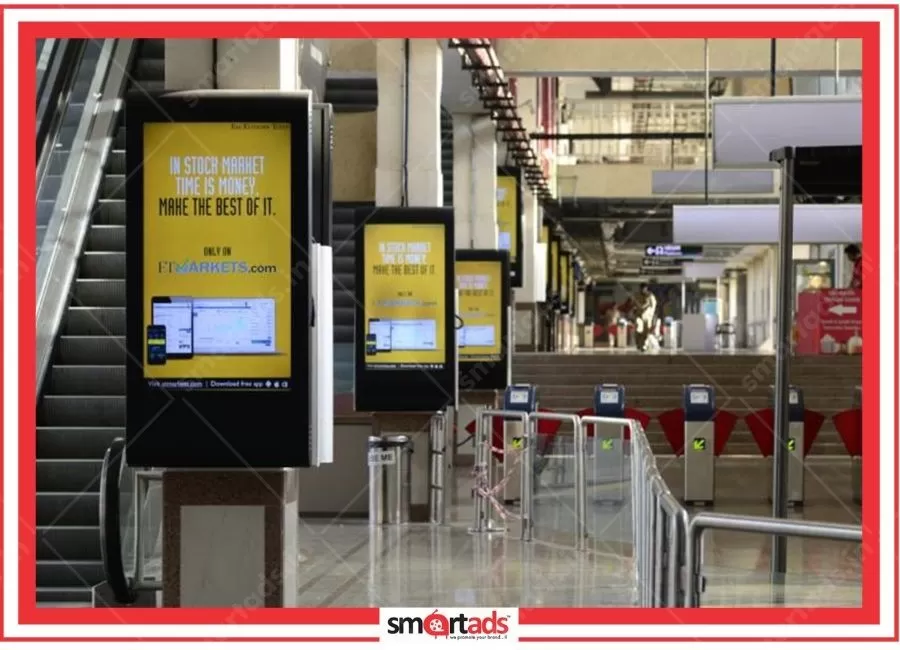
Entry Exit Panel
8 ft x 4 ft
Bright and vibrant multicolored letterin
Rate per Panel / Month
Min Requirement is 3 Panel.
₹48000.00
Showing 1 to 4 of 4 Results
MEDIA DETAILS
8 ft x 4 ft
Bright and vibrant multicolored letterin
Rate per Panel / Month
Min Requirement is 3 Panel.
₹48000.00
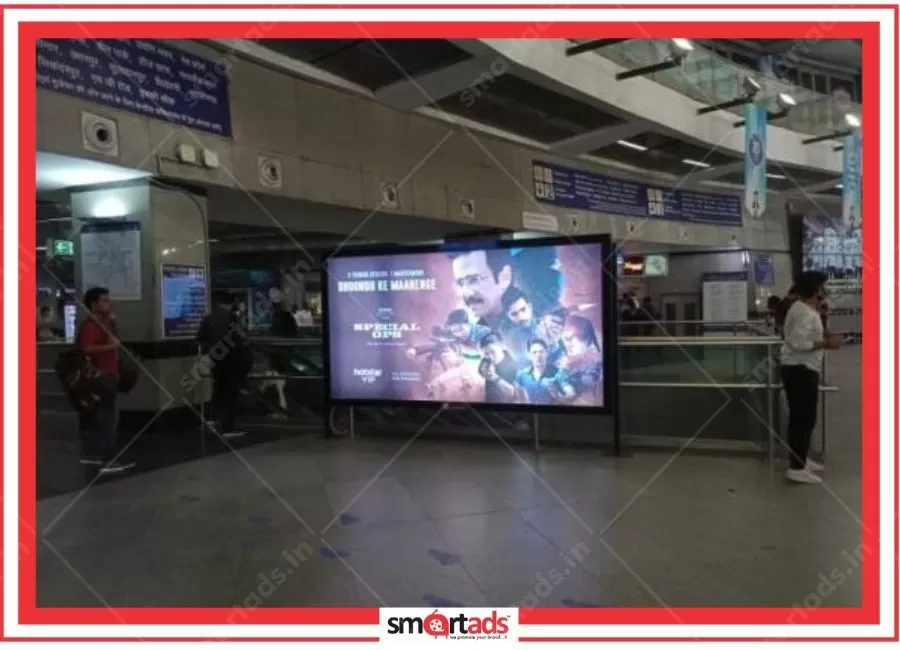
10 ft x 5 ft
A new wide wall system designed to accom
Rate per Panel / Month
Min Requirement is 3 Panel.
₹50000.00
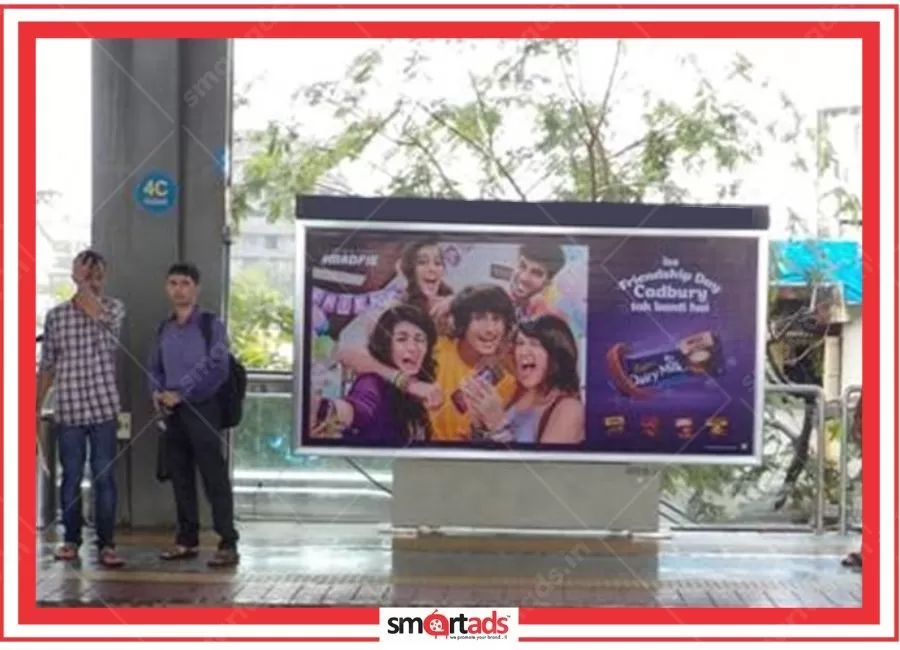
8 ft x 4 ft
A raised flooring or other horizontal su
Rate per Panel / Month
Min Requirement is 3 Panel.
₹35000.00
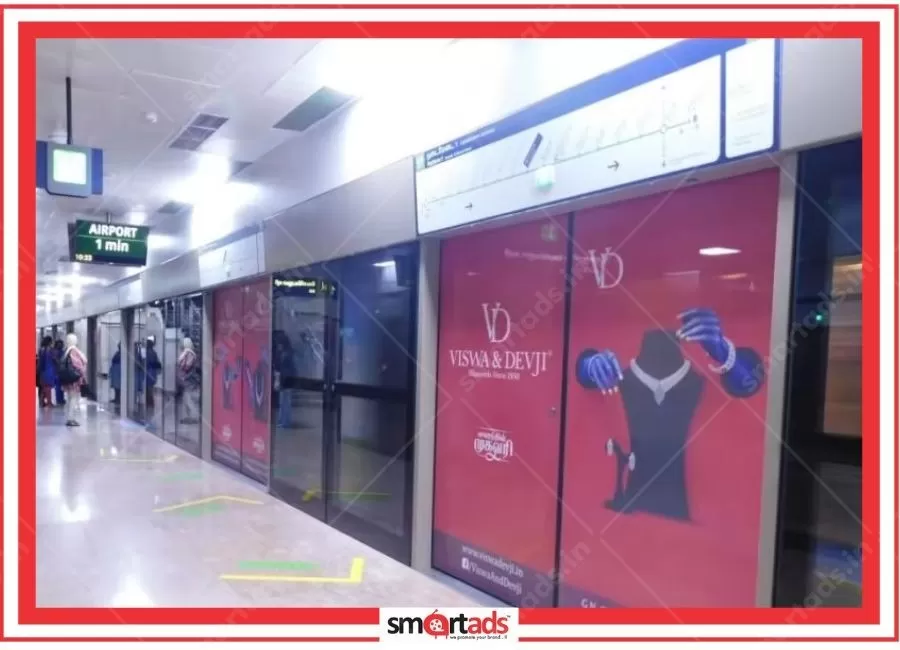
7 ft x 4 ft
Also known as platform edge doors (PEDs)
Rate per Plateform / Month
Min Requirement is 1 Stations.
₹1200000.00
MEDIA REACH

MinimumQty :
10
EstimateReachPeople :
15 Million
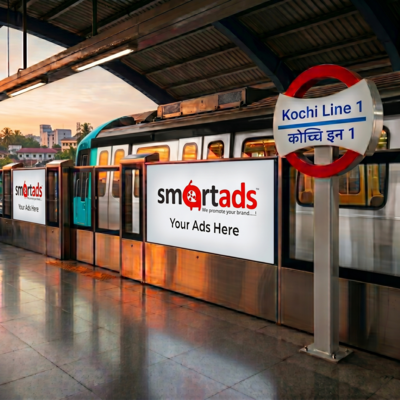
Kochi Metro's Blue Line — the original Line 1 corridor stretching from Aluva to Thrippunithura — carries somewhere in the neighbourhood of 65,000 to 70,000 passengers on a typical weekday, which means any brand placing itself along this route is reaching a captive, educated, largely urban audience that is almost impossible to replicate through conventional outdoor or print. What surprises most media planners when they first look at the numbers is how competitive the cost-per-contact works out to be relative to what you would spend chasing a similar demographic profile on social platforms. We have found, across dozens of campaigns planned through this corridor, that brands consistently underestimate what the metro environment does to message recall — and that is a mistake worth correcting before your next media plan goes to print.
Frankly speaking, a lot of brands treat metro station advertising as an afterthought — something they bolt onto a campaign after television and digital have already consumed the bulk of the budget. That thinking, in our experience, gets the logic exactly backwards. The Kochi Metro Line 1 corridor runs through some of the most commercially significant micro-markets in Kerala: Aluva, Edapally, Kaloor, MG Road, and Maharaja's College are not just transit stops — they are commercial and institutional nerve centres, which means the audience passing through them skews heavily toward working professionals, college students, and upper-middle-class households who are genuinely difficult to reach through mass media at an efficient cost.
The FICCI-EY Media and Entertainment Report has consistently flagged transit media as one of the fastest-growing out-of-home sub-categories in India, driven precisely by the expansion of metro rail networks in Tier 1 and emerging Tier 1 cities. Kochi sits in that second category — a city that punches well above its population size in terms of consumer spending power and brand aspiration — which makes Line 1 a particularly interesting proposition. At SmartAds, we always tell our clients that the question is not whether to include metro advertising in a Kerala campaign; the question is which stations to prioritise and which formats to combine for the best frequency-to-cost ratio.
What a lot of people miss is the dwell time advantage. A passenger waiting on a platform, or riding an escalator, or walking through a paid concourse, is not multitasking the way they are when they are scrolling a feed. The environment enforces a kind of passive attention that outdoor on a highway cannot replicate; the message is encountered at close range, in a controlled lighting environment, with no competing visual clutter beyond the station's own design language. That combination — captive audience, controlled environment, premium demographic — is genuinely rare in Indian media buying.
The inventory across Kochi Metro Line 1 is more varied than most planners initially assume, which is part of why a site visit or a detailed inventory brief from your media partner is worth doing before you finalise a plan. The core formats break down into platform-level placements — backlit panels, unipole-style station pillars, and digital screens on platforms — and concourse-level placements, which include entry gate wraps, ticket vending machine surrounds, and large-format wall panels in the paid zone. Each of these serves a different communication purpose; platform panels are best for sustained exposure during wait time, while concourse placements work harder for directional or call-to-action messaging because passengers are in motion and decision-making mode.
Beyond static and backlit formats, a handful of the higher-footfall stations — Edapally and MG Road being the two we have used most often for client campaigns — offer digital display screens, which allow copy rotation and time-of-day targeting. This is particularly useful for categories like banking and financial services, where morning commuters and evening commuters may need different messages. One financial services client we worked with ran a two-message rotation on the MG Road digital screens: a product awareness message during the 7–9 AM window and a branch-visit prompt during the 5–7 PM window, which produced a measurable uplift in branch walk-ins over a four-week period compared to the control period.
Train branding is the third major inventory category, which tends to get overlooked because it requires a longer lead time and a higher minimum commitment. Full train wraps on the rolling stock used on Line 1 deliver extraordinary reach because the branded train is seen not just by passengers inside but by platform audiences at every station it passes through, and by pedestrians and motorists at the several at-grade crossings along the Aluva–Edapally stretch. The cost for a full train wrap works out to somewhere between ₹8 lakh and ₹15 lakh per month depending on the train set and the duration of the commitment, which sounds significant until you model the number of impressions delivered across the full route in a 30-day period.
This is the question that comes up in virtually every briefing call, and the honest answer is that rates vary considerably depending on station tier, format size, and booking duration — but we can give you meaningful benchmarks that will help you build a realistic budget. A standard backlit panel at a mid-tier station like Kaloor or Palarivattom will typically be priced somewhere in the ballpark of ₹40,000 to ₹60,000 per month for a 4x6 feet format; the same format at a premium station like MG Road or Edapally can run closer to ₹80,000 to ₹1.2 lakh per month, which reflects the significantly higher daily footfall at those locations.
Concourse wraps and large-format installations at the busiest stations are priced differently — they are usually negotiated as a package rather than a per-panel rate, and the minimum campaign duration tends to be 30 days, though 60-day and 90-day bookings attract meaningful rate efficiencies. In our experience, a 90-day booking at a premium station will typically come in at somewhere between 15% and 20% cheaper on a per-day basis than a 30-day booking, which is a saving worth structuring your campaign calendar around if the brand's communication cycle allows it. Digital screen slots are generally sold in 10-second or 15-second spots within a loop, and the CPM works out to roughly ₹12 to ₹18 per thousand impressions — a number that surprises most clients when they compare it to what they are currently paying for YouTube pre-roll in the same geography.
Production costs are a separate line item that planners sometimes forget to account for. Vinyl printing for a backlit panel, installation, and dismantling will typically add somewhere between ₹8,000 and ₹20,000 to the total cost depending on format size and complexity; for a train wrap, production costs can be substantial — in the range of ₹2 lakh to ₹4 lakh — which is why we always advise clients to think of train branding as a three-month-minimum commitment so that the production cost is amortised effectively across the campaign period.
Not all 22 stations on Line 1 are created equal from a media planning perspective, and the temptation to buy across the entire corridor — which some vendors actively encourage — is one we have seen backfire when the budget would have been better concentrated at five or six high-impact locations. The stations that consistently deliver the best combination of footfall, demographic quality, and format availability are MG Road, Edapally, Aluva, Kaloor, and Maharaja's College; each of these serves a distinct audience profile, which makes them useful for different campaign objectives.
MG Road is the commercial and retail heart of Kochi's metro network, which means it attracts the highest concentration of office-going professionals and high-income shoppers — making it the default choice for financial services, luxury retail, and premium consumer brands. Edapally, by contrast, is a major interchange and commercial hub adjacent to Lulu Mall, which is one of the largest shopping centres in India by footfall; brands in FMCG, electronics, and fashion tend to find Edapally particularly effective because the audience is already in a shopping mindset. A retail client we worked with — a mid-premium apparel brand based in Pune expanding into Kerala — ran a six-week campaign concentrated at Edapally and MG Road, and their store footfall data showed a 34% increase in first-time visitors during the campaign period compared to the six weeks prior.
Aluva serves a somewhat different purpose: it is the northern terminus and a major interchange with road transport from Ernakulam's northern suburbs and from Thrissur district, which means it captures a wider geographic catchment than its urban location might suggest. For brands targeting the aspirational middle class — categories like education, two-wheelers, and consumer durables — Aluva tends to outperform its footfall numbers because the audience has a higher propensity to be in an active consideration phase.
The comparison that comes up most often in our planning conversations is between metro station inventory and conventional hoardings on NH-66 or the Bypass, which are the traditional premium OOH locations in Kochi. The honest answer is that they serve different purposes and should not be treated as substitutes. A highway hoarding delivers broad reach across a mixed demographic — commuters, truckers, tourists — while metro station advertising delivers a concentrated, repeatable impression on a specific, identifiable audience segment. The reach numbers favour the hoarding; the quality and frequency metrics favour the metro.
To put some rough numbers on it: a premium hoarding on the Bypass will typically be priced somewhere between ₹1.5 lakh and ₹2.5 lakh per month for a 40x20 feet format, which delivers high visibility but very limited audience data. The metro station, by contrast, gives you a captive audience in a controlled environment, with the added advantage that the same commuter is likely to see your panel multiple times per week — which builds frequency in a way that a single highway hoarding simply cannot. TAM AdEx data has consistently shown that out-of-home campaigns with high frequency-per-contact outperform low-frequency, high-reach campaigns on brand recall metrics, which is an argument that tends to resonate with brand managers who are tired of reach numbers that don't translate into awareness scores.
To be fair, there are categories where the highway hoarding wins: real estate, for instance, benefits from the geographic specificity of a highway location in a way that a metro station cannot replicate. But for categories where the target audience is urban, educated, and income-qualified — banking, insurance, EdTech, premium FMCG, healthcare — the metro station environment is genuinely superior, and the cost-per-qualified-contact calculation tends to make that case very clearly.
One of the most common planning mistakes we see is brands approaching metro station bookings with the same lead time they would use for a newspaper ad or a digital campaign. The inventory on Kochi Metro Line 1, particularly at the premium stations, is genuinely constrained — there are a finite number of backlit panels and digital screen slots, and the better locations tend to be booked two to four months in advance, especially around high-demand periods like Onam, Christmas, and the January–March quarter when consumer spending in Kerala peaks.
Our standard recommendation is to initiate the booking conversation at least eight weeks before the intended campaign start date; for a train wrap or a large-format concourse installation, twelve weeks is more realistic because the production process for vinyl wraps on rolling stock requires KMRL (Kochi Metro Rail Limited) approval at multiple stages, which adds time that cannot be compressed. A retail brand we worked with learned this the hard way when they approached us six weeks before Onam with a brief for a full train wrap — we were able to secure the inventory, but the compressed production timeline added approximately ₹60,000 in rush charges that could have been avoided with an earlier start.
Campaign duration also affects creative strategy in ways that are worth thinking through at the brief stage. A 30-day campaign is well-suited to a product launch or a promotional push; a 60-day or 90-day campaign allows the brand to build genuine recall among the regular commuter base, which is where the compounding effect of frequency really starts to show up in awareness research. The GroupM TYNY Report has noted that transit media performs significantly better on brand linkage scores when campaigns run for a minimum of 45 days — a finding that aligns with what we have observed across our own client campaigns on this corridor.
The answer differs meaningfully depending on what the brand is trying to accomplish, which is why we always push back on briefs that treat this as a binary yes-or-no question. For a regional brand — a Kerala-based financial cooperative, a local hospital group, a regional retail chain — Line 1 is almost self-evidently the right environment because the audience is exactly the urban Kerala consumer they are trying to reach, and the brand's regional credibility actually works in its favour in this context. The metro station environment carries a certain aspirational quality that benefits brands which want to signal modernity and urban relevance without abandoning their local identity.
For national brands, the calculus is slightly different but still compelling. Kerala consistently ranks among the top states in India for per-capita consumer spending, literacy rates, and media consumption — metrics that make it a priority market for categories ranging from FMCG to financial services to consumer electronics. A national brand that is building a Kerala-specific push, or that is trying to establish presence in Kochi ahead of a broader South India expansion, will find that Line 1 delivers an audience quality that is difficult to match through any other single medium in the city. At SmartAds, we have planned campaigns for national automotive brands, pan-India EdTech companies, and multinational FMCG players on this corridor, and the consistent finding is that Kochi Metro audiences over-index on brand consideration and purchase intent relative to the cost of reaching them.
One automotive brand we worked with — a two-wheeler manufacturer launching a premium commuter model — ran a 45-day campaign across six Line 1 stations, combined with a digital retargeting layer that served ads to users in the station geofences. The combined campaign produced a test-drive booking rate that was roughly 2.3 times higher in the Kochi metro catchment than in comparable campaigns run in other South Indian cities without the metro station component, which was a result that shifted how that client thought about transit media allocation going forward.
Standalone metro station campaigns are relatively rare in our experience, and they tend to underperform relative to campaigns where the metro placement is integrated with at least one or two other media touchpoints. The reason is straightforward: metro advertising builds frequency and salience among a specific audience segment, but it does not always generate the initial awareness that makes the metro message land with full impact. Television or digital display can do that awareness-building work efficiently, while the metro station placement then reinforces the message in a high-attention environment at a moment when the consumer is receptive.
The integration model we have found most effective for Kochi campaigns combines regional television — specifically Malayalam news and entertainment channels, which have among the highest per-household viewership rates in India according to BARC data — with metro station placements at three to five high-footfall stations, and a digital retargeting layer that captures mobile users within the station geofences. This three-part structure allows the brand to build reach through television, reinforce with high-frequency physical presence in the metro environment, and then follow up with a personalised digital message that drives a specific action. The cost of running all three elements simultaneously is often lower than planners expect, particularly when a single media partner is handling the coordination across channels.
Radio is another medium that pairs particularly well with metro advertising in Kochi, partly because a significant proportion of metro commuters are also car owners who listen to radio during their non-metro commutes — which means the radio spot can reach the same audience in a different context and reinforce the metro message. Radio Kerala and private FM stations in Kochi have strong reach among the 25–45 urban professional demographic, which overlaps heavily with the metro commuter profile; a coordinated campaign across both channels tends to produce brand recall scores that are meaningfully higher than either medium alone.
This is where a lot of campaigns fall short — not in the planning or execution, but in the measurement framework. Metro station advertising is an OOH medium, which means it does not come with the click-through rates and conversion pixels that digital campaigns generate automatically; measurement requires deliberate planning and, in some cases, primary research. The metrics we recommend tracking fall into three broad categories: reach and frequency estimates based on footfall data, brand health metrics tracked through pre- and post-campaign surveys, and downstream business metrics like store footfall, website traffic from the Kochi geography, or sales data from the campaign period.
KMRL publishes ridership data that can be used to construct reach and frequency estimates at the station level; a panel at a station with 8,000 daily entries will deliver a different reach profile than one at a station with 25,000 daily entries, and these numbers should be built into the campaign evaluation model from the start. Frequency estimates require an assumption about what proportion of the daily ridership is regular commuters versus occasional users — in our experience, somewhere between 55% and 65% of Kochi Metro ridership on Line 1 consists of regular commuters who travel the same route at least three times per week, which means a 30-day campaign delivers a meaningful frequency level to that core audience.
Brand health tracking — awareness, consideration, and message recall — is the metric that most clearly demonstrates the value of a metro campaign to senior stakeholders who are used to digital attribution models. We recommend running a simple intercept survey or an online panel survey among Kochi Metro users before and after the campaign; the cost of this research is modest relative to the media spend, and the data it produces is far more persuasive in a budget review meeting than footfall estimates alone. One FMCG client we worked with ran this kind of pre-post measurement for the first time on a Kochi Metro campaign and found that unaided brand awareness among Line 1 commuters increased by 18 percentage points over a 60-day campaign period — a result that justified a significant increase in their transit media allocation for the following year.
Q: What is the minimum budget required to run a campaign on Kochi Metro Line 1?
The practical minimum for a meaningful campaign — one that will actually move brand metrics rather than simply tick a box — is somewhere in the range of ₹2.5 lakh to ₹3.5 lakh for a 30-day period, which would typically cover two or three mid-tier station panels with production costs included. That said, we would generally advise against running at the absolute minimum unless the campaign objective is very specific and the station selection is highly targeted; a slightly higher investment of ₹5 lakh to ₹8 lakh opens up access to premium station formats and allows for a more strategic placement mix that will deliver meaningfully better results. The important thing is not to spread a limited budget too thin across too many stations — concentration at two or three high-footfall locations will almost always outperform a diluted presence across eight or ten stations.
Q: How long does it take to get a campaign live on Kochi Metro Line 1?
The standard lead time from booking confirmation to campaign go-live is somewhere between three and five weeks for static formats — this covers the KMRL approval process, artwork sign-off, production, and installation. Digital screen campaigns can sometimes be turned around in two to three weeks because there is no physical production involved, but the approval process still takes time and should not be assumed to be instantaneous. Train wrap campaigns require the longest lead time — typically eight to twelve weeks — because the production complexity and the operational coordination with KMRL's maintenance schedule add stages that cannot be rushed. Our strong recommendation is to build these lead times into your campaign calendar from the outset rather than treating them as variables that can be compressed under deadline pressure.
Q: Can small and medium-sized businesses advertise on Kochi Metro Line 1, or is it only for large brands?
Metro station advertising on Line 1 is genuinely accessible to SMEs, and frankly speaking, some of the most effective campaigns we have planned on this corridor have been for regional brands with budgets that would be considered modest by national advertiser standards. The key for an SME is to be very precise about station selection — rather than trying to cover the whole corridor, a local business should identify the one or two stations that are closest to their catchment area or that serve their specific target demographic, and concentrate their entire budget there. A single well-placed panel at MG Road or Edapally, maintained for 60 to 90 days, can build genuine brand recognition among a highly relevant audience at a cost that is often comparable to what the same business would spend on a month of digital advertising with far less demographic precision.
Q: What kind of creative works best in the metro station environment?
The metro station environment rewards simplicity and visual impact above almost everything else; this is not the place for dense copy or complex messaging hierarchies. The most effective creative we have seen on this corridor tends to follow a simple formula: one dominant visual, a maximum of seven to eight words of headline copy, and a single clear brand identifier. The viewing distance and dwell time vary significantly depending on the format — a platform panel is viewed from a distance of three to six metres for a sustained period, while a concourse panel may be viewed from closer range but for a shorter time — which means the creative brief should specify the format and location before the design process begins, not after. Brands that adapt their existing television or print creative for the metro environment without rethinking the format for the specific context tend to get mediocre results; brands that brief specifically for the metro environment tend to get results that justify the investment very clearly.
Q: Does SmartAds handle the KMRL approval process, or does the brand need to manage that separately?
At SmartAds, we handle the end-to-end process including KMRL liaison, artwork submission, approval coordination, production management, and installation supervision — the brand or their marketing team does not need to manage any part of the approval process directly. This is one of the practical advantages of working with a media partner that has an established relationship with KMRL and understands the specific requirements for artwork specifications, content compliance, and installation scheduling. The approval process does require that creative content comply with KMRL's content guidelines — which prohibit certain categories of advertising and have specific requirements around political and religious content — and we brief clients on these requirements at the outset so that the creative development process does not produce work that needs to be reworked at the approval stage.
Q: How does Kochi Metro Line 1 advertising perform for digital-first brands trying to build offline presence?
This is a question we are getting more often as EdTech, FinTech, and D2C brands look for ways to build brand credibility beyond their digital channels, and the honest answer is that the metro environment works very well for this purpose. Digital-first brands often have strong performance marketing metrics but weak brand recall among audiences who have not already encountered them online; the metro station environment reaches exactly the kind of urban, educated, digitally-active consumer who is the target audience for most of these brands, but it reaches them in a physical context that builds a different kind of brand trust than a social media ad. We have found that digital-first brands which add a metro station component to their media mix in Kochi tend to see improvements in branded search volume and direct traffic from the Kochi geography during and after the campaign period — which is a measurable downstream indicator that the offline investment is generating online brand interest.
The brands that get the most out of Kochi Metro Line 1 advertising are, almost without exception, the ones that approach it as a strategic medium rather than a tactical add-on — which means thinking carefully about station selection, format mix, campaign duration, and measurement framework before the booking is confirmed rather than after. The corridor has genuine media value that is still not fully reflected in what most brands are spending there; the audience quality, the dwell time advantage, and the frequency potential among regular commuters combine to produce a cost-per-qualified-contact that is difficult to match through any other single medium in Kochi at a comparable budget level.
The integration opportunity is also worth taking seriously. Metro station advertising on Line 1 works best when it is part of a coordinated plan that includes at least one reach medium — television, radio, or digital — and ideally a downstream conversion mechanism like a geofenced mobile campaign or a proximity-triggered digital touchpoint. The brands that treat metro advertising as one element in a thoughtfully constructed media ecosystem consistently outperform those that treat it as a standalone buy, and the incremental cost of adding the integration layer is usually modest relative to the improvement in campaign outcomes.
If you are building a media plan for Kochi — whether for a regional launch, a national brand's Kerala push, or an SME looking to build local brand presence — we would encourage you to give Line 1 a more prominent role than it typically receives in first-draft media plans. The inventory is finite, the premium locations book up faster than most planners expect, and the brands that move early tend to secure the best placements at the best rates. At SmartAds, we work with clients across the full spectrum of budgets and objectives on this corridor, and we are genuinely happy to put together a station-by-station analysis and rate card for any brand that wants to understand what a well-structured campaign here could look like. You can reach us at SmartAds.in to start that conversation — no commitment required, just a clear picture of what the medium can realistically deliver for your specific brief.
