
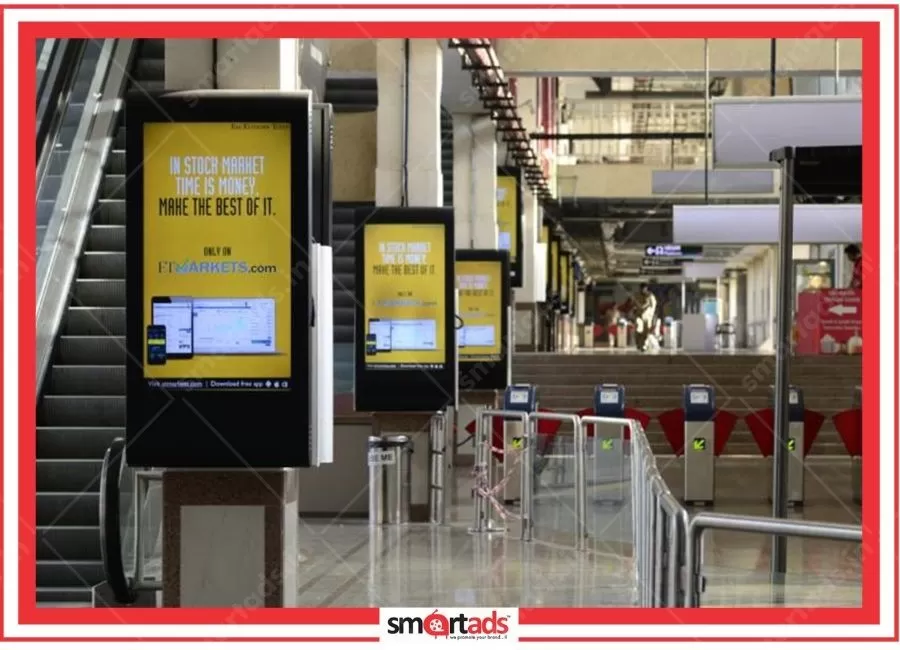
Entry Exit Panel
8 ft x 4 ft
Bright and vibrant multicolored letterin
Rate per Panel / Month
Min Requirement is 3 Panel.
₹48000.00
Showing 1 to 4 of 4 Results
MEDIA DETAILS
8 ft x 4 ft
Bright and vibrant multicolored letterin
Rate per Panel / Month
Min Requirement is 3 Panel.
₹48000.00
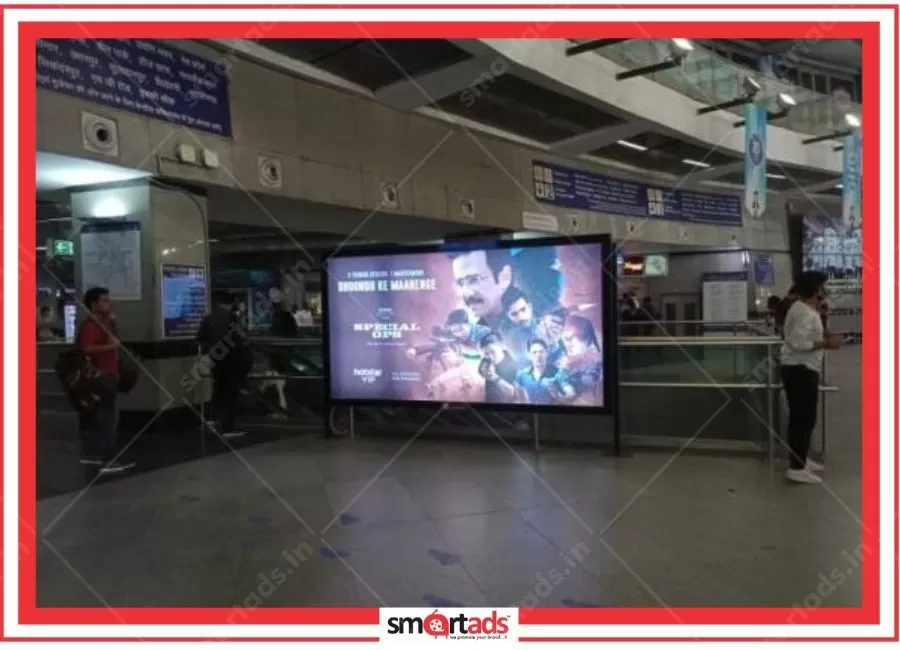
10 ft x 5 ft
A new wide wall system designed to accom
Rate per Panel / Month
Min Requirement is 3 Panel.
₹50000.00
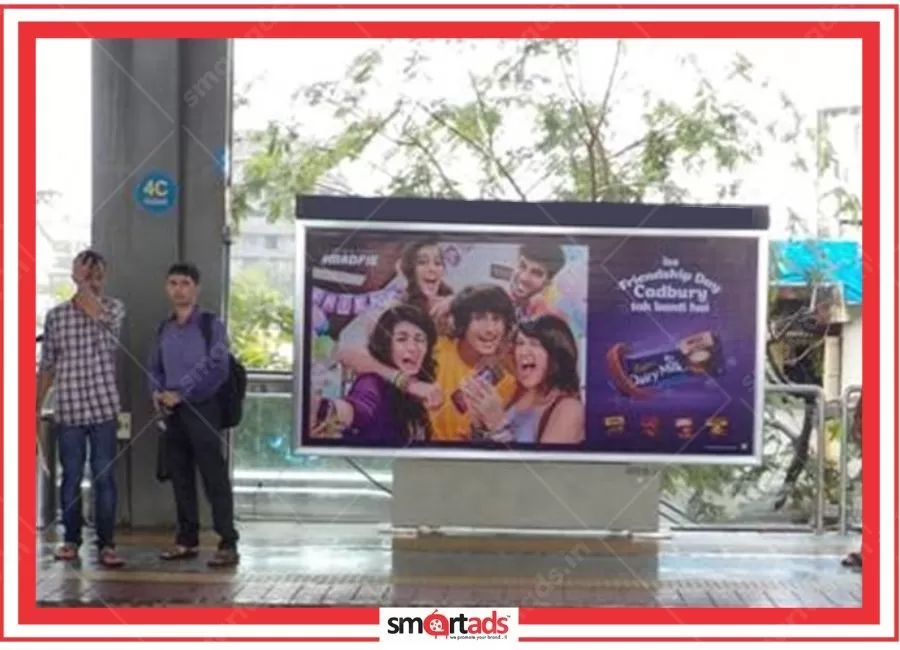
8 ft x 4 ft
A raised flooring or other horizontal su
Rate per Panel / Month
Min Requirement is 3 Panel.
₹35000.00
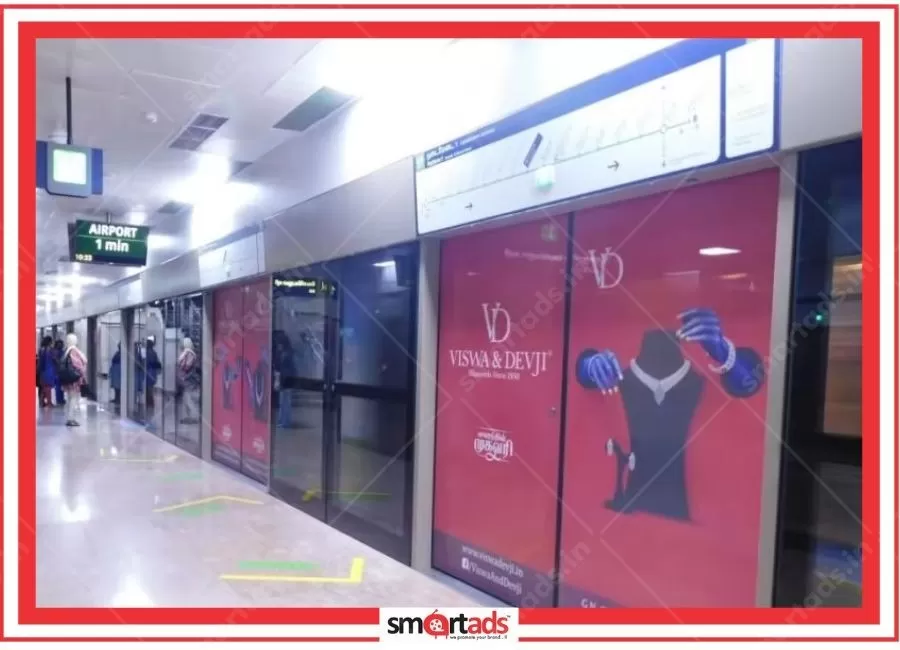
7 ft x 4 ft
Also known as platform edge doors (PEDs)
Rate per Plateform / Month
Min Requirement is 1 Stations.
₹1200000.00
MEDIA REACH

MinimumQty :
10
EstimateReachPeople :
15 Million
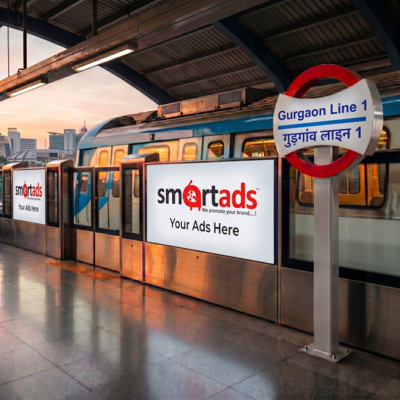
Most brands still treat metro advertising as a supplementary channel — something you bolt onto a campaign after the television and digital budgets are locked. That instinct, frankly speaking, costs them a great deal. The Yellow Line, which connects Samaypur Badli in Delhi all the way down through Huda City Centre in Gurgaon, carries somewhere in the ballpark of 5 to 6 lakh daily commuters through its Gurgaon stations alone, which means you are looking at one of the most concentrated, captive, and economically active audiences that any out-of-home format in the NCR can deliver.
The Yellow Line's Gurgaon stretch — running through stations like Huda City Centre, Sikandarpur, MG Road, IFFCO Chowk, Guru Dronacharya, Arjan Garh, Ghitorni, Sultanpur, Chattarpur, and Qutab Minar before entering Delhi — is not ordinary transit real estate. These stations sit at the intersection of corporate Gurgaon and residential Gurgaon, which means the footfall profile is unusually premium. A significant proportion of daily commuters through Sikandarpur and MG Road stations are working professionals from the financial services, IT, and consulting sectors — the exact demographic that most FMCG, banking, automobile, and D2C brands spend considerable sums chasing on Instagram and LinkedIn.
What a lot of people miss is that the dwell time at metro stations is fundamentally different from roadside hoarding exposure. A commuter waiting on a platform for three to five minutes, or standing in a queue at a token counter, is not moving at 60 kilometres per hour; they are stationary, mildly bored, and visually available in a way that no highway billboard can replicate. Our experience at SmartAds shows that recall scores for metro station creatives — particularly platform-level displays and concourse backlit panels — tend to run 30 to 40 percent higher than equivalent roadside formats in the same geography, a pattern we have observed consistently across campaigns in the NCR market.
To be fair, the channel is not without its constraints. Creative formats are regulated by DMRC, which means certain categories face restrictions, and the booking process involves navigating a multi-vendor ecosystem that can be opaque for first-time buyers. That is precisely where having an experienced media partner matters; the difference between a well-negotiated package and an off-the-shelf rate card can be substantial, often in the range of 15 to 25 percent on total outlay.
Not all stations on Line 1's Gurgaon section are equal, and treating them as interchangeable is one of the more expensive mistakes we see brands make. Huda City Centre, which is the southern terminus of the Yellow Line, commands the highest footfall among Gurgaon stations and functions as a major interchange hub — commuters arriving from Sohna Road, Golf Course Road, and the DLF sectors all funnel through this station, which makes it the anchor property for any serious Line 1 campaign. The advertising inventory here includes platform screen door panels, concourse lightboxes, and pillar wraps, each of which reaches a slightly different audience moment.
Sikandarpur and MG Road stations are, in our assessment, the most strategically interesting properties on the Gurgaon stretch for premium brands. Sikandarpur sits directly adjacent to the Cyber Hub and DLF Cyber City complex, which houses the Indian offices of dozens of multinational corporations; the commuter profile here skews heavily toward 25-to-40-year-old professionals with household incomes that make them attractive targets for financial products, luxury automobiles, and premium lifestyle brands. MG Road station, meanwhile, benefits from its proximity to the Galleria Market and several high-footfall residential catchments, which gives it a slightly more mixed but still premium audience profile.
IFFCO Chowk deserves a special mention because it is one of the busiest interchange points for bus-to-metro transfers in Gurgaon, which means it captures a broader socioeconomic cross-section than the pure office-corridor stations. For mass-market FMCG brands, telecom players, or education companies targeting a wider demographic, IFFCO Chowk often delivers better cost-per-thousand numbers than the more premium stations, even though the absolute footfall at Sikandarpur may be higher.
This is the question every client asks first, and we understand why — rate transparency in the metro advertising space has historically been poor. The honest answer is that costs vary considerably depending on format, station tier, duration, and whether you are buying through DMRC's authorised concessionaire or through a media buying partner who has negotiated bulk inventory. That said, we can offer some useful benchmarks from our own buying experience.
For a standard backlit concourse panel at a Tier 1 station like Huda City Centre or Sikandarpur, monthly rates typically work out to somewhere between ₹80,000 and ₹1.5 lakh per face, depending on panel size and exact placement. Platform-level displays, which enjoy higher dwell-time exposure, tend to command a premium of roughly 20 to 30 percent over equivalent concourse placements. Train wrap advertising — which involves branding the exterior or interior of an entire train rake — is a different proposition altogether; a full train wrap on the Yellow Line can run into the range of ₹8 to 12 lakh per month, which sounds significant until you calculate the impression volume across the entire Delhi-Gurgaon corridor and the CPM works out to roughly ₹6 to ₹9, a number that surprises most brand managers when they compare it to what they are currently paying for programmatic display reach in the same geography.
At SmartAds, we always tell our clients that the real value calculation for metro advertising is not the rate card number — it is the cost per verified impression against a specific audience profile. When you factor in the captive dwell time, the income profile of Gurgaon Line 1 commuters, and the creative impact of large-format backlit panels in a relatively uncluttered environment, the effective CPM compares very favourably with digital channels that are technically cheaper but considerably noisier. A campaign we ran for a fintech brand targeting salaried professionals in Gurgaon found that the metro station component, which accounted for roughly 30 percent of the total budget, drove nearly 55 percent of the tracked brand recall lift — a result that reshaped how that client allocated budget in subsequent quarters.
The Delhi Metro Rail Corporation operates one of the more structured advertising regulatory environments among Indian transit systems, which is both a blessing and a source of frustration for media planners. On the positive side, the regulatory structure means inventory is well-maintained, displays are professionally managed, and there is genuine accountability for installation quality — something that cannot always be said of unorganised OOH markets. The flip side is that certain product categories face outright restrictions, and creative executions must conform to DMRC's content guidelines, which prohibit certain imagery, messaging styles, and competitive comparisons.
Category restrictions are worth understanding before you commit budget. Alcohol advertising is prohibited across all DMRC properties, as is tobacco in any form; political advertising is tightly controlled and essentially unavailable for commercial brands. Certain pharmaceutical categories require pre-approval, and financial products must carry regulatory disclosures in formats that DMRC specifies — which can affect creative design significantly. We have seen campaigns delayed by two to three weeks because these compliance requirements were not factored into the production timeline, which is a costly mistake when you are trying to synchronise metro activity with a broader campaign launch.
The booking process itself involves working with DMRC-authorised concessionaires, of which there are a limited number for the Gurgaon stretch. Inventory is finite and popular stations book up well in advance — particularly for Q4 (October through December), which coincides with the festive season and sees demand from FMCG, retail, and e-commerce brands spike considerably. Our recommendation is to initiate conversations at least eight to ten weeks before your intended campaign start date, and to have creative assets in a near-final state before booking confirmation, since DMRC requires creative approval as part of the process.
Platform screen door panels are, in our experience, the most underrated format on the Gurgaon metro stretch. These panels sit directly at eye level on the glass doors that separate the platform from the tracks, which means every commuter waiting for a train is essentially forced into a direct line of sight with the creative. The format is particularly effective for campaigns that rely on visual impact — luxury brands, automotive launches, and retail promotions tend to perform especially well here because the large format and backlit quality allow for rich creative execution.
Concourse lightboxes serve a different function; they work best for messages that require slightly more copy or information hierarchy, since commuters passing through the concourse are walking at a moderate pace and can absorb more content than someone glancing at a platform door panel. Banking and financial services brands, education companies, and real estate developers have historically found concourse placements productive for this reason. Pillar wraps, which are three-dimensional and visible from multiple angles simultaneously, are excellent for brand awareness campaigns where the goal is simply maximum visual presence rather than message complexity.
Digital screens — which are available at select Gurgaon stations and are managed through DMRC's digital out-of-home network — represent an interesting emerging option; they allow for dayparting, which means you can run different creatives at morning rush hour versus evening peak, and they support short video loops that static formats cannot. The cost premium over static formats is real, running roughly 40 to 60 percent higher on a per-face basis, but for brands with strong video assets and a message that benefits from motion, the investment is often justified. One retail client we worked with in the consumer electronics category used digital screens at IFFCO Chowk and Sikandarpur to run product demonstration loops during evening peak hours, which aligned with the post-work browsing behaviour of their target audience and contributed to a measurable uplift in footfall at their nearby store.
Gurgaon is one of the most competitive OOH markets in India, with significant inventory across NH-48, Golf Course Road, Sohna Road, and the various sector roads that connect the city's commercial and residential zones. Roadside hoardings on NH-48, which is arguably the most premium outdoor corridor in the NCR, command rates that can reach ₹3 to 5 lakh per month for a large-format unipole — impressive reach numbers, certainly, but the audience profile is broad and the dwell time is essentially zero for a vehicle travelling at highway speeds.
Metro station advertising on Line 1 offers something that roadside OOH fundamentally cannot: a guaranteed minimum exposure duration. The average commuter spends somewhere between four and eight minutes at a metro station during their journey — waiting on the platform, navigating the concourse, queuing at the entry gates — which means the creative has a genuine opportunity to register. This is not a theoretical advantage; it is reflected in the recall data we have seen from post-campaign studies. The FICCI-EY Media and Entertainment Report has consistently highlighted transit advertising as one of the faster-growing OOH sub-segments in India, driven precisely by this dwell-time advantage in an increasingly fragmented media environment.
That said, metro advertising and roadside OOH are not substitutes for each other — they serve different functions in a well-constructed media plan. At SmartAds, our standard recommendation for brands targeting the Gurgaon premium audience is to use metro station placements as the primary brand-building vehicle and supplement with roadside formats on key arterial roads for frequency building. The combination typically delivers better cost efficiency than either channel in isolation, and the geographic alignment between Line 1 stations and major commercial corridors makes the integration relatively straightforward to execute.
A meaningful campaign on Gurgaon Line 1 — one that achieves genuine market presence rather than token visibility — requires a minimum commitment that most brand managers should plan for carefully. In our experience, a three-station package covering Huda City Centre, Sikandarpur, and IFFCO Chowk with standard concourse placements at each station runs somewhere in the range of ₹3.5 to 5 lakh per month in total media cost, before production. That is the entry point for a campaign that will actually be noticed; single-station buys at lower-traffic stations can be executed for less, but the reach and frequency numbers rarely justify the creative production investment.
For brands with more ambitious objectives — a product launch, a market entry, or a competitive conquest campaign — a full-corridor approach covering all Gurgaon stations on Line 1, combined with platform screen door panels at the two or three highest-traffic stations, can be structured for somewhere between ₹12 and 18 lakh per month, which sounds like a significant number until you calculate the daily impression volume and the audience quality. A campaign of this scale, well-executed, would deliver somewhere in the ballpark of 15 to 20 lakh impressions per month against the Gurgaon commuter base — a reach number that is genuinely difficult to achieve through any other single OOH format in the city at comparable audience quality.
Production costs are a separate line item and should not be underestimated. DMRC requires high-quality print production for static formats, and the specifications are exacting; poor-quality production not only looks bad but can result in rejection at the installation stage. Budget somewhere between ₹50,000 and ₹1.5 lakh for production depending on the number of formats and sizes, and factor in a two-week lead time for production and DMRC approval. We have seen brands try to cut corners on production to protect the media budget, and the results are almost always counterproductive — a mediocre creative on a premium placement is worse than no placement at all, because it actively damages brand perception among a high-value audience.
Measurement is where metro advertising has historically been weakest, and it is a legitimate concern that any serious media planner should address before committing budget. The good news is that the measurement toolkit has improved considerably over the past few years; the less good news is that it still requires deliberate planning rather than passive data collection.
Footfall data from DMRC, which is available in aggregated form through the concessionaire, provides a baseline for impression estimation — but it is important to understand that this is a gross reach number, not a verified exposure figure. More sophisticated measurement approaches include mobile location data analysis, which can track devices that appear in the station catchment area and subsequently show up in brand search or website traffic data; this methodology, while imperfect, provides a reasonable proxy for campaign-driven behaviour change. We have used this approach for several campaigns on the Gurgaon stretch, and the correlation between metro campaign periods and branded search uplift has been consistent enough to give us confidence in the channel's contribution.
Brand recall studies — conducted via intercept surveys or digital panels targeting commuters in the relevant geography — remain the most direct measurement tool, and we recommend commissioning one for any campaign with a monthly media investment above ₹5 lakh. The cost of a credible recall study is typically in the range of ₹1 to 2 lakh, which is a small fraction of the media investment but provides the kind of documented ROI evidence that makes internal budget justification considerably easier. The GroupM TYNY Report has noted the growing sophistication of OOH measurement in Indian markets, and transit advertising specifically is benefiting from the integration of mobile data with traditional footfall metrics — a trend that is making the channel easier to justify to data-driven marketing teams.
The honest answer is that almost any brand targeting the Gurgaon working professional demographic can find value on Line 1, but some categories are structurally better suited to the format than others. Financial services — banking, insurance, mutual funds, and the newer fintech players — are perhaps the single most natural fit; the audience profile at Sikandarpur and Huda City Centre stations is almost precisely the target demographic for these products, and the dwell time allows for slightly more complex messaging than a roadside format permits.
Automotive brands, particularly in the premium and mid-premium segments, have historically been heavy users of metro station advertising in Gurgaon, and for good reason. The commuter who takes the metro from Huda City Centre to Cyber City is, statistically, also a car owner or an aspiring car owner — the metro is a convenience choice, not a necessity choice, for a significant portion of the Gurgaon commuter base. This creates an interesting paradox where transit advertising reaches people who are not primarily defined by their transit behaviour, which makes the audience more valuable than a naive reading of the channel would suggest.
Real estate developers have also found the Gurgaon metro stretch productive, particularly for projects in the southern Gurgaon and Sohna Road corridors that are geographically adjacent to the Line 1 catchment. Education brands — both K-12 and higher education, as well as test preparation and upskilling platforms — have seen strong results, particularly at stations near residential catchments. What we tell our clients is that the question is not whether metro advertising works for your category, but whether your creative is calibrated for the format; a creative designed for a 30-second television spot will not automatically translate to a platform screen door panel, and brands that invest in format-specific creative consistently outperform those that repurpose existing assets.
Q: How far in advance do I need to book metro station advertising on Gurgaon Line 1?
The booking lead time is one of the most frequently underestimated aspects of metro advertising, and getting it wrong can derail an otherwise well-planned campaign. For standard concourse and platform placements at Tier 1 stations like Huda City Centre and Sikandarpur, we recommend initiating the booking process at least eight weeks before your intended campaign start date; during the festive season — roughly September through December — that lead time should be extended to ten or twelve weeks because demand from FMCG, retail, and e-commerce brands is intense and inventory at premium stations sells out quickly. The booking process involves creative approval by DMRC, which typically takes five to seven working days once the artwork is submitted, and production and installation require an additional week to ten days. Brands that try to compress this timeline invariably encounter either delays or compromises on placement quality, neither of which serves the campaign well.
Q: Can small and mid-sized brands afford Gurgaon Line 1 metro advertising, or is it only for large advertisers?
This is a question we get fairly often, and the answer is more encouraging than most people expect. A single-station campaign at a mid-tier station like Guru Dronacharya or Arjan Garh — which still delivers meaningful footfall — can be structured for a monthly media investment of roughly ₹80,000 to ₹1.2 lakh, which is within reach for many mid-sized brands. The key is to be strategic about station selection rather than trying to achieve corridor-wide presence on a limited budget; one well-chosen station with excellent creative will outperform three mediocre placements spread across the corridor. We have worked with several mid-sized brands — a D2C skincare company and a regional education platform among them — who achieved strong results from single-station campaigns by concentrating their budget on the right station and investing properly in creative production. The format rewards strategic thinking more than raw budget size.
Q: What creative specifications does DMRC require for metro station advertising?
DMRC's creative specifications are detailed and non-negotiable, which is why we always advise clients to involve their creative agency and media partner in the specification conversation before production begins rather than after. Static backlit panels require high-resolution print files — typically at 720 DPI or higher at actual size — and DMRC specifies exact bleed and safe zone dimensions for each format, which vary by station and placement type. Content must comply with DMRC's advertising policy, which prohibits certain categories outright and requires specific disclaimers for financial and pharmaceutical advertising. Digital screen content must be submitted as video files conforming to specific resolution and file size parameters, and loop duration is regulated. The approval process typically takes five to seven working days, but revisions — which are common for first-time metro advertisers who are unfamiliar with the guidelines — can add another week. Our standard practice is to submit creative for informal review before the formal approval submission, which significantly reduces the risk of rejection and delay.
Q: How does metro station advertising on Gurgaon Line 1 integrate with digital campaigns?
The integration between metro advertising and digital channels is one of the more interesting strategic opportunities available to Gurgaon-focused advertisers, and it is an area where we have seen significant innovation over the past two to three years. The most straightforward integration is geographic — running targeted social media and programmatic display campaigns against audiences in the pin codes and sectors served by Line 1 stations, so that commuters who see your metro creative are also encountering your brand on their phones during the same period. This creates a frequency multiplier effect that neither channel can achieve in isolation; the metro placement builds visual brand association, and the digital touchpoint reinforces the message in a more interactive environment. More sophisticated integrations use mobile location data to identify devices that have been detected in the station catchment area and then retarget those specific devices with digital advertising — a methodology that is technically feasible and increasingly common among sophisticated advertisers in the NCR market.
Q: What is the minimum campaign duration for metro station advertising on Line 1?
DMRC and its authorised concessionaires typically require a minimum booking duration of one calendar month for static formats, which is the standard unit of sale across most Indian metro systems. Shorter durations are occasionally available for digital screen placements, where weekly or even daily bookings can sometimes be negotiated — but these are exception cases rather than standard offerings, and the per-day rate for short-duration digital bookings is considerably higher than the effective daily rate of a monthly contract. Our experience is that a single month is rarely sufficient to build meaningful brand recall from metro advertising; the research suggests that consistent exposure over two to three months is required for the format to deliver its full awareness-building potential. Brands that commit to a quarter — three consecutive months — typically see a step-change in recall metrics in the third month that does not appear in shorter campaigns, which is why we generally recommend a minimum three-month planning horizon for clients who are serious about building brand presence on the Gurgaon metro corridor.
Q: Are there any category restrictions I should be aware of before planning a Gurgaon metro campaign?
Category restrictions on DMRC properties are more extensive than many advertisers realise, and discovering a restriction after creative has been produced is an expensive and frustrating experience. Alcohol and tobacco advertising is prohibited entirely, with no exceptions. Political advertising is not available for commercial brands. Certain pharmaceutical categories — particularly prescription medicines and products making health claims — require pre-approval from DMRC and may be subject to additional content restrictions. Financial services advertising must carry SEBI or IRDAI-mandated disclaimers in formats specified by DMRC, which can significantly affect creative design. Competitive advertising that directly names or disparages competitors is not permitted. Beyond outright prohibitions, DMRC's content guidelines restrict certain types of imagery and messaging that might be considered offensive or inappropriate in a public transit environment — which is a broader category than it might initially appear. We always recommend a category and creative pre-check with the concessionaire before committing to production, because the cost of that conversation is zero and the cost of discovering a restriction at the approval stage is considerable.
The brands that get the most from Gurgaon Line 1 metro advertising are not necessarily the ones with the largest budgets; they are the ones that approach the channel with genuine strategic intent, invest in format-appropriate creative, and commit to a duration that allows the medium to work. Metro advertising rewards patience and consistency in a way that digital channels — with their instant feedback loops and real-time optimisation — do not always require, and that requires a different kind of organisational discipline.
What we have found, across dozens of campaigns on the Gurgaon metro corridor, is that the brands which treat metro station advertising as a serious brand-building investment — rather than a tactical add-on — consistently outperform those that treat it as an afterthought. The audience quality on Line 1's Gurgaon stations is genuinely exceptional; it is difficult to think of another OOH format in the NCR that delivers such a concentrated, captive, and economically active audience at comparable cost efficiency. The channel is not right for every brand or every campaign objective, but for brands targeting the Gurgaon professional demographic, it deserves serious consideration as a primary — not supplementary — media vehicle.
If you are planning a campaign that targets the Gurgaon market and want a media partner who understands the Line 1 inventory in detail — which stations are worth the premium, which formats deliver the best creative impact for your category, and how to integrate metro placements into a broader media mix — the SmartAds team is available to work through the specifics with you. We operate across 500+ cities and have deep experience with transit advertising across Indian metro systems; you can reach us through SmartAds.in to request a customised media plan built around your specific objectives, budget, and timeline.
