
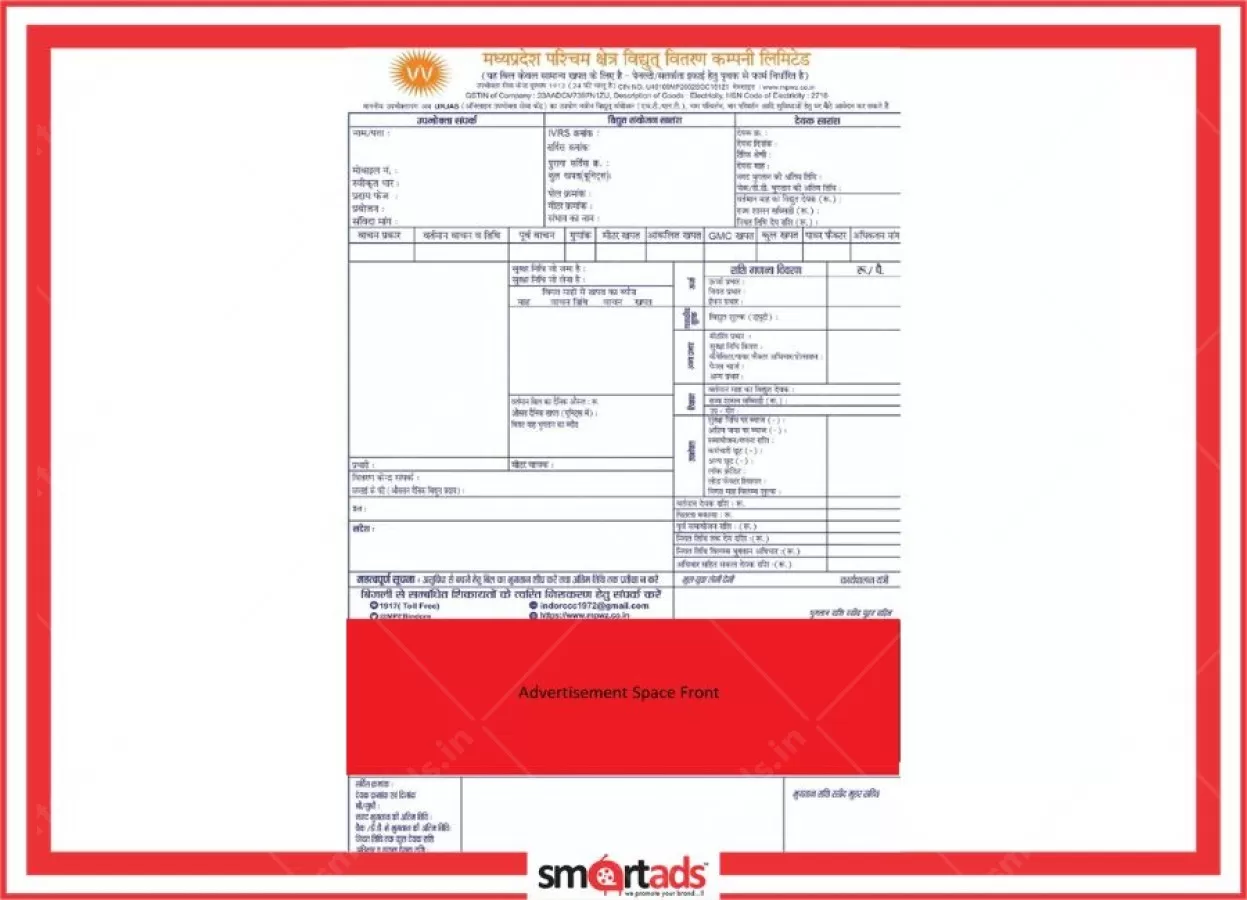
MPPKVVCL Electricity Bill
33mm (H) X 181mm (W) | 40mm (H) X 181mm
Electricity bills gives advertisers a hu
Rate per Bill / Time
Front & Back Page
₹0.75.00
Showing 1 to 1 of 1 Results
MEDIA DETAILS
33mm (H) X 181mm (W) | 40mm (H) X 181mm
Electricity bills gives advertisers a hu
Rate per Bill / Time
Front & Back Page
₹0.75.00
MEDIA REACH

MinimumQty :
3400000
EstimateReachPeople :
6800000
You can't buy Jhabua attention with display ads — not at scale. BTL is where that attention actually exists. Campaigns here scale from 3400000 units to reach approximately 6,800,000 people per activation, calibrated for distributed tier-3 neighbourhood footfall patterns.
For Jhabua, electricity bills typically deploys across arterial junctions, weekly markets, and community gathering points, with localised creative tuned to Madhya Pradesh audience preferences. Below-the-line marketing creates memorable brand experiences that people share through word-of-mouth, multiplying your reach beyond the immediate interaction.
Reach in Jhabua compounds when 3400000-unit activations are clustered within priority demand zones — which most planners learn the hard way — a pattern that fits tier-3 markets where local concentration drives recall. Creating market presence that signals authority and investment.
If you're planning Electricity Bills advertising in Jhabua, start by matching the medium to real audience attention. Below-the-line marketing creates memorable brand experiences that people share through word-of-mouth, multiplying your reach beyond the immediate interaction. Keep the message simple and run long enough to build frequency, because repetition is where recall compounds. In Jhabua, Madhya Pradesh, electricity bills campaigns scale from 3400000 units to reach approximately 6,800,000 people per activation, calibrated for distributed tier-3 neighbourhood footfall patterns. Use Minimum Qty. (3400000) and Reach (6800000) to keep the plan practical, with emphasis on creating market presence that signals authority and investment.
Electricity Bills advertising in Jhabua uses BTL placements to keep a brand visible in moments that fit audience behavior. Unlike channels that are easy to skip, this medium works through contextual presence and repeated exposure. A good definition includes where it appears (pop-up stalls, sampling counters, door-to-door distributions, auto-rickshaw branding, and in-store promoter placements), how it's planned (micro-market targeting, consumer journey mapping, incentive structure design, real-time lead digitization, and multi-day execution scheduling), and what execution requires. For Jhabua, electricity bills typically deploys across arterial junctions, weekly markets, and community gathering points, with localised creative tuned to Madhya Pradesh audience preferences. When those parts are aligned upfront, campaigns feel intentional, look consistent, and build stronger recall over time.
Brands choose Electricity Bills advertising in Jhabua when they need dependable visibility and stronger recall than short one-time spikes. The channel performs best for launches, seasonal offers, store openings, and reputation building across Jhabua. What sets this medium apart is the planning advantage: you control placement quality, audience fit, timing, and frequency, giving you predictable campaign outcomes rather than guesswork. If you want faster decisions and fewer execution surprises, start with a clear shortlist and a plan built around creating market presence that signals authority and investment.
Electricity Bills advertising in Jhabua can be executed across several format options depending on the goal, creative complexity, and audience attention span. Available touchpoints include pop-up stalls, sampling counters, door-to-door distributions, auto-rickshaw branding, and in-store promoter placements. For quick-scan environments, use short copy and bold branding. For longer dwell situations, add proof points and structured offers. Keep messaging unified across formats so recall compounds rather than resets with each new placement.
Cost for Electricity Bills advertising in Jhabua varies mainly by placement quality, audience density, seasonality, and campaign duration. The strongest cost control comes from planning levers such as micro-market targeting, consumer journey mapping, incentive structure design, real-time lead digitization, and multi-day execution scheduling. A smart mix of premium and value placements can protect both visibility and budget without over-spending on any single touchpoint. Budget planning for Jhabua starts with the 3400000-unit minimum deployment, with cost-per-impression efficiency improving as you scale. Plan for production, approvals, and timelines early so you don't pay for last-minute fixes or rush charges.
Ready to plan Electricity Bills advertising in Jhabua? Share your goal, budget range, preferred dates, and priority zones. we'll recommend the right format mix from available BTL touchpoints, apply smart planning levers to protect your budget, and build a practical schedule that avoids wasted spend. If performance matters, we'll set tracking upfront so every impression is measurable. The final recommendation will stay focused on creating market presence that signals authority and investment. Get a customized media plan and pricing from SmartAds.
Across Madhya Pradesh, electricity bills that perform well share three common traits: tight audience targeting, consistent creative across exposures, and measurement that closes the loop on attribution.
lead volume and quality scoring, same-day vs delayed conversions, cost per acquisition, location-level performance ranking, and ROI analysis
Specifications
Minimum Qty.: 3400000
Reach: 6800000
