
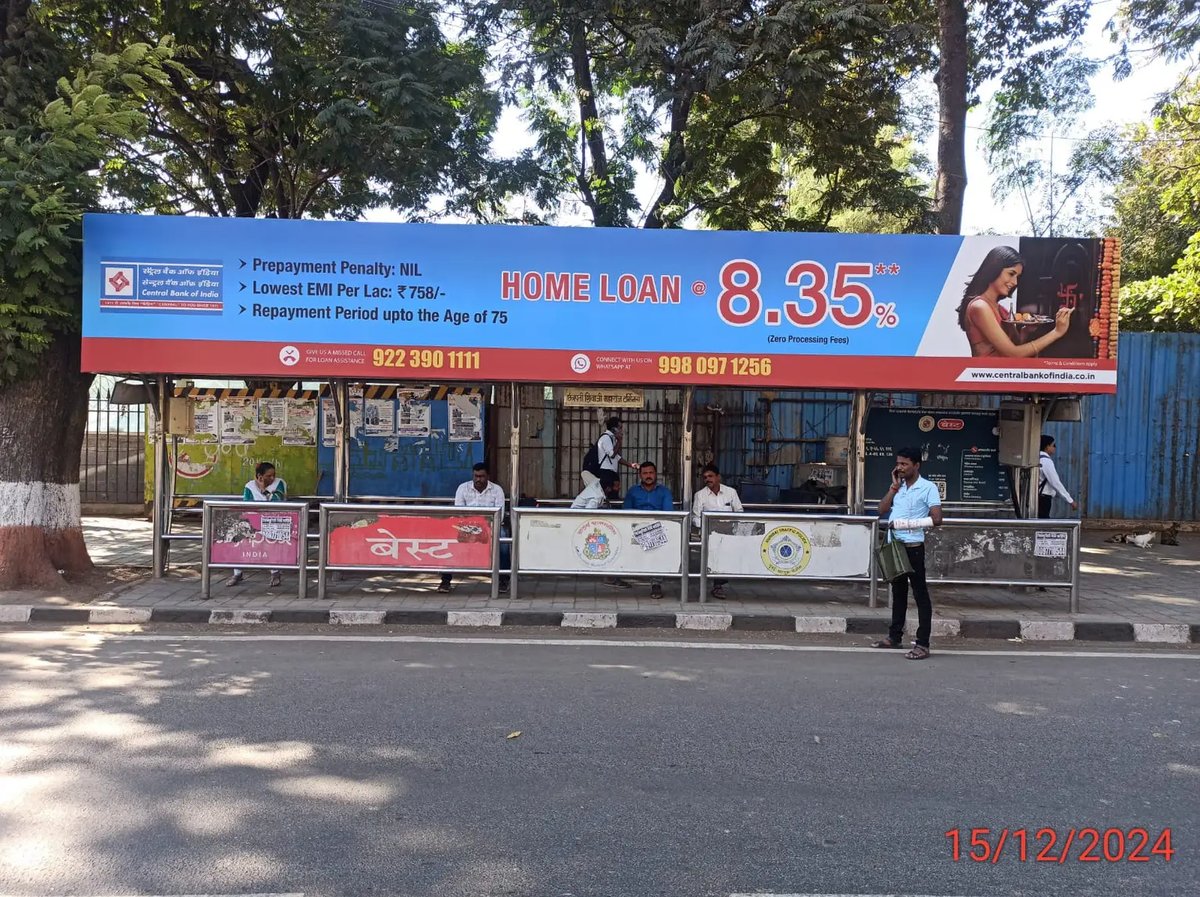
Non Lit
Top Panel(W x H)32.0 x 5.0 Side Panel(W
A bus stop is a designated place where b
Rate per Bus Shelter / Month
₹108000.00
Showing 1 to 1 of 1 Results
MEDIA DETAILS
Top Panel(W x H)32.0 x 5.0 Side Panel(W
A bus stop is a designated place where b
Rate per Bus Shelter / Month
₹108000.00
MEDIA REACH

Size :
Small
Dimension :
Top Panel(W x H)32.0 x 5.0 Side Panel(W x H)4.0 x 5.0
SqFt :
180.00
Lighting :
Back-Lit
Area :
CSMT
State :
Maharastra

This isn't a generic billboard pitch. It's a Small Non-Lit site in CST on Mahapalika Road near Opp BMC Office Nr. CST Behind TOI Bldg, and the location does most of the work. At ₹42,000 for a 218.00 sq ft canvas, the cost-per-impression math gets sharper the longer you commit.
Within CST on Mahapalika Road near Opp BMC Office Nr. CST Behind TOI Bldg is curated for town and neighbourhood audience visibility under evening footfall around bazaars and arterial junctions. Strategic outdoor placements turn high-traffic locations into brand touchpoints, reaching consumers repeatedly at the moments closest to their purchase decisions. Every commuter sees the same outdoor sites day after day, and that involuntary repetition is what makes OOH one of the strongest recall-building channels available.
Reach in CST is built through repeated daily exposure across evening footfall around bazaars and arterial junctions. The actual per-impression cost varies by traffic volume and campaign duration, with location catchment profile, time-of-day visibility, site exclusivity, competitive presence, and seasonal demand patterns being the primary planning levers — and the data backs this up — which is why two sites at the same rate can produce wildly different results. Local clusters that repeat often in the right zones.
If you're planning Bus Shelter advertising in CST, start by matching the medium to real audience attention. Strategic outdoor placements turn high-traffic locations into brand touchpoints, reaching consumers repeatedly at the moments closest to their purchase decisions. Keep the message simple and run long enough to build frequency, because repetition is where recall compounds. This Small Non-Lit hoarding in CST on Mahapalika Road near Opp BMC Office Nr. CST Behind TOI Bldg captures town and neighbourhood audience attention. Use Size (Small) and Dimension (Top :- 30x4 Back Drop :- (5.6x3.5) x 5) to keep the plan practical, with emphasis on maximizing impression value per rupee through strategic planning.
Bus Shelter advertising in CST uses Outdoor placements to keep a brand visible in moments that fit audience behavior. Unlike channels that are easy to skip, this medium works through contextual presence and repeated exposure. A good definition includes where it appears (roundabout hoardings, bridge panels, petrol pump signage, market entry arches, and mobile van advertising), how it's planned (micro-market selection, directional visibility, cluster frequency across routes, daypart lighting, and creative refresh cycles), and what execution requires. Within CST, the placement on Mahapalika Road near Opp BMC Office Nr. CST Behind TOI Bldg is curated for town and neighbourhood audience visibility under evening footfall around bazaars and arterial junctions. When those parts are aligned upfront, campaigns feel intentional, look consistent, and build stronger recall over time.
To build meaningful reach in CST, start by mapping where your audience actually spends time, not where media is cheapest. The available touchpoints for this medium include roundabout hoardings, bridge panels, petrol pump signage, market entry arches, and mobile van advertising, each serving different audience moments. Layer these across your priority zones to create a frequency pattern your audience encounters organically. Positioned on Mahapalika Road with dn traffic density in CST, this site delivers consistent daily exposure. Size (Small) and Dimension (Top :- 30x4 Back Drop :- (5.6x3.5) x 5) provide a starting benchmark for planning scale.
Bus Shelter advertising in CST can be executed across several format options depending on the goal, creative complexity, and audience attention span. Available touchpoints include roundabout hoardings, bridge panels, petrol pump signage, market entry arches, and mobile van advertising. For quick-scan environments, use short copy and bold branding. For longer dwell situations, add proof points and structured offers. Keep messaging unified across formats so recall compounds rather than resets with each new placement.
Ready to plan Bus Shelter advertising in CST? Share your goal, budget range, preferred dates, and priority zones. we'll recommend the right format mix from available Outdoor touchpoints, apply smart planning levers to protect your budget, and build a practical schedule that avoids wasted spend. If performance matters, we'll set tracking upfront so every impression is measurable. The final recommendation will stay focused on maximizing impression value per rupee through strategic planning. Get a customized media plan and pricing from SmartAds.
For CST, the levers that move outcomes are: micro-market selection, directional visibility, cluster frequency across routes, daypart lighting, and creative refresh cycles.
proof-of-execution photos with timestamps, estimated OTS (opportunity-to-see) data, unique landing page visits, and area-level sales correlation
Specifications
Size: Small
Dimension: Top :- 30x4 Back Drop :- (5.6x3.5) x 5
Sq Ft: 218.00
Lighting: Non-Lit
Area: CST
State: Maharastra
Bus Stop: Azad Maidan
Desc.: Opp BMC Office Nr. CST Behind TOI Bldg
Rate: 42000
Road: Mahapalika Road
Traffic: Dn
Zone: South
Creative requirements for CST: Prioritize brand recognition over information: logo, colour, and tagline should be identifiable in under two seconds from a moving vehicle.
