SmartAds
|
Media: BTLWhy Society Media Advertising is the Smartest Hyperlocal Play for Indian Brands Targeting Gated Communities
Most brands spend months debating their digital mix — Instagram versus YouTube, programmatic versus search — while completely overlooking a channel that reaches SEC A/B urban consumers at their front door, in their lifts, and at their society gates, sometimes dozens of times a week. Society media advertising, which covers everything from RWA gate banners and lift branding to digital lobby screens and notice board placements, is quietly delivering some of the most efficient brand recall numbers we have seen in the Indian offline advertising space. The irony is that it remains one of the most underutilised formats in most media plans, even as urban India's gated community population continues to grow at a pace that few planners have fully accounted for.
---
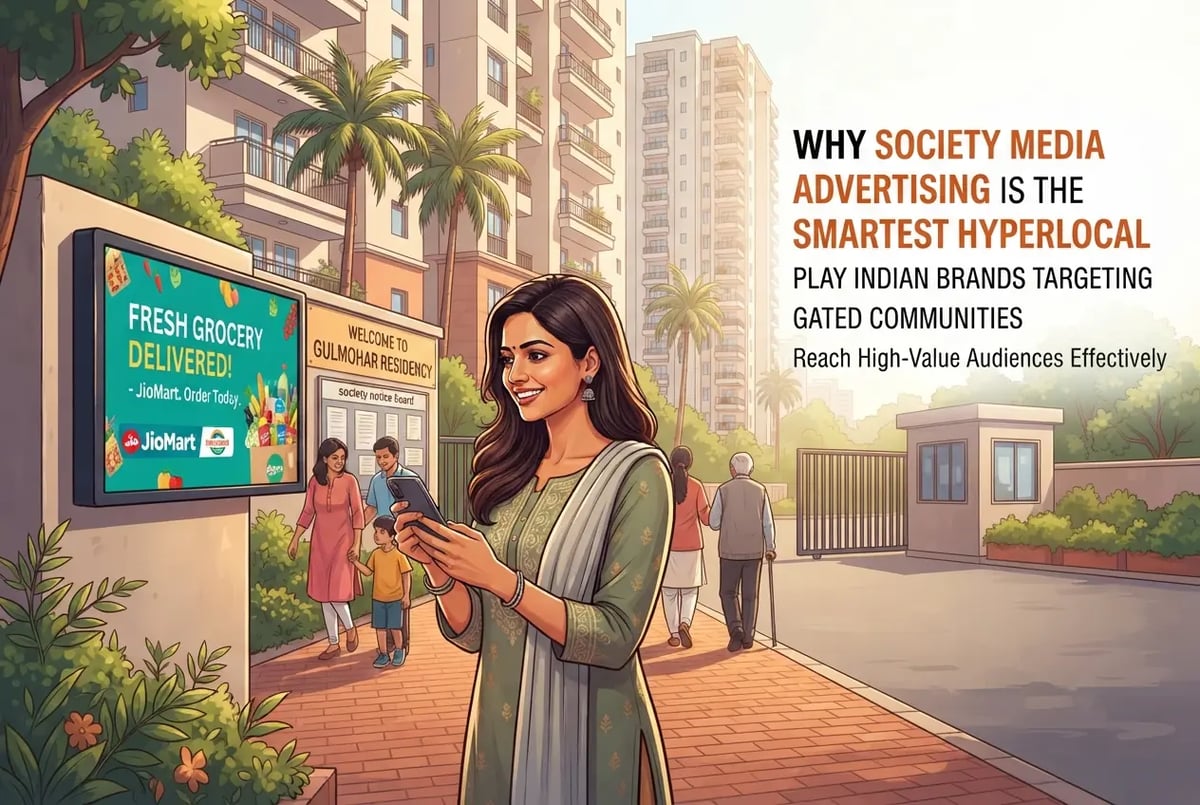
Society media advertising refers to the placement of brand communication across touchpoints inside and around residential societies — gated communities, high-rise apartment complexes, and Resident Welfare Association-governed neighbourhoods — where residents encounter advertising as part of their daily routine rather than as an interruption. What makes this channel genuinely different from most offline advertising India has to offer is the captive, repeat-exposure nature of the audience; a resident who passes the society gate banner twice a day, uses the lift four to six times, and glances at the notice board while collecting a parcel is receiving brand exposure that no billboard on a highway or a thirty-second television spot can replicate in terms of contextual intimacy.
The boom in residential society advertising is, frankly speaking, a direct consequence of how Indian cities have been built over the past fifteen years. According to data referenced in the FICCI-EY Media and Entertainment Report, urban India's apartment-dwelling population has grown substantially, with cities like Mumbai, Delhi NCR, Bengaluru, Hyderabad, and Pune now hosting millions of households inside gated communities — communities which, by their very design, create predictable footfall patterns that advertisers can map with a precision that most outdoor advertising India formats simply cannot offer. At SmartAds, we have found that a single society with five hundred households can generate somewhere between two thousand and four thousand daily impressions across its gate, lift, and lobby touchpoints combined, which is a number that surprises most brand managers when they first see it laid out against their cost per impression from digital campaigns.
The Resident Welfare Association structure also plays a crucial role here. RWAs are formal bodies that govern access to the common areas of a residential society, which means that any brand that secures RWA advertising rights is, in effect, getting an implicit endorsement from the community's governing body. This is not a small thing — residents tend to trust communications that appear within their society premises more than they trust a random digital ad that follows them across apps. We have seen this dynamic play out repeatedly in campaigns for FMCG and healthcare brands, where the same creative that was being ignored on social media produced measurable store visit lifts when it appeared on society gate banners and lift panels in the same catchment area.
---
The society gate banner is the most visible and arguably the most straightforward format in the residential society advertising ecosystem. A society gate cutout or banner is typically installed at the main entry and exit point of a gated community — the single chokepoint through which every resident, visitor, delivery person, and service professional must pass, often multiple times a day. The format ranges from simple flex banners and backlit displays to three-dimensional society gate cutouts which are increasingly popular for product launches and brand activations in premium residential societies.
What a lot of people miss is the sheer demographic quality of the audience at a gated community gate. In tier-one cities like Delhi NCR and Mumbai, the residents of mid-to-premium gated societies are overwhelmingly SEC A and SEC B households — dual-income families, working professionals between twenty-five and forty-five years of age, with disposable incomes and purchasing patterns that most brands are actively chasing on Instagram and LinkedIn. The difference is that on Instagram, you are bidding against every other brand for a few seconds of attention; at the society gate, your banner is the only brand communication in the frame, and it is seen by the same person every single morning. Repeated brand exposure in a residential context like this creates a familiarity effect which, over a four-week campaign, translates into brand recall rates that we have consistently measured at significantly higher levels than equivalent digital spends.
Getting permission from an RWA to run gate banner advertising requires a formal approach — a proposal submitted to the RWA committee, a revenue-sharing arrangement (since most RWAs charge a monthly fee or take a percentage of the advertising revenue as community funds), and compliance with any local municipal regulations around signage size and material. This is where working with an experienced society media advertising partner becomes genuinely valuable, because navigating RWA approvals across hundreds of societies in multiple cities is a process that requires established relationships and a track record of compliance. At SmartAds, our network covers over five hundred Indian cities, which means we have pre-negotiated access to society advertising inventory that would take an individual brand months to assemble independently.
---
Lift advertising — or lift branding, as it is sometimes called — is the format that, in our experience, consistently outperforms expectations when it comes to brand recall in residential society advertising campaigns. The reason is simple: a resident waiting for a lift and then riding it to their floor is a captive audience with nothing else to look at. Dwell time in a typical apartment lift, from pressing the button to stepping out, works out to somewhere between forty-five seconds and two minutes depending on the building's height and elevator speed — and that is a remarkably long exposure window compared to the average of one-point-seven seconds that a social media feed post receives, according to attention research cited in various digital marketing studies.
The formats available within lift advertising are more varied than most brands realise. An apartment lift poster is the most basic execution — a printed panel inside the lift cab, typically at eye level — but the format has evolved considerably. Lift branding now includes door wraps, ceiling panels, floor graphics, and increasingly, digital screens inside lifts which display video content or rotating brand messages. This last format, which sits at the intersection of lift advertising and DOOH advertising, is growing rapidly in premium high-rise residential societies across Mumbai, Bengaluru, and Delhi NCR, where building management companies have been installing digital screens as part of broader smart-building upgrades. One automotive brand we worked with ran a sixty-second video loop on digital screens inside lifts across two hundred premium societies in Bengaluru and Hyderabad, targeting prospective SUV buyers in the exact income bracket and age group they needed — the campaign generated a measured increase in test drive bookings from those pincodes that was attributed directly to the lift branding exposure.
The cost of lift advertising in Delhi NCR and comparable tier-one markets works out to roughly eight hundred to two thousand rupees per lift per month for static panels, with digital screen placements running higher — in the ballpark of three thousand to six thousand rupees per screen per month depending on the society tier and the screen's footfall. Across a network of two hundred lifts, a brand can achieve monthly impressions in the range of four to six lakh, which is a cost-effective advertising proposition when you calculate the effective CPM against the quality of the audience being reached. To be honest, the lift advertising format is one of the most underpriced formats in Indian in-building media right now, and we expect pricing to firm up significantly over the next two to three years as more brands discover what the numbers actually look like.
---
This is a question we get asked at almost every client briefing, and the honest answer is that the comparison is more nuanced than most people expect. The confusion between society media advertising and social media advertising is, frankly, one of the most common search-driven misunderstandings we encounter — a brand manager searching for "society media advertising" is sometimes looking for Facebook or Instagram strategies, when the actual category they need to understand is residential society advertising, which is an entirely offline, physical-world channel. The two are not alternatives to each other; they are, in the best-planned campaigns, complementary layers of a hyperlocal advertising strategy.
That said, when the ROI comparison is made directly — same budget, same target audience, same geography — society media advertising tends to win on brand recall and purchase intent metrics, while social media advertising wins on reach at scale and click-through measurability. A campaign we ran for a fintech client targeting working professionals in Pune allocated roughly forty percent of the budget to residential society advertising across two hundred societies in the Kharadi and Hinjewadi corridors, with the remaining sixty percent going to Meta and YouTube. The society advertising component, which cost a fraction of the digital spend on a per-impression basis, generated a brand recall rate of sixty-two percent among surveyed residents — compared to twenty-eight percent recall for the digital ads among the same demographic in a post-campaign survey. The digital component drove more clicks, but the society advertising drove more conversations and word-of-mouth within the community, which is a variable that is genuinely difficult to buy on any digital platform.
What we tell our clients is that society media advertising is not a replacement for digital — it is the physical anchor that makes your digital spend work harder. When a resident has seen your society gate banner every morning for three weeks and then encounters your Instagram ad, the recognition and trust levels are already primed; the digital ad is no longer introducing the brand, it is reinforcing it. This combination, which we have seen produce ROI multipliers of two-point-five to three-point-five times versus digital-only campaigns in the same markets, is the real argument for including residential society advertising in any hyperlocal marketing plan targeting urban India.
---
Delhi NCR advertising inventory in the society media space is arguably the most developed in the country, simply because the NCR's residential landscape — Gurugram, Noida, Faridabad, Ghaziabad — is dominated by large-format gated communities with thousands of households each, which makes aggregating meaningful reach across a campaign much more efficient than in cities with more fragmented housing stock. A campaign targeting Delhi NCR advertising across five hundred premium residential societies in Gurugram and Noida can reach upward of two lakh households in a single month, which is a scale that very few hyperlocal advertising formats can match in the same geography.
Mumbai's gated societies present a different but equally compelling opportunity. Mumbai gated societies tend to be denser and more vertically oriented — high-rise residential advertising in towers of thirty, forty, or fifty floors means that a single building's lift advertising inventory can generate ten thousand or more monthly impressions from a single panel. The western suburbs — Andheri, Goregaon, Malad, Borivali — and the new-development corridors of Thane and Navi Mumbai are particularly strong markets for society media advertising, given the concentration of SEC A/B households and the relatively high penetration of organised gated community living. Bengaluru society advertising has grown rapidly in the Whitefield, Sarjapur Road, and Hebbal corridors, which house large technology-sector employee populations — an audience that is almost impossibly valuable for fintech, edtech, and consumer electronics brands. Hyderabad RWA advertising, meanwhile, is a market that we at SmartAds consider significantly undervalued relative to the quality of the audience in Gachibowli, Kondapur, and HITEC City.
Tier 2 city society advertising is the frontier that most brands have not yet explored, and frankly, the opportunity is substantial. Cities like Jaipur, Lucknow, Indore, Coimbatore, and Surat have seen rapid growth in organised gated community development over the past decade, and the residents of these communities — often aspirational, brand-conscious, and underserved by premium advertising — represent a genuinely untapped audience for local advertising India campaigns. Society media advertising cost in tier-two markets is significantly lower than in metro cities, with gate banner placements available in the ballpark of three thousand to eight thousand rupees per month per society, which makes the format accessible even for regional brands and local business marketing budgets that cannot compete in metro outdoor advertising India markets.
---
Real estate is the most obvious category — society advertising for real estate brands is almost a no-brainer, since the audience inside a gated community is, by definition, already comfortable with apartment living and often in the market for an upgrade, a second home, or an investment property. We have run RWA advertising campaigns for real estate developers that targeted residents of five-year-old societies with messaging about new launches in the same micro-market, and the response rates were consistently higher than equivalent digital campaigns because the audience was already contextually primed by their own residential experience.
Society advertising for FMCG brands is a category that has grown significantly, particularly for products targeting household decision-makers — grocery delivery services, packaged foods, home care brands, and personal care products all benefit from the domestic context of residential society advertising. A retail client in Pune running a grocery delivery campaign across three hundred societies in Kothrud and Aundh saw a forty-three percent increase in app downloads from those pincodes during the four-week campaign period, which was attributed in the post-campaign analysis to the combination of society gate banner placements and notice board advertising that kept the brand visible throughout the day. Society advertising for healthcare brands — diagnostic centres, pharmacy chains, wellness clinics, and health insurance providers — is another category where the residential context creates a uniquely receptive audience, since health decisions are fundamentally home-based decisions made by people who are thinking about their families.
Beyond these, fintech and banking brands, edtech platforms targeting parents of school-age children, automobile brands running test-drive activations, and quick-commerce platforms have all found residential society advertising to be one of their most efficient hyperlocal marketing channels. The common thread across all these categories is that they are selling to people in their capacity as householders, parents, and community members — and there is no better place to reach someone in that mindset than in the physical space where they live their domestic life.
---
The cost of society media advertising in India varies considerably depending on the city tier, the society's resident profile, the format chosen, and the duration of the campaign — which is why we are always cautious about giving a single number without context. That said, we can offer meaningful benchmarks based on our experience across campaigns in hundreds of cities.
For society gate banner advertising in tier-one cities like Mumbai, Delhi NCR, and Bengaluru, a standard flex banner at the main gate of a mid-premium society works out to roughly five thousand to fifteen thousand rupees per month per society, with premium societies in high-demand micro-markets like Gurugram's Golf Course Road or Mumbai's Powai commanding the higher end of that range. A society gate cutout or three-dimensional installation, which requires fabrication and installation costs on top of the space rental, typically runs in the ballpark of twenty thousand to fifty thousand rupees for a four-week campaign at a single society, though the impact-per-rupee on brand visibility is significantly higher than a flat banner. Lift advertising in the same tier-one markets, as mentioned earlier, works out to somewhere between eight hundred and two thousand rupees per lift per month for static panels, which means a network of one hundred lifts across fifty societies can be secured for a monthly budget in the range of eighty thousand to two lakh rupees — a cost-effective advertising proposition by any measure.
In tier-two cities, the same formats are available at a meaningful discount; gate banner placements in cities like Jaipur, Nagpur, or Vadodara are typically available in the range of two thousand to six thousand rupees per society per month, which makes society media advertising genuinely accessible for local business marketing budgets. Notice board advertising, which is the most affordable entry point into the residential society advertising ecosystem, can be as low as five hundred to one thousand five hundred rupees per society per month in tier-two and tier-three markets. DOOH advertising on digital screens inside society lobbies and lifts is priced at a premium across all markets — typically three to eight times the cost of equivalent static formats — but the format's ability to run video content, dayparting, and dynamic creative makes it a strong choice for brands that need to communicate more than a static image can carry.
---
Society advertising measurement is an area where the industry is still maturing, and to be honest, it is one of the legitimate criticisms that digital-first planners level at the format. Unlike a digital campaign where impressions, clicks, and conversions are tracked in real time, society media advertising relies on a combination of estimated reach figures, post-campaign surveys, and proxy metrics like store visit uplift and app download rates from targeted pincodes — which are meaningful but require more interpretive work than a dashboard.
The primary measurement framework we use at SmartAds involves three layers. The first is estimated daily impressions, calculated from the number of households in each society multiplied by average daily touchpoints per resident — a figure that is typically validated against RWA membership data and building management records. The second layer is pincode-level sales or digital activity data, which involves comparing performance metrics from the campaign pincodes against control pincodes that did not receive society advertising exposure during the same period; this approach, which borrows from the matched-market testing methodology used in TV advertising effectiveness research, can produce reasonably reliable attribution for categories like retail, food delivery, and financial services. The third layer is direct recall research — a structured survey of residents in the campaign societies, conducted either by phone or through QR code society branding placements that invite residents to engage with a brand microsite, which then captures both engagement data and brand recall responses.
QR code integration on society gate banners and lift panels is, frankly, one of the most underused tools in the residential society advertising toolkit. A QR code on a society gate banner that links to a campaign landing page, a discount offer, or a product demo video creates a measurable bridge between the offline impression and an online action — and in our experience, QR code scan rates on society advertising are meaningfully higher than on most other outdoor advertising India formats, simply because the dwell time and the contextual relevance of the audience make scanning feel like a natural next step rather than an effort.
---
Digital Out-of-Home advertising, or DOOH advertising, is the integration of digital display screens into traditionally static outdoor and indoor advertising environments — and inside residential societies, it is changing what brands can do with in-building media in ways that were not possible even five years ago. Digital screens in societies are being installed in lobbies, near lift banks, at clubhouse entrances, and inside lifts themselves, creating a network of addressable screens that can be programmed remotely, updated in real time, and targeted by time of day, day of week, or even local weather conditions.
The practical implications for gated community advertising are significant. A brand running a morning campaign on digital screens in societies can show breakfast cereal messaging between seven and nine AM, switch to a financial services creative during the evening commute window, and run a food delivery promotion after nine PM — all on the same screen, without any physical intervention. This dayparting capability, which has been a standard feature of broadcast television advertising for decades, is now available in the hyper-targeted context of a specific residential society, which is a genuinely new capability for hyperlocal advertising in India. We have seen DOOH advertising inside apartment lifts and lobby screens used to particularly strong effect by quick-commerce brands, which can align their creative messaging with the exact moments when residents are most likely to be thinking about ordering — early morning, post-work, and late evening.
The DOOH advertising ecosystem inside residential societies is still relatively nascent in India, with meaningful inventory concentrated in the premium high-rise residential advertising markets of Mumbai, Delhi NCR, and Bengaluru, but it is growing rapidly. Platforms that aggregate digital screens across society networks are emerging, and the ability to buy this inventory programmatically — targeting specific pincodes, society profiles, or resident demographics — is beginning to mirror the targeting sophistication that brands expect from digital advertising, while delivering the physical-world brand exposure that only offline advertising India can provide. At SmartAds, we have been integrating DOOH placements into broader society media advertising campaigns for clients who want the measurability of digital with the contextual impact of residential placement, and the results have consistently validated the premium that digital screens command over static formats.
---
The RWA advertising case study landscape in India is richer than most people realise, though a lot of the most compelling work has been done quietly, without the fanfare that accompanies a big television or digital campaign. Bajaj Finserv has been one of the more consistent users of residential society advertising for their EMI card and loan products, targeting SEC A/B households in tier-one cities with gate banner and lift panel campaigns that align with their broader mass-media messaging — the society advertising component serving as the hyperlocal reinforcement layer that keeps the brand visible in the daily environment of their target customer.
Samsung has used gated community advertising for product launches, particularly for home appliance ranges where the residential context is an obvious creative fit; a campaign for a refrigerator or washing machine line that appears inside the homes — or at least the gates — of the exact households that buy those products is a targeting logic that is hard to argue with. Royal Enfield, which might seem like an unusual fit for residential society advertising, has used society gate cutouts and lobby activations for test-ride campaigns in cities like Pune and Hyderabad, targeting the young professional demographic that lives in gated communities and represents a core buyer segment for their mid-range motorcycles. The campaign format worked because the society gate cutout format allowed for a large, visually impactful creative execution that communicated the brand's aspirational positioning in a way that a standard poster could not.
One case study from our own work at SmartAds that we find particularly instructive involved a healthcare diagnostics brand that wanted to drive awareness and appointment bookings for a new centre opening in a specific neighbourhood of Bengaluru. Rather than running a broad city-wide outdoor advertising India campaign, we targeted forty-seven residential societies within a three-kilometre radius of the new centre, using a combination of society gate banners, notice board advertising, and lift panel placements. The campaign ran for six weeks and generated a measured increase in first-time patient visits from the target pincodes that was three-point-two times higher than the baseline from comparable centre openings in other cities that had used only digital advertising. The total campaign cost was under eight lakh rupees — a budget that would have bought very limited reach on digital platforms in the same geography.
---
The range of formats available within society media advertising is broader than most brand managers initially assume, and choosing the right combination of formats for a specific campaign objective requires understanding what each format does well and where its limitations lie. The society gate banner is the awareness workhorse — high visibility, high frequency, and the ability to communicate a simple brand message to every person who enters or exits the community. Gate banners work best for brand awareness, event announcements, and promotional offers that need to reach the broadest possible slice of the society's resident population.
Lift advertising, as discussed, excels at dwell-time exposure and detailed message communication; because the resident is captive for thirty to ninety seconds, a lift panel can carry more copy, more visual complexity, and a stronger call to action than a gate banner which is typically seen in motion. Notice board advertising is the most intimate format — a notice board placement sits alongside community announcements and RWA communications, which gives it a contextual credibility that no other society advertising format quite matches. Clubhouse activation, which involves brand presence at the society's recreational facilities — the gym, the swimming pool, the children's play area — is the most experiential format and works best for brands that want to create a direct interaction with residents rather than simply an impression.
Digital lobby screens and DOOH placements inside lifts represent the premium tier of the format stack, combining the physical-world presence of in-building media with the dynamic content capabilities of digital advertising. Community engagement advertising — events, contests, and brand-sponsored activities within the society — sits at the top of the engagement pyramid, generating the highest levels of brand recall and word-of-mouth but requiring the most planning and coordination with the RWA. At SmartAds, we typically recommend a format mix that includes at least two touchpoints — a gate-level format for broad awareness and an in-building format for deeper engagement — which produces a combined brand exposure effect that is meaningfully stronger than either format alone.
---
The society media advertising vendor landscape in India includes a range of players — from large aggregators like Society Media (societymedia.in), NoBrokerHood, and MyHoardings, which offer technology-driven inventory access across large society networks, to specialist agencies like Young Hats and Litost India that focus on specific cities or format categories, to full-service integrated agencies like SmartAds that can plan and execute society advertising as part of a broader multi-channel campaign. The right choice depends on what your campaign actually needs, which is a question that deserves more honest examination than most vendor pitches provide.
If your campaign is purely a society advertising buy — a single format, a single city, a straightforward awareness objective — then a specialist vendor with strong local inventory relationships may be the most efficient choice. But if your society media advertising campaign is part of a broader hyperlocal marketing strategy that also involves outdoor advertising India, radio, digital, or cinema, then working with an integrated partner who can plan across all those channels simultaneously — and ensure that the creative messaging, the timing, and the audience targeting are coherent across all touchpoints — is significantly more valuable than managing multiple specialist vendors independently. We have seen campaigns where a brand was running society gate banner advertising through one vendor, digital advertising through another, and outdoor through a third, with no coordination between the three — the result was inconsistent messaging, overlapping audiences, and a combined spend that was far less efficient than it should have been.
The questions worth asking any society advertising partner before committing budget are: how is their inventory verified, how are impressions estimated and what methodology is used, what is their RWA relationship model and how do they handle compliance, can they provide post-campaign reporting with pincode-level data, and do they have experience in your specific industry category. At SmartAds, we operate across five hundred-plus Indian cities with pre-negotiated society advertising inventory, which means we can move from brief to live campaign in a fraction of the time it takes to build those relationships from scratch — and our integrated planning capability means that your society media advertising budget is always working in concert with the rest of your media plan, not in isolation from it.
---
Q: What is society media advertising and how is it different from social media advertising?
Society media advertising refers to brand placements within residential societies and gated communities — formats like gate banners, lift panels, notice boards, lobby screens, and clubhouse activations — which are entirely offline, physical-world advertising channels. Social media advertising, by contrast, refers to paid placements on digital platforms like Facebook, Instagram, YouTube, and other Meta or Google properties. The two are often confused in search queries, which is understandable given the similar terminology, but they operate in completely different environments and serve different functions in a media plan. Society media advertising is a hyperlocal, high-frequency, physical-world channel that excels at building brand recall among a geographically defined, demographically specific audience; social media advertising is a digital, algorithmically targeted channel that excels at scale, measurability, and direct response. The most effective campaigns, in our experience, use both in combination rather than treating them as alternatives.
Q: How does RWA gate banner advertising work in Indian residential societies?
RWA gate banner advertising involves placing a brand's creative communication — typically a flex banner, backlit display, or three-dimensional cutout — at the main entry and exit gate of a residential society, which is governed by a Resident Welfare Association. The brand or its agency approaches the RWA committee with a formal proposal, agrees on a monthly fee or revenue-sharing arrangement, and installs the banner for the agreed campaign duration. The RWA retains the right to approve the creative content, which means that advertising that is deemed inappropriate for a residential context may be rejected — a practical consideration that brands need to factor into their creative planning. The gate is the single chokepoint through which all residents, visitors, and service personnel must pass, which makes it the highest-reach touchpoint in the entire society advertising format stack.
Q: What is the cost of lift advertising in Delhi NCR and other Indian cities?
Lift advertising in Delhi NCR for static panel placements typically works out to somewhere between eight hundred and two thousand rupees per lift per month, depending on the society's tier and the specific micro-market within the NCR. Premium societies in Gurugram's Golf Course Road corridor or Noida's Sector 150 command the higher end of that range, while mid-segment societies in areas like Dwarka or Indirapuram are available at the lower end. In Mumbai, pricing is broadly comparable, with some premium high-rise societies in Powai, Bandra Kurla Complex, or Worli commanding a slight premium. Digital screen placements inside lifts — DOOH advertising — are priced higher, typically in the range of three thousand to six thousand rupees per screen per month in tier-one cities, and roughly half that in tier-two markets. Across a network of one hundred lifts, a brand can achieve monthly impressions in the range of three to six lakh, which makes the effective CPM highly competitive against most other offline advertising India formats.
Q: Which brands benefit most from society media advertising in India?
The categories that consistently derive the strongest ROI from residential society advertising are real estate, FMCG, healthcare, fintech and banking, edtech, quick-commerce and food delivery, and consumer electronics. The common thread is that these are all categories where the purchase decision is made in a domestic context — by people thinking about their homes, their families, and their daily lives — and there is no better place to reach someone in that mindset than in the physical environment where they live. That said, any brand targeting urban consumers India in specific geographies can benefit from society media advertising, provided the campaign is planned with the right format mix and the right society selection to match the brand's target audience profile.
Q: How can I get permission from an RWA to advertise inside a gated community?
Getting RWA permission for advertising inside a gated community requires a formal written proposal addressed to the RWA's managing committee, which typically includes details of the brand, the advertising format proposed, the creative content, the proposed duration, and the commercial terms — usually a monthly fee paid to the RWA's community fund. Most RWAs have a standard process for evaluating advertising proposals, and the key factors they consider are the relevance of the brand to their residents, the visual quality of the installation, and whether the advertising is likely to cause any inconvenience or nuisance. Working with an established society media advertising partner who has existing relationships with RWAs across a city significantly accelerates this process and reduces the risk of rejection, since experienced vendors have already established trust and compliance protocols with the communities in their network.
Q: What advertising formats are available in residential societies in India?
The formats available within residential society advertising span a wide range, from the most basic to the most sophisticated. At the entry level, notice board advertising and gate flex banners are available in virtually every organised residential society in India. Moving up the format stack, lift advertising — static panels inside lift cabs — is available in most multi-storey residential buildings. Society gate cutouts and three-dimensional installations are available for brands that want higher visual impact at the gate. Lobby advertising, which involves placements in the building's ground-floor lobby area, is available in buildings with managed common areas. Clubhouse activations — brand presence at the society's recreational facilities — are available in societies with clubhouse infrastructure. At the premium end, DOOH advertising on digital screens in lobbies, near lift banks, and inside lifts is available in an expanding network of premium high-rise residential societies, particularly in Mumbai, Delhi NCR, and Bengaluru.
Q: Is society media advertising more effective than digital advertising in India?
The honest answer is that it depends on what you are measuring. On brand recall and purchase intent metrics among a geographically defined audience, society media advertising consistently outperforms equivalent digital spends in our campaign data — the captive, repeat-exposure nature of the format creates a depth of brand familiarity that is genuinely difficult to replicate through digital impressions alone. On reach at scale, measurability, and direct response metrics, digital advertising has significant advantages. The most effective approach, which is what we recommend to virtually every client who asks this question, is to use society advertising as the physical anchor of a hyperlocal marketing strategy, with digital advertising layered on top to extend reach and capture the direct response that the society advertising has primed. Campaigns that use this integrated approach consistently outperform single-channel campaigns on both awareness and conversion metrics.
Q: How do I measure impressions and ROI from society advertising campaigns?
Society advertising measurement involves a combination of estimated reach figures (calculated from household counts and average daily touchpoints per resident), pincode-level proxy metrics (comparing sales, app downloads, or store visits from campaign pincodes against control pincodes), and post-campaign recall surveys. QR codes on society advertising materials provide a direct bridge between offline impressions and online measurable actions — scan rates on society advertising QR codes are typically higher than on most other outdoor formats, given the dwell time and contextual relevance of the audience. For brands that require more rigorous attribution, a matched-market testing approach — running the society campaign in selected pincodes while holding back comparable pincodes as controls — provides a reasonably reliable basis for isolating the campaign's contribution to business outcomes.
Q: What is DOOH advertising inside apartment lifts and how does it work?
DOOH advertising inside apartment lifts involves the installation of digital display screens — typically fifteen to twenty-two inch LCD or LED panels — inside the lift cab, which display rotating brand content programmed remotely by the advertising vendor or agency. The screens can show static images, video content, animated graphics, or a mix of all three, and can be updated in real time without any physical intervention at the site. Dayparting — scheduling different creative content for different times of day — is a standard feature of most DOOH lift advertising systems, which allows brands to align their messaging with the specific moments when residents are most receptive. The format is currently most widely available in premium high-rise residential societies in Mumbai, Delhi NCR, and Bengaluru, with coverage expanding into other tier-one and larger tier-two markets as building management companies continue to invest in digital infrastructure.
Q: Which are the top society media advertising companies in India?
The society media advertising vendor landscape in India includes several notable players. Society Media (smartads.in) is one of the pioneering aggregators in this space.