SmartAds
|
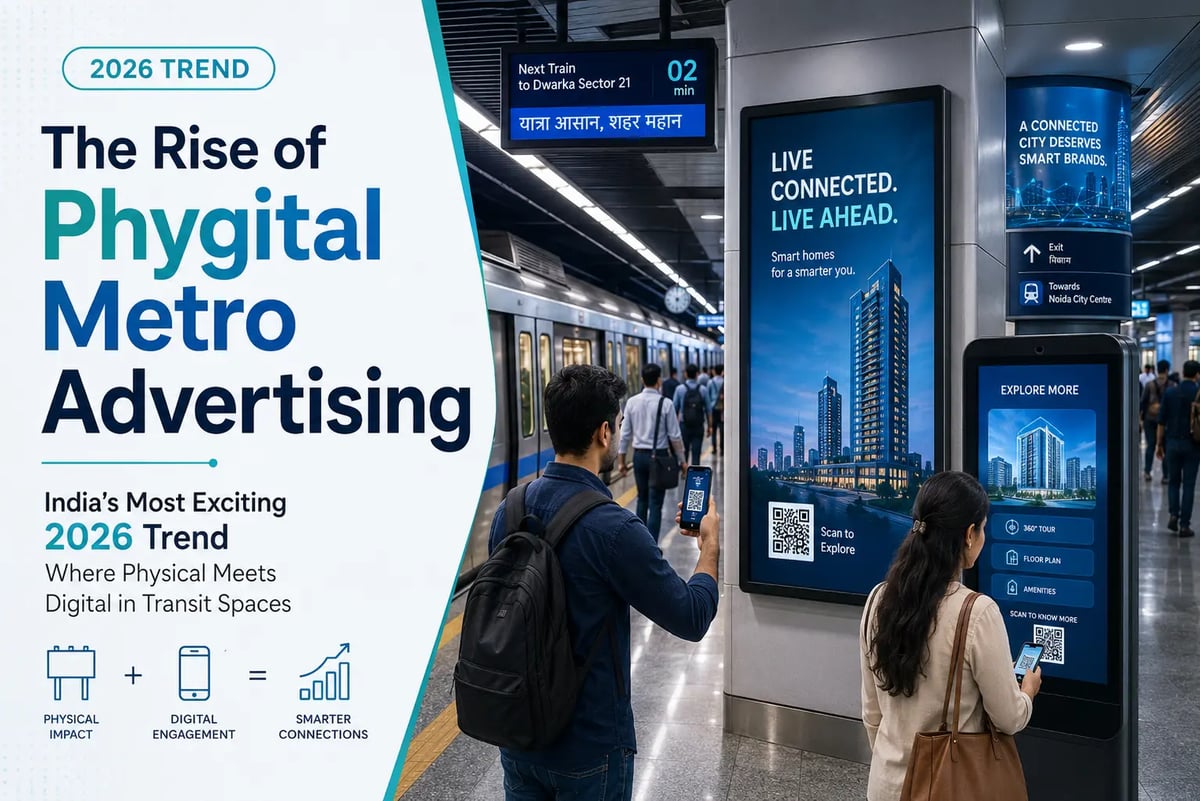
Media: BTLThe Rise of Phygital Metro Advertising: India's Most Exciting 2026 Trend Where Physical Meets Digital in Transit Spaces
Most brands still think of metro advertising as a static poster on a platform wall — and that assumption is costing them one of the most valuable captive audience moments in urban India. The numbers tell a different story: India's metro rail network now carries somewhere in the ballpark of 10 million daily commuters across its operational corridors, and by 2026, that figure is projected to climb significantly as new lines open in cities that barely had a metro station five years ago. What has changed — and what most media plans have not yet caught up with — is that those commuters are no longer just looking at a poster; they are scanning QR codes, triggering augmented reality experiences, and being retargeted on their phones within minutes of exiting a station.
The honest answer is that phygital advertising is not a new concept — retailers have been experimenting with physical-meets-digital experiences for years — but metro rail networks have created a uniquely powerful environment for it to reach maturity. Phygital metro advertising refers to the convergence of physical out-of-home formats inside metro stations and train coaches with digital triggers, interactive technologies, and data-driven campaign mechanics; it is the point where a concourse advertising panel stops being a passive display and starts being the first touchpoint in a measurable, multi-channel consumer journey. What makes this different from a standard DOOH screen is the intentionality of the integration — the QR code that routes a commuter to a personalised landing page, the NFC chip embedded in a pillar wrap that unlocks a brand experience on a smartphone, the programmatic DOOH screen that switches creative based on the time of day, the weather outside, or the demographic profile of the platform crowd.
What a lot of people miss is the dwell time advantage that metro environments offer, which simply does not exist in the same way on a highway billboard or a newspaper page. A commuter waiting on a platform in Delhi Metro's Blue Line might stand in the same spot for anywhere between three and eight minutes during peak hours; that dwell time, when combined with a well-designed phygital trigger, creates an audience engagement depth that most digital formats struggle to match. At SmartAds, we always tell our clients that the metro environment is one of the few places left in India where a brand can command genuine, undistracted attention — and phygital advertising is the mechanism that converts that attention into a measurable action.
Traditional OOH advertising in India has always relied on impressions — the number of people who theoretically pass by a format — but phygital metro advertising introduces a layer of accountability that changes the entire value proposition for brand managers. When a QR code gets scanned, when an AR experience gets triggered, when a geo-fenced retargeting pixel fires as a commuter exits the station, the campaign stops being a faith-based media buy and starts generating data that can be taken into a boardroom and defended with confidence. This shift is, frankly speaking, the single most important development in OOH advertising India has seen in the last decade.
The Ministry of Housing and Urban Affairs (MoHUA) has been executing one of the most ambitious urban infrastructure programmes in the country's history, and the scale of that expansion is creating a phygital advertising opportunity that will not come around again for a generation. India's metro rail network has grown from roughly 250 kilometres of operational track in 2014 to well over 900 kilometres today, with projects under various stages of construction or approval that could push the total past 1,700 kilometres within the next few years — a figure that, when you translate it into advertising inventory, represents thousands of new station environments, platform panels, concourse advertising spaces, and train wrap advertising opportunities that brands can activate across India metro cities. The Viksit Bharat 2047 framework, which envisions metro connectivity as a core pillar of urban mobility, has given this expansion a policy momentum that makes it structurally different from earlier infrastructure cycles.
What the Pitch-Madison Advertising Report 2026 signals — and what we have been observing in our own campaign planning at SmartAds — is that OOH advertising India is moving from a supplementary line item in media plans to a primary channel for urban brand building, precisely because metro rail ridership is creating the kind of concentrated, high-frequency urban commuter audiences that used to be the exclusive domain of television. The Namo Bharat RRTS corridor connecting Delhi and Meerut, for instance, has introduced a new category of transit advertising India has not seen before — semi-high-speed rail commuters who are predominantly SEC A and SEC B urban professionals, spending 45 to 60 minutes in a premium transit environment twice a day. That is not a captive audience; that is a media channel.
The phygital trend 2026 is being accelerated by a confluence of factors that are unlikely to reverse: smartphone penetration in Indian metros is effectively universal among the commuter demographic, 5G and phygital advertising infrastructure is being rolled out along major urban corridors by Jio, Airtel, and Vi, and metro rail corporations like DMRC, MMRCL, and BMRCL are actively seeking advertising partners who can monetise their station environments beyond traditional static formats. One automotive brand we worked with in early 2025 ran a campaign across three Delhi Metro stations that combined LED screens metro stations with QR code activations and geo-fenced retargeting; the campaign delivered a brand recall lift of roughly 34 percent among commuters who completed the full phygital journey, compared to 12 percent among those who only saw the static elements — a difference that surprised even the client's own research team.
The format landscape inside Indian metro networks is considerably richer than most media planners assume when they first start exploring transit advertising India, and the phygital layer adds a dimension of interactivity that transforms even the most familiar formats into something genuinely new. Concourse advertising — the large-format panels and backlit displays in the entry and ticketing zones of metro stations — has historically been one of the highest-footfall formats in OOH advertising India, but when those panels are equipped with QR codes metro advertising triggers or NFC advertising chips, they become the entry point into a brand's digital ecosystem rather than just a visual impression. Tunnel advertising, which uses the walls of metro tunnels to create animated or sequential visual experiences visible through train windows, has been adopted by several metro networks as a premium format; the phygital version of tunnel advertising integrates Bluetooth beacons that push notifications to commuters' phones as the train passes through the branded tunnel section.
Train wrap advertising remains one of the most visually arresting formats in the metro advertising India inventory, and its phygital evolution has been particularly interesting to watch — a full exterior train wrap that also carries NFC panels on the interior coach walls, for instance, creates a brand experience that travels with the commuter from the platform to the destination. Platform panel ads, which line the edges of platforms and are seen by waiting commuters at close range, have been upgraded in several Delhi Metro and Mumbai Metro stations to include digital screens capable of running programmatic DOOH campaigns; these screens can serve different creative to morning commuters versus evening commuters, which is a level of audience targeting that static platform panels simply cannot match. Pillar wraps in station concourses, which were previously purely static, are now being combined with QR code activations that route commuters to time-sensitive offers — a retail client in Pune used this combination during a festive season campaign and recorded over 14,000 QR scans across a two-week period, which translated into a cost-per-lead that was roughly 40 percent lower than their concurrent social media campaigns.
Naked-eye 3D screens, which create the illusion of three-dimensional objects emerging from a flat display without requiring special glasses, have begun appearing in the concourses of premium metro stations in Hyderabad Metro and Delhi Metro's newer corridors; these formats generate significant earned media value because they are inherently shareable, making them a powerful tool for viral OOH India campaigns where the physical installation becomes a social media event in its own right. Immersive advertising India is also finding expression in dedicated brand zones — enclosed or semi-enclosed spaces within large metro interchange stations where a brand can create an experiential environment that commuters can walk through, interact with, and photograph. These are not inexpensive activations, but the audience engagement they generate, particularly when combined with social sharing mechanics, can deliver a media value multiplier that justifies the investment for the right brand at the right moment.
Programmatic DOOH — or pDOOH, as it is increasingly referred to in media planning conversations — is the technology layer that most fundamentally changes what metro advertising India can do for a brand, because it introduces the real-time data advertising logic of digital media buying into a physical environment. In a traditional DOOH campaign, a brand books a screen for a fixed period and serves the same creative to everyone who passes by; in a pDOOH campaign, the screen is connected to a demand-side platform — platforms like Vistar Media are among those operating in the Indian market — which can dynamically serve different creative based on triggers like the time of day, the day of the week, live weather conditions, local event data, or even aggregated audience data about the demographic profile of commuters at that station at that moment. The practical implication is that a quick-service restaurant brand can serve a breakfast creative at 8 AM, a lunch offer at noon, and a dinner promotion at 7 PM, all on the same screen, without any manual intervention.
What we have found at SmartAds is that programmatic DOOH campaigns in metro environments consistently outperform fixed-creative DOOH campaigns on brand recall and conversion metrics, particularly when the creative is designed with contextual relevance in mind rather than simply repurposing a television commercial for a vertical screen. The weather-triggered ads use case is a particularly compelling example — a beverage brand we worked with in Mumbai Metro activated a cold drink creative whenever the temperature outside crossed 34 degrees Celsius and switched to a warm beverage creative when temperatures dropped, which sounds simple but delivered a measurable uplift in post-campaign sales tracking that the brand's own analytics team attributed directly to the contextual relevance of the messaging. Real-time data advertising of this kind requires both the right technology infrastructure and a creative team that has built assets for dynamic deployment, which is a production consideration that brands often underestimate when they first explore pDOOH.
The geo-fenced advertising India dimension of programmatic DOOH is where the phygital metro loop closes most elegantly — when a commuter passes a pDOOH screen in a metro station, a geo-fence can be triggered on their mobile device, which then allows the brand to retarget that specific individual with a digital ad on social media, a search platform, or a news app within hours of the physical exposure. This retargeting lift — the incremental conversion rate among people who were geo-fenced after a DOOH exposure versus those who only received the digital ad — has been measured in several international studies at somewhere between 30 and 60 percent, and our experience with Indian metro campaigns suggests the Indian market performs at the higher end of that range, possibly because metro commuters are already in a high-intent urban consumption mindset. Footfall analytics tools, which use anonymised mobile signal data to measure how many people were actually in proximity to a specific screen during a campaign period, are increasingly being used alongside pDOOH campaigns to provide impression verification that goes beyond the theoretical traffic counts that OOH advertising India has historically relied on.
The digital trigger technologies — QR codes, augmented reality advertising, and NFC advertising — are the mechanisms through which a physical metro ad becomes a phygital experience, and each has a distinct role in the consumer journey that brands need to understand before they decide which combination to deploy. QR codes metro advertising is, by a significant margin, the most widely adopted trigger technology in Indian metro campaigns right now, primarily because the technology requires no app download, works on any smartphone camera, and has achieved near-universal consumer familiarity since the UPI payment revolution normalised QR scanning behaviour across Indian urban populations. A well-placed QR code on a platform panel ad or a concourse advertising installation can route a commuter to a product page, a contest entry form, a video experience, or a location-based offer — and because the scan is a deliberate action, the intent signal it carries is considerably stronger than a passive impression.
Augmented reality advertising in metro environments is at an earlier stage of adoption in India, but the AR campaigns India has seen in the last two years suggest that the format has a disproportionate impact on brand experience and social sharing when executed well. AR triggers in metro spaces typically work through one of two mechanisms — either a printed marker on a physical format that activates an AR experience through a brand's app or a web-based AR platform, or a location-based AR trigger that activates when a commuter's phone detects a specific GPS or Bluetooth beacon coordinate inside the station. Samsung India ran an AR campaign in select metro stations that allowed commuters to virtually experience a new smartphone's camera features by pointing their existing phone at a branded installation; the campaign generated earned media coverage that, by the brand's own estimate, delivered a media value several times the cost of the activation itself. NFC advertising, which requires a commuter to tap their phone against an NFC-enabled surface to trigger a digital experience, has a lower adoption rate in India than QR codes because it requires NFC to be enabled on the device and involves a slightly more deliberate physical action — but for premium brand experiences targeting SEC A audiences, the intentionality of the tap creates a stronger engagement signal than a passive scan.
The most sophisticated phygital metro campaigns we have planned at SmartAds combine all three trigger types in a layered architecture — QR codes for broad reach and easy access, AR experiences for depth of engagement and social shareability, and NFC for high-intent conversion moments — which allows the campaign to capture commuters at different levels of engagement intent without forcing any single interaction model on the entire audience. The thing is, most brands deploy QR codes as an afterthought, adding them to creative that was designed for static display without thinking about where the scan journey leads or how to measure it; the brands that are winning in phygital metro advertising are the ones that design the digital journey first and then build the physical creative around it.
Delhi Metro advertising has the longest history and the deepest inventory of any metro advertising India market, which gives it a structural advantage in phygital activations simply because DMRC has had more time to upgrade its station infrastructure with LED screens, digital concourse panels, and the connectivity backbone that programmatic DOOH requires. The Delhi Metro network, which spans multiple corridors across Delhi, Gurgaon, Noida, and Faridabad, carries a daily ridership that makes it one of the highest-footfall transit advertising India environments in the world, not just in India; the audience profile skews heavily toward SEC A and SEC B urban professionals, students, and shoppers, which is precisely the demographic that most aspirational consumer brands are trying to reach. Delhi Metro Rail Corporation has been actively developing its advertising inventory in partnership with concessionaires, and the phygital formats available across its premium stations — particularly the interchange stations like Rajiv Chowk, Kashmere Gate, and Central Secretariat — represent some of the most valuable brand visibility real estate in the country.
Mumbai Metro advertising is undergoing a transformation that, frankly speaking, is more dramatic than anything happening in any other Indian metro city right now, because the Mumbai Metro Rail Corporation (MMRCL) is building an entirely new network from scratch — which means the station designs, digital infrastructure, and advertising concession frameworks are being planned with phygital advertising in mind from the outset rather than retrofitted onto legacy infrastructure. The Line 2A and Line 7 corridors that are now operational, along with the underground Line 3 (Aqua Line) connecting Colaba to SEEPZ, are attracting significant advertiser interest because they pass through some of Mumbai's highest-value commercial and residential corridors; Mumbai Metro advertising rates on these premium lines reflect that demand, with concourse advertising on the Aqua Line commanding premiums that are in the ballpark of 20 to 30 percent above equivalent Delhi Metro inventory. Bengaluru metro advertising, operated by BMRCL, serves a technology-savvy commuter base that is arguably the most receptive to phygital advertising triggers in India — the Bengaluru metro commuter demographic has among the highest smartphone sophistication and app engagement rates of any metro city, which makes QR code and AR campaign mechanics more likely to convert.
Hyderabad Metro, operated by L&T Metro Rail, has been particularly progressive in its approach to advertising innovation, having introduced several premium brand experience zones and large-format LED installations across its network; the Hyderabad Metro commuter base, which includes a significant proportion of IT sector professionals commuting between Hitech City and other commercial hubs, represents a high-value SEC A audience for technology, financial services, and lifestyle brands. Chennai Metro Rail Limited (CMRL) is expanding its network significantly, which is opening up new phygital advertising inventory in a city that has historically been underserved by premium transit advertising India options. The Tier-2 city metro advertising opportunity — in cities like Lucknow, Nagpur, Jaipur, Ahmedabad, and Pune — is where we expect the most significant growth in phygital metro advertising over the next three to five years; these networks are newer, their station infrastructure is more modern, and the advertiser competition for premium inventory is considerably lower than in Delhi or Mumbai, which creates a cost efficiency advantage for brands willing to invest in phygital activations before the market matures. Pune metro advertising, in particular, has been attracting interest from FMCG and retail brands because the commuter demographic skews young and the network connects several of the city's highest-footfall commercial zones.
The Smart Cities Mission, launched by the Government of India and administered through MoHUA, has invested in urban digital infrastructure across 100 designated smart cities — and a significant portion of that infrastructure investment directly enables the phygital advertising ecosystem that is now emerging in metro environments. Smart city advertising infrastructure includes integrated command and control centres with city-wide sensor networks, public Wi-Fi installations, smart street furniture with embedded digital displays, and the fibre optic and 5G backbone that allows real-time data advertising to function at scale; when this infrastructure overlaps with metro station zones — which it does in virtually every smart city that has a metro network — it creates a phygital ecosystem where the metro station is not an isolated advertising environment but a node in a connected urban data network. The policy alignment between the Smart Cities Mission and the metro expansion programme under MoHUA is not coincidental; Viksit Bharat 2047 explicitly frames integrated urban mobility and digital infrastructure as complementary pillars of India's development trajectory.
What this means practically for brands is that smart city advertising in metro zones can increasingly draw on city-level data streams — traffic conditions, event calendars, air quality indices, public gathering data — to inform programmatic DOOH creative decisions in ways that were technically impossible even three years ago. A health insurance brand, for instance, could trigger air-quality-aware creative on metro station DOOH screens when pollution levels in the city cross a certain threshold; a ride-sharing platform could activate surge-pricing awareness creative at metro stations when a major event is scheduled nearby; a real estate developer could target commuters at specific metro stations based on the residential catchment areas those stations serve. The smart city infrastructure layer, in other words, transforms the metro station from a closed advertising environment into an open data-responsive media channel, which is the fullest expression of what phygital metro advertising can become.
At SmartAds, we have been working with clients to incorporate smart city data triggers into metro campaign planning since early 2024, and the learning curve is real — the technology exists, but the creative and strategic frameworks for using it effectively are still being developed. The brands that invest in building that capability now, before phygital metro advertising becomes a standard line item in every media plan, will have a significant first-mover advantage in audience engagement and brand experience differentiation; the brands that wait until the market is mature will find themselves paying premium rates for inventory that early movers locked in at considerably lower costs.
The measurement conversation is where phygital metro advertising separates itself most clearly from traditional OOH advertising India, because the phygital layer introduces a set of accountable metrics that simply do not exist for a static billboard — and brands that fail to build measurement into their campaign architecture before launch are leaving significant strategic value on the table. The foundational metric is still reach, measured through footfall analytics data that metro corporations and their advertising concessionaires provide based on ticketing data and, increasingly, anonymised mobile signal analysis; daily ridership India metro figures are well-documented for major networks, and station-level footfall data is available for most premium inventory, which gives brands a defensible impression count to work with. But the metrics that actually differentiate a phygital campaign are the ones that measure the digital journey triggered by the physical exposure — QR scan rates, which in a well-designed metro campaign typically run somewhere between 0.5 and 3 percent of estimated footfall depending on the quality of the creative and the incentive offered; AR experience completion rates; NFC tap-through rates; and geo-fenced retargeting conversion lifts.
Attention-adjusted CPM is a metric that we at SmartAds have started incorporating into phygital metro campaign evaluations, and it is one that we think will become standard in the industry within the next two years. The logic is straightforward: a metro commuter who dwells on a platform for five minutes and looks at a DOOH screen multiple times during that dwell time is generating a fundamentally different quality of attention than a social media user who scrolls past a video ad in 1.5 seconds; when you adjust CPM for attention quality — using dwell time data, eye-tracking studies, and brand recall measurements — the attention-adjusted CPM for phygital metro advertising works out to roughly ?12 to ?18 for premium stations, which is a number that surprises most first-time advertisers when they compare it to what they are paying for Instagram reach at face-value CPM. The comparison becomes even more favourable when you factor in the geo-fenced retargeting component, which effectively extends the campaign's digital reach to a qualified audience that has already had a physical brand exposure.
Brand recall studies specific to metro environments — conducted through intercept surveys at station exits or through panel-based digital surveys targeting commuters identified through geo-fencing — are the gold standard for measuring the upper-funnel impact of phygital metro advertising, and several metro corporations are now facilitating these studies as part of their premium advertising packages. Footfall attribution, which attempts to measure whether exposure to a metro campaign drove subsequent visits to a physical store or location, is technically feasible through mobile location data partnerships and is increasingly being requested by retail and QSR clients who want to close the loop between transit media exposure and in-store conversion. The honest assessment is that the measurement ecosystem for phygital metro advertising in India is still maturing — the tools exist, but the industry standards for how to use them consistently are still being established — and brands that work with media planning partners who understand both the technology and its limitations will get considerably more reliable ROI data than those who rely on standard OOH impression metrics alone.
The brands that have invested most seriously in phygital metro advertising in India are, not coincidentally, the ones whose target audiences most closely match the urban commuter demographic — and the strategies they have deployed offer useful templates for brands across categories that are still figuring out how to approach this channel. Samsung India has been among the most consistent investors in phygital metro advertising, using a combination of large-format LED screens metro stations, AR campaign triggers, and train wrap advertising to create immersive brand experiences around major product launches; the Galaxy series launches in particular have used Delhi Metro advertising and Mumbai Metro advertising environments as primary launch channels rather than supplementary ones, which reflects a strategic conviction that the metro commuter audience is the most efficient path to the urban premium consumer segment. What makes Samsung's approach instructive is the integration between the metro activation and the digital retargeting layer — commuters who interact with a Samsung AR trigger in a metro station are subsequently served product-specific digital ads on YouTube and Instagram, which creates a sequenced brand experience that is considerably more effective than either channel in isolation.
Airtel has used phygital metro advertising extensively for its 5G service rollout, which makes a certain strategic logic given that 5G and phygital advertising are directly related — demonstrating 5G speed and capability in a metro environment where the connectivity is actually live creates a proof-of-concept brand experience that no television commercial can replicate. The Airtel campaigns we have observed across Hyderabad Metro and Bengaluru metro advertising environments have combined concourse advertising panels with live speed-test QR codes that allow commuters to verify the 5G claim in real time; this is a particularly clever use of the phygital mechanic because the interaction itself is the brand message, not just a vehicle for delivering it. Swiggy and Zomato have both used metro advertising India extensively for promotional campaigns, typically combining platform panel ads and pillar wraps with time-sensitive QR code offers that expire within hours of the commuter scanning them — creating urgency mechanics that leverage the commuter's immediate post-journey hunger intent in a way that is both contextually relevant and measurable.
One FMCG brand we worked with at SmartAds — a personal care company launching a new product line targeting urban millennial women — ran a phygital metro campaign across five stations on Delhi Metro's Violet Line and two stations on Mumbai Metro's Line 2A simultaneously, combining branded concourse advertising with a web-based AR experience triggered by QR codes on the panels. The campaign ran for three weeks and generated over 28,000 QR scans, of which roughly 18 percent completed the full AR experience; the geo-fenced retargeting pool built from station footfall data delivered a click-through rate on subsequent digital ads that was approximately 2.4 times the brand's benchmark for cold-audience digital campaigns. The brand's marketing team subsequently increased its metro advertising India allocation by 60 percent for the following quarter — not because we told them to, but because the data made the case on its own terms.
To be honest, phygital metro advertising in India faces a set of structural challenges that are real and worth acknowledging, because brands that go in with unrealistic expectations tend to make poor campaign decisions and then blame the channel rather than the execution. The regulatory and permit landscape is perhaps the most significant friction point — each metro rail corporation operates under its own advertising concession framework, and the rules governing digital installations, interactive formats, and technology integrations vary considerably between DMRC, MMRCL, BMRCL, and CMRL. Brands and their agencies need to navigate these frameworks carefully; DMRC, for instance, has specific guidelines around the luminosity of digital displays, the content categories permitted in different station zones, and the technical specifications for any interactive installation, which means that a campaign designed without understanding these constraints can face execution delays or format modifications that compromise the creative vision. The approval timelines for novel phygital formats — particularly AR installations and NFC-enabled surfaces — can run to several weeks, which requires campaign planning cycles that are longer than most brands are accustomed to for digital activations.
Connectivity inside metro tunnels and underground stations remains a genuine technical challenge for real-time programmatic DOOH, because the 5G and Wi-Fi infrastructure that enables live data triggers is not uniformly available across all stations and corridors; some of the most valuable advertising environments — deep underground stations in Mumbai Metro's Aqua Line, for instance — have connectivity limitations that prevent certain phygital mechanics from functioning as designed. This is improving rapidly as metro corporations invest in in-tunnel connectivity infrastructure, and the 5G rollout by Jio and Airtel is accelerating the timeline, but brands should verify connectivity conditions for specific stations before committing to programmatic or interactive activations that depend on live data feeds. The creative production challenge is also underestimated — phygital metro campaigns require assets in multiple formats, aspect ratios, and interactive states, which increases production costs and timelines compared to a standard OOH campaign; brands that repurpose television or digital creative for metro screens without adapting it for the format and context consistently underperform relative to campaigns built specifically for the metro environment.
The audience measurement gap — the absence of a standardised, industry-wide methodology for measuring phygital metro campaign reach and engagement in India — is a challenge that the Outdoor Advertising Association of India (OAAI) and individual metro corporations are working to address, but which currently means that brands must rely on a patchwork of footfall data, mobile signal analytics, and self-reported QR scan metrics that are not always directly comparable across campaigns or markets. We have seen this create real problems in budget allocation decisions, where a brand's finance team demands ROI metrics that are consistent with digital campaign reporting standards but the phygital metro data is structured differently; the solution, in our experience, is to establish the measurement framework and reporting template before the campaign launches rather than trying to retrofit metrics after the fact.
The convergence of 5G connectivity and artificial intelligence is not a distant future scenario for phygital metro advertising in India — it is already beginning to manifest in the more advanced metro advertising environments, and the trajectory over the next three to five years is genuinely transformative. 5G and phygital advertising are linked at a fundamental infrastructure level: the low latency and high bandwidth of 5G networks enable the real-time data feeds, live audience analytics, and dynamic creative serving that make programmatic DOOH genuinely responsive rather than just automated; when 5G coverage inside metro stations and tunnels reaches the same density as surface-level urban coverage — which MoHUA and the telecom operators are targeting within the next two to three years — the technical constraints that currently limit phygital metro activations in underground environments will largely disappear. The implication for brands is that the creative and strategic possibilities of phygital metro advertising in 2028 or 2029 will be considerably richer than what is available today, which argues for building the capability and the agency relationships now rather than waiting for the technology to mature.
AI's role in phygital metro advertising is most immediately visible in the creative optimisation layer — machine learning systems that analyse which creative variants perform best at which stations, at which times, with which audience profiles, and automatically adjust the programmatic DOOH serving logic to maximise attention-adjusted CPM and conversion metrics. Real-time data advertising powered by AI can also incorporate sentiment analysis from social media, live event data, and even facial expression analytics from camera systems in station environments — though the last of these raises privacy considerations that the Indian regulatory framework is still working through — to create a level of contextual relevance in metro advertising that approaches the personalisation level of one-to-one digital marketing. The media mix India 2026 picture, as reflected in reports like the FICCI-EY Media and Entertainment Report and the Dentsu e4m Report, consistently shows OOH and transit media gaining share as brands recognise that the urban commuter audience is becoming harder to reach efficiently through purely digital channels; phygital metro advertising is the format that bridges that gap most effectively.
Omnichannel marketing India strategies are increasingly being architected with phygital metro as the physical anchor — the high-frequency, high-attention touchpoint that primes audiences for digital conversion — rather than as a standalone brand awareness channel. The brands that will win in the phygital metro advertising space beyond 2026 are those that treat the metro environment not as a poster site with a QR code attached but as a sophisticated data-collection and audience-activation platform that feeds into a broader omnichannel ecosystem; the ones that still think of it as an upgraded bus shelter will find themselves outperformed by competitors who have figured out that the metro station is, in 2026, one of the most valuable and underpriced media environments in urban India.
Q: What is phygital metro advertising and how is it different from traditional OOH advertising in India?
Phygital metro advertising is the integration of physical out-of-home formats — concourse advertising panels, platform panel ads, train wrap advertising, pillar wraps, tunnel advertising — with digital trigger technologies like QR codes, NFC advertising, augmented reality advertising, and programmatic DOOH systems inside metro rail environments. The fundamental difference from traditional OOH advertising India is accountability and interactivity: a traditional billboard generates impressions, which are estimated rather than measured, and creates no direct pathway for consumer action; a phygital metro installation generates measurable engagements — scans, taps, AR interactions, geo-fenced retargeting pools — that can be tracked through the full consumer journey from physical exposure to digital conversion. The dwell time advantage of metro environments, where commuters spend several minutes in a defined space rather than passing at speed, amplifies the effectiveness of phygital triggers considerably compared to roadside OOH formats.
Q: Which Indian metro cities offer the best phygital advertising opportunities in 2026?
Delhi Metro advertising and Mumbai Metro advertising represent the largest and most developed phygital advertising markets in India by volume of inventory and sophistication of available formats; Delhi Metro Rail Corporation's network, with its scale and ridership, offers the broadest reach, while Mumbai Metro's newer lines offer more modern infrastructure with phygital capabilities built in from the design stage. Bengaluru metro advertising is particularly attractive for technology and lifestyle brands because of the high smartphone sophistication of its commuter base, which makes QR code and AR campaign mechanics more likely to convert; Hyderabad Metro offers a premium SEC A audience in its IT corridor stations that is highly valued by financial services, technology, and luxury brands. For brands seeking cost efficiency and first-mover advantage, Tier-2 city metro advertising in cities like Pune, Lucknow, Nagpur, and Ahmedabad offers modern infrastructure, lower inventory costs, and less advertiser clutter — a combination that often delivers superior brand visibility relative to investment.
Q: How much does a phygital metro advertising campaign cost in India in 2026?
Campaign costs vary significantly based on the metro network, the specific stations selected, the formats deployed, and the duration of the campaign, which makes it difficult to give a single figure without understanding the specific brief; that said, we can offer useful benchmarks for planning purposes. A basic platform panel ad campaign across a handful of stations in Delhi Metro or Mumbai