
SmartAds
|
Media: NewspaperSituation Vacant Advertisement: A Comprehensive Guide for Marketers
A Situation Vacant advertisement is essentially a classified job listing – a short ad placed by an employer to announce open positions. These concise ads usually appear in newspapers or online classified sections and invite eligible candidates to apply. In this data-driven guide, we explain why situation vacant ads remain a powerful tool for brands and agencies. We cover current trends (the global classified market was ~$35?B in 2024 and is projected to reach $80?B by 2033, best practices for advertisement writing, and how to craft ads that attract suitable job candidates. Whether you’re a marketer drafting a classified advertisement or advising a client, this article provides step-by-step insights (with examples and FAQs) on creating effective job ads that stand out.
Situation vacant ads are a classic form of classified advertising used to announce job openings. In essence, a situation vacant advertisement means you have a vacant job position and want eligible candidates to apply. These ads are typically brief, text-based announcements organized under a “Job” or “Recruitment” section of a newspaper or classified portal. They usually include a clear heading, a concise description of the position, required qualifications, and contact details. Classified ads like this have been popular for decades due to their low cost and targeted reach. For example, one media site explains that classified ads allow businesses to “provide targeted exposure to local audiences at a low cost,” making them efficient for recruitment. As an advertising medium, these text ads may be as short as 50 words, focusing only on the necessary details (job title, experience, qualification, and application instructions).
Situation vacant advertisements are essentially classified ads for jobs. They usually feature a clear headline and concise text, and appear in sections like “Situations Vacant” in local or national newspapers. In modern times, online classified platforms (similar to newspaper classifieds) have also become popular for these ads. The key is that a situation vacant ad is written from the employer’s perspective, listing what the company needs – the opposite of a “situation wanted” ad placed by a job seeker. Such ads help employers define the role and reach potential candidates quickly.
A well-crafted classified ad balances brevity and completeness. Typically, you start with a strong heading like “Situation Vacant” or “Required” followed by the job title. For example: “SITUATION VACANT: Marketing Manager – XYZ Corp. Only applications from experienced, MBA-qualified candidates will be considered.” Details like education, experience, and how to apply are included in a brief paragraph. This format is intentional: newspapers and online classified platforms often charge by word count or line count, so ads are kept very concise. Good advertisement writing in this context means being clear and direct. A recent example illustrates this: “DAV Public School, Shastri Park, Delhi-31 requires 2 PGTs in English against permanent post. Only experienced and highly qualified candidates…”. Notice the ad specifies the number of posts, required qualifications, and contact process succinctly. This is the essence of a situation vacant ad in a newspaper – a focused announcement inviting qualified candidates to respond.
Situation vacant ads are a cost-effective way for brands and agencies to recruit talent. Classified advertising offers targeted local reach at a fraction of the cost of larger display ads. For example, a financial report notes that “classified ads allow you to target specific demographics or geographic areas, ensuring that your message reaches the most relevant audience”. In practical terms, a regional newspaper’s classified column lands in the hands of local job seekers and professionals – often exactly the audience a local business wants to attract. Indeed, major industries (like education and hospitality) still find good candidates through local situation vacant advertisements in newspapers.
The classified columns of local dailies and national newspapers see heavy job listing traffic. As Brand Verge explains, classified ads provide “wide exposure to targeted local audiences, simple and fast listing options, direct contacts, and low cost compared to display ads.”. These advantages mean a small business or startup can post a situation vacant ad and reach candidates without a huge ad budget. Even in the digital age, print classifieds retain an element of trust and visibility (readers often view newspaper ads as credible). Research shows that well-placed newspaper ads still capture the attention of decision-makers in local markets.
From a marketing perspective, a strong classified campaign reinforces brand visibility. Listing job openings can double as brand advertising – qualified candidates see your company name and values when reading these ads. Data trends also underscore why these ads matter: the global online classified market is growing (projected at 9.5% CAGR through 2033 and jobs are one of the primary categories. In fact, one industry report shows Jobs consistently ranks among the top three classified ad categories (alongside real estate and automotive). This indicates robust ongoing demand for recruitment ads in classifieds. Additionally, with mobile internet penetration (69% of the world’s population) and the rise of smartphone usage, many job seekers search classifieds online. In short, situation vacant ads remain important marketing touchpoints to attract qualified talent in a targeted and measurable way.
The key to a powerful job ad is clear, concise advertisement writing. Start by drafting an advertisement that covers the essentials: Who (the employer), What (the position and number of vacancies), Where (location), Requirements (qualifications and experience), and How to apply (contact or submission details). Follow these steps:
Focusing on brevity is crucial because many classifieds limit word count or charge by line. A Geeks for Geeks guide notes that classified ads usually have “a headline, description, contact information,” and are limited in length. That’s why ads often read like bullet points in sentence form. Avoid unnecessary fluff or long paragraphs. Use simple, formal language, but make it engaging enough to stand out. For instance, emphasize the appeal: “Candidates will enjoy competitive pay and a friendly team environment.” This persuasive touch can motivate candidates.
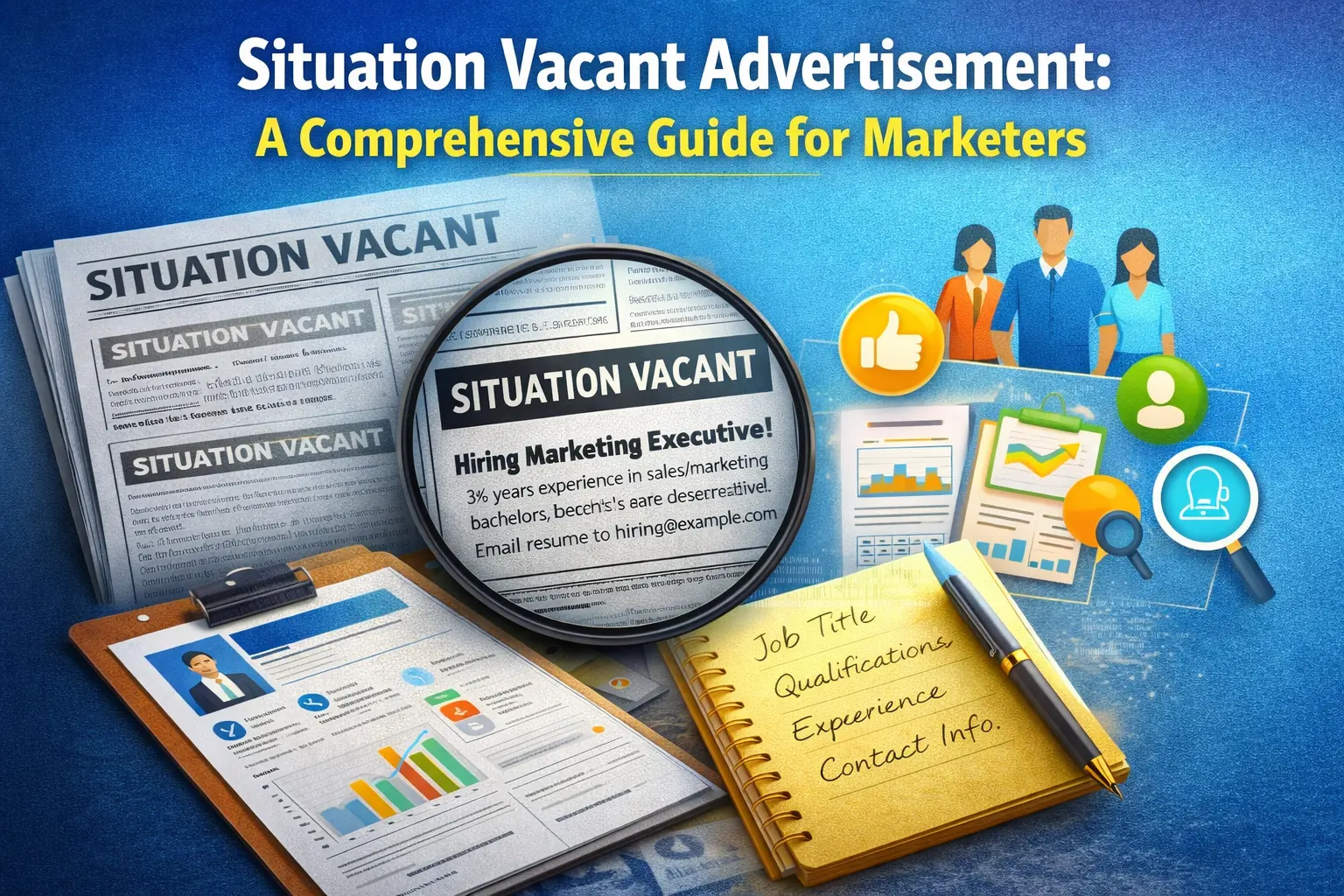
A successful situation vacant ad must clearly cover job role, qualifications, and application instructions. The essential elements are:
A template excerpt from a school ad shows these elements in action:
SITUATION VACANT – “Himalaya Public School, Rohini, Delhi requires a qualified Female Receptionist. Candidate should have excellent communication skills in English and Hindi. Interested candidates may send their resume with a recent photograph to Principal, Himalaya Public School, Delhi, by 10th July. Contact No. 9899xxxxxx.”
This ad specifies the role, skills (communication skills), application method, contact number, and deadline in a compact way. By mentioning qualifications (fluency in languages) and location, it guides the right applicants to respond. When you draft a suitable advertisement, mimic this clarity: list only essential facts in a logical order.
Selecting where to publish your ad is as important as the ad itself. Local newspapers or local dailies are ideal for region-specific hiring – they reach candidates who are actually nearby. Many classified ads sections let you choose a classified column of a local newspaper, which can be cost-effective and targeted. For instance, a Delhi-based school might place its ad in the classified column of a Delhi city paper, rather than a costly national paper.
On the other hand, national newspapers (or column of a national daily) provide wider visibility. If you need to fill specialized roles (like senior executives) or want to attract talent from across regions, a leading national paper may be worth the investment. Keep in mind that national classifieds tend to be more expensive and often have stricter word limits. Also consider frequency: some advertisers run their ads once in a local daily and repeat them a few times for best results.
If space is extremely limited (for example, “Write the advertisement in about 50 words” as some boards require), a local paper might give more flexibility with minor fees. It’s also common to publish job ads in both print and online simultaneously: many newspapers now post classified ads on their websites for additional reach. No matter the platform, ensure you choose one whose readership matches your job’s requirements. For example, publications like The Times of India (North India) or Hindustan Times (Delhi/NCR) are known for large employment sections. Always ask for a media kit or circulation details to confirm that your preferred newspaper’s audience aligns with your target hires.
In short, weigh cost versus reach. A local newspaper giving maximum local exposure can yield quality candidates and is budget-friendly. A leading national newspaper might be better for senior or niche positions, despite higher costs. You might even target both: a short local ad for immediate hires and a national-classified for hard-to-fill roles.
Consider a hypothetical case: ABC Retail Pvt. Ltd. wanted to hire 10 store managers across Delhi and Mumbai. Instead of only using online job portals (which can be costly), the marketing team crafted a situation vacant advertisement campaign with SmartAds’ guidance. They placed ads in Delhi’s and Mumbai’s local newspapers under “Situations Vacant,” repeating them on weekends for two weeks. The ad read:
SITUATION VACANT – STORE MANAGERS (10 Posts) – “Required a dynamic Store Manager for our new outlet in Mumbai/Delhi. Graduate with 3+ years retail experience preferred. Excellent communication and leadership skills needed. Competitive salary + benefits. Send resume to careers@abcretail.com by 15th July.”
This simple ad included number of posts, location, education/experience and call to action. It emphasized competitive benefits and specified contact details. Within days, ABC Retail received dozens of inquiries – many from candidates who had not responded to online job boards. The campaign demonstrated that a well-placed local classified can drive applicant engagement by reaching passive job seekers (people who read newspapers but aren’t actively searching online).
Key lessons from this success: keep the ad focused, tailor it for each city (mentioning “Mumbai” or “Delhi”), and include an email for quick responses. The phrase “competitive salary + benefits” worked as a persuasive hook. As data suggests, adding actionable incentives or clear Call to Action phrases boosts responses. If ABC Retail had used vague language, they might have missed out on qualified applicants. This case shows that blending data (location, salary info) with persuasive language yields results.
Current trends highlight that job advertising, especially online classified platforms, is on the rise. The global classifieds market (which includes job ads) is growing fast: from roughly $35?B in 2024 to an expected $80 B by 2033. This growth is driven by digital adoption: about 68.7% of the world’s population is online as of 2025, and smartphone penetration is ~69%. Indeed, one report notes that “mobile platforms account for over 70% of classified advertisement access”. This means today’s job ads must be mobile-friendly too (e.g. easily readable on phones).
For marketers, an important stat is that online classifieds dominate this market. Over 80% of classified ad volume is on online platforms. However, print still matters: established newspapers have online portals for their classified pages, effectively bridging print’s credibility with digital convenience. Reports also show “Primary Categories: Real Estate, Automotive, Jobs” – confirming that recruitment ads are among the most common classified listings globally.
From the candidate perspective, 2025 surveys indicate that many job seekers use a mix of channels. They may browse an online job board, but also glance at the newspaper’s classified ad on Sunday morning. Notably, offline reach can hit passive applicants – those “not actively looking” but open to opportunities. A recent study highlights that 73% of candidates are passive, but a strong ad can capture their interest on the weekend paper or their phones.
In India specifically, while digital hiring platforms are booming, many organizations still allocate budget for print classifieds because of their localized impact and trust factor. For example, in metro cities like Delhi, The Times of India and Hindustan Times classifieds sections see hundreds of job ads weekly. According to industry analysis, sectors like education and retail continue to rely on print + online mix for hiring.
Key takeaway: Use data to inform your strategy. If analytics show most applicants come from online sources, lean more on digital classifieds. If local foot traffic matters (e.g. a new retail outlet), include newspaper ads. Remember that metrics like click-through or call volume can now be tracked even for classifieds – some platforms let you measure responses. Combining traditional classified advertising data with digital analytics is the modern approach.
In the classifieds world, “Situation Vacant” and “Situation Wanted” are two sides of the same coin. We’ve covered situation vacant (employer ads), but a situation wanted ad is placed by a job seeker. A good situation wanted ad advertises an individual’s skills or services to attract potential employers. For example, a retiree or a skilled freelancer might write: “Experienced IT professional with 10 years in software development seeking challenging assignment. Strong communication skills. Open to contract work.” Such ads also appear in classified columns.
The main difference is perspective: situation vacant ads say “We have a job”; situation wanted ads say “I am available”. Both can help fill vacancies. As one source explains, “In short, one is an ad from a job seeker. The other is from an employer”. For marketers, understanding this helps craft better campaigns. For instance, if talent supply is scarce, encouraging a situation wanted section (or monitoring it) can pre-qualify candidates even before roles open.
Typically, situation wanted ads highlight the candidate’s qualifications and the type of suitable job they seek. An example from a newspaper classified might read: “An electronics engineer, 25, healthy, male, looking for a suitable job in or around Delhi in an electronics or communications company. The candidate has good communication skills and 3 years’ experience. Available for immediate joining.”. The phrase “looking for a suitable job” appears in such ads. Notice how it directly mentions location (Delhi) and key skills.
In practice, recruitment campaigns sometimes feature both. For example, a school wanting new teachers could publish a situation vacant ad asking for applications, and simultaneously invite situation wanted ads in a local paper (e.g. “Female teachers seeking new assignments, contact School Principal at… ”). The mutual presence of both ad types makes the job market more transparent. As a marketer, consider that scenario when advising clients: if you run a situation vacant ad, also check situation wanted listings to proactively reach candidates who have already shown interest in similar roles.
By following these guidelines and tailoring ads to your audience, marketers can craft situation vacant advertisements that attract quality candidates and outperform competitors’ postings.


