SmartAds
|
Media: BTLBQS Advertising in India: Bus Queue Shelter Branding, Costs, and Campaign Strategy
Most brand managers we speak with have walked past thousands of bus queue shelters without ever seriously considering them as a media buy — and that, frankly, is one of the more expensive blind spots in Indian outdoor advertising. The Indian OOH advertising market was valued at somewhere in the ballpark of Rs 3,500 crore in 2023, according to the FICCI-EY Media and Entertainment Report, and bus shelter advertising accounts for a quietly significant slice of that number; one that keeps growing as urban commuter density rises and smart city infrastructure begins to reshape what a bus stop can actually do. What makes BQS advertising genuinely interesting — and what most generic media planning conversations miss — is that it delivers eye-level engagement to a captive audience at the precise moment when they have nothing else competing for their attention.
There is a tendency in media planning circles to treat bus queue shelter advertising as the little sibling of large-format hoardings — something you add to a plan when the big formats are sold out or the budget is running thin. We have spent years pushing back against that assumption, because the mechanics of BQS advertising are fundamentally different from any other out-of-home format, and those differences matter enormously for certain campaign objectives.
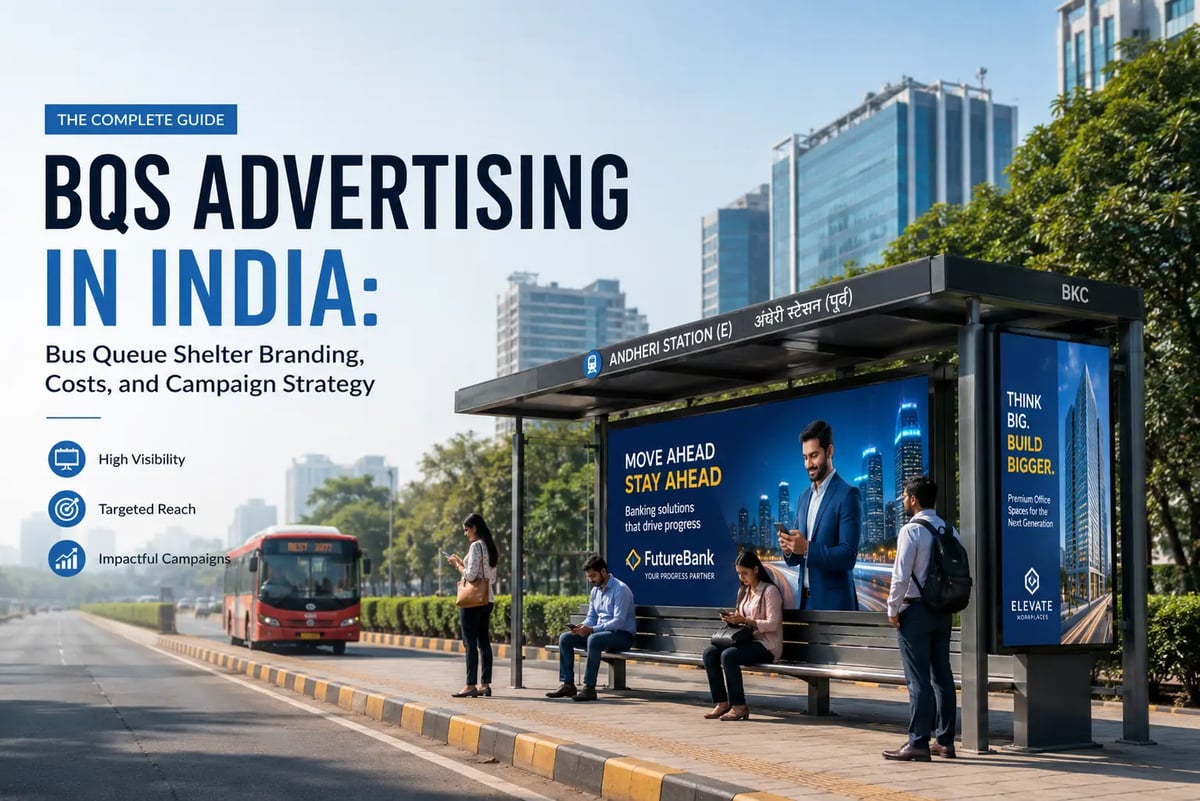
A bus queue shelter, for those who need the precise framing, is the covered waiting structure installed at bus stops across Indian cities — the kind maintained by municipal corporations, state transport departments, or private concessionaires under advertising rights agreements. The advertising panels integrated into these structures, which typically face outward toward pedestrians and inward toward waiting commuters, constitute what the industry calls BQS advertising. The ad panel sits at eye level, which is a detail that sounds trivial until you compare dwell time: a commuter waiting for a bus in a city like Delhi or Mumbai will spend anywhere between four and twelve minutes at that shelter, during which the BQS ad is essentially impossible to avoid. That is a captive audience in the most literal sense of the phrase.
What a lot of people miss is how the booking and rights structure works. BQS advertising in India is not sold the way digital inventory is sold — you cannot simply log into a platform and buy a shelter. Advertising rights for bus shelters are typically awarded through municipal corporation tenders or contracts with the Department of Transport, Government of NCT Delhi in the case of the capital, or through BMTC in Bengaluru, or through equivalent state transport bodies in other cities. Private concessionaires — companies like Arc Outdoor Media, Ginger Media Group, and others — win these tenders and then sell the advertising inventory to brands, either directly or through agencies. At SmartAds, we manage these relationships across 500+ cities, which means our clients do not have to navigate that concessionaire landscape themselves; we already know who holds the rights, what the current inventory looks like, and where the best-performing locations are in each market.
The format question is where most first-time BQS advertisers get confused, because the term "bus shelter advertising" covers a wider range of executions than people expect. The most common distinction is between backlit and frontlit panels — and that distinction has real implications for visibility, cost, and creative execution.
Backlit advertising panels, which are illuminated from behind using fluorescent or LED light boxes, are the premium format in BQS branding; they remain visible after dark, which is critical in cities where peak commuting hours extend well into the evening. Frontlit advertising, by contrast, relies on external lighting or ambient daylight, which makes it effective during daytime hours but significantly less impactful once the sun goes down. In our experience working with FMCG and BFSI clients, backlit BQS panels consistently outperform frontlit in brand recall studies — particularly in metro cities where evening commuter footfall is heavy. Non-lit BQS panels exist in smaller markets and Tier-2 cities, where infrastructure may not support illuminated formats; they are cheaper, but the trade-off in visibility is real and should be factored into planning.
Beyond the lighting distinction, BQS ad formats in India also vary by panel size and placement. The standard single-panel format, which is the most commonly available, typically measures around 4 feet by 6 feet — though dimensions vary by city and concessionaire. Some shelters accommodate double-panel or full-shelter wraps, which are larger-format executions that essentially brand the entire structure; these are more expensive but create a significantly stronger visual impact. Vinyl pasting on bus shelter panels remains the dominant production method for static media advertising in India, though digital screens are beginning to appear in premium locations under the Smart City Mission. There are also three-sided scrollers in some high-traffic locations, which rotate multiple advertisers' creatives on a single panel — a format that reduces cost but also reduces exclusivity.
Frankly speaking, this is the question that every client asks first, and it is also the question that is most frequently answered badly by generic media rate cards. BQS advertising cost in India varies dramatically based on city tier, location quality, panel type, and campaign duration — and any agency that gives you a single flat rate without those qualifiers is not giving you useful information.
In Delhi-NCR outdoor advertising markets, a single backlit BQS panel in a high-traffic location — think Connaught Place, Rajouri Garden, or the major arterial roads in Noida — will typically cost somewhere between Rs 15,000 and Rs 35,000 per month, depending on the specific location and the concessionaire. Mumbai bus shelter advertising in premium zones like Bandra, Andheri, or the Western Express Highway corridor runs in a similar range, sometimes touching ?40,000 per month for the best spots. Bengaluru BQS advertising, which is managed largely through BMTC-affiliated concessionaires, tends to be slightly more affordable — in the ballpark of Rs 12,000 to Rs 28,000 per month for backlit panels in high-footfall areas. Hyderabad BQS advertising and Ahmedabad bus shelter rates are generally lower still, with good locations available in the Rs 8,000 to Rs 20,000 per month range. Kolkata BQS inventory, managed partly through Kolkata Municipal Corporation frameworks, can be among the most cost-efficient in the metro tier, with quality locations available for roughly Rs 10,000 to Rs 22,000 per month.
The CPM story is where BQS advertising genuinely surprises people. When you calculate the cost per thousand impressions for a well-located bus shelter panel in a city like Delhi or Mumbai — accounting for daily commuter footfall past that location, which in a busy corridor can run to 30,000 or 40,000 people per day — the CPM works out to somewhere in the range of Rs 5 to Rs 12, which is a number that stops most digital-first marketers in their tracks when they compare it to what they are paying for verified reach on Instagram or YouTube. To be fair, OOH impressions and digital impressions are not perfectly comparable — the measurement methodologies are different — but the directional comparison is valid and important for budget allocation conversations. On top of that, BQS advertising rates in India do not carry the auction volatility that digital platforms do; you negotiate a rate, you lock it in, and your cost does not spike because a competitor decided to increase their bidding.
The hoarding versus BQS debate is one we have had with clients more times than we can count, and the honest answer is that it is not really a competition — they serve different functions. But since most brand managers are working with finite budgets and need to make allocation decisions, it is worth being direct about where BQS advertising has a genuine structural advantage.
Hoarding advertising, or large-format billboard advertising, wins on sheer scale and visibility from a distance; a 40-by-20-foot billboard on a highway or an elevated road commands attention from vehicles moving at speed, which makes it excellent for brand awareness campaigns targeting automotive audiences or highway travellers. Bus queue shelter advertising wins on proximity and dwell time — the commuter standing two feet from a BQS ad panel, waiting for their bus, is in a fundamentally different state of attention than a driver glancing at a hoarding at 60 kilometres per hour. Eye-level advertising at close range, combined with four to twelve minutes of forced exposure, creates a qualitatively different brand impression. We have seen this dynamic play out repeatedly in post-campaign recall studies: BQS branding consistently outperforms hoardings on message retention metrics, even when the hoarding has higher raw impression numbers.
The cost comparison also favours BQS advertising for brands with moderate budgets. A single premium hoarding in Mumbai or Delhi can cost anywhere from Rs 2 lakh to Rs 10 lakh per month, which means a brand can afford perhaps one or two locations in a city. The same budget deployed in BQS advertising could cover fifteen to thirty shelter panels distributed across multiple high-traffic locations, which creates a network effect — daily commuters encounter the brand at multiple points in their journey, which reinforces the message in a way that a single large-format site cannot replicate. This distributed presence is something we specifically recommend to FMCG and retail clients who need to build frequency with a local urban audience rather than a single-point impression.
The short version is that almost any consumer-facing brand can make BQS advertising work, but certain sectors have structural reasons to prioritise it. FMCG advertising is the most obvious fit — brands selling packaged foods, personal care products, beverages, and household goods are targeting exactly the urban commuter demographic that bus shelter advertising reaches most efficiently. The daily commuter is also, statistically, the daily grocery buyer; the brand impression created at a bus stop in the morning has a measurable influence on purchase decisions made at the kirana store or modern trade outlet later that day.
BFSI advertising has been one of the fastest-growing categories in BQS advertising over the past few years, which reflects a broader shift in how insurance companies, mutual fund houses, and digital payment platforms think about mass-market brand awareness. A fintech brand trying to build trust with first-time investors or insurance buyers in Tier-2 cities — places like Ludhiana, Gandhi Nagar, or Nashik — will find that bus shelter branding creates a legitimacy signal that purely digital advertising cannot replicate; there is something about seeing a brand's name on physical infrastructure that reads as established and credible to audiences who are still developing their relationship with financial products. E-commerce advertising on BQS panels has similarly grown, particularly around sale events, where brands like food delivery platforms and quick commerce players use bus stop advertising to reinforce app download and reorder messaging to urban audiences.
One sector that is chronically underrepresented in BQS advertising discussions is real estate, which is ironic given how well the format fits the brief. A residential project in a specific micro-market benefits enormously from hyperlocal bus shelter branding in the catchment area — potential buyers commuting through that neighbourhood encounter the project name repeatedly over weeks, which builds the kind of familiarity that converts into site visits. We ran a campaign for a mid-segment residential developer in Pune who had previously relied entirely on digital and newspaper advertising; after deploying BQS ads across twelve shelters in the project's catchment area for sixty days, site visit inquiries from that locality increased by roughly 34% compared to the same period the previous year. The developer described it as the most cost-efficient awareness spend they had done in three years.
Delhi BQS advertising is, by volume and quality, the most developed BQS market in India — the Department of Transport, Government of NCT Delhi, has overseen a relatively organised system of shelter advertising rights, and the sheer density of bus routes across the capital means that inventory is available across virtually every residential and commercial corridor. The best-performing locations in Delhi-NCR outdoor advertising tend to cluster around metro feeder routes, major market areas, and hospital or educational institution catchments, where daily footfall is both high and consistent.
Mumbai bus shelter advertising presents a different kind of opportunity — one shaped by the city's extraordinary commuter density and the relatively compact geography of its commercial zones. Locations along the Western Line feeder routes, in Bandra and Andheri, and around the BKC business district tend to command premium rates precisely because the footfall numbers are exceptional; a single well-placed shelter in Andheri West can deliver impressions that would require three or four shelters in a less dense city. Bengaluru BQS advertising has grown significantly as BMTC's network has expanded, and the tech corridor between Whitefield and Electronic City has become a particularly attractive zone for brands targeting the IT professional demographic. Hyderabad BQS advertising, especially around Hitech City and Gachibowli, follows a similar logic.
What a lot of media planners overlook is the opportunity in Tier-2 cities, which we think represents one of the genuinely undervalued spaces in Indian outdoor advertising right now. Cities like Ludhiana, Gandhi Nagar, Coimbatore, Indore, and Nagpur have growing middle-class commuter populations, far less advertising clutter on their bus shelters, and BQS advertising costs that are a fraction of metro rates — often in the range of Rs 3,000 to Rs 8,000 per panel per month. For brands pursuing a pan-India strategy or specifically targeting Tier-2 urban consumers, a BQS campaign that combines ten metro locations with thirty Tier-2 locations can deliver broader reach and higher frequency than a metro-only plan at the same total budget.
The honest answer is that digital transformation in BQS advertising in India is real but uneven — and anyone who tells you that DOOH has already taken over the bus shelter format in Indian cities is describing a future that has arrived in pockets but not yet at scale. Digital out-of-home screens have been installed at bus shelters in select cities under the Smart City Mission, particularly in cities like Pune, Ahmedabad, Bhopal, and parts of Delhi-NCR; these digital screens outdoor allow for dynamic content, time-of-day scheduling, and — in some cases — audience-triggered creative delivery using IoT advertising displays.
Programmatic OOH buying for BQS inventory is an emerging capability in India, which is still considerably behind where it is in markets like the UK or Australia but is developing quickly. A handful of technology platforms have begun aggregating DOOH inventory from concessionaires and making it available through programmatic pipes, which means that brands can, in theory, buy bus shelter advertising in specific cities or corridors through an automated buying interface rather than a manual negotiation. The reality, as of 2024-2025, is that programmatic DOOH covers a small fraction of available BQS inventory in India — most of the market is still transacted through direct relationships with concessionaires or through agencies like SmartAds that maintain those relationships. But the direction of travel is clear, and brands that want to be early movers in programmatic OOH should be building those capabilities now.
Augmented reality advertising executions on bus shelter panels have appeared in a few high-profile campaigns in Indian metros, where QR codes or AR triggers on static BQS panels invite commuters to engage with a digital experience on their phones; this kind of interactive advertising display is still more novelty than mainstream, but it points toward a future where the bus shelter becomes a physical touchpoint in a broader digital campaign ecosystem. Location intelligence advertising — using anonymised mobile data to understand who is actually passing a given bus shelter and when — is also beginning to influence how BQS inventory is valued and planned; this demographic targeting outdoor capability is still nascent in India but is already changing conversations around measurement and accountability.
The booking process for bus shelter advertising in India is more involved than most digital media buys, and understanding the steps involved helps brands avoid the common mistakes that lead to delayed campaigns or suboptimal location selection. The first thing to understand is that BQS advertising rights are held by concessionaires — private companies that have won advertising contract tenders from municipal corporations or state transport departments — and that these concessionaires vary by city and sometimes by zone within a city. Navigating this landscape without an agency means identifying the right concessionaire for each city, negotiating separately with each, and managing multiple production and installation timelines simultaneously.
At SmartAds, our approach to BQS campaign booking starts with a location audit — we map the client's target audience geography against available inventory in each city, identify the highest-footfall locations within budget, and shortlist a panel network that delivers the required reach and frequency. This is not a step that should be skipped or rushed; the difference between a well-located BQS panel and a poorly located one can be a factor of three or four in terms of actual impressions delivered, even if the rates are similar. Once locations are confirmed, creative artwork is submitted to the concessionaire for approval — most require high-resolution files in specific formats, typically large-format TIFF or PDF at 150 DPI for vinyl printing, with bleed margins built in. Installation timelines are generally five to seven working days after artwork approval, which means a campaign that needs to go live on a specific date requires artwork submission at least ten days prior.
Campaign duration is a question we get frequently, and our honest recommendation is that BQS advertising campaigns should run for a minimum of thirty days to generate meaningful frequency with the commuter audience; sixty to ninety day campaigns are where the real brand-building impact accumulates, because the repetitive exposure over multiple weeks is what drives brand recall from awareness into consideration. Shorter campaigns — two weeks or less — can work for tactical event-driven advertising, like a product launch or a sale period, but they are rarely the right choice for brand awareness objectives. Measurement and attribution for BQS campaigns in India typically rely on a combination of footfall data from location intelligence platforms, brand recall surveys conducted in the campaign geography, and — increasingly — mobile device movement data that can identify devices which have been exposed to a specific shelter location.
The GroupM TYNY Report and the Dentsu e4m Report have both flagged OOH advertising as one of the faster-recovering and faster-growing segments of the Indian media market coming out of the pandemic years, and BQS advertising has been a meaningful part of that recovery story. The trend that we find most strategically significant for clients is the growing integration of BQS branding into hyperlocal marketing strategies — brands are increasingly using bus shelter advertising not as a mass-reach vehicle but as a precision tool for neighbourhood-level brand building, which is a use case that the format is genuinely well-suited for.
The Smart City Mission has been the most consequential structural development for BQS advertising in the medium term; as more Indian cities receive smart city infrastructure investment, the quality and capability of bus shelter panels is improving — better illuminated bus shelters, digital screens, solar-powered panels, and in some cases real-time information displays that increase commuter dwell time at the shelter and therefore increase ad exposure. This infrastructure upgrade is happening at different speeds in different cities, but the directional trend is consistent. We have also seen a significant increase in brands using BQS advertising as part of integrated campaigns — running the same creative across bus shelter panels, transit media on buses and metro stations, and digital channels simultaneously, which creates a surround-sound effect for the urban commuter audience.
One trend worth watching is the emergence of audience measurement standards for OOH advertising in India, which have historically been far less rigorous than broadcast or digital measurement. The industry has been working toward more standardised impression measurement methodologies — using traffic count data, pedestrian footfall sensors, and mobile location data — which will eventually make BQS advertising more comparable to digital on an apples-to-apples basis. When that measurement infrastructure matures, we expect to see a significant revaluation of BQS advertising rates in high-footfall locations, because the data will confirm what experienced media planners already know: the CPM for a well-located bus shelter panel is genuinely competitive with most digital formats.
Bus queue shelter advertising works best, in our experience, when it is treated as one layer in a broader out-of-home advertising strategy rather than a standalone buy. The logic is straightforward: large-format billboard advertising creates the initial brand impression at distance and scale; BQS ads reinforce that impression at eye level and close range as the same audience moves through the city; transit media on bus bodies and metro stations bridges the two, catching the audience in motion between locations. This layered approach to outdoor advertising is what we recommend to clients with budgets large enough to support multiple OOH formats, because each format does something the others cannot.
A campaign we planned for an automotive brand launching a new entry-level hatchback in three South Indian cities illustrates this well. The brand had used hoardings for all previous campaigns and was sceptical about BQS advertising; we proposed a split where roughly 40% of the OOH budget went to large-format sites on arterial roads, 35% went to bus shelter branding in residential and commercial catchments, and 25% went to transit media on BMTC buses in Bengaluru. The BQS panels, which were placed specifically near dealership catchment areas and in middle-income residential neighbourhoods, generated the highest unaided recall scores in the post-campaign survey — higher than the hoardings, which had significantly larger physical dimensions. The brand's regional marketing team told us it was the first time they had seen BQS ads outperform hoardings in recall data, and it fundamentally changed how they allocated their OOH budget in subsequent campaigns.
The multi-channel integration question also applies to the relationship between BQS advertising and digital campaigns. We have found that running coordinated BQS and digital campaigns — where the creative message and visual identity are consistent across bus shelter panels and social media or search ads — produces a measurable lift in digital campaign performance, because the physical brand presence creates a familiarity that makes the digital ad feel more credible and less interruptive. This is particularly true for brands entering a new city or a new consumer segment, where the bus shelter presence signals a kind of physical commitment to the market that a purely digital campaign cannot replicate.
Q: What is BQS advertising and what does BQS stand for?
BQS stands for Bus Queue Shelter, which refers to the covered waiting structures installed at bus stops across Indian cities. BQS advertising is the practice of placing branded advertising panels on or within these shelters — typically facing outward toward pedestrians and inward toward waiting commuters. The format is classified as transit media within the broader out-of-home advertising category, and it is distinct from other OOH formats in that it delivers eye-level, close-proximity brand exposure to a captive audience with meaningful dwell time. Advertising rights for bus shelters are typically held by private concessionaires who have won tenders from municipal corporations or state transport departments, and brands access this inventory either directly through concessionaires or through media agencies that maintain those relationships.
Q: How much does BQS advertising cost in India in 2024–2025?
BQS advertising cost in India varies considerably by city, location quality, panel type, and campaign duration. In Delhi-NCR, backlit BQS panels in premium locations typically run somewhere between Rs 15,000 and Rs 35,000 per month per panel; Mumbai bus shelter advertising in high-footfall zones can reach Rs 40,000 per month for the best locations. Bengaluru and Hyderabad BQS advertising rates are generally in the Rs 10,000 to Rs 28,000 range, while Kolkata and Ahmedabad tend to be more affordable at Rs 8,000 to Rs 22,000 per month. Tier-2 cities like Ludhiana, Gandhi Nagar, and Indore offer BQS advertising at significantly lower rates — often Rs 3,000 to Rs 8,000 per panel per month — which makes them attractive for brands pursuing high-frequency local presence at modest budgets. Production costs for vinyl printing and installation typically add another Rs 2,000 to Rs 5,000 per panel on top of the media rate.
Q: What are the different types of BQS ad formats available in India?
The primary distinction in BQS ad formats is between backlit, frontlit, and non-lit panels. Backlit advertising panels are illuminated from behind using fluorescent tubes or LED systems, which makes them visible around the clock and is the premium format in most metro markets. Frontlit panels rely on external or ambient lighting and are effective during daytime hours but lose visibility after dark. Non-lit BQS panels are the most basic format, typically found in Tier-2 and Tier-3 cities where infrastructure may not support illuminated formats; they are the most affordable but also the least impactful. Beyond lighting, formats also vary by size — standard single panels, double panels, and full-shelter wraps are all available depending on the concessionaire and location. Digital BQS panels with LED screens are available in select smart city locations and allow for dynamic creative, time-of-day scheduling, and multiple advertisers rotating on a single panel.
Q: How is BQS advertising different from hoarding or billboard advertising?
The fundamental difference is one of proximity, dwell time, and audience state. Hoarding advertising and billboard advertising are designed to be seen from a distance — typically by people in moving vehicles — and the exposure window is measured in seconds. BQS advertising is experienced at close range by stationary commuters who may spend four to twelve minutes at the shelter, which creates a qualitatively different brand impression. Hoardings win on scale and long-distance visibility; bus shelter advertising wins on message retention, eye-level engagement, and the ability to deliver detailed creative messaging that a moving audience cannot absorb. From a cost perspective, BQS advertising generally offers a lower CPM than large-format hoardings, particularly in high-footfall urban locations, though a single hoarding can deliver very high gross impression numbers in the right location.
Q: Which cities in India offer the best BQS advertising opportunities?
Delhi and Mumbai offer the largest and most organised BQS advertising markets in India, with the highest footfall locations and the most developed concessionaire infrastructure. Bengaluru, Hyderabad, and Ahmedabad are strong secondary markets with growing inventory and competitive rates. Kolkata offers good value in the metro tier. For brands targeting specific demographic segments, the best city is not always the largest — a fintech brand targeting young professionals might find Bengaluru's tech corridors more efficient than a broader Delhi buy, while an FMCG brand targeting mass-market consumers might prioritise Tier-2 cities like Ludhiana, Gandhi Nagar, or Coimbatore, where BQS advertising costs are lower and competitive clutter is significantly reduced.
Q: Which industries or brands benefit most from BQS advertising in India?
FMCG brands benefit most structurally, because their target audience — the urban daily commuter — is exactly who bus shelter advertising reaches most efficiently, and the purchase cycle is short enough that a brand impression in the morning can influence a purchase decision the same day. BFSI brands, particularly insurance companies, mutual fund platforms, and digital payment apps, have been among the fastest-growing categories in BQS advertising because the format builds the kind of physical brand credibility that supports financial product adoption. E-commerce and food delivery brands use BQS ads effectively for app awareness and reorder messaging. Real estate developers benefit from hyperlocal bus shelter branding in project catchment areas. Healthcare brands, educational institutions, and consumer durables companies have all used BQS advertising effectively in India.
Q: How do I book a BQS advertising campaign in India?
The booking process involves identifying the right concessionaire for each target city, selecting specific shelter locations based on footfall and audience data, negotiating rates and campaign duration, submitting creative artwork for approval, and managing installation timelines. Working through an agency like SmartAds simplifies this considerably — we maintain relationships with concessionaires across 500+ cities, which means location selection, rate negotiation, and production coordination are handled centrally rather than requiring separate vendor conversations for each city. For brands booking independently, the starting point is identifying which company holds the advertising contract for bus shelters in each target city — this varies by city and sometimes by zone — and then requesting a location list and rate card from that concessionaire.
Q: What is the typical duration of a BQS advertising campaign?
Most BQS advertising campaigns run for thirty, sixty, or ninety days, with sixty days being the most common duration for brand awareness objectives. Shorter campaigns of two to four weeks are used for tactical purposes — product launches, promotional events, or sale periods — but they do not generate sufficient frequency to build lasting brand recall. Longer campaigns of three to six months are used by brands pursuing sustained brand-building objectives, particularly in new markets where they are trying to establish presence from scratch. The minimum booking period with most concessionaires is typically fifteen to thirty days, though this varies. Production and installation timelines mean that campaigns require artwork submission at least ten days before the intended go-live date.
Q: What are backlit and frontlit BQS panels and which is better?
Backlit BQS panels are illuminated from behind using light boxes — originally fluorescent, increasingly LED — which makes them visible in all lighting conditions, including after dark. Frontlit panels are lit from the front by external light sources or rely on ambient daylight. For most urban campaigns, backlit advertising is the superior choice because peak commuting hours in Indian cities extend into the evening, and a panel that goes dark after sunset is losing a significant portion of its potential impressions. The CPM advantage of backlit panels over frontlit is substantial when you account for the full daily impression window. Backlit panels are more expensive — typically 20% to 40% more than frontlit for comparable locations — but the visibility uplift generally justifies the premium for brand awareness campaigns. Frontlit panels make sense in locations where campaigns are specifically targeting daytime audiences, or in markets where backlit inventory is not available.
Q: How is digital technology and smart city infrastructure changing BQS advertising in India?
The Smart City Mission has catalysed the installation of digital screens at bus shelters in select cities, enabling dynamic creative, time-of-day scheduling, and in some cases programmatic OOH buying. IoT-enabled bus shelters with real-time bus arrival information have also been deployed in cities like Pune and Ahmedabad, which increases commuter dwell time at the shelter and therefore increases ad exposure. Programmatic DOOH buying for BQS inventory is available in limited markets but growing. Augmented reality advertising executions — where QR codes on static panels trigger digital experiences — have been used in a handful of campaigns. Location intelligence platforms are beginning to provide more rigorous audience measurement for BQS sites, using mobile device movement data to quantify who is actually passing each shelter and when. These developments are still unevenly distributed across Indian cities, but the trajectory is clear.
Q: What creative dimensions and file formats are required for BQS ads?
Standard BQS ad panel dimensions in India are typically around 4 feet wide by 6 feet tall for single panels, though this varies by city and concessionaire — always confirm exact dimensions with the concessionaire before finalising artwork. For vinyl printing, which is the standard production method for static BQS advertising, most concessionaires require high-resolution files at 150 DPI minimum, supplied as TIFF, PDF, or EPS format with bleed margins of at least 5 centimetres on all sides. For digital BQS screens, formats vary by screen specification — JPEG or MP4 files are most common, with resolution requirements depending on the specific screen. Creative best practices for BQS ads include using large, bold typography that reads clearly at a glance, limiting copy to a maximum of seven to eight words for the primary message, using high-contrast colour combinations, and ensuring the brand name and logo are immediately visible without requiring the viewer to search for them.
Q: How can I measure the effectiveness and ROI of a BQS advertising campaign?
Measurement for BQS advertising in India has historically been less rigorous than for broadcast or digital formats, but the methodologies available are improving. Traffic count data from municipal authorities and transport departments provides a baseline for pedestrian and vehicular footfall past each shelter location. Mobile location intelligence platforms — which use anonymised device movement data — can estimate the number of unique devices that have been in proximity to a specific shelter during the campaign period, providing an impression count that is more granular than traffic counts alone. Brand recall surveys conducted in the campaign geography before and after the campaign period measure the lift in unaided and aided brand awareness attributable to the BQS exposure. For campaigns running alongside digital activity, uplift in branded search volume and social media engagement in the campaign cities can provide a proxy for OOH-driven awareness. Return on ad spend for BQS campaigns is most cleanly measured for retail and e-commerce brands that can track sales or footfall in the catchment area of the shelters during and after the campaign period.
Bus queue shelter advertising is one of those formats that tends to be underestimated right up until the moment a brand actually runs a well-planned campaign and sees the results — at which point it typically becomes a recurring line item in the annual media plan. The combination of eye-level proximity, genuine dwell time, and a captive audience that has no screen to look at while they wait creates a brand impression that is qualitatively different from almost anything else in the OOH advertising toolkit.
What we consistently tell our clients at SmartAds is that the format's value is only as good as the location selection and the creative execution. A BQS ad in the wrong location — low footfall, poor visibility, irrelevant audience — will underperform just as badly as any other media buy in the wrong context. But a well-planned BQS campaign, with locations chosen based on actual footfall data and audience composition, creative designed for the specific dimensions and lighting conditions of the panels, and a duration long enough to build meaningful frequency, can deliver brand awareness results that compete with formats costing several times more per impression.
The India OOH market is in a period of genuine structural growth, driven by urbanisation, smart city infrastructure investment, and improving measurement standards — and BQS advertising is positioned to benefit from all three of those tailwinds. Brands that build expertise in this format now, before digital DOOH screens become the norm at bus shelters and rates adjust accordingly, are likely to look back on this period as a window of exceptional value.
If you are planning a BQS advertising campaign — whether it is a single-city pilot or a multi-market rollout across Tier-1 and Tier-2