
SmartAds
|
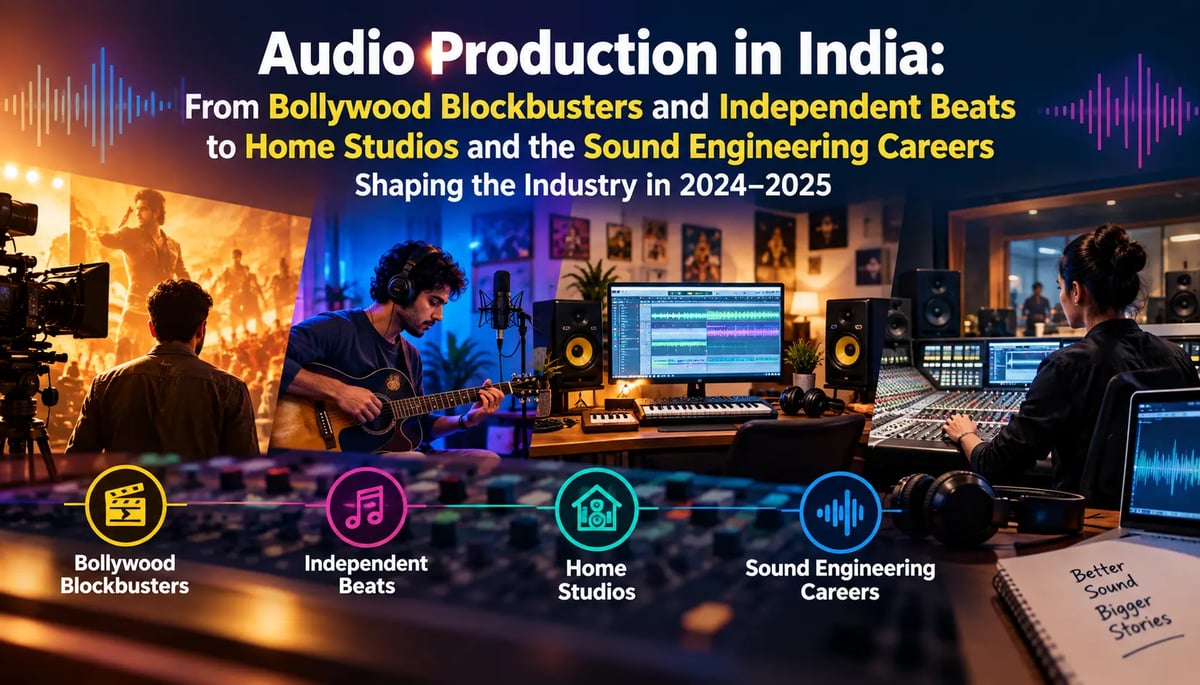
Media: RadioAudio Production in India: From Bollywood Blockbusters and Independent Beats to Home Studios and the Sound Engineering Careers Shaping the Industry in 2024–2025
India produces more music than almost any other country on earth — and yet the infrastructure, workflows, and economics that make that possible remain poorly understood even by many working professionals inside the industry. The Indian music industry crossed ?1,500 crore in recorded music revenues in 2023, according to the IFPI Global Music Report, with streaming accounting for the overwhelming majority of that figure; what that number doesn't tell you is how much of the actual audio production work behind those streams happens in home studios, mid-tier facilities, and regional recording hubs that rarely get written about. We have spent years at SmartAds working alongside brands, independent artists, and production houses on audio campaigns, jingle production, voiceover work, and branded audio content — and what we see consistently is that the gap between what people think audio production costs and what it actually costs, between what they think it requires and what it actually requires, is enormous.
Audio production is, at its core, the entire chain of decisions and processes that transforms an idea — a melody in someone's head, a script on a page, a brief from a brand — into a finished, broadcast-ready sound file. It is not a single step; it is a pipeline that runs from composition and arrangement through studio recording, editing, audio mixing, audio mastering, and finally delivery to whatever platform or medium will carry the sound to its audience. What a lot of people miss is that "audio production" is actually the umbrella term, and music production is one specific application of it — alongside podcast production, voiceover production, jingle production, film scoring, sound design for video, and the increasingly significant world of branded audio content.
In India, the way this pipeline operates varies enormously depending on context. A Bollywood film score might involve a music producer working with a full orchestra at Yash Raj Studios in Mumbai, a team of sound engineers running Pro Tools sessions across multiple rooms, and a post-production workflow that eventually delivers a Dolby Atmos mix for theatrical release — a process that can take months and cost several crore rupees. Meanwhile, an independent artist in Bengaluru might record vocals in a treated bedroom, send stems to a mixing engineer in Chennai over WeTransfer, and have a finished track on JioSaavn and Spotify India within three weeks for a total spend of somewhere between ?15,000 and ?50,000. Both are legitimate audio production workflows; they are simply calibrated to entirely different scales and objectives.
What makes India particularly interesting as an audio production market is the sheer diversity of what gets produced. Tamil film music, Punjabi pop, Carnatic classical recordings, Hindi hip-hop, devotional content, regional folk fusion, corporate jingles for radio campaigns, podcast series for brands — all of these flow through the same fundamental audio production process, even if the tools, the aesthetics, and the economics differ dramatically. At SmartAds, we always tell our clients that understanding this diversity is the first step to making smart decisions about where to invest in sound.
The pre-production stage is where most projects either succeed or fail, and it is also the stage that gets the least attention in most writing about audio production. Pre-production covers everything that happens before a single microphone is switched on in a recording studio: the composition and arrangement of the music, the writing of scripts for voiceover or podcast production, the selection of session musicians, the scheduling of studio time, and the creation of a reference track or demo that everyone involved can align on. We have seen this backfire when brands skip pre-production entirely, show up at a studio with a vague brief, and then spend twice the budgeted studio time — which is billed by the hour — trying to figure out what they actually want.
The recording phase is where the raw material gets captured, and the quality of what you record is the ceiling for everything that follows. Studio recording in a professional facility with good room acoustics, quality microphones, and a skilled audio engineer will always give you more to work with than a rushed home studio session — but the gap between professional and home recording has narrowed significantly over the past decade, particularly for vocals and electronic music production. The key variables are microphone quality, room treatment, gain staging discipline, and the experience of the person operating the equipment; a well-treated home studio with a ?25,000 condenser microphone and a competent audio engineer can produce results that are genuinely competitive with mid-tier professional facilities.
Post-production is where the recorded material gets shaped into its final form, and it encompasses editing, audio mixing, and audio mastering — three distinct processes that are often conflated by people outside the industry. Editing involves cleaning up the raw recordings: removing noise, comping the best takes, aligning timing, and preparing the session for the mix engineer. Audio mixing is the process of balancing all the individual elements — vocals, instruments, effects — into a coherent stereo or spatial image, using tools like equalization (EQ), compression, reverb, and stereo imaging to give each element its place in the frequency spectrum and the soundstage. Audio mastering is the final stage, in which the mixed track is processed to meet the loudness standards of streaming platforms like Spotify India and JioSaavn, and to ensure it translates well across different playback systems — from earbuds to car speakers to cinema sound systems.
The recording studio landscape in India has changed substantially over the past decade, and the change has not been uniform across cities. Mumbai remains the undisputed centre of Bollywood music production, with facilities like Bay Owl Studios and Psalm33 Studio offering world-class rooms that attract both film composers and independent artists; the day rates at top Mumbai studios typically run somewhere in the ballpark of ?8,000 to ?25,000 per hour depending on the room and the engineer, which is a number that surprises many independent artists who assumed professional studio recording would be prohibitively expensive. Delhi and its satellite cities have developed a strong cluster of facilities — Fresh Lime Studios and Kintsugi Studios in New Delhi, and Ferris Wheel Studios in Gurgaon — which have become particularly popular with the independent and alternative music communities in North India.
Chennai has a recording studio ecosystem that is deeply intertwined with the Tamil and Telugu film industries, and facilities like 20dB Soundstudios and Prasad Studios have long track records of delivering high-quality music recording for regional cinema — but they are also increasingly accessible to independent Tamil artists who want professional sound production without the Bollywood price tag. The presence of KM Music Conservatory, which was founded by AR Rahman, has also contributed to a broader culture of sound engineering education and professional audio production in Chennai that is genuinely distinctive. Bengaluru has developed its own scene, particularly around electronic music and indie rock, with a number of mid-tier studios that cater specifically to independent artists working on tighter budgets.
What we tell independent artists who come to us for guidance is that the best recording studio for your project is not necessarily the most expensive or the most famous — it is the one where the engineer understands your genre, the room sounds right for your instrumentation, and the workflow matches your timeline. A Carnatic vocalist recording an album does not need the same room or the same signal chain as a hip-hop producer tracking vocals for a mixtape; the studio's experience with your specific style of music matters as much as the technical specifications of the equipment. Goa has also emerged as an interesting outlier, with O3 Studio developing a reputation for creative, genre-fluid projects that attract artists from across the country who want to record in a less pressured environment.
Frankly speaking, the cost of audio production in India is one of the most frequently asked and least honestly answered questions in the industry. Most studio websites either don't publish rates at all or list only a base hourly figure that bears little relationship to the total cost of a finished track. What we have found, from years of commissioning audio production for brand campaigns, jingle production, and voiceover work, is that the total cost of a professionally produced single — from pre-production through to a mastered file ready for streaming platforms — typically falls somewhere between ?30,000 and ?3,00,000 depending on the complexity of the arrangement, the calibre of the musicians involved, and the studio tier.
At the entry level, an independent artist working with a music producer who operates from a home studio, using digital instruments and a modest session musician budget, can get a finished track produced, mixed, and mastered for somewhere between ?15,000 and ?40,000 — which represents genuinely good value if the producer is skilled. A mid-tier production with live instruments, professional studio recording in a facility like those mentioned above, and a dedicated mixing engineer might run to somewhere between ?75,000 and ?1,50,000 per track. At the top end, a Bollywood-quality production with full orchestration, multiple recording sessions, and a mastering engineer who works to Dolby Atmos specifications can cost several lakh rupees per song; the total audio production cost for a major Bollywood film soundtrack, including all the ancillary costs of session musicians, studio time, and post-production, can run into several crore rupees.
For brands commissioning jingle production or audio advertisements for radio campaigns, the cost structure is somewhat different. A 30-second jingle produced for a regional radio campaign — which might involve a music composer, a voiceover artist, a session musician or two, and a mixing engineer — can be delivered for somewhere between ?20,000 and ?80,000 depending on the production values required and the markets it will run in. Voiceover production for a single 30-second spot, without music, typically costs somewhere between ?5,000 and ?25,000 depending on the talent and the studio. Podcast production, which is a growing segment of the audio production market in India, can range from a basic per-episode fee of around ?3,000 to ?8,000 for editing and mixing, up to ?30,000 or more per episode for full-service production including scripting, recording, sound design, and distribution management.
This is a question we get asked constantly, and the confusion is understandable because both processes happen after recording and both involve technical manipulation of audio — but they operate at entirely different levels of the production chain and serve entirely different purposes. Audio mixing is the process of working with individual tracks within a session: balancing the relative levels of the drums, bass, guitars, vocals, and every other element; applying equalization (EQ) to carve out frequency space for each instrument; using compression to control dynamic range and add punch; adding reverb and other spatial effects to create depth and dimension; and making creative decisions about stereo imaging that determine how wide and spacious the finished mix will sound. A skilled mix engineer is essentially sculpting a three-dimensional sonic space out of dozens or sometimes hundreds of individual recorded elements.
Audio mastering, on the other hand, works with the finished stereo mix as a single file — or, in the case of Dolby Atmos and other immersive audio formats, with a set of stems — and prepares it for distribution. The mastering engineer applies gentle equalization and compression across the full mix to enhance its overall tonality and consistency, brings the track up to the appropriate loudness level for the target platform (Spotify India, for instance, normalises streams to around -14 LUFS, which is a standard that mastering engineers work to), and ensures that the track sounds coherent and competitive across a wide range of playback systems. The mastering engineer is also the last quality-control checkpoint before a track goes to a music label or gets uploaded to a streaming platform; they will flag problems with the mix — excessive low-end buildup, harshness in the high frequencies, phase issues — that the mix engineer may have missed.
What a lot of people miss is that you cannot fix a bad mix with great mastering; the mastering engineer can only work with what they are given, and a mix that has fundamental problems will still have those problems after mastering, just at a louder volume. The two processes are complementary, not interchangeable, and the best results come from having them handled by different engineers who each bring fresh ears to the material. In the Indian music industry, it is still relatively common — particularly at the independent level — for the same person to handle both mixing and mastering, which is a workflow compromise that is sometimes necessary for budget reasons but which we generally advise against when the budget allows for separation.
---
The choice of digital audio workstation is one of the most hotly debated topics in any music production community, and the Indian music production community is no exception — with the added complexity that the genres being produced here span an unusually wide range, from Carnatic classical to Punjabi pop to Tamil hip-hop to Bollywood orchestral scoring. The honest answer is that the best DAW is the one you know well enough to work quickly in, because workflow speed matters enormously in a commercial music production environment; but there are genuine differences between the major platforms that make some better suited to certain types of work.
Pro Tools is the industry standard for professional recording studios and post-production facilities across India and globally, which means that if you are working in a professional studio environment — at Yash Raj Studios, at Prasad Studios, at any of the major Mumbai or Chennai facilities — you will almost certainly be working in Pro Tools. Its editing capabilities are unmatched for complex multi-track sessions, and its compatibility with professional studio hardware makes it the default choice for audio engineers working at the highest level. The cost is a genuine barrier for independent producers, however; a subscription runs to several thousand rupees per month, which adds up quickly for someone just starting out.
Ableton Live has become the dominant choice for electronic music producers and live performers in India, particularly in the Bengaluru and Mumbai electronic music scenes, because its session view and clip-based workflow are uniquely suited to loop-based composition and live performance. Logic Pro, which is Mac-only, has an enormous following among Indian music producers who work on Apple hardware — it offers a remarkable range of built-in instruments and effects that are genuinely competitive with third-party plugins, and its price point (a one-time purchase rather than a subscription) makes it attractive for independent producers. GarageBand, which is free on all Apple devices, is where a large number of Indian music producers begin their journey, and it is more capable than its reputation suggests; we have heard finished tracks produced entirely in GarageBand that were genuinely competitive with tracks produced in more expensive software. For producers working on Windows who want a capable, affordable DAW, FL Studio has a large and loyal following in India, particularly among hip-hop and trap producers.
---
The adoption of AI in music production in India is happening faster than most industry observers expected, and it is creating both opportunities and anxieties that are worth taking seriously. On the production side, AI-powered tools are being used for tasks that previously required significant technical expertise: automatic stem separation (which allows producers to isolate vocals, drums, or bass from a mixed track), AI-assisted mastering services, vocal pitch correction that goes well beyond what traditional tools offered, and music composition assistance tools that can generate chord progressions, melodies, or even full backing tracks from a text prompt or a hummed melody. Services like these are being used by independent producers across India who are working without the budget for a full production team.
The implications for the Indian music industry are complex. On one hand, AI tools are democratising audio production in a way that is genuinely exciting — a producer in a small town in Uttar Pradesh who has a good ear and a laptop can now access mastering quality and production tools that would have required a professional studio and a team of engineers a decade ago. On the other hand, the music label ecosystem and the professional audio engineer community are grappling with questions about how AI-generated or AI-assisted music will be attributed, compensated, and regulated; the Indian Music Industry (IMI) has begun engaging with these questions, though the regulatory framework remains nascent. AI in music is not replacing skilled audio engineers and music producers at the top end of the market — the creative judgment, the genre knowledge, the ability to communicate with artists, and the technical problem-solving that a great sound engineer brings to a session are not things that current AI tools can replicate — but it is reshaping the economics of the mid-tier and entry-level segments of the market in ways that will take years to fully play out.
At SmartAds, we have started incorporating AI-assisted audio production tools into our workflow for certain categories of branded audio content — particularly for rapid turnaround voiceover production and for generating reference tracks for jingle briefs — and what we have found is that these tools work best as accelerators for human creativity rather than replacements for it. A music producer who knows how to use AI tools effectively can deliver a first-draft jingle concept to a client in hours rather than days; but the final production still requires the judgment, the taste, and the technical skill of an experienced audio engineer to be genuinely competitive.
The formal education infrastructure for audio production and sound engineering in India has expanded significantly over the past decade, though it remains concentrated in a handful of cities and the quality varies considerably between institutions. KM Music Conservatory in Chennai, which was established by AR Rahman, is widely regarded as one of the most prestigious music education institutions in India; it offers programmes in music production, sound engineering, and performance that attract students from across the country and from abroad, and its industry connections — particularly within the Tamil and Bollywood film music ecosystems — give graduates a meaningful advantage in the job market.
SAE Institute India, which operates as part of the global SAE network, has campuses in Mumbai and other cities and offers diploma and degree programmes in audio engineering, music production, and related disciplines; the international accreditation and the standardised curriculum make it a popular choice for students who want credentials that are recognised globally. Beyond these flagship institutions, there are a growing number of private music production schools and online programmes that offer shorter, more focused courses in specific aspects of audio production — DAW-specific training, mixing and mastering workshops, sound design for film and television — at price points that are accessible to a wider range of students. The fees for a full-time diploma programme at a reputable institution typically run somewhere between ?2,00,000 and ?8,00,000 for the full course, while shorter certificate programmes can be found for considerably less.
What we observe in the market is that formal education is increasingly being supplemented — and in some cases replaced — by self-directed learning through online platforms, YouTube tutorials, and mentorship from working professionals. Many of the most successful young music producers and audio engineers in India are largely self-taught, having developed their skills through years of practice and by immersing themselves in online communities; the formal education route remains valuable primarily for the structured learning environment, the access to professional equipment, and the industry networking opportunities it provides. The music production course India landscape is also increasingly international in orientation, with Indian students taking courses from institutions like Berklee Online and Coursera alongside domestic programmes.
---
The Bollywood music production process is one of the most industrialised creative workflows in the world, which is both its greatest strength and, depending on your perspective, its most significant limitation. A major Bollywood film soundtrack typically involves a music director or composer who is responsible for the overall sonic identity of the film's music, working with a team that includes arrangers, session musicians, lyricists, and playback singers — all coordinated through a production pipeline that is tightly managed by the music label (which might be T-Series, Saregama, Sony Music Entertainment India, or another major label) and the film production house. The studio recording sessions are meticulously scheduled, the session musicians are among the most experienced in the country, and the post-production workflow — mixing, mastering, and increasingly Dolby Atmos mixing for theatrical release — is handled by specialist engineers working in top-tier facilities.
Independent music production in India operates on an entirely different logic. The independent artist is typically also the music producer, or works with a single producer who handles most of the production work; the budget is a fraction of what a Bollywood production commands; and the timeline is driven by creative readiness rather than a film release schedule. What independent music production has gained in the streaming era is distribution reach that was previously only available to artists signed to major labels — a track uploaded to JioSaavn, Gaana, Spotify India, and YouTube Music India through a digital distribution service reaches the same audience as a label-backed release, which has fundamentally changed the economics and the power dynamics of the Indian music industry. The FICCI-EY Media and Entertainment Report has consistently noted the growth of independent music as a share of streaming consumption in India, which reflects both the quality improvement in independent audio production and the changing listening habits of Indian audiences.
To be fair, the gap between Bollywood and independent audio production is narrowing in some respects and widening in others. The technical quality of independent productions has improved dramatically as home studio equipment has become more affordable and as mixing and mastering services have become more accessible; but the marketing budgets, the sync licensing opportunities, and the sheer promotional machinery that a major Bollywood release commands remain largely inaccessible to independent artists. One independent artist we worked with — a singer-songwriter from Pune who was releasing her second EP — had a production that was genuinely competitive in sound quality with mid-tier Bollywood releases; what she lacked was not audio production quality but the promotional infrastructure to get that quality heard by a mass audience, which is where strategic media planning becomes as important as the production itself.
The home studio has become the primary production environment for a large and growing segment of Indian music producers and audio engineers, and the equipment decisions you make at the outset will shape your workflow and your sound for years. The core of any home studio is the audio interface — the device that converts the analogue signal from your microphone or instruments into digital audio that your computer can process — and a quality audio interface in the ?10,000 to ?30,000 range from brands like Focusrite, Universal Audio, or PreSonus will serve most independent producers well. The microphone is the other critical investment; a large-diaphragm condenser microphone in the ?15,000 to ?40,000 range will capture vocals and acoustic instruments with a level of detail and character that is genuinely competitive with professional studio recording, provided the room acoustics are treated properly.
Room treatment is the element that most home studio builders underestimate, and it is also the one that has the most impact on the quality of your recordings and your mixes. An untreated room introduces reflections, standing waves, and frequency buildups that will make your mixes sound inconsistent — what sounds balanced on your studio monitors will sound bass-heavy on a car speaker, or thin on earbuds, because the room is giving you a false picture of the frequency balance. Basic acoustic treatment — foam panels, bass traps in the corners, a reflection filter around the microphone — can be assembled in India for somewhere between ?5,000 and ?20,000 and will make a substantial difference to the quality of both your recordings and your mixing decisions. Studio monitors are the other critical investment for anyone doing serious mixing work; a pair of quality near-field monitors in the ?15,000 to ?50,000 range will give you a much more accurate picture of your mix than consumer headphones or speakers, which are typically designed to make music sound flattering rather than accurate.
The total investment for a functional home studio setup in India — computer, DAW, audio interface, microphone, studio monitors, headphones, and basic acoustic treatment — can be assembled for somewhere between ?80,000 and ?2,00,000, which represents a genuinely accessible entry point for serious audio production. We worked with a jingle production house in Noida that had built an impressive home studio setup for just under ?1,50,000 and was consistently delivering broadcast-quality audio advertisements for regional radio campaigns; their secret was not the most expensive equipment but rather the investment in room treatment and the time spent learning their tools deeply before taking on commercial work.
T-Series is the largest music label in India by revenue and by streaming volume — its YouTube channel is the most-subscribed in the world, which gives some indication of the scale at which it operates — and its audio production infrastructure spans recording studios, in-house production teams, and a vast catalogue that covers Bollywood, regional music, and devotional content. Saregama India Limited is one of the oldest and most storied music labels in the country, with a catalogue that stretches back to the earliest days of recorded music in India and a contemporary strategy that has successfully repositioned the brand for the streaming era through products like the Carvaan digital audio player and aggressive licensing of its archive. Sony Music Entertainment India and Universal Music India represent the global major labels' presence in the Indian market, with rosters that include both international artists and Indian talent across multiple genres.
Tips Industries Limited is another significant player in the Indian music label ecosystem, with a strong catalogue of Bollywood music and a growing presence in regional music; its decision to make its catalogue available on YouTube for free in the early days of the platform — a decision that was controversial at the time — turned out to be a prescient move that built enormous brand awareness and streaming volume. The relationship between music labels and audio production in India is evolving rapidly in the streaming era; labels are increasingly functioning as marketing and distribution partners rather than gatekeepers of production resources, as independent artists gain access to professional-quality audio production tools and direct distribution to streaming platforms without needing label infrastructure.
What the major music labels still offer that independent artists cannot easily replicate is the sync licensing network — the relationships with film producers, advertising agencies, and television networks that get music placed in contexts that generate both revenue and visibility. For brands commissioning jingle production or branded audio content, the music label ecosystem is also a source of licensed music and talent that can add credibility and reach to an audio campaign; at SmartAds, we have navigated this landscape for clients who wanted to use recognisable music in their audio advertisements, and the licensing process — which involves both the music label and the Indian Music Industry (IMI) framework — is more accessible than many brands assume, provided you work with people who understand the rights landscape.
---
Regional music is not a niche within the Indian music industry — it is, in terms of volume of content produced and the size of the audiences it reaches, the beating heart of the industry. Tamil film music alone generates hundreds of tracks per year across dozens of major releases; Telugu music production is similarly prolific, with a production ecosystem centred in Hyderabad that rivals Mumbai in scale if not in global visibility; Punjabi music has become a genuinely global genre, with artists from the Punjab region regularly charting on international streaming platforms. The audio production standards in these regional ecosystems have risen dramatically over the past decade, driven partly by the demands of streaming platforms and partly by the competitive pressure of artists wanting their music to sound world-class.
What is particularly interesting from an audio production perspective is the way that regional and folk music traditions are being integrated into contemporary production frameworks. Producers working in genres like Punjabi folk fusion, Tamil hip-hop, or Kerala's distinct film music tradition are developing hybrid approaches to audio production that combine traditional instrumentation — dhol, nadaswaram, veena, tabla — with contemporary digital audio workstation production techniques, creating sounds that are genuinely distinctive and that are finding audiences both within India and in the Indian diaspora globally. The technical challenges of recording traditional Indian instruments well — capturing the overtone complexity of a sarangi, the attack and decay characteristics of a mridangam, the spatial presence of a shehnai — require a level of microphone technique and signal chain knowledge that is specific to these instruments and that is not well covered in most Western-oriented audio production education.
The growth of regional music on streaming platforms like JioSaavn, Gaana, and YouTube Music India is also creating new commercial opportunities for audio production professionals who specialise in regional content. Brands that want to reach audiences in Tamil Nadu, Andhra Pradesh, Kerala, or Punjab through audio campaigns — whether through radio advertising, branded audio content, or music sponsorships — increasingly need audio production partners who understand the sonic aesthetics of these regional markets; a jingle that sounds right for a Hindi-speaking North Indian audience may feel tonally wrong for a Tamil or Malayalam audience, and the best audio production for regional campaigns requires genuine cultural and musical knowledge, not just technical competence.
The podcast production market in India has grown faster than almost any other segment of the audio industry over the past three years, driven by the proliferation of smartphones, the availability of affordable mobile data, and a growing appetite for long-form audio content in Hindi and regional languages. The number of active podcast listeners in India is estimated by various industry sources to be in the tens of millions, and the content spans everything from true crime and business commentary to educational content, mythology, and branded audio series produced by corporations as part of their content marketing strategies. Facilities like Spooler Podcasts in Bengaluru and The Voice Mall in New Delhi have emerged as specialist providers of podcast production and voiceover production services, catering to both individual creators and corporate clients.
Voiceover production is a segment of audio production that has always been commercially significant in India — the country's multilingual media landscape creates constant demand for voiceover artists who can work in Hindi, English, Tamil, Telugu, Kannada, Malayalam, Bengali, Marathi, and dozens of other languages — but it has become even more prominent as digital content production has exploded. DUBnSUB is one of the most recognised names in the Indian dubbing and voiceover production industry, handling everything from film dubbing to corporate narration to e-learning content; the scale at which professional voiceover production operates in India reflects both the diversity of the market and the sophistication of the production infrastructure that has developed to serve it.
For brands, the intersection of podcast production and voiceover production with broader audio campaigns is an area of significant opportunity that is still underexplored. A brand that invests in a well-produced podcast series — with professional audio production, quality sound design, and a consistent sonic identity — is building an audience relationship that a 30-second radio advertisement cannot replicate; the intimacy of the podcast format, combined with the targeting capabilities of digital audio platforms, makes it one of the most efficient tools available for building brand affinity with specific audience segments. We have worked with a financial services brand that launched a branded audio content series in Hindi and two regional languages simultaneously, and the production workflow — which involved coordinating voiceover recording sessions across three cities, consistent sound design across all episodes, and a mastering process calibrated for mobile listening — was a genuinely complex audio production project that required the kind of integrated planning that most brands are not equipped to handle internally.
The career landscape for audio production professionals in India is broader and more varied than it was even five years ago, which reflects both the growth of the industry and the diversification of the contexts in which professional audio production is needed. The most visible career path is the recording studio route — starting as a studio assistant or intern, developing skills in session management and Pro Tools operation, progressing to assistant engineer and then to full engineer status — but this is only one of several viable trajectories. Sound engineering for live events and concerts is a large and active market in India, particularly in the major cities, and it requires a distinct skill set from studio recording that emphasises real-time decision-making and the ability to work with variable acoustic environments.
Film scoring and sound design for film and television is another significant career path, and one that is particularly well developed in the context of the Indian film industry's enormous output across Bollywood, Tamil, Telugu, Malayalam, and other regional cinemas. The post-production facilities in Mumbai, Chennai, and Hyderabad employ substantial teams of audio engineers, dialogue editors, Folio artists, and re-recording mixers who work on the audio post-production of feature films and television series; the transition to Dolby Atmos and other immersive audio formats for theatrical release has created new demand for engineers with specialised skills in spatial audio mixing. Salary ranges for audio engineers in India vary considerably by experience and sector — a junior audio engineer at a professional recording studio might earn somewhere between ?20,000 and ?40,000 per month, while an experienced mixing engineer with a strong client roster can command several lakh rupees per project.
The growth of branded audio content, podcast production, and digital advertising has also created a category of audio production careers that did not exist a decade ago: the audio producer who specialises in commercial and branded content. These professionals — who might work in-house at a media agency, at a production house, or as independent freelancers — need a combination of technical audio production skills and commercial communication instincts that is relatively rare and consequently well compensated. At SmartAds, we work with audio production professionals across all of these categories depending on the nature of the brief, and what we have found is that the professionals who thrive in the commercial audio production space are those who can move fluidly between creative and technical roles and who understand the business objectives behind every piece of audio they produce.
Q: What is audio production and how does it differ from music production?
Audio production is the broad discipline that covers the recording, editing, mixing, mastering, and delivery of any kind of audio content — music, voiceover, podcast, film dialogue, sound design, jingles, and everything else. Music production is a specific subset of audio production that focuses on the creation of musical content, from composition and arrangement through to a finished, release-ready recording. The distinction matters in practice because the skills, tools, and workflows involved in producing a podcast episode or a corporate voiceover are different from those involved in producing a Bollywood track or an independent album, even though both fall under the umbrella of audio production. A music producer is specifically concerned with the creative and technical decisions that shape a piece of music; an audio engineer working in post-production for film or television is doing audio production work that has nothing to do with music production in the traditional sense.
Q: How much does professional audio production cost in India?
The cost of professional audio production in India varies enormously depending on the type of content, the production tier, and the markets involved. For a single music track, the total cost from pre-production through to a mastered file can range from roughly ?15,000 at the entry level to several lakh rupees for a full Bollywood-quality production. A 30-second jingle for a radio campaign typically costs somewhere between ?20,000 and ?80,000 depending on the production values and the talent involved. Podcast production can range from ?3,000 to ?30,000 per episode depending on the scope of services. Professional voiceover production for a single 30-second spot runs somewhere between ?5,000 and ?25,000. Studio recording rates at professional facilities in Mumbai and Delhi typically run somewhere between ?8,000.


