


Delhi

Mumbai

Bengluru

Ahmedabad

Jaipur

Chennai

Hydrabad

Kolkatta

Lucknow

Pune
How Interactive Creative Experiences Are Redefining Immersive Brand Storytelling and Audience Engagement for Indian Advertisers in 2025–2026
Brands that still measure campaign success purely by impressions are, frankly speaking, measuring the wrong thing. A study cited in the FICCI-EY Media and Entertainment Report noted that experiential touchpoints generate recall rates that outperform passive media exposure by a factor of four to five — which is a number that should make any media planner pause before allocating the entire budget to a thirty-second television spot. The Indian consumer, shaped by a decade of smartphone-first behaviour and an increasingly sophisticated appetite for novelty, is no longer content to simply watch a brand; they want to touch it, respond to it, and share the moment with their network.
What Are Interactive Creative Experiences and Why Do They Matter for Indian Brands?
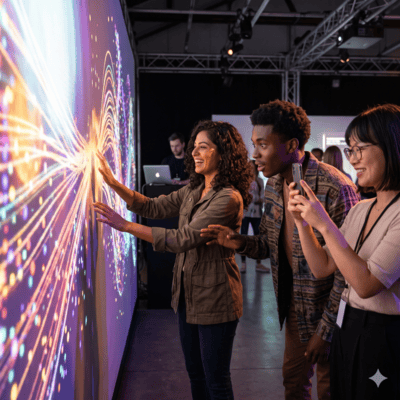
Most brands get this wrong from the very beginning — they treat interactive creative experiences as a production format rather than a communication philosophy. The distinction matters enormously. An interactive creative experience is not simply a touchscreen kiosk placed next to a product display; it is a designed encounter in which the audience becomes an active participant in the brand's narrative, which means the story changes shape depending on who is engaging with it. This participatory quality is what separates genuinely immersive brand experiences from elaborate but ultimately passive spectacle.
What a lot of people miss is that India's market conditions make this category particularly compelling right now. The country has somewhere in the ballpark of 820 million internet users, a median age hovering around 28, and a Gen Z and millennial cohort that has grown up inside digital environments where interactivity is the default expectation rather than a premium feature. When you layer that demographic reality over the fact that urban Indian consumers are increasingly congregating in high-footfall environments — malls, metro stations, airports, multiplexes — the opportunity for interactive creative experiences for brands in India becomes structurally obvious. The audience is young, mobile, and physically present in spaces where brand activations can reach them.
At SmartAds, we always tell our clients that the most powerful thing about an interactive experience is not the technology it uses but the emotional contract it creates. When a consumer spends four minutes inside a brand's augmented reality environment or completes a gamified challenge tied to a product launch, they have made a voluntary investment of attention — which is categorically different from the involuntary exposure that a pre-roll ad delivers. That voluntary investment translates into brand recall, social sharing, and, when the experience is designed well, genuine purchase intent.
How Is Experiential Marketing Transforming Advertising in India?
The GroupM TYNY Report has, for several consecutive years, flagged experiential marketing as one of the fastest-growing line items in Indian brand budgets, and our experience at SmartAds confirms that trend on the ground. What used to be a niche allocation — something a brand might do once a year at a flagship event — has migrated into the core media plan for categories ranging from FMCG and automotive to fintech and quick-service restaurants. The reason is not sentiment; it is data. Experiential campaigns consistently outperform on the metrics that matter most to brand managers making ROI arguments to their management: dwell time, unaided recall, and net promoter score lift.
To be fair, the shift has not happened uniformly across all sectors. Categories with high involvement and high consideration — automotive, consumer electronics, luxury — adopted experiential marketing in India earlier and more aggressively, because the purchase journey for those products naturally accommodates longer engagement windows. But what we have seen in the last two years is a meaningful acceleration among FMCG brands, which traditionally lived and died by television GRPs and had little appetite for anything that could not be measured in reach and frequency. Brands like Amul and Coca-Cola India have both experimented with interactive installations and pop-up activations that blend physical presence with digital amplification, and the results have been compelling enough to shift budget conversations at the category level.
The Dentsu e4m Digital Report has pointed to a broader structural shift that underpins all of this: Indian consumers are spending more time in what researchers call "experience-seeking" modes, actively looking for things to do, share, and remember rather than simply things to buy. Experiential design, when it is executed with cultural intelligence and creative rigour, meets that consumer in exactly the right psychological state — which is why brands that invest in immersive brand experiences tend to see social media activation rates that passive media simply cannot replicate.
Top Interactive Creative Experience Formats Brands Are Using in India Right Now
Three years ago, a projection mapping installation at a brand event would have stopped a crowd cold. Today, the bar is considerably higher, and that is actually a good sign for the industry — it means Indian audiences have developed genuine sophistication around immersive experiences, which pushes creative teams to think harder and execute better. The formats that are generating the most traction right now span a wide spectrum, from technology-intensive AR and VR experiences to more accessible but equally powerful gamification mechanics and pop-up activations.
AR experiences built on smartphone cameras remain the most scalable format for pan India deployment, because they require no proprietary hardware and can be triggered through QR codes, social media filters, or branded apps — which means a campaign designed in Mumbai can reach a consumer in Mysuru or Patna without a single additional rupee of production spend. VR experiences, on the other hand, tend to work best in controlled, high-footfall environments like malls or airport lounges, where the brand can invest in headset infrastructure and trained staff; the immersion is deeper, but the reach is necessarily narrower. Projection mapping and hologram installations occupy a different position entirely — they are inherently public, inherently shareable, and inherently spectacular, which makes them powerful tools for product launches and brand anniversaries where earned media amplification is part of the objective.
What a lot of planners underestimate is the power of interactive installations that do not rely on screens at all. Multi-sensory environments — spaces that combine scent, sound, texture, and visual design — have been used effectively by beauty and lifestyle brands in Bangalore and Delhi to create consumer experiences that feel genuinely memorable rather than merely impressive. Shobiz Experiential and Studio Numen have both produced work in this space that demonstrates how sensory design, when it is grounded in brand strategy, can generate user-generated content and social sharing at rates that paid media cannot buy.
AR, VR, Projection Mapping and Holograms: The Technology Powering India's Immersive Experiences
The technology stack behind immersive brand experiences in India has matured considerably, and the cost curves have moved in directions that make these formats accessible to a much wider range of advertisers than was the case even three years ago. AR experiences built using platforms like HelloAR or custom solutions from studios like Digital Jalebi and TILTLABS can now be produced at budgets that sit somewhere between fifteen and forty lakhs for a well-executed campaign — which, when you compare it to the production and placement cost of a national television campaign, represents a genuinely interesting value proposition if the target audience skews urban and digital.
VR experiences require a more significant infrastructure investment; a properly staffed and equipped VR activation zone at a mall in Hyderabad or Chennai, running for two weeks, might cost somewhere in the ballpark of twenty-five to sixty lakhs depending on the complexity of the content and the number of simultaneous headset stations. The CPM on that spend, however, works out to a figure that surprises most clients when they calculate it — because the depth of engagement per user is so much higher than any passive format that the cost-per-engaged-minute is often lower than what they are paying for digital video. Craftech 360 and Whizco Creative Tech are among the studios that have built repeatable production pipelines for VR experiences in the Indian market, which has helped bring both quality and cost predictability to the format.
Projection mapping and hologram installations sit at the premium end of the budget spectrum; a large-format projection mapping event on a heritage building or a brand's flagship store facade in Mumbai or Delhi can involve production costs ranging from fifty lakhs to several crores, depending on the surface area, the duration, and the complexity of the 3D anamorphic content. Drone show marketing, which has emerged as a spectacular format for mass events and product launches, is similarly investment-intensive but generates earned media coverage that can extend the campaign's effective reach by a significant multiplier. At SmartAds, we have planned several technology-led activations of this nature and found that the key variable is not the technology itself but the narrative clarity of the creative — because a technically impressive but strategically incoherent projection mapping show will be shared for its spectacle and forgotten within a week.
Case Studies: Indian Brands That Nailed Interactive Creative Campaigns
One campaign that stands out in our experience at SmartAds involved a mid-sized consumer electronics brand launching a new product line in three metros simultaneously — Mumbai, Delhi, and Bangalore. Rather than anchoring the launch in a press conference and a television burst, the client agreed to allocate a meaningful portion of the budget to a series of interactive creative experiences placed inside high-footfall malls in each city. Visitors could step into a fully designed immersive environment where the product's features were demonstrated through a combination of AR experiences and hands-on interactive installations; the dwell time per visitor averaged just over six minutes, which is a number that most digital planners would find extraordinary when compared to the two-to-three-second average attention window on a social media feed. The campaign generated user-generated content that reached an estimated audience three times larger than the paid media footprint, and post-campaign brand recall scores in the three cities moved by fourteen percentage points among the target demographic.
A second case that illustrates a different dimension of this space involved a retail client in Pune — a regional apparel brand that wanted to compete with national players during the festive season without the budget to match them on television or digital. The solution was a pop-up activation in a prominent mall that used gamification mechanics: shoppers who completed a style-quiz experience on a large interactive screen received personalised product recommendations and a discount voucher, which created both engagement and a direct conversion pathway. The conversion rate from activation participants to in-store purchasers was roughly twenty-two percent, which was considerably higher than the brand's historical walk-in conversion rate, and the cost per acquisition worked out to a fraction of what they were paying through paid digital channels.
The third case worth noting involved an automotive brand we worked with that was launching a premium SUV in Hyderabad and Chennai — two markets where the brand had historically underperformed relative to its national share. The experiential campaign used a combination of VR experiences that placed prospective buyers inside a simulated driving environment and a hologram display that allowed visitors to explore the vehicle's design details without a physical unit being present at every location. The qualified lead generation from the experiential activations was, by the client's own assessment, the most cost-efficient lead source in the entire campaign, outperforming both digital lead-gen and traditional test-drive events on a cost-per-qualified-lead basis.
Gamification and Interactive Advertising: Why India Is Responding at 5–6X Higher CTRs
Frankly speaking, gamification in marketing is one of those ideas that sounds gimmicky until you look at the data, at which point it becomes very difficult to argue against. Research cited in the Journal of Interactive Advertising has documented engagement rate differentials between gamified ad formats and standard display advertising that range from four to six times higher — which aligns closely with what we have observed across campaigns we have planned in the Indian market. The reason is not mysterious: gamification converts a passive exposure into an active choice, and active choices generate memory traces that passive exposures simply do not.
India's gaming ecosystem provides important context here. WinZO and Gameshastra represent just two nodes in a gaming audience that the FICCI-EY report has estimated at somewhere above five hundred million casual gamers — a number that includes a very large proportion of Tier 2 and Tier 3 city residents who might be difficult to reach through premium experiential activations but are entirely accessible through gamified digital engagement formats. Dirtcube Interactive has built interactive advertising experiences specifically designed for this audience segment, and the results consistently show that well-designed gamification mechanics generate CTR and conversion rate improvements that justify the incremental production investment. At SmartAds, we have found that the sweet spot for gamification in Indian campaigns is experiences that are simple enough to complete in under ninety seconds but rewarding enough — through prizes, personalisation, or social sharing mechanics — to motivate completion and sharing.
The intersection of gamification and social media activation is where the real multiplication effect lives. When a gamified interactive experience is designed with a shareable output — a score, a personalised result, a visual that the user can post — it effectively becomes a user-generated content engine, which extends the campaign's reach into networks that paid media cannot access. Zomato and Swiggy have both used gamified interactive advertising formats to drive app engagement and order frequency, and the mechanics they have employed — streaks, challenges, personalised recommendations framed as games — have become something of a template for how FMCG and food-service brands think about digital engagement in India.
How to Plan an Interactive Creative Experience Campaign for the Indian Market
The single biggest mistake we see brands make when planning interactive creative experiences is starting with the technology rather than the audience insight. A hologram installation is not a strategy; it is a production format, and it will fail to generate meaningful results if it is not anchored in a clear understanding of who the audience is, where they are, what motivates them, and what action the brand wants them to take. The planning process for a well-executed interactive experience campaign should begin with exactly the same strategic questions that any media plan begins with — and then layer the experiential design on top of that foundation.
City selection is a variable that deserves more attention than it typically receives. Mumbai and Delhi are the obvious choices for flagship activations, because they offer the largest concentrations of the urban, affluent, digitally active consumers who are most likely to engage with immersive experiences and amplify them through social sharing. Bangalore's tech-savvy, startup-adjacent consumer base makes it particularly receptive to AR/VR experiences and tech-led marketing formats; we have found that dwell times in interactive installations in Bangalore consistently run higher than the national average, which we attribute to a combination of audience sophistication and genuine curiosity about new technology. Hyderabad has emerged as a genuinely strong market for experiential campaigns in the automotive and consumer electronics categories, driven by a growing affluent consumer base and relatively lower activation costs compared to Mumbai or Delhi.
The budget architecture for an interactive creative experience campaign should account for three distinct cost components: production and technology, which typically represents the largest single line item; staffing and activation management, which is frequently underestimated and can run to twenty or thirty percent of total spend on a complex multi-city activation; and digital amplification, which is the component that converts a physical experience into a scalable media event. At SmartAds, our experience shows that campaigns which allocate at least fifteen to twenty percent of total budget to digital amplification — paid social, influencer seeding, and PR — consistently outperform those that treat the physical activation as self-sufficient. The best interactive creative experiences for brands in India are designed from the outset to generate content that travels beyond the activation footprint.
What Does the Experience Economy Mean for Advertisers in India?
The experience economy is not a new concept — the academic framework was articulated by Pine and Gilmore in the late 1990s — but its application to Indian advertising is genuinely new, and the implications are still being worked out in real time. The core argument is that consumers in maturing economies progressively shift their spending and attention from goods to services to experiences; India, with its rapidly expanding middle class and a young population that has grown up with access to global cultural references, is moving through this transition faster than most economists predicted.
What this means practically for brand managers is that the competitive landscape for consumer attention has expanded beyond the traditional media environment. Brands are no longer competing only with other brands for share of voice; they are competing with concerts, travel experiences, restaurant launches, and the entire social calendar of an increasingly experience-hungry urban consumer. The Indian Music Experience Museum in Bangalore and the Pradhanmantri Sangrahalaya in Delhi — both of which use interactive installations and immersive technology to create memorable visitor experiences — represent the kind of cultural benchmarks against which brand experiences are increasingly being measured. If your brand activation is less engaging than a museum, you have a creative problem, not a budget problem.
The experience economy also has significant implications for how brands think about Tier 2 and Tier 3 markets. The assumption that immersive brand experiences are exclusively a metro phenomenon is being challenged by data from TAM AdEx and by our own campaign experience; consumers in cities like Indore, Coimbatore, Lucknow, and Surat are demonstrably hungry for novel brand experiences, and the relative scarcity of such experiences in those markets means that a well-executed interactive activation can generate disproportionate attention and social amplification. The cost of activation in these markets is also considerably lower than in the metros, which means the ROI arithmetic can be very attractive for brands willing to think beyond the obvious geographies.
Creative Outdoor and Phygital Experiences: Blending the Physical and Digital in India
The 3D anamorphic billboard format, which gained global attention through installations in Tokyo and New York, has found a genuinely enthusiastic audience in India — particularly in Mumbai and Delhi, where high-footfall commercial corridors provide both the physical infrastructure and the captive audience that the format requires. These creative outdoor advertising installations work because they create a moment of genuine perceptual surprise; the brain registers something that appears to violate the laws of physics, which triggers an involuntary attention response and a strong motivation to share the experience. BookMyShow and several entertainment brands have used anamorphic outdoor formats for film and event promotions in India, and the earned media generated by social sharing has consistently extended the effective reach of those campaigns well beyond the paid OOH footprint.
Phygital experiences — environments that blend physical presence with digital interaction in ways that feel natural rather than forced — represent what we consider the most durable and scalable format in the interactive creative experiences category. A retail brand that equips its store staff with AR tools, or a bank that creates an interactive digital installation in its branch lobby, or an FMCG brand that places a gamified kiosk in a modern trade outlet — all of these are phygital experiences, and all of them share the quality of meeting the consumer in a context where they already have intent and attention. The Indian retail sector, which is undergoing significant modernisation across both organised and unorganised trade channels, provides an enormous canvas for phygital creative experiences; we have seen BTL activations in modern trade environments generate engagement metrics that rival what brands achieve through dedicated experiential events, at a fraction of the cost.
Generative art and AI-powered interactive experiences represent the emerging frontier of this space. Platforms built on tools like Gemini AI and discussed at forums like the India AI Impact Summit are enabling brands to create personalised, real-time interactive experiences — where the content generated by the installation responds to the specific individual engaging with it, creating a genuinely unique encounter for each participant. Google Arts & Culture has demonstrated what this can look like at a cultural level; the challenge for brand marketers is to apply the same logic to commercial contexts in ways that feel genuinely valuable rather than merely novel. At SmartAds, we are actively exploring generative art applications for several clients in the lifestyle and luxury categories, and our early experiments suggest that the personalisation dimension of AI-powered interactive experiences significantly increases both dwell time and social sharing intent.
Frequently Asked Questions About Interactive Creative Experiences in India
Q: What are interactive creative experiences in the context of advertising and marketing in India?
Interactive creative experiences are designed brand encounters in which the consumer actively participates in the experience rather than passively receiving a message — which distinguishes them fundamentally from traditional advertising formats. In the Indian advertising context, this category encompasses a wide range of formats: AR experiences triggered by smartphone cameras, VR environments accessed through headsets, gamified digital platforms, projection mapping installations, interactive installations in retail and event environments, and phygital activations that blend physical presence with digital interaction. The defining characteristic is not the technology used but the participatory quality of the encounter; the audience's actions shape the experience, which creates a sense of agency and investment that passive media cannot replicate.
Q: How do interactive creative experiences differ from traditional advertising campaigns?
The most fundamental difference is the direction of communication. Traditional advertising is broadcast — a brand transmits a message to an audience that receives it without responding — while interactive creative experiences are dialogic, meaning the experience changes in response to the audience's input. This participatory quality has measurable consequences for brand outcomes: recall rates for interactive experiences consistently outperform passive formats, emotional engagement is deeper and more durable, and the social sharing behaviour that interactive experiences generate creates earned media amplification that traditional campaigns cannot access. On top of that, interactive experiences generate first-party data about consumer preferences and behaviour that is genuinely valuable for subsequent campaign planning.
Q: Which Indian brands have successfully executed interactive creative experience campaigns?
Several Indian brands have built genuinely impressive track records in this space. Amul has used interactive digital installations at events and exhibitions to extend its brand storytelling beyond its iconic print and outdoor campaigns. Coca-Cola India has deployed AR experiences and interactive vending installations that create memorable brand moments at scale. BMW India has used VR experiences for product launches and dealer activations that allow prospective buyers to experience vehicles in environments that physical showrooms cannot replicate. Zomato and Swiggy have both built gamification into their core digital engagement strategies in ways that blur the line between marketing and product experience. The common thread across all of these examples is that the interactive experience is grounded in a clear brand strategy rather than deployed as a technology demonstration.
Q: What technologies are used to create immersive and interactive brand experiences in India?
The technology stack is broad and continues to expand. Augmented reality is delivered through smartphone cameras using custom apps or social media filters; virtual reality requires headset hardware and is typically deployed in controlled activation environments. Projection mapping uses specialised software and high-lumen projectors to transform physical surfaces into dynamic visual canvases. Hologram displays use a combination of transparent screens and precisely controlled lighting to create three-dimensional visual illusions. Interactive installations use sensor technology — motion detection, facial recognition, touch interfaces — to respond to audience behaviour in real time. Generative AI tools, including platforms built on Gemini AI, are enabling a new generation of personalised interactive experiences in which the content is created dynamically in response to the individual user. Studios like Digital Jalebi, TILTLABS, HelloAR, and Craftech 360 are among the Indian production partners that have developed deep expertise across these technology categories.
Q: How much does it cost to run an interactive creative experience campaign in India?
The cost range is genuinely wide, which is both a challenge and an opportunity for brands at different budget levels. A well-executed AR experience campaign — including creative development, technical build, and digital distribution — can be produced for somewhere between fifteen and forty lakhs, which makes it accessible to mid-sized brands. A VR activation running across two or three mall locations for two weeks might cost somewhere in the ballpark of twenty-five to sixty lakhs, depending on content complexity and staffing requirements. Large-format projection mapping events and hologram installations at premium locations in Mumbai or Delhi can run from fifty lakhs to several crores. Pop-up activations with gamification mechanics and interactive installations can be designed for budgets starting at ten to fifteen lakhs for a single-city execution. The key variable is not the format but the strategic clarity of the brief; a well-designed fifteen-lakh AR experience will consistently outperform a poorly conceived sixty-lakh VR installation.
Q: Why are Indian consumers increasingly demanding immersive and interactive brand experiences?
Several structural factors converge to explain this shift. India's median age of approximately 28 means that the largest segment of the consumer population has grown up in digital environments where interactivity is the default mode of engagement; passive consumption feels, to this cohort, like a lesser form of experience. The explosion of social media sharing behaviour has created a powerful incentive for consumers to seek out experiences that are worth photographing and posting — which immersive brand experiences are specifically designed to be. The FICCI-EY Media and Entertainment Report has documented a consistent year-on-year increase in consumer spending on experiences relative to goods, which reflects a broader cultural shift in how aspiration and status are expressed. And frankly speaking, the sheer volume of advertising that Indian consumers are exposed to daily has created a form of perceptual immunity to passive formats that interactive experiences are specifically designed to overcome.
Q: What is the role of AR and VR in shaping interactive creative experiences for Indian audiences?
AR and VR serve different strategic functions within the broader category of immersive experiences, and understanding that distinction is important for effective planning. AR experiences are inherently scalable — because they run on devices that consumers already own, they can reach audiences across India without requiring physical infrastructure at every touchpoint — which makes them well-suited for campaigns that need broad reach alongside deep engagement. VR experiences sacrifice reach for depth; the immersion that a well-designed VR environment creates is qualitatively different from any other media format, which makes VR particularly effective for high-consideration purchase categories where the quality of the brand experience directly influences purchase intent. The most sophisticated campaigns we have planned at SmartAds have used AR and VR in combination — using AR to generate broad awareness and engagement, and VR to provide a deeper experience for the subset of consumers who are closest to a purchase decision.
Q: How can brands measure the ROI of interactive creative experience campaigns in India?
Measurement frameworks for interactive creative experiences need to account for both immediate performance metrics and longer-term brand outcomes. On the performance side, dwell time, interaction rate, completion rate, and social sharing rate are the primary indicators of engagement quality; these can be tracked through the technology infrastructure of the experience itself. Conversion metrics — footfall to activation, activation to purchase, activation to lead — provide the direct commercial linkage that management teams need to justify investment. On the brand side, pre- and post-campaign brand recall studies, net promoter score measurement, and brand sentiment tracking through social listening tools provide evidence of the longer-term impact. Tatvic Analytics and similar measurement partners have developed methodologies specifically designed to attribute brand outcomes to experiential touchpoints, which addresses one of the historical challenges of justifying experiential spend in a media mix dominated by easily measurable digital formats.
Q: What is experiential marketing and how does it relate to interactive creative experiences?
Experiential marketing is the broader strategic discipline of creating brand encounters that engage consumers through direct participation and sensory involvement; interactive creative experiences are the specific execution formats through which experiential marketing strategies are brought to life. The relationship is analogous to the relationship between content marketing as a strategy and a specific blog post or video as an execution. Experiential marketing encompasses the full range of brand activation formats — events, sampling, demonstrations, sponsorship activations, and interactive installations — while interactive creative experiences specifically refer to those formats in which the consumer's active participation shapes the encounter. In practice, the best experiential campaigns in India combine multiple formats, using interactive creative experiences as the centrepiece while surrounding them with complementary touchpoints that extend reach and deepen engagement.
Q: Which cities in India are the best markets for launching interactive creative experience campaigns?
Mumbai and Delhi are the natural starting points for flagship activations, given their combination of large affluent consumer populations, premium retail and event infrastructure, and strong media ecosystems that amplify experiential campaigns through earned coverage and social sharing. Bangalore is particularly strong for tech-led marketing formats — AR/VR experiences and AI-powered interactive installations tend to generate higher engagement rates there than in any other Indian city, in our experience. Hyderabad has emerged as a genuinely compelling market for automotive and consumer electronics experiential campaigns, driven by a growing affluent consumer base and relatively lower activation costs. Chennai and Pune are strong secondary markets for FMCG and lifestyle brands. What a lot of brands miss, however, is the opportunity in Tier 2 cities like Indore, Lucknow, Surat, and Coimbatore, where the relative novelty of immersive brand experiences creates disproportionate attention and social amplification — and where activation costs can be forty to fifty percent lower than in the metros.
Q: How can small and mid-sized Indian brands afford interactive creative experiences?
The cost accessibility of this category has improved dramatically, and several strategic approaches make interactive creative experiences viable for brands with modest budgets. AR experiences built on social media platforms — Instagram filters, Snapchat lenses — can be produced for budgets starting at three to five lakhs, which puts them within reach of virtually any brand with a digital presence. Gamification mechanics can be built into existing digital platforms — websites, apps, WhatsApp — without requiring dedicated physical infrastructure. Pop-up activations in Tier 2 cities, where footfall is strong and activation costs are lower, can deliver excellent ROI for regional brands. Shared activation spaces — where multiple brands co-sponsor an experiential event — are another cost-sharing model that we have used effectively for mid-sized clients. The key insight is that the quality of the creative idea matters far more than the scale of the production budget; a genuinely clever interactive experience built for fifteen lakhs will outperform a technically impressive but strategically incoherent one built for sixty.
Q: What is the future of interactive creative experiences in the Indian advertising industry?
The trajectory is clear, even if the specific formats are still evolving. AI-powered personalisation will become the defining characteristic of the next generation of interactive creative experiences; experiences that respond to the individual — their preferences, their behaviour, their context — will progressively replace experiences that deliver the same encounter to every participant. The integration of generative art tools and platforms like Gemini AI into experiential production pipelines will make this personalisation feasible at scale and at costs that are accessible to mainstream advertisers. The phygital model — blending physical presence with digital interaction in ways that feel natural — will become the standard architecture for retail and FMCG brand experiences. And the geographic expansion of high-quality experiential marketing into Tier 2 and Tier 3 India will be one of the most significant growth stories in the Indian advertising industry over the next three to five years, driven by improving infrastructure, rising consumer expectations, and the competitive advantage available to brands willing to move early into those markets.
Closing: The Case for Making Interactive Creative Experiences Central to Your Media Plan
The evidence, taken together, makes a compelling case — and we say this not as a sales argument but as a genuine observation from years of planning media for brands across India. Interactive creative experiences are not a supplementary tactic to be deployed when the main campaign has been funded; they are increasingly the most efficient and durable way to build the kind of brand relationship that drives long-term commercial outcomes. The brands that are winning in India's experience economy are those that have understood this shift and reorganised their media thinking accordingly — treating immersive brand experiences not as events but as media channels in their own right, with their own reach, frequency, and engagement metrics.
The work of designing genuinely effective interactive creative experiences demands a combination of creative intelligence, technology fluency, and strategic discipline that is rare in any single agency or production house. What we have found at SmartAds, across hundreds of campaigns planned across 500-plus Indian cities, is that the most successful interactive experience campaigns are those that begin with a clear strategic brief, are designed with cultural intelligence for the specific audiences and geographies they are targeting, and are amplified through a thoughtfully planned media surround that extends their reach beyond the activation footprint. The technology is a means, not an end; the creative idea is the thing that makes an experience worth having and worth sharing.
If you are building a media plan for 2025–2026 and wondering where interactive creative experiences fit relative to your existing television, digital, and outdoor allocations, the honest answer is that the question should probably be reversed — the interactive experience should be the anchor around which the other media are planned to amplify. That is a significant shift in how most brands currently think about their media mix, and we acknowledge that it requires a different kind of planning conversation. The team at SmartAds.in is available to have exactly that conversation — bringing specific market intelligence, production cost benchmarks, and campaign experience to help you design interactive creative experiences that are right for your brand, your audience, and your budget.
